All posts by webadmin

Ruthless Strike Across LoC Signals India’s Eye-for-an-Eye Resolve by Lt Gen SYED ATA HASNAIN

Recent ceasefire violation in the Keri sector in Jammu seems to be a deliberate attempt to escalate tension at a time when the focus is on the meeting between alleged Indian ‘spy’ Kulbhushan Jadhav and his mother and wife.

There is a common saying in the Indian Army that the LoC is one place where a sub-tactical situation can become strategic in less than five minutes. That’s because alongside that state, a host of other situations interplay to give it hype. The context here is about the Pakistani trans-LoC strike, which killed an officer and three jawans of one of India’s finest Infantry units – the 2nd (Royal) Sikh in the Keri sector of Rajouri on 22 December 2017.

A response by the Indian Army on Christmas at Rakh Chikri area of Poonch sector laid low three Pakistan Army personnel, and critically injured some more. Ordinarily, this news would have disappeared from media tickers within hours. However, currently it’s a different situation. How different is it really?

LoC Emerges as the Ground for Messaging

First, 15 months ago, India’s surgical strikes within ten days of losing 20 soldiers in the Uri terror attack sent a clear message of intent that India would no longer accept such actions without an effective response.

Second, the LoC is no longer just a line on the ground separating the two Armies. It’s a place where Pakistan attempts to send a message to the world about the existence of the Jammu & Kashmir (J&K) issue, especially when the situation in the state comes under the total control of India. For many years it has sponsored a proxy war in the state, especially in the Kashmir Valley. It has failed in its attempts to turn the situation in its favour.

Third, currently after a year, and more so of attempting to create turbulence of an extreme kind in the Valley, Pakistan’s efforts have been largely neutralised. This has been done through effective professional military domination of the situation by Indian security forces (SF) led by the Indian Army.

Fourth, in Pakistan, the polity is in turbulence with radical elements attempting to rule the roost.

Deep State on the Lookout for Vulnerabilities

We recently witnessed the lockdown of Islamabad by the Tehreek Labaik Ya Rasool Allah (TLY), a new radical organisation. Jamat-ud-Dawa chief Hafiz Saeed has founded the Milli Muslim League (MML) to gain political clout. His pre-eminence and that of the JuD/LeT has been under threat by other organisations in the strategic space for political and terror-related power.

Peaceful conditions in J&K do not enhance his image and call for something spectacular. It is not an easy doing with the kind of domination the Indian SF have gained in the hinterland.

The LoC is a little different where troops are strung along its length in large and small deployments, necessitating patrolling and counter infiltration, thus enhancing vulnerabilities. It is these vulnerabilities which the JuD/ISI/Pakistan Army (also known as the deep state) can exploit.

Also Read: Pakistan Protests: Mix of Politics & Religion Adding Fuel to Fire

Having operated extensively on the LoC, I can vouch for the above vulnerabilities, and can confirm that it is near impossible to be secure everywhere because all deployments carry an element of risk.

The Indian Army’s vulnerability is higher because of deployment in smaller detachments and sub-units aimed at curbing infiltration. Patrolling is done to dominate gaps.

I can visualise Late Major Ambadas and his men of the 2 Sikh moving from one post to another to take stock, direct, brief, control and simultaneously dominate. That’s what tactical level commanders do all the time. His move was probably waylaid by a combined ambush of Pakistani regulars and a few terrorists, called Border Action Team (BAT).

Rakh Chikri: The Location for Trans-LoC Operation

Within three days, the Indian Army’s very famous 93 Infantry Brigade at Poonch has retaliated by killing three Pakistani soldiers.

This area of the LoC is approximately 120 km by road from Keri, where the Pakistani action was executed (much less as per crow flight), and falls within the responsibility of the Pakistan Army’s 2 POK Brigade located at Rawalakot. Apparently, it is the 59 Baluch deployed at Rakh Chikri where the Indian Army’s trans-LoC operation has been conducted.

This is a well-known landmark. In its vicinity, major operations were conducted both in 1965 and 1971.

It’s a forested feature (Rakh means forest), approximately a kilometre in depth, with many satellite posts in front. A trans-LoC operation need not be a surgical strike on a precise location such as a terror camp. It can simply be an entry across the LoC by a small body (10-15 soldiers) of well-trained sharp shooters from Special Forces, or the locally deployed Infantry unit, carrying prepared improvised explosive devices (IEDs) with pressure switches for initiation.

Routes of Pakistani patrols and logistics supply are well known to our forward troops as much as ours are known to Pakistan Army. Thus, it’s a question of selection of ground across the LoC where such a tactical level strike is conducted, essentially in the ambush mode followed by more casualties inflicted by concealed IEDs; a safe route for get away to own side is ensured.

Link Between Keri’s Ceasefire Violation and Jadhav

The Pakistan Army has admitted the casualties, but as per its policy, it remains in denial about the entry of Indian troops across the LoC. This has been a consistent policy for long, and was also followed during the September 2016 surgical strikes.

The very frequent transgression of foreign troops into its territory under Pakistan Army control (US Navy Seals strike at Abbotabad and Indian surgical strikes in PoK) has left it red-faced and hence this policy.

Lastly there is an apparent link of the Pakistani action at Keri with the permission for the family of Kulbhushan Jadhav to meet him. Pakistan possibly wished to deliver a message of psychological ascendancy; that it had an alleged Indian spy in custody and could conduct an operation to impose casualties on Indian troops, while having the ‘magnanimity’ to allow the alleged spy’s family to meet him. This despicable approach of the Pakistan establishment is unlikely to ever result in gestures for peace from India.

Also Read: Surgical Strikes Will Happen Again If Need Arises, Says Army Chief

(Lt Gen (Retd) Syed Ata Hasnain is a former GOC of the army’s 15 Corps and now associated with Vivekanand International Foundation and Institute of Peace & Conflict Studies. He can be reached at @atahasnain53. This is an opinion piece and the views expressed above are the author’s own. The Quint neither endorses nor is responsible for the same.)


Hope fades for 5 soldiers

Hope fades  for 5 soldiers
Photo for representation only.

Srinagar, December 14

Even as efforts to trace the five missing soldiers continue more than 48 hours after they were buried under snow in north Kashmir, there is little hope of their being found alive.In two separate incidents on Tuesday when the Valley’s upper reaches witnessed heavy snowfall, two soldiers slipped down a slope in Nowgam sector of Kupwara district while three went missing from a forward post in Kanzalwan Gurez along the Line of Control in Bandipora.(Follow The Tribune on Facebook; and Twitter @thetribunechd)The Army has deployed avalanche rescue and High-Altitude Warfare School (HAWS) teams. “The search is on but they have not been traced,” a defence official said. — TNS


From tea seller to army man

From tea seller to army man
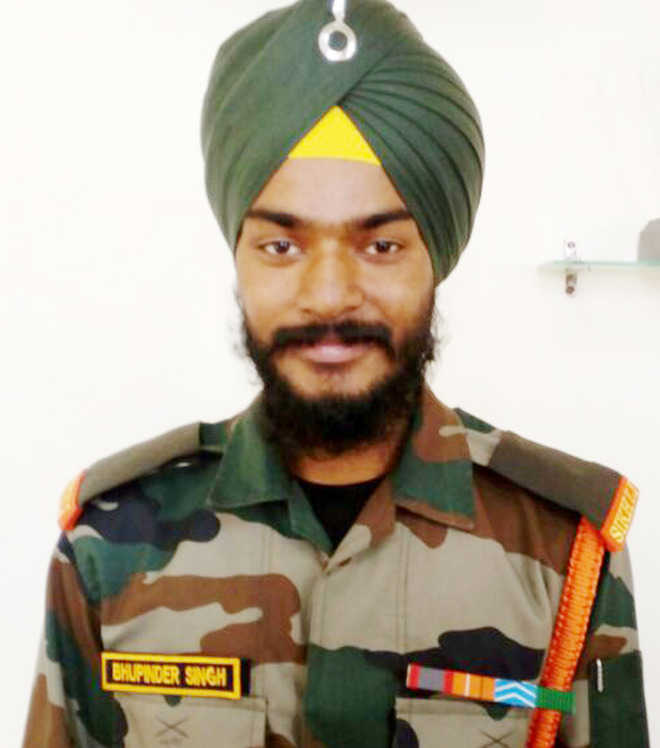
Bhupinder Singh

Tribune News Service

Amritsar, December 22

While selling tea near construction sites in and around his nondescript Fattu Bhila village, 30 km from the city, during his childhood, Bhupinder Singh had nothing to dream about in his life.Now, while receiving training as a general duty soldier in the Sikh Light Infantry unit of the Army, Bhupinder (20), son of a labourer, wonders how the destiny had something else in store for him.With the recently earned badge of honour and the olive green on his back, Bhupinder returned triumphant to his village, bringing pride and joy to his family and the villagers.He recalls how he dropped out of Class V from a government school to support his family. The life took a turn in 2011 for this hardworking lad when he was serving tea to labourers at the construction site of Satya Bharti Adarsh School’s expansion project. He caught the attention of schoolteachers, who got him enrolled where he used to serve tea in Class VI to continue his studies.Initially, Bhupinder’s father was worried over the financial burden of studies, but he was soon brought to ease when he learnt that his son would get free education, uniform, textbooks, stationery and mid-day meal.Displaying a keen interest in science, he brought home several accolades for his academic progress, projects and models. Before he could complete his higher secondary, he cleared the entrance test for the Army.“From pouring tea to figuring out hydraulics, Satya Bharti School has brought wonderful surprises and the happiest of memories for me,” he said.Ravinder Vohra, Principal, Satya Bharti Adarsh Senior Secondary School, said, “Bhupinder had developed good work ethics during his school and with sheer perseverance and grit he overcame all the hurdles to accomplish his goals.”


Animals are unsung heroes of history’

Personalities are important, but we forget the animals associated with them. COLONEL HARDEEP SINGH

CHANDIGARH :“Do you remember the name of the horse who fought alongside Napoleon?” asked Colonel Hardeep Singh, speaking at a session on ‘Military animals: The unsung heroes’ during the Military Literature Festival, here on Saturday.

“Personalities are important, but we forget the animals associated with them,” he said.

While military animals fought on the battlefield and risked their lives for different countries, their bravery has not been documented as that of their human counterparts. Lt Gen Baljit Singh, a panellists on the session rued that canine soldiers in India have not been given their due credit. One of the heroes that he talked about was Bobbie, a mongrel with the Berkshire Regiment. He guarded the regiment and accompanied his handler Lance Sgt Peter Kelly onto the battlefield in Afghanistan in 1880.

“During the war, the British force was overrun by the Afghans, and over half of the regiment was killed. Bobbie kept barking furiously and also sustained serious injuries. He, however, survived along with a few other soldiers. When he returned to England, he was presented to Queen Victoria, who bent down and pinned the Afghan medal on his collar,” Lt Gen said. Bobbie now remains stuffed at the regimental museum in Salisbury, decorated with the medal.

DOG WHO SAVED SOLDIER’S LIFE

Lt Gen Singh also narrated an account from Brig Darshan Khullar’s (retd) book ‘When Generals Failed’ of an Indian dog who saved a grievously injured soldier. The dog kept on barking after seeing a party, constantly peeped inside a hut and run around it to attract its attention. Upon checking, the team found an emaciated jawan, who came crawling out on his arms.

The jawan later told the officer that he had survived six days on the crumbs brought to him by his canine friend.

Lt Gen Singh emphasised that the valour of canine heroes should be recognised and tales of their bravery told like that of their human counterparts.


Defence ministry gives better cover for LoC jawan families, benefits set to increase

Liberalised pension plan will support wounded or deceased soldier’s family in a better way than existing pension schemes. Will this bring relief to army personnel demanding OROP?


Defence minister Nirmala Sitharaman has taken a decision which is likely to benefit border troops and their families. The first full time female defence minister of India has decided to give liberalised family pension to army personnel working on the Line of Control (LoC) or international border along Pakistan.

The liberalised family pension covers accidental death or sustained injury due to natural calamities such as floods, avalanches, landslides, cyclone, fire and lightening or drowning in river while performing operational duties. It also covers death or injury sustained during movement against enemy forces and armed hostilities in operational area.

The liberalised family pension provides for 100 per cent of last permissible emoluments in comparison to normal family pension which provides for 30 per cent of the last permissible emoluments.

The defence minister has approved that the same benefit of liberalised family pension be extended to army personnel deployed along Line of Actual Control (LAC) along India-China border.

Pension has been a hot topic among the armed forces. Army personnel have been demanding ‘One Rank One Pension’ (OROP) for many years. Still disparity exists in the pensions of army personnel even they are of the same rank. There was a major agitation by the army personnel in 2016 for the demand of One rank One Pension. Defence minister’s latest move might allay the fears of large section of soldiers and senior army officials.


Social media is to stay, forces need to use it constructively’

CHANDIGARH: Discussing the challenges posed to the military by the increasing use of social media, panellists agreed that social media per se is not bad and can be used said that effectively in solving many problems.

SANJEEV SHARMA/HT■ (From left) Col Avnish Sharma, Col Ajai Shukla, Maj Navdeep Singh, journalists Ambreen Zaidi and Suman Sharma and student activist Gurmehar Kaur at a session on social media.Colonel Avnish Sharma (retd) said the responsibility lies with military personnel in conducting themselves to because transparency has increased manifolds in the age of social media.

“Civilians see us as an organisation which lives up to the principles of discipline, honesty, secularism and devotion to duty.”

Also in the panel was Gurmehar Kaur who was trolled online for her views on Indo-Pak relations. “The military belongs to the country and polarisation inside it has to be resisted. The propaganda on social media about one or the other party has to be resisted so that saffronisation of military can be stopped.”

Adding to the discussion, Colonel Ajai Shukla (retd), said, “Social media does provide challenge because the security dynamics is involved,” adding that the United States of America has a handbook for the military on the use of social media. “We need to address the lack of understanding,” he said.

Recounting her experience, Ambreen Zaidi, a journalist, said she and her husband were refused rented accommodation in New Delhi because they are Muslims.

She then raised the matter on Twitter and that was the first occasion when the couple’s religion was seen to be more important than the fact they are an army family.

“I was trolled on the social media, given death and rape threats but I wasn’t intimidated. They then started reaching out to my children and I was afraid for a while. However, it all settled down after some time and I started replying to the trolls in a way that hurt them the most,” she said.

Suman Sharma, a journalist, added to what Col Sharma point and said that the social media is here to stay. “It can become a force multiplier if used in a positive way. It is increasing accountability and keeps officers in check.”


’65 war with Pak was a draw: Capt

’65 war with Pak was a draw: Capt
Punjab Chief Minister Capt Amarinder Singh speaks at the Military Literature Festival in Chandigarh on Friday. TRIBUNE PHOTO: RAVI KUMAR

Bhartesh Singh Thakur

Tribune News Service

Chandigarh, December 8

“As far as 1965 war is concerned, we made little territorial gains. Pakistan occupied some area in Kutch and we made some gains in north Punjab. It was a draw. We didn’t have ammunition to last beyond a week. After that we would have been throwing stones at each other. It was even,” said Punjab Chief Minister Capt Amarinder Singh at the Military Lit Fest today.He was replying to a question in a session with military historians on whether India won the 1965 war with Pakistan. Islamabad claims victory in the war and commemorates it as defence day every September 6.(Follow The Tribune on Facebook; and Twitter @thetribunechd)However, Lt Gen TS Shergill, who was also part of the session, said the Indian military did not allow Pakistan to achieve its war objectives. “India secured Kashmir and destroyed their war machines, which they acquired from the US. India didn’t allow them to acquire any territory. They wanted to reach up to the Beas,” he said and described the war as victory for India.On not making the Henderson-Brooks report on the Indo-China 1962 war public, Capt Amarinder said: “The Henderson-Brooks report is being hidden to save political skin. It is a bad decision.”Commenting on India’s forward policy that led to war with China, he added: “We provoked Chinese. Forward policy was wrong. What was the system? Then defence minister Krishna Menon was shifting battalions. Corps Commander was just obeying orders… 4 Div was building houses in Ambala before going for the war. They didn’t have training. It was unfortunate.”On writing military history, the Punjab CM said when he wrote about the battle of Rezang La, which took place during the Indo-China war in 1962, he took seven survivors to the actual battlefield and asked them to narrate the story. “I asked them to take their positions and narrate about it. Different version came out… I even took my 2 Sikh to Poonch… History has a habit of changing. Things are added by interested parties.”Capt Amarinder has authored seven books on military history so far.


Apolitical armed forces Introspection best behind closed doors

Apolitical armed forces

The Army chief Gen. Bipin Rawat came out with yet another surprising formulation at a public interaction organised by an Army backed think-tank. In less than a year since taking over as the Army chief, the general has proven to be more garrulous than probably all his predecessors combined. Besides talking up the surgical strikes in Pakistan, which of course was a done thing for the Army after South Block took public ownership of a cross-border operation in peace time for the first time, several of the Army chief’s statements have been on the razor’s edge where detached professionalism acquires hues of partisanship towards the ruling arrangement. These include the L’affaire Human Shield in Kashmir, lending the army for Yoga Day and acknowledging an Army incursion into Myanmar to neutralise militants.These were evidently made-for-TV moments and went against the considered past practice of maintaining ambiguity and preserving the army’s options. But what the army chief said this time was the right opposite: he spoke of politicisation of the armed forces and hoped the military “should be somehow” kept away from politics. If this is what an Army chief feels in public, then there is something amiss. The principal professional obligation of a service chief is to ensure his force remains resolutely non-political and is steeped in conformity with constitutional principles. That is something that the founders of our republic had ensured while formatting the power arrangement of independent India. What exactly was the Army chief trying to convey? General Rawat has so far walked a fine balance: his observations on Myanmar, surgical strikes and human shield have suited the ruling arrangement’s political preferences; but he has held his peace on the army being asked to maintain hygiene or being commandeered to construct railway over-bridges. The army may have aggregated a few blemishes for pulling out the politicians’ chestnuts out of the fire by endless deployment for internal security operations, but in the main, it has a stellar record of causing minimum collateral damage and discomfort to the civilian population. If the Army chief was rankled by internal conversations, he should have opted to convey his impressions to his crowd under Chatham House rules.


Central Asia goes Islamist by Lt Gen Bhopinder Singh,

In the middle of Asia are the five former Soviet republics, suffixed with the Persian word ‘Stan’ (meaning ‘land of’) attached to their ethnic identities, that is, Kyrgyzstan, Turkmenistan, Kazakhstan, Tajikistan, Uzbekistan, and then the sixth, Afghanistan (though it was never part of the Soviet confederation). This historical crossroads of global cultures, religions and ideas was the confluence region of the famed Silk Road, which bore the famous Mughal dynasty that ruled the Indian sub-continent.

However, the cultural identity of Central Asia got suppressed under the national project of Sovietisation that disabled perceived elements of religiosity in a quest to promote collectivisation and a ‘proletarian culture’. The ethnic minorities and their innate diversities got increasingly engendered and subsumed in the Russian language and cultural sensibilities, ostensibly as a form of ‘modernisation’.

The dormant impulses of the region found instinctive expression, asserting themselves, in the implosion of the USSR in 1991, and the five Central Asian Republics (CARs) were born. Soon, the reigns passed from Moscow, to its erstwhile party apparatchiks and regional strongmen, who have since maintained relative stability (barring the Tajik civil war of 1992 to 1997), albeit whilst following dictatorial means and methods. Continued life-sustaining aid and invaluable investments from Moscow have also ensured the relatively peaceful relationship of the new republics and Russia, with the forceful retention of officially-mandated ‘Secularism’.

The inherent but dormant sense of Islamic identity was soon fanned and instigated, however, by generous doles from the Saudi Arabian coffers that ensured rapid shipments of religious texts, construction and renovation of mosques and an overall infusion of the alien Salafist strain. Suddenly, the principal fear for the newly independent states of the region was, ironically, religion.

As the bloody Tajik civil war pitted the ‘Islamic Renaissance Party’ as the principal opposition, and in neighbouring Afghanistan, the Taliban took control, repression and persecution of the newly emerging and hardline Islamic groups, intensified. Endemic poverty, suffocation of democratic rights and religious intolerance have combined with easy access to online information to radicalise the hungry stomachs of the region, who look upon religion as the logical salvation. Unsurprisingly, an estimated 2,000 to 4,000 people from the region are believed to have joined Islamic State in the Syrian-Iraqi swathes, and some others in the equally restive Afghanistan-Pakistan region.

The footprints of the radicalised Central Asian diaspora are now emerging in the diverse terror attacks in Kunduz, Stockholm, Istanbul, St Petersburg to, most recently, in New York.

Terror from these lands publicly emerged on US soil on April 15, 2013, when two homemade bombs at the annual Boston Marathon killed three people and injured several others – two Kyrgyz-American brothers Dzhokhar Tsarnaev and Tamerlan Tsarnaev, were found guilty. Immediately, the West woke up to the intricacies and diversities of Islamist terror from the erstwhile-USSR, beyond the Chechen insurgency.

More recently, inspired by the IS playbook, Sayfullo Saipov, an Uzbek immigrant, drove his rented truck over cyclists and pedestrians in New York, killing eight people. These are not isolated examples of radicalisation, as terror organisations like the East Turkestan Islamic Movement, Islamic Movement of Uzbekistan, Islamic Movement of Central Asia and Hizb ut-Tahrir have been active in the region for over a decade.

An interesting trend of radicalisation of immigrants from Central Asia on foreign soils can be attributed to the usual sense of disenfranchisement and inability to ‘fit-in’ with the local milieu socially, culturally and financially. This is conveniently tapped into by the ideologues of the regressive and absolutist religious organisations. It is estimated that 85-90% of IS fighters from the CARs were radicalised and recruited when they were in Russia on work!

Similarly, the Stockholm terror attack suspect was a rejected asylum seeker from Uzbekistan, who is also said to have encouraged his friends to join IS. Clearly, the specific targeting of the CARs by the likes of IS, by customising their literatures, manuals and inspirational materials into the vernacular languages, is paying dividends, and the relative obscurity of the region in the global imagination is turning into a recognition of it beyond its much-publicised energy reserves.

Whispers of extending the US Executive Order 1376 (‘Protecting the Nation from Foreign Terrorist Entry into the United States’, commonly called the ‘Muslim ban’) beyond Iran, Iraq, Libya, Somalia, Sudan, Syria, and Yemen have started to include the CARs.

Religion, the unifier

The region’s desperate economic conditions, glaring disparities and the authoritarian governments are engaged in simplistic counter-terrorism, as opposed to preventing it. Strongmen like Kazakhastan’s Nursultan Nazarbayev, Tajikistan’s Emomali Rakhmon and, till very recently, Uzbekistan’s Islam Karimov have brutally muzzled all dissent, centralised the control levers and unintentionally stirred up public resistance by publishing high official approval ratings that run contrary to the sentiment on the street (for instance, the referendum aimed at perpetuating the Rakhmon regime in Tajikistan by aiding his son was passed by ‘95% of the population’, when only ‘92% voter turnout’ was recorded!).

In this region, the dominant strain of Islam is the Sunni Hanafi (with a sprinkling of Shia Ismailis and Imamis), who are essentially localised and more ‘cultural’ in essence, than puritanical or supremacist. But beyond poverty, it is religion that has become the common denominator that unites the mainstream to come under a common platform against the ruling autocrats.

Thus political integration, engagement and inclusivity is a must, as indeed developing a more equitable society wherein the obvious wealth of the land can be shared, as opposed to the usurpation by the infamous oligarchs of the region. These CARs have already supported the ‘War on Terror’ by allowing air access and other strategic investments to the West (including a military hospital made by India at the Farkhor Air Base in Tajikistan). Yet, the lack of democracy and imbalanced economics are dangerously pushing these energy-rich havens into a familiar spiral of religious terror that prevails in the region’s underbelly of the Af-Pak and West Asian regions.

(The writer is former Lt Governor of Andaman & Nicobar Islands and Puducherry)


In Faraway French Commune, Ceremonial Send-Off For Two First World War Indian Soldiers by Syed Ata Hasnain

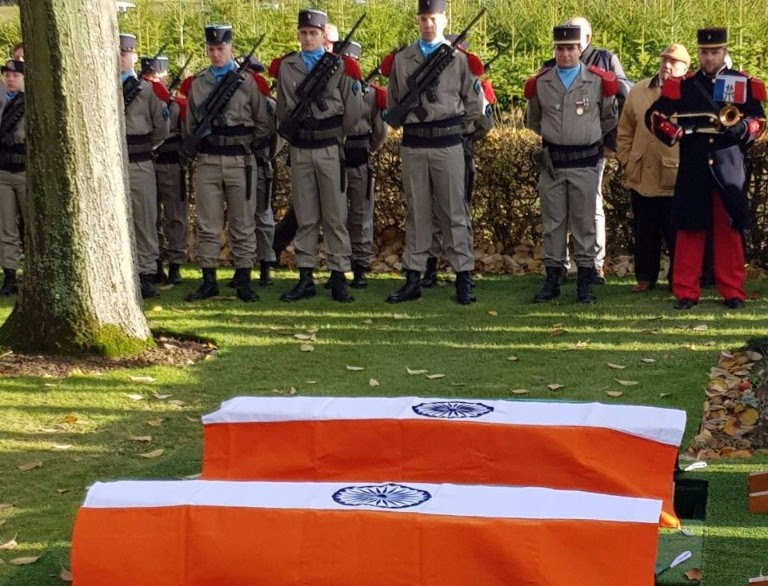
Coffins of the two brave heart martyrs of 39 Garhwal Rifles at the French war cemetery.Coffins of the two brave heart martyrs of 39 Garhwal Rifles at the French war cemetery.
Snapshot
  • Himself from the Indian Army’s Garhwal Rifles, the author writes about the events and other facts related to the discovery of the mortal remains of two Indian soldiers of the 39th Garhwal Rifles of the Indian Expeditionary Force in the faraway battlefield near Neuve-Chapelle, France, where the regiment did service during the Great War.

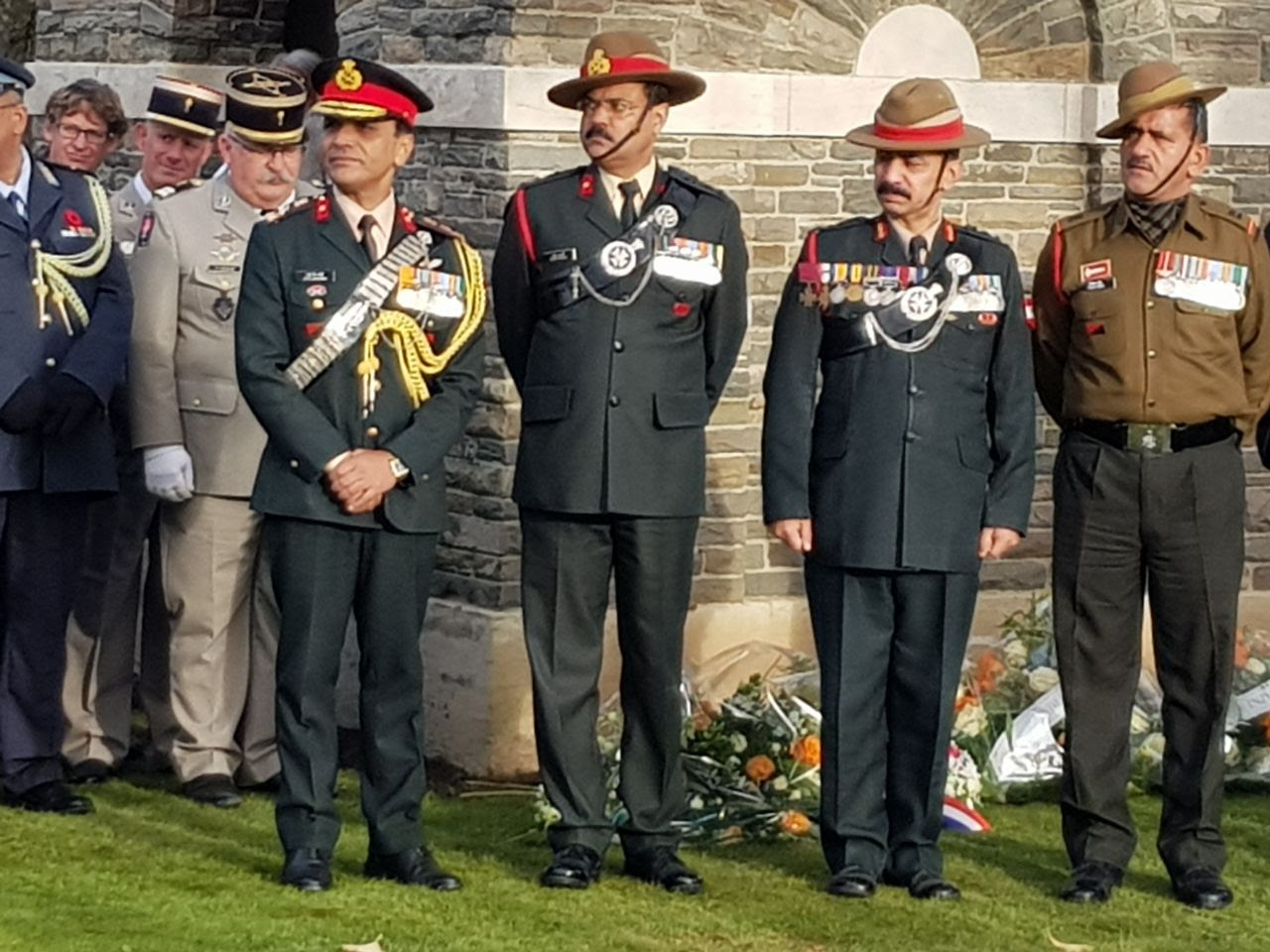
Less in print but much more on social media, a fascinating news story is doing the rounds. It is of the burial ceremony on 12 November 2017 (a day after Armstice Day), near La Gorgue, France, of the recently discovered mortal remains of two Indian soldiers of the 39th Garhwal Rifles (39 GR) who were martyred for the cause they fought for in the Great War (First World War). There was a solemn ceremony with attendance too by personnel from the Indian Army’s Garhwal Rifles.

The story is related to India’s fascinating military heritage. The official version told through a Press Information Bureau report has this to say – On 20 September 2016, during excavation work on southern side of the village of Richebourg near Laventie Military Cemetery, approximately 230 kilometres away from Paris, two human remains were found. On examining their belongings, they were identified as casualties of 39th Garhwal Rifles.

The office of Commonwealth War Graves Commission (CWWGC), which is curator of the graves of these unsung heroes, in mutual consultation with the French Government and the Indian Embassy in France decided to hold a burial ceremony at Laventie Military Cemetery, with full military honours for these martyrs alongside the Annual Memorial Service to commemorate the Indian soldiers, who sacrificed their lives in France and Belgium.

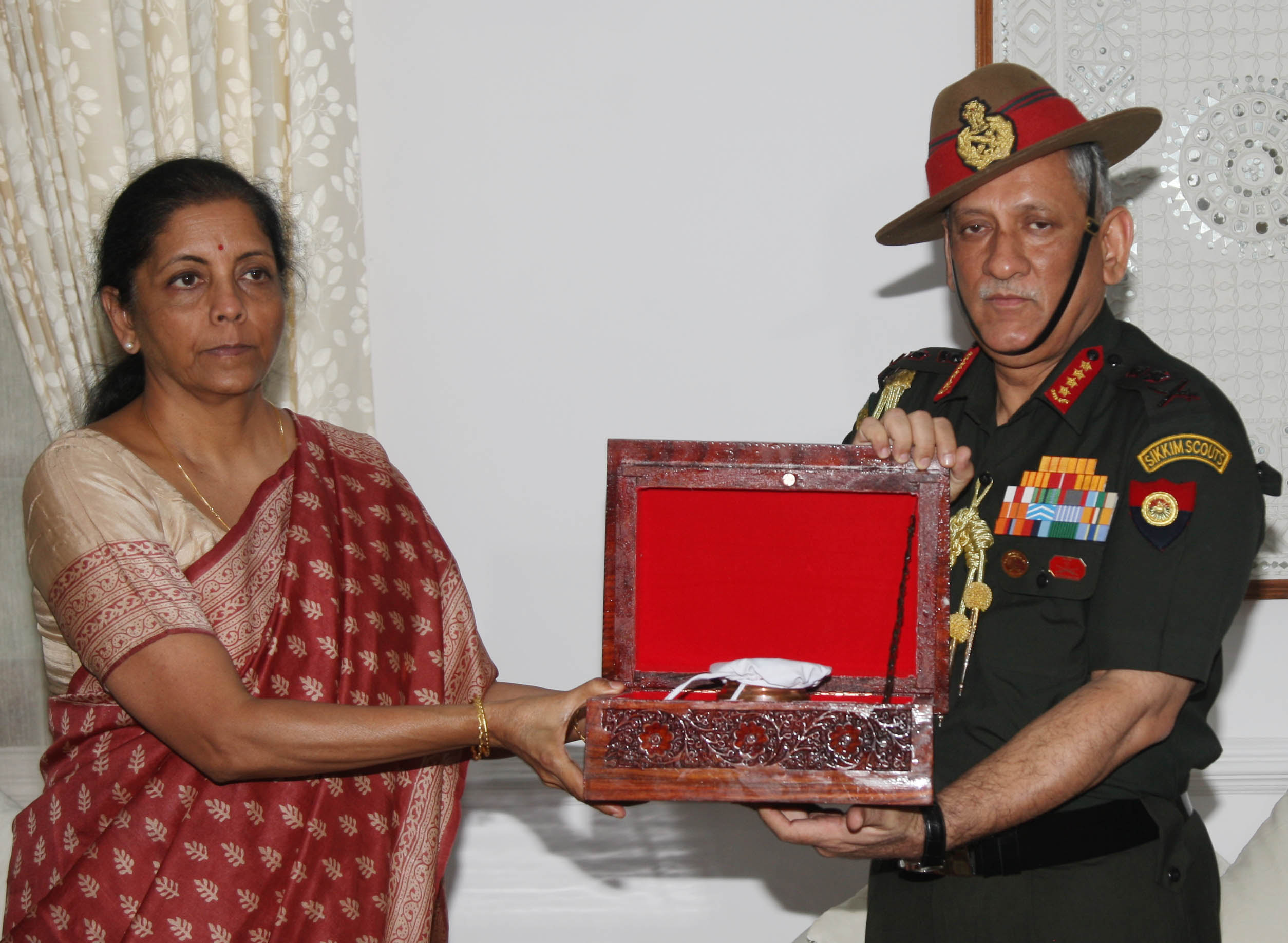
The soil in two urns, from the final resting place of the two brave heart martyrs at Laventie Military Cemetery was formally presented to the Raksha Mantri by the Army Chief General Bipin Rawat during a solemn ceremony in New Delhi on 14 November 2017. The urns and the national flags shall be interred suitably at Lansdowne the home of the Garhwal Rifles.The soil in two urns, from the final resting place of the two brave heart martyrs at Laventie Military Cemetery was formally presented to the Raksha Mantri by the Army Chief General Bipin Rawat during a solemn ceremony in New Delhi on 14 November 2017. The urns and the national flags shall be interred suitably at Lansdowne the home of the Garhwal Rifles.

The Indian Army was represented by a delegation comprising the Commandant and the Subedar Major of the Garhwal Rifles Regimental Centre (GRRC), two bagpipers from the Garhwal Rifles Regimental Pipe Band and Colonel Nitin Negi, grandson of late Naik Darwan Singh Negi, Victoria Cross (VC), the gallant hero of the battle of Festubert. They were nominated to attend the ceremony. In a symbolic gesture, the soil from the graves of these soldiers would be brought back to their homeland.

The dots in history which join together to tell us the fascinating story of the battles in which these unknown brave hearts were martyred, in the cause for which they fought, need to be retold. But first, something about the Indian contribution to the British cause in the Great War. A total of 1,100,000 Indian soldiers served overseas although the strength of the Indians in uniform is known to have been as high as 1,400,000. An estimated 72,000 soldiers gave up their lives for the cause they fought for. A total of 9,200 decorations were won including 11 Victoria Crosses. The first contribution was in Western Europe, where the Indian Expeditionary Force proceeded headlong into battle with the marauding Germans.

The Garhwal Rifles has been through an evolution of different titles. Its troops come from the Garhwal region of Uttarakhand. Until 1887, there was no separate regiment comprising just Garhwali troops. They formed part of five different regiments of the Gurkhas. It was only on 5 May 1887 that the Garhwalis got a regiment of their own on the basis of their proven fighting capability. This was done on the orders of none other than the iconic Jangi Laat Field Marshal Sir Roberts of Kandahar, VC who led the British effort in the Second Afghan War and was later Commander-in-Chief. Legend has it that he was so impressed with the soldierly qualities of his ethnic Garhwali ADC, Laat Subedar Balbhadra Singh that he had this to say – “A nation which can produce men like Balbhadra Singh Negi, must have a Battalion of their own”.

The first unit was raised at Almora but then shifted to a ridge in the Garhwal Himalayas called Kaludanda, where it set up a camp. It is around this camp that the hill town of Lansdowne (named after Viceroy Lord Lansdowne under whose pen the orders for the raising of the regiment were given) came into existence. To support the ever-increasing size of this garrison, as it expanded into more units, the habitation of Kotdwara (near Najibabad) close to the Rohilkhand plains also came up along with a rail connection and a metalled road. Lansdowne became the home of the Garhwalis even as another unit was added in March 1901.

A painting of Naik Darwan Singh, VC, at the battle of Festubert, November 1914A painting of Naik Darwan Singh, VC, at the battle of Festubert, November 1914

As the Great War commenced in 1914, the two Garhwali units carrying the regimental title, 39 Garhwal Rifles, formed part of the Garhwal Brigade under the Meerut Division. It was one of the first Indian formations, along with the Lahore Division, which sailed to France to stem the impending German onslaught in the autumn of 1914. Almost immediately they were in action at the First Battle of Ypres. Here, the Garhwal Brigade was involved in the war’s first trench raid on 9-10 November 1914. On the night of 23 November 1914, four months after the First World War broke out, Naik Darwan Singh Negi of the 1st Battalion of 39th Garhwal Rifles, twice wounded in the head and once in the arm, pushed on to recapture trenches lost to the Germans in Festubert, France. He was awarded the VC. His citation read:

For great gallantry on the night of the 23rd–24th November, near Festubert, France, when the regiment was engaged in retaking and clearing the enemy out of our trenches, and, although wounded in two places in the head, and also in the arm, being one of the first to push round each successive traverse, in the face of severe fire from bombs and rifles at the closest range.

On 5 December 1914, Naik Darwan Singh was driven from the battlefield to receive the British Empire’s highest military honour for valour, at the hands of King George V thus becoming the first Indian soldier to receive the VC at the hands of the King Emperor in the field itself. The particular significance of the Battle of Festubert was that it was a defensive operation in which the recapture of lost trenches was accorded great importance as a contributing factor to the projection of resilience and reputation of the Indian Expeditionary Force. Naik Darwan Sigh’s heroic action in which he was also wounded was thus a great display of the Indian fighting prowess, which helped cement their reputation.

The Garhwal Brigades’s saga of valour continued through 1915. In a second instance of extreme valour, Rifleman Gabar Singh of 2nd Battalion the Garhwal Rifles, on the night of 10 March 1915 fought a spree of battles with the bayonet in the stretched trenches at Neuve-Chapelle. He was posthumously awarded the VC. An excerpt from his citation read:

During an attack on the German position Rifleman Gabar Singh Negi was one of a bayonet party with bombs who entered their main trench, and was the first man to go round each traverse, driving back the enemy until they were eventually forced to surrender. He was killed during this engagement.

Laventie, the little township eight kilometres north of Neuve-Chapelle, is the location where the mortal remains of the two brave hearts were recently found. However, not much can be said whether these were specifically men of the 1st Battalion or the 2nd Battalion. The Indian Army Headquarters on its part despatched a team comprising a Commandant and a Subedar Major along with two bagpipers of the Pipes and Drums Band, all from the GRRC.

Adding novelty to the solemn occasion of the burial ceremony at the Laventie Military Cemetery was the presence of Colonel Nitin Negi currently a serving officer of the Garhwal Rifles. He is the son of Colonel Balbir Negi (retired) also from the Garhwal Rifles. Colonel Balbir Negi is the third son of Naik (later Subedar) Darwan Singh Negi, VC, the iconic hero of the Battle of Festubert. Colonel Nitin Negi surprised many in India when they saw his photograph at the ceremony adorning the medals of his grandfather on the right of his chest. This is a long forgotten practice but authorised for beneficiaries of the ‘Passing it On’ tradition whereby those in uniform display their parental campaign medals on the right while displaying their own on the left of the chest (see photograph). The purple ribboned VC is among the rarest of rare medals on display on any chest.

Colonel Nitin Negi, grandson of Naik  Darwan Singh Negi, VC. He is the third generation Garhwali soldier. His father, Colonel Balbir Negi  is the third son of Naik Darwan Singh, VC.Colonel Nitin Negi, grandson of Naik  Darwan Singh Negi, VC. He is the third generation Garhwali soldier. His father, Colonel Balbir Negi  is the third son of Naik Darwan Singh, VC.

With focus on valour of the Indian Army and the path-breaking role of the Garhwal Rifles, it will be in order to bring to light some aspects of the regiment to public notice. The regiment went on to win its third VC at the Battle of Kotkai in North Waziristan on 2 January 1920. Lieutenant (Lt) W D Kenny of the 4th Battalion the 39th Garhwal Rifles gave the regiment the honour of all its three battalions being adorned with a VC each (rarest achievement). An extract from his citation read:

Repeatedly attacked by the Mahsuds in greatly superior numbers for over four hours this officer maintained his position, repulsing three determined attacks, being foremost in the hand-to-hand fighting which took place, and repeatedly engaging the enemy with bomb and bayonet. His gallant leadership undoubtedly saved the situation and kept intact the right flank, on which depended the success of the operation and the safety of the troops in rear.

Lt Gen Sir James Willcocks, commanding the Indian Expeditionary Force in France had this to say about the Garhwalis in his book With the Indians in France – “The 1st and 2nd Battalions both did splendidly on every occasion in which they were engaged… the Garhwalis suddenly sprang to the very front rank of our best fighting men… nothing could have been better than their elan and discipline”

Not surprisingly, in 1921, 39th Garhwal Rifles was adorned with the title 39th Royal Garhwal Rifles and given the honour of all its units wearing their scarlet lanyard on the right shoulder. The lanyard is colloquially called ‘The Royal Rassi’ by the troops, who are affectionately referred as Bhullas (younger brothers). On completion of their training at GRRC Lansdowne, the young recruits are attested at an impressive Attestation Parade, where they take their oath on the Gita under the swirl of the National Tricolour; they then ceremonially wear the Royal Rassi in one of the most impressive ceremonies of the Indian Army.

Since we are into some forgotten aspects of Indian military heritage and tradition, it may be worth recalling an odd anecdote. The Lansdowne Ghost too is related to the battles in France and Flanders. Major W H Wardell of the 1/39 Garhwal Rifles was the Adjutant (Dandpal in Hindi) of the regiment at Lansdowne before the battalion embarked on its journey to Europe. He was known to be a stickler for turnout, correct order and form in everything, besides the white charger he rode distinguished him apart from all others.

Unfortunately, in one of those endless bayonet charges in the labyrinth of trenches in West Europe, he was killed and his body was not recovered. On the very night of his death, he appeared riding his white charger on the desolate roads of Lansdowne which first saw electric lighting only in 1962. Turning out the guard at the Regimental Quarter Guard and ticking a soldier for a loose button he rode on with instructions to the soldier to report to the Adjutant next morning. A white charger has been often sighted in Lansdowne and many a yarn is spun by old time officers, who claim to have seen Major Wardell, adding to the plethora of ghost tales of Lansdowne.

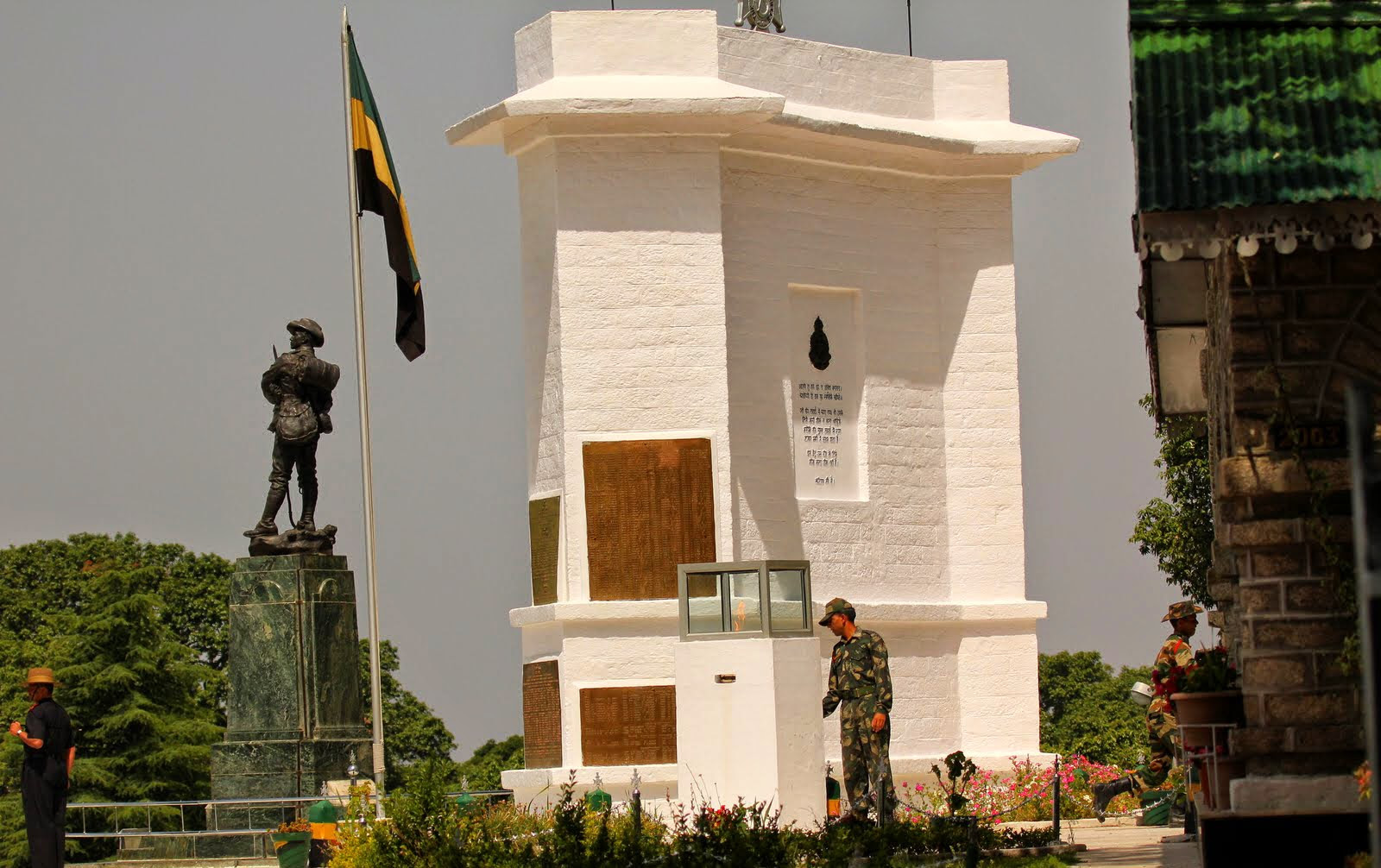
Regimental War Memorial of the Garhwal Rifles at Lansdowne.Regimental War Memorial of the Garhwal Rifles at Lansdowne.

The heritage of the regiment’s valour and other deeds are all enshrined in the Darwan Singh Sanghralaya (museum) at Lansdowne and is definitely a veritable delight for those who appreciate military heritage. The regiment has also made major contributions to the ecology of Lansdowne to restore its green cover and bring to life the hundreds of drying springs through construction of check dams and rain water harvesting. These efforts have won it the Indira Gandhi Paryavaran Puraskar.

In the post-Independence period, the Garhwal Rifles (the earlier numerals 39 and later 18 were subsequently removed) has excelled in operations of different kinds. In the 1947-48 operations in J&K, its 3rd Battalion was awarded the battle honour of Tithwal having also won a Mahavir Chakra (MVC) and 18 Vir Chakras (VrC). In the Sino-Indian Border War 1962, its 4th Battalion was awarded the battle honour Nuranang, the only such honour given to a battalion on the eastern front. The unit also won 2 MVCs and 7 VrCs besides many other medals. In the Indo-Pakistan conflict in 1965, three of its battalions, the 1st, 6th and the 8th won the battle honours of Gadra Road, Phillora and Butur Dograndi respectively.

The 1971 operations saw its 5th Battalion win the battle honour, Hilli. In 1987-90, as many as six units of the Garhwal Rifles participated in Operation Pawan in Sri Lanka. Its achievements in Siachen, J&K militancy/terror and the North East have been equally impressive. During the Kargil operations in 1999, 17th and 18th battalions won the theatre honour, Kargil. The 18th Battalion also won the battle honour Dras. The Garhwali Rashtriaya Rifles unit 36 RR has four Army Chief Citations and two Army Commander’s Appreciations to its credit for its outstanding achievements in counter terrorism operations in South Kashmir.

Today the regiment contributes the maximum strength to the senior ranks of the Indian Army. Its Colonel of the Regiment (Head), Lt Gen Sarath Chand is the Vice Chief of the Army Staff (VCOAS), while it also has one Army Commander, two Corps Commanders and a number of division commanders doing service at different locations. At the pre-commissioning academies, it remains one of the most popular regiments in the choice of newly-commissioned officers.

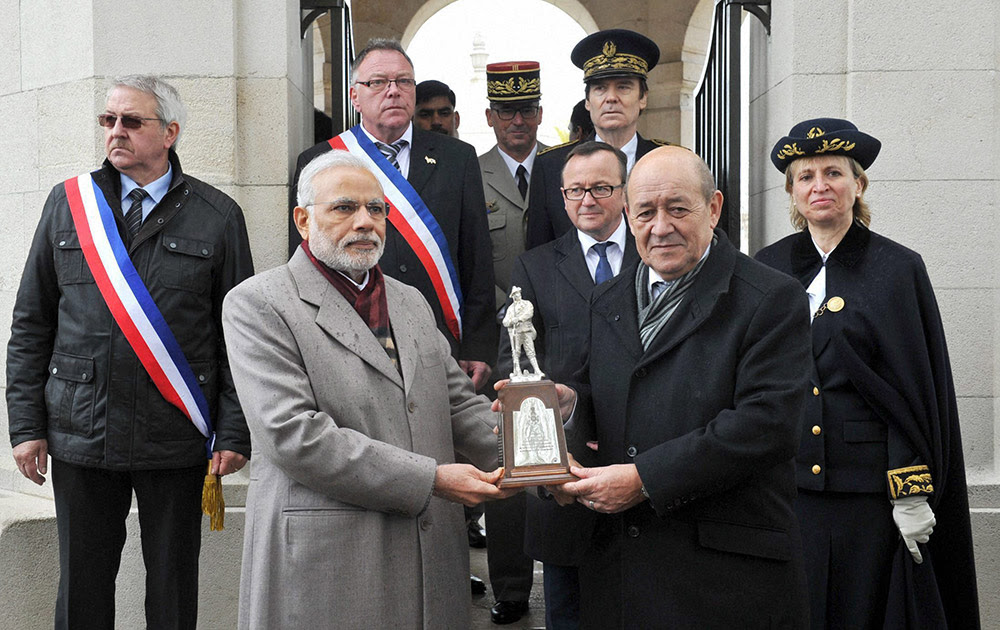
Prime Minister presenting a silver replica of the Garhwal Rifles War Memorial after his visit to the Neuve-Chapelle War Memorial in France.  Prime Minister presenting a silver replica of the Garhwal Rifles War Memorial after his visit to the Neuve-Chapelle War Memorial in France.  

The discovery of the mortal remains of two soldiers of the former 39 Garhwal Rifles and the ceremony involving their ceremonial burial in France has once again provided the occasion for remembrance of the supreme sacrifice made by Indian soldiers for the cause they fought for. It would be in fitness of things to mention that when Narendra Modi became the first Indian Prime Minister to visit the famous Neuve-Chapelle War Memorial in France, he chose the silver replica of the Garhwali War Memorial at Lansdowne as a ceremonial gift to his hosts. The replica symbolises the Unknown Soldier, who is ever ready to go to battle and even sacrifice his life in the service of the motherland. Incidentally, not known among many, it is only personnel of the armed forces who take an oath of duty unto death.

(The writer was also Colonel of the Garhwal Rifles. He is a second generation officer of the regiment. His father, also a General Officer of the Indian Army, was commissioned into 1/39 Royal Garhwal Rifles the unit to which Naik Darwan Singh, VC belonged, and served 16 years with it before he raised 4 Garhwal Rifles to which the author belongs     )


clip

clip

clip

clip