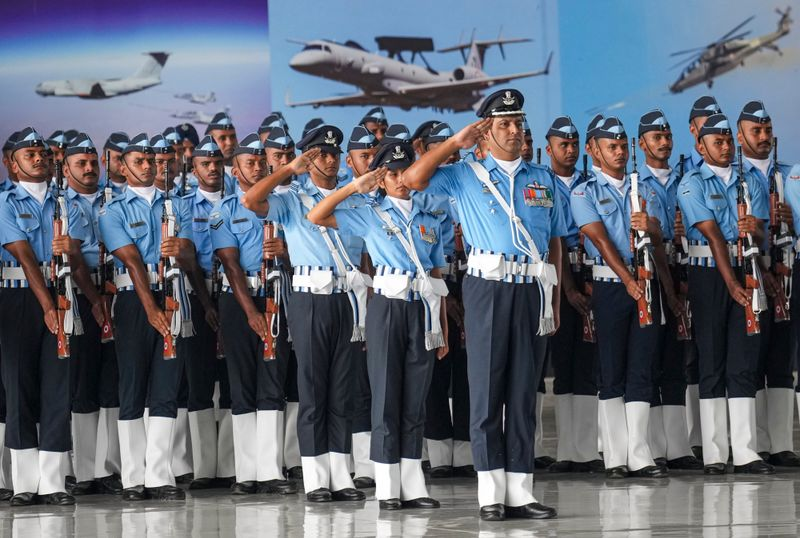
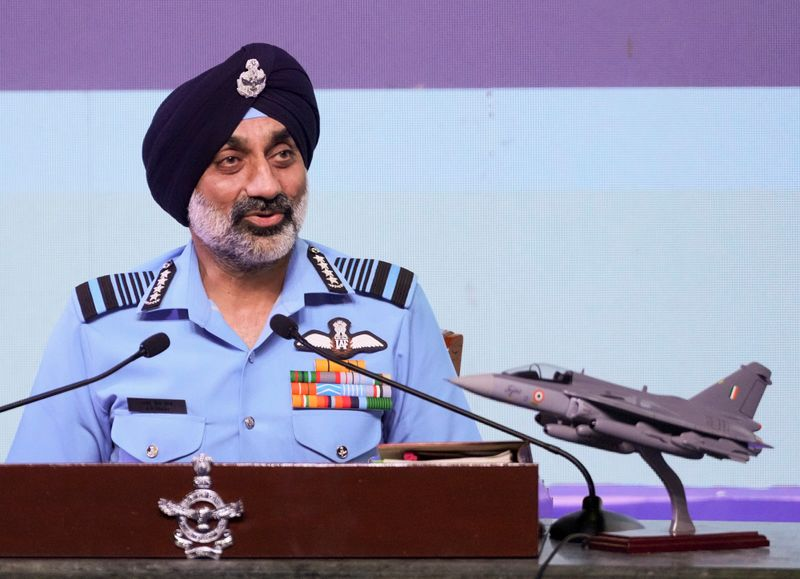
AS part of the 93rd Air Force Day celebrations, the Chief of the Air Staff, Air Chief Marshal Amar Preet Singh, addressed a press conference in Delhi on October 3. The event was significant, marking both the completion of his first year in office and his first major media interaction since Operation Sindoor. During the briefing, the Chief covered a wide range of topics, including the Indian Air Force’s role i
AI, algorithms to decide future wars, says Rajnath
Minister urges innovators to think beyond existing solutions and develop technologies that redefine warfare
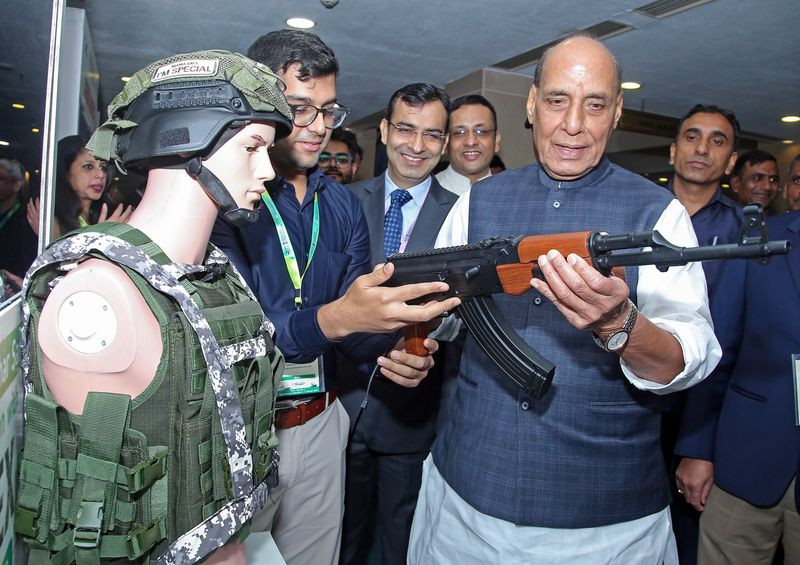
The battlefield has changed and wars of tomorrow will be fought with algorithms, autonomous systems and artificial intelligence, a demonstration of it was seen in Operation Sindoor, said Defence Minister Rajnath Singh.
Drones, anti-drone systems, quantum computing and directed-energy weapons will define the future, he said today while speaking at the ‘Raksha Navachar Samvaad’, an interaction between the Ministry of Defence and startups and innovators.
The minister urged innovators to think beyond existing solutions and develop technologies that redefine warfare. “We must not remain imitators or followers in technology we must become the creators and standard-setters for the world,” he added. Today, more than 650 innovators have emerged and prototypes are being sourced worth Rs 3,000 crore, he said.
Singh encouraged startups to set higher benchmarks, underlining that India has more than 100 unicorns today, but none in the defence sector, calling upon them to change that.
“Let the first defence unicorn of India emerge from among you. It will be a matter of pride not only for you but for the entire nation,” he added.
The minister lauded the collective effort of innovators for contributing to record-breaking achievements in defence production worth Rs 1.5 lakh crore and exports exceeding Rs 23,000 crore in the last financial year.
“You are the architects of a new India that believes in designing, developing and producing for itself. The energy and innovation you bring are key to realising the Prime Minister’s vision of a technologically self-reliant India,” he highlighted.
t
India slams Pak at UN over 1971 ‘genocidal mass rape’
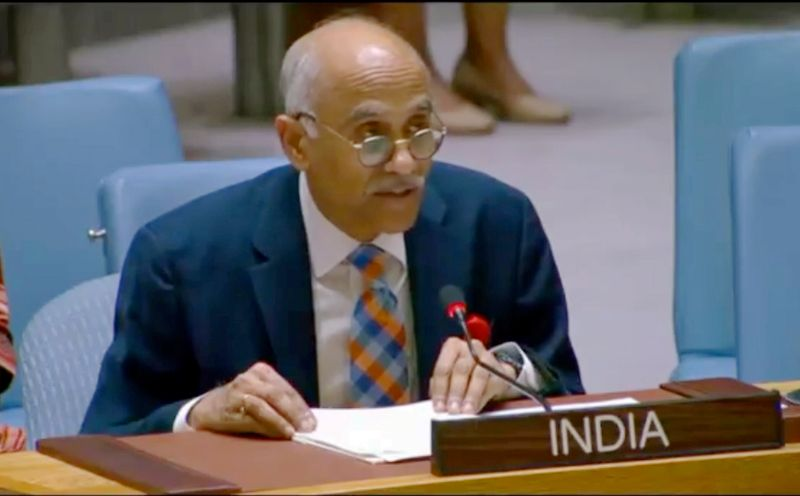
Permanent Representative of India to the United Nations Parvathaneni Harish at the UN Security Council open debate on women, peace and security in New York on Tuesday. PTI
Speaking at the UNSC Open Debate on Women, Peace and Security, Ambassador Parvathaneni Harish, India’s Permanent Representative to the UN, said Pakistan’s statements on Jammu and Kashmir were “an annual ritual of misdirection and hyperbole”.
“A country that bombs its own people and conducted a campaign of genocidal mass rape of 4,00,000 women citizens by its own army cannot lecture others on peace or human rights. The world sees through Pakistan’s propaganda,” he said.
Harish underscored that India’s record on women, peace and security stood in stark contrast — “unblemished and unscathed” — and reflected a long tradition of empowering women in peacekeeping, long before the adoption of the landmark UN Security Council Resolution 1325.
“India recognised long before the world did that women are indispensable agents of peace,” he said, recalling that Indian women medical officers were deployed to the Congo in the 1960s in one of the UN’s earliest peacekeeping missions.
That early leadership reached a milestone in 2007, when India deployed the world’s first all-female Formed Police Unit to Liberia — an initiative Harish described as “a game-changer” that helped rebuild communities, reduce crime and inspire Liberian women to join law enforcement.
The envoy also cited India’s trailblazers in global peacekeeping — Dr Kiran Bedi, the first woman to head the UN Police Division; and Major Suman Gawani and Major Radhika Sen, recipients of the UN Military Gender Advocate Awards in 2019 and 2024, respectively. “It is no longer a question of whether women can do peacekeeping. Rather, it is whether peacekeeping can do without women,” Harish said.
Highlighting India’s global capacity-building role, he noted that the Centre for United Nations Peacekeeping in New Delhi trains over 12,000 troops annually, including specialised programmes for women officers.
India also hosted the International Conference on Women Peacekeepers from the Global South in February 2025, drawing representatives from 35 nations, followed by a UN Women Military Officers Course in August with participants from 15 countries.
“As we look ahead. India remains unwavering in its commitment to the women, peace and security agenda and stands ready to share its expertise with partners, especially in the Global South,” he said.
Indian, UK naval aircraft carriers hold joint drills
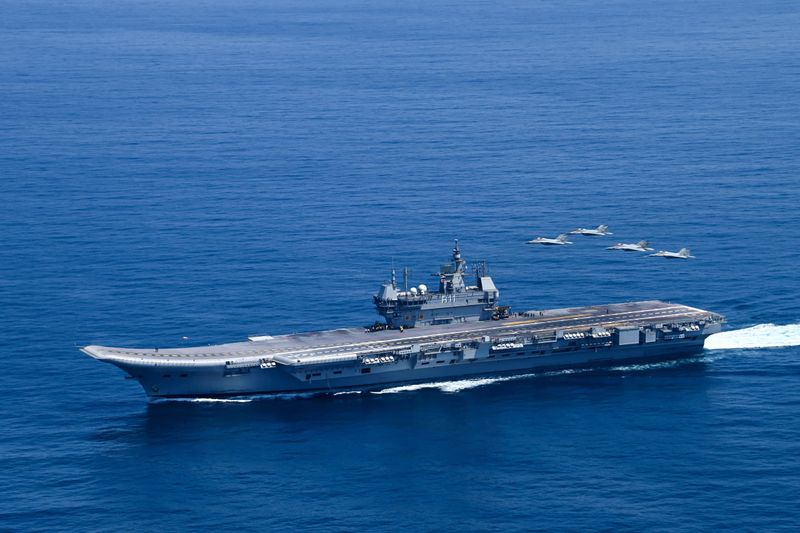
The Indian Navy and UK’s Royal Navy today kicked off a maritime exercise involving aircraft carriers.
Both navies would be fielding, what in Naval parlance is called the ‘carrier strike group’. This includes fighter jets and copters on deck of the aircraft carrier which is accompanied by other warships and submarines getting live situational feed from surveillance planes and satellites.
Called ‘exercise Konkan’, it will be conducted off the western sea board of India. The Indian Navy said the eight day (October 5-12) exercise will be conducted in two phases. The sea phase will encompass complex maritime operational drills focusing on anti-aircraft, anti-surface, and anti-submarine exercises, flying operations and other seamanship evolutions. Both participating nations will deploy frontline assets, including aircraft carriers, destroyers, frigates, submarines, and integral and shore based air assets.
The Indian side will be represented by the carrier battle group of the indigenous aircraft carrier INS Vikrant in company with other warships, submarines and aircraft. The UK Carrier Strike Group (UK CSG 25), is led by HMS Prince of Wales, including assets from Norway and Japan.
Over the past two decades, this exercise has grown significantly in scale and complexity, fostering enhanced interoperability and mutual understanding in maritime operations between the two navies, the Indian Navy said.
This exercise is a reaffirmation of the shared commitment to ensuring secure, open and free seas and will exemplify the comprehensive strategic partnership outlined in ‘India-UK Vision 2035’, the Navy said.
Exercise Konkan will serve as a platform to consolidate strategic ties, enhance interoperability and contribute to regional maritime stability.
The UK Navy’s fighter jets, on Oct 14, are to carry out a daylong exercise with the Indian Air Force off the western coast of India. The UK flotilla is on a eight-month deployment – started in April — across Asia and Indo-Pacific as part of ’Operation Highmast’.
Despite tariff tensions, maritime exercise ‘Malabar’ set for Nov
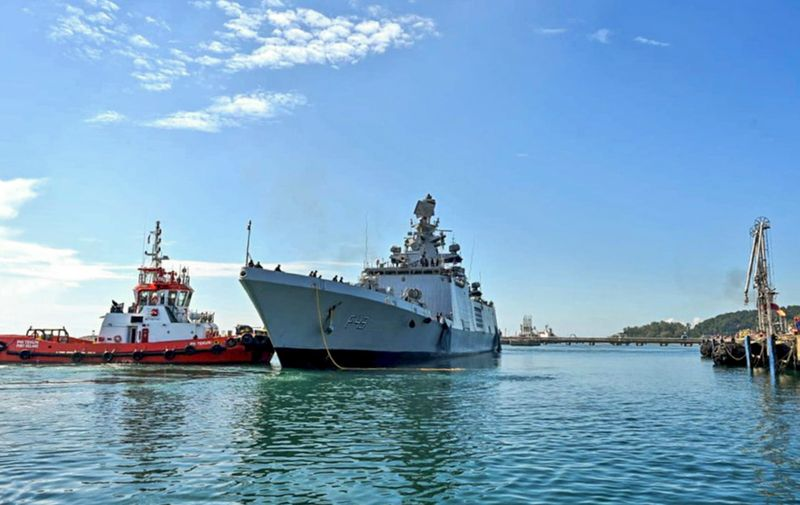
INS Sahyadri leaves for Guam, 2,500 east of the Philippines, to take part in drill hosted by US
Despite India facing punitive tariffs from the US, a multi-nation annual marquee maritime exercise is on as per schedule in November with Japan and Australia also joining in.
Sources confirmed that Indian Navy warship INS Sahyadri would join the maritime exercise ‘Malabar’ to be hosted by the US at Guam, one of its military bases in the western-part of the Pacific Ocean. Guam, an island, is some 2,500 east of the Philippines.
The Indian warship has already left Indian shores and would be part of maritime engagements with several countries enroute to Guam.
The four-nation exercise called ‘Malabar’ is often dubbed by Beijing as ‘anti-China’, largely due to the fact that the four partners in ‘Malabar’ are also partners in the Quad.
India-US ties have plunged after Trump imposed 50 per cent tariff on India, among the highest in the world. Half of this tariff is punitive in retaliation for buying Russian crude oil. The other half stems from the stalled trade negotiations.
Last year in October, India hosted the ‘Malabar’, beginning with the harbour phase in Visakhapatnam, followed by the sea phase. The Malabar-2024 was carried out as of the most comprehensive version of all editions so far, incorporating complex operational scenarios, the Ministry of Defence had said after the exercise.
The Malabar, which began in 1992 as a bilateral naval drill between the US and the Indian Navy, has evolved into a key multilateral event aimed at enhancing interoperability to address shared maritime challenges in the Indian Ocean and Indo-Pacific region.
The exercise gains importance as all four countries operate the same maritime surveillance planes, which are also capable of hunting submarines. These planes can generate a common ‘picture’ of the sea.
The four also have in their arsenal other common platforms, which can enable seamless communication with each other.
Last year, the Malabar had its focus on a broad range of activities designed to enhance cooperation and operational capabilities, this year the tempo is expected to be the same.
This could include discussions on special operations, surface, air and anti-submarine warfare. Complex maritime operations such as anti-submarine warfare, surface warfare, and air defence exercises could also be conducted at sea.
Ladakh violence: SC to take up today Sonam Wangchuk’s wife Angmo’s petition against his detention under NSA
Ladakh violence: SC to take up today Sonam Wangchuk’s wife Angmo’s petition against his detention under NSA
The Supreme Court will on Monday take up Ladakh climate activist Sonam Wangchuk’s wife Gitanjali Angmo’s petition seeking his immediate release from detention under the National Security Act (NSA).
Angmo’s petition is listed for hearing before a Bench of Justice Aravind Kumar and Justice NV Anjaria on October 6.
Detained on September 26 under Section 3(2) of the NSA two days after the September 24 violent clashes between protesters demanding statehood and Sixth Schedule status for Ladakh and the police, Wangchuk was lodged in Jodhpur jail in Rajasthan.
Four people had died and 90 others were injured in the clashes in the newly created Union territory of Ladakh.
Terming it “illegal, arbitrary, and unconstitutional”, Angmo has contended that the detention order violated her husband’s fundamental rights guaranteed under Articles 14 (right to equality), 19 (right to various freedoms), 21 (right to life and liberty) and 22 (Protection against arrest and detention in certain cases) of the Constitution.
Angimo questioned the Ladakh Administration’s decision to invoke the NSA against Wangchuk. Wangchuk’s wife alleged that she has not been given a copy of the detention order in violation of rules, and that she had had no contact so far with her husband.
The Ladakh Administration has rejected allegations of a “witch-hunt” or a “smokescreen” operation against Wangchuk.
In her habeas corpus petition, Angmo sought a direction to the Ladakh Union Territory Administration to “produce Sonam Wangchuk before this Hon’ble Court forthwith”.
Demanding immediate access to the detenue (Wangchuk), she urged the top court to quash the preventive detention order. She also sought urgent listing of her petition.
She has sought a direction to the authorities concerned to “allow immediate access of the petitioner to her husband, both telephonic and in person”.
Alleging that no grounds of detention have been furnished to date, either to Wangchuk or to his family, his wife contended that she had been kept under virtual house arrest in Leh, while students and staff of the Himalayan Institute of Alternatives, Ladakh (HIAL), founded by Wangchuk, were facing harassment, intimidation, and intrusive investigations.
“The arbitrary transfer of Wangchuk to Jodhpur, the harassment of students and staff of the Himalayan Institute of Alternatives, Ladakh (HIAL), the virtual house arrest of the petitioner herself, and the false propaganda linking Shri Wangchuk to foreign entities clearly demonstrate mala fide state action intended to suppress democratic dissent and peaceful environmental activism,” she submitted.
The arrest has inflicted severe mental pain and anguish on the people of Ladakh, who revered Wangchuk as their leader, the petition stated. “A recent tragic incident has been reported where a member of the Ladakh Buddhist Association committed suicide, allegedly depressed after his detention, underscoring the devastating psychological impact on the community,” the petition alleged.
Angmo sought a direction to the authorities to ensure that Wangchuk was provided with his medicines, clothes, food and other basic necessities forthwith. She also sought a direction to them to place before the top court “the order of detention along with grounds of detention and all records pertaining thereto” as also his medical report.
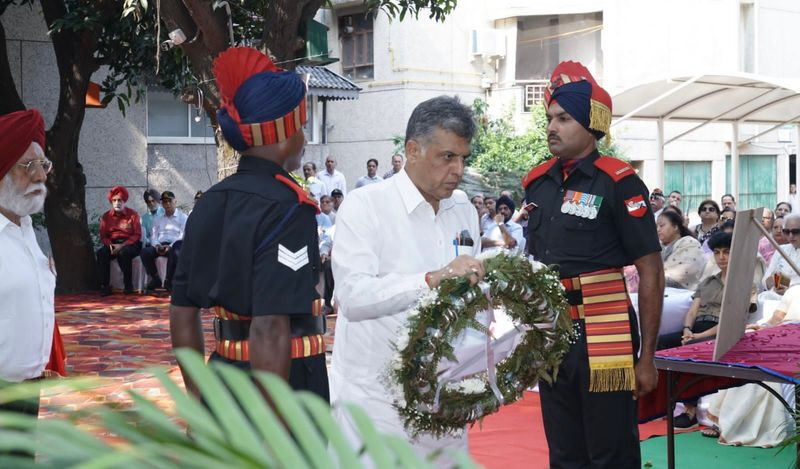
Member of Parliament from Chandigarh and former Union Minister Manish Tewari paid floral tributes Lieutenant Rajiv Sandhu Mahavir Chakra, who fell martyr during the Indian Peacekeeping Force operations, IPKF operations in Sri Lanka in 1988.
In a solemn ceremony held at Rajiv Vihar, Chandigarh, floral tributes were paid to mark the supreme sacrifice of Second Lt Rajiv Sandhu, Mahavir Chakra, who was martyred during the Indian Peacekeeping Force operations in Sri Lanka in 1988.
Speaking on the occasion, Member of Parliament from Chandigarh and former Union Minister Manish Tewari said, “Second Lt Rajiv Sandhu was an alumnus of St John’s High School, Chandigarh. He later went to DAV College, Chandigarh, and post-graduated from Panjab University, after which he joined the officer’s training school and right after being commissioned in the Army, he was deployed in Sri Lanka for Operation Pawan.”
HS Lucky, president, Chandigarh Territorial Congress Committee, serving retired generals, brigadiers and colonels of the Army also paid their floral tributes on this occasion, which was organised by the Resident Welfare Association led by Lt Col Sra and Lt Col Sakhlani and his colleagues.
Among others, Col DS Sra, Col Saklani, Col Jagdish Chander, Col Gursawek Singh, Mrs SS Rana, Sarabjit Kaur (MC), Surjit singh Dhillon and Sanjiv Gabha were also present on the occasion.
WAR is a muddle of actions — some that actually happened and some that almost did. The 1965 war was the first in which our forces were allowed to cross the international border. Major battles took place in Punjab. Fighting in the Rajasthan sector started after the ceasefire took effect on September 22 as the Pakistanis carried out an air attack on the Jodhpur jail hospital.
The Army had only one brigade deployed to defend the whole of Rajasthan. The operational responsibility of this border was with the Delhi & Rajasthan (D&R) Area, headquartered in Delhi. In view of the flare-up, its advance headquarters quickly moved to Jodhpur. Two brigades were soon shifted from the east and placed under the D&R Area.
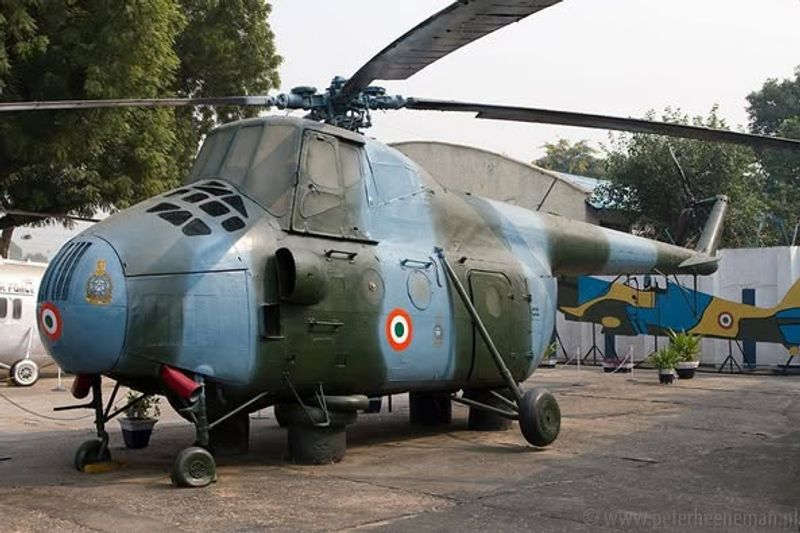
The GOC visited forward posts regularly. On October 24, the first stop was Tanot, which was occupied by a Sikh Light Infantry Company. Apart from the GOC, there were two Brigadiers, two Lt Colonels — including the commanding officer of the Camel Battalion — and me as the ADC.
After the visit, as the helicopter took off from the makeshift helipad at Tanot to fly south-west to Longewala, the rotors created a mini sandstorm, momentarily blinding the pilots.
On reaching a post, and assuming it to be Longewala, the pilots descended to an altitude of about 100 ft, looking for a landing pad. Through the portholes, we could see the post; obstacles placed on the cart track, camels sitting idle, washings laid out on the sand to dry. Soldiers, mostly in vests and shorts, looked up curiously as the helicopter circled overhead thrice.
Failing to find a suitable landing place, the pilots regained height. As there were no landmarks other than sand dunes, the usual method of terrain flying was not possible. Unsure of their location, the pilots finally headed eastwards. After about half an hour, we reached a larger post where Gorkha troops were spotted. The pilots made a landing; it was Ramgarh, well in the rear.
Later that day, a Pakistani wireless signal was intercepted, seeking an explanation from the post commander about why a low-flying helicopter with clear Indian markings was not shot down. Actually, the place where we ‘almost landed’ was the Sadhawala post that had changed hands between the warring sides a few times. On that day, it was under Pakistani occupation. Luckily, as it was a Sunday, the post commander had gone to the rear and the JCO in charge could not take a decision. Being unaware of the ground situation, we all kept sitting placidly, inhaling fumes from the fuel tank mounted inside the Mi-4 helicopter.
Looking back, I think that had we actually landed, we would have been taken prisoners. The incident would have made headlines in Pakistani newspapers. While the senior officers would have been named, I would have been mentioned merely as ‘one Captain’. Being a junior is a handicap in every situation.
He said IAF would need 35 to 40 new planes each year to remain relevant and he batted for expanding air power over the next two decades
Air Chief Marshal AP Singh has stated that IAF destroyed or damaged at least a dozen Pakistani planes during Operation Sindoor. Addressing a press conference, he dismissed Islamabad’s claims of causing major losses to IAF as “Manohar Kahaniyan” (feel-good tales).
Addressing a press conference here, he said IAF would need 35 to 40 new planes each year to remain relevant and he batted for expanding air power over the next two decades, but refrained from putting a number to the expansion.
On being asked about Pakistan’s losses during Operation Sindoor (May 7-10), the IAF Chief said during the airstrikes on Pakistan Air Force (PAF) bases, one C130-J plane, one air-borne early warning plane and 4 to 5 US-made F-16 jets were hit on the ground, which were at a base for maintenance.
Counting the IAF strikes in the air, he said, “We have clear evidence that a long-range hit was made almost 300 km away. It happened to be a PAF signal intelligence plane, along with five hi-tech fighters, including F-16 and J-17 (Chinese) class aircraft, according to our system.”
The IAF Chief hinted that the strikes in the air were carried out using the newly inducted Russian S-400 air defence system, a long-range surface-to-air missile system. He added that on the ground, IAF targeted four radar sites, two command and communication sites, three plane hangars in separate stations, a missile site, and runways at two places.
Regarding Pakistan’s claim of downing IAF planes during Operation Sindoor, the IAF Chief said, “Their narrative is ‘Manohar Kahaniyan’. Let them be happy, as they need to show something to their audience to save their reputation. That doesn’t matter to me.”
He further added, “If they think they shot down 15 of my jets, let them think about it. I hope they’re convinced about it, and they’ll cater for 15 less aircraft in my inventory when they come to fight again. So, why should I talk about it?”
Even today, I won’t say anything about what happened, how much damage was done, how it happened, because let them find out.
The IAF Chief challenged Pakistan’s narrative, saying, “Have you seen a single picture where something fell on any of our airbases, something hit us, a hangar was destroyed, or anything like that? We showed so many pictures of their places. However, they couldn’t show us even a single picture. So, their narrative is ‘Manohar Kahaniyan’. Let them be happy.”
Mentioning the S-400 missiles, the IAF Chief said, “The long-range SAMs that we have procured recently and operationalised have turned the tables on them. We could look deep inside their territory and ensure they were not able to operate even within their territory to a certain distance.” He added, “We were able to bring them to their knees in one night of intensive operations.”
The IAF Chief discussed the future, saying, “IAF is working towards Vision 2047. We have drawn out our own roadmap, and we’re working on that. We’re also looking at what’s happening around the world.”
On newer fighter jets, he said, “We’re going in for strategic partnerships with some aircraft and systems that we immediately need. The technology can be brought to India and manufactured in India, which will help us in two ways: quick filling of our gaps and infusion of technology in India, helping our R&D sector absorb and become better in that technology.”
State Stalwarts
DEFENCE MINISTER
Minister Rajnath Singh
ALL HUMANS ARE ONE CREATED BY GOD
HINDUS,MUSLIMS,SIKHS.ISAI SAB HAI BHAI BHAI
CHIEF PATRON ALL INDIA SANJHA MORCHA
LT GEN JASBIR SINGH DHALIWAL, DOGRA
SENIOR PATRON ALL INDIA SANJHA MORCHA
MAJOR GEN HARVIJAY SINGH, SENA MEDAL ,corps of signals
.
.
PATRON ALL INDIA SANJHA MORCHA
MAJ GEN RAMINDER GURAYA ,MADRAS REGIMENT
sanjhamorcha303@gmail.com
PRESIDENT SOUTH ALL INDIA SANJHA MORCHA
COL SS RAJAN BOMBAY SAPPERS,
PRESIDENT UTTARAKHAND ALL INDIA SANJHA MORCHA
COL B M THAPA ,BENGAL SAPPERSS
PRESIDENT HARAYANA STATE CUM COORDINATOR ESM
BRIG DALJIT THUKRAL ,BENGAL SAPPERS
PRESIDENT TRICITY
COL B S BRAR (BHUPI BRAR)
PRESIDENT CHANDIGARH ZONE
COL SHANJIT SINGH BHULLAR
.
.
PRESIDENT PANCHKULA ZONE AND ZIRAKPUR
COL SWARAN SINGH
INDIAN DEFENCE FORCES
DEFENCE FORCES INTEGRATED LOGO
INDIAN AIR FORCE
Air Officer C-in-C WESTERN AIR COMMAND
AIR MSHL S PRABHAKARAN AVSM VM
AOC-IN-C, EASTERN AIR COMMAND
Air Marshal Inderpal Singh Walia
AOC-in-C SOUTH WESTERN AIR COMMAND
Air Marshal Vikram Singh
AOC-IN-C, SOUTHERN AIR COMMAND
Air Marshal J.Chalapati
AOC-IN-C TRAINING COMMAND
AIR MARSHAL SK GHOTIA VSM
AOC-IN-C MAINTENANCE COMMAND
Air Marshal Jagdish Chandra
Flag Officer Commanding in Chief, Western Naval Command
ice Admiral R Hari Kumar, PVSM, AVSM, VSM
Flag Officer Commanding in Chief, Eastern Naval Command
Vice Admiral Sanjay Bhalla, AVSM, NM
Flag Officer Commanding in Chief, Southern Naval Command