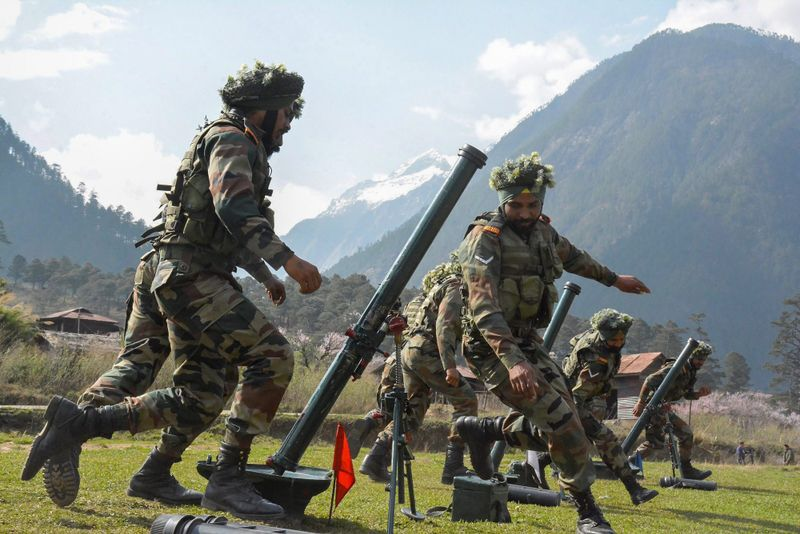
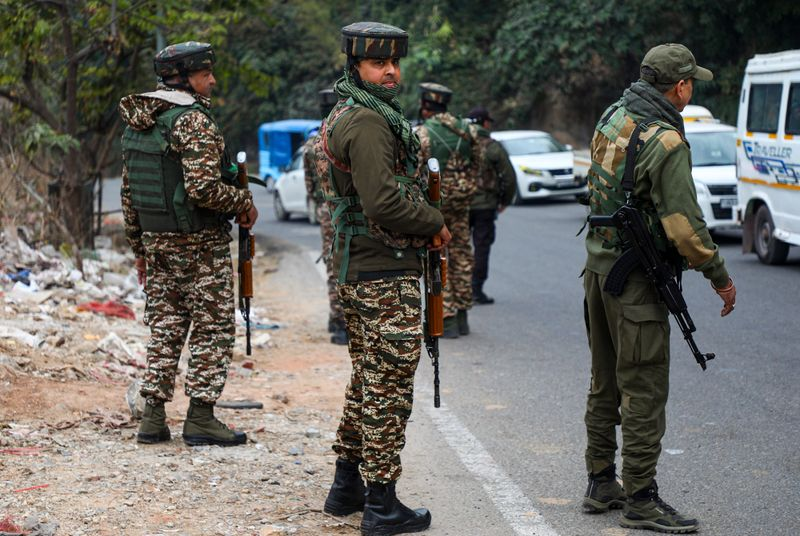
Gunfights break out in Sukma and Bijapur forests during anti-Naxalite operations
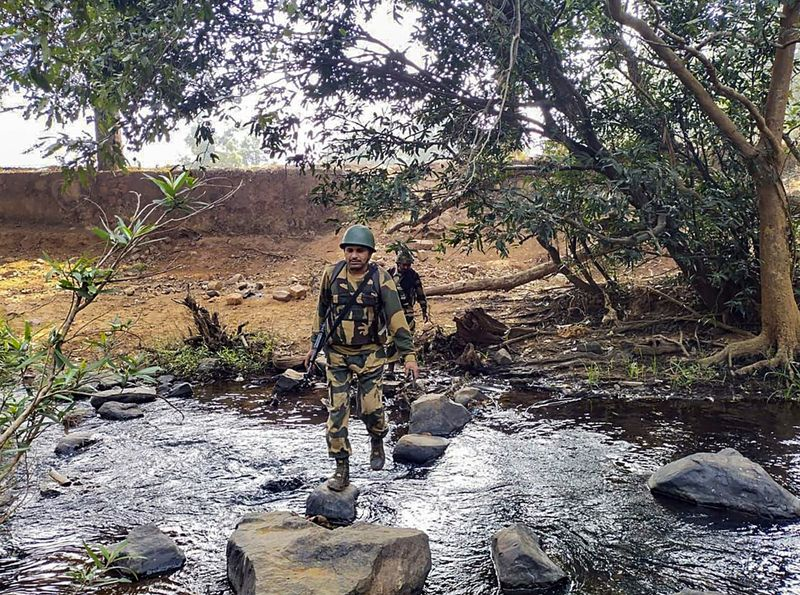
Security forces killed 14 Naxalites, including wanted ultras Mangtu (DVCM) and Hunga Madkam, in separate encounters in Chhattisgarh’s Sukma and Bijapur districts in the Bastar region on Saturday, officials said.
While 12 Naxalites, including Mangtu (DVCM), were neutralised by the security forces during an exchange of fire in Sukma, the bodies of two Maoist cadres, including Hunga Madkam, were found in the forests of Gaganpalli village in Basaguda, Bijapur, senior officials in the Ministry of Home Affairs said.
In Bijapur, the forces recovered one SLR rifle and one 12-bore rifle, along with the bodies of two Naxalites, they said.
A senior police official said the encounter broke out in the southern region of Sukma district when the team of security personnel was out on an anti-Naxalite operation.
In Bijapur, the gunfight broke out in a forest in the southern region of the district when a team of the District Reserve Guard, a unit of the state police, was out on a similar operation around 5 am, another official said.
Intermittent firing was underway when the last reports were received. Further details were awaited, the official said.
Last year, 285 Naxalites were gunned down in separate encounters with security forces in Chhattisgarh.
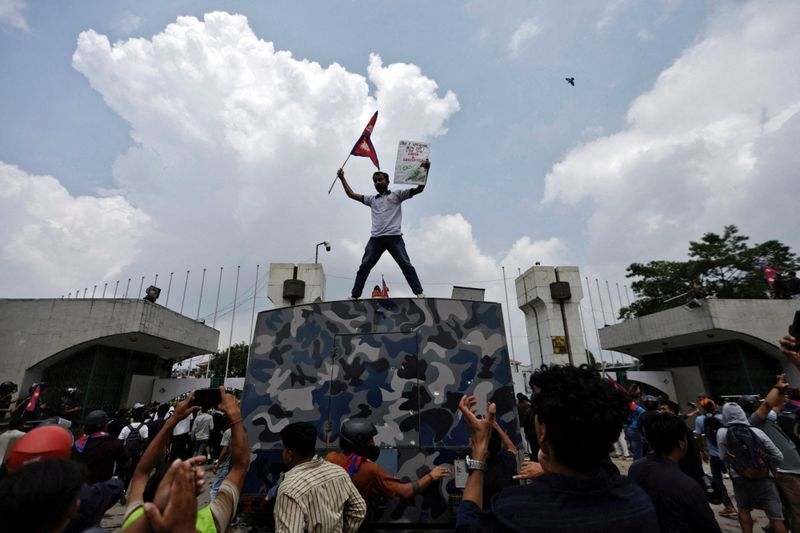
The outcome of Nepal’s fifth revolution (Jan Andolan) in September was the announcement of elections on March 5, 2026. Cadres of the ousted KP Oli-CPN (UML) government had clashed with Genji (Z) revolutionaries. The vandalism during the protests cost $5 billion (the government’s estimate puts the figure at $572 million). On September 9, all state institutions had collapsed, forcing Oli to resign; in the vacuum that ensued, the army was unable to protect government property. In its response to an inquiry, the army said it had to make a choice between protecting people (leaders and officials) and property. The Genji protests were ‘not all that spontaneous’. There is evidence that the US had stirred the pot. Further, doubt lingers over whether elections will be held; or, held on time.
The Genji protests were ostensibly against the Internet ban, which escalated after police firing killed 17 protesters. That figure shot up to 77 martyrs. The people’s uprising that piggybacked Genji protests expanded the latter’s demands — from good governance, elimination of corruption and job creation to constitutional amendments restoring political stability and voting from abroad. About 2,000 youth leave the country every day for employment. Genji is a collective of 49 disparate groups, whose leader is Sudan Gurung, a musician-turned-head of a humanitarian organisation. He signed at least three agreements with Karki, most notably the 10-point agreement in December. It includes amendments, which, according to advocate Radhesham Adhikari, will be difficult to implement and become a hurdle to timely elections.
Though the Nepali Congress and CPN (UML) have filed petitions for the restoration of Parliament, they will fight the elections. Some Genji members are joining the Bibeksheel, Ujyaalo Nepal and Rastriya Swatantra parties. The RSP president, Rabi Lamichhane, jailed for fraud cases, has been released. Ujyaalo Nepal was lit by the dynamic Kulman Ghising, who rid Kathmandu of load-shedding. The Mayor of Kathmandu, Balen Shah, struck a no-surprise deal as the PM face of the RSP, with Ghising also merging Ujyaalo with the RSP to become its vice-president. Genji leaders Gurung and Purushottam Yadav are backing the RSP, making it formidable. Pre-poll alliance is the new normal. Even the NC and UML are considering it after the boost of the RSP — precisely the virus of political instability that Genji wants to remove.
Despite being ousted from the government, four-time PM Oli won a landslide third-term chairmanship of the UML. Add to this, his party’s strong grassroots organisation and most government officials being his appointees, Oli may spring a surprise. While five-time PM NC leader Deuba will step down as party president, he will fight elections for an unprecedented eighth time. The party is factionalised into three groups, led by India-backed Shekhar Koirala, US-supported Gagan Thapa and with motley-backers Bimalendra Nidhi/KP Sitaula. Four-time PM Prachanda, minus the Maoist tag, is a survivor and coordinator of the reminted Nepal Communist Party, consisting of 10 Left parties. The new crop of political parties will not make much dent on grassroots parties, which are likely to come back but with smaller vote share and seats. The Left’s majority in Parliament is expected to reduce to less than 50 per cent.
The elections will be held in March, but could go into phases. 2026 promises some surprise and plenty of uncertainty for Nepal.
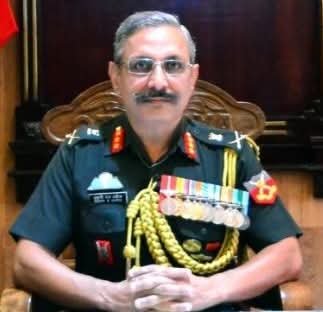
Heartiest congratulations to Lt Gen SS Dahiya, COS ARTRAC, on being elected the Colonel Commandant of The Bengal Sappers & Military Survey…May the Bengal Sappers and Mil Survey achieve ever greater heights of excellence under his leadership !
Bengal Sappers bid a heartfelt farewell to Lt Gen Raghu Srinivasan, PVSM, VSM, outgoing Col Comdt for his exemplary service and timeless guidance, we extend our deepest gratitude. Sir, your legacy of leadership and inspiration will endure.
We now warmly welcome Lt Gen SS Dahiya, SM, VSM, our new Colonel Commandant to this group. Sir, we stand ready under your command, committed to excellence in 2026 and beyond.
MESSAGE FROM NEW COLONEL COMMANDANT
It is my proud privilege to be nominated as the 20th Col Comdt, The Bengal Sappers & Mil Svy. It shall be my sincere endevour to live up to the onerous task assigned and look fwd to some invigorating interactions with the esteemed members of this forum.
Equally grateful to Lt Gen Raghu Srinivasan, PVSM, VSM, for setting a very vibrant relationship with the Gp.
Profound regards and best wishes for the new year TO ALL Bengal Sappers
Defence ministry clears procurement of long-range rockets, missiles, radar systems worth Rs 79,000 crore
Loiter munition will be used for precision strike of tactical targets, whereas low level lightweight radars will detect and track small size, low flying unmanned aerial systems
The defence ministry on Monday approved procurement of long-range rockets, missiles, radar systems and military platforms worth Rs 79,000 crore to bolster the military’s combat prowess.
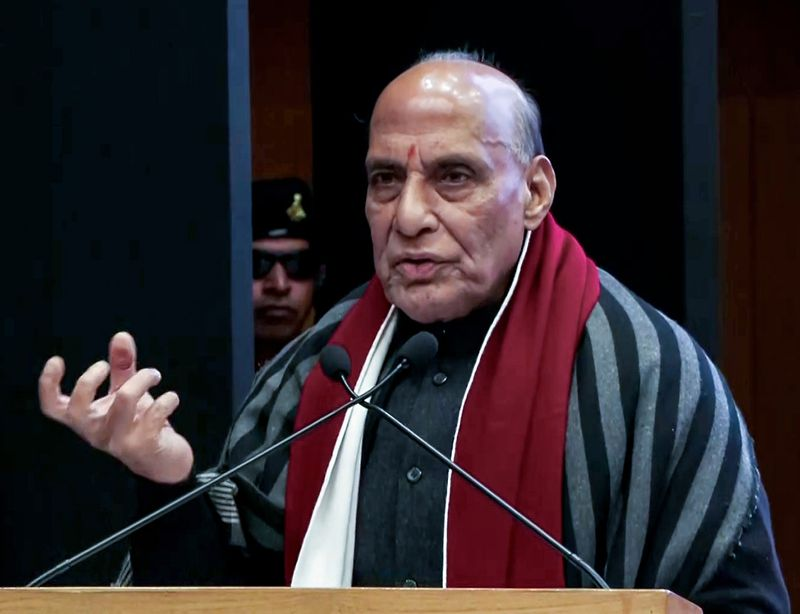
The Defence Acquisition Council (DAC), chaired by Defence Minister Rajnath Singh, green-lighted the proposals.
The DAC approved procurement of loiter munition systems for the Army’s artillery regiments.
It also cleared acquisition of low level lightweight radars, long-range guided rocket ammunition for Pinaka rocket system and integrated drone detection and interdiction system (Mk-II) for the Indian Army, the defence ministry said.
Loiter munition will be used for precision strike of tactical targets, whereas low level lightweight radars will detect and track small size, low flying unmanned aerial systems, it said.
It said long range guided rockets are being procured to enhance the range and accuracy of Pinaka rocket systems for effective engagement of high value targets.
Integrated drone detection and interdiction system (Mk-II) with enhanced range will protect the vital assets of the Indian Army in tactical battle area and hinterland.
For the Indian Navy, approval was accorded for procurement of high frequency software defined radios (HF SDR) Manpack and for leasing high altitude long range (HALE) remotely piloted aircraft system (RPAS).
The unspecified number of RPAS is being taken on lease for continuous intelligence, surveillance and reconnaissance over the Indian Ocean region, the ministry said.
For the Indian Air Force, approval was given for procurement of automatic take-off landing recording system, Astra Mk-II missiles, full mission simulator and SPICE-1000 long range guidance kits, etc, it said.
“Induction of the automatic take-off landing recording system will fill the gaps in the aerospace safety environment by providing high definition all-weather automatic recording of landing and take-off,” the ministry said.
It said Astra Mk-II missiles with enhanced range will increase the capability of the fighter aircraft to neutralise adversary aircraft from large standoff range.
The full mission simulator for light combat aircraft Tejas will augment pilots’ training in a cost effective and safe manner, while SPICE-1000 will enhance long range precision strike capability of the Indian Air Force, according to the ministry.
The Army has reduced its reliance on imported ammunition and now secured indigenous sourcing for 90 per cent of its needs. The push for indigenisation is reshaping ammunition preparedness and long-term war-fighting capability.
Almost 200 variants of ammunition and precision ammunition is used by the Army across its weapon systems – which range from a pistol at the lowest-end and Brahmos missile at the highest. This array of weapons includes, rifles, automatic machine guns, anti-tank missiles, artillery guns, rockets like Pinaka and ammunition used by the Army aviation.
Multi-crore orders
As off today, there is an order of around Rs 16,000 crore worth of ammunition on the domestic industry
In past three years, ammunition supply orders worth Rs 26,000 crore placed on indigenous manufacturers
A policy reform and industry engagement with the private sector has resulted in more than 90 per cent of the ammunition being indigenised and is now sourced through domestic manufacturers.
To have a make-in-India option for the remaining imported ammunition, the Army is also working with research agencies, public sector manufacturers and other private players. To give an example, sources said the precision-guided artillery ammunition, the Excalibur, used effectively in Operation Sindoor, is imported from the US. Efforts are on to make a precision ammunition.
Over the last four to five years, procurement processes have been restructured to promote competition and multiple sourcing options. As off today, there is an order of around Rs 16,000 crore worth of ammunition on the domestic industry. In the past three years, ammunition supply orders worth nearly Rs 26,000 crore have been placed on indigenous manufacturers.
Vendor diversification has improved supply resilience, with many ammunition variants now supplied by multiple domestic sources.
India’s security environment is increasingly shaped by uncertainty, rapid technological change and prolonged crises. In this backdrop, military readiness depends not only on advanced weapons but also on the ability to sustain operations over time. For this, the supply chain needs to be localised, sources said.
Ammunition, spares and logistics form the backbone of combat endurance. Recognising this, the Army has placed self-reliance in ammunition production at the core of its preparedness strategy. This was kicked off in the past five years or so and has picked up speed after Operation Sindoor.
For years, ammunition supply relied heavily on legacy production systems in the public sector and overseas sourcing, leaving it vulnerable during global disruptions. Recent conflicts like the longdrawn Russia-Ukraine conflict highlighted a reality — nations that can sustain ammunition supplies domestically are better positioned to maintain operational momentum.
Reacting to the changed global scenario, the Army accelerated indigenisation in line with the national vision of Make in India. The next phase focuses on consolidating gains. Priority areas include strengthening domestic raw-material supply chains for propellants and fuzes, modernising manufacturing infrastructure, accelerating technology transfers and ensuring rigorous quality standards. Together, these measures aim to build a robust and self-sustaining ammunition ecosystem.
Jalandhar: War tensions, heavy rains disrupted city life
Year ender: Drone sightings, blackout drills and waterlogging left Jalandhar residents coping with daily challenges
The year 2025 will be remembered as a time when the distant idea of war abruptly entered everyday conversations, homes and classrooms. For residents of Jalandhar district, tension between India and Pakistan, transformed routine life into days and nights marked by fear and uncertainty. The residents spent sleepless nights listening to loud explosions, suspected drone attacks and emergency alerts echoing across the city.
For two to three consecutive nights, panic gripped Jalandhar as residents reported hearing booming sounds overhead. Children, who had never experienced such an atmosphere, were visibly frightened, while adults struggled to reassure their families amid rapidly changing developments.
As anxiety spread, its impact became visible on the streets and inside markets. Supermarkets and grocery stores witnessed panic buying, with long queues forming as early as opening hours. People stood with loaded carts, waiting to stock up on essentials. Wheat flour, rice, pulses, cooking oil and other daily-use items were purchased in bulk, as families prepared to survive for weeks indoors if the situation escalated further. Store owners reported an unusual surge in demand. The fear was not limited to supplies. Migrant workers and families living away from their native places began leaving the city, hoping to find safety in their hometowns.
The Jalandhar Commissionerate Police had also rolled out strict security measures to prevent any untoward incident. Police Commissioner issued a series of directives aimed at tightening surveillance across the city. Hotels, motels, guest houses and inns were instructed not to accommodate any individual without verified identity documents. “All guests must submit a self-attested copy of a valid government-issued photo ID, and their mobile numbers must be verified by the establishment,” the Commissioner said, underlining the need for vigilance during the tense period.
The announcement of a one-hour mock drill involving a complete blackout further told about the gravity of the situation. When the drill was conducted for the first time, near-total compliance was observed, especially in Jalandhar Cantonment, where lights went out promptly. Streets fell silent, windows were darkened and residents followed instructions with discipline, aware that preparedness could save lives in a real emergency.
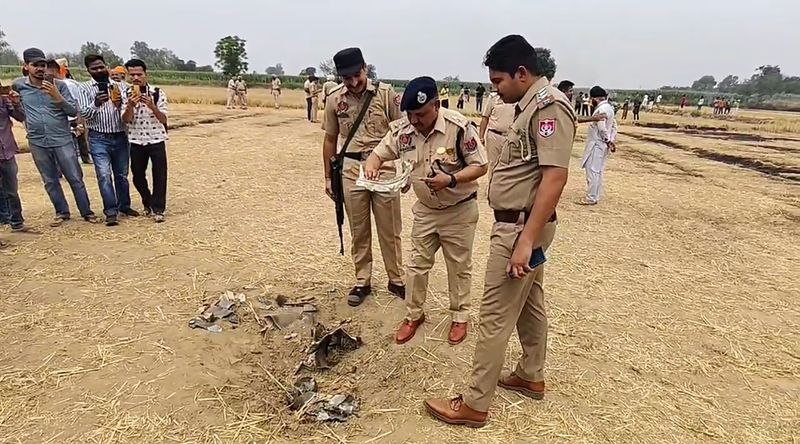
The most alarming episode unfolded on the night of May 9–10, when multiple drone sightings and missile-related incidents were reported. Intermittent explosions were heard across parts of Jalandhar, intensifying panic. In Kangniwal village near Adampur, residents were jolted awake around 1.30 am by a loud blast. Villagers who stepped outside later discovered missile debris scattered nearby.
Soon after, the district administration imposed an immediate blackout at 1.30 am, which remained in force until 6 am. Officials urged residents to stay indoors and avoid spreading rumours. Missile debris was also reported from Mand Maur village near Kartarpur and Rampur Khalian village near Phagwara.
Issuing an official statement, the Deputy Commissioner confirmed that Jalandhar was on red alert, adding that “many objects were seen and were neutralised by the armed forces.” Citizens were repeatedly advised to remain calm and limit outdoor movement. In response to the evolving situation, the Punjab government ordered the closure of all educational institutions for three days, prioritising student safety amid the escalating border tensions.
As calm gradually returned, 2025 left behind more than just memories of fear. For Jalandhar, Operation Sindoor was not just a military operation, it was a moment when war felt uncomfortably close to home.
In 2025, the city also witnessed continuous rainfall lasting for several days, bringing normal life to a standstill across Jalandhar. The persistent downpour flooded major roads, submerged key intersections, and caused severe traffic disruptions, leaving commuters struggling to navigate waterlogged streets. Several residential areas were also affected as rainwater entered homes and low-lying localities.
According to a preliminary assessment conducted by the district administration, more than 300 houses in Jalandhar district suffered full or partial damage due to the heavy rainfall. In view of the worsening situation, the Punjab state government had also announced an eight-day closure of schools across the city due to flooding and safety concerns. The rains also resulted as a setback to students’ academic schedules.
Owing to the incessant rains and forecasts of more downpours, Deputy Commissioner Jalandhar, Dr Himanshu Aggarwal, also ordered that all private and government, elementary and secondary schools in the district remain closed. He said the decision was taken as students and teachers were facing significant difficulties in commuting amid flooded roads and adverse weather conditions.
Frozen passes, unyielding resolve: The saga of Ladakh’s defenders
Fearless Tales: Major Thakur Prithi Chand volunteered to lead a small band of just 18 soldiers | Awarded Maha Vir Chakra on August 15, 1948
In the frozen heights of Ladakh during the Indo-Pakistan War of 1947–48, one of independent India’s most inspiring military epics unfolded under the leadership of Major Thakur Prithi Chand of the 2nd Dogra Battalion. At a time when Ladakh stood isolated, vulnerable and under imminent threat from advancing Pakistani forces, Prithi Chand’s actions proved decisive in safeguarding this strategically vital region for India.
Brothers in arms: Major Thakur Prithi Chand and Major Thakur Khushal Chand at Naushehra railway station in February 1947.
Between mid-February and early March 1948, under some of the harshest winter conditions imaginable, Major Prithi Chand volunteered to lead a small band of just 18 soldiers into Ladakh. The force consisted largely of Lahauli Buddhists serving in 2nd Dogra Battalion, the men accustomed to hardship, but unprepared for the extremes that lay ahead.
Accompanied by his younger cousin Major Kushal Chand and their uncle Subedar Thakur Bhim Chand, Prithi Chand led this group across the treacherous Zoji La pass — 11,000 feet high and buried under more than 20 feet of snow — without specialised winter equipment. This perilous march alone stands as a remarkable feat of endurance and determination.
Commander in Chief’s congratulatory letter to Col Thakur Prithi Chand on receiving the Maha Vir Chakra.
On reaching Leh, the trio immediately set about organising the defence of Ladakh. Major Prithi Chand took command of two platoons of Jammu and Kashmir State Forces and rapidly raised and trained nearly 200 local militia. By May 1948, the situation had deteriorated sharply. Pakistani forces had overrun much of Baltistan, captured Kargil, and were advancing towards Leh through the Indus and Nubra valleys. With minimal resources, scant ammunition, and a vast front stretching across hundreds of miles, Major Prithi Chand adopted innovative guerrilla tactics to stall the enemy advance.
Displaying extraordinary mobility and leadership, he personally led raids and ambushes, often appearing in one valley one day and another many mile away the next. Living largely on sattu and enduring extreme physical strain, Prithi Chand and his men succeeded in holding the enemy at bay until reinforcements could be flown in. Their efforts not only delayed the invasion, but preserved Ladakh for India at a critical moment in the conflict.
Col Thakur Prithi Chand with his wife Rukmani Devi.
For his exceptional courage, leadership, and indomitable spirit, Major Thakur Prithi Chand was awarded the Maha Vir Chakra on August 15, 1948. Major Thakur Kushal Chand also received the Maha Vir Chakra, while Subedar Bhim Chand was honoured with the Vir Chakra and bar. In fact, Bhim Chand was the first in the country to get two Vir Chakras. Together, their actions in Ladakh remain a timeless testament to sacrifice and heroism, etched permanently into the annals of Indian military history.
Upon his promotion to the rank of Lieutenant Colonel in 1950, Chand was given the command of the 3rd Battalion of the 11th Gorkha Infantry Regiment. He retired as a Colonel in 1962.
Born in the village of Khangsar Khar in Lahaul, Col Thakur Prithi Chand hailed from the distinguished house of Kolong, which governed the remote region of Lahaul during the British era. He was the third son of Thakur Amar Chand, the Wazir of Lahaul and a World War I veteran who served in Mesopotamia and was honoured with the title of Rai Bahadur.
Deep historical ties bound the Thakurs of Lahaul to Ladakh through marriage, shared culture, language, and faith—connections that later shaped Col Thakur Prithi Chand’s commitment to the region.
Educated at Kullu High School and Shri Pratap College, Srinagar, Prithi Chand was compelled to leave his studies unfinished to shoulder family responsibilities following his elder brother’s illness. This early assumption of duty foreshadowed a life defined by service.
Married to Rukmani Devi, the couple had no issue. Presently, Shamsher Thakur and Milap are carrying the legacy of this brave heart who dedicated his life for the sake of his beloved motherland.
A devout Buddhist, Col Thakur Prithi Chand remained committed to social and cultural causes after retirement, serving as president of the Himalayan Buddhist Society in Manali. His life remains a powerful testament to sacrifice, resilience and unwavering devotion to the nation.
Army, J&K Police intensify vigil in Chenab valley to thwart terror threat
Braving sub-zero temperatures, the Army and the Special Operations Group (SOG) of Jammu and Kashmir Police have intensified their vigil in the high altitude areas of Chenab valley district to counter any attempt by terrorists to disrupt New Year celebrations, officials said on Wednesday.
A massive counter-terrorist operation has been underway since last week in the upper reaches of Doda, Kishtwar and Ramban districts of Chenab valley, including the snow-bound areas and adjoining Udhampur, Reasi and Kathua districts, besides Rajouri and Poonch districts.
According to intelligence assessments, around 30 to 35 Pakistani terrorists are currently active in the forests of the Jammu region, and the operation to flush them out intensified after the recent snowfall in the higher reaches. The security forces are expecting the terrorists to shift to lower areas close to human habitat before the complete closure of the mountain passes.
“Intelligence inputs suggested terrorist groups active in Doda, Kishtwar and parts of Udhampur district bordering Bhaderwah since the last two years could attempt to disrupt New Year celebrations by exploiting dense fog, extreme cold and difficult terrain,” a police officer said.
He said the anti-terrorist operations are focused on the higher, middle and upper mountainous areas where the terrorists are believed to be hiding away from the populated areas.
The intensified operations by troops of the Rashtriya Rifles and the SOG have also extended to Bhalessa bordering the Chamba district of neighbouring Himachal Pradesh, officials said.
BJP leader and Bhaderwah MLA Daleep Singh Parihar lauded the forces for the ongoing operations and said this is a testament to the continuous sacrifices made by the armed forces to safeguard the nation and the people of the country.
“We salute the security personnel who spend holidays away from their families to protect not only the national borders but also the scattered population residing in the vast mountains vulnerable to terrorist attacks,” he said.
Hailing from Bhalessa, Parihar said the Army is present everywhere in the hills to counter the terror threats. “If we are living in a peaceful atmosphere here and celebrating New Year like elsewhere in the world, it is only because we have faith that the Army is here to protect us,” Parihar said.
Commending the personnel of the Rashtriya Rifles and the SOG for maintaining tight vigil despite testing circumstances like harsh winters and treacherous hilly terrain, the local residents of Bhallesa said they have complete faith in the Army.
“When the entire world is welcoming 2026, our brave Army and J&K Police in Doda and Kishtwar districts are spending these harsh winter days in relentless anti-terror operations in the dense forests and tough mountainous terrain,” Firdous Khanday, a local from Gandoh Bhalessa, said.
Despite sub-zero temperatures and severe weather challenges, and difficult terrain, he said the forces remain fully committed to neutralising the threats posed by terrorists and maintaining peace in the region.
“Their resolve to counter terrorists stands as a symbol of courage. We live in safety only because of the unmatched dedication and bravery of our forces,” Khanday said.
Air Marshal Nagesh Kapoor takes charge as Vice Chief of Air Staff
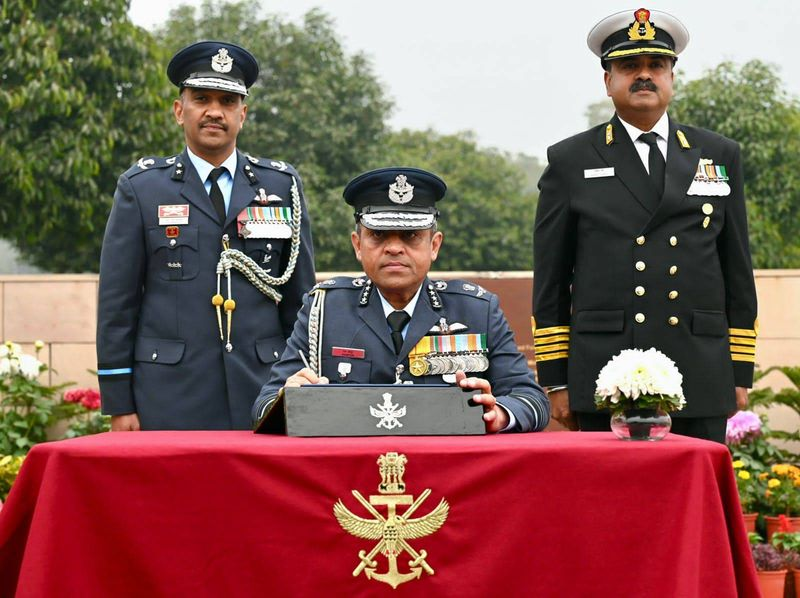
Air Marshal Nagesh Kapoor on Thursday took charge as the IAF’s Vice Chief of the Air Staff.
Prior to this appointment, he served as the Air Officer Commanding-in-Chief of the South Western Air Command (SWAC).He succeeds Air Marshal Narmdeshwar Tiwari, who retired on Wednesday after four decades of illustrious service to the nation.
“Air Marshal Nagesh Kapoor assumed the appointment of Vice Chief of the Air Staff, IAF on 01 Jan 26. Commissioned into the Flying Branch of IAF in Dec 1986, he has a rich experience of flying on various fighter and trainer aircraft of the IAF,” the Indian Air Force (IAF) said in a post on X.
He took charge as the Vice Chief of the Air Staff at the Vayu Bhawan here. Air Marshal Kapoor was accorded a Guard of Honour.The air officer also laid a wreath at the National War Memorial here and paid tribute to the bravehearts.
State Stalwarts
DEFENCE MINISTER
Minister Rajnath Singh
ALL HUMANS ARE ONE CREATED BY GOD
HINDUS,MUSLIMS,SIKHS.ISAI SAB HAI BHAI BHAI
CHIEF PATRON ALL INDIA SANJHA MORCHA
LT GEN JASBIR SINGH DHALIWAL, DOGRA
SENIOR PATRON ALL INDIA SANJHA MORCHA
MAJOR GEN HARVIJAY SINGH, SENA MEDAL ,corps of signals
.
.
PATRON ALL INDIA SANJHA MORCHA
MAJ GEN RAMINDER GURAYA ,MADRAS REGIMENT
sanjhamorcha303@gmail.com
PRESIDENT SOUTH ALL INDIA SANJHA MORCHA
COL SS RAJAN BOMBAY SAPPERS,
PRESIDENT UTTARAKHAND ALL INDIA SANJHA MORCHA
COL B M THAPA ,BENGAL SAPPERSS
PRESIDENT HARAYANA STATE CUM COORDINATOR ESM
BRIG DALJIT THUKRAL ,BENGAL SAPPERS
PRESIDENT TRICITY
COL B S BRAR (BHUPI BRAR)
PRESIDENT CHANDIGARH ZONE
COL SHANJIT SINGH BHULLAR
.
.
PRESIDENT PANCHKULA ZONE AND ZIRAKPUR
COL SWARAN SINGH
INDIAN DEFENCE FORCES
DEFENCE FORCES INTEGRATED LOGO
INDIAN AIR FORCE
Air Officer C-in-C WESTERN AIR COMMAND
AIR MSHL S PRABHAKARAN AVSM VM
AOC-IN-C, EASTERN AIR COMMAND
Air Marshal Inderpal Singh Walia
AOC-in-C SOUTH WESTERN AIR COMMAND
Air Marshal Vikram Singh
AOC-IN-C, SOUTHERN AIR COMMAND
Air Marshal J.Chalapati
AOC-IN-C TRAINING COMMAND
AIR MARSHAL SK GHOTIA VSM
AOC-IN-C MAINTENANCE COMMAND
Air Marshal Jagdish Chandra
Flag Officer Commanding in Chief, Western Naval Command
ice Admiral R Hari Kumar, PVSM, AVSM, VSM
Flag Officer Commanding in Chief, Eastern Naval Command
Vice Admiral Sanjay Bhalla, AVSM, NM
Flag Officer Commanding in Chief, Southern Naval Command