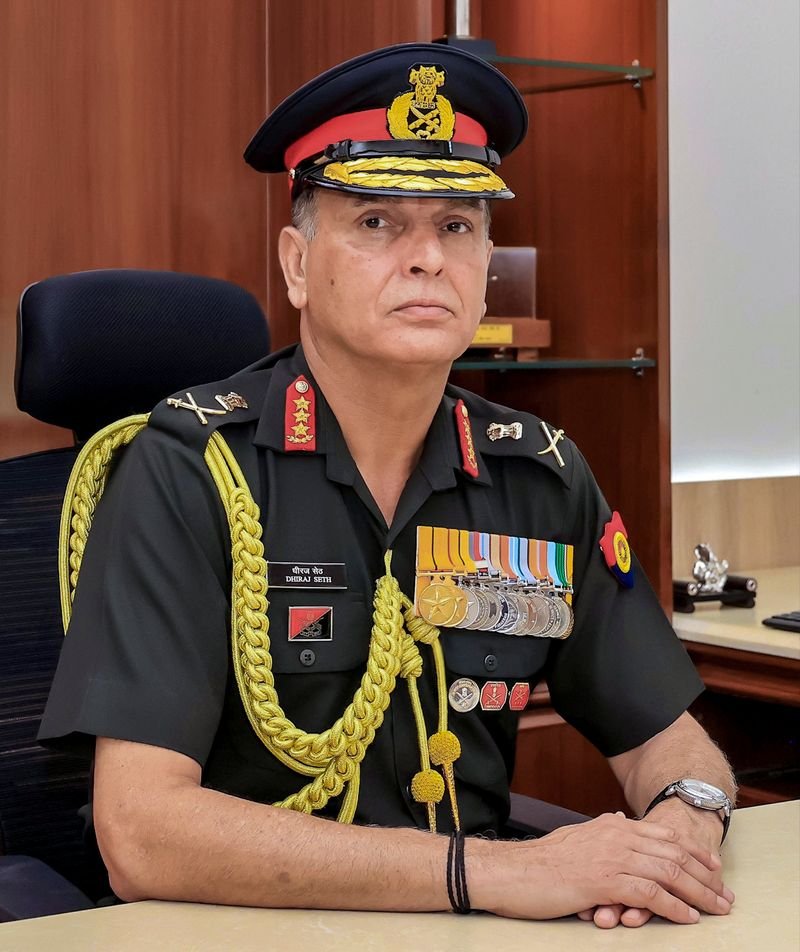
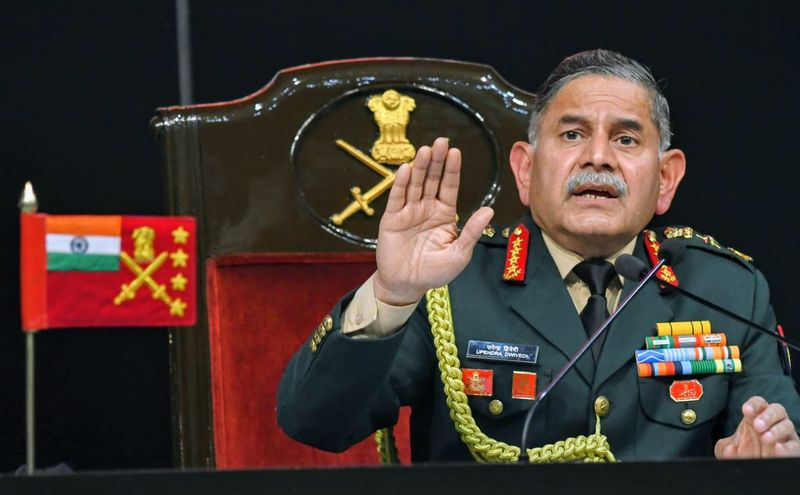
Gen Dwivedi on Saturday said that if Pakistan continues to harbour terrorists and operate against India, then they have to ‘decide whether they want to be part of geography or history or not’
The Pakistan Army on Sunday criticised Indian Army Chief Gen Upendra Dwivedi’s recent remarks, while urging New Delhi to learn to “co-exist” peacefully.
Gen Dwivedi on Saturday said that if Pakistan continues to harbour terrorists and operate against India, then they have to “decide whether they want to be part of geography or history or not”.
Terming Gen Dwivedi’s comments as “provocative”, the Pakistan Army said that responsible nuclear states reflect restraint, maturity and strategic sobriety.
“Threatening a sovereign nuclear neighbour with elimination from ‘geography’ is not strategic signalling or brinkmanship; it is sheer bankruptcy of cognitive capacities…,” the army said in a statement.
“India needs to reconcile with Pakistan’s salience and learn to peacefully co-exist with it,” it said.
It said that “any attempt to target Pakistan can trigger consequences that shall neither be geographically confined nor strategically or politically palatable for India”.
Recalling the four-day conflict in May last year, it said Indian leadership “would be well advised not to attempt to push South Asia towards another crisis or war whose consequences would only be devastating for the complete region and beyond.”
India launched Operation Sindoor on May 7 last year in response to the Pahalgam terror attack in which 26 people, mostly tourists, were killed. It carried out airstrikes on nine terror infrastructures in Pakistan and Pakistan-occupied Kashmir, eliminating at least 100 terrorists.
The action triggered a rapid escalation in tensions, with Pakistan launching retaliatory strikes, though most of them were thwarted by the Indian military.
The hostilities ended with an understanding on halting the military actions on May 10 following talks over the hotline between army officials of the two sides.
Why Pakistan is renaming places to Hindu and Sikh names like Krishan Nagar and Sant Nagar in Lahore
Some of the prominent areas proposed for restoration include Queen’s Road, Lawrence Road, Empress Road, Krishan Nagar, Santnagar, Dharampura, Laxmi Chowk, Sant Nagar Jain Mandir Road, Mohan Lal Bazaar, Bhagwan Pura and Shanti Nagar
Pakistan’s Punjab government has approved a plan to restore the original pre-Partition names of several streets and roads in Lahore as part of an initiative aimed at reviving the city’s historical and cultural heritage, an official said on Monday.
The decision was taken during a Punjab Cabinet meeting chaired by Maryam Nawaz. The initiative has been proposed by former Pakistan Prime Minister Nawaz Sharif, who heads the Lahore Heritage Areas Revival project.
According to officials, several historic streets, alleys and neighbourhoods in Lahore had been renamed over the decades, replacing British-era and Hindu-associated names with those linked to Islamic, Pakistani or local figures.
“The Punjab Cabinet meeting, chaired by Chief Minister Maryam Nawaz, a few days ago had approved a plan to restore the original and historical names of various streets and roads in Lahore and its neighbourhood,” a Punjab government official told PTI.
Some of the prominent areas proposed for restoration include Queen’s Road, Lawrence Road, Empress Road, Krishan Nagar, Santnagar, Dharampura, Laxmi Chowk, Sant Nagar Jain Mandir Road, Mohan Lal Bazaar, Bhagwan Pura and Shanti Nagar.
Officials said the move is intended to revive Lahore’s historical identity and preserve its multicultural past.
Separately, Nawaz Sharif has also proposed restoring three cricket grounds and a traditional wrestling arena at Minto Park, now known as Greater Iqbal Park. The move is being viewed by many as an attempt to address criticism over the demolition of these facilities during Prime Minister Shehbaz Sharif’s tenure as Punjab chief minister in 2015.
Former Pakistan cricket captain Inzamam-ul-Haq was among the players trained at clubs located in Minto Park. Before Partition, legendary Indian cricketer Amarnath had also trained there.
The wrestling arena had once hosted legendary wrestlers such as Gama Pehalwan, Goonga Pehalwan and Imam Bakhsh. Before Partition, the park was also a major venue for Dussehra celebrations by Lahore’s Hindu community.
Gunshot injuries during firing competition cannot be classified as war injury: Armed Forces Tribunal
In May 1994, a soldier had suffered gunshot wounds in his leg and chest while participating in a small arms competition organised by the Army
Gunshot injuries sustained accidentally on the firing range during competitive events cannot be termed as ‘war injury’ and hence cannot be extended the same disability benefits as applicable to casualties during war or war-like situations, the Armed Forces Tribunal (AFT) has ruled.
In May 1994, a soldier had suffered gunshot wounds in his leg and chest while participating in a small arms competition organised by the Army. The accident occurred due to the negligence of his fellow soldier and he was evacuated to a military hospital for treatment.
The injury report and court of inquiry declared the wounds as attributable to military service, and he was downgraded to low medical category (LMC). His disabilities were assessed at 50 per cent for life.
His service, however, remained continuous and during that period he developed additional disabilities of bronchial asthma and aspergilloma of the lung, which were attributable to stress and strain of military service. He was discharged from service in 2008 with composite disabilities assessed at 80 per cent and accordingly granted disability pension.
In 2018, he contended that he was entitled to war injury pension since the injury had taken place in war-like conditions. War injury pension is significantly higher than disability pension.
He claimed that his injury fell under Category-E of a letter issued by the Ministry of Defence in 2001, which listed death or injuries during battle inoculation training exercises or demonstration with live ammunition to be classified as war injury.
He further stated that his case is also covered under Army Order 1/2003 which includes casualties occurring while carrying battle Inoculation / training or operationally oriented training in preparation for actual operations due to gunshot wounds / explosion of live ammunition / explosives / mines or by drowning or electrocution.
The Tribunal’s Bench of Justice Sudhir Mittal and Lt Gen Ranbir Singh observed that the applicant had not suffered disabilities due to battle inoculation, training exercises or demonstration with live ammunition but due to an accidental firing at the small arms range, which though attributable to military service does not qualify as war injury according to categories listed in the ministry’s letter of 2001.
The Bench, while holding that he was correctly being paid disability pension, allowed his plea to round-off the disability percentage to 100 per cent, in accordance with earlier directives of the Supreme Court, with effect from 2008.
The Artificial Limb Centre (ALC) in Pune is among the country’s premier military rehabilitation institutions and has played a key role in treating battle casualties and personnel with life-altering injuries for decades.The visit comes at a time when ex-servicemen associations and disabled veterans have raised concerns over the Union government’s proposed move to restrict income tax exemption on disability pensions in the armed forces.Under the new provision announced in the Union Budget, armed forces personnel receiving a disability pension after ‘superannuation’ may no longer be eligible for complete income tax exemption.The exemption is proposed to remain applicable only to those who are ‘invalidated out of service’ due to bodily disability. The visit, however, has assumed significance amid these concerns.The delegation interacted with officers and soldiers undergoing treatment and rehabilitation for apputations and spinal cord injuries.
speaking to TOI, Col Gaurav Dutta, former blade runner, said the visit by the Pay Commission members was important in helping policymakers understand the issue beyond technical definitions.“The government, in the Budget, has announced that armed forces personnel receiving disability pension after superannuation will no longer be entitled to income tax exemption. Only personnel who were invalidated out of service due to bodily disability will now be entitled to the exemption. The Income Tax Department is yet to issue a notification in this regard,” Dutta told TOI.“There are veterans who have taken home loans, education loans, etc., based on the expected tax-exempt pension and will be severely impacted. This will have huge financial ramifications for them. Therefore, the current visit was crucial to understand how injured and disabled soldiers go through in this phase and why disability pension is necessary,” he added.Veterans have argued that the distinction between personnel invalidated out of service and those who continue serving despite disabilities before superannuating is unfair and insensitive to the realities of military life.“Several disabled soldiers continue in service despite severe injuries, often taking up instructional, administrative or staff roles after rehabilitation. These personnel should not be penalised for choosing to remain in service and contribute further to the armed forces,” said another senior veteran on the condition of anonymity.Military veterans believe such engagements could influence future recommendations on pensions, rehabilitation support and welfare measures for injured armed forces personnel.“The cadets at the NDA also get injured during the training. Some of them even get medically boarded out. Such issues need to be dealt in a sensitive manner so they will get rehabilitated in a proper way,” said Col Vinay Dalvi (retd).
The Artificial Limb Centre (ALC) in Pune is among the country’s premier military rehabilitation institutions and has played a key role in treating battle casualties and personnel with life-altering injuries for decades.The visit comes at a time when ex-servicemen associations and disabled veterans have raised concerns over the Union government’s proposed move to restrict income tax exemption on disability pensions in the armed forces.Under the new provision announced in the Union Budget, armed forces personnel receiving a disability pension after ‘superannuation’ may no longer be eligible for complete income tax exemption.The exemption is proposed to remain applicable only to those who are ‘invalidated out of service’ due to bodily disability. The visit, however, has assumed significance amid these concerns.The delegation interacted with officers and soldiers undergoing treatment and rehabilitation for amputations and spinal cord injuries.Speaking to TOI, Col Gaurav Dutta, former blade runner, said the visit by the Pay Commission members was important in helping policymakers understand the issue beyond technical definitions.“The government, in the Budget, has announced that armed forces personnel receiving disability pension after superannuation will no longer be entitled to income tax exemption. Only personnel who were invalidated out of service due to bodily disability will now be entitled to the exemption. The Income Tax Department is yet to issue a notification in this regard,” Dutta told TOI.“There are veterans who have taken home loans, education loans, etc., based on the expected tax-exempt pension and will be severely impacted. This will have huge financial ramifications for them. Therefore, the current visit was crucial to understand how injured and disabled soldiers go through in this phase and why disability pension is necessary,” he added.Veterans have argued that the distinction between personnel invalidated out of service and those who continue serving despite disabilities before superannuating is unfair and insensitive to the realities of military life.“Several disabled soldiers continue in service despite severe injuries, often taking up instructional, administrative or staff roles after rehabilitation. These personnel should not be penalised for choosing to remain in service and contribute further to the armed forces,” said another senior veteran on the condition of anonymity.Military veterans believe such engagements could influence future recommendations on pensions, rehabilitation support and welfare measures for injured armed forces personnel.“The cadets at the NDA also get injured during the training. Some of them even get medically boarded out. Such issues need to be dealt in a sensitive manner so they will get rehabilitated in a proper way,” said Col Vinay Dalvi (retd).
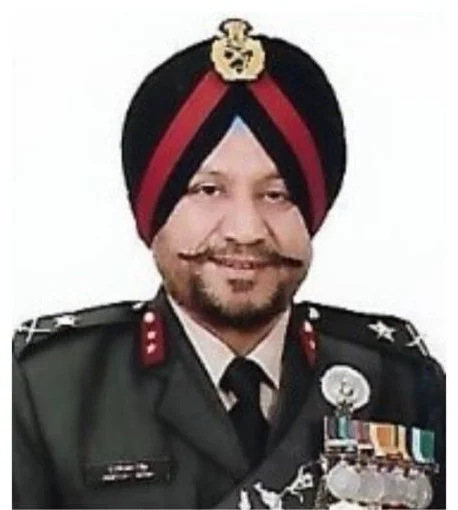
Maj Gen Harvijay Singh, SM) Senior Patron Sanjha Morcha
Jo to praym khaylan ka chaao, sir dhar talee galee mayree aao.Those who wish to play the game of love (Sikhi way of life), come to me with your head in your palm. Guru Gobind Singh
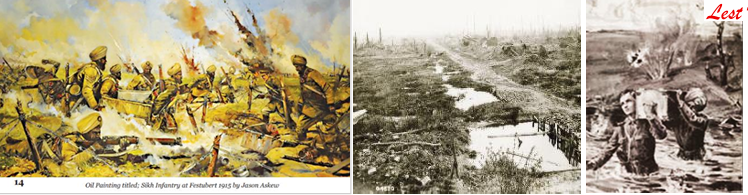
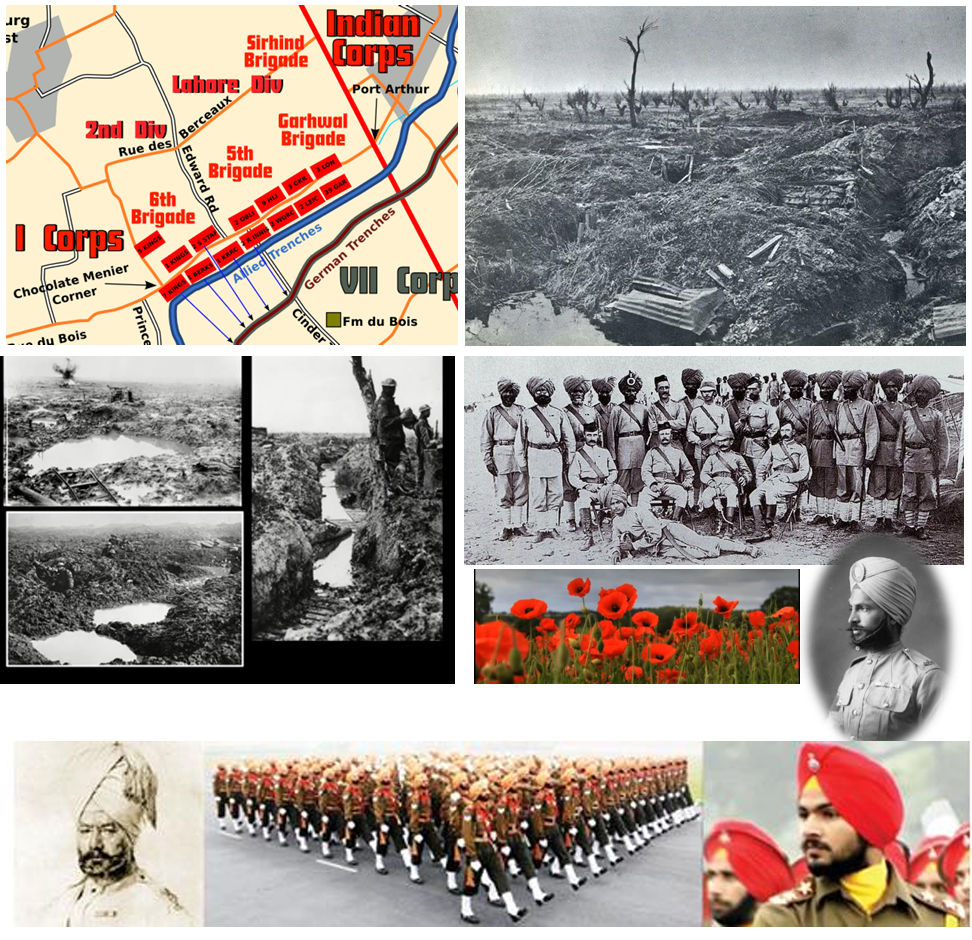
On 17 May 1915, a company of 15th SIKHs (Now 2nd Battalion, the SIKH Regiment) were in occupation of a section of a German trench. Engaged in the northern pincer of the offensive, near Richebourg l’Avoué, they were a part of the 3rd (Lahore) Division – 9th (Sirhind) Brigade Area between the two sides had been barricaded with corpses; the stench was un-bearing. Their state of ammunition was critically low. Resupply from the reserve trenches 250 yards away could enable them to hold out. British units had attempted to do so twice, on both occasions the officer in command had been killed and the party practically wiped out; a frightful situation to say the least.
Only a desperate action could save the day. Lieutenant John Smyth, 15th SIKHs, was ordered to take a bombing party. He took with him ten bombers from a crowd of volunteers. It became difficult for him to reject volunteers and finally he chose randomly perhaps looking for bigger guys who could pull the heavy load. Names of these heroes must be recalled with pride. Lance-Naik Mangal Singh, Sepoys Lal Singh, Sucha Singh, Sampuran Singh of 15th SIKHs. Sarain Singh, Sundur Singh, Ganda Singh, Harnam Singh of 19th PUNJABIs. Fateh Singh, Ujagar Singh, of 45th SIKHs. They set out with a gusty battle cry: ‘Jo Bole So Nihal, Sat Sri Akal’, ……. taking two boxes containing ninety-six bombs.
Dropping over the parapet they wriggled their way through the mud, pulling and pushing the boxes along with them. They used pagris attached to the boxes and the men in front pulled them along, over and through the dead bodies, those behind pushed. • Even before they progressed a few yards, Fateh Singh fell, severely wounded. • In another hundred yards, Sucha Singh, Ujagar Singh and Sundur Singh were shot. Extreme bravado and faith in their Guru kept the remaining six going. • They nearly reached the end, when, Sarain Singh and Sampuram Singh were shot dead. Ganda Singh, Harnam Singh and Mangal Singh were wounded.
The second box had to be abandoned. Lieutenant Smyth and Sepoy Lal Singh wriggled their way ahead yard by yard. Water around them churned by a hail of bullets, and, clambered up the far bank amongst their cheering comrades. Both were unhurt, though their clothes were perforated by bullet holes. • However, shortly afterwards Lal Singh was struck by a bullet and killed instantly. In the final count, all ten Brave Sikhs were casualties. Once again after Saragarhi all Sikh Soldiers in a detail, had fallen executing an extreme and impossible task. For them the ‘izzat’ (pride) of the regiment and devotion to duty was above any other fear and danger. So ended one of the most gallant episodes of the World War I. “Attaching their puggarees to the fronts of the boxes, the men pulled them over or through the dead bodies, all of the party lying flat on the ground.
At any moment the bombs in the boxes might have exploded, for the whole of the ground was hissing with the deluge of rifle and machine gun fire, while the air was white with the puffs from bursting shrapnel.” Page 37, Leader Newspaper (Melbourne), Saturday 31 July 1915 Lieutenant Smyth was awarded the Victoria Cross. Lance Naik Mangal Singh received the Second-Class Indian Order of Merit, while the Indian Distinguished Service Medal was conferred on all sepoys of the bombing party; another and only collective award after the epic battle of Saragarhi. Many critics have felt the Sikhs deserved higher gallantry awards; for the gallant bombers, this was never a consideration. The Indian Armed Forces stand tall among their global peers because of their rich battle-hardened heritage, high motivation and tough training. ………………Contd, because these stories must be told – Lest we Forget
The 15th Sikh Regiment of the British Indian Army – A rich legacy. Today the: 2nd Battalion, the SIKH Regiment (2 SIKH) — the direct, unbroken successor of the old 15th (Ludhiana) Sikhs. The 15th Sikhs built a formidable record across Asia and Africa: • China Expedition (1860–62) • Second Anglo-Afghan War — Ahmed Khel, Kandahar • Sudan (Mahdist War) — Suakin, Tofrek Chitral Expedition • Tirah Campaign • World War I o Western Front (France) o Egypt (Western Frontier Force) o Mesopotamia
:WWII soldier’s widow died without family pension; AFT orders lifetime arrears to daughter-in-law
The applicant’s husband, who too has since died because of cancer, approached DSC Records in 2022 to get his mother’s family pension and life time arrears (LTA) sanctioned
In an unusual case, the Armed Forces Tribunal (AFT) has granted life time arrears of family pension to the daughter-in-law of a World War II-era soldier whose widow could not be sanctioned family pension for the duration she was alive after his death.
The father-in-law of the applicant, Ram Surat was enrolled in the Indian Army as a Sepoy in 1944 and discharged from service in 1946. He later enrolled in the Defence Security Corps (DSC), where he served from 1962 to 1975.
On release from service, the soldier was granted service pension. He died in 2003 and his wife passed away in 2009. However, the pension payment order (PPO) for grant of family pension in her favour could not be issued during her lifetime due to non-receipt of the required documents.
“After the demise of soldier, it was the duty cast upon the respondents to issue PPO in favour of the wife of the late soldier for grant of family pension, but the same has not been issued for want of required documents,” the bench of Justice Suresh Kumar Gupta and Lt Gen Anil Puri observed in their order of May 6.
“However, the respondents did not make any sincere efforts to obtain the documents from the wife of the late soldier and she died in the year 2009 without getting family pension,” the bench added.
The applicant’s husband, who too has since died because of cancer, approached DSC Records in 2022 to get his mother’s family pension and life time arrears (LTA) sanctioned. The respondents claimed that the LTA certificate was received from the Treasury Officer concerned in June 2023, stating that the wife of the soldier has already been paid LTA benefits of her late husband, and hence the applicant is not entitled for payment of LTA.
This was countered by the applicant, saying that in reply to a letter from DSC Records in 2024, the Senior Treasury Officer, requesting the Records to take necessary action for releasing of family pension in respect of the soldier’s widow so that the due amount could to be paid to the next kin.
“The husband of the applicant and now the applicant have been raising the issue of family pension / LTA right from the year 2009. In 2026, the amount of LTA has still not been released in favour of the applicant. This itself shows the lackadaisical approach of the respondents in not releasing the amount of LTA in favour of the applicant, who happens to be the daughter-in-law of late soldier,” the bench remarked.
Directing the respondents to release the LTA amount within three months, the bench said that there is no other claimant except the applicant and as such, there would be no hurdle in releasing the LTA amount in favour of the applicant particularly when she is the only legal heir of the late soldier.
Pension cannot be deducted from salary if new job not linked to past military service or offers no pay protection: HC
The Delhi High Court has ruled that the amount of pension drawn by defence officers cannot be deducted from the salary paid by Central Public Sector Enterprises if the post-retirement appointment through open advertisement is not linked to past military service and no subsequent pay protection is granted.
Two retired officers, a Colonel and a Wing Commander, were selected by Engineering Projects (India) Limited (EPIL), a Central Public Sector Enterprise in 2013 through a recruitment advertisement and their pay was fixed at the minimum of the applicable pay scales and no pay protection with reference to their last drawn military pay was granted. All details about their past service and defence pension drawn were duly furnished.
In 2019, EPIL sought to deduct the defence pension drawn by them from the salary paid by the organisation and for that purpose, directed them to furnish pension particulars for refixation of pay. They challenged the action as arbitrary, unreasonable, contrary to the governing policy framework and irreconcilable with the pay fixation consciously made and acted upon by EPIL itself at the time of their appointment.
“The officers were not absorbed into EPIL from the Armed Forces or any government department, nor were they appointed on deputation or with continuation of any lien from their previous service. They responded to public advertisements, participated in an open selection process and were thereafter appointed as regular employees to civil posts,” Col Indra Sen Singh (retd) counsel for the petitioners told The Tribune.
“Pension can be deducted only where an employee receives the benefit of past service by way of pay protection or fixation at a higher stage. If pay is fixed after reckoning last pay drawn, the non-ignorable portion of pension may be deducted to prevent double benefit. However, where the employee is treated as a fresh recruit and salary is fixed at the bare minimum of the scale, there is no rationale to deduct pension,” he added.
EPIL maintained that as per departmental rules the pay of re-employed government pensioners in CPSEs is to be fixed at the minimum of the applicable scale and that pension admissible to the retired employee is to be subtracted from admissible pay. It further averred that the petitioners had failed to furnish complete pension particulars, thereby preventing proper pay fixation in accordance with the applicable policy, and payments made contrary to applicable rules can be recovered.
Observing that pension earned for past service cannot be subjected to unilateral adjustment or deduction unless the rules clearly and fairly authorise such consequence, the Bench of Justice Sanjeev Narula, in its order of May 8, held that where the employer has consciously declined to grant pay protection or any corresponding advantage, the rationale for deducting pension does not operate with force.
The Bench also pointed out that the petitioners entered EPIL through open selection and the terms of appointment did not state that the defence pension drawn by them would be subtracted from their salary. No pay protection was granted and EPIL accepted and acted upon these terms for several years and the issue regarding deduction of pension was sought to be reopened only thereafter.
Finding it ‘considerably difficult’ in accepting EPIL’s interpretation of the said rules, the Bench said that if the organisation considered the provision applicable to the petitioners, the same ought to have been applied at the stage of appointment itself, or at least within a reasonable period.
“In the absence of fraud, concealment or misrepresentation on the part of the petitioners, the provision could not remain unacted upon for years together and thereafter be invoked retrospectively to unsettle service conditions which had been consciously fixed and acted upon,” the Bench remarked. “EPIL was not justified in seeking to deduct the defence pension drawn by the Petitioners from the salary fixed and paid by EPIL,” the Bench ruled.
Soldier’s wife gets new lease of life as Army helicopter airlifts kidney from brain-dead accident victim
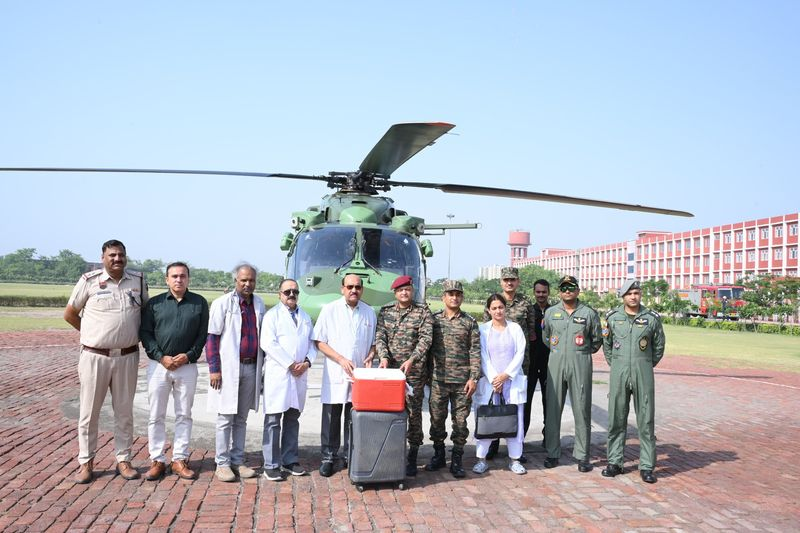
An Army Aviation helicopter executed the critical life-saving mission from Chandimandir to Rohtak and back with precision and within stringent timelines, the Western Command says
The wife of a serving soldier received a new lease of life after the Command Hospital, Chandimandir, in collaboration with the Post Graduate Institute of Medical Sciences, Rohtak, successfully facilitated the retrieval and rapid air transportation of a kidney from a brain-dead road accident victim.
An Army Aviation helicopter executed the critical life-saving mission from Chandimandir to Rohtak and back with precision and within stringent timelines, the Western Command said on Sunday.
The harvested organ was swiftly airlifted along with the medical team of Command Hospital, for an urgent transplant procedure at Chandimandir.
The successful transplant provided a new lease of life to the wife of a serving soldier, reflecting the operational efficiency, seamless civil-military coordination and humanitarian commitment of the Indian Army,” the Command said.
Command Hospital, Chandimandir, a tertiary care institution under the Western Command, is the Army’s premier organ retrieval and transplant centre and has made pioneering advancements in this field.
Earlier this month, the hospital had carried out its first heart retrieval for transplant, and in the process saved the life of a 14-year-old Sudanese boy admitted to a Delhi hospital. The organ was harvested from a 42-year-old brain-dead woman and airlifted to Delhi via a chartered flight within half an hour.
The boy was terminally ill and in the last stage of the battle for life. The hospital’s organ transplant team had also retrieved her liver, pancreas and kidneys, thereby enabling multiple recipients a new lease of life through organ donation.
In the past, Western Command Hospital has performed several organ harvesting and transplant operations, providing a new lease of life to critically ill people by harvesting kidneys, pancreas, liver, heart and cornea from brain-dead patients. It was among the first in the country to undertake pancreas transplant, said to be among the most difficult surgeries.
Organ donation was started in the Armed Forces in the late 2000s and introduced at the Western Command Hospital in 2014. The process is coordinated by the Armed Forces Organ Retrieval and Transplantation Authority in New Delhi.
Several other military hospitals across the country have also performed similar life-saving organ transplant operations.
Colonel Babu’s Maha Vir Chakra at Galwan and his regiment’s 270-year-old legacy of Bihari musketeers
During the intervening night of June 14-15 six years ago, Indian and Chinese troops clashed violently at Galwan on the Line of Actual Control (LAC) in eastern Ladakh, resulting in fatalities on both sides, including the Commanding Officer of the Sixteenth Battalion of the Bihar Regiment, Colonel Bikkumalla Santosh Babu, who was decorated posthumously with the Maha Vir Chakra, the second highest award for gallantry in the face of the enemy.
The battalion was deployed in Galwan during Operation Snow Leopard following the protracted stand-off between India and China that began in the Spring of 2020 and has still not been fully resolved. It was tasked to establish an observation post opposite Chinese positions.
According to the citation for his award, while holding the position, his column faced stiff resistance from the adversary who attacked using lethal and sharp weapons along with heavy stone pelting from adjoining heights. Undaunted by the violent and aggressive action by the overwhelming strength of the enemy soldiers, the officer continued to resist the enemy’s attempt to push back Indian troops.
Despite being grievously injured, Colonel Bikkumalla Santosh Babu led from the front with absolute command and control despite hostile conditions to deter the vicious enemy attack on his position. In the skirmish that broke out and ensuing hand-to-hand combat with enemy soldiers, he valiantly resisted the enemy attack till his last breath, inspiring and motivating his troops to hold ground,” the citation states. Displaying exemplary leadership and astute professionalism, he showed conspicuous bravery in the face of the enemy and made the supreme sacrifice for the nation.
It was after two decades that a Maha Vir Chakra (MVC) was conferred for actions on the battlefield. In fact, the last MVC to be awarded was also to an officer serving with the Bihar Regiment, which was announced in 2000.
As part of Operation Vijay during the 1999 Kargil conflict, Captain Gurjinder Singh Suri, commissioned in the Army Ordnance Corps but was serving as the Ghatak platoon commander with 12 Bihar, was killed in a gun battle in the Uri sector in November 1999 when Pakistani army attacked the Faulad Post.
After the attack was repulsed, the platoon was clearing bunkers during which he killed two enemy soldiers and silenced a machine gun. In the process, he received a burst in his left arm but continuing with the task lobbed two hand grenades into a bunker killing another soldier. At this point, he was hit by an enemy rocket-propelled grenade critically wounding him.
Skilled musketeers of yore
Though amongst the Indian Army’s youngest Infantry Regiments, having been raised in its present form in 1941, its troops trace their martial lineage to 1757, when the 34th Sepoy Battalion was raised at Patna by Lord Robert Clive, the first British Governor of the Bengal Presidency and architect of the East India Company.
Barring the Parachute Regiment that was formed in 1945, the Bihar Regiment is among the last three Infantry Regiments to have been raised as part of the erstwhile by the British Indian Army. In 1941, amidst the Second World War, three infantry regiments came into being – the Assam Regiment in June 1941, the Bihar Regiment in September 1941 and the Mahar Regiment in October 1941.
The Sepoy Battalion was formed by men from only from the Bhojpur region of Bihar and subsequent battalions expanded their recruitment base across the entire Shahabad area that comprises present day districts of Bhojpur, Buxar, Rohtas and Kaimur.
According to the Indian Army’s official website detailing infantry regiments, their success in combat had impressed the local ruler, Mir Kasim, to begin raising units trained in western combat techniques. The Bihari battalions raised by Mir Kasim had not only done well, but also beaten the British in some engagements.
The Bihari or ‘Poorbia’ soldiers as they came to be called because they hailed from the eastern Ganga plains, thereafter continued to be the backbone of the Bengal Infantry of the British, emerging as disciplined soldiers and quick to learn and apply the tactical drills and field craft with initiative.
An essay contained in the book, ‘India’s Princely States: People, Princes and Colonialism’, states that over time, Purbias had emerged as a community of specialist musketeers in context of Malwa armies and rulers in Malwa were keen to enlist Poorbias for the expertise in firearms possessed by them in order to update their military technology.
1857 War of Independence and beyond
As part of the Bengal Native Infantry that comprised personnel from Awadh and Bihar regions, Bihari troops played a significant role in the First War of Independence, 1857, which the British also refer to as the Sepoy Mutiny. In March 1857, at Barrackpore near Calcutta, Sepoy Mangal Pandey of the 34th Bengal Native Infantry, who hailed from Ballia in eastern Uttar Pradesh, attacked British officers, and in May 1857, the war began in earnest from the Meerut garrison. Thereafter, Biharis were not encouraged by the British to join the military until after the First World War.
In 1923, an Indian Territorial Force Battalion, the 11th (Territorial) Battalion of the 19th Hyderabad Regiment (11/19HR), was formed with its headquarters at Danapore Cantonment. The Bihar Regiment was formed in 1941 by regularising 11/19HR and christening it as the First Battalion of the Bihar Regiment.
The newly raised battalion saw action in the Burma Campaign of World War – II, and as part of the Lushai Brigade and captured Haka in October 1944 and Gangaw in January 1945. For its actions, the battalion was awarded two Battle Honours – Haka and Gangaw, and bestowed the Theatre Honour Burma. The Second Battalion, raised in December 1942 participated in Operation Zipper for recapturing British Malaya. A third battalion was raised in 1945.
The Regiment’s first post-Independence raising was in 1960 and at present it has 20 regular battalions, four Rashtriya Rifles battalions and two Territorial Army battalions that draw their manpower from the states of Bihar, Jharkhand, Uttar Pradesh and some pockets of Odisha and West Bengal.
Post-Independence, the Regiment has participated in every war and major operation, including Kargil where it was awarded a Theatre Honour, as well as overseas in Sri Lanka and UN peacekeeping missions. Its roll of honour includes four Ashok Chakra, the highest civilian gallantry award and three Maha Vir Chakra.
State Stalwarts
DEFENCE MINISTER
Minister Rajnath Singh
ALL HUMANS ARE ONE CREATED BY GOD
HINDUS,MUSLIMS,SIKHS.ISAI SAB HAI BHAI BHAI
CHIEF PATRON ALL INDIA SANJHA MORCHA
LT GEN JASBIR SINGH DHALIWAL, DOGRA
SENIOR PATRON ALL INDIA SANJHA MORCHA
MAJOR GEN HARVIJAY SINGH, SENA MEDAL ,corps of signals
.
.
PATRON ALL INDIA SANJHA MORCHA
MAJ GEN RAMINDER GURAYA ,MADRAS REGIMENT
sanjhamorcha303@gmail.com
PRESIDENT SOUTH ALL INDIA SANJHA MORCHA
COL SS RAJAN BOMBAY SAPPERS,
PRESIDENT UTTARAKHAND ALL INDIA SANJHA MORCHA
COL B M THAPA ,BENGAL SAPPERSS
PRESIDENT HARAYANA STATE CUM COORDINATOR ESM
BRIG DALJIT THUKRAL ,BENGAL SAPPERS
PRESIDENT TRICITY
COL B S BRAR (BHUPI BRAR)
PRESIDENT CHANDIGARH ZONE
COL SHANJIT SINGH BHULLAR
.
.
PRESIDENT PANCHKULA ZONE AND ZIRAKPUR
COL SWARAN SINGH
INDIAN DEFENCE FORCES
DEFENCE FORCES INTEGRATED LOGO
INDIAN AIR FORCE
Air Officer C-in-C WESTERN AIR COMMAND
AIR MSHL S PRABHAKARAN AVSM VM
AOC-IN-C, EASTERN AIR COMMAND
Air Marshal Inderpal Singh Walia
AOC-in-C SOUTH WESTERN AIR COMMAND
Air Marshal Vikram Singh
AOC-IN-C, SOUTHERN AIR COMMAND
Air Marshal J.Chalapati
AOC-IN-C TRAINING COMMAND
AIR MARSHAL SK GHOTIA VSM
AOC-IN-C MAINTENANCE COMMAND
Air Marshal Jagdish Chandra
Flag Officer Commanding in Chief, Western Naval Command
ice Admiral R Hari Kumar, PVSM, AVSM, VSM
Flag Officer Commanding in Chief, Eastern Naval Command
Vice Admiral Sanjay Bhalla, AVSM, NM
Flag Officer Commanding in Chief, Southern Naval Command