



Sanjha Morcha

Israel delays release of Palestinian prisoners, citing ‘humiliating’ handovers of hostages 

The statement by Prime Minister Benjamin Netanyahu’s office came early Sunday as vehicles apparently carrying prisoners left the open gates of Ofer prison, only to turn around and go back in

Israel says the release of hundreds of Palestinian prisoners is delayed “until the release of the next hostages has been assured, and without the humiliating ceremonies” at handovers of Israeli captives in Gaza.

The statement by Prime Minister Benjamin Netanyahu’s office came early Sunday as vehicles apparently carrying prisoners left the open gates of Ofer prison, only to turn around and go back in.

The release of 620 Palestinian prisoners had been delayed for several hours and was meant to occur just after six Israeli hostages were released on Saturday. It was meant to be the largest one-day prisoner release in the Gaza ceasefire’s first phase.

Five of the six hostages freed Saturday were escorted by masked, armed militants in front of a crowd — a display that the UN and others have criticised as cruel after previous handovers.

Omer Shem Tov, another hostage, reacts as he is reunited with his family. Photo: Reuters

The Israeli statement cited “ceremonies that demean the dignity of our hostages and the cynical use of the hostages for propaganda purposes”. It was likely a reference to a Hamas video showing two hostages who have yet to be released watching a handover in Gaza on Saturday and speaking under duress.

Hamas had released the last six living hostages expected under the ceasefire’s first phase, with a week remaining in the initial stage.

Israel’s announcement abruptly put the future of the truce into further doubt.

Freed were three Israeli men seized from the Nova music festival and another taken while visiting family in southern Israel during the Hamas-led October 7, 2023, attack that triggered the 16-month war in Gaza. The two others were held for a decade after entering Gaza on their own.

Five were handed over in staged ceremonies that the Red Cross and Israel have condemned as cruel and disrespectful.

Omer Wenkert, Omer Shem Tov and Eliya Cohen were posed alongside Hamas fighters. A beaming Shem Tov, acting under duress, kissed two militants on the head and blew kisses to the crowd. They wore fake army uniforms, though they were not soldiers when abducted.

Cohen’s family and friends in Israel chanted “Eliya! Eliya! Eliya!” and cheered.

“You’re heroes,” Shem Tov told his parents as they later embraced, laughing and crying. “You have no idea how much I dreamt of you.” His father, Malki Shem Tov, told public broadcaster Kan his son was held alone after the first 50 days and lost 17 kilograms (37 pounds).

Earlier Saturday, Tal Shoham, 40, and Avera Mengistu, 38, were freed. Mengistu, an Ethiopian-Israeli, entered Gaza in 2014. His family told Israeli media he has struggled with mental health issues. The Israeli-Austrian Shoham was taken from Kibbutz Be’eri. His wife and two children were freed in a 2023 exchange.

Later, Israel’s military said Hisham Al-Sayed, 36, was released. The Bedouin Israeli entered Gaza in 2015. His family has told Israeli media he was previously diagnosed with schizophrenia.

Israel’s government didn’t respond to questions about the delay in releasing prisoners. Hamas accused Israel of violating the ceasefire deal, with spokesperson Abdel Latif Al-Qanou accusing Israeli Prime Minister Benjamin Netanyahu of “deliberately stalling”.

The hostage release followed a heartrending dispute when Hamas on Thursday handed over the wrong body for Shiri Bibas, an Israeli mother abducted with her two young boys. The remains were determined to be those of a Palestinian woman. Netanyahu vowed revenge for “a cruel and malicious violation”. Hamas suggested it was a mistake.

Israeli forensic authorities confirmed a body handed over on Friday was Bibas. Dr. Chen Kugel, head of the National Institute of Forensic Medicine, said they found no evidence Bibas and her children were killed in an Israeli airstrike, as Hamas has claimed. Kugel did not give a cause.

Hamas denied the Israeli military claim, based on forensic evidence and unspecified “intelligence”, that its militants killed the children “with their bare hands”, calling it a lie aimed at justifying Israeli military actions against civilians in Gaza.

The ceasefire deal has paused the deadliest and most devastating fighting ever between Israel and Hamas, but there are fears the war will resume.

Hamas has said it will release four bodies next week, completing the truce’s first phase. After that, Hamas will hold over 60 hostages — about half believed to be alive.

Talks on the ceasefire’s second phase are yet to start, but negotiations are likely to be more difficult.

Hamas has said it won’t release the remaining captives without a lasting ceasefire and full Israeli withdrawal from Gaza.

An Israeli official said Netanyahu would meet with security advisers on Saturday evening about the ceasefire’s future, focusing “on the goal of returning all our hostages, alive and dead”. The official spoke on condition of anonymity because the meeting had not been formally announced.

Wenkert, Cohen, Shoham and Shem Tov had an “extremely difficult period in captivity”, the Beilinson hospital said, but it did not give details at the families’ request.

Niva Wenkert, Omer’s mother, told Israel’s Channel 12 that “on the surface, he looks OK, but there’s no telling what’s inside”.

Families and others rallied again Saturday night in Tel Aviv to pressure Netanyahu’s government for a deal.

Hamas later released a video showing two hostages still held, Evyatar David and Guy Gilboa Dallal, as they sat in a vehicle and spoke under duress at the handover for Shem Tov, Cohen and Wenkert. A group representing hostages’ families called the video “sickening”.

The 620 Palestinian prisoners meant to be freed include 151 serving life or other sentences for attacks against Israelis. Almost 100 would be deported, according to the Palestinian prisoners’ media office.

Also meant to be released are 445 men, 23 children aged 15 to 19, and a woman, all seized by Israeli troops in Gaza without charge during the war.
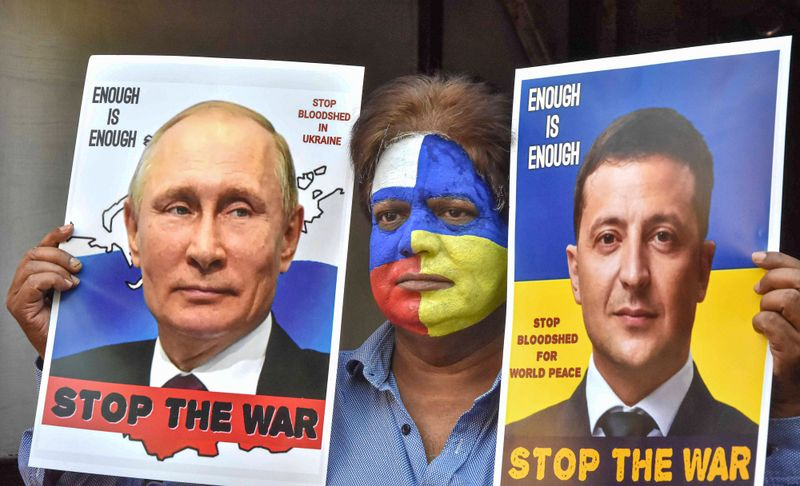

This war is no longer about Ukraine

The debate has shifted away from the minutiae of settlement terms to the global chessboard

THREE years and counting — this is what we might have possibly said of Russia’s conflict with Ukraine. But today, we may need to count no more. If this sounds too good to be true, it is. The big story on the third anniversary of the war is not the untold death and destruction, not the imminent collapse of the Ukrainian forces and not the rupture of Europe’s relations with Russia. It is the arrival onto the diplomatic stage of the President of the United States, Donald Trump, with his determination to bring the war to an immediate end. President Trump is set to succeed, not because he says so but because the adversary is saying so. Russia is ready for closure.

For India, and for most of the world, there could not be better news. India, for a very good reason, has been on the side of peace and has always wanted the conflict to end on the negotiating table. Not everyone is happy. The Munich Security Conference has been a celebration of the trans-Atlantic alliance. Its 2025 edition could well have been its funeral ceremony. The blunt admonition of Europe by US Vice-President JD Vance was the forerunner to even more dramatic events that followed. The US and Russia met face to face soon thereafter and in a historic breakthrough have set the ball rolling for an early summit meeting between their Presidents, and resetting the relationship. Ukraine will only be one piece of this reset.

Few would have imagined this turn of events. If Russia’s invasion in 2022 was a geopolitical shock, the manner in which the war is being steered to an end is no less disruptive.

Trump’s diplomatic blitzkrieg has not happened in a vacuum. Apart from domestic causes within the US, it has come against the backdrop of a growing sense of frustration, despair and fatigue in Europe over the war. Europe’s political institutions and its economy have not measured up to the challenge. The war has taken a heavy toll on the European project. Today, Europe is seething, bitter, divided and feeling let down. Trump has succeeded in convincing US voters that Europeans have become free riders. Europe is thus faced with its biggest crisis since the end of the Cold War.


Ukraine, and specifically President Zelenskyy, has been accused by Trump and Elon Musk of not only not avoiding the war, but of even causing it. The tables have been turned. Yesterday’s allies are today’s detractors. Ukraine’s existence as a functional state is under question. It is on the brink of defeat with 20 per cent of its territory under Russian occupation and 60 per cent of its energy infrastructure damaged.

On the Russian side, 30,000-35,000 troops are estimated to have been killed every month. According to British Defence Ministry sources, the war has led to 700,000 Russian casualties, the loss of 19,000 pieces of equipment and 9,000 tanks and APCs (armoured personnel carriers), giving it the epithet of a ‘meat grinder’. In this war of attrition, Russia has won on the battlefield but at a high human cost and reputational damage. Even if not evident in the immediate term, sweeping sanctions have squeezed its economic choices.

The debate has shifted away from the minutiae of the terms of a settlement over Ukraine to the global chessboard. How far will the new version of US-Russia detente go? What will be its terms? And what impact will it have on the global order as we know it? A grand bargain is in the offing, reminiscent of the Ronald Reagan-Gorbachev moment. A new post-1991 architecture will be created to accommodate Russia’s security interests in Europe, but with a deeply divided Europe. US and European approaches to Russia are set to diverge, and even within Europe, there are sharp differences. If Russia wants to build on the new opportunity that President Trump is offering it, and address European fears, it will have to make compromises and give concessions. Signals coming so far indicate that this is indeed the likely trajectory.

The US is going it alone. Europe is watching and is a straggler, left to its own devices. It will find a ready and willing partner in India to provide strategic succour, as it discovers the imperative of exercising its strategic autonomy. This could well be a transformative moment for India-Europe relations. Similarly, with the imminence of rehabilitation and return of Russia into the international fold, the shackles that held back the growth of normal India-Russia relations will be broken. There is a lot of slack and lost ground to be recovered.

The push factors that drove Russia’s unnatural and involuntary dependence on China will reduce drastically. Russia, too, will pursue its own version of strategic autonomy vis-à-vis China, and engage in self-correction. This will be both voluntary and also part of the grand bargain that President Trump will enforce on Russia. All told, hard alliances will loosen and major actors will exercise freedom of action not seen before. The geopolitical playing field is poised to open up. The Global South will heave a sigh of relief as it will not have to look over its shoulders as it pursues its foreign policy interests.

The elephant in the room is China. If it is Russia today, it will be China tomorrow. The next stop on the Trumpian caravan is China, and the latter is ready and waiting. China is already watching how its close partner, Russia, is being weaned away to greener pastures. The US-China relationship can go in many directions. It is today the most complex and most consequential relationship in the world, and because of this, it is unlikely to swing from one extreme to another. Yet, China is the force that drives President Trump’s project to make America great again and restore its global glory.


All of this is good for India. The idea of strategic autonomy is getting mainstreamed. A world that is not divided into alliances is what India has been arguing for. This is the stepping stone towards multipolarity. The question is how democratic the new order will be, or whether it will settle into only a latter-day concert of major powers.

Thus, on the third anniversary of the Ukraine war, it is not about Ukraine!


NEGOTIATING PEACE WITH RARE EARTH MINERALS-Maj Gen Harvijay Singh, SM


Give the US 50% ownership of Ukraine’s rare earths in exchange for US investment in Ukraine. US Treasury
Secretary Scott Bessent to Volodymyr Zelensky.
The United States has threatened to cut off Ukraine’s access to Starlink satellite internet terminals if Kyiv does
not reach a deal with the US regarding critical mineral resources, Reuters reported on 21 Feb, citing three
sources familiar with the negotiations.
Undoubtedly, this is modern-day Economic Colonization; an example of Geoeconomics – Nations will
compete for control of valuable natural resources like oil, gas, and rare earth minerals, which can shape their
own geopolitical power.
The United States is particularly interested in Ukraine’s reserves of rare earth minerals which are crucial for
modern electronics, batteries, and other cutting-edge technologies. Some of the key minerals include
tantalum, beryllium, niobium, titanium and lithium. These are extensively used in semiconductors, electric
vehicles, brake on jet aircraft and defence technologies.
Most of the world’s supply and production of rare earth minerals comes from China, which is
increasingly cracking down on exports; unlike others, China has a strong counter to the United States trade
restriction. The US has them (rare earth minerals), but not in the quantities that they need – hence their sinister
plan in Ukraine.
Ukraine has about 5% of the world’s total reserves of critical rare earth materials – largely untapped reserves of
tantalum, beryllium and niobium. Estimated at more than 2.6 billion tons and worth up to $14.5 trillion.
Ukraine initially rejected the offer but behind the scenes arm twisting has continued. Several of Zelensky’s
aides have encouraged him to sign the updated proposal to avoid a further clash.
Now, here is a twist: some 70 % of Ukraine’s trove of the rare earth mineral resources are located in the regions
of Donetsk, Dnipropetrovsk and Luhansk – Russia controls most of it. The question is – how will the USA be able
to access the deposits?
The next twist has been shaped by the capture of Russian territory in the Kursk region by Ukrainian forces
which is likely to have a significant impact on the peace talks – now likely to be brokered by the US. The
incursion has disrupted Russia’s ability to dictate the peace terms and has strengthened Ukraine’s (now also by
proxy, the US) position. Ukraine sees it as an opportunity for the return of entire Ukrainian territory occupied by
Russia. Geopolitically, Russia is not in a position of returning any inch of the occupied territory. Therefore ……..
will the US offer to Russia to make East Ukraine (Donbass) territory captured by Russia as ‘Global Territory’ –
like Gaza with the goal of redeveloping Gaza Donbass into a prosperous region.
Sorry that will not be ‘Global Territory’ but ‘Bi- Superpowers Territory’ who will control the mining of rare earth
minerals and share the spoils ……… A very Geoeconomic end to the Ukraine war ……. USA and Russia the
winners and Ukraine and Europe left dazed and bewildered.
Putin would be regretting losing territory in Kursk; problem with loosing territory is – it seeds the ambitions of
others – Putin does lose a fair bit byte bite of bargaining power if Kursk is on the negotiation table. But the scales
appear to be tilting in favour of Trump who has said that both Russia and Ukraine must make concessions.
Grey Zone Warfare is passé; such open threats amounting to an escalation which goes a step beyond the grey
cloak of the Grey Zone Warfare will lead to a modern form of Neo Colonization.
In the lighter vein; as the landscape of conflict evolves, new terminologies and definitions will emerge to
capture the nuances of this form of warfare.

Comments by writers Ex- GOC, Maj Gen Kuldip Sindhu

What’s going on is akin to a bunch of school kids having a spat – pathetic show at intn’l level. Doland is the kid bully on the block, and EM his sidekick. VZ is trying to put up a brave face, but will be knocked down.

Fight was never over Ukr’s independence/democracy – but always abt its granary, biochem research & Rare Earth Minerals in the Mariulpol belt.

Now Doland wants his £ of flesh. REM for $500 bn aid given – figure highly inflated. Let’s hope the US is once again mired on frgn shores; it must be start of the end of Pax Americana👊


Made In India Sniper Rifle By Bangalore-Based SSS Defence Outshines Foreign Competitors In National Competition

In a significant achievement for India’s defence manufacturing sector, the National Security Guard (NSG) has won the sniper category in the All India Police Commando Competition using an indigenous sniper rifle. The .338 Saber sniper rifle, designed and manufactured by Bangalore-based SSS Defence, outperformed top international competitors, including the renowned American Barrett 50 Cal rifle used by Force One of Maharashtra Police.

The Saber .338 sniper rifle, has achieved a significant milestone by outperforming some of the world’s best sniper rifles in the All India Police Commando Competition.

The Barrett 50 Cal is a highly regarded anti-materiel and sniper rifle known for its power and accuracy. It is widely used by US Special Forces and has been procured by the Indian Army to enhance firepower along sensitive borders like the Line of Control (LoC).

Last year, Force One emerged victorious in this competition but finished second this time behind NSG’s impressive performance with an indigenous rifle. This highlights both their skill and reliance on high-quality foreign equipment.

This victory highlights the capabilities of Indian defence manufacturers, as an indigenously produced sniper rifle surpassed a renowned American counterpart in a high-level competition.

The Saber .338 sniper rifle, developed by SSS Defence, is a significant achievement in India’s indigenous defence manufacturing sector. It is the only domestically designed and manufactured sniper rifle in the prestigious .338 Lapua Magnum calibre, known for its long-range precision capabilities.

The SSS Defence Saber .338 is a high-performance sniper rifle designed and manufactured in India, chambered for the .338 Lapua Magnum cartridge. This bolt-action rifle is engineered to engage targets effectively at distances up to 1500 meters and beyond, making it an ideal tool for military and law enforcement units requiring long-range precision capabilities.

The Saber features a heavy, free-floating barrel available in lengths of 24, 26, or 27 inches with a right-hand twist of 1:11.25″, contributing to its sub-Minute of Angle (MoA) accuracy when used with match-grade ammunition. The rifle’s ambidextrous chassis includes a foldable rear stock, adjustable cheek piece, and length of pull adjustments to accommodate shooters of varying builds.

In terms of design flexibility, the Saber offers a compact configuration mode that allows operatives to quickly adapt to different operational environments. It includes a full rail fore-end with accessory mounting points at multiple positions for attaching various optics or accessories. The rifle comes with detachable box magazines available in five-round and ten-round variants. Its receiver system is made from aluminium alloy with cerakote and black oxide coatings for durability.

The SSS Defence Saber has gained international recognition by securing export orders from foreign nations while also being considered by the Indian Army as part of their sniper rifle requirements. Recently, it was successfully used by India’s National Security Guard (NSG) during the All India Police Commando Competition where it outperformed other top-tier sniper rifles like the Barrett .50 Calibre used by some forces.

Competition Highlights

The NSG emerged victorious against elite commando teams from central and state forces.

Force One secured second place using the American Barrett 50 Cal calibre sniper rifle.

This victory marks a milestone for India’s indigenous defence manufacturing capabilities under the Atmanirbhar Bharat initiative. It also highlights that India is now exporting its weapons internationally; SSS Defence has already sold these rifles to another country.

Organiser


Indian Army Contingent Departs For India-Japan Joint Military Exercise Dharma Guardian

An Indian Army contingent of 120 personnel has departed for Japan to participate in the 6th edition of the India-Japan Joint Military Exercise “Dharma Guardian”. This exercise is scheduled to take place from February 24 to March 9, 2025.

The Indian contingent will be represented mainly by troops from a battalion of the MADRAS Regiment, along with troops from other arms and services. The Japanese side will be represented by the 34th Infantry Regiment of the Japan Ground Self Defence Force (JGSDF).

The aim of Exercise Dharma Guardian is to enhance interoperability between the two forces while undertaking joint urban warfare and counter-terrorism operations under UN mandate.

It focuses on high physical fitness, joint planning, and tactical drills, including disaster response strategies. This exercise reinforces bilateral defence cooperation between India and Japan, promoting regional security and stability in line with their shared vision for a free, open, and inclusive Indo-Pacific.

Exercise Dharma Guardian is an annual event conducted alternately in India and Japan. The previous edition was held in Rajasthan during February-March 2024.

ANI


First Indian Navy Training Squadron Arrives In Vietnam

The first Indian Navy training squadron arrived at Cam Ranh Bay, Vietnam, on February 20, 2025. The squadron consists of ships INS Tir and ICGS Veera, although some reports also mention INS Sujata as part of the visit.

This visit aims to strengthen maritime cooperation and interoperability between India and Vietnam through various interactions, including cross-training visits, professional discussions, community programs, and a trip to the Vietnam Naval Academy.

The visit will conclude with bilateral naval exercises between the Indian Navy and the Vietnam People’s Navy and Coast Guard. These exercises are designed to enhance interoperability and exchange best practices between the two navies. This deployment aligns with India’s broader initiative under its Security And Growth for All in the Region (SAGAR) vision to enhance regional maritime security.

India and Vietnam have a strong strategic partnership that was further strengthened during a recent visit by Vietnam’s Prime Minister to India in August 2024. This naval visit reinforces closer maritime cooperation between both nations.

Agencies


Jammu And Kashmir: Will the Line of Control Ceasefire Endure?

Escalating Violence Levels

by Nilesh Kunwar

While there was never any doubt that Rawalpindi is continuing with its proxy war in J&K, recent events indicate a planned escalation in terrorist activities, both in terms of scope and intensity. On the intervening night of February 4/5, an intended terrorist attack in the Krishna Ghati (KG) Sector of J&K’s Poonch district failed when a landmine explosion caused an unspecified number of casualties to members of Pakistan army’s ‘Border Action Team’ (BAT) comprising regular soldiers and terrorists while they were attempting to cross the Line of Control (LoC).

On February 10, an Indian army soldier in the Nowshera Sector of J&K’s Rajauri district sustained gunshot injuries due to firing from across the LoC. The next day, an Indian army officer and a soldier who were part of a patrol along the LoC in Akhnoor district of J&K were killed in an improvised explosive device (IED) blast. Just a day later, Pakistani troops violated the ceasefire agreement by carrying out unprovoked firing on Indian army posts in KG Sector, which evoked a befitting response from the Indian side. Though neither side mentioned anything about this incident, the Pakistan army has (according to reliable sources), suffered significant losses.

On February 14, an Indian army soldier was injured in the Battal area of Akhnoor district due to sniper fire from across the LoC. Two days later, an India army post came under fire in Gulpur Sector of Poonch district from a forested area across the LoC but there were no casualties. Retaliation by the Indian army to this provocative act though short was both intense and appears to be effective as the Pakistan army hasn’t indulged in similar antics again.

The discovery of two powerful IEDs in Shopian and Pulwama districts of South Kashmir on Tuesday isn’t a mere coincidence. It explicitly points at a deliberate effort by the Pakistan army’s spy agency Inter Services Intelligence (ISI), which is masterminding terrorism in J&K in attempting to intensify terrorist violence levels in the hinterland by causing multiple casualties to Indian security forces through use of IEDs. The prevailing situation also increases the likelihood of similar actions like ambushes and attacks on isolated posts.

Besides escalating violence levels, it appears that ISI has also directed its sponsored terrorists in J&K to create an environment of abnormality in the hinterland by terrorising locals. This is evident from the fact that on February 3, terrorists shot dead a retired army soldier and injured his wife and niece in Kulgam district of South Kashmir. On February 16, bodies of two locals who had been strangulated were found in Kathua district, and given the absence of any plausible motive and considering the unusual nature of this twin murder, the authorities haven’t ruled out the possibility of this heinous crime being the handiwork of terrorists.

Pakistan army chief Gen Syed Asim Munir’s reckless and provocative announcement expressing his willingness to fight 10 more wars for Kashmir, though amusing, should not be disregarded as a joke. His emotional outburst that stems from the Pakistan army’s repeated failures to wrest control of J&K nevertheless provides a valuable insight into the fossilised mindset of the Pakistan army and its obdurate belief that the Kashmir issue can only be resolved through the military option. This revelation should serve as an eye-opener to all those on both sides of the Radcliffe Line who harbour the grand ‘aman ki asha’ (Hope for peace) delusion.

Rawalpindi’s Pathetic Defence

On February 14, reports appeared in Pakistani media which quoted “security sources” mentioning that “the Indian military has a long history of unprovoked firing and subversive actions against unarmed civilians along the LoC,” and alleging that “India has been attempting sabotage operations by transporting and deploying IEDs along the LoC.” Claiming that “Evidence reveals that since 2016, India has planted IEDs in 54 separate incidents along the LoC,” this report claims that “Between February 4 and 6, four Indian IEDs were discovered in the Battal Sector and Rawalakot” and mentions a ceasefire violation by Indian army on February 12.

The timing of release as well as the contents of this news report appear to be more of a justification of the Pakistan army’s recent provocative actions along the LoC rather than a fair account of events. Furthermore, by accusing the Indian army for every conceivable crime ranging from false flag operations, fake encounters, smuggling of narcotics and weapons to creating unrest in Pakistan occupied Jammu and Kashmir (PoJK) to “drive a wedge between the public and the military,” the information purportedly provided by unnamed “security sources” reeks of raw propaganda.

The most intriguing part of the report in Pakistani media is the assertion that “Pakistan has also provided evidence of these subversive activities to UN officials stationed in these regions.” The charter of the UN Military Observer Group in India and Pakistan (UNMOGIP) includes investigation of ceasefire complaints and submitting its findings to each party and the UN Secretary General. Hence, if Rawalpindi had indeed provided reliable evidence of the wide array of allegations that it has levelled against the Indian army, UNMOGIP/ the UN would have definitely put New Delhi in the dock.

However, since nothing of this sort has happened, it’s apparent that the so-called evidence that Islamabad claims to have shared with UNMOGIP lacked credibility and hence no action was taken on the same. But then, this isn’t something new. Readers would recall that in May 2017, Pakistan army’s media wing Inter Services Public Relations (ISPR) had accused the Indian army of having targeted a UNMOGIP vehicle in PoJK but had to face severe embarrassment when UN Secretary General’s spokesperson bluntly called out Rawalpindi’s bluff by stating “There is no evidence that the UNMOGIP military observers were targeted by the gunfire.”

Will the LoC Ceasefire Hold?

With Pakistan army’s growing belligerence evident from its frequent LoC ceasefire violations and Gen Munir talking about waging 10 wars for Kashmir, many rightly wonder whether the LoC ceasefire will endure. While it’s difficult to predict Rawalpindi’s thought process as it sometimes defies logic, a brief background to how the LoC ceasefire came into effect would certainly help in finding the answer.

The LoC ceasefire proposal was first mooted in Aug 2003 by the then Pakistan President Gen Pervez Musharraf and its prompt reciprocation by New Delhi saw the formal declaration of ceasefire three months later, and despite intermittent spells of cross-LoC firing, the ceasefire has thankfully held out. However, while many may credit Gen Musharraf and the Pakistan army for ushering peace along the LoC out of pure goodwill and even perceive this development as Rawalpindi’s willingness to maintain peace and tranquillity, this inference is absolutely incorrect.

It’s no secret that the Pakistan army revelled in cross-LoC firing till the eighties because permission for the Indian army to retaliate was a tedious process inextricably mired in red tape. Those who had then served on the LoC would recall the staple “Your orders to fire come from New Delhi while we carry the order to fire in our pockets” taunt frequently hurled by Pakistani officers and even soldiers. Luckily, things have since changed and the Indian army is now permitted to undertake immediate and appropriate retaliatory actions.

With this development, the Pakistan army realised that it was at the receiving end. Proof of this lies in the fact that Rawalpindi has consistently refused to disclose details of casualties suffered due to retaliation by the Indian army. In June 2017, the Nawaz Sharif government informed the Senate that Rawalpindi was refusing to disclose details of the fatalities of its rank and file along the LoC citing “national security” concerns and more so because “it didn’t want to show the enemy how many of our soldiers have been martyred.”

Doesn’t this desperate attempt to conceal facts conclusively prove that the Pakistan army has been suffering inordinately high fatalities due to Indian army’s retaliatory fire? Hence, it’s obvious that Gen Musharraf’s 2003 ceasefire offer was an unavoidable compulsion arising from its exceedingly high attrition rates and not due to a genuine desire for peace.

Accordingly, even though domestic compulsions are currently compelling it to take provocative actions along the LoC, Rawalpindi knows very well that continuing this misadventure will extract a heavy price in terms of soldier fatalities. Hence, despite heightened tensions, the ceasefire is likely to endure.

The Indian army must therefore ensure that it continues to deal with any ceasefire violations as well as false flag operations like BAT raids and IED attacks orchestrated by the Pakistan army, immediately and with full force, because unfortunately, this is the only language that Rawalpindi understands!

Nilesh Kunwar is a retired Indian Army Officer who has served in Jammu & Kashmir, Assam, Nagaland and Manipur. He is a keen ‘Kashmir-Watcher,’ and after retirement is pursuing his favourite hobby of writing for newspapers, journals and think-tanks. Views expressed above are the author’s own


ACE Ltd Secures ₹420 Crore Defence Contract, Strengthening India’s Indigenous Manufacturing

Action Construction Equipment Ltd (ACE) has secured a significant contract worth ₹420 Crores from the Ministry of Defence to supply 1,121 Rough Terrain Fork Lift Trucks (RTFLTs). This order accounts for 60% of the total procurement of 1,868 RTFLTs intended for use by the Indian Army, Navy, and Air Force. The contract highlights ACE’s expertise in specialized cranes and material handling equipment, reinforcing its leadership in these sectors.

Contract Value: ₹420 Crores for supplying 1,121 RTFLTs.

Share of Total Procurement: ACE secured a dominant 60% share of the total order.

Defence Application: The RTFLTs will enhance combat readiness and logistical efficiency across all three branches of India’s armed forces.

Strategic Importance: Supports India’s ‘Make in India’ and ‘Aatmanirbhar Bharat’ initiatives by promoting indigenous manufacturing.

Impact On Indigenous Manufacturing

This milestone underscores ACE’s technological capabilities and robust R&D efforts. By contributing significantly to India’s self-reliance in defence manufacturing, ACE reinforces its position as a key player in enhancing national defence infrastructure. The project aligns with government policies aimed at boosting domestic production through initiatives like ‘Aatmanirbhar Bharat’.

The procurement is expected to generate employment opportunities both directly and indirectly by supporting Micro, Small, and Medium Enterprises (MSMEs) involved in component manufacturing`. This aligns with broader economic goals focused on empowering indigenous industries.

This contract marks a significant step forward for ACE Ltd., solidifying its role as a leader in specialised equipment while bolstering India’s push towards self-sufficiency in military logistics.

Agencies


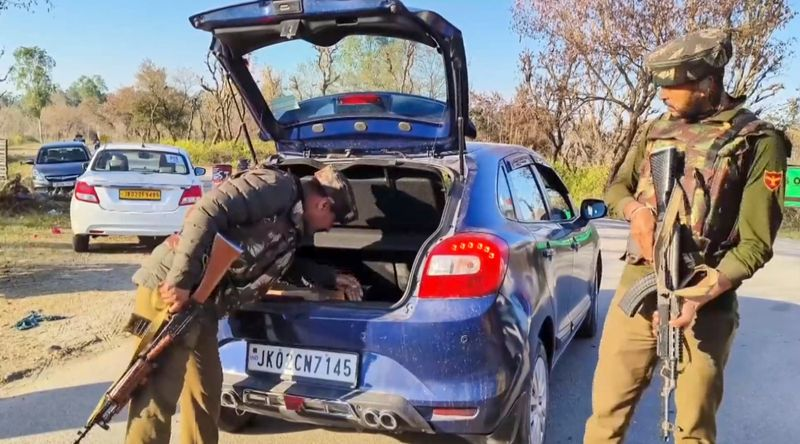
Anti-terror operation launched across Jammu

Security forces on Saturday launched anti-terror operations at nearly three dozen places across Jammu region, security officials said. The operations were launched over suspicious movements in some parts and as part of an area domination exercise in other places. No…

Security forces on Saturday launched anti-terror operations at nearly three dozen places across Jammu region, security officials said.

The operations were launched over suspicious movements in some parts and as part of an area domination exercise in other places. No contact has been established with the terrorists so far, officials said.

Operations were going on in the twin border districts of Poonch and Rajouri, higher reaches of Udhampur-Kathua belt, mountainous Doda and Kishtwar and the forests near the Line of Control (LoC) in Jammu district when the last reports of suspicious activities were received.

Advertisement

According to officials, a search operation was started at Maidaan Mohalla in Sangiote area of Gursai in Poonch district after two suspected foreign terrorists were found roaming under the cover of darkness late Friday night.

Security forces also launched a cordon and search operation in Mohalla Qasba, Allapir and Jaalian in Mandi and Mankote in Poonch and Dera Ki Gali and adjoining areas besides parts of Sunderbani and Nowshera sectors in nearby Rajouri district.

A search is underway at 13 places in Poonch-Rajouri and 18 places in the higher reaches of Udhampur, Kathua, Doda, Kishtwar and Doda districts with a focus on Khaderan forest. — PTI


India cornerstone of UN peacekeeping: UN body chief

Says its women peacekeepers are indispensable

ndia remains a cornerstone of UN peacekeeping and its women peacekeepers have demonstrated that missions with greater female representation improve operational outcomes and contribute to lasting peace, the United Nations peacekeeping chief has said.

UN Under-Secretary-General for Peace Operations Jean-Pierre Lacroix will visit New Delhi this week to attend the conference ‘Enhancing the Role of Women in Peacekeeping: A Global South Experience’ being organised by India on February 24-25.

“India remains a cornerstone of UN peacekeeping” and “Indian women peacekeepers are redefining peacekeeping itself,” Lacroix told PTI in an exclusive interview here.

Noting that it’s a “privilege” to attend the conference in India, Lacroix said the gathering would bring together women officials from about 50 countries in the Global South to discuss the evolving challenges in peacekeeping and the critical role women play in advancing peace and security.

“More women in peacekeeping means a more effective peacekeeping. India has long been a leader in advancing women, peace and security in peacekeeping missions—not only as a top troop and police contributor but also as a pioneer in advancing gender parity, its leadership in training and capacity building and its commitment to increasing women’s participation in missions,” he said in the written interview ahead of the conference.

He said the presence of Indian women peacekeepers “proves that missions with greater women representation build stronger relationships with communities, improve operational outcomes, and contribute to lasting peace”.