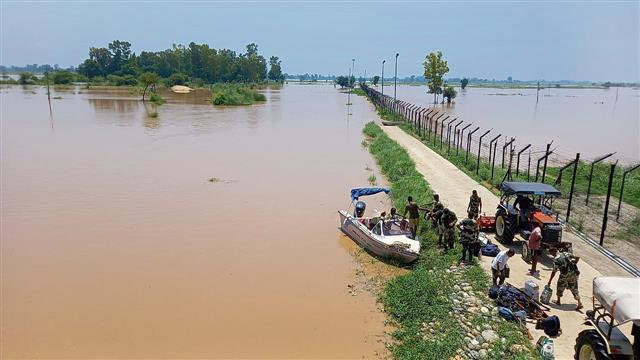
For three days, nearly 5,000 villagers cast away their deep-rooted political affiliations and also buried village rivalries to execute the onerous job of plugging a 300 feet wide, 30 feet deep breach at the Beas, a task which had become essential to their survival.
Officials say lives, livelihoods and livestock of hundreds of villagers living in 25-30 villages could have been washed away had the project been delayed by even a few hours.
Drainage officers said they were stunned at the speed and swiftness at which the mission was completed. They claimed under normal circumstances, it takes 20-22 days to finish such an exercise.
On August 17 evening, DC Himanshu Aggarwal was informed that a ‘dhussi’ had been breached at Jagatpur Tanda village. “It was imperative for us to start work immediately as the breach was getting bigger and bigger,” he said.
Two hours later, work started in right earnest. Hundreds of tractor-trolleys started bringing in soil from nearby districts. By the end of the exercise, 2.5 lakh sand-bags had been used. In all, the DC had to requisition 1,200 trolleys and 15 JCB machines from different departments.
As many as 18 floodlights were set up at four vantage points by Mandi Board officials. Four generators, too, were placed nearby. It was as if a country was preparing for a war. The supply of food packets and drinking water bottles seemed to be never ending. Youngsters had their two-wheelers ready just in case of a medical emergency.
Trolleys had to dump soil 200 metres away from the site because of the uneven terrain. From there, villagers carried sand bags on their back. “Indeed, where there is a will, there is a way,” said the emotionally drained DC at the end of the mission.
Mammoth task
5,000 villagers worked round the clock
2.5 lakh sandbags used
18 floodlights set up at four vantage points
4 generators for night operations
1,200 trailers brought in soil from nearby districts
15 JCB machines requisitioned by DC from various departments
As floodwater has submerged villages along the Sutlej in Ferozepur district, the cross-border smugglers are constantly trying to push huge quantity of contraband along with arms and ammunition inside the Indian territory.
In the past one month, the counter intelligence wing has seized over 132 kg of heroin in the Ferozepur sector. Lakhbir Singh, AIG, Counter Intelligence Wing, Ferozepur Range, said the cross-border smugglers had become active as the raging Sutlej submerged villages along the International Border.
The river enters Pakistan nine times and again flows into India, only to finally drain into the neighbouring country.
Sources said smugglers were usually expert divers who were using floods to their advantage.
With several border outposts of the BSF getting inundated at certain locations, the BSF has enhanced vigil and patrol the area on motorboats. Today, the 182 Battalion of the BSF and the CI apprehended two Pakistan-based smugglers and seized close to 30 kg narcotics during the wee hours in a joint operation near the border.
The AIG said the joint operation was conducted along the banks of the Sutlej near Gatti Matar village. “Around 2:45 am, our teams noticed some persons coming from Pakistan towards India. Sensing imminent threat, jawans fired at them. As a result, a person was hit on his hand,” said a BSF officer.
Subsequently, troops apprehended two Pakistani smugglers along with 26 packets containing 29.26 kg of heroin. The smugglers have been identified as Muhammad Ajmal Riyan of Kanganpur village and Sivna of Alipur village, both residents of Kasur, Pakistan.
After administering first aid, the injured smuggler was admitted to the Civil Hospital from where he was referred to Faridkot.
A case under Sections 21-C, 29 and 30 of the NDPS Act, besides Section 3, 34 and 20 of the Indian Passport Act has been registered in Fazilka.
Hotels facing risk as Dharampur road sinks at many spots
With a nearly 50-metre stretch each sinking at two locations in Sanwara on the Chandigarh-Shimla National Highway-5, channelling traffic has become an arduous task for the Himachal police.. Photo: Ambika Sharma
With a nearly 50-metre stretch each sinking at two locations in Sanwara on the Chandigarh-Shimla National Highway-5, channelling traffic has become an arduous task for the Himachal police. More so as the lane facing the hill has been lying closed for traffic owing to mounds of debris flowing down the slopes following rain.
A narrow lane is available for motorists and vehicles from one side are permitted to cross at a time. Initially, only one portion of the road had developed cracks near an HPMC juice bar. The cracks, however, deepened and the road has sunk by a few feet now. Some showrooms, restaurants and hotels, including Hotel AAA, which lie next to the sinking site, have been declared unsafe and vacated by the authorities. Other structures in the periphery too face the risk of being damaged if the road sinks further as the repair work is yet to begin. Gaping cracks are also visible at another spot on the road. Policemen have been deputed to ensure the smooth movement of traffic as the highway faces a heavy influx of vehicles carrying essential commodities, tourists, apples and vegetables, besides inter-state and local buses.
Anand Dhaiya, Project Director, NHAI, said the restoration work at sites where the damage was less would begin soon while for more-damaged points such as Chakki Mor, an expert opinion was awaited. “Temporary restoration measures are underway. The work to clear the debris at various points on the Parwanoo-Solan highway is likely to be completed within two weeks,” said Dhaiya.
The residents, meanwhile, are awaiting permanent restoration of the highway as every spell of rain has been aggravating the situation.
Balwinder Singh, project in-charge of construction firm GR Infraprojects, said, “A tentative plan for restoring the damage has been sent to the NHAI. Once they approve it, the final design will be sent and the work will begin as per their directions. At least 12 vulnerable sites, including two at Sanwara, have been included where the restoration work is awaiting approval.”
*PLAN B : MEDICAL INSURANCE – SSS (SAINIK SEVA SAMITI)*
PLAN B : MEDICAL INSURANCE – SSS (SAINIK SEVA SAMITI)*
*(Shared By Cdr Sudhir Dua, IN)* *(Secretary SSS)*
*Plan B because we can use ECHS* which is our service entitlement but is subject to funds constrained by MoD. Service HQ tries their best to help ESM and Serving. *But many times ECHS and MH cannot cater to our Needs.* *Then Medical Insurance can be the Saviour.* ECHS rates are low only about the 30 to 40% of normal rate ,the payments are delayed by EcHS due to Poor funds disbursement by MOD, if their occupancy is high they refuse ECHS patients even in emergency and we are unable to act as we have not paid our bills. A Small Mediclaim Insurance helps meet emergencies as Hospitals generally don’t refuse Insurance Patients as they get timely Payments and almost 80 % of rack rates. *Due our Service exigencies and Age or Sometimes lack of facilities in MH, it is advisable to have a Small Mediclaim Plan as Option B*
Parents, Parent- in- laws , Children and Grandchildren can also avail sss policy. Many Children have a Corporate plan but when they shift jobs they land up in shadow zones without V medical cover for themselves and family
Under present norms parents and dependents are subjected to financial restrictions. To get their support with present transparent direct tax systems is difficult through ECHS.
Today Medical costs can be high and youngsters take high value plans for 1 CR, But due to ECHS support we can just have a small Rs 5 to 10 lakhs Cover with no Age limit and all Pre existing diseases covered from Day One.
Icing on the cake is dedicated Helpdesk from TPA and Broker
Helpdesk at Sss helps for Membership only Paid Members can buy a Mediclaim plan or even opt for additional OPD plan *For details take membership on www.ssamiti* Org using join us and primary membership form. Members can see all details on website seek help to answer all queries from sss help desk. After getting confident about sss and the plan, please log-in with your sss id pay for Membership on the website and also Optional OPD plan.
Besides this all Members can get discounted Group Policies for their cars ,international travel and soon to start a comprehensive home care plan
*Cdr Sudhir Dua* *Secretary Sss*
Note pls call Helpdesk for all queries Pooja
Sss is a proven plan and operational since last 3 years Rs 5.8 CR premium already transfered to new india assurance .
*Sss caters as an excellent plan B*
Sea change: Indian women are making their presence felt in merchant navy
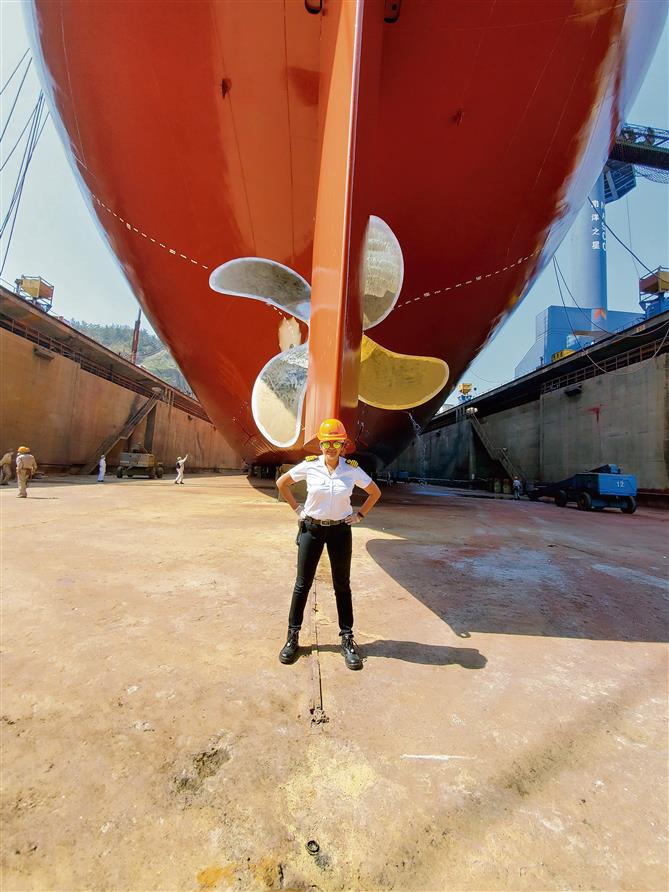
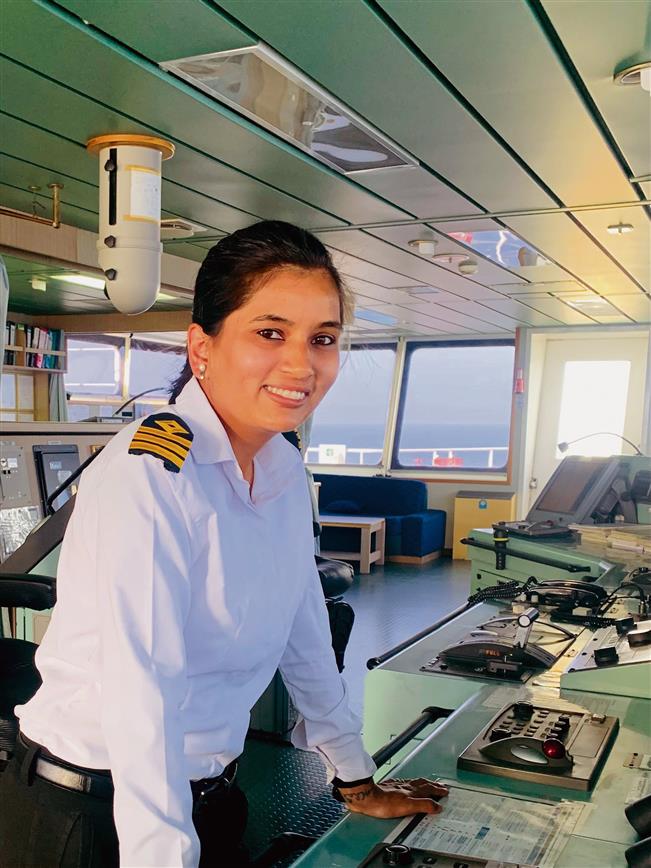
AFTER sailing for 18 years, Capt Suneha Gadpande took a break from being an officer on ship last year, taking up a shore job as Marine Superintendent for Hafnia Shipping in Singapore. Aware that her biological clock was ticking, she’d frozen her eggs six years back. The 39-year-old is looking forward to a new phase in her life. She is aware that life won’t be easy if and when she returns to the ship as a single mother, but she is used to challenges coming her way ever since she joined merchant navy, a male bastion.
Capt Suneha Gadpande wanted to join the Indian Navy but at that time, women sailors were not allowed.
In the first batch of the girl nautical cadets of the Shipping Corporation of India (SCI) in 2003, Suneha went on to command an all-women officer Indian tanker merchant ship, Mt Swarna Krishna, a first in maritime history. Having left the SCI in 2012 with a masters ticket, she became the first Indian woman to hold a senior rank in a multi-national shipping company. Honoured by former President Pranab Mukherjee for being among the 100 women achievers of India, she was recently recognised under ‘Bharat ki Laxmi Abhiyaan’ by PM Narendra Modi. All these achievements came with a multitude of struggles, which included facing hostile conditions, battling egos and making tough choices even at the cost of her career.
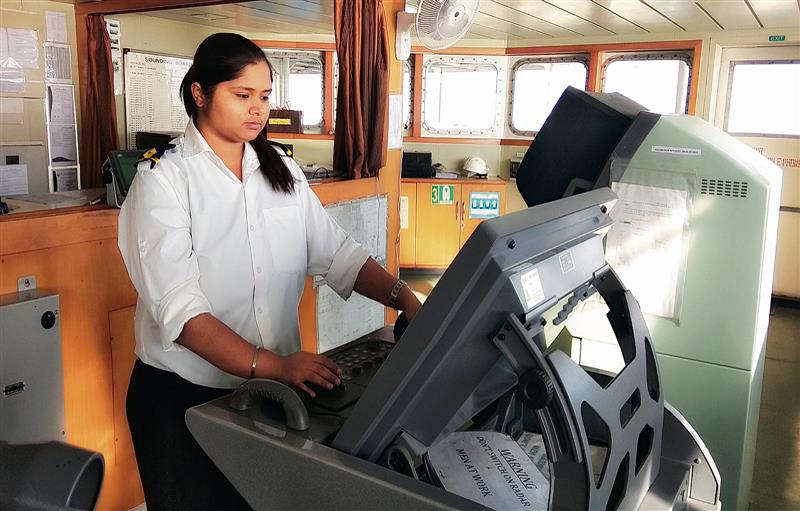
Chief Officer Nidhi Walia
A strong advocate of gender inclusivity, Capt Suneha says, “For your voice to be heard, it is essential to prove your mettle.”
In spite of nearly 17 per cent of the seafarers worldwide being from India, second after the Filipinos (30 per cent), the presence of Indian women in merchant navy remains miniscule, at less than 1 per cent.
Second Officer Parul Luhach
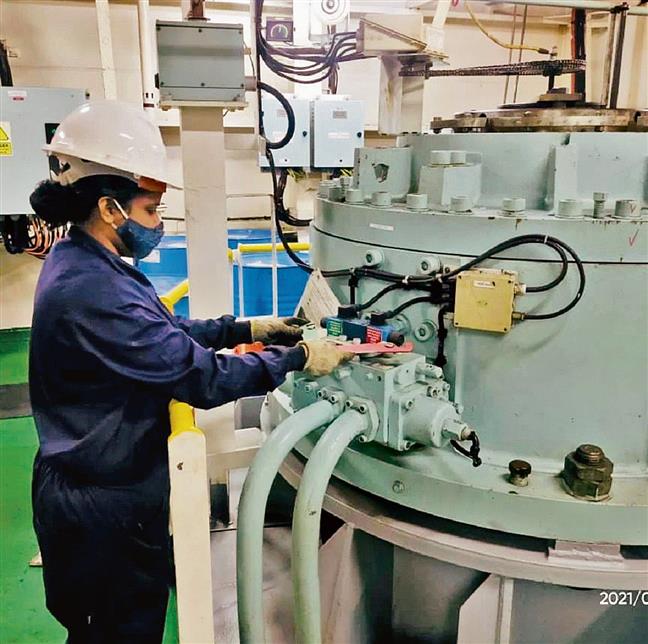
“Starting the career itself is quite challenging since most companies won’t let you reach them. It took me more than a year after completing BTech (Instrumentation) to find a company that was willing to take girls on board,” says Priyanka Sen from Rajasthan. After two years in the profession, this 28-year-old Electro Technical Officer is referred to as the ‘Dabangg’ girl. The initial bias and suspicion over her capabilities to handle the ship by herself have been replaced by respect, including from her male colleagues.
Electro Technical Officer Priyanka Sen.
Second Officer Parul Luhach (30) from Faridabad agrees. “The hard reality that women were not welcome in merchant navy hit us after we finished our course. Not just women from our batch, even our seniors or super seniors had not been able to get any placements. It was after more than a year of completing the course that I was able to get an opening. Today, I see myself as a changed person. This profession has polished me.” Parul entered merchant navy purely by chance 10 years back. She was already in her first year at Delhi’s LSR College when a friend’s sister told her about the profession. Parul had a tough time convincing her Haryana Jat family that she wanted to enter this male-dominant profession. With support from her grandmother, she took the plunge. She doesn’t regret the life she has chosen.
The peak in career often coincides with the period when women need to start a family, which makes it a difficult choice for many but when girls enter a sector like maritime, they are aware of the challenges involved. Dr Malini Shankar, VC, Indian Maritime University
Mohali-based Nidhi Walia (30) had never been a shy girl. However, as a girl cadet in the merchant navy a decade back, her confidence and ability to grasp and communicate well in English turned out to be a stumbling block initially. “Many male colleagues found my confidence hard to digest. For them, it would have been easier to deal with a woman who was not asserting herself. It was my family’s support that helped me pursue my passion to explore the world and earn well.” As Chief Officer, her work entails loading and offloading cargo, besides personnel management on the ship. “When you work with more than 20 men, it raises your confidence and you feel you can face any kind of situation in the world,” says Nidhi.
Women are in minority in merchant navy and all eyes are on them. So, even a small genuine error will stand out. It’ll take decades to bring about acceptability. Harjeet Joshi, former Chairperson of the Shipping Corporation of India
It is not all smooth sailing, for this profession brings with it loneliness. More so, when you are the only woman on a huge ship. According to Meenakshi Gupta, director of Hong Kong-based marine consultants and trainers Sygnus Marine, “Working in long shifts is not everyone’s cup of tea. Life at sea is extremely tough, even under the best of circumstances. Think of isolation, boredom outside of shifts, sea sickness, no Internet (the horror of not having Insta, Facebook and WhatsApp, in today’s world!), long contracts and no social life. For seafarers, in general, it isn’t easy, but more so for women due to the absence of emotional support from your own gender.”
Once on the ship, the most difficult part is not just dealing with professional hazards and lack of emotional support, but also pressure from families back home to get married. “Finding a match for women seafarers is not easy as most people find it difficult to accept that the woman will not be home for six to seven months after marriage. Mostly, a career break is required then,” says Parul.
Dr Malini Shankar, Vice-Chancellor of the Indian Maritime University, Chennai, says, “Earlier, very few women entered this sector but with emphasis on diversity and equality, one finds females enrolling in marine courses. Many shipping companies like Maersk and MSC are offering handsome scholarships to women cadets.”
“In 2018, we had only 2 per cent women enrolling in BTech. The number has gone up to 8 per cent. Their presence in BSc (Nautical Science) too has gone up from 2 per cent to 8.2 per cent — the most popular courses being BTech in naval architecture and ocean engineering. At present, there are 74 girls in nautical sciences, 97 in BTech, 53 in BTech (naval architecture).” Interestingly, many girls entering this profession are from North India, though one would expect those from coastal areas to have an overwhelming presence, Dr Shankar adds.
The maritime industry remains perhaps the last of the male bastions that women are still struggling to break into. According to a 2021 survey report, ‘Women in Maritime’, issued by the International Maritime Organisation (IMO), the proportion of women employed as seafarers globally is very small, and the percentage of those from India is barely 0.5 per cent.
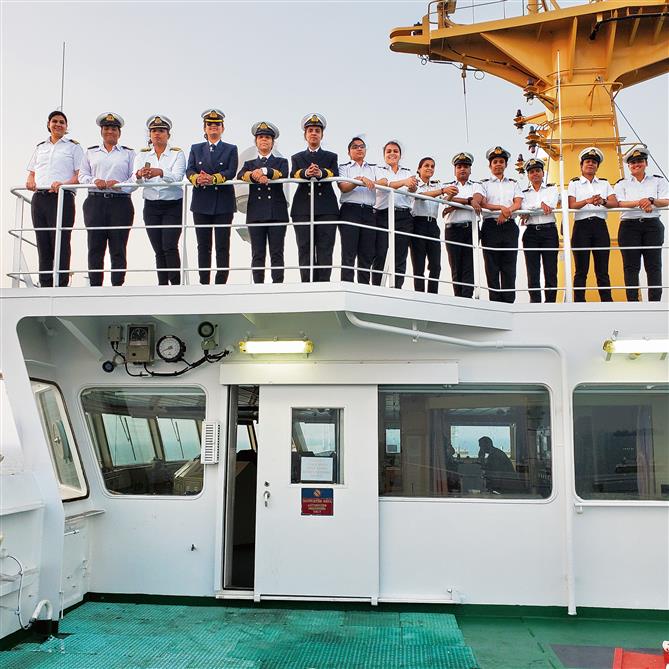
The new Seafarer Workforce Report from BIMCO and the International Chamber of Shipping has warned that the industry must significantly increase training and recruitment levels if it is to avoid a serious shortage of officers. Given the growing demand for Standards of Training Certification and Watchkeeping (STCW) certified officers, the report predicted the need for an additional 89,510 officers by 2026 to operate the world merchant fleet. Currently, 18.9 lakh seafarers operate over 74,000 vessels around the globe. Female STCW-certified seafarers are estimated to be 1.28 per cent of the workforce. The IMO has been pressing to bridge this gender gap. Change is taking place, albeit slowly. Gender sensitisation is being mandated as part of the training courses. Most evident is the changing uniform of women. The loose men’s jumpsuits they had been wearing are being replaced by customised shirts and pants, besides availability of sanitary pads on ships. A proper maternity leave policy is also being reviewed. Many companies like the SCI have at least two women officers on board.
In an effort to become gender inclusive, a number of shipping giants are bringing in changes in their policies. Container logistics giant Maersk last year rolled out India’s first women seafarers’ cadet programme. As part of its ‘Equal at Sea’ initiative, it has set for itself an ambitious 2027 goal of women making up for 50 per cent of its fresh cadet intake. Presently, the company has 40 per cent of its naval staff coming from India. Interestingly, it has no Indian female seafarers at higher ranks, the company confirmed.
A woman officer, on condition of anonymity, says all this talk about getting more women on board is mere eyewash. Most companies are only interested in getting the diversity numbers, she claims, adding that women get bypassed for senior-level posts despite undergoing the same training. Hiring needs to be done not only at the entry level but also at operational levels, she adds.
“Gender sensitisation is the need of the hour,” says Harjeet Joshi, who was the first woman chairperson of the SCI. She flagged off the first all-women officer tanker merchant ship carrying 50,000 metric tonnes of inflammable cargo in 2021. The feat was repeated a year after. “The idea was to prove that women officers are as capable when it comes to handling even the most difficult of ships,” adds Joshi. “It is fashionable to talk about equality and diversity,” she points out, “but deep down, have we given up the grudges and perceptions? It will take decades for the mindset to change.”
It was a century ago in 1923 that Sumati Morarjee joined her father-in-law’s company, earning the sobriquet of ‘the first woman of Indian shipping’. With their grit and determination, Indian women are making their presence felt in merchant navy, one step at a time.
Depsang on table, India, China hold third meet in 4 days
Military officers of India and China today met for the third time within four days to resolve the border standoff, especially at the sensitive Depsang plains.
Major General-level officials met at two locations —Chushul and Daulat Beg Oldie — in eastern Ladakh on Monday. This was the third meeting since Friday.
The push to resolve the deadlock also comes just ahead of the expected bilateral between Prime Minister Narendra Modi and Chinese President Xi Jinping on the sidelines of the BRICS summit from August 22 to 24 in South Africa.
Major General-level officers have been tasked with finding a workable solution that could be implemented along the undemarcated Line of Actual Control (LAC).
There are differences over the pulling back of troops from the Depsang plains and Charding Nullah near Demchok. The two sides have been locked in a standoff since April 2020. Talks have been deadlocked over the dispute over the 972-sqkm plateau Depsang. The two sides have issues over troop positions, especially at the “bottleneck” on the eastern edge of Depsang. India has been objecting to the People’s Liberation Army (PLA) deliberately blocking Indian patrols on the patrolling route that goes east of the “bottleneck” in Depsang. Prior to April 2020, Indian patrols were using the patrolling route, but since then the PLA has been craftily using a clause in the 30-year-old border agreement to block Indian patrols.
As per the border agreement, patrolling parties of one country have to return on encountering the patrol party of the other country.
One of the options being discussed now is that Indian troops would coordinate with the Chinese when patrols go east of the “bottleneck”. This would mean the creation of a new buffer zone and not carrying out patrols independently.
The claims of both sides overlap, especially in the Depsang plains. Some of these locations hold strategic value as they overlook the Aksai Chin plateau which is under illegal control of China.
India has already suggested to China that a graded three-step process is needed to ease the standoff. The first is disengagement of troops within close proximity in grey zones along the LAC and getting back to positions as on April 2020.
The next two steps — de-escalation and de-induction — will entail pulling back troops and equipment to the pre-April 2020 levels. Till that is agreed upon and complied with, it cannot be assumed to be business as usual.
With water continuing to be released from both Pong and Bhakra dams, inundating thousands of acres of land, some border outposts of the Border Security Force (BSF) too have been submerged along the Indo-Pak border.
With more rain forecast in Himachal Pradesh in the next three days, the state government is on high alert. One person is learnt to have been swept away in floodwaters in Dhaliwal Bet village of Dhilwan.
It is learnt that two outposts of the BSF in Ferozepur and Fazilka areas have been submerged, while four have been surrounded by water. Residents of Fazilka along with BSF personnel have built a 2,200-metre security dam on the India-Pakistan border to save their crops.
In Fazilka and Ferozepur, thousands of acres continue to be submerged. A state government report shows that crops on 4,168 acres in Fazilka have been damaged. As many as 1,321 persons were evacuated today, including 1,246 from Ferozepur alone. As many as 247 persons in these two districts, in addition to 28 in Tarn Taran, have been shifted to relief camps.
Today, 68,696 cusecs of water was released from the Pong dam and 58,400 cusecs from the Bhakra dam. The water level in the Pong dam remained 1.27 feet above the maximum limit of 1,390 feet. The water level in the Sutlej remained high at Hussainiwala (2,25,420 cusecs), though it has started falling at Harike (1,69,643 cusecs today against 2.80 lakh cusecs last week).
In Tarn Taran, too, 39 villages continue to be inundated, while 49 villages in Gurdasapur were impacted. The breach in dhussi bundh in Harike Hathar area has flooded 24 villages.
Kasur in Pak hit by floods too
Floodwater has reached Kasur in Pakistan. The maize crop has been significantly affected on the Pakistan side.
Ladakh mishap: 6 of nine soldiers killed from region
Six of the nine Army personnel who died on duty after their vehicle plunged into a gorge in Ladakh on Saturday night belonged to the region. While three of them hailed from Haryana, two were from Punjab and another from Himachal Pradesh.
Gunner Ankit, 24, from Gaddi Kheri village of Rohtak was the sole breadwinner of his family, which includes his mother, wife and younger brother. He joined the Army in 2018 after Class XII.
Gunner Manmohan Singh of Hathin village in Palwal joined the Army in 2016 to fulfil his father’s dream.
He completed his graduation while in service. Manmohan has left behind three elder sisters, parents and a one-year-old son. Naik Tejpal Singh, another deceased, belonged to Ujina Sangel village of Nuh. He was inducted into the Army in 2013. He has two sons aged six and three.
Critically injured jawan Anuj Kumar, who hails from Dhigana (Jind), joined the Army in 2021. “His father Bijender was also an Army man and died on duty about 10 years ago,” said Anuj’s uncle Rajbir.
Two from Punjab are Gunner Tarandeep Singh, 23, from Kamali village in Bassi Pathana subdivision of Fatehgarh Sahib, and Naib Subedar Ramesh Lal, 39, of Sarsiri village in Faridkot district. Havildar Vijay Kumar, another deceased, hailed from Nehra village of Shimla Rural in Himachal Pradesh.
Critically injured belongs to Jind
A critically injured soldier, Anuj Kumar, hails from Dhigana village of Jind district. He joined the Army in 2021. “Anuj’s father Bijender was also an Army man and died on duty about 10 years ago,” said Anuj’s uncle Rajbir.
For Armed Forces Officers and Veterans who may not be aware*
For Armed Forces Officers and Veterans who may not be aware* : In case of any emergency you can dial 1904 from your mobile and you will be connected to the nearest Army exchange. Identify yourself and the operater will connect you to the concerned office/r. A really useful facility. It has been tried in different cities and those also work”
Similar number of 1932 for AirForce exchange
Whats App for suggestions on ECHS Matters:-9868857972
Complaints for Army issues :-9643300008
ECHS helpline:- 1800114115
Directorate of Ex-Servicemen Affairs:- 1800113999
Airforce helpline:- 1800115800
Navy helpline :-1800220560
Army helpline:- 1800116644
Please share with all Veterans & Veernaris. Regards and Jai Hind
Police record shows a ‘closed’ case of theft and molestation in summer ’90, but no word on gold seizure
Right from the time travails began chasing Second Lieutenant Shatrughan Singh Chauhan in 1990, a police station close to Srinagar’s central Lal Chowk filed an FIR against unknown army personnel, accusing them of theft. The complainant, Raja Begum, claimed army men took away two gold rings and Rs 3,000 from her home, after having harassed her daughters during a crackdown at her home in Batamaloo under Shergadi police station area.
Batamaloo, barely two km from the central Lal Chowk, is where Chauhan said the army recovered 147 gold biscuits (weighing 30 kg) in a search operation on April 11, 1990. According to the FIR filed the next day by Begum, wife of Abdul Wahat Matto, the incident took place near the Sufi shrine of Ziyarat Sharief. People of the locality say no such family lives there. Nor does anybody in the area remember a neighbour by the name of Begum’s husband. In the Banpora area of Batamaloo, which is a km from the shrine, a Mattoo family says they have no information about the 26-year-old matter.
State Stalwarts
DEFENCE MINISTER
Minister Rajnath Singh
ALL HUMANS ARE ONE CREATED BY GOD
HINDUS,MUSLIMS,SIKHS.ISAI SAB HAI BHAI BHAI
CHIEF PATRON ALL INDIA SANJHA MORCHA
LT GEN JASBIR SINGH DHALIWAL, DOGRA
SENIOR PATRON ALL INDIA SANJHA MORCHA
MAJOR GEN HARVIJAY SINGH, SENA MEDAL ,corps of signals
.
.
PATRON ALL INDIA SANJHA MORCHA
MAJ GEN RAMINDER GURAYA ,MADRAS REGIMENT
sanjhamorcha303@gmail.com
PRESIDENT SOUTH ALL INDIA SANJHA MORCHA
COL SS RAJAN BOMBAY SAPPERS,
PRESIDENT UTTARAKHAND ALL INDIA SANJHA MORCHA
COL B M THAPA ,BENGAL SAPPERSS
PRESIDENT HARAYANA STATE CUM COORDINATOR ESM
BRIG DALJIT THUKRAL ,BENGAL SAPPERS
PRESIDENT TRICITY
COL B S BRAR (BHUPI BRAR)
PRESIDENT CHANDIGARH ZONE
COL SHANJIT SINGH BHULLAR
.
.
PRESIDENT PANCHKULA ZONE AND ZIRAKPUR
COL SWARAN SINGH
INDIAN DEFENCE FORCES
DEFENCE FORCES INTEGRATED LOGO
INDIAN AIR FORCE
Air Officer C-in-C WESTERN AIR COMMAND
AIR MSHL S PRABHAKARAN AVSM VM
AOC-IN-C, EASTERN AIR COMMAND
Air Marshal Inderpal Singh Walia
AOC-in-C SOUTH WESTERN AIR COMMAND
Air Marshal Vikram Singh
AOC-IN-C, SOUTHERN AIR COMMAND
Air Marshal J.Chalapati
AOC-IN-C TRAINING COMMAND
AIR MARSHAL SK GHOTIA VSM
AOC-IN-C MAINTENANCE COMMAND
Air Marshal Jagdish Chandra
Flag Officer Commanding in Chief, Western Naval Command
ice Admiral R Hari Kumar, PVSM, AVSM, VSM
Flag Officer Commanding in Chief, Eastern Naval Command
Vice Admiral Sanjay Bhalla, AVSM, NM
Flag Officer Commanding in Chief, Southern Naval Command