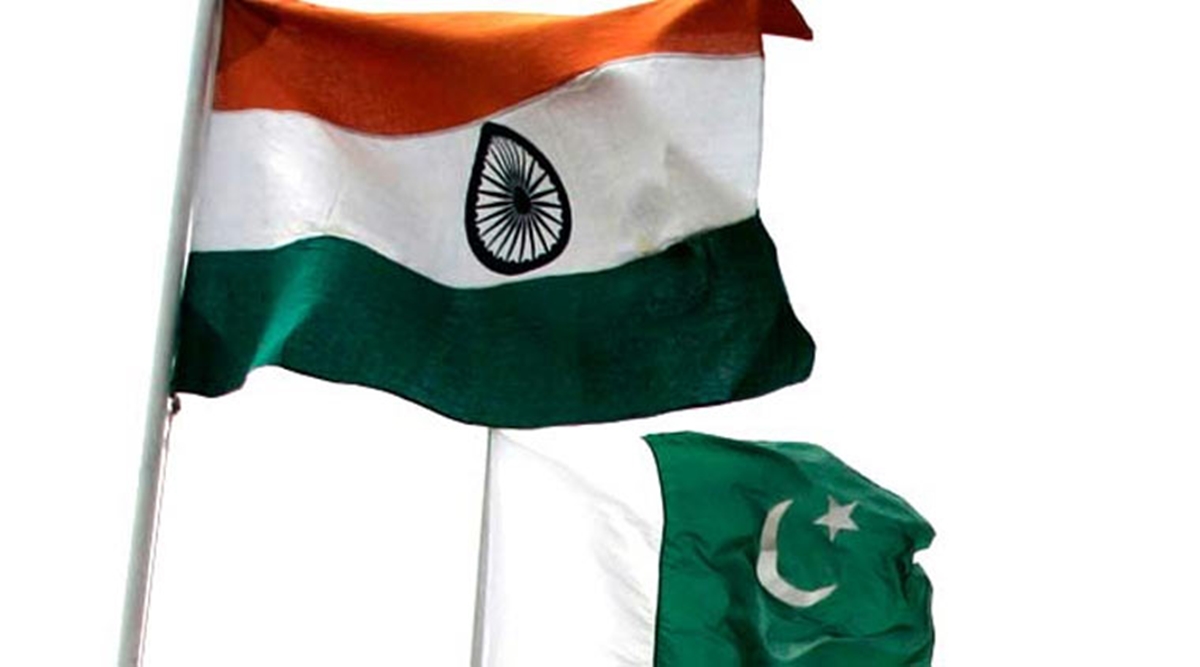
India has conveyed its ob[1]jections to the US over the recent visit to Pakistan[1]Occupied-Kashmir by the American Ambassador to Islamabad, the Ministry of External Affairs (MEA) said on Friday. India also took objections to the US ambassador to Pakistan holding some meetings in PoK. “We have con[1]veyed our objections to the visit,” MEA spokes[1]person Arindam Bagchi said at a media briefing. He also said rights of people in China’s Xin[1]jiang region should be “respected and guaran[1]teed” but noted that its decision to abstain from a resolution on the con[1]cerns at the UN human rights commission was in line with the practice of not voting on country[1]specific resolutions. It is for the first time that India clearly called for respecting the human rights of the people of Xinjiang Uyghur autono[1]mous region. “The human rights of the people of Xinjiang Uyghur Autonomous Region should be re[1]spected and guaranteed. We hope that the rel[1]evant party will address the situation objectively and properly,” External Affairs Ministry spokes[1]person Arindam Bagchi said. His comments came at a media briefing when asked about India’s ab[1]stention at the UN rights body on the resolution calling for a debate on the human rights situ[1]ation in Xinjiang. PTI
Russia finding new ways to spread propaganda videos
DAVID KLEPPER Russia has devised yet another way to spread disin[1]formation about its invasion of Ukraine, using digital tricks that allow its war propaganda videos to evade restrictions imposed by governments and tech companies. Accounts linked to Rus[1]sian state-controlled media have used the new method to spread dozens of videos in 18 different languages, all with[1]out leaving telltale signs that would give away the source, researchers at Nisos, a U.S.- based intelligence firm that tracks disinformation and other cyber threats, said in a report released Wednesday. The videos push Kremlin conspiracy theories blaming Ukraine for civilian casualties as well as claims that residents of areas forcibly annexed by Russia have welcomed their occupiers. English-language versions of the Russian propaganda videos are now circulating on Twitter and lesser-known platforms popular with American con[1]servatives, including Gab and Truth Social, created by former President Donald Trump, giv[1]ing Russia a direct conduit to millions of people. In an indication of the Kremlin’s ambitions and the sprawling reach of its disinfor[1]mation operations, versions of the videos were also created in Spanish, Italian, German and more than a dozen other languages. “The genius of this ap[1]proach is that the videos can be downloaded directly from Telegram and it erases the trail that researchers try to fol[1]low,” Nisos’ senior intelligence analyst Patricia Bailey told The Associated Press. “They are creative and adaptable. And they are analyzing their audience.” The European Union moved to ban RT and Sputnik, two of Russia’s leading state-run me[1]dia outlets, after Russia’s inva[1]sion of Ukraine in late Febru[1]ary. Tech companies such as Google’s YouTube and Meta’s Facebook and Instagram also announced they would ban content from the outlets within the 27-nation EU, undermin[1]ing Russia’s ability to spread its propaganda. Russian attempts to get around the new rules began almost immediately. New websites were created to host videos that make debunked claims about the war. Rus[1]sian diplomats took on some of the work. The latest effort revealed by analysts at Nisos involved uploading propaganda videos to Telegram, a loosely moder[1]ated platform that is broadly popular in Eastern Europe and used by many conservatives in the United States. In some cases, watermarks identify[1]ing the video as RT’s were removed in a further attempt to disguise their source. Once on Telegram, the vid[1]eos were downloaded and reposted on platforms includ[1]ing Twitter without any labels or other indications that the video was produced by Rus[1]sian state media. Hundreds of accounts that later posted or reposted the videos were linked by Nisos researchers to the Russian military, embas[1]sies or state media. Some of the accounts ap[1]peared to use fake profile photos or posted content in strange ways that suggested they were inauthentic. One example: a Twitter account supposedly run by a woman living in Japan that had a singular interest in Rus[1]sian propaganda. Instead of posting about a variety of topics such as entertainment, food, travel or family, the ac[1]count user only posted Rus[1]sian propaganda videos — and not just in Japanese, but also in Farsi, Polish, Spanish and Russian. The account also cited or reposted content from Russian embassies hundreds of times, researchers found, showing again the close relationship between Russian diplomats and the country’s propaganda work. When it comes to Russia’s overall disinformation capabil[1]ities, Bailey said, the network is “just one piece of a puzzle that is quite large.” Twitter labels content that it can identify as coming from Russian state media. Since late February, the company says it’s added labels to more than 900,000 different Tweets that contained links to Russian state outlets like RT. In ad[1]dition, the platform does not artificially promote content from state media accounts. “We use labels to make it clear on Twitter when an ac[1]count is operated by a state actor, such as a state-backed media outlet, and we will not recommend or amplify Tweets from these types of accounts,” a company spokesperson told The AP. PTI I ndia has once again sent out a clear message to Pakistan that there can be no talks without Pakistan dismantling the terrorist infrastructure which it has built over the years and has been using it relentlessly against this country under its pernicious policy of inflicting a thousand cuts. Addressing a rally in Kashmir valley, which was his first since the abrogation of Article 370 in 2019, Union Home Minister Amit Shah bluntly ruled out any dialogue unless Pakistan changed its behaviour and junked the policy of state terrorism. In his speech, Shah said that some people had been suggesting to him that he should talk to Pakistan. But he was clear on this issue. “I don’t want to talk to Pakistan. I would talk to Gujjars and Paharis of Baramulla. I will talk to the youth of Kashmir. They (Pakistan) have spread terrorism here. What good have they done for Kashmir.” Shah used a large part of his 25-minute speech to slam the “three families that have ruled Kashmir for 70 years”. While the BJP leaders have often hit out at the families of Abdullahs and Muftis, it was for the first time that Shah brought Gandhis too in the line of his attack. He said he saw a tweet of Mehbooba (Mufti) ji. She had said that the Home Minister should go back only after giving account of what they have given to Kashmir,” Shah said. “Mehbooba ji, listen with open ears and eyes, what we have done, I will give its account but what you and Farooq (Abdullah) sahib have done, you should give that account later… I have come here to ask you, Mehbooba and Farooq sahib, tell us how much investment has come to Kashmir in 70 years, how many industries have been set up, how many factories have been opened and how many youth have been given employment. (There has been an investment of) only 15,000 crore in 70 years. In three years, Modi ji brought an investment of 56,000 crore”. The Home Minister said the Modi government’s “achieve[1]ment” was to take democracy to the grassroots in J&K. “Before that democracy was limited to 87 legislators, six parliamentarians and three families – Mufti family, Abdul[1]lah family and Gandhi family,” he claimed. “We have taken it to villages, to 30000 panches and sarpanches.” He also subbed the National Conference (NC) as “Abdul[1]lahs and sons” and the Peoples Democratic Party (PDP) as “Mufti and company”. Shah said that they gave stones and guns in the hands of Kashmiri youth. “Modi ji brought industry here and gave mobiles and laptops in their (youth’s) hands.” He went on to say that there were two models: Modi ji’s model of development, peace and employment and Gupkar model. Gupkar model gave Pulwama attack. Modi model gave a Rs 2,000 crore hospital to Pulwama. Gupkar model gave stones and machine guns in youth’s hands and closed colleges whereas the Modi model gave IIMs, IITs, AIIMS, NIFTs and NEET.” The Home Minister also pointed out that 42,000 people have been killed in J&K due to terrorism since the start of militancy in 1990. “Who is responsible for the deaths of these 42,000 people? The three families, who ruled Kashmir for 70 years, are responsible,” he alleged. “You know the most difficult thing is to shoulder the coffin of your son. 42,000 people have been killed here. Has the son of any leader been killed ever? We want that the fear of separatism should go away from Kashmir, terrorism should go away and Kashmir becomes the paradise of India.” Kashmir was a “hotspot of terrorism” earlier, but had now turned into a “hotspot of tourism” under the BJP dis[1]pensation. In the past, six lakh tourists would visit Kashmir annually,” he said. “I have come here in October – 22 lakh tourists have already visited Kashmir so far this year, and it has given employment to five lakh youth.” Shah listed the developmental works undertaken by the Centre in J&K since 2014 and highlighted the setting up of new medical colleges announced during the Manmohan Singh government, electricity to every village, free health cards to the people among its key achievements. Terrorism in J&K has virtually ended, appealing to its people to join the mainstream. The Modi government wouldn’t tolerate terrorism, he said, exhorting the people to come and join the mainstream and be part of development. SPIRITUAL WORLD DISCLAIMER: The opinions ex[1]pressed in the articles published in these columns are the personal opinions of the authors. The facts and opinions appearing in the articles do not reflect the views of Bright Punjab Express and Bright Punjab Express does not assume any responsibility or liability for the same.
Message to Pakistan Russia finding new ways to spread propaganda videos DAVID KLEPPER Russia has devised yet another way to spread disin[1]formation about its invasion of Ukraine, using digital tricks that allow its war propaganda videos to evade restrictions imposed by governments and tech companies. Accounts linked to Rus[1]sian state-controlled media have used the new method to spread dozens of videos in 18 different languages, all with[1]out leaving telltale signs that would give away the source, researchers at Nisos, a U.S.- based intelligence firm that tracks disinformation and other cyber threats, said in a report released Wednesday. The videos push Kremlin conspiracy theories blaming Ukraine for civilian casualties as well as claims that residents of areas forcibly annexed by Russia have welcomed their occupiers. English-language versions of the Russian propaganda videos are now circulating on Twitter and lesser-known platforms popular with American con[1]servatives, including Gab and Truth Social, created by former President Donald Trump, giv[1]ing Russia a direct conduit to millions of people. In an indication of the Kremlin’s ambitions and the sprawling reach of its disinfor[1]mation operations, versions of the videos were also created in Spanish, Italian, German and more than a dozen other languages. “The genius of this ap[1]proach is that the videos can be downloaded directly from Telegram and it erases the trail that researchers try to fol[1]low,” Nisos’ senior intelligence analyst Patricia Bailey told The Associated Press. “They are creative and adaptable. And they are analyzing their audience.” The European Union moved to ban RT and Sputnik, two of Russia’s leading state-run me[1]dia outlets, after Russia’s inva[1]sion of Ukraine in late Febru[1]ary. Tech companies such as Google’s YouTube and Meta’s Facebook and Instagram also announced they would ban content from the outlets within the 27-nation EU, undermin[1]ing Russia’s ability to spread its propaganda. Russian attempts to get around the new rules began almost immediately. New websites were created to host videos that make debunked claims about the war. Rus[1]sian diplomats took on some of the work. The latest effort revealed by analysts at Nisos involved uploading propaganda videos to Telegram, a loosely moder[1]ated platform that is broadly popular in Eastern Europe and used by many conservatives in the United States. In some cases, watermarks identify[1]ing the video as RT’s were removed in a further attempt to disguise their source. Once on Telegram, the vid[1]eos were downloaded and reposted on platforms includ[1]ing Twitter without any labels or other indications that the video was produced by Rus[1]sian state media. Hundreds of accounts that later posted or reposted the videos were linked by Nisos researchers to the Russian military, embas[1]sies or state media. Some of the accounts ap[1]peared to use fake profile photos or posted content in strange ways that suggested they were inauthentic. One example: a Twitter account supposedly run by a woman living in Japan that had a singular interest in Rus[1]sian propaganda. Instead of posting about a variety of topics such as entertainment, food, travel or family, the ac[1]count user only posted Rus[1]sian propaganda videos — and not just in Japanese, but also in Farsi, Polish, Spanish and Russian. The account also cited or reposted content from Russian embassies hundreds of times, researchers found, showing again the close relationship between Russian diplomats and the country’s propaganda work. When it comes to Russia’s overall disinformation capabil[1]ities, Bailey said, the network is “just one piece of a puzzle that is quite large.” Twitter labels content that it can identify as coming from Russian state media. Since late February, the company says it’s added labels to more than 900,000 different Tweets that contained links to Russian state outlets like RT. In ad[1]dition, the platform does not artificially promote content from state media accounts. “We use labels to make it clear on Twitter when an ac[1]count is operated by a state actor, such as a state-backed media outlet, and we will not recommend or amplify Tweets from these types of accounts,” a company spokesperson told The AP. PTI I ndia has once again sent out a clear message to Pakistan that there can be no talks without Pakistan dismantling the terrorist infrastructure which it has built over the years and has been using it relentlessly against this country under its pernicious policy of inflicting a thousand cuts. Addressing a rally in Kashmir valley, which was his first since the abrogation of Article 370 in 2019, Union Home Minister Amit Shah bluntly ruled out any dialogue unless Pakistan changed its behaviour and junked the policy of state terrorism. In his speech, Shah said that some people had been suggesting to him that he should talk to Pakistan. But he was clear on this issue. “I don’t want to talk to Pakistan. I would talk to Gujjars and Paharis of Baramulla. I will talk to the youth of Kashmir. They (Pakistan) have spread terrorism here. What good have they done for Kashmir.” Shah used a large part of his 25-minute speech to slam the “three families that have ruled Kashmir for 70 years”. While the BJP leaders have often hit out at the families of Abdullahs and Muftis, it was for the first time that Shah brought Gandhis too in the line of his attack. He said he saw a tweet of Mehbooba (Mufti) ji. She had said that the Home Minister should go back only after giving account of what they have given to Kashmir,” Shah said. “Mehbooba ji, listen with open ears and eyes, what we have done, I will give its account but what you and Farooq (Abdullah) sahib have done, you should give that account later… I have come here to ask you, Mehbooba and Farooq sahib, tell us how much investment has come to Kashmir in 70 years, how many industries have been set up, how many factories have been opened and how many youth have been given employment. (There has been an investment of) only 15,000 crore in 70 years. In three years, Modi ji brought an investment of 56,000 crore”. The Home Minister said the Modi government’s “achieve[1]ment” was to take democracy to the grassroots in J&K. “Before that democracy was limited to 87 legislators, six parliamentarians and three families – Mufti family, Abdul[1]lah family and Gandhi family,” he claimed. “We have taken it to villages, to 30000 panches and sarpanches.” He also subbed the National Conference (NC) as “Abdul[1]lahs and sons” and the Peoples Democratic Party (PDP) as “Mufti and company”. Shah said that they gave stones and guns in the hands of Kashmiri youth. “Modi ji brought industry here and gave mobiles and laptops in their (youth’s) hands.” He went on to say that there were two models: Modi ji’s model of development, peace and employment and Gupkar model. Gupkar model gave Pulwama attack. Modi model gave a Rs 2,000 crore hospital to Pulwama. Gupkar model gave stones and machine guns in youth’s hands and closed colleges whereas the Modi model gave IIMs, IITs, AIIMS, NIFTs and NEET.” The Home Minister also pointed out that 42,000 people have been killed in J&K due to terrorism since the start of militancy in 1990. “Who is responsible for the deaths of these 42,000 people? The three families, who ruled Kashmir for 70 years, are responsible,” he alleged. “You know the most difficult thing is to shoulder the coffin of your son. 42,000 people have been killed here. Has the son of any leader been killed ever? We want that the fear of separatism should go away from Kashmir, terrorism should go away and Kashmir becomes the paradise of India.” Kashmir was a “hotspot of terrorism” earlier, but had now turned into a “hotspot of tourism” under the BJP dis[1]pensation. In the past, six lakh tourists would visit Kashmir annually,” he said. “I have come here in October – 22 lakh tourists have already visited Kashmir so far this year, and it has given employment to five lakh youth.” Shah listed the developmental works undertaken by the Centre in J&K since 2014 and highlighted the setting up of new medical colleges announced during the Manmohan Singh government, electricity to every village, free health cards to the people among its key achievements. Terrorism in J&K has virtually ended, appealing to its people to join the mainstream. The Modi government wouldn’t tolerate terrorism, he said, exhorting the people to come and join the mainstream and be part of development
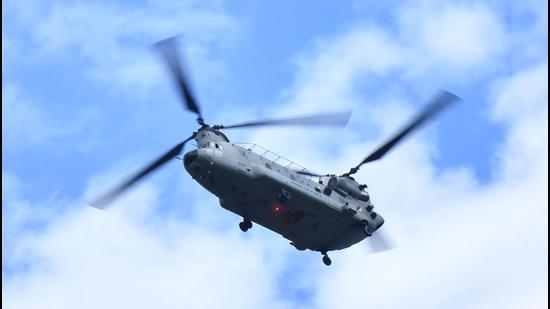
The residents of Chan[1]digarh on Thursday wit[1]nessed a thrilling air show by the Indian Air Force at the Sukhna Lake. It was a two-and-a-half-hour long full dress rehearsal of the mega air show to be staged by the IAF on Saturday to mark the 90th anniversary of the by the Indian Air Force (IAF) at Sukhna Lake on Thursday. Presi[1]dent Draupadi Murmu and Defence Minister Rajnath Singh will attend the show on Saturday. Newly-inducted Pra[1]chand combat helicopter (indigenous light combat helicopter) was among 80 fighters, transport aircraft and helicopters that par[1]ticipated in the air show. The programme started at 2.30 pm and concluded at 5 pm. All fighters including Su[1]30 MKI, Tejas and Rafale took part in the event. Similarly, transport air[1]craft like IL 76 and C-130s, and helicopters except the Avro, Dornier, Chetak and Cheetah also participated. The event began with the IAF’s Akash Ganga skydiv[1]ing team. It was followed by Chinook helicopter under[1]taking manoeuvring and underslung operations. The UT Administra[1]tion had set up 11 alight[1]ing points where people, who booked their tickets through the app, couldpark their vehicles and board a CTU bus to reach the venue. On each entry pass, zone number, alighting point and entry staircase was prominently displayed. The general public had been asked to reach the alight[1]ing point as mentioned on their entry pass by their own arrangements, with or without vehicle, where CTU buses were parked to transport them to their respective zones. The entire Sukhna Lake was divided into seven zones, with a separate en[1]try staircase. Each zone is also mapped with 11 alight[1]ing points. General public while booking the entry passes will have the option of selecting the alighting points of their choice.
Three vehicles of Indian Army Convoy came under heavy landslide
Three vehicles of Indian Army Convoy came under heavy landslide while going from Ladakh to Second Glacier in the morning, in which 6 Army personnel were martyred.
With the first fleet of the indigenously-built Light Combat Helicopter inducted into the IAF, India should go all out to turn her ‘buyer’ air force into a ‘builder’ air force. Successive Indian governments have already taken too long to carry out indigenisation, despite buying the best machines for the squadrons
TARGET: One hopes that by the time IAF celebrates its centenary, its squadrons will have 100% indigenous fighters of at least three variants. Tribune photo
Abhijit Bhattacharyya
Author and Columnist
A FEW years ago, the then Indian Air Force (IAF) Chief asked at a brainstorming meet: “Shouldn’t the IAF always seek the latest and best of fighters for the country’s security?” The answer, obviously, was an instant, unanimous ‘yes’, as a participant promptly quoted a loaded statement, gleaned from somewhere: “The exhortation to climb every mountain is best disregarded by those ill-clad for inclement weather at the peak.” The allegory was, and is, relevant even today as the IAF completes 90 years. The best machines indeed should be in the sky for the fliers.
With the first fleet of the indigenously-built Light Combat Helicopter (LCH) inducted into the IAF on Monday, India should go all out to turn her ‘buyer’ air force into a ‘builder’ air force. Successive Indian governments have already taken too long to carry out indigenisation, despite buying the best machines for the squadrons.
At the turn of the 20th century and the beginning of the 21st, the IAF’s fighter inventory virtually made it a cent per cent “imported air force”. That’s understandable owing to New Delhi’s prolonged dependence on imports.
It’s not that Delhi didn’t try to come out of it. It did try; and the credit goes to the then Prime Minister Indira Gandhi’s government for having approved the development of the ‘all-weather multi-role’ light combat aircraft (LCA) in 1983. It’s important to remember here that the government preceding hers had peremptorily scrapped the earlier indigenous fighter programme ‘Marut’ more out of political than military or technological reasons.https://76e1e5616ba276554743a7c2aacc1118.safeframe.googlesyndication.com/safeframe/1-0-38/html/container.html
Consequently, when the indigenous LCA programme was reborn, it was back to the drawing board. Regrettably, this propensity for political folly and irrational rivalry to show their predecessors in a poor light has been the bane of India’s defence preparedness.
Understandably, the competing business interests of foreign manufacturers of fighter aircraft (owing to the slow pace of development of the indigenous fighter programme) took advantage of the mistakes of the Indian leadership. And, expectedly decision-making gave a jolt to the timely choice of a suitable machine and the transfer of its technology to the IAF. Every foreign vendor saw India as a traditional and big market for products ranging from commercial goods to combat aircraft. They still do.
Nevertheless, once things thawed a bit, India’s LCA programme began in earnest and didn’t needlessly try to touch the sky in one “vertical Charlie”. The idea, in 1983, had begun with the future replacement of MiG-21.https://76e1e5616ba276554743a7c2aacc1118.safeframe.googlesyndication.com/safeframe/1-0-38/html/container.html
Hence, the parameter stipulated for the LCA had several similarities with the Soviet fighter. The initial batch of the single-engine IAF MiG-21 was of 11,240-pound static thrust (the thrust developed by an airplane engine that is at rest with respect to the earth and the surrounding air), with the afterburner taking it to 14,550 pounds. In comparison, however, the LCA engine was planned to inject more power into the single engine; 11,700-pound static dry and 22,400 pounds with afterburning.
In matters like the maximum takeoff weight (9 to 9.5 tonnes), service ceiling (50,000 ft), payload (3 to 4 tonnes) etc, the LCA was planned and designed to be on a par with Soviet-origin craft. But, that was the calculation almost four decades ago. With time, the threat perception and the consequential scenario have changed. Hence, today it’s no surprise to see LAC, under new name Tejas Mark-IA (which is the new and improved variant of the operational Mark-I), entering flight testing on May 20 (as per the annual report of Hindustan Aeronautics Limited). “Modified to Mark-1A aircraft standard, it’s being used as a test platform for production and induction” of the present Tejas, which’s already operational.
According to Jane’s Defence Weekly, the aircraft (Mark-1A) are to be delivered to the IAF on schedule by 2024. Nevertheless, the credit goes to at least four past Air Chiefs for having relentlessly pushed the growth, development and deployment of indigenous air fighters for the IAF, thereby trying to remove the stigma of being an “imported air force”.
If one scrutinises the fighter programmes of the world’s top 10 air forces, it would emerge that only China, the US, Russia and France are the actual builders of their machines. Sweden, too, manufactures “Saab JAS-39 Gripen”, but none of the European countries today manufacture a fighter solo. It’s either a consortium of nations making a Eurofighter or the US-made F-16 or F-35 is the preferred choice across continents.
In this background, though slow, the steady progress of Tejas is laudable. One hopes that by the time IAF celebrates its centenary, its squadrons will operate with 100 per cent indigenous fighters of at least three variants for roles such as air defence, close air support to ground forces, counter-air operations and interdiction to deep penetration strikes through the electronic warfare system.
In the midst of India’s Tejas being operational, however, it would be in order to have some idea as to where the IAF stands today. According to the International Institute for Strategic Studies’ annual Military Balance, India had 36 fighter squadrons in 2013 of 866 combat-capable craft and 25 squadrons of helicopters. The 2021 figures of Military Balance, however, show marked depletion of fighters, with 31 squadrons of 777 combat-capable craft. In contrast, the number of helicopter squadrons rose to 28, thereby virtually putting the strength of fighters and rotorcraft on a par.
Another point comes to the fore regarding Tejas. As a single-engine multi-role fighter, it’s got to have a minimum 27,500-pound static thrust, if not more, with the afterburner. That’s because it’s the fighter engine which impacts superior or inferior combat results, giving an edge, with outmatching performance/speed, service ceiling, payload, systems, avionics, armament and endurance.
Thus, whereas the 40-year-old Lockheed Martin’s multi-role single-engine F-16 Falcon generates 29,588-pound static thrust, the latest single-engine F-35 strike fighter creates 37,000-pound static thrust. Even the sparsely used Lockheed Martin’s twin-engine air dominance fighter’s F-22 Raptor gives 37,000-pound static thrust to each power plant.
Well, the perception — “India’s slow to take off and China is fast” — is valid. But, how has it happened? The Chicago Tribune’s September 27 edition gives a glimpse — “Former Chicago college student convicted of spying for Chinese intelligence service”. Ji Chaoqun was assigned by Beijing for aerospace espionage for the Chinese fighter development programme. Understandably, Ji’s not an isolated case. It’s part of China’s strategic long-term espionage. Hence, India, till now, is on the slow, but steady, track.
As technology and air capabilities of the IAF evolve, nuanced means of air power employment would emerge, posing unique challenges in the training and honing of skills for the practitioners. Like they say, the IAF needs to train as it fights. With the changing times and challenges in reduced inventories due to costing issues, the IAF has to strive to be ‘lean and mean’.
Great strides: The IAF is one of the world’s leading air forces today, 90 years after its inception. PTI
Gp Capt Murli Menon (Retd)
Defence analyst
The Indian Air Force (IAF) has made great strides in its evolution to become one of the world’s leading air forces today, 90 years after its inception. From the ungainly khaki to its present-day azure blue uniform, from the hawai sepoys before Independence to women fighter pilots today, we have indeed come a long way in the entire spectrum of air power prosecution.
From the humble beginnings at Drigh Road, Karachi, on October 8, 1932, and the commissioning of the first IAF batch of five pilots on April 1, 1933, the IAF has fought four major wars in the subcontinent and rendered sterling service during peace-time humanitarian assistance and disaster relief to Indians and foreign citizens ad interim, evolving into a mature entity with its own articulated Air Power Doctrine and nuanced instruments of air power orchestration ranging from a Space Command to cyber capabilities and an original ‘Top Gun’ air tactics factory by way of the Tactics and Combat Development Establishment (TACDE).
The vintage of aerial fighter platforms has already reached the four-and-a-half generation capability and fifth-sixth generation capabilities are in the offing. The service has integrated the nation’s commendable space and information technology prowess into its own war-fighting domain, craftily achieving the capabilities to undertake all-weather long-range operations such as the Balakot air strike, the very raison d’etre of an air force.
It needs recognition that the IAF over these nine decades has had its share of trials and tribulations. From being blooded during World War II, it earned its aviation spurs by living up to myriad challenges, tasks and demands imposed on it during the 1948, 1965, 1971 and Kargil operations.
While it is impossible to do justice to all the supporting staff and air warriors who have contributed to the IAF story so far, suffice to say that it has indeed become an instrument of pride for the nation, covering itself with glory within the country and the world over by way of the HADR, UN and other international commitments.
Meanwhile, lessons learnt from operations and wars worldwide has enabled the IAF to evolve into an entity of considerable air capability and reach, making its friendly partner air, land and sea armed forces yearn to undertake mutually beneficial air exercises all over the world.
It is heartening to look back at what the IAF has become since the times of the Skeen Committee of June 1925 to lay down the role for Indian professionals who would don the King’s Commission to train at the RAF College, Cranwell, as the original air warriors. From the Royal Flying Corps of those days to today has been a historic path-breaking journey, wherein tales of valour and bravery abound, virtually becoming a shining beacon of career motivation for the entire young population of our many-splendoured nation.
While celebrating Air Force Day, it is but natural for the service to take stock of its operational track record. As technology and air capabilities of the IAF evolve, nuanced means of air power employment would emerge, posing unique challenges in the training and honing of skills for the practitioners. Like they say, the IAF needs to train as it fights.
It was heartening to hear some veterans marvel at the progress made even in an archetypal ‘Crew Room’ ambience since the days of yore. From antiquated techniques of debriefing a training aerial mission several years ago, the IAF has now adopted advanced debriefing techniques employing airborne digital sensor platforms, Airborne Warning and Control Systems (AWACS), aerostat radars, realistic armament and flight simulation, all dovetailed to give more ‘bang for the buck’ in the aerial training domain.
Not only have the steeds operated by the IAF advanced in capability and technology over the years, the IAF is now learning to adapt to the new mantra of atmanirbharta. The induction of platforms such as the Tejas Mk1, indigenously manufactured trainer and transport aircraft all pose distinct professional challenges to the engineer and the operator.
Optimising indigenous capability to fly and operate state-of-the-art gear would be specially challenging for the IAF as compared to its sister services, given the vagaries and risk elements ingrained in military aviation. Whilst adapting to indigenisation, the IAF would also need to modify its manpower and training mores in view of the renewed format of personnel induction, the Agnipath scheme.
With the changing times and challenges in reduced inventories due to costing issues, the IAF has to really strive to be ‘lean and mean’ in the true sense. Alongside would be the need for its leadership to adapt to these challenges.
The IAF Chief has talked of how they have had to upgrade the Air Power Doctrine to adapt to the new peculiarities such as cyber war and prolonged conflict situations. More nuanced and capable IAF leadership would be the order of the day for our men in blue.
Thus, for the Indian Air Force in this changing environment of cutting-edge technology and manpower and equipment challenges, some things would remain the same — to learn to fight as it trains.
Momentous decisions on integration can be taken only by the political executive. Expecting the CDS to accomplish the integration needed for a joint structure is asking too much of him. Being first among equals, he may endeavour to build a consensus for change with the three service chiefs, but he is not empowered to force this change. Such decisions have been taken in other countries by the political executive.
PRIORITY: As the head of the Department of Military Affairs, the CDS has to facilitate the restructuring of military commands for an optimal utilisation of resources. ANI
Lt Gen Pradeep Bali (Retd)
Military Commentator
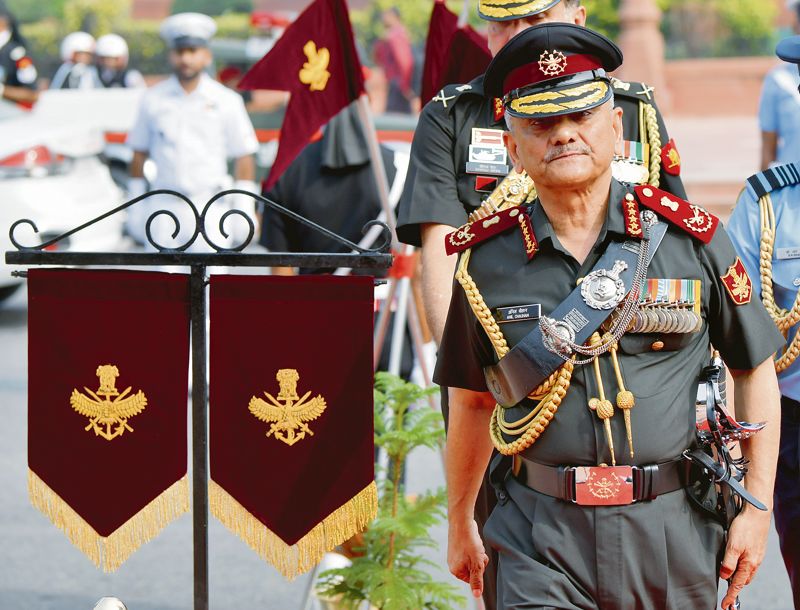
THE recent appointment of Lt Gen Anil Chauhan (retd) as the Chief of Defence Staff (CDS) after an inexplicable delay of 10 months is indeed welcome news and puts at rest any apprehension about the rollback of this apex position in the hierarchy of the armed forces.
The amendments to the statutory provisions laid down for the three services for the selection of the CDS a few months earlier gave this appointment a somewhat political hue. However, any individual who meets the current selection criteria for the top job in the armed forces will undoubtedly be a professional of exceptional and proven calibre and competence and such is well the case with the present appointment.
What is the task ahead for the CDS? Primarily to bring about jointness in operations, logistics and maintenance of the three services. As the head of the Department of Military Affairs, the CDS also has to facilitate the restructuring of military commands for an optimal utilisation of resources. This would be achieved by bringing about jointness in operations, including through the establishment of joint theatre commands. The new incumbent has spelt out the need to look after the interests of all three services and build a synergised approach in going ahead in fulfilling the mandate.
There appears to be a strong desire for bringing about changes in the services, especially the Army. The armed forces have been constantly evolving their structuring, organisation, equipment and training according to the security requirements. Their doctrines are under constant review as per the changes taking place in threat perceptions and advances in technology. The desire for change should be focused on tangible capability-enhancing factors, like the induction of high-end technology into weapons and equipment of the three forces, which boost their lethality, mobility, battlefield transparency and survivability. What need to be shed are budgetary constraints and labyrinthine processes that have been a dampener on the acquisition of military weapons and equipment. These are the key areas and issues that need to be addressed by the CDS with a missionary zeal.
However, the desired level of integration, even in basic issues like the commonality of logistics and acquisitions, still seems a far cry despite having had a very proactive CDS for almost two years. In this vein, achieving structural and operational jointness appears to be almost a pipe dream. The prime reason, apparently, is the lack of desire to move in this direction by one or the other service headquarters by protecting their turf and safeguarding parochial interests.
In a joint theatre command scenario, the primacy of individual service will always be to the fore in specific structures. The integrated air defence of the nation must be with the Air Force and the maritime expanse of the Indian Ocean and beyond the domain of the Navy. However, the integrated theatre commands, looking after our land borders in the East, North and West, have to be with the Army as the lead service. All this calls for asking some uncomfortable questions and taking even more difficult decisions.
Air transport, even the biggest, is only an instrument to support the land Army. Siachen and other high-altitude deployments are sustained largely by air effort. Similarly, all helicopter operations, whether for ferrying troops or supplies, casualty evacuation or even in the attack mode, would be in support of the operations conducted by an Army formation. Even a bomber run is meant to destroy enemy assets with shock and awe tactics preceding a land offensive. The fact that the IAF has and will always be in support of the Army, which is required to combat aggressive and hostile neighbours, is a reality that has to be accepted. Not doing this amounts to frittering efforts, energy and resources, something that India can ill afford.
Momentous decisions on integration can be taken only by the political executive. Expecting the CDS to accomplish the integration needed for a joint structure is asking too much of him. Being first among equals, he may endeavour to build a consensus for change with the three service chiefs, but he is not empowered to force this change. Such decisions have been taken in other countries by the political executive.
Two examples pertaining to the restructuring of the armed forces of nations of global consequence amply support this approach.
In the US, it was the Senator Goldwater-Congressman Nichols Department of Defence Reorganisation Act in 1986, signed by the then President Ronald Reagan, that made the most sweeping changes to the United States Department of Defence by reworking the command and organisational structure of the armed forces. The Goldwater-Nichols Act was an attempt to fix problems caused by inter-service rivalry, which had emerged during the Vietnam War.
At the other end of the spectrum, in a totalitarian regime like China, the integrated theatre commands of the People’s Liberation Army (PLA) emerged at an accelerated speed in the last decade due to the simple reason that this change was driven by the Central Military Commission, whose Chairman is the triple-hatted President of China and, more importantly, the General Secretary of the Communist Party.
Integrated command and formation structures are long overdue in the Indian context. Gleaning from the Prime Minister’s yearly address at the Combined Commanders’ Conference, the political executive is positively inclined to and desirous of this.
The creation of the CDS post was a decision taken by the political leadership, as was the decision to widen the pool from which he could be appointed. Both have gone through smoothly once decided upon by the Cabinet.
A similar top-driven approach is needed for the armed forces to evolve into a fully synergised joint organisation.
At some stage, the call has to be taken against turf wars and specious arguments for status quo. While the CDS can, and surely will, be a facilitator for this change, it has to be strongly driven by the political leadership so that we achieve the optimum utilisation of national efforts.
State Stalwarts
DEFENCE MINISTER
Minister Rajnath Singh
ALL HUMANS ARE ONE CREATED BY GOD
HINDUS,MUSLIMS,SIKHS.ISAI SAB HAI BHAI BHAI
CHIEF PATRON ALL INDIA SANJHA MORCHA
LT GEN JASBIR SINGH DHALIWAL, DOGRA
SENIOR PATRON ALL INDIA SANJHA MORCHA
MAJOR GEN HARVIJAY SINGH, SENA MEDAL ,corps of signals
.
.
PATRON ALL INDIA SANJHA MORCHA
MAJ GEN RAMINDER GURAYA ,MADRAS REGIMENT
sanjhamorcha303@gmail.com
PRESIDENT SOUTH ALL INDIA SANJHA MORCHA
COL SS RAJAN BOMBAY SAPPERS,
PRESIDENT UTTARAKHAND ALL INDIA SANJHA MORCHA
COL B M THAPA ,BENGAL SAPPERSS
PRESIDENT HARAYANA STATE CUM COORDINATOR ESM
BRIG DALJIT THUKRAL ,BENGAL SAPPERS
PRESIDENT TRICITY
COL B S BRAR (BHUPI BRAR)
PRESIDENT CHANDIGARH ZONE
COL SHANJIT SINGH BHULLAR
.
.
PRESIDENT PANCHKULA ZONE AND ZIRAKPUR
COL SWARAN SINGH
INDIAN DEFENCE FORCES
DEFENCE FORCES INTEGRATED LOGO
INDIAN AIR FORCE
Air Officer C-in-C WESTERN AIR COMMAND
AIR MSHL S PRABHAKARAN AVSM VM
AOC-IN-C, EASTERN AIR COMMAND
Air Marshal Inderpal Singh Walia
AOC-in-C SOUTH WESTERN AIR COMMAND
Air Marshal Vikram Singh
AOC-IN-C, SOUTHERN AIR COMMAND
Air Marshal J.Chalapati
AOC-IN-C TRAINING COMMAND
AIR MARSHAL SK GHOTIA VSM
AOC-IN-C MAINTENANCE COMMAND
Air Marshal Jagdish Chandra
Flag Officer Commanding in Chief, Western Naval Command
ice Admiral R Hari Kumar, PVSM, AVSM, VSM
Flag Officer Commanding in Chief, Eastern Naval Command
Vice Admiral Sanjay Bhalla, AVSM, NM
Flag Officer Commanding in Chief, Southern Naval Command