Days after Lt Colonel Saurabh Yadav died in an Army aviation helicopter crash in Arunachal Pradesh’s Tawang, the Indian Army Wives’ Agitation Group has written to Prime Minister Narendra Modi, terming the Cheetah and Chetak series of copters “flying coffins”.
Lt Col Yadav was flying a Cheetah when it crashed on October 5. His co-pilot was injured. The Cheetah choppers are based on a 1950s design and several attempts to induct their replacement have failed to fructify over the past 15 years. These copters, weighing over 3.5 tonne, fall in the light utility helicopter (LUH) class. These are the lightest copters in the Army and IAF fleet.
2 Army personnel killed in field firing exercise in Madhya Pradesh
Two Army personnel were killed and another was injured during a field firing exercise involving a tank in Madhya Pradesh’s Babina, officials said on Friday.
The two personnel were hit when the barrel of the T-90 tank burst, they said.
“During the annual firing at Babina Field Firing Ranges on October 6, a tank barrel burst took place. The tank was manned by a crew of three personnel. The crew was provided immediate medical aid and evacuated to military hospital in Babina,” said an official.
“The commander and the gunner unfortunately succumbed to burns. The driver is out of danger and under treatment,” the official said.
First such initiative by Air Force since Independence
In what is the biggest rejig of the force in decades, the Union Government has approved the creation of a weapon systems branch for the officers of the Indian Air Force (IAF).
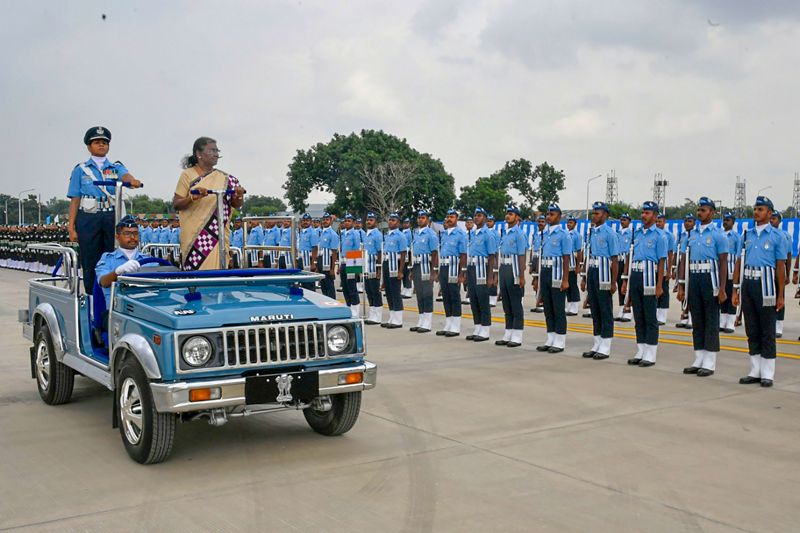
The announcement was made by IAF Chief Air Chief Marshal VR Chaudhari in Chandigarh on Saturday during a parade to mark the 90th anniversary celebrations of the Air Force. He said it was the first time since Independence that a new operational branch had been created. The branch will be divided into four sub-streams, each with its own specialisation to carry out launch of weapons, collate information and even operate space assets.
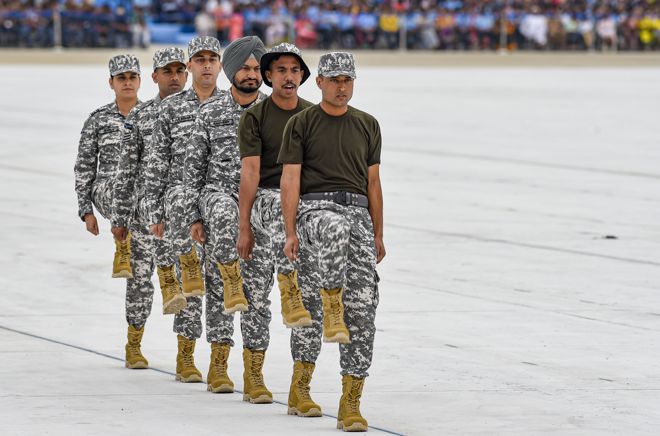
IAF personnel in new combat uniform.
The branch will induct a specialised cadre of officers and be in-charge for all major weapons’ firing, including those launched from some fighter jets, all helicopters and even ground-launched missiles like the S400 imported from Russia. The cadre will also be responsible for UAV and space operations.
Will save Rs 3,400 cr
Creation of weapon systems branch will result in savings of over Rs 3,400 crore due to reduced expenditure on flying training. —Air Chief Marshal VR Chaudhari
This would essentially be for manning of four specialised streams of surface-to-surface missiles, surface-to-air guided missiles, remotely piloted aircraft (better known as UAVs) and all weapon system operators in twin-engine and multi-crew aircraft, the IAF Chief said.
“Creation of this branch will result in savings of over Rs 3,400 crore due to reduced expenditure on flying training,” he said.
The first sub-stream is ‘flying’. Officers in this category will be weapon systems operators in twin-engine and multi-seat aircraft like fighters jets Sukhoi30 MKI — some 265 in the fleet. All attack helicopters also fall in the same category, including the Boeing Apache AH-64E, the indigenous light combat helicopter (LCH) and the Russian Mi -25/35.
The second sub-stream will be called ‘remote’. Personnel will be operators of many UAVs like the Predator from the US or the armed version of the domestic UAV Rustom (now known as the TAPAS-BH) made by DRDO.
Another sub-stream is ‘intelligence’. This shall comprise analysts of imagery obtained through surveillance assets in space or UAVs. Analysts of intelligence inputs, information warfare specialists, observers and signal intelligence collation will be part of it and so will operators of space systems.
The fourth sub-stream is named ‘surface’. It shall have mission commanders and operators of surface-to-air guided weapons and surface-to-surface missiles. The newly imported S-400 missiles from Russia will be part of it and so will be all air-defence weapons like the Akash missile.
Specialised cadre in 4 sub-streams
Flying: Air Force officers in this category will be weapon systems operators in twin-engine and multi-seat aircraft like fighters jet
Kenya’s first woman General leads delegation to Indian Military Academy
In furtherance of traditional India-Kenya ties and defence cooperation, Maj Gen FG Ahmed, Commandant, Kenya Military Academy, visited the Indian Military Academy (IMA), Dehradun, along with a high-level delegation comprising five members from the Kenyan armed forces.
Maj Gen Ahmed is the first woman to hold the rank of General in the Kenya Armed Forces and the Commandant Kenya Military Academy. She was commissioned as a Second Lieutenant in 1985 and posted to the Kenya Air Force.
During its three-day visit that concluded today, the visiting delegation was briefed in detail the training regime being followed at the IMA, including the representation from friendly foreign countries, a spokesperson for the IMA said.
The Commandant of the Kenyan academy appreciated the determined and daring junior leadership, courage of the Indian gentleman cadets at the tactical level and the swift execution of military strategy and plans displayed during the operational tasks assigned to them as part of training.
The Kenya delegation also appreciated the state-of-the art training facilities at IMA being utilised for training the cadets to face the varied challenges of modern day warfare. They also commended the staff for maintaining stellar training standards.
The Kenyan General interacted with Lt Gen VK Mishra, the IMA Commandant, on training and administrative matters and exchanged notes on various aspects of military training.
She also interacted with the cadets undergoing pre-commission training and applauded them for their camaraderie, team work and resilience. She mentioned that IMA has produced top-class military leaders who have risen to highest levels in friendly countries who send their cadets for training here.
The tank, mechanised makeover: Armoured Corps and Mechanised Infantry are undergoing their biggest transformation
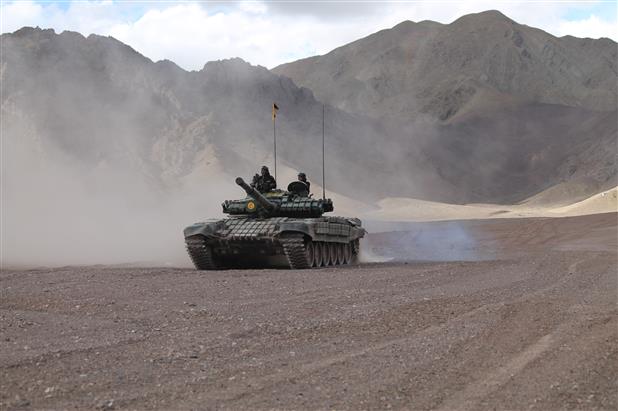
A T-72 tank of the Army deployed in eastern Ladakh (file pic). Photo courtesy: MoD
Ajay Banerjee
DURING the ongoing military stand-off with China in eastern Ladakh, the 1 Strike Corps of the Indian Army — headquartered at Mathura and tasked westwards — was given a mandate along the Line of Actual Control (LAC). Hundreds of tanks and infantry combat vehicles — colloquially known by their Russian brand name ‘BMP’— were moved from the plains to the LAC.
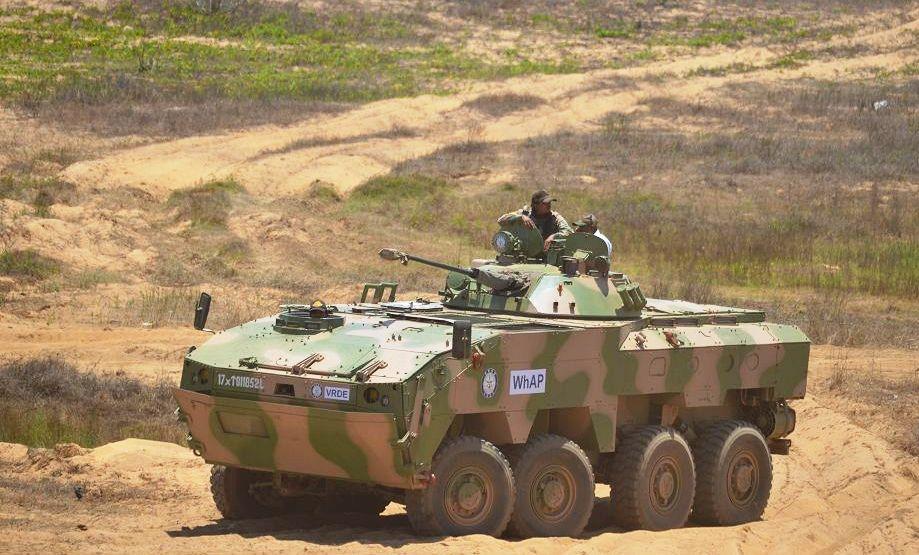
A wheeled armoured protected vehicle, made by DRDO, being used by Mechanised Infantry.
For years, regiments of BMPs and tanks have been positioned on the plateau of eastern Ladakh and northern Sikkim. The stand-off forced fresh inductions since the Army assessed that “threats on the northern borders are likely to remain in the foreseeable future”.
Learning a lesson from the stand-off, the Armoured Corps and Mechanised Infantry of the Army are undergoing their biggest transformation in decades. Former Director General Military Operations (DGMO), Lt Gen Vinod Bhatia (retd), says, “The Indian armed forces have built requisite capabilities and enhanced capacities to deter China’s aggressive behaviour along the LAC.”
A series of changes include equipping the regiments with drones that can function as a swarm, addition of loitering ammunition, beyond-line-of-sight guided missiles, systems to bring down enemy drones, swifter and more powerful tanks, specialised high-altitude tanks, new generation armoured vehicles and missile launchers, besides better anti-tank guided munitions (ATGM).
The infusion of greater technology and precision strike capability will keep the armoured and mechanised forces relevant as ‘new’ airborne threats like drones and loitering ammunitions have emerged. Former Western Army Commander Lt Gen KJ Singh (retd) says the “focus has to be on boosting protection against top attack (from air); tanks need to have agility and imaginative dispersed deployment”.
Loitering ammunition
It can stay up for a specified period and be programmed and controlled from the ground to hit specific targets at the desired time. The plan is to acquire a canister launch system that will be integrated on the ‘BMP-2’.
Swarm drones
The two arms of the Army are now getting niche technology — one of them is ‘swarm drones’ sourced from two Indian start-ups. Swarm drones consist of a number of drones controlled from the ground station that can carry a variety of ammunition. They are capable of overwhelming enemy defences. Tests have been carried out in Ladakh.
Artificial Intelligence (AI) allows a swarm of drones to communicate with one another and also the control station. AI-based ‘swarming algorithms’ enable the drones to automatically distribute tasks among themselves to target the enemy equipment on ground like artillery, air defence equipment, command and control centres and vehicles.
AI-based targeted attack
The Army has also initiated a case for drones that can autonomously do surveillance and also be armed to launch a strike when needed. This includes operations in high-altitude areas like Siachen, eastern Ladakh and Sikkim.
Known within the Army as the Integrated Surveillance and Targeting System (ISAT-S), it enables beyond-line-of-sight attack. The surveillance drone will fix targets and launch smart munitions automatically on identified targets for a precision kill. Artificial Intelligence ensures recognition and differentiation between targets like tanks, gun positions, vehicles and humans.
These are to be integrated with tank formations.
The ISR punch
Intelligence, surveillance and reconnaissance (ISR) will provide a better picture to commanders on the ground in case of a conflict. These will use mini-UAVs, specialised equipment to ‘see through armour’, and autonomous combat vehicle — the last one being a ground-based unmanned vehicle that can be sent ahead to tackle the enemy. “Fuel cell and alternate fuel-based technologies are being worked on to ensure a system that allows for silent overwatch,” said a senior Army official.
An AI-based surveillance system allows for an alarm to be triggered in case of unusual movement, facilitating faster decision-making. Gen Bhatia adds: “High-altitude warfare now includes light tanks, drones, loitering ammunition, night-fighting capability, better surveillance, well equipped and armed soldiers and long-range artillery guns.”
New light tank, Zorawar
After the recent experiences along eastern Ladakh, the Army is looking at an indigenous light tank in the range of 25 tonnes. Named ‘Zorawar’ — after Zorawar Singh, the Dogra General who captured Ladakh in 1834 — the tank is being designed to be transportable in a C-17 plane of the Indian Air Force for rapid deployment.
Zorawar will have niche technologies to include artificial integration, drone integration, and have a high degree of situational awareness. “The next generation of tanks is to be based on minimising radar signature, enhanced agility and countering drones,” says Gen KJ Singh.
China has inducted a large number of medium and light tanks. In contrast, the Indian Army had to induct a considerable number of T-72 and T-90 tanks (weighing 41 tonnes and 46 tonnes, respectively) in operational areas. “These helped in gaining tactical surprise. However, these tanks were primarily designed for operations in plains,” said a serving officer.
Future tanks
The Army has a considerable fleet of battle tanks consisting of T-72s, T-90s and Arjun. While the T-72s have been the main battle tank of the Armoured Corps for close to 40 years, the time has come for induction of modern tanks
The target is a state-of-the-art future ready combat vehicle (FRCV) as future conflicts are estimated to be intense, fast-paced and multi-dimensional.
It will carry niche technologies to include AI, drone integration, a protection system, have a high degree of awareness about the battlefield and be capable of operating with the unmanned ground vehicles.
“FRCV will be able to integrate itself with all war-waging platforms on land and in air while being seamlessly networked with each other,” a senior officer said. FRCV will be inducted in a phased manner from 2030.
The main battle tank, the Arjun MK-1A, is a technological improvement over the Arjun inducted a decade ago. This version will carry 71 new features, and is all set to acquire missile-firing capability from its main gun. The missile firing from the main gun has been tested successfully.
The tank would ensure effortless mobility in all terrains, besides precise target engagement during day and night. The Army has placed an order for 118 Arjun MK-1As.
Mechanised forces’ changes
In the past four decades, the Mechanised Infantry has been employed in conventional and unconventional operations and terrains — in the high-altitude areas of eastern Ladakh and Sikkim to the deserts of Rajasthan and plains of Punjab.
For Mechanised Infantry, the target is replacement of vintage equipment with futuristic platforms, and capability enhancement of existing equipment through upgrades.
One of the biggest changes is an indigenous engine. It’s being trial-evaluated. Multiple projects are also being progressed for better survivability, modern navigation aids, effective communication and critical operational logistic requirements.
A futuristic infantry combat vehicle (FICV) is to replace the existing lot of BMP-2s. The project is all set for getting an approval from the Ministry of Defence.
The Mechanised Infantry is getting lethal capability beyond visual range (BVR); this includes automatic 30-mm cannon and co-axially mounted 7.62-mm machine gun to engage aerial targets.
Changes in tank formations
Niche technologies to include AI, drone integration, higher situational awareness and ability to work with unmanned teams.
It will synchronise with technological advancements to dodge and negate enemy surveillance systems, counter aerial threats and enhance own survivability.
Arjun MK-1A tanks will have 71 new features, and have missile firing capability from its main gun. 118 Arjun MK-1As have been ordered.
Indigenous light tank ‘Zorawar’ is designed to operate in varying terrain. Niche technologies will include AI and drones.
The future ready combat vehicle (FRCV) is targeted for induction in 2030. It will be a force-multiplier for future conflicts, which are expected to be multi-dimensional.
About the Mechanised Infantry modernisation plan
Acquisition of contemporary, adaptable and niche technology, along with interoperability with other arms.
Replacement and new acquisition of equipment capability enhancement include night ops, better lethality, firepower, ISR (intelligence, surveillance & reconnaissance).
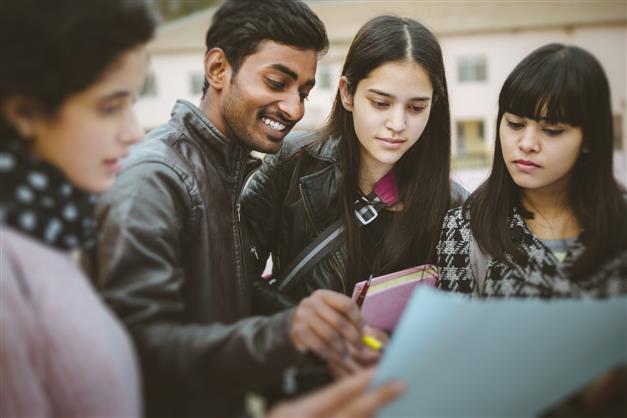
In a move that will help Indian students offset the falling value of the rupee and combat inflation, Canada has allowed international students to work over 20 hours per week off-campus while the class is in session. This is being permitted as a temporary measure from November 15, 2022 to December 31, 2023.
At present, international students in Canada can work off-campus during their studies for up to 20 hours per week. This limit is lifted during scheduled breaks such as the summer and winter holidays.
This measure will allow over five lakh eligible international students already in Canada to potentially work more hours. Aimed at alleviating labour shortages, it will also apply to those who have already submitted a study permit application, announced Immigration Minister Sean Fraser in Ottawa on Friday.
Fraser said Canada has already processed more than 4.52 lakh study permit applications since January, a 23 per cent increase compared to the 3.67 lakh processed over the same period last year.
In 2021, Canada had over 6.20 lakh of which one-third were from India.
This policy allows international students to support themselves financially while also seeking to ensure that they remain focused on completing their studies rather than be focused on working in Canada. Facing nearly 10 lakh job vacancies, however, has resulted in the Canadian government easing this rule for just over a year.
Canada has been banking on international students as a key channel for permanent residents in recent years and most of the 4.05 lakh immigrants given citizenship last year were from this category.
According to research reports, most of the foreign students are interested in remaining in Canada as permanent residents after completing their studies.
According to Statistics Canada, international students who get permanent residence tend to integrate quickly into the Canadian labour market due to their previous experience of living in the country on visas.
The Immigration, Refugees and Citizenship Canada (IRCC) already offers a Post-Graduation Work Permit which allows work for three years for any employer of their choice.
In September, Fraser had proposed a strategy on helping more temporary residents gain permanent residence which will be incorporated in the new Immigration Levels Plan 2023-2025 to be unveiled on November 1.