Sanjha Morcha

What passengers need to know before boarding domestic flight Slew of guidelines, from one check-in bag to installing Aarogya Setu app

What passengers need to know before boarding domestic flight

ndian nationals, who were stranded in UK due to COVID-19 pandemic, check-out from the international airport after arriving from London in a repatriation flight under the Vande Bharat Mission, at Gannavaram near Vijayawada. PTI

New Delhi, May 21

A day after announcing the resumption of domestic commercial passenger flights from May 25, the Civil Aviation Ministry on Thursday issued detailed guidelines for airlines, airports, passengers and other stakeholders on issues ranging from control on air fares to restrictions on number of bags.

Here are the points passengers should keep in mind: 

  • Before entering the terminal, passenger to ensure that he or she is wearing a mask
  • Passenger to report at the airport 2 hours before flights
  • Passenger to travel in an authorized taxi/personal vehicle following the norms specified by the Home Ministry
  • During transit to airport, the passenger should take all precautions to prevent infection
  • Passenger to certify the status of history of his or her health through the Aarogya Setu App or a self-declaration form
  • Ensure web check-in and obtain a boarding pass
  • Baggage limitations – Only one check-in bag and one cabin bag allowed
  • Vulnerable persons such as very elderly, pregnant women, passengers with ailments are advised to avoid air travel
  • Passenger to download the baggage tag and baggage identification number, print it and affix it on the bag at a prominent place
  • In case the passenger is not able to print the baggage tag, then he or she should mention the PNR number and his or her name on a thick piece of paper and affix it / tag it with a strong string
  • Passenger to proceed to security hold area after security screening
  • While waiting in the security hold area, passenger to maintain social distancing and sanitisation protocols
  • Chairs marked ‘Not For Use’ should not be occupied
  • Passenger to dispose all the bio-hazardous material like used masks, gloves, tissues etc. in the yellow-coloured disposable bins/bags placed at strategic locations at the airport
  • Passengers to collect the safety kit (three-layered surgical mask and sanitiser) from the airlines near the boarding gate
  • Passengers to wear mask and sanitise his/her hands before proceeding to the boarding gate for scanning of the boarding pass
  • Passengers to be attentive towards boarding announcements and reach the boarding queue by following social distancing
  • Display of identity cards by passengers is a must & check-in of the boarding pass would be done by the passenger by self-scanning of e-boarding pass
  • During the flight, passengers to strictly follow hygiene and sanitation. Face-to-face interaction to be minimised
  • Passenger to minimise the use of toilets and avoid any non-essential movement in the aisles
  • No queuing at the toilets and only one companion for children and the elderly would be allowed
  • No meal service in the aircraft. Water bottle to be made available in the galley area or on the seats. Eatables not to be consumed during the flight
  • No newspaper or magazine will be available, no onboard sale of any item
  • If the passenger feels uncomfortable, fatigued or has respiratory distress, it should be brought to the immediate notice of the crew
  • The disembarkation from the airlines would be sequential
  • Social distance and sanitation should be maintained at the arrival gate aerobridge, coaches, jet ladders ramps etc
  • To disembark passengers to strictly follow the instructions of the crew
  • Trolleys in the arrival area to be used sparingly
  • Passenger to wait at the baggage hold area till the baggage arrives in batches. — Agencies

2 ex-Major Generals charged with graft Answer sheets were ‘manipulated’ by accused officers

2 ex-Major Generals charged with graft

New Delhi, May 19

The Central Bureau of investigation (CBI) has booked two former Major Generals for alleged corruption in conducting Group C and D examinations in the Survey of India in 2002, resulting in wrong selection of 44 candidates as those who had succeeded were made to fail, officials said on Tuesday.

The FIR has been registered against then Brigadier MV Bhat, Director, Survey Training Institute (STI), and then Brigadier KRMK Babaji Rao, Deputy Surveyor General, STI. Both of them retired as Major Generals, they said.

CBI-1

Other names include JK Rath and R Rama Singh, the then officials of STI.

The agency has registered the FIR after a two-year-long preliminary inquiry based on a complaint from a vigilance officer in the Ministry of Science and Technology who alleged malpractices in compilation of marks in the answer sheets of the Limited Departmental Competitive Examination for Group D to C Topo Trades held during October 2002 in the Survey of India. It was alleged that candidates who had passed were made to fail and vice versa, resulting in wrong selection of 44 candidates. The agency had alleged that answer sheets were deliberately manipulated by accused officers to favour selected candidates, they said. — PTI


Chinese daily hints at new LAC flashpoint

Chinese daily hints at new LAC flashpoint

Tribune News Service
New Delhi, May 18

Chinese newspaper Global Times today hinted at opening of another flashpoint on the Sino-India border, but played down the possibility of a serious situation, as witnessed in Doklam in 2017.

Nepal to issue new map

New Delhi: Responding to India blacktopping a road that passes through an area it claims sovereignty on, Nepal on Monday decided to issue a new political map that includes this land at Lipulekh. The map will depict Kalapani and Limphudhara that are also claimed by Nepal. TNS

Quoting unnamed military sources, it said Chinese border defence troops have made necessary moves in response to “India’s recent, illegal construction of defence facilities across the border into Chinese territory in the Galwan Valley region”.

“India is merely seeking to divert domestic attention due to its unsuccessful handling of Covid pandemic, and China has a military advantage there. So, the Indian military won’t escalate the incident,” it said, quoting Chinese analysts.

The paper accused India of crossing the boundary in Galwan Valley of Ladakh. “The Indian side built defence fortifications and obstacles to disrupt Chinese border defence troops’ normal patrol, purposefully instigated conflict and attempted to unilaterally change the current border-control situation.”

Indian media has also been reporting tension in the sector for the past one week.

The Ministry of External Affairs (MEA) has not commented on the flare-up, but it reacted to troop face-offs last week in two sectors by expressing confidence in the ability of the existing mechanism to resolve the issue.

The MEA also suggested that the face-offs were not part of a grand strategy by explaining that these occasionally occur due to difference in perception of the LAC alignment.


Three years of service unlikely to attract talent

he utility of officers employed for the proposed three-year service would be highly suspect. We will end up being flooded with officers of the Captain rank who will be going around looking for odd jobs in the civil market. To draw on the right material that can meet the demands of exacting standards of performance in the defence services, the terms and conditions offered for short service commission have to be attractive enough.

Three years of service unlikely to attract talent

Lt Gen Harwant Singh (Retd)

Military Commentator

THE news that the Army is considering a proposal to allow civilians to join the force for three years, claimed to be an effort to attract talented young people, is laughable. How does one attract good talent with the offer of just three years’ service? What will be the utility of an officer when taken in for such a short period is the question the higher command needs to address.

The proposal is part of efforts to bring in reforms in the 13 lakh-strong Army. The military appears to be under pressure to cut its expenses in every possible manner. This is in keeping with the proposal to reduce the defence budget. The military’s higher command, in response to this demand from the government, is going about like a bull in a china shop rather than applying its mind and standing up for what is inescapable for national security.

Several committees have looked into reorganising the Army, essentially to cut costs, reduce teeth-to-tail ratio, make the Army more efficient (lean and mean, a phrase often used) and improve the career prospects of the officer cadre. Still, there appears to be continuing pressure on the military to further decrease expenses. There is little realisation that in areas of national defence, as in life, some things do not come cheap.

However, the government (MoD) has been cherrypicking only those recommendations of various committees that conform to its thinking and plans. Thus, many of the more useful recommendations of the Ajai Vikram Singh Committee and more recently those of the Shekatkar Committee have been left out. Since most of the recommendations are interlinked, so when you do ‘cherrypicking’, it leads to disruptions and complications and the end result is often the opposite of what was intended.

The number of civilian employees paid out of the defence budget is around 3.75 lakh. These are from various groups such as the Defence Research and Development Organisation (DRDO), ordnance factories, Military Engineer Services (MES), defence PSUs. MoD, etc. Though they are around 25 per cent of the strength of the defence forces, in terms of pay, allowances and pensions, their take-home, in proportionate terms, is much higher.

This is due to non-functional financial upgradation (NFFU) granted to these civilian employees and the availability of far more vacancies for them in higher pay bands, compared to those in the defence forces. Further, their advancement in career to higher pay bands (due to NFFU) comes with far shorter service than that of defence forces officers. Thus, an officer in Class A service — most of them among these 3.75 lakh are in this class — climbs to the pay band of a joint secretary to the Government of India with 19 years of service, while a Major General, unfairly equated with a joint secretary, gets to that pay band after around 29 years of service.

This group of 3.75 lakh is the actual tail that needs drastic pruning and yet it has never been touched. In the defence forces, there are about 20 in the apex scale of pay, whereas among these civilians, with a far smaller cadre strength, the figure is well over 100.

Nearly 70 per cent of the Army’s budget is tailored towards revenue expenditure, leaving little money for other essential requirement of modernisation etc. A former Chairman, Chiefs of

Staff Committee, Admiral Arun Prakash (retd) highlighted this aspect in an article. What seems to be missed out is that revenue expenditure is 70 per cent because the budget itself is small (during 2019-20, it was about 1.46 per cent of the GDP). If the allocation for defence were to be 3 per cent of the GDP (as proposed by the Parliamentary Committee of Defence), this percentage would perhaps come down to 40 per cent or less of the defence budget.

A review of the officer cadre involves the ratio between regular and short service cadre and rank structure of various appointments within the service. In the past, the Ajai Vikram Singh Committee recommended a ratio of 1:1.1 between the regular and short service cadre. The more appropriate ration should be 60:40 (60 per cent regular and 40 per cent short service).

The authorised strength of the officer cadre of the Army is nearly 40,000. Presently, the shortage of officers is around 12,000; it has persisted all along and impacts the performance of units.

Presently, the short service commission officers serve up to 10 years, extendable to 14. Such length of service has drawbacks and problems of readjustment and re-employment in civil life. Equally, such terms and conditions of service just cannot attract good material.

On the proposed three years of service, the utility of officers employed for such a short period would be highly suspect. We will end up being flooded with officers of the Captain rank, released from the Army, who will be going around looking for odd jobs in the civil market, which will have its own impact on the military’s standing in civil society.

To draw on the right material that can meet the demands of exacting standards of performance in the defence services, the terms and conditions offered for short service commission have to be attractive enough.

Therefore, the duration of the short service should be five years with additional four months for training. Their academic qualification should be Class XII (science stream) or graduation. As regards their resettlement, a small percentage may be absorbed in regular commission and all others given assured admission and free technical education with stipend for the duration of their education. Some can be absorbed in CPOs and central civil services.

Those who wish to altogether opt out should be given an appropriate one-time financial grant. These officers could be given CSD canteen facilities.

Finally, from what has been appearing in the press, asking the military to accept second-grade weapons and equipment, reducing the strength of officers and men in units, and changing organisations of field formations throws up a dismal picture.

Possibly, we are moving closer to our state that prevailed before 1962. The military’s higher command owes it to the nation to keep the country safe and stand up for national security interests.


How to sanitise essential items at home, PGI doctor explains

Virus cannot survive or remain stable on newspapers, cash or books for long. one should keep them outside for 2-3 hours before using them.How to sanitise essential items at home, PGI doctor explains

Plastic or metal items like pen or pencil box can be sanitised as there is evidence that sanitisers work on them. (Source: File Photo)

During the pandemic, as people bring essentials or other items home, the fear of contracting coronavirus from the same also looms large. PGIMER’s Department of Community Medicine and School of Public Health Professor Dr Sonu Goel explains why sanitisers are not recommended for use on fruits and vegetables and handling of cooked food can be a cause of concern. While busting myths, Professor Goel also sheds light on the protocol to be followed while bringing essentials to one’s home.

How can we ensure safety as we get vegetables and fruits from the vendors?

This virus is likely to remain on fruits and vegetables for 6-8 hours and if they are exposed to heat, the virus stays on it for less than four hours. In any case, when one get vegetables from vendors, the general protocol should be that they should keep it outside for four hours within the packet itself.

After the said time, dispose of the packet and put the eatables in warm water or wash them with warm water and baking soda to ensure complete safety.

There are many who use sanitisers on vegetables and fruits. Is it a suitable method?

Sanitisers are completely not recommended for vegetables and fruits, rather they can be harmful because of the presence of chemicals. Moreover, there is no evidence that the sanitisers can kill virus on vegetables and fruits.

Sanitisers are useful only for our hands, body and metal or steel surfaces. Spraying chemicals on vegetables and fruits, becomes all the more harmful as it is chemicals being sprayed on things which one will consume.

Warm water is sufficient or put just a drop of KMnO4 or potassium permanganate in the warm water and dip the eatables in it. It is the safest to use and also pocket-friendly.

If one does not have potassium permanganate, baking soda can be used in warm water. Wear a mask while doing it.

What should be done in case of items such as bananas or onions which cannot be dipped in warm water or washed?

It is like a catch 22 situation especially now when the temperature outside is soaring and there are perishable items also. Such items should be put in a closed space where heat does not reach it directly.

The aim is to not expose yourself to these things and keep them outside for 3-4 hours before consuming them. Do not immediately cook these vegetables or consume the fruits.

In case of medicines strips too, there is no evidence that sanitisers work on them. Keep them in a closed box at room temperature. One should not get exposed to them immediately after buying them as they too have changed hands several times.

Ensure that you does not put these medicines under direct sunlight as it could affect its efficacy.

Many companies have launched vegetable sanitisers. Do you recommend them?

I am not aware of the composition of these sanitisers. If these vegetable sanitisers have KMnO4 or potassium permanganate, then it is fit for use or else not.

What should one do in case of grocery items such as cheese and milk which cannot be kept outside for four hours?

If cheese and milk are packed, one should wash them with soap water and immediately dispose of the outer packet (all while wearing ones mask). However, these packets should not be disposed of in an open dustbin.

They should be discarded in a way that they are not directly exposed to any human being. In case of items in plastic, metal or cold drink cans, the virus may remain for 24-48 hours.

Thus, such items should not be refrigerated, but kept at room temperature where there is no human exposure.

Is cooked food that is ordered from outside safe? What about cooked food that comes packed in boxes?

There is no problem with cooked food because it is already heated at boiling temperature which the virus will not survive. Cooked food is not the issue but its handling is a cause of concern as someone must have packed it and then delivered.

It changes hands several times in the process. Ideally, one should avoid cooked food from outside. If there are unavoidable circumstances, ensure that the packet it is coming in, such as the pizza box or cake box, are discarded immediately.

There is no evidence that sanitisers are effective on cardboard surfaces, thus, using it may prove futile.
What to do in case of cash, newspapers or stationery items? Many governments are sanitising books and recommending the same.

Virus cannot survive or remain stable on newspapers, cash or books for long. one should keep them outside for 2-3 hours before using them.

Sanitisers may be of no use on these. Plastic or metal items like pen or pencil box can be sanitised as there is evidence that sanitisers work on them.

How should the purchased garments or shoes be sanitised? Should the received letters and courier be sanitised?

One should make sure that the shoes worn outside are not used inside the house, as there is a possibility that one could have stepped on an infected person’s spit or similar contaminated surface, while outside.

In case of purchase of new garments and shoes, they should be kept in the verandah or balcony for 48 hours. It is recommended that one should wash the new garments before wearing it.

Courier or post received should also be kept in the sunlight before being accessed- if paper-based, it should be kept under sunlight for 3-4 hours, while if it is plastic or metal based, it should be disinfected.

One must also ensure that they use their own pen while signing on receipt letters brought by the postman.

5 Safe Methods of Disinfecting Your Home

cleaning glass

Vinegar is ideal for cleaning glass because it doesn’t leave a film or streaks behind. JUSTIN PAGET/GETTY IMAGES

It’s the weekend and time to clean the house. You’re elbow deep in rubber gloves, wielding a can of disinfectant in one hand and a bottle of bleach in the other. Sure, you want to disinfect your home, but who wants all of those chemicals floating around in the air that you breathe?

The good news is you don’t need to use harsh chemicals to keep your house clean and germ-free. And the best part about using natural products is that they tend to be cheaper than a bottle of store-bought household cleaner. Here are five safe methods you can use to disinfect your home that won’t break the bank.

1. Vinegar

Anyone who has used vinegar as a cleaning solution is bound to give it rave reviews. This is because despite its stinky nature, vinegar is an all-natural disinfectant. It contains acetic acid, which gives it antimicrobial properties and makes it great at killing mold. Vinegar has endless uses in the household; it’s ideal for cleaning glass and stainless steel without leaving streaks. It can also get that nasty mold out of your toilets and sinks, and it’s safe for washing all of your fresh produce. Some tough jobs around the house call for straight vinegar, but for those everyday jobs, just mix one tablespoon of vinegar with 1 cup (29 milliliters) of water and keep it in a spray bottle.

2. Hydrogen Peroxide

You’ve surely used hydrogen peroxide to clean out a cut before applying a bandage, but did you know it’s also great for household cleaning? It does wonders on stains in both carpets and clothes, and when used in conjunction with vinegar, it’s an excellent scum buster on tubs and tile. And unlike vinegar, hydrogen peroxide doesn’t have a noticeable smell nor does it need to be diluted with water. It’s also handy for washing your produce and whitening your teeth.

3. Lemon Juice

If your house is plagued with alkaline stains like soap scum, crank out the lemon juice. The citric acid in lemons helps break down that annoying scum better than just about anything else. And you can also use lemons to shine up your copper pots and pans so they’ll look like new. But more than that, these tart fruits also are able to sanitize and disinfect non-porous surfaces, and reduce bacteria on hard surfaces — and they smell way better than vinegar.

lemons
When life gives you lemons, make household cleaner!
GLASSHOUSE IMAGES/GETTY IMAGES

4. Tea Tree Oil

Tea tree oil is an all-natural essential oil that’s extracted from the leaves of the Australian Melaleuca tree. Because tea tree oil is naturally antibacterial, anti-fungal and antiseptic, it’s commonly used in cosmetics and skincare, but it’s also a great household cleaner when mixed with water. It’s so concentrated that all you need is a few drops to create an effective cleaner. Use it in everyday applications like cleaning countertops and tile. It’s also good for disinfecting areas where pets have had accidents or kids have gotten sick.

5. Soap and Water

If you’re not dealing with a heavy-duty germ situation and just generally want to get your house clean, then soap and water is the original eco-friendly cleaner. Soap provides a lather that’s able to mix oil and water together in a way that attracts and suspends dirt so that it can be rinsed away. So a bucket full of hot, soapy water is always your best bet for cleaning floors, countertops and other household surfaces.



Set military reforms in motion Time to revisit the 2017 report recommending comprehensive changes

Set military reforms in motion

Unreal: Some requirements appear to be straight out of ‘Marvel comic books’.

Rahul Bedi

Senior journalist

To expedite military reforms, as suggested recently by Finance Minister Nirmala Sitharaman, in times of severe recession generated by Covid-19, the Ministry of Defence (MoD) could do well to dust off a three-year-old management and services expert committee report.

Submitted to the MoD in 2017, the 200-odd-page report had recommended the establishment of a semi-independent body to streamline and accelerate materiel procurements for India’s continually postponed military modernisation. Located away from New Delhi’s security zone, where access to officials is controlled, its overall control, however, would remain with the MoD.

The report had advocated the establishment of a Defence Capability Acquisition Authority (DCAA) to manage all aspects of defence equipment acquisitions for all three services. It envisaged the intended authority with around 900 members to work outside the MoD, which, for decades, has been plagued by time-consuming procurement procedures, internecine rivalries and corruption scandals.

Headed by Dr Pritam Singh, formerly of the IIM, Lucknow, the eight-member committee was instituted by the MoD in 2016, and included serving and retired two and three-star service officers, financial and technical experts. Over seven months, the committee interacted with materiel procurement officials from France, South Korea, the UK and the US as well as the Indian military, Integrated Defence Staff and the Indian Coast Guard. Specialists from local think tanks, industry associations and the state-run Defence Research and Development Organisation (DRDO), too, were consulted.

Thereafter, the committee suggested dividing the DCAA into seven ‘vertical’ units dealing with land, air, maritime, science and technology, industrial collaborations, and commercial and legal issues. It stressed the importance of integrated project management teams or assorted programmes with strict financial and completion deadlines to reduce dependency on imported materiel, and augment self-reliance.
In short, the authority would be an independent body manned by a cadre of technical and military professionals with domain knowledge, as well as accountability and flexibility to augment India’s military capabilities.

Most importantly, the DCAA would have overarching responsibility for all military procurements, including formulating qualitative requirements (QRs) for equipment, issuing requests for information (RfIs) and request for proposals (RfPs), overseeing trials, conducting price negotiations, and managing offset obligations. All such matters were presently handled or mishandled by a miasma of military and MoD departments, which either worked at cross-purposes, or not at all.

The prevailing procurement system directed by successive editions of the Defence Procurement Procedure (DPP) since 2002 is riddled with Byzantine processes, resulting in delays. The DPP-2020, for instance, that is to succeed DPP-2016, is under formulation. But the latter runs into over 700 pages, many of which in the draft version remain largely incomprehensible, bewilderingly interlacing civil and military bureaucratese.

The FM has stressed the formulation of ‘realistic’ general staff qualitative requirements (GSQRs) for desired equipment to fast-track procurements. It remains an open, but shameful secret that over the years, the services had impeded their modernisation by framing impracticable and poorly drafted GSQRs. In 2015, this had prompted then Defence Minister Manohar Parrikar to declare publicly that some of the military’s QRs appeared to be ‘out of Marvel comic books’ because the technologies and capabilities they specified were ‘absurd and unrealistic’.

The process of drawing up RfIs and RfPs is executed with limited knowledge and blinkered views, especially by the Army. Poorly conceived, formulated and drafted QRs create confusion and delays, resulting in the entire process either being aborted at an advanced stage or re-tendered, only to be terminated yet again.

In its report tabled in Parliament in 2012, the Defence Parliamentary Committee declared that 41 of the Army’s RfPs for diverse equipment had, in recent years, been withdrawn or terminated for varied reasons, included faulty GSQRs and stringent or overambitious GSQRs.

‘There are certain stages where exclusively the jurisdiction is with Service Headquarters’, the committee report declared, pinning responsibility on the Army. The MoD and attendant financial advisers, it stated, had no role whatsoever in framing weapon QRs, their responsibilities coming into play much later.

The report goes on to state that all Army GSQRs are formulated jointly by the Service Headquarters in consultation with the largely uniformed Directorate General Quality Assurance (DGQA), and, at times, with input from the DRDO. GSQRs are formulated in response to RfIs, ahead of issuing the RfP. All available literature on the proposed equipment is gathered and its multiple characteristics collated, with the aim of including as many features as possible to demonstrate the exhaustiveness of the task undertaken and the enthusiasm of the officer concerned.

As the draft travels up the chain of command, it gathers additional parameters, as each officer feels compelled to suggest supplementary accompaniments. Deletions are rarely effected and the final QR takes the shape of a well-compiled wish list of utopian dimensions, which in many instances, simply does not exist.

Space constraints do not countenance the long list of terminated tenders. In 2012, the then Army Chief Gen VK Singh had stated that military procurements were a ‘version of snakes and ladders, where there is no ladder, but only snakes’. He had further warned that if the snakes bite, the entire process comes back to zero.

Perhaps the current economic predicament can be an opportunity for ushering in realistic military reforms and foreclosing the possibility of notching a zero.


Court martial finds Colonel not guilty of molesting woman, GOC-in-C does not confirm verdict

As per Army Rules and Regulations, the findings of the court-martial are to be confirmed by the convening authority of the trial, which in this case, was the GOC-in-C Western Command, Lt Gen RP Singh.

GOC-in-C Western Command, Meerut court-martial, Western Command Colonel court-martial, India news, Indian Express

With the GOC-in-C not confirming the verdict, the Army may now take administrative action against the Colonel, who retires next month.

A Colonel who has twice been found not guilty by a General Courts Martial (GCM) on the charges of outraging the modesty of a woman employee of the National Cadet Corps (NCC) now faces possible administrative action after the General Officer Commanding in Chief (GOC-in-C) of the Western Command did not confirm the verdict of the trial.

The court-martial in Meerut had found the Colonel not guilty of the charges levelled against him. However, the verdict was not accepted by the higher authorities and was sent back to the court for reconsideration. On the second instance too, the accused was found not guilty by the court-martial.

As per Army Rules and Regulations, the findings of the court-martial are to be confirmed by the convening authority of the trial, which in this case, was the GOC-in-C Western Command, Lt Gen RP Singh.

With the GOC-in-C not confirming the verdict, the Army may now take administrative action against the Colonel, who retires next month.

The case dates back to 2015 when a woman employee of NCC working in Delhi alleged that the Colonel held her hand when she was serving tea to him. He was tried under Section 69 of the Army Act read with Section 354 of the IPC. The officer had made counter-allegations in his defence saying that he had been made a scapegoat as the original target was a Colonel of the Judge Advocate General’s (JAG) branch who had been raising issues of impropriety in the Directorate General of NCC.

The officer had also levelled allegations in writing against a Brigadier of JAG branch stating that he had demanded Rs 5 Lakh bribe for getting him off the hook and on his refusal to pay the amount, had allegedly ensured that he faced court-martial.

Alleging that there was a tug-of-war between civilian officers of the NCC headquarters and Army officers, the Colonel had stated in his petition before Armed Forces Tribunal that one of the civilian officers, who was involved in the unsavoury turf battles and played a role in setting up the trap, has been made the head of the inquiry in his case. Misuse of government transport by the civilian officers, including the inquiry panel head, for commutation from residence to the office, and drawing privileges of a higher grade than what was authorised by her has also been alleged in the petition.

The Colonel had also levelled serious allegations in his petition about corrupt activities being covered up in Delhi’s NCC Headquarters on the behest of senior officers.

It is also learnt that the officer has now presented before the Western Command authorities that no reason has been provided to him of non-confirmation of the verdict. He has stated that the charge against him has tarnished his military character and reputation of his family permanently. He has asked for reasons to be provided to him for non-confirmation of the verdict so that he can challenge it in a court of law.


Defence production hit most: Rajnath

Defence production hit most: Rajnath

Tribune News Service

New Delhi, May 21

Defence Minister Rajnath Singh on Thursday said the manufacturing sector had been the worst-hit by the lockdown and the disruption in supply chains, and the defence sector was more aggravated than others as the only buyer of its products was the government.

Addressing a video conference on micro, small and medium enterprises (MSME) e-conclave, Singh said: “There are more than 8,000 MSMEs and partners of many organisations — ordnance factories, DPSUs and service organisations. They contribute more than 20 per cent of the total production of these organisations”.

The MoD, he said, had taken several steps for industries, especially MSMEs, such as extension of response dates of tenders and early clearance of pending payments. The definition of MSME has been revised for expansion. At the same time, there will be no distinction between manufacturing and services sector MSMEs.

In government contracts (procurements) of value Rs 200 crore or less, global tenders will not be allowed. This will help MSMEs to grow their business. In the event of being unable to participate in trade fairs due to Covid-19, e-market linkages will be ensured. The government and PSUs will also ensure the clearance of all outstanding payments in the next 45 days.


CDS Bipin Rawat to work on items for import ban, artillery guns could be included

FM Nirmala Sitharaman announced a slew of measures to boost ‘Make in India’ in defence sector, including raising the FDI limit in manufacturing to 74%

An M777 155mm lightweight field howitzer

An M777 155mm lightweight field howitzer | Gabriela Maj/Bloomberg
New Delhi: Chief of Defence Staff Gen. Bipin Rawat will soon initiate identification of weapons and platforms for an import ban as the Narendra Modi government Saturday announced a slew of measures to boost the ‘Make in India’ programme in the defence sector.

While raising the foreign direct investment (FDI) limit in defence manufacturing to 74 per cent from the current 49 per cent as part of the fourth tranche of the economic stimulus package, Finance Minister Nirmala Sitharaman said the government will notify a list of weapons and platforms for ban on import with year-wise timelines.

This is a first for the sector in India.

The FM also stressed that there would be indigenisation of imported spares and separate provisioning for domestic capital procurement.

The indigenisation of spare parts has been in the works for long. It was kickstarted by former defence minister Manohar Parrikar.

Calling these “structural reforms”, Sitharaman said these steps will reduce the huge defence import bill.

Last year, India ranked as the second biggest importer of defence equipment in the world. India was the top importer for over a decade but last year’s ranking did not take into account the slew of multi-billion-dollar deals — S-400 Triumf air defence system, lease of a nuclear submarine, manufacturing of frigates and AK 203 — signed between India and Russia in the last three years, deliveries of which are yet to start.

Sitharaman also said the Ordnance Factory Board (OFB) would be corporatised, but underlined that this was not privatisation. The OBF runs 41 factories across the country and its corporatisation has been under public discussion for some time.

The hike in FDI limit in defence manufacturing will come as a huge relief for foreign companies who have been consistently asking the Ministry of Defence (MoD) to give them the controlling stake in a joint venture.

The FM also announced a time-bound defence procurement process besides setting up of a Project Management Unit (PMU) to support contract management. She stressed setting up realistic demands for weapons and platforms that are intended to be purchased.

She also said the government has decided to overhaul trial and testing procedures.


Army opens its Base Hospital for treating Delhi Police’s corona-infected personnel

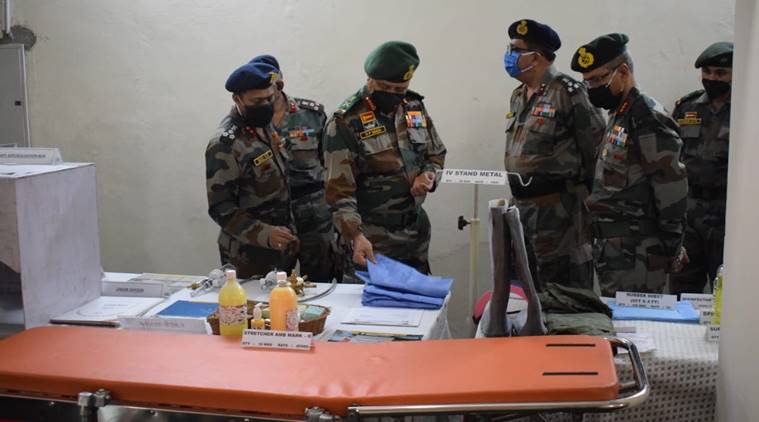
The Army hospital was thrown open for the policemen after a request was made to the Army Headquarters by the Delhi Police.

COVID-19 Delhi, COVID-19 Delhi Outbreak, COVID-19 Delhi Lockdown, COVID-19 Delhi Cases, COVID-19 Delhi Deaths, COVID-19 Delhi Recovered, Army Base Hospital, Delhi Cantonment, Army Base Hospital Delhi Cantonment, Delhi Police, Army Base Hospital Delhi Police, Army Base Hospital Delhi Police COVID-19, Army Base Hospital Delhi COVID-19, Army Base Hospital COVID-19, GOC-in-C Western Command, Lt Gen RP Singh, Lt Gen VK Mishra, General Officer Commanding Delhi Area, Cariappa Parade Ground, Cariappa Parade Ground Quarantine Facility, Delhi News, Indian Express News

he Army’s Base Hospital in Delhi Cantonment has extended its medical facilities to Delhi Police after latter made a request for admitting Covid-19 positive cases in the force.

At present seven policemen are undergoing treatment at the Base Hospital. Senior Army officers informed The Indian Express that the Army hospital was thrown open for the policemen after a request was made to the Army Headquarters by the Delhi Police.

“There are adequate arrangements at the Base Hospital to combat Covid-19 and since Delhi Police asked for our help we have had no hesitation in taking in their personnel who have tested positive for coronavirus. Seven of them are currently under treatment”, said a senior Army officer.

On May 6, a Delhi Police constable died of coronavirus after he was allegedly turned away from two hospitals. There had been allegations that had he been given timely help, the constable, in his early 30s, would have survived.

It is learnt that following this incident the top brass of Delhi Police decided to enlist the help of the Army medical authorities in order to ensure that its personnel who are infected by the virus while discharging their duties are ensured best possible medical treatment.

The GOC-in-C Western Command, Lt Gen RP Singh, also visited the Base Hospital in Delhi earlier this week and took stock of the anti-Covid measures. He also inquired about the facilities, which are being provided to the police personnel and directed that all possible help must be provided to them.

The GOC-in-C also visited the Delhi Area headquarters and was briefed by Lt Gen VK Mishra, General Officer Commanding Delhi Area about the prevailing Covid-19 situation and assistance being provided to civil authorities including Delhi Police.

The Army Commander also visited the quarantine facilities set up by the Army at Cariappa Parade Ground in Delhi Cantonment.