Sanjha Morcha

Ration for defence officers, a matter of dignity, pride & honour. It shouldn’t be stopped

Ration for defence officers doesn’t just mean bread and butter. It is considered to be a dignified privilege given to the soldiers who have dedicated their lives to the motherland, irrespective of the field or the peace area . It is a matter of dignity , pride and honour of an soldier. No amount of money can substitute it. Stopping  ration is a disrespectful move and demoralizing the armed forces. Any amount of money in lieu of ration is  against the ethics and ethos of a defense personal.

Please sign my petition to show your respect for the defence personals.

RATION SHOULD BE CONTINUED FOR ALL THE DEFENSE PERSONALS.

JAI HIND!!!


OUTPOURING OF A VETERAN.

Respected Veterans,

Jai Hind.

  1. While I greatly appreciate Gen SG Vombatkere being an intrepid crusader with indomitable spirit, zeal & enthusiasm in fighting for the poor, the underprivileged & the down-trodden, the Question is: Who cares? Do his articles really make a difference? NO. Sad, but that is the truth. To the middle class, and that includes you & me, it hardly matters as to what happens to others. Tomorrow, if I am mugged and killed in broad daylight, will it make a difference? NO. Not even a handful of Veterans would attend my cremation. We, Bharathvasis are a bigoted lot; especially Ex-Servicemen, ably led by retired Officers.
  2. There are over 4000 retired Officers of the Army, Navy & Air Force at Bangalore; and how many of them show up at the National Military Memorial on Kargil Diwas (26 July) and Vijay Diwas (16 Dec) to pay Homage to their brethren? Hardly, 25-30 of them. What about others? Don’t ask me as to what they do. All that I know is, there is a galaxy of retired Lt Gen, Air Marshals and Vice Admirals settled down at Bangalore; not to mention officers of the rank of Maj Gen, Rear Admiral and Air Vice Marshal. If I have not mentioned Officers of the rank of Col, Capt (IN) and Gp Capt and below, it is just that they are a whole horde, to whom words like ‘Welfare of Ex-Servicemen’ and ‘Loyalty to your Men, even after retirement’ are mere buzz-words; and they mean nothing to awaken their collective conscience, if they still have one.
  3. And, it is the same WE retired Officers who are in the forefront to ask for anything & everything FREE. WE retired Officers are a selfish and greedy lot. The less said the better; for even a full page would not be enough to recount the ‘virtues’ of retired officers. The very same retired officers who do not find time to attend the Commemoration Ceremonies at the National Military Memorial, Bangalore, are present in hundreds, guzzling chilled beer, bottle after bottle; and voraciously hogging chicken roast and mutton Biryani, when invited for the Veterans Day Lunch at RSI.
  4. WE Bharathvasis, have everything to be proud of: our Culture and our Heritage. But do we really display any pride in ourselves or our Culture & Heritage? NO. WE Bharathvasis, are a corrupt lot. To cheat is part of our DNA. We are cowards. With such sterling qualities in us; I wonder at times: Do WE really have a right to exist as a Nation? Over a period, our collective conscience has become NUMB. 70 children have lost their lives in UP due to negligence by Doctors and the supervisory staff. Does it really bother anyone? NO. Due to inadequate monsoon, acute water shortage and famine in the interiors are staring us. Cattle are going to die in thousands. Who is going to face the brunt? It is village folks all over the Country. Who cares?
  5. When WE talk of ‘izzat’, ‘honour & dignity’ I find these words sound hollow and are mere rhetoric. When we talk of ‘Welfare of Ex-Servicemen & their families’; it means nothing. It is just lip service. Starting with the Chiefs; and, Mil Fmn Cdrs down the chain, they have absolutely no say in the selection & appointment of retired Officers of the rank of Brig/Col as Director Sainik Welfare in various states; and retired officers of the rank of Lt Col as Dy Directors at the District level. Just to cite an example: The Dircector Sainik Welfare & Re-settlement in Kerala is a retired Sergeant. How did a Sergeant get appointed against a post meant for a retired Brig? Simple. He got appointed when ‘Saint’ Antony was the Defence Minister. And mind you, not one incl the Mil Fmn Cdr concerned raised his voice saying that such an appointment is highly irregular and unacceptable. As I said earlier, when it comes to Welfare of Ex-Servicemen, who cares?
  6. I do not know as to what happens to Officers after their retirement? Just two examples of past Directors Sainik Welfare & Re-settlement, Karnataka. The first, a Brigadier. During his tenure he got a few plots of land from the BDA under the pretext of allotting them to Kargil Widows. Very noble thought. And he was equally noble in his action! On being made available plots of land by the BDA, he promptly allotted two plots to his Mother-in-Law, who I am told is mother of a Lt Gen, who retired as the Dy COAS. And a few more such illegal allotments. A few years down the line, the Brigadier’s misdemeanor comes to light. An FIR is filed by the Police. The Brig goes to the Court and has the FIR quashed on technical grounds!! Que-serai-serai.
  7. Directorates of Sainik Welfare & Re-settlement in all States are sitting on huge piles of cash by way of Fixed Deposits of Flag Day Fund to the tune of hundreds of crores. Amounts can be invested by Govt Depts as Fixed Deposits only in SBI or in other Public Sector Banks and NOT in Private Banks. Yet, a Director Sainik Welfare & Re-settlement had invested over Rs. 28 crores of Flag Day Funds with numerous Private Banks at different rates of interest, in clear contravention to Govt orders on the subject. Any action taken against the Officer, even after the misdemeanor came to light and brought to the notice of the Govt and the local Military Formation? NONE. Que-serai-serai.
  8. In case we are serious about Welfare & Re-settlement of Ex-Servicemen & their families, we need to have serving Officers of the Rank of Brig posted as Director Sainik Welfare & Re-settlement, in all States. When we can have officers of the rank of Maj Gen/Brig as Addl/Dy DG NCC in all States, then why can’t we have serving Officers of the rank of Brig posted as Director Sainik Welfare & Re-settlement, in all States? NCC no doubt is important; but to my mind, far more important is Welfare & Re-settlement of Ex-Servicemen & their families. Veteran Lt Gen SK Bahri and I had met the then Vice COAS in his office in April 2013, in this regard; and, impressed on him the urgent & inescapable of requirement of having serving Officers of the Rank of Brig posted as Director Sainik Welfare & Re-settlement, in all States. But who cares?
  9. I must however say that, there are a few refreshing exceptions. One such is Lt Gen RK Anand, GOC Dakshin Bharath Area, Chennai. He has designated all Officers incharge of CSD Canteens, all over the five southern states, as ‘Executive Director Veterans Welfare’; with instructions that they will attend to all problems concerning welfare of Ex-Servicemen & their families. Not only that, he has instituted a Report to be submitted to him, every Monday morning, as to the number of cases handled by each Executive Director during the preceding week, with details thereof.
  10. To take interest or take part in Politics after retirement, is my fundamental Right. And one should not shy away from Politics under the misplaced notion that Military Veterans should remain apolitical.
  11. Let us NOT be blind to happenings around us. We Veterans, as Citizens have a duty to perform, in raising our voice and protest against any wrong doing by the Govt or the society at large.
  12. By criticizing our Hon’ble PM or the BJP we DO NOT become lackeys of the Congress Party or Sonia Gandhi or Rahul Gandhi; or, we end up condoning corruption by Lalu Yadhav & his ilk. If General Elections are held tomorrow, I have no hesitation in stating that I shall be voting for MODI once again; for want of a better option. I voted for MODI with a lot of hope.
  13. It is time for Veterans to think and ponder as to whether we should be mute spectators to the happening around us; or, stand up for what is right and raise our voice against any injustice or persecution or display of lethargy & apathy by the Govt.
  14. Let us remember, “Silence is no doubt a Virtue; but, there can be no greater SIN than to remain mute and silent in the face of tyranny or wrong doing by the Govt in power or for that matter, anybody”.
  15. To end, I salute Veterans like Gen SG Vombatkere and Gen PG Kamath for expressing their views, without fear or favour.

Regards,

colRajan

Col Rajan

Bangalore, 9449043770

17 Aug 2017


In I-Day address, Pak PM blames India for impasse Hoists ‘largest’ national flag on 400-ft pole at Attari-Wagah border

In I-Day address, Pak PM blames India for impasse
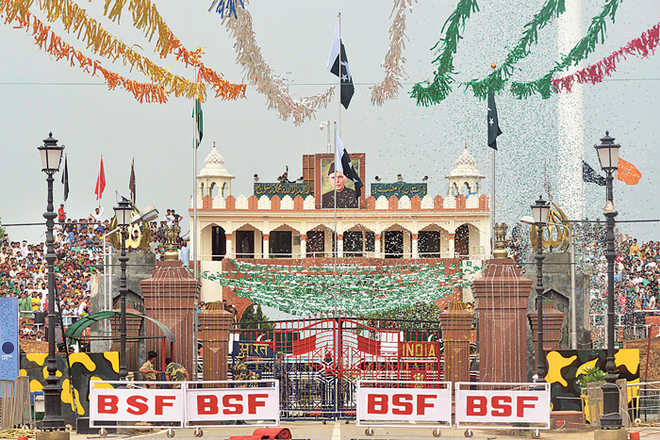
A Pakistani Ranger (top) on Monday unfurls the national flag at the Wagah border to celebrate the country’s Independence Day. AFP

Islamabad, August 14

Pakistan’s new Prime Minister Shahid Khaqan Abbasi today blamed India for the impasse in bilateral ties, saying New Delhi’s “expansionist designs” was the “main hurdle” in constructive relations between the two neighbours.Addressing the nation on its 70th Independence Day, Abbasi said Pakistan “desires positive and constructive” relations with all countries based on sovereign equality.Indo-Pak ties nosedived after a series of attacks last year, including the Uri strike, carried out by the Pakistan- based terror outfits. Following the attacks, India boycotted the SAARC Summit, which was scheduled to be held in November last in Pakistan.“Our government has invariably made efforts to initiate the process of meaningful dialogue and adoption of peaceful means to resolve the issues but unfortunately the expansionist designs of India have remained the main hurdle in this regard,” Abbasi said.Pakistan’s national flag today flew at 400 ft, the highest in South Asia, at the Attari-Wagah border with India to mark the country’s 70th Independence Day.The 120×80 ft flag is also the largest in the history of the country, the Pakistani media reported.Pakistan Army chief Gen Qamar Javed Bajwa hoisted the flag near the border after midnight, kicking off the Independence Day celebrations across the country.The flag is said to be the highest in South Asia and the eighth highest in the world.Gen Bajwa said: “Some 77 years ago, Pakistan resolution was passed in the same city (Lahore). Pakistan came into being on the night of 27th Ramadan. Today, the country is progressing on the path of law and constitution. All institutions are working properly. We will make Pakistan the country of Quaid-e-Azam and Allama Iqbal.”He enunciated the many challenges Pakistan faced, but also tried to drum up the nationalistic sentiment.“We have rendered many sacrifices — we will never forget our martyrs. We will execute each and every terrorist in Pakistan. I want to tell our enemies, whether they are in the east or in the west, that your bullets will end but not the chests of our jawans,” he added.“I assure you that we will never let you down. Any power that will aim to weaken Pakistan, the Army and all other institutions will foil their attempts,” he said.Other speakers at the event also paid tributes to those killed during migration to Pakistan. — PTIOur friendship stronger than steel: Wang  Islamabad: Chinese Vice Premier Wang Yang, “special guest” at Pakistan’s Independence Day celebration, said on Monday that the two countries have always stood by each other and their friendship was “stronger than steel and sweeter than honey”. Wang, a member of the Politburo of the Central Committee of China’s ruling Communist Party, is among the country’s top leaders. He arrived in Islamabad on Sunday on a two-day visit. AFP


Pakistan hoists ‘largest’ national flag to mark Independence Day

Pakistan hoists ‘largest’ national flag to mark Independence Day
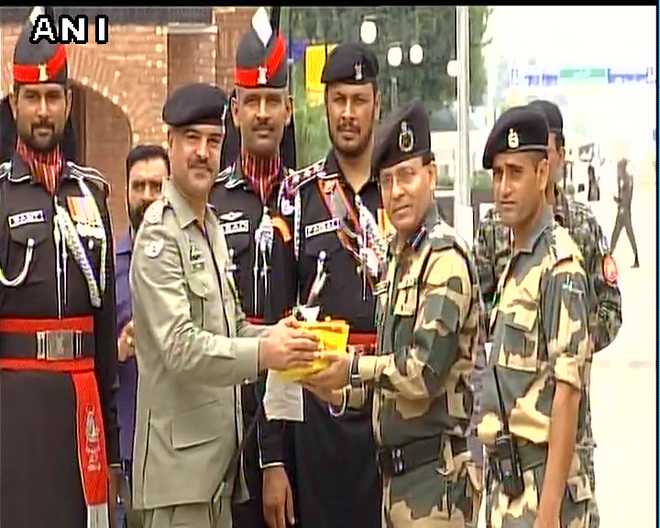
Sweets being exchanged at the Wagah-Attari border. ANI

Lahore, August 14

Pakistan on Monday hoisted a 400-ft-high national flag, the largest in its history, at the Attari-Wagah border with India to mark the country’s Independence Day.Army chief Gen Qamar Javed Bajwa hoisted the flag at the border after Sunday midnight, kicking off the celebrations for the Independence Day across the country.The flag is said to be the highest in South Asia and the eighth highest in the world.Made in Pakistan, it is 400-ft-high and 120 feet by 80 feet in size.

(Follow The Tribune on Facebook; and Twitter @thetribunechd)

Gen Bajwa said: “Some 77 years ago, a Pakistan resolution was passed in the same city (Lahore). Pakistan came into being on the night of 27th Ramadan–it was a blessed night.“Today, the country is progressing on the path of the law and the Constitution. All institutions are working properly. We will make Pakistan the country of Quaid-e-Azam and Allama Iqbal.”Gen Bajwa enunciated the many challenges Pakistan faced but also tried to drum up the nationalistic sentiment.“We have rendered many sacrifices–we will never forget our martyrs. We will execute each and every terrorist in Pakistan. I want to tell our enemies, whether they are in the east or in the west, that your bullets will end but not the chests of our jawans.”“I assure you that we will never let you down. Any power that will aim to weaken Pakistan, the Army and all other institutions will foil their attempts.”Other speakers at the event also paid tributes to those killed during the migration to Pakistan. PTI


HEADLINES 05 AUG 2017

MAJ GEN SATBIR SINGH REMINDS PB GOVT FOR RS SEAT:::SENDS HIS REP & DISTURBS GOG MEET OF ESM AT JALLANDHAR

  1. SATBIR CIRCULATED MESSAGE TO ESM PUNJAB AGAINST CAPTAIN AMARINDER THROUGH WHATS APP.NOW SEEKING RS SEAT
  2. MAJOR GEN SATBIR carrying  WRONG NOTION THAT  HIS SUPPORT TO CAPT AMARINDER IS CAUSE FOR VICTORY.
  3. OROP CELEBRATED BY MAJ GEN SATBIR AT JM THEN WHY HOLDING TO JM

1971 PAK PRISON ESCAPE BY THREE IAF PILOTS NOW A FILM

INFLICTED MORE CASUALTIES ACROSS BORDER, SAYS JAITLEY CLAIMS INCREASING ATTEMPTS BY PAKISTAN TO PUSH IN TERRORISTS

OUR RESTRAINT HAS A BOTTOM LINE, CHINA WARNS INDIA ON DOKLAM

BEIJING RELEASES ‘FACTS’ ON INDIAN TROOPS CROSSING BORDER INTO ITS TERRITORY

RAPE-TAINTED FORCES GET WOMEN CONSTABLES TO TACKLE RED MENACE

SGPC TO REMEMBER 1965 WAR HEROES

MISSING GREY SHADES TEJWANT SINGH GILL

AADHAAR MADE MANDATORY FOR REGISTRATION OF DEATH

CHINA’S CLAIMS ON ARUNACHAL MEANINGLESS: CHINESE SCHOLAR

SOLDIERS MAY SOON SPORT KHADI DRESS

ARMY HAS FORMULATED POLICY ON SOCIAL MEDIA USE: GOVT

FIRST PVT MISSILE SUB-SYSTEM MANUFACTURING HUB OPENS

FRESH CHINA WARNING: INDIA STICKS TO DIPLOMACY

MAJOR PANDEY LAYS DOWN LIFE FIGHTING TERRORISTS IN SHOPIAN


IAF procures UVS without evaluating efficacy: CAG

IAF procures UVS without evaluating efficacy: CAG

July 30, 2017, 9:25 am

New Delhi: With an objective to strengthen its air bases amid increased threat to defence installation, the Indian Air Force (IAF) had procured 57 Under Vehicle Scanning (UVS) at a cost of Rs 17.09 crore during March-November 2012, out of which only 17 UVS systems are functioning as on date, the national expenditure watchdog report revealed. These UVS were procured for tightening the security at the entry gate of 50 bases throughout the country as scanning of vehicles entering the premises was considered to be one of the critical security measures. “IAF HQ issued three supply orders on M/s Turbo Consultancy Services and M/s Infosolutions India for procurement of 57 UVS systems for 17.09 crore… These systems were received between July 2012 and April 2013,” the Comptroller and Auditor General (CAG) findings said. The national auditor also found that only 45 systems were installed as on April 2016 and within warranty period, 43 systems became non-functional. These were neither repaired nor replaced by the vendors as stipulated in the warranty clauses of the supply order. The findings also said that the IAF did not initiate any action against the vendors. In May, 2016, the Air HQrs said that due to excessive malfunctioning of the components and downtime of the systems, vendors had extended the warranty period but did not repair or replace the systems, according to findings. In February 2017, the IAF said 52 out of 57 systems had been installed. However, 35 UVS were still in unserviceable condition and the fresh quotations were invited for repair of the systems. Earlier, the approval was given for 30 systems and was decided that further procurement will be made after evaluating the efficacy of the UVS. The CAG also revealed that they procured the systems without adequately evaluating their efficacy which showed lack of coordination between security establishment and the Air HQrs and Command level.


File returns till Aug 5, link PAN, Aadhaar by 31st

SBI cuts savings interest rate from 4% to 3.5% up to Rs 1 cr | LPG cylinder to cost Rs 4 more every month

File returns till Aug 5, link PAN, Aadhaar by 31st

New Delhi, July 31

In a last-minute decision, the government today extended the deadline for filing income tax returns (ITRs) till August 5, while taxpayers can now link Aadhaar with Permanent Account Number (PAN) by August 31.The Central Board of Direct Taxes said the dates were extended following complaints from “some taxpayers” that they were unable to log on to the Income Tax Department’s e-filing website. The CBDT said there were also complaints that the assessees were unable to link Aadhaar with PAN as their names were mentioned differently in the database.(Follow The Tribune on Facebook; and Twitter @thetribunechd)The government had made the linking of the two databases mandatory for filing ITRs from July this year.The Income Tax Department till yesterday had maintained that no extension would be given as already over two crore returns had been received and no major glitches had been detected. Meanwhile, the State Bank of India (SBI) today cut from 4 per cent to 3.5 per cent the interest rate on savings account on balance up to Rs 1 crore. Those having balance above Rs 1 crore would continue to earn interest at 4 per cent per annum.Rajnish Kumar, Managing Director, National Banking Group, SBI, said the reduction was an important aspect as it was difficult to maintain MCLR (marginal cost of fund-based lending) rates at the current level.In the Lok Sabha, Oil Minister Dharmendra Pradhan today said that state-run oil companies had been ordered to raise subsidised cooking gas (LPG) prices by Rs 4 per cylinder every month to eliminate all the subsidies by March next year.The government had previously asked IOC, BPCL and HPCL to raise rates of subsidised domestic LPG by Rs 2 per 14.2-kg cylinder per month (excluding VAT).Now, the quantum had been doubled so as to bring down the subsidy to nil, he said.Every household is entitled to 12 cylinders of 14.2-kg each at subsidised rates in a year. Any extra requirement is to be bought at market price.“The companies were authorised to hike the price of subsidised domestic LPG cylinder by Rs 2 per cylinder per month (excluding VAT) with effect from July 1, 2016,” he said. Oil companies had hiked LPG rates on 10 occasions since that go-ahead.“The government has again authorised them to continue to increase the effective price of subsidised domestic LPG by Rs 4 per cylinder effective from June 1, 2017, per month (excluding VAT) till the reduction of government subsidy to ‘nil’, or till March 2018, or till further orders,” he said.Oil companies have raised rates twice since, the last being on July 1 when rates were up by a steep Rs 32.  — TNS/PTI


India and China should sign a new boundary convention in the Sikkim sector : Chinese scholars

Beijing: Notwithstanding the Doklam standoff, Chinese military analysts say that India and China should sign a new boundary convention in the Sikkim sector to replace the 1890 Great Britain-China agreement and make it more contemporary.

“For China early harvest means, we want to have a new agreement with India, because the 1890 convention was signed between Great Britain and China,” Senior Colonel Zhao Xiaozhou, Director at the Centre on China-America Defence Relations of the Academy of Military Science, told an Indian media delegation here yesterday.

“At that time, it was not the People’s Republic of China, (PRC). India became independent in 1947. It is better we change the signatures of the convention, that is what I mean early harvest,” he said.

“It is very essential because there are territorial disputes in the eastern, central and western sectors of the India-China border. Only in the Sikkim section we have the fixed border. So, we want to start from the easiest, that is what we call early harvest,” he added.

The Chinese Foreign Ministry too in its August 2 fact- sheet on Doklam standoff referred to Beijing’s expectations of an “early harvest” in the Sikkim sector.

“The Chinese and Indian sides have been in discussion on making the boundary in the Sikkim Sector an ‘early harvest’ in the settlement of the entire boundary question during the meetings between the Special Representatives on the China- India Boundary Question,” it had said, referring to the 1890 convention.

“The boundary in the Sikkim sector has long been delimited by the 1890 Convention, which was signed between then China and Great Britain. China and India ought to sign a new boundary convention in their own names to replace the 1890 Convention. This, however, in no way alters the nature of the boundary in the Sikkim sector as having already been delimited,” it had said.

On the Sikkim part of the boundary, India’s Ministry of External Affairs (MEA) in its June 30 statement on the Doklam standoff had said, “Where the boundary in the Sikkim sector is concerned, India and China had reached an understanding also in 2012 reconfirming their mutual agreement on the ‘basis of the alignment’. Further discussions regarding finalisation of the boundary have been taking place under the Special Representatives framework.”

Therefore “it is essential that all parties concerned display utmost restraint and abide by their respective bilateral understandings not to change the status quo unilaterally. It is also important that the consensus reached between India and China through the Special Representatives process is scrupulously respected by both sides,” the MEA had said.

Of the 3,488-km-long India-China border from Jammu and Kashmir to Arunachal Pradesh, a 220-km section falls in Sikkim.

India and China have been locked in a face-off in the Doklam area of the Sikkim sector for the last 50 days after Indian troops stopped the Chinese People’s Liberation Army from building a road in the area.

China claimed that it was constructing the road within its territory and has been demanding immediate pull-out of the Indian troops from Doklam. Bhutan says Doklam belongs to it but China claims sovereignty over the area. China also claims that Thimphu has no dispute with Beijing over Doklam.



New rules clipping tribunal wings come under HC lens

New rules clipping tribunal wings come under HC lens

Vijay Mohan

Tribune News Service

Chandigarh, August 5

New rules for various tribunals notified by the Centre recently have come under the judicial scanner. The rules purportedly undermine the independence of the quasi-judicial bodies and place them under the control of the very ministries that are respondents in cases filed against themTaking up a petition filed by an ex-serviceman and ex-president of Armed Forces Tribunal (AFT) Bar Association, a Division Bench of the Punjab and Haryana High Court comprising Justice Mahesh Grover and Justice Raj Shekhar Attri has issued a notice to the Centre.(Follow The Tribune on Facebook; and Twitter @thetribunechd)Averring that the new rules were in contravention of those laid down by the Supreme Court in the cases of Madras Bar Association and R Gandhi and of the High Court in Navdeep Singh versus Union of India, the petitioner, Surinder Sheoran, contended the government’s action threatened the basic fabric of independence of the tribunals in many ways.The petition states that insofar the AFT is concerned, the government has provided that the tribunal shall function under the Ministry of Defence and that the Defence Secretary, who is the first opposite party in every litigation, shall be a part of the committee for recruiting and re-appointing members of the AFT. He would also be responsible for removal and any inquiry against the members, which was specifically barred by the Supreme Court in Madras Bar Association’s case and by the High Court in Navdeep Singh’s case.Till now, an SC Judge could hold an inquiry against members, but the new rules provide that even absence of a representative of the judiciary in the selection process will not make the appointments invalid. It has also been stated that while the SC had directed a tenure of five to seven years for members to ensure stability, the new rules have decreased it from existing four to three years.The rules have also introduced a new clause wherein any person with experience in business, economics, commerce, finance, accountancy, etc can be an AFT member.What legal experts say

  • New rules contravene concept of separation of powers and judicial independence
  • Make tribunals, their members subservient to Union secretaries against whom orders are to be passed
  • Wrong to reintroduce clauses that have been repeatedly quashed by HCs and SC in a number of cases


There is no military solution in J&K, separatist finances should have been targeted much earlier by Lt Gen Syed Ata Husnain

The most ineffective way of fighting your adversary in a hybrid conflict, like the one in J&K, is to fight it through only the military route. It will mostly ensure that you will restore temporary order and the situation will slip back to create mayhem around you and often under your own presence. However, in most parts of the world that is exactly how such modern day conflicts are fought and therefore are rarely won. It is so because the understanding of the term ‘hybrid conflict’ never focuses on the first word of the term but rather on the second. The common perception is that conflict has everything to do only with the military and hence is its purview and others have only a peripheral role. Actually the reverse is the truth. The word hybrid is the more important one and its scope extends to multiple domains which are multiplying by the day with new technologies and other dimensions of modern human existence. Violence at different levels and different locations keeps the conflict relevant and visible while an adversary delves into other domains silently and effectively. Among these domains are promotion of extremist radical ideology, creation of intense alienation, keeping the organs of government on tenterhooks and incapable of governance, intimidation of government agencies, media and private citizens, gun running and narcotics to sustain finances and lastly and perhaps most importantly maintaining financial conduits for the unimpeded flow of money into the conflict system. Without the latter no such hybrid conflict can be sustained beyond a few months.

Fighting hybrid conflict only militarily is the inability of a society to grow intellectually and appreciate the true potential of different forms of conflict. Killing terrorists is easy when we have a large enough force of soldiers and policemen. The invisible elements of hybrid conflict are far more dangerous than the seemingly more potent but largely visible elements such as cannon fodder terrorists who die in sufficient numbers to keep statisticians busy in their jobs.

A common question which even some intellectuals tend to ask me is – “why despite killing so many terrorists and losing so many soldiers, we cannot establish better control over Jammu & Kashmir”.  I hate to give you my answer because it actually trivializes the achievements of my fellow soldiers and that is something I am wont to do. Yet, someone has to take on the mantel to explain to the public that the type of conflict we are witnessing in J&K is not the good old conventional war which they are used to hearing about. While keeping our army and police forces engaged in the fight against terrorists and stone throwers there have been a range of activities taking place under the sponsorship and patronage of a host of other people. The Separatists have been projecting the cause for separatism through literature, social media, media patronage, mosque power, direct engagement and creation of structures which can be activated in minutes to respond to diverse situations. The campaign to radicalize Kashmiri society, denied by most Kashmiri citizens, has been a deliberate ploy to empower the mosque and link Pakistan’s deliberately chosen path of radical Islam to become the Valley’s new ideology. It happened right under the care of all elements who profess to know the Valley rather well. None of us could stop it because of our intellectual inability to realize what was shaping around us. In any case India’s security agencies were largely bereft of knowledge on religious ideology when radical Islamists across the border were planning and coordinating activities in the Valley with sheer impunity.

None of the above can be done by Separatists with the level of competence they have displayed without adequate financial backing and that is a truism for any such conflict. The ISIS could survive three years in Northern Iraq because of the looted finances from the Mosul treasury and the revenues of taxation and the oil refinery. Once most of that was spent it was no longer possible to continue in the same mode. For some of us who understood the nature of conflict in J&K and the actual strategy of Pakistan it was always a question of evolving our own strategy through ‘whole of government’ approach. Unfortunately the political class could not appreciate what its role was at the operational and strategic level. Its role in preventing the flow of finances to the separatist ranks and the obstacles in the way of ideological change taking place in the mosques would have made all the difference. The bane remained the perception that it was a conflict situation and was the responsibility of the security forces.

I have written many times so let it be  only a reminder that the Separatists have  far better network and organizational structures than even the army. There are elements in every ‘qasba’ and every town, the intelligence providers, backed by an army of lawyers, treasurers, ideologues, rabble rousers, stone throwers, drug addicts and of course terrorists. All of them survive on the additional income provided by the Separatists. There has been enough money coming in to finance a plethora of over ground workers, compensate families of terrorists, pay guides at the LoC or safe house owners and compensate stone throwers on an everyday basis.

Yet all these years the infrastructure was allowed to remain in place. Money came from foreign sources into legitimate accounts, cash was drawn by cards from accounts opened and existing in Delhi and more cash was even available through gift packets on Pakistan national day, at the Pakistan High Commission. This happened primarily because there was some element of faith in the Separatists that successive governments had reposed. The government was underwriting much of their personal expenditure in the hope they would eventually deliver. With the situation in South Kashmir having drastically changed the equations of control of the movement, the Government has finally acted and acted swiftly after a media inspired sting operation. It is good to see that both parties of the coalition government in J&K have supported the National Investigation Agency’s initiative with arrest of seven Separatist leaders. Details of the financial networks which is the darkest part of terror networks is bound to produce enough incriminating material to ensure that the leadership is sufficiently ineffective for long. Care must be taken to prevent VIP facilities and availability of communications to the leaders otherwise the entire gamut of operations may be compromised.

Finally, it appears that the whole of government approach is at last emerging in the J&K situation. Next should be curtailing of mosque power and for that the effective advice of moderate Muslim clerics from rest of India should definitely make a difference.  In the interim the Army and other security forces must continue the excellent run of counter infiltration and counter terror operations   to prevent the resurgence of gun power in the Valley. The ‘whole of government’ approach must continue hereafter in different domains with energy and understanding as never before.