Sanjha Morcha

DG opens bridge on Koksar nullah in Lahaul

DG opens bridge on Koksar nullah in Lahaul
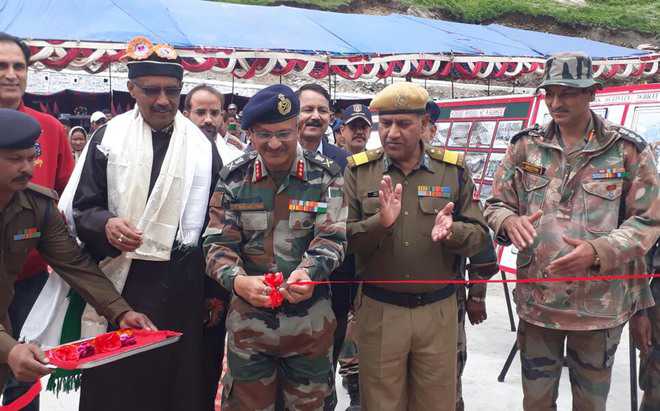
BRO DG SK Shrivastava inaugurates a bridge at Koksar on the Manali-Leh highway while Lahaul Spiti legislator Ravi Thakur looks on. Photo: Jai Kumar

Tribune News Service

Mandi, July 3

Director General of Border Roads Organisation SK Shrivastva today inaugurated 70-metre-long span steel superstructure bridge on the Koksar nullah in Lahaul-Spiti constructed at a cost of Rs 8 crore.The bridge is located on the Manali-Sarchu road. The construction of this bridge is part of upgrade plan of the Manali-Sarchu road. The road is part of strategic importance.BRO Commander AK Awasthi said Koksar-1 bridge, in spite of being located at an altitude of 10,300 feet, had been completed within three years. The Manali-Sarchu road remains covered with heavy blanket of snow for six months in a year.The Director General appreciated the efforts of BRO officials to accomplish the task in a stipulated time and pledged the BRO’s commitment to nation building by connecting remote areas to the main stream.Another bridge, constructed at a cost of Rs 2 crore by the BRO, was inaugurated by Lahaul-Spiti MLA Ravi Thakur.


Search on for missing IAF helicopter

Search on for missing IAF helicopter
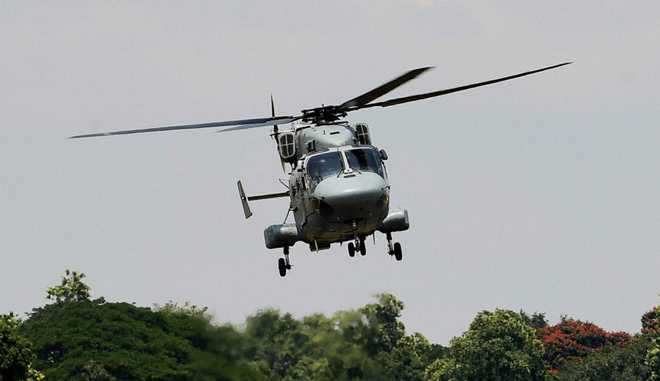
The chopper was on a flood victim rescue mission. — Representational image

Itanagar, July 5

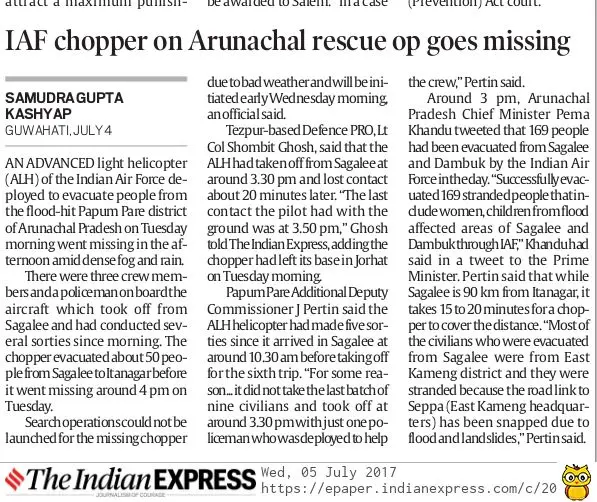
A massive ground search operation is on for the second day on Wednesday in Arunachal Pradesh for a missing Indian Air Force (IAF) helicopter with three operating crews on board, an official said.

(Follow The Tribune on Facebook; and Twitter @thetribunechd)

“Rescue teams from the Army, Indo-Tibetan Border Police along with state police were trekking through the jungle and hill areas between Yupia and Hoj Telam in Papum Pare district to locate the missing chopper,” Sandeep Goel, the police chief of Arunachal Pradesh, said.

Meanwhile, police officials quoting eyewitnesses said the helicopter may have crashed at Hostalam between Borum and Toru area.

The Advanced Light Helicopter (ALH) of the IAF engaged in flood rescue mission in the state went missing on Tuesday at 3.50 pm after it took off from Pilputu Helipad near Sagalee for the Naharlagun heliport.

The helicopter was evacuating people stranded in Sagalee and Dambuk due to massive landslides caused by heavy rains.

Tezpur-based Defence spokesperson Lt Col Sombit Ghosh said the chopper had gone out for flood rescue operations from its base in Jorhat on Tuesday morning.

Papum Pare district official J.Pertin said the IAF helicopter which was pressed into evacuation of people stranded due to floods in Sagalee, had made five sorties since it arrived there at around 10.30 a.m. on Tuesday.

“In the sixth sortie to Naharlagun, for unknown reason, the crew did not take the last batch of nine civilians and took off from Sagalee with just one policeman, who was deployed to help the two crew members and then went missing,” Pertin told IANS.

On Tuesday, Chief Minister Pema Khandu had said in a tweet that 169 persons had been evacuated from Sagalee and Dambuk by the Indian Air Force during the day till then.

“Successfully evacuated 169 stranded people that include women, children from flood affected areas of Sagalee and Dambuk through IAF,” Khandu said.

Sagalee is just north of Itanagar, Dambuk in Lower Dibang Valley is about 350 km east of here.

In May, two pilots of the Indian Air Force in Sukhoi-30 fighter jet crashed near the Assam-Arunachal Pradesh border.

In 2015, a Pawan Hans helicopter with three persons on board, including Tirap Deputy Commissioner Kamlesh Joshi, crashed in a dense jungle. Joshi was killed in the crash.

In 2011, the then Arunachal Pradesh Chief Minister Dorjee Khandu and four others died after their Pawan Hans chopper crashed at a remote location in the state.

A few days later, another helicopter crashed while landing in Tawang, killing 16 people.

Following the crashes, commercial chopper services were stopped in the state till 2013 when Pawan Hans restarted the service in Arunachal Pradesh and other parts of the region.

Pawan Hans Helicopter Services Limited (PHHL) has been operating chopper services across Arunachal Pradesh, Sikkim, Meghalaya, Nagaland and Tripura and daily Guwahati-Tawang services for over 15 years.

It is one of the major lifelines in the landlocked and mountainous Arunachal Pradesh. — IANS


Army back in violence-hit Darjeeling

Angry Mamata lashes out at Centre for ‘non-cooperation’; orders probe into communal flare-up

Army back in violence-hit Darjeeling
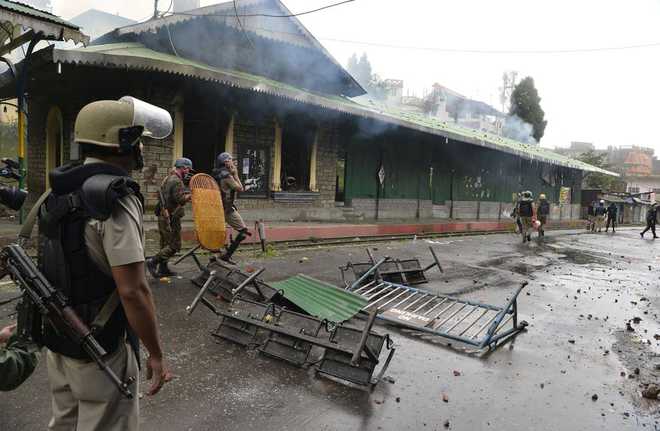
Police personnel at the Sonada toy train railway station that was set afire during an indefinite strike called by the Gorkha Janmukti Morcha in Darjeeling on Saturday. AFP

Shubhadeep Choudhury

Tribune News Service

Kolkata, July 8

The Army was today called in, the second time in 30 days, as Darjeeling and neighbouring Sonada erupted after the body of a youth was recovered in Sonada. West Bengal Chief Minister Mamata Banerjee, blaming the BJP-led Union Government for the crisis, said if enough CRPF companies had been made available to the state in time, violence would not have occurred in the hills.(Follow The Tribune on Facebook; and Twitter @thetribunechd)“There is total non-cooperation from the Centre”, she alleged at a press conference here. “The Union Government did send seven companies of central forces after trouble broke out in Darjeeling, but six of the seven companies had inherent limitations as these consisted of three companies each of SSB and women CRPF personnel,” she said. Pointing out that personnel of the SSB and women CRPF were not geared up for the job at hand, Mamata said this only showed that “there was a deliberate attempt” by the Centre to deny her help. She announced a judicial inquiry into the communal violence in Baduria and Basirhat in North 24 Parganas district as well as a probe to ascertain who was responsible for the death of a young man at Sonada on Friday night.Young Tashi Bhutia’s body was found at Sonada this morning with bullet wounds. The Gorkha National Liberation Front, which had earlier spearheaded the movement for Gorkhaland but was reduced to a fringe force following the emergence of the Gorkha Janmukti Morcha (GJM), claimed that the deceased was one of its activists. “Another Gorkha martyred. Tashi Bhutia alias Khitta, a Gorkha National Liberation Front (GNLF) cadre,  was last night martyred by CRPF in Sonada @ around 11 PM”, Neeraj Zimba Tamang, GNLF spokesman, posted on his Facebook page.Residents of Sonada took out a procession with Bhutia’s body and clashed with the police who used tear gas shells and rubber bullets to disperse the mob. Miscreants set afire the waiting room of the Sonada railway station — a heritage station on the Siliguri-Darjeeling toy train route. In Darjeeling, Gorkhaland supporters set ablaze an office of the ruling Trinamool Congress and clashed with the police at Chowkbazar. One person was reportedly killed in the violence.The Army was first deployed in Darjeeling on June 8 and withdrawn on June 24, much to the chagrin of the CM.


Pervez Musharraf considered using nukes against India in 2002: report

Pakistan’s former military dictator Gen Pervez Musharraf says he considered the use of nuclear weapons against India amid tensions following the 2001 terror attack on the Indian Parliament, but decided against doing so out of fear of retaliation, according to a media report.

Musharraf, 73, also recalled that he had many sleepless nights, asking himself whether he would or could deploy nuclear weapons, the Japanese daily ‘Mainichi Shimbun’ said.

The former president disclosed that amid tensions between India and Pakistan following the 2001 terrorist attack on the Indian Parliament, he contemplated the use of nuclear weapons, but decided against doing so out of fear of retaliation.

When tensions were high in 2002, there was a “danger when (the) nuclear threshold could have been crossed,” the paper quoted Musharraf as saying.

At the time, Musharraf had publicly said that he would not rule out the possibility of using nuclear weapons.

Musharraf also said, however, that at the time, neither India nor Pakistan had nuclear warheads on their missiles, so it would have taken one to two days to make them launch-ready.

Asked whether he had ordered that missiles be equipped with nuclear warheads and put into firing position, he said, “We didn’t do that and we don’t think India also did that, thank God” — pointing, perhaps, to a fear of retaliation, the paper reported.

The two countries subsequently avoided an all-out clash and tensions subsided.

The then army chief Musharraf ousted the then Prime Minister Nawaz Sharif in a coup in October 1999. The army general served as president from 2001 to 2008.

Musharraf has been living in Dubai since last year when he was allowed to leave Pakistan on pretext of medical treatment. He has been charged with involvement in the murder of the former two-time prime minister Benazir Bhutto in 2007.


DG, BRO, visits Rohtang tunnel

Our Correspondent

MANALI, July 3

Lt Gen SK Shrivastava, Director General Border Roads (DGBR), visited both portals of the Rohtang tunnel to evaluate the current status and progress of the work. He visited south portal of the Rohtang tunnel at Dhundi on Sunday and north portal at Sissu today.He spent hours at the sites and had detailed discussions with his staff and the companies involved in the construction of the tunneling works. Brigadier DN Bhatt, Chief Engineer of Rohtang tunnel project, briefed him about the ongoing works and further steps taken to speed up the works.The DG, BRO, said the breakthrough of the tunnel would happen in October 2017. He said after the breakthrough other activities too would speed up and in this snow season, the remaining activities at north portal would be taken up from the south-end to further enhance the pace of work.


‘Wall of heroes’ set up at Central varsity

Jammu, July 28

The Central University of Jammu (CUJ) has inaugurated a ‘wall of heroes’, displaying photographs of Param Vir Chakra recipients, as part of the Union HRD Ministry’s ‘Vidya Veerta Abhiyan’.The event has been organised by the National Service Scheme (NSS) of the CUJ in collaboration with the 26 Infantry Division, Jammu.The wall which is titled as “Our Heroes” was inaugurated by Prof Ashok Aima, CUJ Vice Chancellor, and Maj Gen SK Sharma, YSM GOC of 26 Infantry Division, at a function held on the campus to commemorate Vijay Diwas.In his address, Prof Ashok Aima emphasised the valour and sacrifices of soldiers during war and how it is important for students to realise its value. He said the university would constantly interact with the Army and security forces for exchange of knowledge and values.He also directed the National Service Scheme (NSS) to chart out a programme where the university could constructively engage with the war veterans and ‘veer naris’.While delivering the keynote address, Maj Gen SK Sharma highlighted that war was not just the business of the Army or other forces, it was the collective effort of a nation to defend its core values and interests.More than 15 war veterans from various units who fought in Tiger Hills and Tololing and five ‘veer naris’ were felicitated by the Vice Chancellor and the GOC. — TNS


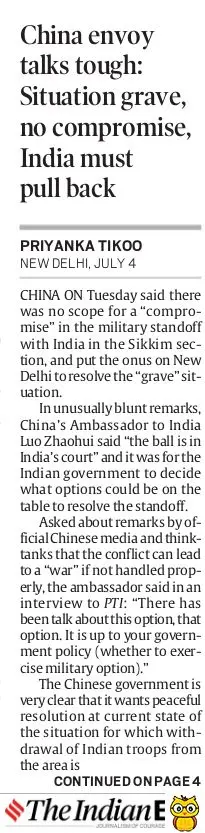
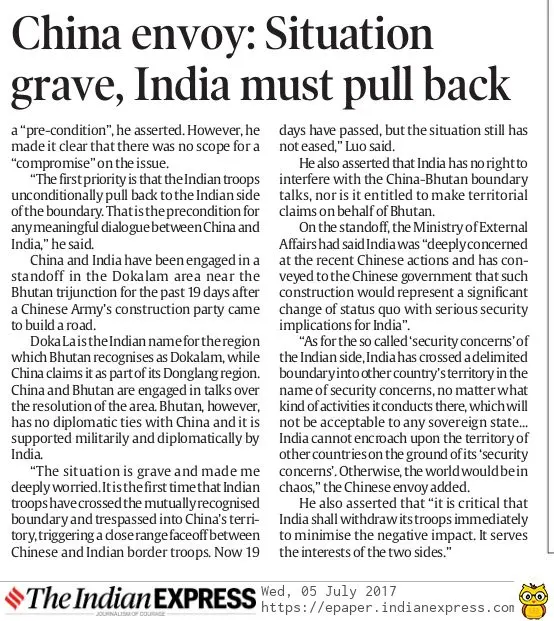
Sikkim standoff: India ‘trampled’ on Panchsheel pact, says China

Sikkim standoff: India ‘trampled’ on Panchsheel pact, says China
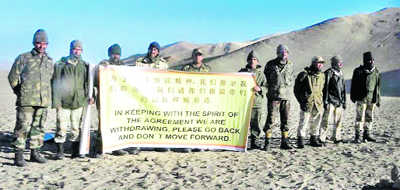
Indian soldiers showing a banner, asking Chinese troops to withdraw. Photo for representational purpose only. Tribune file

Beijing, July 5

Upping the ante on the Sikkim standoff, China on Wednesday accused India of “trampling” on the Panchsheel principles and asked New Delhi to “correct its mistakes” as soon as possible by pulling back troops.

(Follow The Tribune on Facebook; and Twitter @thetribunechd)

China also claimed that India was “misleading the public” by saying that Chinese troops are building a road close to the Chicken’s Neck in the Sikkim sector which could endanger India’s access to its north-eastern states.

“I want to point that the relevant actions by the Indian side violated the purposes and principles of the UN Charter in defiance of the international law and international norms. As we all know, in the 1950s, China, India and Myanmar proposed the five principles (Panchsheel) of co-existence,” Chinese Foreign Ministry spokesman Gen Shuang told reporters here.

“However to the surprise of everyone, the Indian side trampled on the basic norms governing the international relations proposed by itself by illegally crossing into other country’s territory,” he said.

The Five Principles of Peaceful Coexistence, known as the Panchsheel, are a series of principles which have formed the bedrock of the relationship between India and China. Their first formal codification in treaty form was in an agreement between China and India in 1954.

Geng said this time the Indian troops crossed the delineated boundary into the Chinese side and nature of the incident was “very serious”.

“China and India have been in contact through the Special Representatives mechanism to solve the boundary question but this incident, I believe, violates the spirit upheld by the Special Representatives mechanism and goes in contrast to the efforts made by the two countries,” he said.

China has already lodged a protest with India on this, Geng said.

“Indian border troops are still staying on the Chinese territory,” he said.

The situation is yet to be resolved and “India should pull back the troops that is precondition to avoid worsening of the situation”, Geng said.

“Troops should be pulled back as soon as possible to demonstrate the sincerity to improve bilateral ties so as create conditions for the normal development of bilateral relations,” he said.

“If the Indian side refuses to correct its mistakes in a timely fashion, how it proposes to win the trust of its neighbours and how it is supposed to play a bigger role in the international affairs,” he said.

“We once again urge the Indian side to abide by the boundary convention and respect the Chinese sovereignty and immediately withdraw the border troops and properly deal with the incident in a timely fashion,” Geng said.

The Chinese Foreign Ministry spokesperson claimed that the incident has nothing to do with the tri-junction between China, India and Bhutan.

“In disregard of the 1890 Sino-Britain convention, the Indian side said that Doklam is located within the tri- junction of the three countries, that is misleading the public,” he said.

“The 1890 convention said that the Sikkim section of the boundary commences from East mountain and the incident (of road building) took place about 2,000 metres away from Mount Gipmochi,” Geng asserted.

The Indian side is actually “misleading the public” by saying that the incident took place at the tri-junction point, Geng said, defending China’s road building which India and Bhutan have objected to.

India has expressed concern over the road-building, apprehending that it may allow Chinese troops to cut India’s access to its northeastern states.

Geng also said that besides former Prime Minister Jawaharlal Nehru endorsing the 1890 Sino-British convention on Sikkim in a letter to his Chinese counterpart Zhou Enlai in 1959, the Indian Embassy in a note to the Chinese government in February, 1960, also endorsed it.

“The note said that the boundary between Sikkim and China’s Tibet has already been delineated and there is no dispute about that in the map and in practice,” he said.

Quoting the note, Geng said, “The Indian government would like to add one more thing that the boundary has already been demarcated as well on the ground.”

“The above mentioned was written in black and white in the note from India,” Geng said.

Asked about Nehru, in his letter to Zhou, pointing out that Chinese maps showed Bhutanese territory as part of Chin, Geng said, “there is no such consent as you mentioned”.

The former prime minister had pointed out to China that it was claiming sizable part of Bhutan’s territory.

“It is not clear to us what exactly is the implication of your statement that the boundaries of Sikkim and Bhutan do not fall within the scope of the present discussion,” Nehru wrote in the letter to Zhou.

“In fact, Chinese maps show sizable areas of Bhutan as part of Tibet,” Nehru had said.

Geng said, “Since the illegal trespass of the border troops, both sides have expressed stern position. The fact is that the Sikkim section of the China India boundary has already been delineated.”

Since India’s Independence, the Indian government has repeatedly affirmed the fact that the Sikkim section has been delineated by this convention, he said.

Geng’s remarks come a day after, in unusually blunt remarks, China’s Ambassador to India Luo Zhaohui said “the ball is in India’s court” and it was for the Indian government to decide what options could be on the table to resolve the standoff.

Asked about remarks by official Chinese media and think- tanks that the conflict can lead to a “war” if not handled properly, the ambassador had said ,”There has been talk about this option, that option. It is up to your government policy (whether to exercise military option).”

Asked about Prime Minister Narendra Modi’s comments that not a bullet has been fired at the India-China boundary for two decades, Geng said, “I want to point settlement of the boundary serves the fundamental interests of the two sides.” “It is also a strategic target, two sides are working to achieve. We have been trying to explore ways to resolve the boundary question with in the Special Representatives mechanism and we have jointly taken measure to maintain peace and tranquillity in the border areas,” Geng said.

“What is shocking is that the India border troops entered into the Chinese side of the delineated border in the Sikkim section which is serious in nature,” he said. PTI
 

clip

clip

clip

clip

clip


The Hundred Kills Syndrome Can Only Be A Contributary Factor Towards Peace In Kashmir: More Is Needed In Other Domains Tooby Lt Gen Ata Husnain

IMG-20170304-WA0044
SNAPSHOT

The combination of military effectiveness and public introspection needs to be taken to the next level through effective harnessing of soft power.

The situation perhaps is ripe for it but are there enough takers to undertake the challenge with sensitivity and an eye on the future.

The Security Forces (SF) have reached a landmark achievement in 2017 which is being touted around a bit. They have eliminated a hundred hardcore terrorists in this calendar year, in less than seven months thus far. A fine military achievement that no one can contest. A round of appreciation is needed as especially in the last few weeks there have been successful encounters almost every day and the fatal casualty ratio between terrorists killed and SF personnel martyred has been showing constant improvement after the abysmal level to which it had sunk in February this year.

For those who may be excited by numbers, it is not my intent to dampen their enthusiasm, but wish to inform them that just in South Kashmir in 1999 the Army’s Victor Force of the Rashtriya Rifles (RR) was killing on an average 35-40 terrorists a month. Yet, it is as challenging today as it was then and you can take that as authentic since I was then controlling operations in South Kashmir. When I examine the environment in the same area of responsibility today, I find the General Officer Commanding, his commanders, officers and men perhaps have an even more daunting task with lesser strength of terrorists but perhaps more challenges than even we then had.

Before any analysis of the reasons for this success, it needs to be emphasised that any pragmatic analyst of conflict will advise the SF two things. First, there are miles to go before they sleep. For no fault of theirs the situation had drifted and alienation enhanced. They have to be conscious that military hard power’s achievements in the form of enhanced terrorists killed must create the conditions for the return of soft power as the means to stabilise and resolve conflict; the achievements also enhance resistance by the unarmed anti-national elements.

Second, the SF need to be mindful of the fact that wily minds across the Line of Control (LoC) are already working on creating a surge in terrorist ranks; space created by military achievement can quickly roll back. The only positive I can deduce at this stage of the analysis is that we have all the means available to prevent such a surge, and we should never shy away from employing additional forces and concepts to maintain military dominance. Military dominance is a term always likely to be misconstrued as the negative employment of hard power. That mistake must never be made.

In the same breath about mentioning success, the SF needs to be sensitive to the failure or relative failure to prevent the tragedy of the attack on the innocent victims of the Shri Amarnath Yatra. Such aberrations are a part of the security scenario and highlight the fact that a hundred successes will be offset by one failure. There is a need for better coordination as never before between agencies and different forces. Shedding the colour of the uniform and all egos achieves manifold more.

Why the success has come the SF way is important to analyse. No doubt there has been much hard work and in my opinion the return of the effectiveness of the intelligence grid is the biggest contributory factor. It proves the resilience of the Jammu and Kashmir Police (JKP) and intelligence agencies, and their ability to bounce back from a deep abyss. Without actionable intelligence it is difficult to keep the terrorists on the run. It is not just a question of scoring numbers in the quantum of terrorists killed but also preventing them from being effective by raiding potential hideouts and disallowing their mobility through check points, patrolling, night ambushes, cordon and search and river control.

The second reason for the high numbers is the achievements on the counter infiltration grid where in a short spurt the Army neutralised a dozen attempts and eliminated a large number of infiltrators. The trend this year has seen the activation of Uri and Naugam routes. The Army should be prepared for surge attempts at the Shamshabari. Machil, Keran and Tangdhar will be attempted in the next few weeks.

If praise for JKP, intelligence agencies and the regular Army at the LoC is due, no one can take away the credit from the RR and Central Reserve Police Force (CRPF) in the hinterland. Operating in an environment, where no standard operating procedure currently applies, it is difficult to refine drills and coordinate for a fresh situation every other day. The CRPF has done a fine job despite not being adequately equipped for the duties it is performing.

All the success in the field of hard power has to finally translate into a successful run of soft power to sustain a campaign against the hybrid sponsored proxy conflict. People in rest of India continue to be frustrated by the ups and downs of the situation in Kashmir Valley. Frustration translates to verbal abuse, especially on social media, and that has a negative response in the Valley, furthering alienation. People with no orientation to this type of conflict cannot understand why hard power, the use of the gun and the elimination of the terror groups, does not result in total success in integrating Kashmir to rest of India. We are yet far from educating our people that the centre of gravity in such conflicts is not the armed elements but the people who must return to the fold. To do that, a totally different approach has to be followed and that has nothing to do with appeasement which many misconstrue.

While deeply regretting the unfortunate loss of innocent lives due to the attack on the Amarnath Yatra, it was heartening to see the post incident handling of the situation. Although the attack on the Yatra, which resulted in loss of seven innocent lives was a negative blip in the security picture, we had very restrained statements. Even the social media did not go as negative as could have been expected from such a traumatic event.

The visibility of the Chief Minister and the Deputy Chief Minister was a contributory source for the confidence. The visit to the incident site at night, personal oversight over the handling of casualties at the hospital and attendance at the airport ceremonies did show that the government was in control.

What never fails to impress me is the maturity of the people of Jammu. In 2008, there was a display of negative reaction. What may not have gone home to the people of Kashmir is the fact that Jammu’s response to all the violence in the Valley remains muted and ever mature. That should indicate how much of a place citizens of Kashmir have in India. It also should reinforce the argument, which I repeatedly make that the stabilisation of Kashmir lies in the route through Jammu, a notion appreciated and commented upon most positively by the Jammu-based media. It is something the civil societies and the level-headed citizenry of the two regions need to make together as they understand each other far better than anyone else in rest of India.

The confidence generated by the post event handling should give a fillip to the political handling of the Valley. Already the Chief Minister has put her party members on notice and demanded that the representatives from the Pulwama, Shupian and Kulgam based constituencies can no longer shy away from their responsibilities because of the security situation. This brings me to my age-old observation that unless grassroots politics returns to the rural areas of Kashmir, the space will remain occupied by the vigilantes, mosques and rabble rousers.

A conscious effort has to be made by the political and administrative authority to bring the SF and the political functionaries together. Experimentation on this was done in 2011-12 with the Awami Sunwai (townhall-type public meetings) programmes, which at the beginning were oriented to the Army’s initiative but progressively were joined by political representatives. The security and organisational platforms were provided by the Army for these representatives to then travel and meet the public in faraway areas. It created tremendous hope and helped in resolving some of the longstanding administrative issues, which the people could not otherwise place before the political leadership.

Negative events sometimes help turn the tide and create a groundswell which is not in favour of chaos and turbulence. Perhaps the Shri Amarnath Yatra tragedy is one such event. In the sacrifice of the innocent pilgrims we may yet find a trigger which can bring more introspection within those who have believed in the effectiveness of the gun.

The combination of military effectiveness and public introspection needs to be taken by the scruff of the neck to the next level through effective harnessing of soft power. For that you need a mechanism which is sensitive towards strategic communication and its ability to turn the tide. The situation perhaps is ripe for it but are there enough takers to undertake the challenge with sensitivity and an eye on the future.


IAF Chief Dhanoa Flies Rafale Jet in France

Dhanoa flew the fighter at the Saint-Dizier airbase – a prominent installation of the French air force, an IAF official said.

New Delhi: Chief of the Air Staff, Air Chief Marshal BS Dhanoa paying homage at Amar Jawan Jyoti, India Gate in New Delhi on Monday. PTI Photo (PTI1_2_2017_000074B)


New Delhi: Chief of Air Staff B S Dhanoa on Tuesday flew a sortie in a Rafale fighter jet from a French airbase to gain first-hand experience of the aircraft, 36 of which are being procured for the Indian Air Force.

Dhanoa is a on a four-day visit to France to ramp up cooperation between the air forces of the two countries in a range of areas.He flew the fighter at the Saint-Dizier airbase – a prominent installation of the French air force, an IAF official said.

India is procuring the Rafale multi-role fighter jets from French aviation major Dassault under a Euro 7.87 billion (approx Rs 59,000 crore) deal inked in September last year Air Chief Marshal Dhanoa will also take stock of progress in their supply.

The fighter jets are capable of carrying nuclear weapons and will be equipped with the latest missiles that will give the IAF greater “potency” over arch-rival Pakistan.

The Rafale combat aircraft will come with various India- specific modifications including Israeli helmet mounted displays, radar warning receivers and low band jammers, among others.

The Inter-Governmental Agreement for the supply of the jets was signed in September last year, 16 months after Prime Minister Narendra Modi announced India’s plans to buy 36 Rafale aircraft in fly-away condition.

According to the deal, the delivery of the jets will start in 36 months and will be completed in 67 months from the date the contract is inked.


Pak providing ‘safe haven’ to terrorists: Washington

Pak providing ‘safe haven’ to terrorists: Washington
Lashkar chief Hafiz Saeed continued to address large rallies in Pakistan, says report. — AFP file

Washington, July 19

The US on Wednesday listed Pakistan among the nations and regions providing “safe havens” to terrorists, saying terror groups like the LeT and JeM continue to operate, train, organise and fundraise inside the country in 2016.In its annual ‘Country Report on Terrorism’, as mandated by the Congress, the State Department said Pakistani military and security forces undertook operations against groups that conducted attacks within Pakistan such as Tehrik-e Taliban Pakistan.(Follow The Tribune on Facebook; and Twitter @thetribunechd)“Pakistan did not take substantial action against the Afghan Taliban or Haqqani, or substantially limit their ability to threaten US interests in Afghanistan, although Pakistan supported efforts to bring both groups into an Afghan-led peace process,” the State Department said.”Pakistan did not take sufficient action against other externally focused groups, such as Lashkar-e-Toiba (LeT) and Jaish-e-Mohammad (JeM) in 2016, which continued to operate, train, organise, and fundraise in Pakistan,” the report said.India, it said, continued to experience attacks, “including by Maoist insurgents and Pakistan-based terrorists”.Indian authorities continued to blame Pakistan for cross-border attacks in Jammu and Kashmir, it said.”In January, India experienced a terrorist attack against an Indian military facility in Pathankot, Punjab, which was blamed by authorities on JeM. Over the course of 2016, the Government of India sought to deepen counterterrorism cooperation and information sharing with the United States,” the State Department said.The Indian government continued to closely monitor the domestic threat from transnational terrorist groups like ISIS and Al-Qaeda in the Indian Subcontinent (AQIS), which made threats against India in their terrorist propaganda. A number of individuals were arrested for ISIS-affiliated recruitment and attack plotting within India, the report said.In a separate chapter, the State Department listed Pakistan as one of the safe havens of terrorism.The State Department said numerous terrorist groups, including the Haqqani Network (HQN), the LeT and JeM, continued to operate from Pakistani soil in 2016.‘Lashkar wings openly engaged in fundraising’“Although LeT is banned in Pakistan, LeT’s wings Jamaat-ud-Dawa (JuD) and Falah-i-Insaniat Foundation (FiF) were able to openly engage in fundraising, including in the capital,” it said.”LeT’s chief Hafiz Saeed (a UN-designated terrorist) continued to address large rallies, although in February 2017, Pakistan proscribed him under relevant provisions of Schedule Four of the Anti-Terrorism Act, thus severely restricting his freedom of movement,” it noted.The 2015 ban on media coverage of Saeed, JuD, and FiF continued and was generally followed by broadcast and print media, it said.According to the State Department, the Pakistani government did not publicly reverse its December 2015 declaration that neither JuD nor FiF is banned in Pakistan, despite their listing under UN sanctions regimes, although in January 2017, Pakistan placed both organisations “under observation” pursuant to Schedule Two of the Anti-Terrorism Act.While not a ban, keeping the outfits under observation allows the government to closely scrutinise the activities of both organisations.On November 11, Pakistan’s National Counterterrorism Authority published its own list of banned organisations that placed JuD in a separate section for groups that are “under observation” but not banned.Pakistan continued military operations to eradicate terrorist safe havens in the Federally Administered Tribal Areas, although their impact on all terrorist groups was uneven, it said.In its report to the Congress, the State Department said in 2016, India and the United States pledged to strengthen cooperation against terrorist threats from groups, including al-Qaeda, the ISIS, JeM, LeT and D-Company (Dawood Ibrahim’s group), including through greater collaboration on designations at the UN.Indian and US leaders directed officials to identify new areas of collaboration through the July US-India Counterterrorism Joint Working Group, applauded finalisation of a bilateral arrangement to facilitate the sharing of terrorism screening information, and called upon Pakistan to bring the perpetrators of terrorist attacks against India to justice, the report said.The United States and India worked together to designate JeM leader Maulana Masood Azhar, although the listing was blocked in the UN 1267 Committee, the State Department said.Other areas mentioned in the report as safe havens are Afghanistan, Somalia, the Trans-Sahara, Sulu/Sulawesi Seas Littoral, Southern Philippines, Egypt, Iraq, Lebanon, Libya, Yemen, Columbia and Venezuela. — PTI