













Sanjha Morcha

What’s New

Click the heading to open detailed news

Current Events :

web counter

Print Media Reproduced Defence Related News

Envoys from 15 nations begin two-day J&K tour

rEnvoys from 15 nations begin two-day J&K tour15 foreign envoys begin 2-day J&K tour to assess situationFIRST-HAND EXPERIENCE US ambassador Kenneth Juster part of delegationFIRST-HAND EXPERIENCE Similar visit by EU ambassadors likely in future: External affairs ministry
The delegation of foreign envoys at the banks of the Dal Lake in Srinagar on Thursday. The group is on a two-day visit to Jammu & Kashmir to assess the ground situation. ANI

Mir Ehsan and Rezaul H Laskar

letters@hindustantimes.com

Srinagar/New Delhi : A group of 15 envoys and diplomats on Thursday interacted with security officials, politicians and civil society representatives in Srinagar as part of the first such visit organised by the government since Jammu & Kashmir’s special status was revoked on August 5, 2019, restrictions on movement and communication imposed, and many political leaders detained.

The group, which is making a two-day visit to Jammu & Kashmir to assess the ground situation, includes US ambassador Kenneth Juster, South Korean envoy Shin Bong-kil and Norwegian envoy Hans Jacob Frydenlund. The diplomats had “frank interactions” during their meetings, ministry of external affairs (MEA) spokesperson Raveesh Kumar said in New Delhi.

Soon after their arrival, the diplomats went to 15 Corps headquarters, where security officials and army commanders briefed them on the situation in Kashmir after Article 370 of the Constitution was nullified last August, and the challenges in maintaining security, including the threat of terrorism and the situation along the Line of Control (LoC).

The external affairs ministry spokesperson said the objective of the visit was for the envoys to see first hand the government’s efforts to normalise the situation and “and how normalcy has been restored to a large extent”, but members of the Opposition, such as leaders in the Congress, said that similar opportunity to visit the region should also be given to Indian politicians.

The diplomats had a luncheon meeting with former legislators and ministers led by Altaf Bukhari, former Peoples Democratic Party (PDP) minister. There were also interactions with civil society representatives from all over Kashmir and the local media.

“We discussed issues related to Kashmir with the diplomats,” said Bukhari. Another former minister, Ghulam Hassan Mir, who heads the Democratic Political Party, said the envoys wanted to learn about the situation.

“We told them after the state was degraded into a Union Territory, the Centre promised development here but there are still no signs of development. We told them about [the need for] internet restoration and release of political prisoners, including three former chief ministers, whose detention is not required now,” Mir said. While many of the restrictions imposed on August 5 have since been eased, a significant number of political leaders continue to remain in detention

Congress leader and former legislator Shoaib Lone, who said he met the diplomats in a personal capacity, added that the political leaders had asked the envoys to “play a positive role for ending hostilities between India and Pakistan”.

Budgam municipal council chairman Hakeem Rohullah said the diplomats posed several questions about communications, the economy and the situation in the Valley. “It was a very fruitful discussion,” he said.

After their arrival, the diplomats travelled in bulletproof SUVs to reach Lalit Hotel near the Dal Lake.

Roads leading to the hotel were closed to traffic. The convoy passed through some main markets of Srinagar, where shops were open and transport was plying normally.


Govt appoints 2 joint secys, 13 deputies to assist CDS

CDS Gen Bipin Rawat with Army chief Gen MM Naravane (left), Navy chief Admiral Karambir Singh (2nd from left) and Air Chief Marshal RKS Bhadauria in New Delhi on January 1. Arvind Yadav/HT

HT Correspondent

letters@hindustantimes.com

NEW DELHI : The newly-created department of military affairs, headed by the chief of defence staff (CDS), will be staffed with two joint secretaries, 13 deputy secretaries and 25 under secretaries, a government official said on condition of anonymity, adding that the officers would be a mix of civilians and uniformed personnel.

The new department, under CDS General Bipin Rawat, is an addition to the four existing verticals in the defence ministry: the departments of defence, defence production, defence research and development, and ex-service welfare. As CDS, Rawat is the principal military adviser to the defence minister on all matters related to the tri-services.

He took over as the country’s first CDS on December 31.

In his first official directive after taking over as CDS, Rawat last week asked top officials of Headquarters Integrated Defence Staff to prepare a proposal to create an Air Defence command to enhance military synergy and optimally utilise the resources of the armed forces. Rawat has set a June 30 deadline for the proposal to be submitted.

In the last few days, he held series of meetings with important functionaries of the defence ministry and the three services exploring ways to bring in inter-service synergy and jointness in a time bound manner.

The government expects the CDS to bring about jointness among the three services within three years.

He is expected to prepare an annual report for the defence minister on achievements in improving jointness.

One of the key objectives behind so-called jointmanship is the setting up of joint or theatre commands for the best use of military resources to fight future battles. While the army and the navy have been open to the idea, the Indian Air Force has concerns about theaterisation.

The new department will also work towards promoting the use of indigenous equipment by the services at a time when the armed forces are heavily dependent on imported military hardware.

“The creation of the new posts is a step towards achieving the ultimate goal of bringing in tri-services synergy. The department needs to have officers who understand cross-service issues and are well versed in government procedures,” said Lieutenant General Satish Dua (retd), a leading expert on issues related to the tri-services.


Arrangements reviewed for Army recruitment rally

Arrangements reviewed for Army recruitment rally

Civil and Army authorities review the arrangements for the Open Army Recruitment rally to be held at Indira Gandhi Stadium, Una, from January 9. Photo: Rajesh Sharma

Our Correspondent

UNA, JANUARY 8

The Una district administration and Army authorities have made elaborate arrangements for the Army recruitment rally at the Indira Gandhi Sports Complex here. The arrangements for the rally were reviewed today by Additional Deputy Commissioner Arindam Chaudhary and Army Recruiting Officer Col N Satish Kumar.

The recruitment rally will be held from January 9 to 20 for the youth belonging to Una, Hamirpur and Bilaspur districts. The ADC informed that 35 additional police personnel have been deployed to ensure law and order and for traffic duties near the venue.

The authorities dispelled social media rumours regarding cancellation of the rally in view of the inclement weather. Col Kumar called upon the aspirants not to miss the opportunity. He also cautioned them to be wary of touts promising to get the tests cleared in exchange for money. He said 30 CCTV cameras have been installed at the venue to ensure transparency.

In view of the cold weather, some social organizations of the district have pooled their resources to provide free food and shelter to the aspirants. Social activists have advertised contact numbers 9816052394, 9364700000, 7018873859, 9418033806 where the aspirants can contact for boarding and lodging.

Free ‘langar’ service for morning tea, lunch and dinner has been arranged at the adjoining ground of Government College, Una, while stay arrangements have been made at various places like Baba Bal Ashram, Gurdwara Shaheed Singh, old bus stand, Town Hall, Mahadev temple, Kotla Kalan and Gurdwara Dharamsala Mahantan in Una city, said an activist.


Army jawan among 3 held as narco terror module using drones busted

HT Correspondent

letterschd@hindustantimes.com

Chandigarh : Punjab Police on Friday seized two highly sophisticated China-made drones, and arrested an army jawan and two smugglers having links with Pakistan-backed narco-terror module. The drones were being used to smuggle weapons and drugs from across the border, police said.

The police have also seized drone batteries, custom-made drone containers, two walkie-talkie sets, ₹6.22 lakh in cash (believed to be proceeds of drugs) and the magazine of an INSAS rifle from the accused.

According to DGP Dinkar Gupta, those arrested have been identified as Dharminder Singh of Dhanoa Khurd village in Amritsar, army Naik Rahul Chauhan of Pooja Vihar in Ambala Cantonment in Haryana, and Balkar Singh of Kalas village in Amritsar.

Dharminder was arrested from a Hardo Rattan village on the Indo-Pak border, while Balkar was brought on Production warrant on Thursday from Amritsar jail where he is lodged in a drug case. Chauhan was reportedly involved in procuring and supplying drones and training to smugglers. He is said to be the kingpin of the racket.

The DGP said the drones, capable of travelling 2-3 kms on either side of the border were reportedly being launched from the Indian side to fly into Pakistan to pick up payloads of narcotics. He said two members of this module were still absconding and investigations were underway to find out the accused other links.

“Preliminary investigations confirmed that Chauhan was directly involved in operating drone sorties across the border for picking up heroin as well as weapons from Pakistan with the help of his associates in India and Pakistan. He and his accomplices were in direct contact with Pakistani smugglers on encrypted messaging platforms. Latest plan was to send one of the walkie talkie sets across the border to Pakistan to facilitate two-way communication,” said the DGP.

In September last year, police had busted Pakistan-supported Khalistan Liberation Force (KLF) module that was dropping arms and ammunitions in border areas using drones.

The members have revealed that they were involved in cross-border smuggling of drugs and weapons over drones over the past few months. The first drone (Quadcopter) was recovered from an abandoned government dispensary building in Modhe village in Amritsar, hidden by Dharminder and his associates. The second drone was recovered from a house in Karnal on the disclosures of Chauhan. The house belongs to a friend of Chauhan.

Gupta said the police had launched a covert operation to ensure close monitoring and checking of the border areas in view of the recent influx of weapons and drugs from across the border through drones as well as other means.


Navy’s R-Day tableau to showcase warships, jets Will feature aircraft carrier Vikrant

Navy’s R-Day tableau to showcase warships, jets

The tableau of the Indian Navy, to be showcased at the Republic Day Parade on January 26 at Rajpath, was unveiled here today. – File photo

New Delhi, January 8

The Indian Navy will showcase its might at sea through models of state-of-the-art assets like Boeing P8I maritime patrol aircraft with harpoon missiles, Kolkata class stealth destroyer displaying a BrahMos launch and Kalvari class submarine launching the Exocet missile.

On the trailer, the tableau showcases indigenous aircraft carrier Vikrant under construction at Cochin Shipyard Limited, along with its complement of MiG 29K fighter aircraft. This not only depicts the strength of the Navy but is representative of its total commitment to the ‘Make in India’ initiative of the government.

The tableau of the Indian Navy, to be showcased at the Republic Day Parade on January 26 at Rajpath, was unveiled here today. The tableau is in pursuance of the Navy Week theme ‘Indian Navy — Silent, Strong, and Swift’. The forward part of the tableau showcases the might and fire power of Navy in all three dimensions — surface, sub-surface and air.

Navy’s role in safeguarding offshore economic assets as well as rendering humanitarian assistance is portrayed through the murals on the sides. These include flood relief operation on Mahalaxmi Express (Op Varsha Rahat) in July 2019, escort operations in Persian Gulf (Op Sankalp) and defence of platforms by Fast Attack Craft. — TNS


Martyr father’s cry goes unheard Has been running from pillar to post to get son’s statue installed

Martyr father’s cry goes unheard

Ravinder Sood

Palampur, January 9

Rulia Ram Walia, father of Maj Sudheer Walia, who had attained martyrdom while fighting militants in Jammu and Kashmir, is moving from pillar to post for the past 20 years for the installation of a statue of his son in Palampur or his native village but the bureaucracy of the state is unmoved.

Rulia Ram has met the Chief Minister, ministers, MLAs, Deputy Commissioners and other senior dignitaries of the government, but all in vain.

He also announced returning his son’s gallantry awards, including Ashok Chakra, but even after a year, no land has been earmarked for the statue.

The Tribune team called on Rulia Ram on Sunday at his native Banuri village, 6 km from here. In a choked voice, he said the state and Centre had no respect for martyrs. “Whenever any soldier attains martyrdom, the state government makes tall claims of providing all kinds of help. However, no one comes forward to fulfil those promises later. There are many other families which have been fighting for the completion of projects announced in the name of their kin who sacrificed their lives for the nation,” said a teary-eyed Rulia Ram.

He said both state and Central governments had failed to acknowledge the supreme sacrifice made by his son and had not installed his statue in the town or at their native village. Besides Ashok Chakra, Major Walia was decorated with Sena Medals for gallantry on two occasions for combating militancy in Jammu and Kashmir.

He also served as an ADC to former Army chief VK Malik for two years. In his book ‘Kargil : From Surprise To Victory’, General Malik has devoted a full chapter on Major Walia.


Bangladeshis attack Indian border outpost; BSF jawan injured

Bangladeshis attack Indian border outpost; BSF jawan injured

The incident took place on Wednesday night. File photo

Shillong, January 9

Suspected Bangladeshi nationals attacked a border outpost in Meghalaya, assaulting two BSF jawans and snatching their weapons, resulting in injuries to one of them, police said.

Another group from the neighbouring country barged into the house of a Meghalaya resident and looted money, mobile phones and a gun, besides injuring the head of the family, a senior officer said.

The incidents took place at around midnight on Wednesday at Amdoh and Rongtila, which are about 5 km from the India-Bangladesh border, West Jaintia Hills SP Lakador Syiem said.

“A group of 10-15 Bangladeshi nationals allegedly surrounded two BSF personnel near the Rongtila border outpost (BOP), assaulted them and snatched their weapons, causing injuries to one of them,” he said.

The weapons snatched from the BSF personnel were later recovered from a nearby forest, Syiem said.

Prior to the incident, another Bangladeshi group had barged into the house of Pratap Bareh at Amdoh village near the Rongtila BOP and looted money, mobile phones and a gun, he said.

Bareh had fired a round at the intruders in self-defence before his gun was snatched and he was assaulted, Syiem said.

Both Bareh and the injured BSF jawan were taken to Dawki Primary Health Centre.

The deputy inspector general of police (Eastern Range) met the injured persons and visited the places of occurrence along with the district deputy commissioner and senior officers of the BSF and police.

After the incidents, the BSF lodged a protest against the intrusion of cross-border criminals from Bangladesh during a flag meeting with its counterpart, the Border Guards Bangladesh (BGB).

The BGB has promised to intensify patrolling to ensure that no Bangladeshi national crossed over the international border with India, a senior BSF official said.

The incident comes a week after another group of persons, also suspected to be from Bangladesh, attacked a car at an area 10 km inside India and decamped with money and mobile phones after injuring the occupants.

Meghalaya Education Minister Lahkmen Rymbui, also the local MLA, condemned the incidents.

“I condemn the dastardly and daring attacks on the BSF and villagers living close to the India-Bangladesh border and urge the authorities concerned to step up vigil and thwart attempts to create fear among the border residents,” he said. PTI


Army men call on war widows in Kaithal

Army men call on war widows in Kaithal

Kaithal, January 9

A team of the Rocket Regiment on Thursday visited war widows in Kaithal town and villages to invite them to a rally to be held in Ambala Cantonment on January 14.

Subedar Tara Chand and Subedar Manoj said the authorities had made arrangements to ferry the war widows to Ambala for the rally. “We called on the war widows in 14 villages of Kaithal and tried to know their problems not only in day-to-day life but also regarding their pension and health facilities,” Chand said. — OC


Lessons for India from Soleimani killing

Our main targets are the likes of Hafiz Saeed and Dawood Ibrahim. Whilst the deal with the Americans is being negotiated, caution needs to be exercised to avoid tricky end-user agreements that stymie our targeting options. Despite imposing a hefty $10-million bounty on Hafiz Saeed and declaring him an international terrorist, the US has not yet prioritised him as a target for neutralisation.

Lessons for India from Soleimani killing

Military message: Israel and the US have traditionally believed in targeted killing of its enemies, be they in the form of spies or terrorists in nature.

Group Captain Murli Menon (Retd)

Group Captain Murli Menon (Retd)
Defence analyst

Countries such as Israel and the US have traditionally believed in targeted killing of its enemies, be they in the form of spies or terrorists in nature. These nations have thus bestowed the requisite authority for such killings on their executive heads.

India, on the other hand, has lived for decades with terror elements operating from across the border with virtual impunity. Our counter-terror campaign perforce was limited to ground operations within our territory. Besides the inability to do precise counter-terror targeting across borders for want of intelligence-gathering and hard kill wherewithal, there was always the fear in the minds of the decision-makers, of escalating to an all-out war from a counter-terror strike.

The January 4 MQ 9 Reaper attack by the US at the Baghdad airport, reportedly using upgraded Hellfire missiles, killing Major-General Qassem Soleimani, head of Iran’s Qudds Force and his aides, has

lessons galore for the political and military analysts alike.

Whilst the political and moral correctness of the Soleimani killing is a matter for a different discussion, the military lessons of the drone strike are very revealing. If the video footage doing the rounds in the social media is indeed a genuine one, the drone strike was militarily perfectly executed to take out a high-value target, with no collateral damage and no involvement of large-scale air or ground military assets. Use of close- in laser designation by friendly forces is well-nigh a possibility, given the apparently high accuracy of the strike. The accompanying radio chatter of the video clip is revealing too, in terms of the lethality of the unmanned weapon system.

The advent of hard kill drones such as the Predator and Reaper has indeed morphed the aerial targeting arena dramatically, as we well know. India is in the midst of negotiating the purchase of MQ 9 Reapers, initially for the Indian Navy and possibly follow-ons for the other two services. Hellfire missiles are already on order with the IAF Apache attack helicopters.

Given the security scenario in our neighbourhood, there is no gainsaying the importance of having this weapon system in the inventory of our Army, Navy and the IAF. The deal for the Indian Navy is being negotiated by the Americans who clearly have their own interests in mind, possibly to target international terrorists in the maritime domain around India.

But India knows better: our main targets are the likes of Hafiz Saeed and Dawood Ibrahim. Whilst the deal with the Americans is being negotiated, caution needs to be exercised to avoid tricky end-user agreements that stymie our targeting options. Despite imposing a hefty $10-million bounty on Hafiz Syed and declaring him an international terrorist, the US has not yet prioritised him as a target for neutralisation.

For India, his urgent killing is a political signal for greater strategic dominance in the war on terror. So, let’s assume that we work around the American penchant for protecting the vested interests of their erstwhile Cold War ally Pakistan, tailoring our tactical intelligence gathering network to obtain real time intelligence on desired targets within Pakistan, and elsewhere in the neighbourhood, should it so warrant.

India already has the signal intelligence capability in terms of our Phalcon AWACS, space assets and other ground and air sensors with our agencies and armed forces. These need to be optimised to facilitate timely hard intelligence on our intended terror targets. This would be a challenge, given the existing lay of the land in terms of the international border, LoC and the hard fact that humint (human intelligence) would be hard to obtain in most cases. That’s where the ingenuity would be called for to optimise our sensors and their triangulation capabilities.

The other important aspect is the fact that deniability of a drone hard kill would be difficult in our context, tending to push such anti-terror missions into the realm of a hot shooting war. This, of course, would not be a desirable option, given that ideally, we would like to emulate the modus operandi of the Americans in Afghanistan, Federally Administered Tribal Areas (FATA) or the Israelis in the Middle East.

Having our strategic ally Israel on board would be highly desirable. The mistakes made earlier by our then leadership in not enlisting Israel’s assistance in neutralising our adversary’s nuclear capability before the Kahuta reactor went critical in the eighties, cannot be allowed to be repeated. We need to train with Israel to carry out such anti-terror missions effectively. So, the challenge in our context is to train for such missions realistically and tailor our mission within the operational parameters of our air war strategy.


Given the uncanny political situation in our country, such high-profile targeted attacks may not find the political sanction across the aisles in our Parliament (as indeed is being witnessed in the US these days). Therefore, it is imperative that we have a gutsy political leadership to go through with such missions. Peacetime counter-terror missions employing drones would be even more challenging in this context.

Though it is not part of the brief as yet for the newly created Chief of Defence Staff, the government may consider bringing counter-terror ops under his ambit, mainly so the equipment induction and operational training could be dovetailed in a truly tri-service manner. Drone warfare has come to stay.

So, whilst aiming for indigenous technology to bear fruit, India should exploit the windfall in terms of the expected Reaper acquisition from the US to build capabilities towards indigenisation and an effective counter-terror campaign. Pre-emptive aerial targeting of national terror enemies has become an accepted norm in modern geopolitics. Having made a beginning with our Uri and Balakot strikes, it is high time India extended its capabilities to the realm of targeted drone kills.


Soldiers serving at Siachen are close to my heart: Army Chief

Soldiers serving at Siachen are close to my heart: Army Chief

The Chief of Army Staff, General MM Naravane, at a forward post in the Siachen sector. Tribune photo

Our Correspondent
Jammu, January 9

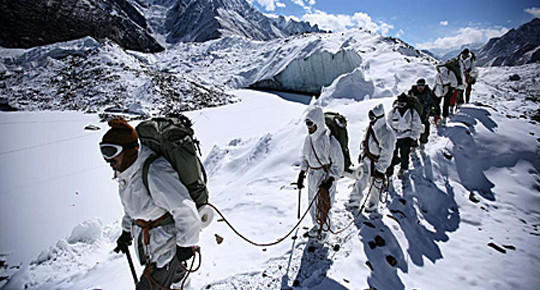
On his maiden visit to the world’s highest battlefield, Siachen, Army Chief General Manoj Mukund Naravane on Thursday said “soldiers serving in Siachen are close to his heart” and they (soldiers) would be provided better facilities to make their life comfortable.

“My message to all soldiers serving here (Siachen) is that you are always in our prayers and thoughts. You might be far from us but you are close to our hearts,” General Naravane said during his first visit to Siachen.

General Naravane was accompanied by Lt-Gen YK Joshi, Chief of Staff, Headquarters, Northern Command, and Lt-Gen Harinder Singh, General Officer Commanding, Fire and Fury Corps. He was briefed on the operational readiness being maintained in the sector by Commander at Siachen Brigade.

“We are aware that everyone is operating here in very tough conditions, inhospitable terrain and weather. We are doing our best to make sure that whatever is required by the troops on ground is made available to them, be it clothing, better rations and facilities to make life comfortable,” General Naravane said.

General Naravane said, “It has always been my intention to come here immediately after taking over, but unfortunately the weather wasn’t excellent. But I am happy that I have been able to visit Siachen Brigade as the Chief of Army Staff.”

“This is strategically very important location at the very head of our defences and it is absolutely essential for us to remain ever-vigilant and in control of these strategic heights because they form the key to the rest of defences of Ladakh and rest of J&K,” he said.

Earlier, the General met and interacted with troops deployed at the forward posts in the Siachen sector and complimented them for their tenacity and high morale, despite the extreme challenges posed by inclement weather, difficult terrain and super high altitude conditions.

At the Siachen Base Camp, General Naravane laid a wreath at the iconic Siachen War Memorial in honour of all the brave Siachen warriors who have made the supreme sacrifice in the defence of the nation.
























