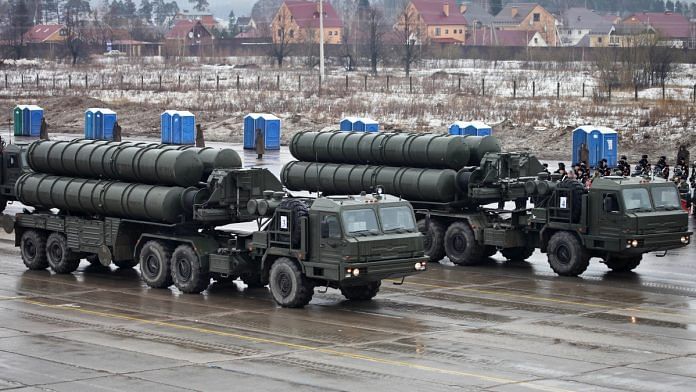
New Delhi: A group of Indian military personnel is leaving for Russia in the next few days to undergo training on key operational aspects of the S-400 air defence systems as Moscow looks at supplying the first batch of the missile to India later this year, officials said on Tuesday.
Russian Ambassador Nikolay R Kudashev interacted with the group at an event in the Russian embassy on Tuesday during which he said the S-400 programme is one of the flagship projects in further boosting military cooperation between the two countries.
He said Indo-Russia military and military-technical ties were based on “ever growing extraordinary mutual interest”, coherence, consistency and complementarity.
In October 2018, India had signed a USD 5 billion deal with Russia to buy five units of the S-400 air defence missile systems, notwithstanding a warning from the Trump administration that going ahead with the contract may invite US sanctions.
India made the first tranche of payment of around USD 800 million to Russia for the missile systems in 2019. The S-400 is known as Russia’s most advanced long-range surface-to-air missile defence system.
Recently, the US imposed sanctions on Turkey under the Countering America’s Adversaries Through Sanctions Act (CAATSA) for purchase of S-400 missile defences from Russia.
Around 100 Indian military personnel are leaving for Russia this month for the S-400 training programme, officials said.
Kudashev said military cooperation has been the main pillar of the special and privileged strategic partnership between the two countries and that the overall Indo-Russia friendship has become an important factor of stability in the region and the globe, according to a Russian embassy release.
“It is based on mutual trust and reflects the true spirit of our bilateral and multilateral commitments in the framework of our vision towards just and equal relations based on the international law and the UN Charter,” he said.
“Coming out of the bipolar world and successfully proceeding through the current establishment of the polycentric order, our partnership is becoming even stronger, experiencing new areas and forms of mutually beneficial and forward-looking cooperation,” the ambassador said.
Russia is expected to start delivery of the S-400 missile systems later this year.
Along with S-400 systems project, Kudashev said both sides are successfully moving towards implementation of AK-203 Kalashnikovs contract, the Ka-226 helicopters programme as well as cooperation in the areas of combat aviation including the Su-30MKI project.
He said both sides are also moving forward in several other projects like the main battle tanks (T-90), frigates, submarines and missiles and joint production of “unique Brahmos”.
In October 2016, India and Russia had finalised a broad agreement to set up a joint venture between Hindustan Aeronautics Ltd (HAL) and two Russian defence majors for procuring 200 Kamov Ka-226T choppers for Indian armed forces.
According to the understanding, 60 Kamov-226T helicopters will be supplied to India in fly-away condition, while 140 will be manufactured in India. Russia had agreed to ensure transfer of technologies to India as part of the pact.
India and Russia finalised the deal for manufacturing AK-203 rifles during Defence Minister Rajnath Singh’s visit to Moscow last year. More than 700,000 rifles are to be produced at an Indo-Russian joint production facility in India.
“Looking forward to an early implementation of the spare parts joint production agreement, which also fits well in Make in India and Atmanirbhar Bharat (self-reliant India) programmes. Work also is going on the mutual logistics support agreement, strengthening maritime cooperation, including in the Indian Ocean,” the Russian ambassador said.
He said Russia intends to be one of the biggest exhibitors at the Aero-India in Bengaluru in February.
“We plan to demonstrate Su-57, Su-35 and MiG-35 fighter jets, helicopters Ka-52, Ka-226, Mi-17B-5, Mi-26 as well S-400 systems and many other new items and equipment,” he said.
The Union government is struck by a crisis of credibility caused by one of the most controversial contemporary television anchors, Arnab Goswami — owner-editor of Republic TV. The transcripts of the purported WhatsApp chats between Goswami and the chief executive officer of Broadcast Audience Research Council, Partho Dasgupta, suggest a conspiracy to boost the viewership ratings of Republic TV at the cost of its rivals and competitors. Unlike hyperventilating news TV channels, the print media does not assume the roles of the investigator, prosecutor and the judge. Even while remaining firmly within the limits of freedom of speech and expression, and not violating anyone’s right to fair trial as directed by the Bombay High Court in its verdict in the case of the coverage of Sushant Singh Rajput’s suicide by Republic TV and Times Now, it needs to be underscored that Goswami has to be treated as an accused in a serious case of fraud.
The Radia Tapes controversy had cost a lot of journalistic reputations; deservedly so. However, those tapes were never authenticated by an investigating agency or made part of a chargesheet unlike the Goswami WhatsApp chats. Worse, here the chats point towards the use of sensitive, highly classified military information about an impending air strike for commercial and pecuniary benefit. The collusion between Goswami and Dasgupta was intended to increase the Television Rating Points of Republic TV by gaming the entire audience research system for higher viewership figures, thereby gaining more advertisements and greater revenue for Goswami’s channel. And it is in the quest for commercial success and money that Goswami allegedly passed on a military secret to Dasgupta, who could have in turn used it for his own benefit.
These chats, if genuine, are an indictment of a pseudo-nationalist TV anchor; a toxic ecosystem of manic-patriotism that allows the monetisation of national grief; and fraudulent viewership or readership measuring mechanisms. A joint parliamentary committee probe is called for, but before that, the courts should restrain this accused from turning judge and jury in his own case by misusing his channel. Also, the government should act fast to retrieve its credibility.
The problem with cantonment boards and why Army doesn’t want them abolished
Representational image. A file photo of the cantonment in Agra. | Photo: ANI
New Delhi: India’s longstanding civilian-military tussle over the management of cantonments — a British-era concept of designating areas that primarily accommodate the military population and their installations — is back in focus with the Narendra Modi government said to be considering the abolition of cantonment areas.
While civilians living in cantonment areas have long complained of issues regarding different restrictions, and said cantonment boards have failed to resolved them, the government’s latest move seeking views and comments from the boards on the abolition of cantonments has not gone down well with the Army.
Speaking to ThePrint, several Army officers, both serving and retired, said if cantonments are abolished, it would adversely impact training and administration of the Army in these areas, and would also be a security hazard.
The civilian residents, however, complain that cantonment boards have been unable to come out with a solution to their daily difficulties that come with living inside cantonments — such access to home loans, free movement within the premises, for example.
According to the Directorate General of Defence Estates, an inter-services organisation of the Ministry of Defence that directly controls cantonment administration, there are 62 cantonments in the country that were notified under the Cantonments Act, 1924, before Independence. The law was succeeded by the Cantonments Act, 2006.
Cantonments and their structure
Comprising both military and civilian population, cantonments are different from military stations, which are meant purely for the training and accommodation of the armed forces.
Cantonments are classified into four categories — class I to class IV —depending on the size of the area and population. While a class I cantonment has eight elected civilians and eight government/military members on the board, a class IV cantonment has got two elected civilians and two government/military members.
This board is responsible for various aspects of the cantonment’s administration.
The station commander of the cantonment is the ex officio president of the board and an officer of the Defence Estates Organisation is the chief executive and the member-secretary. The board has equal representation of elected and nominated/ex officio members to balance the official representation.
Cantonments have several restrictions in place, including on any construction activity or usage of certain roads. It is these restrictions that have become a bone of contention between the civil population living inside cantonments and the military.
Civilian residents of cantonments say they are largely unhappy with the functioning of cantonment boards.
“The common issues often raised by civilians residing in cantonments is that occupation of common areas is difficult and there are limited resources for infrastructure development,” said a source in one of the cantonment boards in the country.
He added that cantonment boards are aware of this problem, but have failed to come up with a solution.
Shailendra Singh Kushwah, vice president, Morar Cantonment in Gwalior, told ThePrint that the restrictions in cantonments are a constant cause for worry for the civil population staying inside.
“Citizens from non-military backgrounds living inside cantonments do not get home loans easily as it is considered defence land. Certain government schemes which were applicable for the regular populace, such as the Pradhan Mantri Awas Yojna, are not always applicable to people living in cantonments,” he claimed.
According to Kushwah, even building additional floors or carrying out basic renovations are a problem for the civilians staying in cantonments as that requires multiple permissions.
Many of the central government schemes such as AMRUT and Pradhan Mantri Awas Yojna cannot be implemented inside cantonments because of the rules associated with cantonments.
The source quoted above said there were also restrictions on movement inside cantonments due to security concerns, “some of which have since been removed” with the opening of cantonment roads to the public. “But a bar on using certain roads inside the cantonments remains.”
In 2018, then defence minister Nirmala Sitharaman opened up cantonment roads for public use. The move received a lot of backlash, particularly from the Army, but Sitharaman defended it saying a detailed review was undertaken and feedback was sought from local military authorities before the decision was taken. She had noted that 850 roads were under closure in the 62 cantonments.
The possibility of abolishing cantonments or even opening them up has evoked strong reactions from the armed forces, which said it would not just impact training but also cause a security threat by allowing in too many strangers into the area.
A senior Army officer told ThePrint that the civil population had been originally permitted to live in cantonment areas to assist the armed forces. “However, with the increasing population, there are increased chances of encroachments and also security threats to the families living in cantonments.”
The officer added the civilians largely have an issue with the cantonment boards than the military itself.
Former 15 Corps Commander Lt. Gen. Gurmeet Singh (Retd) said cantonments are the “interim location” for units and soldiers between two tenures of difficult and challenging “border and field postings” to focus on training and administration.
“Encroachment and land grabbing are the two biggest threats to cantonments from inimical elements in the land mafia, and those often connected to local politics. Security threats from terrorism and anti-India forces are real for Indian armed forces,” he said.
“Cantonments must have controlled access and regulated environments with collective amenities and facilities, with inherent security,” he said, adding that the Army’s training, mobilisation and administration must not be revealed to unwanted elements, from security perspectives.
Singh said the armed forces must have the last word in the management of cantonments, because they are accountable and responsible to their soldiers and families for provision of disciplined and quality living environment.
In 2016, a Committee of Experts, chaired by Lt. Gen (Retd) D.B. Shekatkar, had recommended that the cantonment board should continue to function with civil representatives but the CEO should be accountable to the local military authority and the chairman of the board be a serving officer.
Speaking to ThePrint, Shekhatkar said the move to open up or abolish cantonments should be strongly opposed.
“It is a dangerous move. Opening up cantonments will render the defence land easily to the land and business mafias. It will affect the armed forces and their families, and can be a huge security threat,” he said.
To tackle any internal security threat, the former senior Army officer, said the armed forces must be stationed and located close by, to be effective without undue delay.
“Opening of the cantonment roads has caused irreparable damage to the safety and security of cantonments. Unfortunately, those who allowed this will never be held accountable,” he said.
What urban planning experts say
Pankaj Joshi, principal director, Urban Centre Mumbai, a not-for-profit focusing on urban planning, designing and advocacy, said cantonments were essentially a part of the colonial legacy, which were designed in every city or town for the military to control the local population.
“But that purpose has gone after Independence. Now a lot of the cantonment areas are used for training and education purposes,” he said.
“We need to look at this to ascertain which of the cantonments perform today for their operational requirements or for training and which are for just allied necessities such as educational or residential. Based on that, there is a need for cantonments to be integrated into city and town plans,” he said.
Joshi said there should also be parity in density of people staying in a city that lacks adequate open spaces, amenity spaces for its population.
“All area blankets cannot be a no-go area for urban planning and they should be integrated and scaled in a way beneficial or symbiotic to both defence forces as well as the cities and towns,” he said.
If the govt were to bear the entire cost of price deficit suffered by farmers for 13 crops (out of the 23 for which MSP is declared) in 2017-18, the bill would be Rs47,764 crore. If you add 10 minor crops, the bill would have been about Rs50,000 crore. This is less than the MGNREGA budget that year. The actual budget would be smaller since market intervention and legal provisions would raise the market price and reduce the amount to be paid by the govt.
n a bind: The current crisis calls for a prudent approach. PTI
Kiran Kumar Vissa and Yogendra Yadav
Kiran Kumar Vissa, Agriculture activist; Yogendra Yadav, president, Swaraj India
Can the farmers be offered a guaranteed remunerative price for their produce? The government, some economists and the media would have you believe that this is impossible, both logistically and financially. They are wrong. They either do not understand what the farmers demand, or have not calculated the costs; or they mislead, deliberately. If there was one moment to bust this myth, it is now, when lakhs of farmers are preparing to march to the Capital on Republic Day.
Fortunately, we don’t have to start from scratch. The Central government declares minimum support price (MSP) for 23 crops every year. So, in principle, the government does recognise that the farmers need and deserve a minimum price for their produce. It has a mechanism, however faulty and disputed, for computing and announcing this price. And it acknowledges, though not in legal terms, its responsibility to “support” the farmers in terms of their price.
The problem is that it does not do much to actually offer this support. In reality, less than one-fifth of the farmers get this support, as the government steps in only for two or three crops and that too in a few regions. For most farmers, this MSP remains a maximum securable price, almost a dream price. In the current season, the MSP of maize is Rs 1,850 per quintal, but farmers had to sell it in the past three months between Rs 1,100 and Rs 1,350. Bajra fetched an average price of Rs 1,340 this January in Rajasthan, its largest producer, against the official MSP of Rs 2,150. Growers of pulses like urad, moong and tur face a similar situation. The farmers want and demand that the government must ensure that they get what the government itself admits to be minimum. They demand a law that would place an obligation on the government to make necessary interventions to ensure MSP.
Is this possible? Let us first get rid of the faulty notion of what such a support might mean. Guaranteed MSP doesn’t mean that the government should purchase every quintal of every crop. That would be impossible, unaffordable and unnecessary. Government procurement at MSP can and should be expanded beyond current levels, but it is only one of several mechanisms that can be used to support the farmers. Procurement for the public distribution system should be expanded to include millets, pulses and oilseeds. That would also help meet the nutrition needs of crores of families. Providing 1 kg of pulses to each of the 750 million PDS beneficiaries would generate a demand for about 13 million tonnes of pulse crops, giving a boost to pulse production that currently stands at about 25 million tonnes.
The second mechanism could be a robust and timely market intervention whenever the market prices fall below MSP. This would mean expanding the operations of existing agencies like Markfed and Nafed with better funding, storage and marketing capacities. They need to purchase only a part of the crop, say 10-20%, and this would shore up the prices for the farmers in the rest of the market too. Such a scheme does exist, but its funds need a quantum jump. If this fails, the government can use a third mechanism by way of deficit payment. The government can compensate the farmers for the difference between the MSP and the price they actually secured. This was tried in Madhya Pradesh, as the Bhavantar scheme, but the experiment failed due to poor designing. It should be designed afresh and sufficient funds allocated for this purpose.
The fourth and the last resort mechanism is to make it illegal to trade below MSP. This is not a silver bullet solution and can boomerang if not supported by the first three. Used sparingly, penal provisions for the violators would act as a deterrent to ensure that the market officials implement the provisions.
A prudent mix of these four methods can indeed ensure that no farmer receives a price lower than the official MSP.
Finally, is this affordable? Government spokespersons have pooh-poohed this demand by claiming that it would cost Rs 17 lakh crore, more than half the Union Budget. This is a mischievous figure. This is what it would cost the government if the entire produce of all crops is purchased by the government at MSP and then destroyed or dumped in the Indian Ocean. This calculation assigns zero value to the purchased crop.
To get a realistic estimate, we have calculated the difference between the MSP and the average actual market price of the crop, using the official data for 2017-18. This is what it would cost the government if it procures the crops at higher than the market price or makes deficit payment to the farmers. The average market price is derived from the average (modal) daily prices in markets across the country reported by AgMarknet during the entire season, weighting the modal prices with the quantum of sales for each day.
For instance, the MSP of maize that year was Rs 1,425 but the weighted average market price was only Rs 1,159. Using the estimated marketed surplus production that year of 25.29 million tonnes, the total price deficit suffered by the maize farmers is calculated to be Rs 6,727 crore. In 10 out of the 13 crops (paddy, maize, wheat, bajra, tur, urad, moong, chana, masur, soybean, groundnut, mustard and cotton), the average market price is significantly lower than the MSP.
So, if the government were to bear the entire cost of the price deficit suffered by the farmers for 13 crops (out of the 23 for which MSP is declared) in 2017-18, the bill would have been Rs 47,764 crore. If you add the remaining 10 minor crops, the bill would have been about Rs 50,000 crore. This is less than the MGNREGA budget that year. The actual government expenditure would be smaller since market intervention and legal provisions would raise the market price and reduce the amount to be paid by the government. A higher cost is presented if the government raises the MSP itself at 50% above the Comprehensive Cost (C2), as recommended by the MS Swaminathan Commission. In that case, the maximum cost to government would have gone up to Rs 2,28,000 crore. That is about 1.3% of the GDP, about 8% of the Union Budget. This is stiff, but not impossible. The cost could be shared between the Central and the state governments.
Can the country afford this? Well, it depends on what you think this country is and what is the worth of annadata. This is a question of political will. This is the question crores of farmers are asking today.
The good news is that cross-border terrorism is at an all-time low — not a single big-bang attack since Pulwama and none outside J&K for a decade. This decline in jihadist activity is a good reason to offer Islamabad the olive branch. In 2015, a new twin track framework for dialogue was instituted at the level of National Security Adviser and Foreign Secretary. The NSAs met once in Bangkok, but there was no follow-through after the Uri terrorist attack.
DEEP FREEZE: India-Pakistan ties have remained strained for eight years now. PTI
Maj Gen Ashok K Mehta (retd)
Military Commentator
One New Year resolution the Modi government did not make, one can be sure, is normalising relations with Pakistan — now disrupted for eight years — with whom India has fought four wars and is combating cross-border terrorism (CBT) emanating from that country. Neither the use of force nor diplomacy has resulted in dispute resolution. Gains of war were either frittered away or diplomacy was not sustained enough to produce a durable and interruption-proof framework for dialogue.
While previous governments took big risks in mending fences, public opinion and reputational damage of a muscular government have robbed the engagement process of continuity. The Modi government has prematurely exhausted its patience to abandon strategic restraint for a kinetic response. The Uri and Balakot military strikes not only slammed the doors on dialogue but also put SAARC in cold storage.
India’s reorganisation of J&K has exacerbated friction and frustration in Islamabad. With China claiming damages for the restructuring of Ladakh, India has willy-nilly created a two-front confrontation. Bilateral dialogue that was stopped by the UPA regime following the beheading of an Indian soldier in January 2013 is in its longest pause. Just as India is engaged in a military and diplomatic dialogue with China to resolve the border dispute despite periodic coercion, reviving engagement with Pakistan is essential to defusing one front.
India’s record of resolving the oldest border disputes and longest insurgencies is not very flattering. Dispute resolution is not India’s forte. Diplomatic missions in New Delhi and Islamabad stand downgraded; trade at the Attari-Wagah border and cross-LoC barter have stopped; bus, rail and air connectivity are suspended. Government-to-government business and people-to-people engagement are severely curtailed. Even Track II interactions, most vital when official channels are blocked, are suspended.
The good news is that CBT is at an all-time low — not a single big-bang attack since Pulwama (2019) and none outside J&K for a decade. This decline in jihadist activity is a good reason to offer Islamabad the olive branch. In 2015, a new twin track framework for dialogue, redesignated as Comprehensive Bilateral Dialogue (CBD), was instituted at the level of the National Security Adviser and the Foreign Secretary. The NSAs met once in Bangkok, but there was no follow-through after the Uri terrorist attack and its high-visibility response. The CBD was given an indecent burial with the epitaph: “Terror and talks can’t go together.”
In 1997, the Composite Dialogue was institutionalised with peace, security, J&K and other subjects — Siachen, Sir Creek, Wullar Barrage, terrorism, economic cooperation and promotion of friendly exchanges. Siachen and Sir Creek subjects were ready for signing not once, but twice.
Dialogue was interrupted by the Kargil war and the attack on Parliament, but it took off in earnest again in 2004 after Prime Minister Vajpayee visited Pakistan. Between 2004 and the 2008 Mumbai terror attacks, four rounds of dialogue had taken place and the fifth round in Islamabad got aborted due to the Mumbai attacks. Talks were revived as Resumed Dialogue in 2011 and, altogether, three rounds were held till the beheading of an Indian soldier.
Whereas Vajpayee and Manmohan Singh faced bigger challenges than Modi and took risks to return to the negotiating table, Modi has made relatively little or no investment in dialogue. Gifted with strategic patience, Vajpayee was determined not to give up trying even after a botched trip to Lahore, the skirmish at Kargil, the foul-up at Agra and the attack on Parliament which sparked Operation Parakram. There were gains from Parakram: a ceasefire agreement, reduction in infiltration by 53 per cent, wire-fencing of LoC and ground work for back-channel talks that led to the four-point Musharraf formula that eluded consummation.
Manmohan Singh, in his two terms, enjoyed the fruits of continued engagement, both at upfront and back channels. His first term was marred by the Mumbai attacks which went unresponded in the guise of strategic restraint. According to former NSA MK Narayanan, India did not possess the capabilities for an effective military response. Manmohan Singh resumed talks, but was forced to call them off after the soldier’s beheading. The dialogue has remained interrupted since then and though Modi did make tentative efforts to revive it, not a single session of structured dialogue has been held till date. SAARC has become hostage to the suspension of India-Pakistan dialogue.
During the Modi government’s tenure, India has not faced terror attacks outside J&K (barring one in Gurdaspur). Major attacks were in Pathankot, Uri and Pulwama. But nowhere near the provocations and attacks faced by his predecessors. Uri and Pulwama were replied with spectacular ground and air strikes and their benefits reaped wholesomely during the elections. New red lines were imposed on talks: no consultation with the Hurriyat by Pakistani emissaries; and terror and talks would not go together, virtually ruling out dialogue. Previous governments would also rhetorically stipulate this embargo, but would relent in the larger interests of keeping the channels of communications open.
Following the PLA’s aggression, the Indian Army is enhancing its force deployment against China in Ladakh by redeploying troops from the Pakistan front. This welcome step recognises China, not Pakistan, as the main threat and has the potential to dilute the two-front challenge. A recent study by the Institute for Defence Studies and Analyses (IDSA) reveals that the Indian Army is overstretched along two live borders, overstressing troops. Further, Pakistan’s grand overture on opening the Kartarpur corridor has gone unresponded.
In his memoirs, former President Pranab Mukherjee, with whom Modi enjoyed an excellent rapport, writes: “India needs to tackle Pakistan through deft handling, rather than romanticising its political approach.” He adds: “The country gained little by over-talking surgical strikes in 2016.”
This is repudiation of Modi’s preferred policy of a kinetic response to resuming the dialogue process. At the very least, start talking while retaining the option of a kinetic response. The revival of formal talks with Pakistan will reduce stress on soldiers, dilute one front and save SAARC from extinction.
Retd Col duped of Rs 1.02L after OLX ad in Panchkula
A retired Colonel allegedly lost Rs 1.02 lakh in an online fraud to a man claiming to be a BSF man. – File photo
Tribune News Service
Panchkula, January 20
A retired Colonel allegedly lost Rs 1.02 lakh in an online fraud to a man claiming to be a BSF man.
Col RK Shooran (retd), who lives at Amravati Enclave, told the police that he had placed an advertisement on OLX for selling a bicycle.
In response, the victim received a call on his mobile number claiming to be a BSF man.
To support his claim, the man also sent some documents and “identity proof” to the complainant. He said he was ready to pay Rs 3,000 for the bicycle and would make the payment through PayTm.
“As he followed his instructions, the complainant lost Rs 1.02 lakh from his two bank accounts,” the FIR reads.
A case has been registered under Sections 406 and 420 of the IPC at the Pinjore police station.
Col Narinder ‘Bull’ Kumar’s life story to be made into a biopic
Col Narendra ‘Bull’ Kumar. Photo courtesy: Website of family-run resort ‘Bull’s Retreat’
Mumbai, January 19
A biopic of late Colonel Narinder ‘Bull’ Kumar, who carried out reconnaissance trips to Siachen before Operation Meghdoot of the Indian Army in 1984, is in the offing.
Titled “Bull”, the film will depict the life of the late hero who helped Indian Army claim critical forward posts of the Siachen Glacier as part of the operation.
The late Colonel, who was also the deputy leader of the first successful Indian Mount Everest Expedition in 1965, died at the age of 87.
Rights for a biopic have been acquired by producers Ramon Chibb and Anku Pande, although no official announcement has yet been made about the casting of the film, which is written by Balwinder Singh Janjua.
Chibb, an ex-army officer, is incidentally from the same regiment as Colonel Narinder Kumar and has spent hours with the late armyman.
“We are elated as a team to be the ones to bring this extremely amazing story of heroism and true leadership to the screens soon. We are grateful to late Colonel Narinder ‘Bull’ Kumar’s family to trust us and give us the responsibility to retell his deeply inspiring story and give us the opportunity to do our part in forever commemorating his life. We currently have interest from several studios and look forward to kickstart this project and let the world know the heroic story of an unfathomably brave, adventurous and true patriot,” Chibb said.
Chibb, incidentally, is also associated with writing the story and screenplay of “Fighter”, the Hrithik Roshan-Deepika Padukone action film that was recently announced. Ramon Chibb and Anku Pande are also producing “Fighter” along with director Siddharth Anand. — IANS
An Army officer allegedly shot himself dead at a forward post in the Tangdhar sector along the Line of Control in Jammu and Kashmir, officials said on Monday. Photo for representation only.
Srinagar, January 18
An Army officer allegedly shot himself dead at a forward post in the Tangdhar sector along the Line of Control in Jammu and Kashmir, officials said on Monday.
The deceased has been identified as Major Fayazullah Khan, a company commander of 6 Jammu and Kashmir Rifles, they said.
The officials said the reason behind the officer taking such an extreme step was not immediately known. — PTI
Rijiju to be MoS Defence, MoS Ayush till Naik recovers Naik had met with a serious accident that killed his wife
Minister for Sports and Youth Affairs Kiren Rijiju was on Tuesday given additional charge as MoS Defence and Ayush till the time incumbent minister of these portfolios Shripad Naik recovered after a serious accident.
Rashtrapati Bhavan as advised by the Prime Minister directed that Rijiju serve additionally as the junior minister for defence and Ayush till Naik recovered at a Goa hospital.
Naik had met with a serious accident in Karnataka. His wife and private secretary had died in the accident.
Over 130 have died since Nov 26 during farmers’ agitation: BKU
Farmers protest the agri laws at Ghazipur border on Tuesday. PTI
Sanjeev Singh Bariana
Tribune News Service
Chandigarh, January 19
More than 130 farmers from Punjab have lost their lives during the ongoing farmers’ agitation, said Balbir Singh Rajewal, president, Bhartiya Kisan Union (Rajewal) while talking to The Tribune today.
Rajewal said, “We have asked farm leaders from other states, too, to provide us with the number of farmer deaths in their respective areas along with their names and complete background. We will release this data nationwide to show how the government has turned a blind eye towards the farmers’ woes. The entire world is already watching us,” said Rajewal.
“During a meeting with the central team engaged in discussions with us recently, I gave them the figures of 125 martyrs. There was not even a whimper of acceptance or regret, showing the insensitive behaviour of the officers dealing with the issue. The number of deaths has increased and our team had collected the data of deaths on Delhi borders. We will now be collecting the figure from all districts in our state.”
Assigned the duty of collecting the data from the state, farmer leader Pargat Singh said, “We have the data of about 85 farmers who died on Delhi borders since the first day we came here on November 26 last year. After initiating the exercise of collecting data from across the state, we have got a rough figure of more than 130. We are preparing a detailed list with the help of our workers in different districts.”
“Besides deaths due to suicide, other common reasons for casualties are cold weather, particularly during night, pneumonia and cardiac arrests,” said farm activist Gurdev Singh.
Two protesting farmers die at Tikri border in past 24 hours
A Punjab farmer died of cardiac arrest while a Rohtak farmer had consumed some poisonous substance and succumbed during treatment
State Stalwarts
DEFENCE MINISTER
Minister Rajnath Singh
ALL HUMANS ARE ONE CREATED BY GOD
HINDUS,MUSLIMS,SIKHS.ISAI SAB HAI BHAI BHAI
CHIEF PATRON ALL INDIA SANJHA MORCHA
LT GEN JASBIR SINGH DHALIWAL, DOGRA
SENIOR PATRON ALL INDIA SANJHA MORCHA
MAJOR GEN HARVIJAY SINGH, SENA MEDAL ,corps of signals
.
.
PATRON ALL INDIA SANJHA MORCHA
MAJ GEN RAMINDER GURAYA ,MADRAS REGIMENT
sanjhamorcha303@gmail.com
PRESIDENT SOUTH ALL INDIA SANJHA MORCHA
COL SS RAJAN BOMBAY SAPPERS,
PRESIDENT UTTARAKHAND ALL INDIA SANJHA MORCHA
COL B M THAPA ,BENGAL SAPPERSS
PRESIDENT HARAYANA STATE CUM COORDINATOR ESM
BRIG DALJIT THUKRAL ,BENGAL SAPPERS
PRESIDENT TRICITY
COL B S BRAR (BHUPI BRAR)
PRESIDENT CHANDIGARH ZONE
COL SHANJIT SINGH BHULLAR
.
.
PRESIDENT PANCHKULA ZONE AND ZIRAKPUR
COL SWARAN SINGH
INDIAN DEFENCE FORCES
DEFENCE FORCES INTEGRATED LOGO
INDIAN AIR FORCE
Air Officer C-in-C WESTERN AIR COMMAND
AIR MSHL S PRABHAKARAN AVSM VM
AOC-IN-C, EASTERN AIR COMMAND
Air Marshal Inderpal Singh Walia
AOC-in-C SOUTH WESTERN AIR COMMAND
Air Marshal Vikram Singh
AOC-IN-C, SOUTHERN AIR COMMAND
Air Marshal J.Chalapati
AOC-IN-C TRAINING COMMAND
AIR MARSHAL SK GHOTIA VSM
AOC-IN-C MAINTENANCE COMMAND
Air Marshal Jagdish Chandra
Flag Officer Commanding in Chief, Western Naval Command
ice Admiral R Hari Kumar, PVSM, AVSM, VSM
Flag Officer Commanding in Chief, Eastern Naval Command
Vice Admiral Sanjay Bhalla, AVSM, NM
Flag Officer Commanding in Chief, Southern Naval Command