










Sanjha Morcha

What’s New

Click the heading to open detailed news

Current Events :

web counter

Print Media Reproduced Defence Related News

Free market push may hit small farmers

Unlike the American farmers, the protesting Indian farmers are not using the word ‘parity’. What they are demanding is an income assurance by way of an assured price. Knowing that farmers everywhere have suffered the brutality of markets, farmers want MSP to be made a legal right. This will impact trade policy, but that is a small price compared to the loss of livelihood millions of farmers suffer year after year.
Free market push may hit small farmers

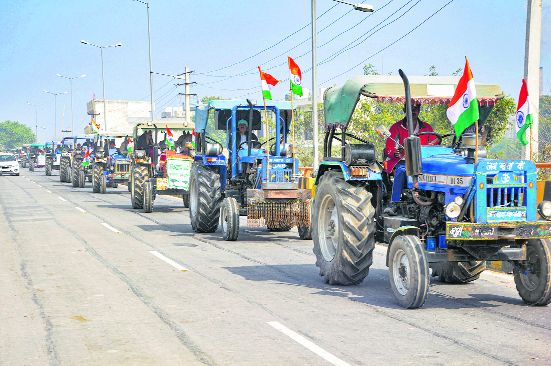
Protest on wheels: The use of the tractor as a symbol of farm discontent is a throwback to the 1979 Tractorcade in the US. PTI
Devinder Sharma

Food & Agriculture Specialist

On a cold winter morning, hundreds of tractors had rolled down the streets of Washington DC. This was on February 5, 1979, when more than 900 tractors (some estimates say more than 1,500) had descended on the American capital to protest against policies which depressed farm prices, resulting in declining income, and

to demand a guaranteed farm income to enable them to stay on the farm.

Forty-two years later, the iconic farm movement — unprecedented in recent Indian history — echoes the same sentiments, with almost similar demands.

The American Agricultural Movement (AAM) — as it was called — arose after the 1977 US Farm Bill failed to protect farm prices at a time of surplus food production. While commodity prices continued to decline, farmers found it difficult to cover even the cost of production. This resulted in small farmers increasingly quitting agriculture, and in the process leading to soaring auction of farm lands. Farmers argued that the government was more concerned about keeping food prices low for consumers than caring for farmers. Sounds familiar, isn’t it?

Wheat price for instance, when adjusted for inflation, was lower than what the American farmers had received after the Second World War. Another study showed that adjusted for inflation, the US farm income in 1976 was less than the annual farm income during the Great Depression years in the 1930s.

It was then that a group of farmers met at Campo, in Colorado, and decided to launch a series of strikes across state capitals to show how the rural family structures were crumbling, increasingly leading to agricultural population declining to obscurity. Using the tractor as a symbol of farm discontent, thousands of tractors were used in the next two years to demonstrate in the state capitals. These tractor demonstrations — which began to be known as Tractorcade — helped take the message of agrarian distress to the urban population, which knew little about the economic disparities plaguing rural America.

According to the US Senate Committee on Agriculture, Nutrition and Forestry, what the farmers wanted was ‘100 per cent parity on domestic and exported agriculture products, all agriculture products contracted at 100 per cent parity, food imports prohibited until domestic supplies were used to fulfil domestic demand, agriculture policy announcements made in advance to give farmers time to adjust production, and a way to give farmers an influence in policy matters’. In other words, American farmers were seeking a price assurance, and even wanted protection at times of trade distortions.

When I look at the demands of the protesting Indian farmers, and compare with what the American farmers were asking for, I see a similarity. While the Indian farmers are not using the word ‘parity’, what they are demanding is an income assurance by way of an assured price. Knowing that farmers everywhere have suffered the brutality of markets, farmers want Minimum Support Price (MSP) to be made a legal right. This will definitely impact trade policy, but that is a small price compared to the loss of livelihood that millions of farmers suffer year after year. When they ask for repealing the three Central laws, which were pushed in without any meaningful consultation with stakeholders, they are in reality seeing a role in formulating future farm policies.

The historic 1979 Tractorcade that stormed Washington DC had attracted farmers from across the country. In an interview, Beverly Anderson, probably the only woman who drove a tractor from 1,300 miles away, recalls: “Sometimes, the tractorcaders were fed by people of the communities where they stayed, and people took notice of them as they drove down the highways. In that respect, their mission was a success — the contacts allowed farmers to tell their stories — that wheat was selling for about the same price as it had at the end of World War II, while production prices increased, that it cost more to put in a crop than they would realise at sale, and that failure of the family farm system would make the country dependent upon imported food.”

Initially, the residents were unhappy, wanted the farmers to be moved out. But then, it so happened that the city was hit with a blizzard and life came to a halt. Public transport was all shut down. It was at that time farmers used the tractors to clear the streets, pull out the cars from under the snow, and take doctors and nurses to hospitals and so on. This helped develop bonhomie with the urban population that began to see farmers as fellow citizens. For several weeks, farmers would drive their tractors daily through various parts of the city appraising people of their plight. Some farmers even stayed back for months.

The then American President, Jimmy Carter, himself a farmer, was sympathetic. “I don’t know of any other group that has suffered more from inflation than farmers,” he had reportedly said. The bureaucracy of course was not convinced. They had more faith in the markets.

As Anderson reminisced: “We were successful in telling the story of the plight of the American farmer. As far as any legislation that helped, not really.”

If only the policy makers had listened to the farmers’ woes, and provided them with at least a guaranteed price, American farming wouldn’t have been left devastated, with farm lands gobbled up, forcing small farmers to move out. Intensive agriculture has destroyed the soil, polluted the groundwater, and chemical pesticides have contaminated the food chain. With the real cost of cheap feed externalised, American agriculture is crying for regeneration. Decades later, the headline of a Time cover story (November 27, 2019) says it all: “They’re trying to wipe us off the map’. Small American farmers are nearing extinction.”

There are lessons here. Free market orthodoxy hasn’t helped increase farm incomes in America, and for that matter, anywhere in the world. It has only pushed small farmers out of agriculture. To make farming an economically viable and sustainable enterprise for small farmers, India needs to carefully listen to the protesting farmers. There may not be another opportunity again.


Healthy mind-body connect alleviates stress

One man’s stress is another man’s challenge. If an individual handles stress well, it is referred to as eustress or positive stress, which is good for growth. On the other hand, if the individual does not cope well, it leads to distress. The external support from people close to him acts as a prop and can certainly help him to cope. Individuals exposed to highly stressful situations tend to turn to others for support.

Healthy mind-body connect alleviates stress

State of being: Detoxification of the mind can act as a tonic and help rejuvenate. PTI

Maj Gen RN Tikku (retd)

Educationist

Be yourself, love yourself;
And lift yourself — by yourself.
— Mantra for well-being

True education lies in the inner space of the learner. It helps you discover who you really are, and a mindful journey begins from within. You are ‘present’ here and now, and you are self-reliant to face life’s challenges. The present century, characterised by fast social changes, has been aptly called the age of anxiety and stress. Everyone has just one thing to say: “We are too busy with our lives.” Tolerance levels is at an all-time low, self-centeredness, hatred, road rage, murder, suicide and like maladaptive patterns of behaviour have alarmingly increased.

What makes an individual behave so? That such an action, contrary to norms, has taken place has to have a reason. This ‘action’ is only an effect. It has to have a ‘cause’. The cause, in general terms, is stress — a force, a pressure, a strain or distress that makes a person act in an unusual manner. And yet, stress by itself is only an effect and not the cause. One has to look deeper and find the causa causans of stress — the cause of the cause, the first cause. Stress is caused by something and there the answer lies. To look at such a cause, the first or the main cause, one has to look at the affected individual, his wants and his needs. This is only part of a much wider problem.


The concept of stress envisages the stressor or stressful event, the individual (his self-perception and stress tolerance) and the response. The stressor is an adjustive demand placed on an individual that produces a psychological or physical reaction, and sometimes produces symptoms of emotional or physiological disability. Stress affects the mind and the body. The process takes time to build up. When people live in a constant state of stress, their bodies produce adrenaline, a short-term reaction to stress. They produce steroids, part of the immune system, as well. When you start producing extra steroids, the immune system suffers. The steroids start working against each other.

How is stress recognised and tackled? Stress is recognised by looking at its symptoms or manifestations, and thereafter tracing the cause, or cause of the cause, if necessary. Failure or delay in determining the cause may lead to serious consequences for the individual and the organisation. Manifestations of stress can be observed at three levels of operation: psychological (irritability, mood swings, worry, anxiety, withdrawal), physical (palpitations, diarrhea, impotence or lack of libido, migraine) and behavioural (impaired quality of work, increased absenteeism, careless driving, over indulgence in smoking, alcohol and drugs). The point of concern is that the stressor at one level may aggravate the situations on other fronts disrupting the homeostasis, a compensatory mechanism within. An example of psychological homeostasis is maintaining one’s self-respect in the face of failures through rationalising mechanism.

The determinants that govern the severity of stress include the characteristics of the adjustive demand (stress), the personality of the individual, and the cultural and situational context in which the stress occurs. What emerges is that stress is essentially individually defined and is the outcome of the focal individual and his environment. The environment presents stimulating conditions, but the perception, coping ability and control mechanism of the individual determines the degree of success achieved in coping with stress.

One man’s stress is another man’s challenge. If an individual handles stress well, it is referred to as eustress or positive stress, which is good for growth. On the other hand, if the individual does not cope well, it leads to distress and disease. The external support from people close to him acts as a prop and can certainly help him to cope. Individuals exposed to highly stressful situations tend to turn to others for support. A father’s statement to his son before the exam: ‘Do the best you can’ is more supportive than ‘I am sure you are going to do well’ or ‘I am not worried, you will surely pass’. The last two statements add to the son’s burden, for not only must he fear the disappointment of not passing, but also the loss of respect in the eyes of his father. This could have serious repercussions on the child.

A healthy mind-body connect is the bedrock of self-belief and consequent well-being. When it comes to health or stress, one cannot take the ‘mind’ out of the equation of prevention and healing. Most diseases are ‘psychosomatic’— they stem from the mind. And by constantly thinking about it, we are allowing it to actually breed. The answer lies in exercise and detoxification of the mind. Practices like mindfulness, self-compassion and meditation are ‘spiritual delights’ and tonic for the mind and body. By focusing on and controlling our breath, we can change how we think and feel. The breath is a means of changing our emotional state and managing stress. There is then inner balance, peace of mind and joy.

The author in his book titled The New Me: A Visionary Treatise to Uplift the Youth in Making the Right Choices has discussed a live case-study of a soldier confronted with the spiralling effect of stress, where the problems faced on the personal front do not receive any cushion or relief from home and work fronts. The case brings out how to recognise and assess stress by looking at its manifestations; the stressor should not be viewed in isolation, but relative to the individual’s perception, capacities and personality; and the role of the individual, the organisation and other agencies in the management of stress.

In today’s bizarre times, ‘self-help’ is the best bet for understanding stress, its early detection, observation, analysis and proper management of unusual behaviour.


Tributes paid to Pulwama martyrs

Tributes paid to Pulwama martyrs

Members of different organisations participate in a candlelight march in the memory of Pulwama martyrs in Tarn Taran.

Our Correspondent

Tarn Taran, February 14

Activists of the Sanyukt Kisan Morcha on Sunday paid tributes tributes to the security personnel killed in the terrorist attack in Pulwama district of Jammu and Kashmir in 2019. Farmers, mazdoors, employees and other trade unionists organized a candlelight march in the town. Pritihipal Singh Marimegha, Baldev Singh Pandori, Tara Singh Khehra and Gurpreet Gandiwind, representatives of mass organizations, condemned the government for allegedly using the martyrs name for political motives.

Meanwhile, workers of the Kisan Mazdoor Sanghrsh Committee,Punjab, also paid tributes to the martyrs at Manochahal Kalan village. Satnam Singh Manochahal said they paid the highest sacrifice to save the integrity of the country. He also condemned the Central Government for not redressing the grievances of the agitating farmers. He called upon the farmers to intensify their agitation till the Centre withdrew the three farm laws.


Oust Dalal for remark, demand khaps

Oust Dalal for remark, demand khaps

Khap activists stage a dharna at Antoha village in Palwal.

Tribune News Service

Palwal/Ambala, February 14

Seeking dismissal of Haryana Agriculture Minister JP Dalal for his alleged controversial statement over the death of farmers during the ongoing agitation, activists of 52 khap panchayats (Pal) staged a dharna at Antoha village of Palwal today. They passed a resolution condemning his ‘statement’ and sought his removal from the state Cabinet.

Swami Shradhanand Saraswati, head of the committee carrying on the agitation in the district under the banner of 52 khap panchayats, said that the protesters held a meeting here today to adopt a resolution to condemn the reported statement of JP Dalal.

They termed it to be an insult to the farmers and farming community of the country. He said the resolution adopted by the protesters has demanded his sacking from the Haryana Cabinet even though he may have tendered an apology.

Saraswati said the 52 khaps would not only boycott his programmes in the district, but would also oppose him if he makes a visit here in his official capacity.

In Ambala, Congress workers led by Haryana Pradesh Congress Committee treasurer Rohit Jain held a demonstration at Inco Chowk in Ambala City against state Agriculture Minister JP Dalal’s statement.


Now on, FASTag or pay twice the sum at NH toll plazas

Now on, FASTag or pay twice the sum at NH toll plazas

Photo for representational purpose only

Tribune News Service

New Delhi, February 14

FASTag will be mandatory from February 15 midnight and any vehicle not fitted with it will be charged double the toll at toll plazas.

A government order said all lanes at electronic toll plazas on national highways will be declared “FASTag lanes” with effect from February 15 midnight.

The Ministry of Road Transport and Highways said the aim was to promote fee payment through digital mode, reduce waiting time and fuel consumption and provide for a seamless passage.


All central government employees to attend office on working days: Personnel Ministry

All central government employees to attend office on working days: Personnel Ministry

Photo for representation. PTI

New Delhi, February 14

All central government employees have been asked to attend office on working days, according to a Personnel Ministry order.

The decision comes amid a significant decline in the number of active COVID-19 cases in the country, including in the national capital.

However, all officers and staff residing in containment zones shall be exempted from coming to office till their containment zone is de-notified, the statement said.

Until now, officers of the level of Under Secretary and above were only attending office due to the coronavirus-induced restrictions imposed in March.

The Centre had in May asked 50 per cent of its employees below the level of Deputy Secretary to work from their offices, while implementing different time slots in its effort to further check the spread of the coronavirus.

The officers/staff shall follow staggered timings to avoid over-crowding in offices/workplaces as decided by the heads of department, it said.

“The government servants at all levels are to attend office on all working days without any exemption to any category of employees,” said the order issued late Saturday to all the central government departments.

Biometric attendance shall continue to be suspended until further orders, it said.

The officers and staff who are residing in the containment zone shall work from home and shall be available on telephone and electronic means of communications at all times, it said.

Meetings, as far as possible, may continue to be conducted with video-conferencing and personal meetings with visitors, unless absolutely necessary in public interest, are to be avoided, the order said.

The Personnel Ministry, in another order, said that “all departmental canteens may be opened”.

According to the Union Health Ministry data updated on Sunday, the COVID-19 active caseload remains below 1.5 lakh.

In Delhi, the active case tally on Saturday dropped to 1,041 from 1,053 the previous day. PTI


It’s sheer surrender: Antony on LAC disengagement

It’s sheer surrender: Antony on LAC disengagement

A K Antony

Tribune News Service

New Delhi, February 14

Former Defence Minister AK Antony today alleged that the terms of disengagement in both Galwan valley and Pangong Tso areas and the creation of a buffer zone was a “surrender” of India’s interests. He accused the Centre of appeasing China by “agreeing to dis-engagment on China’s terms”.

Addressing a press conference, he said, “Please understand the gravity of the situation, disengagement is good but it cannot be at the cost of national security.” He asked the government to disclose its plan to restore status quo ante as on April 2020 along the LAC.

“The government is not realising the danger of creating such buffer zones,” he said. The Army had occupied Kailash range in south of Pangong Tso. “In negotiations, we have agreed to withdraw from there. It could have been a bargaining chip,” he said.

“The area between Finger 4 and Finger 8 was disputed and both armies used to patrol it. There had been incidents of jostling among troops of both countries, but India always maintained it claim up to Finger 8,” he said.

Quoting Defence Minister Rajnath Singh’s statement in Parliament, he said, “Now, we have agreed to come back to Finger 3.”

“Our Army has a post at Finger 4, why has that been vacated and why has the right to patrol up to Finger 8 been surrendered,” he said.

“Galwan was never a point of dispute. It was always a part and parcel of India. For the first time, a buffer zone has been created there,” he said.


CRPF convoy attack case: NIA files chargesheet against Hizb-ul-Mujahideen terrorist Naveed Babu has been accused of planning and executing attack on the CRPF convoy in J&K’s Banihal in March 2019 along with other terrorists

CRPF convoy attack case: NIA files chargesheet against Hizb-ul-Mujahideen terrorist

Tribune News Service

New Delhi, Feb 13

The anti-terror probe agency NIA on Saturday said it had filed a supplementary chargesheet in a special court in Jammu against Hizb-ul-Mujahideen terrorist Naveed Mushtaq Shah alias Naveed Babu in a case relating to the attack on the CRPF convoy in Jammu and Kashmir’s Banihal in March 2019.

The charges have been framed under various sections of Ranbir Penal Code (RPC), Explosive Substances Act, Jammu and Kashmir Public Property (Prevention of Damage) Act and Unlawful Activities (Pervention) Act- UAPA.

In the chargesheet it has been alleged that accused Naveed Babu, who is a former constable of Jammu and Kashmir Police, had deserted the force with arms and ammunition in 2017 when he was posted as a guard at FCI, Budgam, NIA officials said, adding that he later joined the terrorist group Hizb-ul-Mujahideen and became an active terrorist.“Investigation has established that accused Naveed was actively involved in the planning and execution of the attack on the CRPF convoy in Banihal along with other terrorists Riyaz Ahmed Naikoo, Rayees Ahmed Khan and Dr Saifullah Mir, who were subsequently killed in encounters with security forces.

“The deceased terrorists Sahil Abdullah Bhat, Adil Bashir Sheikh and Zubair Ahmed Wani were also actively involved in preparation of the explosives that went into the making of the IED,” said a senior NIA official

Charges have also been abated against the deceased terrorists involved in the conspiracy, the official added.

“The case relates to an attack on the CRPF convoy at Tethar, Banihal, in Ramban district of J&K by a terrorist who had exploded an explosive laden Santro car on March 30, 2019 with the intention of killing security personnel and waging war against the Government of India,” the NIA said in a statement.

In this regard, an FIR was registered at Police Station Banihal and the NIA re-registered the case on April 15, 2019 and took over the investigation of the case, it said, adding that the agency had earlier filed chargesheet against six Hizb-ul-Mujahideen terrorists for their role in the attack.


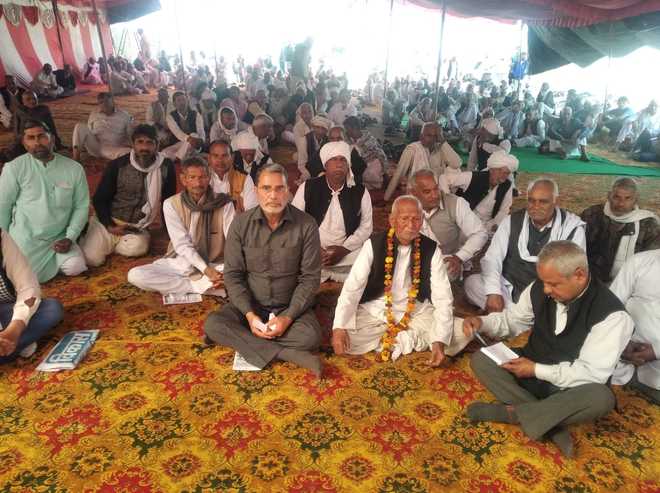
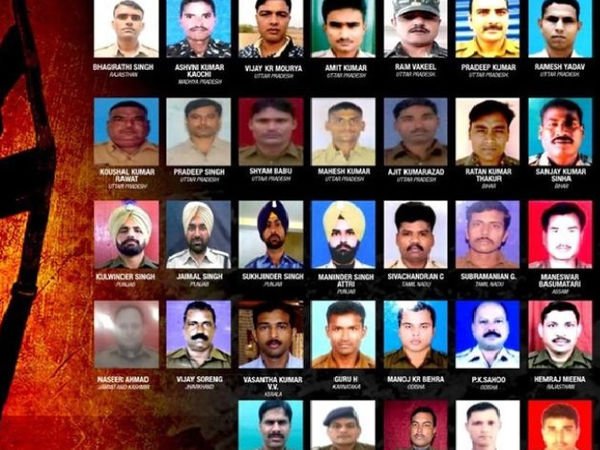
Sanjha Morcha Pays homage to Pulwama Martyrs :: 14 Feb 20119

Pulwama martyrs.

PHOTO-2021-02-14-08-02-03


pulwama


jkl