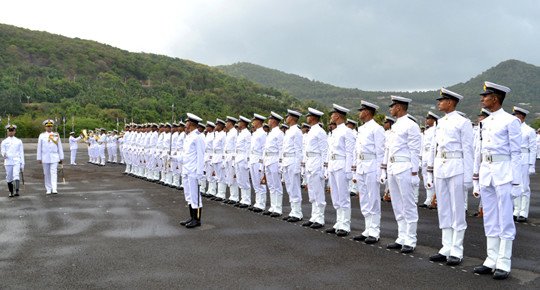
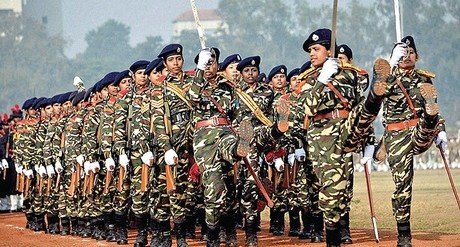
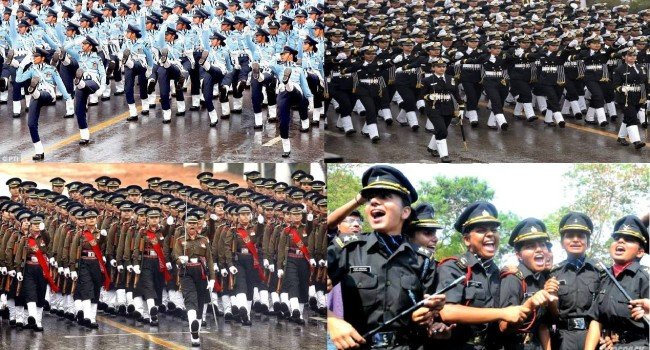
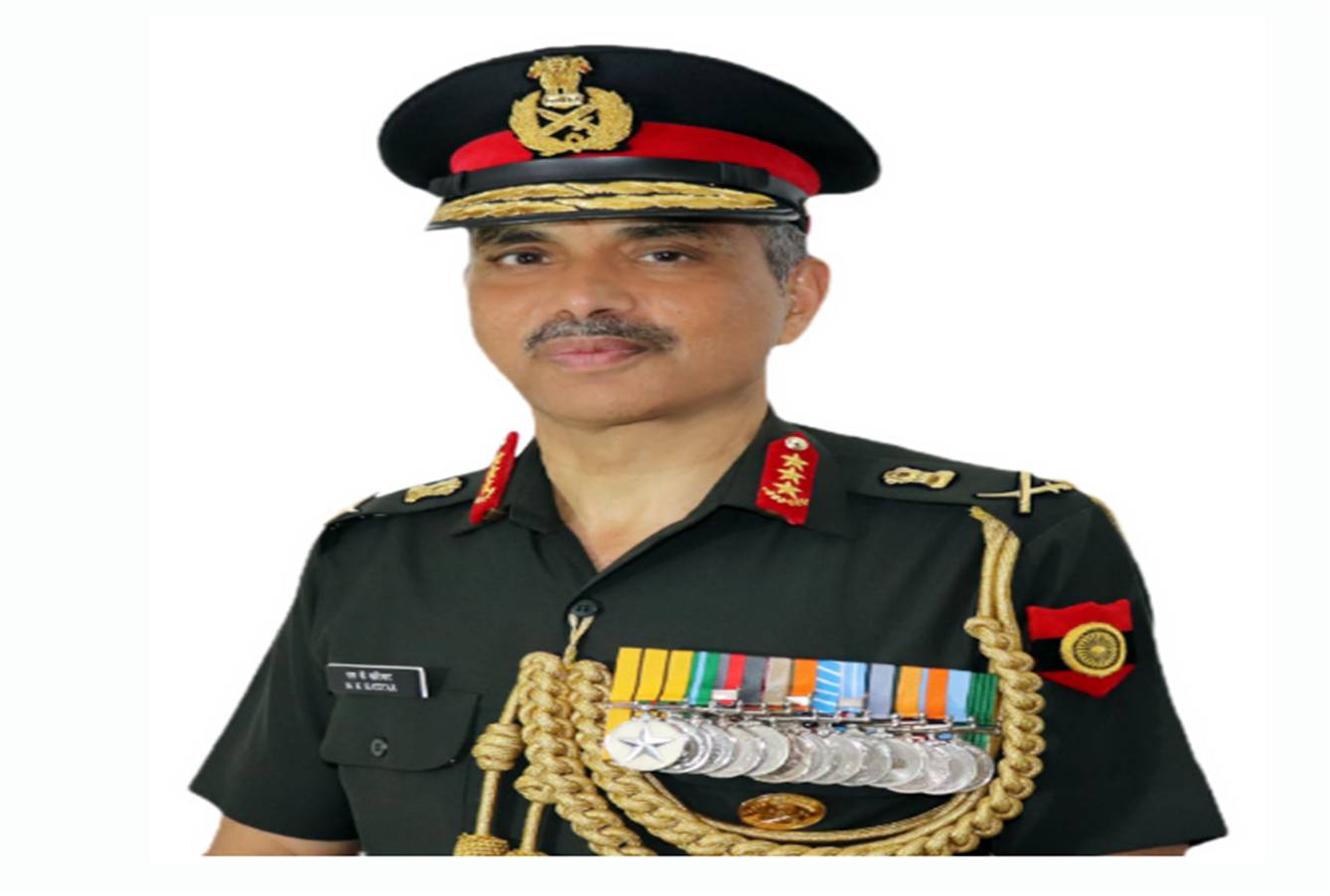
he passing out parade at the IMA, Dehradun, on Saturday.
Tribune News Service
Chandigarh, December 12
For the third time this year, a cadet from Punjab has bagged the prestigious Sword of Honour for being adjudged as the overall best during pre-commission training in an Army institution.
Hails from Ludhiana
Lt Watandeep S Sidhu awarded Sword of Honour at the passing out parade at IMA, Dehradun, on Dec 12
The honour was bestowed on Lt Akashdeep Singh Dhillion from Tarn Taran in June
It was bestowed on Lt Harpreet Singh from Rupnagar at the OTA, Chennai, in March
The Sword of Honour for the Autumn Term-2020, comprising 147th Regular Course (RC) and 130th Technical Graduate Course (TGC), was awarded to Lt Watandeep Singh Sidhu during the passing out parade at the Indian Military Academy (IMA), Dehradun, today.
The gold medal for standing first in the order of merit went to Lt Majji Giridhar, also the parade commander, while the silver medal for standing first from TGC went to Lt Jasminder Pal Singh Sidhu, who hails from Threeke near Ludhiana and is an alumnus of the Rashtriya Indian Military College.
“It’s a matter of great pride for our family. I am overjoyed at my son’s achievement,” Watandeep’s father, Baljinder Singh Sidhu, who works with the Punjab State Electricity Board, said.
Flying Officer Anurag Nain, who hails from Hisar but studied in Delhi, had bagged the Sword of Honour at the Air Force Academy, Dundigal, in June.
As many as 325 Gentlemen Cadets, in addition to 70 from nine friendly countries were formally commissioned today.
With 50 officers, Uttar Pradesh had the highest tally among the states followed by Haryana with 45 and Bihar with 32. Punjab shared the seventh place with Kerela with 15 officers each. Among foreigners, 41 were from Afghanistan and 17 from Bhutan.
The parade was reviewed by Vice Chief of the Army Staff Lt Gen SK Saini.
China wants India to accept the new normal on LAC, move on to restore bilateral ties | Analysis
Chinese soldiers armed with spears and rifles, which were used during the Galwan Valley clash in June.
This month, External Affairs Minister Subrahmanyam Jaishankar has made repeated public statements stating that the only way for restoring frozen India-China ties is to untangle the four friction points in East Ladakh by disengaging and de-escalating the military situation along the 1597 km Line of Actual Control (LAC).
The Chinese on their part are indicating that the People’s Liberation Army (PLA) has established a new normal in East Ladakh by transgression and India should move to restoring bilateral ties by accepting the new LAC. Beijing wants India and China to celebrate 70 years of establishment of bilateral ties and move to restore economic ties. That boundary dispute should be kept separate and resolution parallel to growth in economic ties has been the Chinese narrative since the days of Deng Xiaoping.
While the previous Indian regimes believed that being soft to the PLA on border was a sure recipe for a peaceful and tranquil LAC, this was taken a sign of weakness by the Beijing rulers who time and again tried to change the unresolved line from Shaksgam Valley in Karakoram to Kibithu in far east Arunachal Pradesh. Even junior diplomats from China heckled India for referring to Tibet and Xinjiang or on Indian leaders travelling to Arunachal Pradesh. Buddhism teacher and 14th Dalai Lama was called a terrorist by China but Pakistani Masood Azhar, a terrorist who has spilled the blood of hundreds in India, was a religious-political activist as Beijing blocked his designation as global terrorist no less than four times.
Also Watch | Senator Mark Warner on India-US ties, China, Pakistan & Kashmir #HTLS2020Maybe PLA expects Indian Army to accept the new normal after looking at the roadmap of New Delhi’s relations with Beijing’s iron brother Pakistan over decades, where India has always come around to the dialogue table after every crisis. Indian resilience is seen as a sign of weakness.
Today 19 years ago, five Pakistani terrorists of Masood Azhar’s Jaish-e-Mohammed group struck at Indian Parliament while it was in winter session killing nine security personnel and civilians. Much as we have tried to gloss over the event, the brutal fact is that had the terrorists managed to gun their way into the Houses in session, the entire Indian political leadership would have been held hostage by radicalised thugs. The national humiliation of such an event would have made look the 1999 hijacking of IC-814 flight to Kandahar and subsequent release of three top Islamist terrorists including Azhar in lieu of over 170 passengers a trifle. Yet, in January 2004, India started the dialogue with Pakistan, who again gave a facile commitment that it would not allow its territory by terrorists to target India.
One thought that the 26/11 Mumbai massacre would have been the turning point for India-Pakistan relations with this time Pakistan’s other terror export Lashkar-e-Taiba (LeT) gunning down innocents in the heart of India’s commercial capital. Despite nearly 200 innocents getting butchered in Mumbai, there was no retaliation from India with so-called strategists buying the Pakistani narrative of an imminent nuclear war. This time again, dialogue with Pakistani was resumed in 2010 with counter-terrorism, Mumbai attack trials and humanitarian issues added to the menu.
Prime Minister Narendra Modi called it a day on Pakistan after January 2016 attack on Pathankot airbase by Azhar’s Islamist troopers again. Had it not been for alert Indian security agencies led by National Security Advisor Ajit Doval, India would have been humiliated again if the terrorists had managed to blow parked MiG-21 Bison fighters to smithereens. Not only all the fighters were removed from the airbase but even the then Pakistani NSA Naseer Janjua was informed about the impending attack on January 1 night itself. Documents found on the terrorists indicated that the attack had been given a green signal, the day PM Modi impromptu landed in Lahore on December 25,2015 in a genuine effort to promote ties with Islamabad.
The June 15 Galwan Valley skirmish in which men of 16 Bihar led by Col Santosh Babu retaliated to the PLA aggression on the LAC is one such tipping point with China. On that day, India lost 20 of its brave soldiers including Col Santosh Babu in Galwan Valley as they were overwhelmed in numbers by the aggressive PLA soldiers armed with barbed wire sticks and spears. The Indian soldiers retaliated in full measure with the adversary PLA losing more men in the hand to hand fight including their own commanding officer. Hopefully, the Indian Army will honour the brave Santosh Babu and four other personnel on 2021 Republic Day.
While India wants China to restore status quo ante of April 2020, Beijing apparently feels that the Modi government will come to terms with the new normal on LAC and revive ties in the coming months and willy-nilly accept the rise of the Middle Kingdom. After all, the so-called tiger ASEAN nations have consigned the Chinese aggression in the South China Sea to merely a talking point on bilateral agenda with Beijing. Prime Minister Narendra Modi should not even entertain such a thought.
Panchkula youth third of family to pass out from Indian Military Academy, Dehradun
A 22-year-old resident of Panchkula, Lieutenant Adhiraj Singh Sidhu, who passed out from the Indian Military Academy (IMA), Dehradun, on Saturday, became the third generation officer from his family to pass out from the elite academy.
Sidhu is also the sixth generation officer from his family to join the army. He joins 21 Rajputs, a glorious and illustrious regiment of infantry. He said, “I am proud to continue the family tradition; joining the army was a dream for me.”
His father is a Colonel. His grandfather was a Brigadier, great grandfather a Major, great great grandfather a Captain from the famous 36 Sikh, now 4 Sikh. His grandfather, Brig Pritam Singh Sidhu, was a pass-out of the third IMA course; father Col Sarup Singh Sidhu was from the 79th IMA course; Lt Adhiraj Singh Sidhu passed out from the 147th IMA course. Sidhu is also the fourth person from his family to join the infantry.
As many as 392 cadets graduated from the IMA and the passing out parade was held on Saturday including 322 Indians and 70 from friendly foreign countries.
Mohali resident Lt Yashasavi Sharma, 23, was also among those who passed out from IMA on Saturday. Sharma, who is an ex-cadet of Maharaja Ranjit Singh Armed Forces Preparatory Institute, has been commissioned into the Armored Corps, third cavalry.
Why Army wants a new Deputy Chief and Director General at its headquarters
dea for a Deputy Chief (Strategy) came about during the Doklam crisis when it was felt the Army Headquarters needed closer and direct coordination between its verticals.
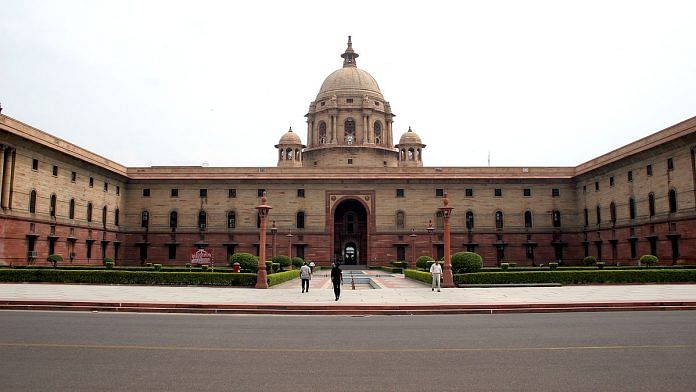
The Ministry of Defence at South Block in New Delhi | Commons
New Delhi: The Army aims to bring in a more cohesive approach to deal with situations like Doklam and Ladakh and undertake optimal utilisation of key verticals with the creation of a new post of Deputy Chief (Strategy) at its headquarters. It also plans to have strategic communication in play in an era of 5th Generation Warfare with the creation of Director General (Information Warfare).
The two new posts, which are part of the Army Headquarters reforms being carried out, have been approved.
Director General of Military Operations (DGMO) Lt Gen Paramjit Singh Sangha is likely to be the first Deputy Chief (Strategy).
Lt Gen Sangha, who was a key officer involved in the planning and execution of the 2016 surgical strike, has a long experience dealing with operational issues.
According to the plan, Directorate of the Military Operations (MO) and Military Intelligence, besides Operational Logistics (DGOL) and Director General (Information Warfare), will report to the new Deputy Chief (Strategy), sources in the defence and security establishment said.
Earlier, all these directorates reported to the Vice Chief individually. However, under the new set-up, the Deputy Chief will become the single-point advice person to the Vice Chief on operational issues.
Sources explained that there were a number of verticals that used to report to the Vice Chief and final assessment of issues happened at this level.
“Now we will have the new Deputy Chief who will collate all the inputs and then put forward a crystallised assessment and way forward,” a source said.
A second source said this would mean various existing verticals will be optimally utilised.
The sources said despite intelligence being a big factor in any operation or situation, the Military Intelligence was not fully utilised.
“The MO was the more dominant player in the Army’s scheme of things. A sense of competition always exists within any organisation and military is also not immune to it. Hence, it was important to have a cohesive approach to information, intelligence, operations and strategy,” a source said.
The idea for a new post came about during the Doklam crisis when it was felt the Army Headquarters needed closer and direct coordination between its verticals.
Re-organisation of the Army Headquarters was one of the four studies instituted by Chief of Defence Staff Gen Bipin Rawat when he was the Army chief.
The Army already has two deputy chiefs who look after Information Systems and Training, and Planning.
On the new post of Director General (Information Warfare), who will report to the Deputy Chief (Strategy), sources said it was important to have a common strategy on communication.
Till now, the Army has had three main verticals looking after information warfare. This included the Army PRO who came under the Ministry of Defence, the Information Warfare unit that comes under Military Operations and the Additional Director General (ADG) Public Information (PI), under Military Intelligence.
The ADGPI has now been named ADG (Strat Comm), headed by a Major General rank officer, and will report to the Director General (Information Warfare), which will be headed by a Lieutenant General-rank officer.
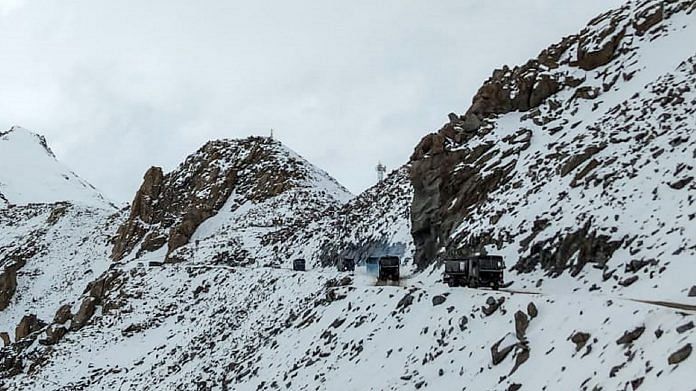
Indian Army vehicles driving through the snow in Ladakh | Representational image | Photo: AFP via Getty Images via Bloomberg
New Delhi: As winter grips eastern Ladakh, the government has asked the Army, Navy and the Air Force to stay alert and firm, and ruled out any possibility of a premature withdrawal from the Kailash ranges on the southern bank of Pangong Tso where India has the upper hand over China.
Top government sources told ThePrint that right at the beginning of the tensions in May, the armed forces were directed to be prepared for any eventuality. They also said the stand-off could last longer than anticipated and the situation was expected to simmer even if a temporary disengagement took place.
The sources also said China has been taken aback by India’s determined response to its aggression, which was done to establish Beijing’s global standing as a superpower against the US, and also respond to India’s fast-paced border infrastructure development.
The sources said while India is not looking at any escalation with China, the Chinese have found that “India is no pushover”. They added that New Delhi will be firm in all fields besides defence, even as it seeks friendly relations with Beijing.
“Shaurya and saiyam (courage and restraint) is the message given to the armed forces and everyone else in the government — ‘courage’ to take on the Chinese aggression, and ‘restraint’ in speaking out on the issue,” a source said.
The source added that this was the message given out to everyone in the government when the tensions first surfaced.
“To be frank, the Chinese military is bigger. But then China has now learnt that the Indian military is no pushover. We don’t want to escalate tensions, but if something is forced on us, Indian forces will throw punches as well. It will not be one-sided,” the source said. “We have asked the military to stay firm and be alert. They have shown extreme courage in quickly responding to the situation.”
Asked how long the Ladakh stand-off could last, sources admitted it would be longer than initially anticipated.
“Two things were very clear from May itself. The development had the possibility of turning into a limited war kind of situation, and could last longer through the winter as India responded militarily,” the source cited above said, adding that the Galwan Valley clash was a sign of how things on the ground can change quickly.
While sources refused to give any specific timeline for a resolution, they did say tensions could continue to simmer at the Line of Actual Control (LAC) even if a temporary disengagement takes place.
Asked if the Army had committed a mistake by failing to anticipate and prevent the Chinese aggression in May itself, the source said the focus should be on how the forces responded eventually.
“Even when two experienced wrestlers are fighting, one might commit a mistake. But the focus should be on actions after that. Indian forces have responded very strongly and have refused to back down,” the source said.
The source said Indian forces have shown huge capability, giving the example of the Galwan Valley clash and of the Army’s action on the night of 29-30 August, when troops outflanked the Chinese and raced to the dominating heights of the Kailash range.
“The response was swift and fierce. Yes, we lost our men in Galwan, but not before sending a chilling message to the Chinese that they too will bear casualties. The Chinese have not accepted their casualties in public, but we are aware. Even in August, the Chinese were taken by surprise by India’s swift actions,” the source said.
Sources said there will be no premature withdrawal from the Kailash range, which China is keen on.
“When it was realised that China had no intention of stepping back, the Army was asked to come up with a plan to ensure that India has something to negotiate with. About seven or eight places were identified along the LAC where India could gain the upper hand. And hence, premature withdrawal from the southern bank (of Pangong Tso) is out of the question,” a source said.
Asked what India is negotiating for, the source said the 14 Corps Commander is the person heading the negotiations, and the specifics will not be discussed in public. But the source did say that India’s ultimate goal is to restore status quo ante.
Sources said the government has promised the armed forces that all their requirements will be met.
“We have given special financial powers for the services, including for capital purchases. Every single immediate demand of the forces is being put on priority and is being cleared at speed,” a source said.
The source said that peace cannot be enforced by the weak. “We have to have a strong defence which can act as a deterrent. One needs a strong military and power to enforce peace. And this is why modernisation of the armed forces is a priority,” the source said, adding that the armed forces have already gone in for large procurement of various necessary items.
“Modernisation of our armed forces has been slow over the years. It will take another four years or so for the modernisation process to show its results. A lot is being done, and a lot more needs to be done,” the source said.
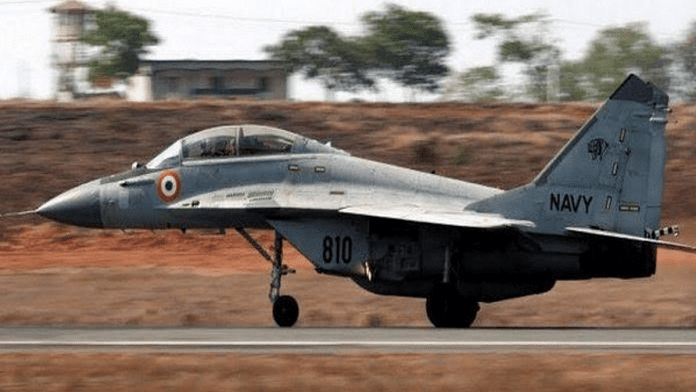
Indian Navy pilot Commander Singh went missing after his MiG-29K aircraft crashed into Arabian Sea on 26 November.
New Delhi: Rescue teams of the Indian Navy have recovered a body, believed to be that of pilot Commander Nishant Singh who went missing after his MiG-29K aircraft crashed into the Arabian sea 11 days back, official sources said on Monday.
They said DNA testing is being carried out to ascertain the identity of the body, which has been recovered from the site of the crash.
“There are reasons to believe that the body is of Commander Nishant Singh. However, it can be fully ascertained following the result of the DNA testing,” said an official on condition of anonymity.
Indian Navy pilot Commander Singh went missing in the Arabian sea after his MiG-29K aircraft crashed into the Arabian Sea on November 26. The second pilot was rescued soon after the incident.
The Indian Navy deployed nine warships, 14 aircraft and a number of fast interceptor craft as part of the search and rescue mission to locate Commander Singh.
Some debris of the aircraft including landing gear, turbo charger and fuel tank engine were located last week.
The Navy had ordered a high-level inquiry to investigate the incident which was third involving the Mig-29K in the last one year.
A MiG-29K twin-seat fighter aircraft had crashed in South Goa district on November 16 last year, but both the pilots had ejected safely.
Another MIG-29K crashed into the Arabian Sea off the Goa coast on February 23 this year after taking off from INS Hansa, a prominent naval air station at Vasco in Goa. The pilot of the aircraft had managed to eject safely.
The MiG-29K is an all-weather carrier-based multirole fighter aircraft developed by Russian aerospace company Mikoyan (MiG). The Indian Navy had procured a fleet of 45 MiG-29Ks from Russia at a cost of around USD 2 billion to operate from INS Vikramaditya.
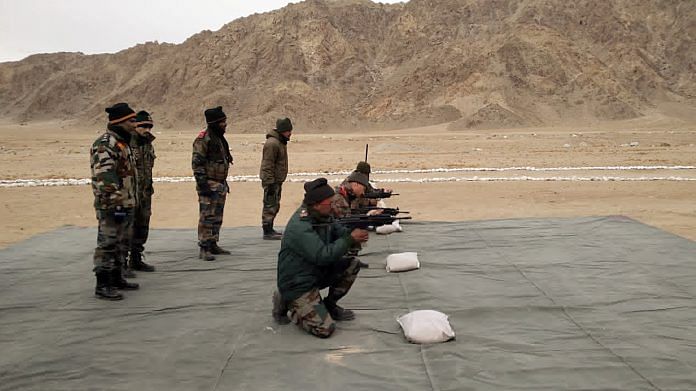
The 5.56×30 mm joint protective venture carbine is a gas-operated semi automatic weapon and has a rate of fire more than 700 rounds per minute.
The defence ministry successfully tests the 5.56 x 30 mm Joint Venture Protective Carbine (JVPC) designed by DRDO on 10 December, 2020. | ANI
New Delhi: A 5.56×30 mm sub-machine gun designed by the Defence Research and Development Organisation (DRDO) has successfully undergone the defence ministry’s user trials, it was announced on Thursday.
The successful completion of trials has paved the way for this gun’s induction into the armed forces, the defence ministry said in a statement.
The DRDO-designed 5.56×30 mm joint protective venture carbine (JVPC) is a gas-operated semi automatic weapon and its rate of fire is more than 700 rounds per minute, it mentioned.
The final phase of the user trials completed on Monday meeting all the general staff qualitative requirements (GSQR) set up the Indian Army, it said.
“This was the last leg of trials in a series of user trials which have been carried out in extreme temperature conditions in summer and high altitudes in winter,” the statement mentioned.
The effective range of the carbine is more than 100 m and weighs about three kg with key features like high reliability, low recoil, retractable butt, ergonomic design and single hand firing capability, it said.
“JVPC has successfully met the stringent performance criteria of reliability and accuracy in addition to quality trials conducted by DGQA (Directorate General of Quality Assurance),” the statement noted.
The DGQA works under the defence ministry.
The weapon has already passed the trials by the home ministry and procurement action is initiated by central armed police forces and various state police organisations, the ministry’s statement noted.
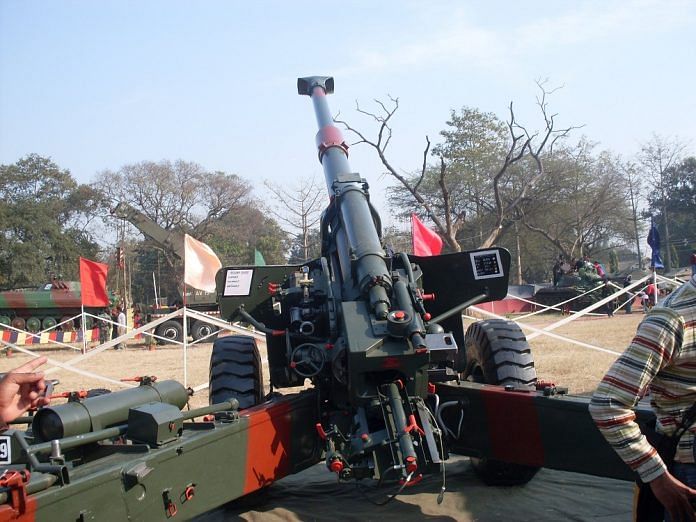
Work has already begun on raising the new artillery brigade, which will see larger deployment of the Ultra Light Howitzers besides other guns.
Representational image | Commons
New Delhi: Amid the ongoing tensions with China in Eastern Ladakh, the Panagarh (West Bengal)-based Mountain Strike Corps (MSC) is set to get its own artillery brigade, ThePrint has learnt.
An artillery brigade is already attached to the Mountain Strike Corps’ only division but the new brigade will be attached to the Corps.
In military parlance, a division is typically constituted of three brigades, which usually consist of armoured, infantry and artillery units besides other elements. Two or more divisions then make up a corps.
Sources in the defence and security establishment said work has already started on raising the new artillery brigade, which will see larger deployment of the Ultra Light Howitzers besides other guns.
Although the grand plans of a full-fledged Mountain Strike Corps, which would have involved over 90,000 troops and expenditure of over Rs 64,000 crore across an eight-year period, was put on a back burner in 2016 due to budgetary constraints, the ongoing Ladakh conflict has shown how useful they can be, sources said.
The Mountain Strike Corps has only one division as of now. Sources, however, said there was no progress in the potential raising of another division, which is meant to be based in Pathankot.
The developments come even as the Army is reportedly looking at converting some of its fighting formations into dual-tasked ones, which would allow them to fight against both China and Pakistan.
Sources said the new artillery brigade with the corps would be useful as the infantry, artillery and Air Force are critical for mountain warfare.
“The armoured elements in the heights are possible in Ladakh and some areas of Sikkim but not in the rest of the terrain. Air Power is essential but it is dependent on weather. The only thing available to act as a punisher round the clock in the mountains are the artillery,” a source said, while explaining why the guns were important.
Sources explained that while in the plains, 1:3 is the ratio needed for an offensive infantry operation, it increases to 1:9 in the mountains.
“So to counter one enemy in the heights, you would need nine of our own for offence. The dynamics of mountain warfare is very different,” said a second source.
The Mountain Strike Corps
Although originally envisaged way back in 2000, the Mountain Strike Corps was finally sanctioned only in 2013. However, the raising of the new corps, which was to be manpower- and equipment-intensive, hit a financial roadblock.
While the corps was supposed to have two divisions instead of the regular three, only the Panagarh-based 51 Division was raised.
Plans for raising of the second division were put on hold due to a paucity of funds. It was then thought that the MSC can be divided into Integrated Battle Groups (IBGs), a new concept brought in by then Army Chief Gen. Bipin Rawat.
The Mountain Strike Corps, also known as the 17 Corps, debuted last year in the massive exercise called “HimVijay”, which also saw the IBGs concept in action.
Recalling the bravery of 9 Sikh in 1971 war, and why the recent renovation of a grave of a fallen Pak officer is in consort with the ethos of the Indian Army to respect all those killed in battle
Photo for representation only. – File photo
Lt Gen Raj Sujlana (Retd)
IRRESPECTIVE of who shows guts and bravery in battle, it deserves respect and honour. The recent report of renovation of thegrave of a fallen Pakistani officer in Jammu and Kashmir is in this spirit, and is in consort with the ethos of the Indian Army to respect all those killed in battle. I was a part of 9 Sikh during the Indo-Pak war in 1971 when this outstanding battalion captured 42 square km of PoK in Lipa valley, a record unmatched by any other Infantry battalion during the war. The enemy’s resistance collapsed as the Sikhs emerged out of thin air, accompanied by the resounding ‘jaikaras’ of ‘Bole So Nihal, Sat Sri Akal’.
Of the many surprise attacks was the capture of the area (referred to here as Three Heights) where the grave is located. Three Heights, at the outbreak of war, was located well to the rear of the enemy defences where they least expected an attack, but was to witness many acts of gallantry. After the capture of the initial objectives, two companies of 9 Sikh took a wide hook by night to launch an attack by infiltration on Three Heights. After one company had established firm base for the attack to the north-east of Three Heights, further infiltration was resumed with a recce in strength under Major ‘Hardy’ Hardul Singh, Lt Taneja and an additional platoon under Lt Pushpinder as immediate reinforcements. It being daylight, stealth was paramount; around 2 pm, this force had creeped close to Three Heights. The enemy was totally unaware and even the six mortars deployed there were unguarded.
The opportunity could not be missed. The troops following up were whistled forward hurriedly, but suddenly a sentry spotted the lurking Sikhs. ‘Hardy’, true to the adage that ‘boldest measures are the safest’, took the initiative and launched the attack. This daylight rush totally surprised the Pakistanis. They defended well, especially the mortar handlers, but the Sikh resilience was overbearing. The follow-up troops, along with the platoon under Lt Pushpinder, had joined up; soon the entire Three Heights, along with four mortars with 280 high explosive bombs and other weapons, was captured. The counter-attack was also beaten back. The enemy casualties were nearly 30 killed and two captured; due to the surprise, our casualties were low: five killed, one officer (Lt Taneja) and six other ranks wounded.
Fast forward to May 1972, Three Heights again witnessed extremely severe fighting. On May 5, Pakistan launched a surprise attack with over two battalions supported by helicopter-based SSGs and heavy artillery support — a ratio of nine attackers to one defender. Some peacetime activities had started; thus the 9 Sikh company was pretty under-strength, but egged on by Major Pancholy, they fought it out till most were killed or wounded. Pancholy, critically wounded, was evacuated along with only a handful of men. 9 Sikh launched a counter-attack soon with four officers leading and three of them were wounded; in an intense fire-fight, Capt Sen killed Maj Sabir Khan, but was himself badly wounded. It was an extremely high-intensity battle. The casualty figure on our side was 20 and 28 were wounded, Pakistan lost many more, including the Commanding Officer (Lt Col Haq Kiyani), and it awarded five Sitara-e-Jurat and two Tamgha-e-Jurat, their third and fourth highest gallantry awards, for this operation.
Some 15 years later, I was back there as the Company Commander. Maj Khan’s grave was a short distance from my bunker. The grave reminded me of the famous poem by Rupert Brooke: ‘If I should die, think this only of me. That there is some corner of a foreign field that is forever (me)…’ But lest the gallantry of many others be forgotten, the poem continues, ‘There shall be in that rich earth richer (gallantry acts) concealed.’ How true! The original epitaph that read ‘Here lies Maj Khan killed by Capt AS Sen of 9 Sikh’ needs to be known and preserved.
Chinese shenanigans India should miss no chance to expose neighbour’s duplicity
THE tense standoff that started in early May at the Line of Actual Control (LAC) in eastern Ladakh is nowhere near its end, even though India and China have held several rounds of talks at ministerial and military levels. On Wednesday, External Affairs Minister S Jaishankar tried to explain why no breakthrough had been achieved so far. He stated that China had given India five ‘differing explanations’ for deploying large forces at the LAC, but he neither elaborated on these arguments nor mentioned whether or how India had countered them. China’s behaviour is predictable, but India should not miss any opportunity to rub it in. A point-by-point rebuttal would have lent credence to India’s claims. Jaishankar did admit that violations of bilateral pacts by China had ‘very significantly damaged’ their relationship that was now at its ‘most difficult phase’in the past 30-40 years.
His comments came a day after the Chinese Foreign Ministry’s business-as-usual statement that China and India are in ‘close communication’ on the border issue through diplomatic and military channels to ‘further ease tensions’. Communication alone can’t be of much help unless genuine efforts are made to bring visible improvement on the ground. It’s here that China has been found wanting. Last month, a ray of hope had emerged when the two armies broadly agreed on a three-step, time-bound process for the disengagement of troops and withdrawal of weaponry from all major friction points. This plan was in line with the roadmap worked out by Jaishankar and his Chinese counterpart Wang Yi in Moscow in September. However, China’s duplicity has precluded restoration of the status quo ante.
Both nations have signed several agreements in the past three decades or so with the purpose of keeping large forces away from the border areas, but the Chinese military build-up has undermined the pacts. China has sought to delink the border dispute from bilateral ties, but India has firmly refused to do so. But this is not enough to make China see reason. India should forcefully insist that the neighbour walk the talk, and soon, or drop all pretences.
State Stalwarts
DEFENCES FORCES RANKS
ARMY, NAVY, AIRFORCE RANKS
FORMATION SIGNS
FORMATION SIGNS
ALL HUMANS ARE ONE CREATED BY GOD
HINDUS,MUSLIMS,SIKHS.ISAI SAB HAI BHAI BHAI
CHIEF PATRON ALL INDIA SANJHA MORCHA
LT GEN JASBIR SINGH DHALIWAL, DOGRA
SENIOR PATRON ALL INDIA SANJHA MORCHA
MAJOR GEN HARVIJAY SINGH, SENA MEDAL ,corps of signals
.
.
PATRON ALL INDIA SANJHA MORCHA
MAJ GEN RAMINDER GORAYA , CORPS OF
sanjhamorcha303@gmail.com
PRESIDENT HARAYANA STATE CUM COORDINATOR ESM
BRIG DALJIT THUKRAL ,BENGAL SAPPERS
PRESIDENT TRICITY
COL B S BRAR (BHUPI BRAR)
PRESIDENT CHANDIGARH ZONE
COL SHANJIT SINGH BHULLAR
.
.
PRESIDENT PANCHKULA ZONE AND ZIRAKPUR
COL SWARAN SINGH
PRESIDENT SAS NAGAR (MOHALI)
COL BALBIR SINGH , ARTY
INDIAN DEFENCE FORCES
DEFENCE FORCES INTEGRATED LOGO
FORCES FLAGS
15 Th PRESIDENT OF INDIA SUPREME COMMANDER ARMED FORCES
Droupadi Murmu
DEFENCE MINISTER
Minister Rajnath Singh
CHIEF OF DEFENCE STAFF (2nd)
General Anil Chauhan PVSM UYSM AVSM SM VSM
INDIAN FORCES CHIEFS
CHIEF OF ARMY STAFF(29th)
General Upendra Dwivedi, PVSM, AVSM (30 Jun 2024 to Till Date)