FASTags will be mandatory for vehicles from January 1, 2021, Union minister Nitin Gakdari said on Thursday.
FASTags, which facilitate electronic payment of fee at toll plazas, was introduced in 2016. Making the tags compulsory would also help in ensuring that vehicles pass seamlessly through the toll plazas as fee payment would be done electronically.
Union Minister for Road Transport, Highways and MSMEs Nitin Gadkari has announced that FASTag is being made mandatory for all vehicles in the country from the New Year, the Ministry of Road Transport and Highways said in a statement.
Addressing a virtual function on Thursday, he also said FASTag will be useful for commuters as they will not have to stop at toll plazas for cash payments. Besides, it will also help save time and fuel, he added.
FASTag was launched in 2016 and four banks together issued nearly a lakh of them. By 2017, their numbers went up to seven lakh and more than 34 lakh FASTags were issued in 2018.
In November this year, the ministry issued a notification also making FASTag mandatory from January 1, 2021 for old vehicles or that were sold before December 1, 2017.
As per the Central Motor Vehicles Rules, 1989, since December 1, 2017, FASTag had been made mandatory for registration of new four-wheelers.
It was also mandated that the renewal of fitness certificate of a transport vehicle will be done only after the vehicle concerned has a FASTag.
For National Permit vehicles, the fitment of FASTag was mandated since October 1, 2019.
A valid FASTag would be made compulsory for getting a new third party insurance. This would come into force from April 1, 2021.
The ministry said that steps for ensuring availablity of FASTag through multiple channels are being taken. They would be available at physical locations as well as online.
The National Toll Collection (NETC) programme has been implemented on a pan-India basis in order to remove bottlenecks and ensure seamless movement of traffic and collection of user fee as per the notified rates using passive Radio Frequency Identification (RFID) technology. PTI
Farmers protesting at Delhi borders remain resolute in seeking repeal of new agri laws This has led to traffic congestion forcing police to divert vehicular movement
Braving harsh cold, thousands of agitating farmers at the Delhi borders on Thursday remained steadfast in their demands to repeal the Centre’s three new agri laws.
Dense fog reduced visibility to just 100 metres in parts of Delhi on Thursday, affecting traffic movement, the India Meteorological Department said, adding that the minimum temperature at the Safdarjung Observatory, which provides representative data for the city, settled at 4.5 degrees Celsius.
Security remained tight at the Delhi borders with hundreds of personnel deployed at Singhu, Ghazipur and Tikri as thousands of farmers have been staging their protests at the borders for nearly a month now. This has also led to traffic congestion forcing police to divert vehicular movement.
Taking to Twitter on Thursday, the Delhi Traffic Police alerted commuters about the routes that remained closed owing to farmers’ agitation and suggested them to take alternative roads.
“The Chilla, Ghazipur borders are closed for traffic coming from Noida & Ghaziabad to Delhi because of farmer protests. People are advised to take alternative route for coming to Delhi via Anad Vihar, DND, Apsara, bhopra & Loni borders,” it said in a tweet.
In another tweet, police said Singhu, Auchandi, Piau Maniyari, Saboli and Mangesh borders are closed.
“Pl take alternative routes via Lampur, Safiabad, Palla & Singhu school toll tax borders. Traffic has been diverted from Mukarba & GTK road. Pl avoid Outer Ring Rd, GTK road & NH 44,” the traffic police mentioned.
On Wednesday, the protesting farmers hardened their position and asked the government not to repeat the proposal of “meaningless” amendments that they have already rejected but come up with a “concrete” offer in writing for the resumption of talks.
Reading out a reply to the government’s talks offer during a press conference, farmer leaders said they are ready for dialogue with an open mind if they get a concrete proposal, but made it clear they will not accept anything less than a complete repeal of the three agriculture laws and legal guarantee for the Minimum Support Price (MSP).
The sixth round of talks on December 9 was cancelled following a deadlock with the farmer unions refusing to budge from their demand for repealing the three laws.
Enacted in September, the three farm laws have been projected by the central government as major reforms in the agriculture sector that will remove the middlemen and allow farmers to sell anywhere in the country.
However, the protesting farmers have expressed apprehension that the new laws would pave the way for eliminating the safety cushion of MSP and do away with the mandi system, leaving them at the mercy of big corporates.
The government has repeatedly asserted that the MSP and mandi systems will stay and has accused the Opposition of misleading the farmers. PTI
Army’s proposed ‘Tour of Duty’ recruitment model could be expanded to Navy and IAF too
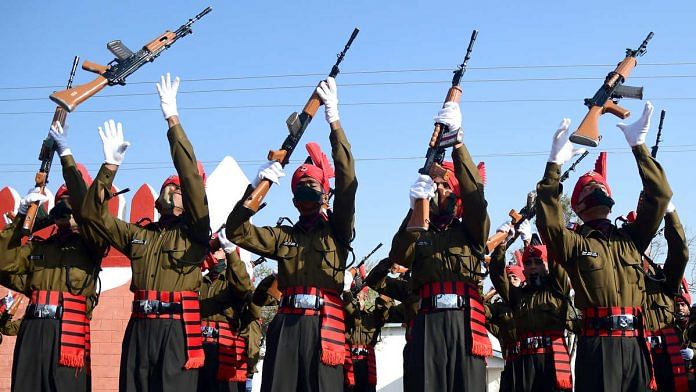
Representational image | Recruits to the J&K Light Infantry celebrate the end of their training | Photo: ANI
New Delhi: Months after it was first proposed by the Army, India’s defence establishment is actively considering expanding the scope of the ‘Tour of Duty’ model of recruitment to the Air Force and Navy as well, ThePrint has learnt.
“We are planning to expand the scheme to bring all three services under its fold. Bringing the Central Armed Police Forces under the same scheme or a similar one is also under consideration,” a defence official said, adding the finer details and calculations for the scheme are being worked out, so it can be implemented by the middle of next year.
Sources said India’s political leadership is keen on the scheme, given its future potential to generate large-scale employment, and is pushing to working out its modalities. They added that there are plans to expand the scheme over the next few years to ensure that close to 40 per cent of the strength of the Army is recruited through it.
Army sources, however, told ThePrint that no concrete decision has yet been taken on the implementation of the scheme, and the idea is currently at the discussion stage.
Earlier this year, Chief of Defence Staff General Bipin Rawat had said the concept is at a nascent stage, and its viability needs to be studied.
Currently, the only option apart from regular permanent commission into the armed forces is the Short Service Commission, in which officers are recruited for a period of 14 years. A large number of SSC officers eventually opt for permanent commission, subject to eligibility. The Army had, in May, proposed the ‘Tour of Duty’ model of recruitment that would let young individuals voluntarily serve for a temporary period of three years. The idea is to attract more youth to join the Army, fill up officers’ vacancies, and later, reduce burgeoning defence pensions, which make up nearly 30 per cent of the defence budget after ballooning when the ‘One Rank One Pension’ (OROP) scheme was implemented.
Defence sources told ThePrint that one of the names being considered for the scheme is ‘Agnipath’ (literally, the path of fire), with the volunteers set to be called ‘Agniveers’ (fire-warriors).
As reported by ThePrint, an initial pilot project is set to be tried out, with the first batch of recruits likely to include up to 100 officers and 1,000 personnel at other ranks. The model will be evaluated and assessed on the results of the pilot project.
‘Close to 40 % of Army could be recruited through it’
To reduce the defence pension bill, the Department of Military Affairs (DMA) headed by CDS Rawat had proposed that those taking PMR (Pre-Mature Retirement) with 20-25 years of service will now be entitled to only 50 per cent of the current pension. As of now, rules state that officers will receive pension which is 50 per cent of their last drawn salary, for which they are eligible upon completing 20 years of service.
The original Tour of Duty proposal stated that the total amount spent on each officer recruited through the scheme would be Rs 80-85 lakh, including pre-commission training, pay, allowances, gratuity, proposed severance packages, leave encashment and other costs. Currently, an amount of Rs 5.12 crore is spent on an SSC officer who retires after 10 years, and Rs 6.83 crore on one who retires after 14 years. The savings on only 1,000 jawans could be Rs 11,000 crore, the proposal said, adding that this money could be put towards the modernisation of the Army.
A second defence official told ThePrint that to further reduce the pension bill, there are plans to expand the scheme over a few years to ensure that close to 40 per cent of Army personnel are recruited through it. The official used the Army as an example since it is the largest of the three services, with a strength of about 14 lakh.
“Around 65,000 personnel of the Army retire every year. The plan being considered is to recruit a certain number of personnel on this scheme, and keep increasing the number progressively every year, till they form a decided percentage of the armed forces,” the official said.
The official said that such large-scale recruitment can come into effect only in about 15 years.
Army chief Gen MM Naravane on Wednesday visited various high-altitude forward areas in eastern Ladakh and reviewed India’s overall military preparedness as the tense border standoff with China in the region prolonged for over seven months, the Army and official sources said.
The Army said Gen Naravane visited the forward areas, including Rechin La, and undertook a first-hand assessment of the situation along the Line of Actual Control (LAC) in Ladakh.
Nearly 50,000 troops of the Indian Army are deployed in a high state of combat readiness in various mountainous locations in eastern Ladakh in sub-zero temperatures. China has also deployed an equal number of troops, according to officials.
Lt Gen PGK Menon, the commander of the Leh-based 14 Corps, popularly known as ‘Fire and Fury’ Corps, briefed the Army chief on various aspects of the situation in eastern Ladakh.
Sources said Gen Naravane reached Ladakh at 8.30 am on a day-long visit with an aim to review the ground situation in the region that is experiencing harsh winter.
“General MM Naravane #COAS visited forward areas of #FireandFury Corps including Rechin La and undertook a first-hand assessment of the situation along the LAC. He was briefed by #GOC #FireandFury Corps and other local commanders on the operational preparedness of our forces,” the Army tweeted.
The Army said Gen Naravane interacted with the troops deployed in forward areas and exhorted them to continue working with the same “zeal and enthusiasm”.
He also distributed sweets and cakes ahead of Christmas.
Around three-and-half months ago, Indian troops had occupied a number of strategic heights in the Mukhpari, Rechin La and Magar hill areas around the southern bank of the Pangong lake in eastern Ladakh after the Chinese People’s Liberation Army (PLA) attempted to intimidate them in the area on the intervening night of August 29 and 30.
“General MM Naravane #COAS undertook on-the-spot inspection of the state of #habitat of troops on the forward line of defences at #RechinLa. He appreciated the efforts made by the formation to make troops comfortable along the #LAC,” the Army said in another tweet.
It said the Army chief also visited the forward base of Tara and interacted with the local commanders and troops. He appreciated their high morale and state of readiness.
The military face-off erupted on May 5 following violent clashes between the Indian army and the PLA in the Pangong lake area. The clashes were followed by a similar incident in north Sikkim on May 9.
Last week, India and China held another round of diplomatic talks during which they agreed to continue work towards ensuring complete disengagement of troops in all friction points along the LAC in eastern Ladakh at the “earliest”.
It was agreed at the talks that the next round of military dialogue should be held at an early date so that both sides can work towards an early and complete disengagement of troops in accordance with the existing bilateral agreements and protocols.
India and China have held several rounds of diplomatic and military talks in the last few months to resolve the standoff. However, no concrete breakthrough has been achieved so far. PTI
Army chief Naravane visits Rechin La posts facing Chinese troops 200 metres away
he Army chief met the ‘Fire and Fury’ Corps and undertook a first-hand assessment of the situation along the Line of Actual Control.
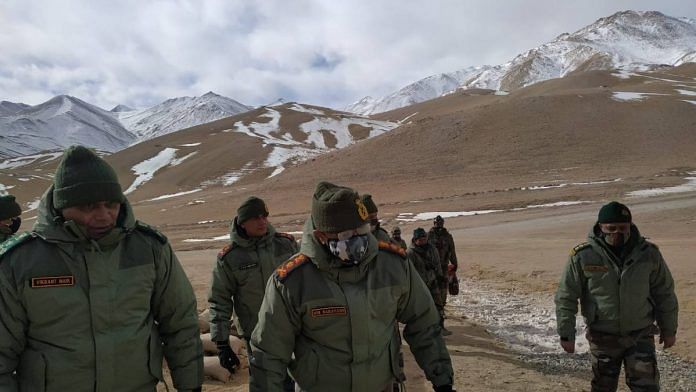
Army chief General MM Naravane visits forward locations in eastern Ladakh | Photo by Special Arrangement
New Delhi: With the harsh winter settling in, Army chief General Manoj Mukund Naravane Wednesday visited the frontline posts in eastern Ladakh, including the ones at Rechin La in the southern bank of Pangong Tso, where the Indian and Chinese troops are engaged in a stand-off, just 200-300 metres apart.
Army officers said Gen. Naravane is on a day-long visit to the Leh-based 14 Corps, also known as the ‘Fire and Fury’ Corps, which takes care of the borders with China in the northern sector.
he officers said the Army chief undertook a first-hand assessment of the situation along the Line of Actual Control (LAC) and interacted with local commanders and troops.
One of his focus areas was habitat of troops on the frontline of defences at Rechin La. The habitat has been a major logistical challenge for the Indian Army but they have largely overcome it, even though sources maintain that certain issues still remain.
The Army chief, who was accompanied by the new Corps Commander Lt Gen. P.G.K. Menon, also visited the forward base Tara in eastern Ladakh. Army officials said the chief distributed sweets and cakes for Christmas to keep up the morale of the soldiers.
Sources in the defence and security establishment said the Army chief visited most forward posts at Rechin La. The Chinese troops are stationed just 200-300 metres away from the post, the sources said.
They added that the Army chief was given a detailed briefing on the security situation by the top Commanders and those heading specialised units posted at the location.
‘No major breakthrough expected’
The sources said that no major breakthrough is expected in the coming weeks, and no dates for the military talks have been finalised.
“The dates are not fixed yet. No major breakthrough is expected,” a source said, when asked whether the Army chief’s visit meant that things could loosen up a bit.
The last round of Corps Commander level talks was held on 6 November, but ended without a breakthrough. The friction is set to last through the winter.
India and China have been in the worst-ever stand-off since the 1962 war, which has resulted in both sides deploying nearly 50,000 troops each, along with artillery and armoured elements.
India had taken the Chinese by surprise on the intervening night of 29-30 August when specialised units outflanked the People’s Liberation Army (PLA) and dominated the crucial heights at the southern banks which gives an overview of China’s Moldo garrison.
The Chinese have been insisting that Indians withdraw its soldiers from the location. The tensions escalated further in September this year when Chinese troops fired shots in the air as a warning to Indian soldiers.
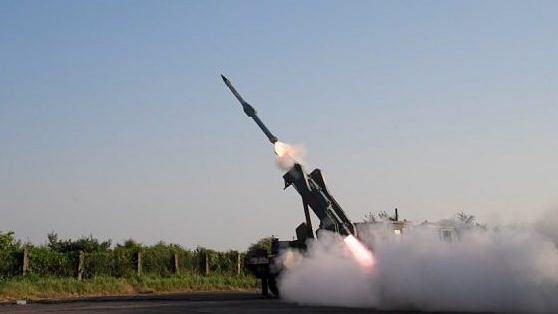
File photo of a surface-to-air missile | The Quick Reaction Surface to Air Missile took off from Chandipur in Odisha on 13 November | ANI
Balasore: India on Wednesday successfully test-fired a medium-range surface-to-air missile (MRSAM) from Odisha coast, defence sources said.
The missile was fired from a ground mobile launcher at launch pad number-1 of the Integrated Test Range (ITR) near here at 3.55 pm, and it hit the target with accuracy, the sources said.
An unmanned air vehicle (UAV), ‘Banshee’, was first flown into the air, which was hit by the MRSAM.
The DRDO has jointly developed the missile in collaboration with Israel Aerospace Industries.
The MRSAM has been manufactured by Bharat Dynamics Ltd.
After its induction into the Indian army, the missile will significantly enhance the combat effectiveness of the defence forces, they said.
The entire mission trajectory from the launch to plunging into the sea was monitored by various radars and electro-optico instruments, the sources said.
Prior to the test, Balasore district administration in consultation with DRDO temporarily evacuated 8,100 people residing within 2.5 km radius of the launchpad to the nearest shelter centres on Wednesday morning, a revenue department official said.
Even as he extended all possible help to families of protesting farmers, Chief Minister Captain Amarinder Singh on Wednesday asked the Akalis and the Aam Aadmi Party (AAP) to stop indulging in petty politics over the farm laws as the issue was not political but concerned the future of the state and its children.
“The issue is not political, it concerns the future of Punjab, our agriculture and the future of our children. If we don’t oppose the black farm laws, we will endanger the future of our children,” said the CM, addressing the people through the 19th Facebook Live #AskCaptain edition.
Appealing to all not to politicise the agitation of the farmers, who were battling severe cold at the Delhi borders where they have been protesting for the past 28 days, the Chief Minister exhorted the AAP and SAD to stand unequivocally in support of the farmers over the farm laws.
Urging the farmers to take care of themselves amid the severe cold, Captain Amarinder asked them to call 1091 helpline or 112 police helpline for any emergency help for their families back in Punjab. Expressing concern over the death of farmers during the protests, he prayed to the almighty that the Centre may resolve the issue soon. “The ball is in their court,” he said, citing the fears of the farmers that the MSP system and the FCI procurement model would end as recommended by the Shanta Kumar report. “Who will buy foodgrains if FCI is wound up?” he asked, adding that this would eventually lead to an end to the PDS system. “Who will feed the poor then?” he asked.
The Chief Minister took a dig at the repeated U-turns of both the Opposition parties on the issue. The truth, said Captain Amarinder, was Punjab was initially not part of the committee formed by the Centre to discuss agricultural reforms but was incorporated after he wrote to them. Subsequently, two meetings were held, one related to finance and attended by Manpreet Badal and the second where only officers were invited and a draft was shared which made no mention of the laws.
His government responded and objected to the suggestions of the Centre in the draft and categorically maintained that MSP should not be tinkered with at any cost, he added.
Not visiting singhu, tikri to avoid politics
Captain Amarinder Singh on Wednesday said he had deliberately chosen not to visit borders of the national capital to express his solidarity with the farmers. Responding to questions about his failure to visit the protesting farmers, he said it was out of respect of the feelings of the farmers, who have clearly stated that they don’t want any political parties to be involved.
Mumbai court dismisses Kangana plea against demolition notice BMC had in 2018 issued notice to the actor for demolishing ‘unauthorised constructions’ at her residential apartment in Khar
A civil court has dismissed a plea filed by actor Kangana Ranaut against Mumbai civic body’s 2018 notice for demolition of “unauthorised constructions” at her residential apartment in suburban Khar, according to an order made available on Wednesday.
Judge L S Chavan on Tuesday dismissed the “notice of motion” filed by the actor.
The Brihanmumbai Municipal Corporation (BMC) had in 2018 issued a notice to the actor for demolishing “unauthorised constructions” at her residential apartment in Khar.
Ranaut had challenged the demolition notice in the Dindoshi civil court in January 2019.
She had also requested the court to restrain the civic body from carrying out demolition at her apartment.
The court had then ordered status quo till the hearing of Ranaut’s petition.
Judge Chavan, after hearing both the sides, dismissed the notice of motion filed by the actor, but gave her six weeks’ time to approach the Bombay High Court against the verdict.
On September 9, the BMC had demolished parts of Ranaut’s bungalow in the Pali Hill area of suburban Bandra calling them “unauthorised”.
Last month, the high court, in its order on Ranaut’s petition challenging the BMC’s action, had said it was a “mala fide act” done to cause substantial loss to the actress. PTI
CBI chargesheets principal of NDA Khadakwasla for ‘cheating’ defence ministry Accused of making false claims about his teaching experience
The CBI has chargesheeted the Principal of the prestigious National Defence Academy, Khadakwasla, Om Prakash Shukla for allegedly making false claims about his teaching experience in his application to the Union Public Service Commission 12 years ago, officials said Wednesday.
The CBI had booked Shukla in 2018 in a case of alleged fraudulent appointments in the NDA’s civilian faculty on the basis of exaggerated claims in research and teaching experience and API scores.
The central probe agency carried out searches on June 6, 2018 on the premises of the accused which had led to the recovery of incriminating documents, the officials said.
In its chargesheet filed before a special court in Pune, the CBI has alleged Shukla made false claims about his teaching and research experience to the UPSC on the basis of which he was appointed as Economics Professor in NDA in 2007-08.
He was later appointed as Principal of the NDA in 2011 on the basis of the claims, thereby allegedly cheating the Defence Ministry, CBI Spokesperson RK Gaur said. PTI
62-year-old woman, her five companions drive jeep to farmers’ protests