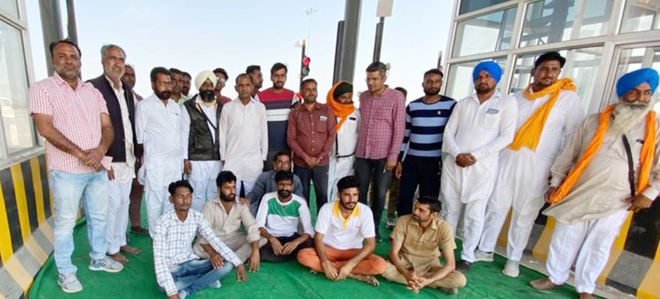
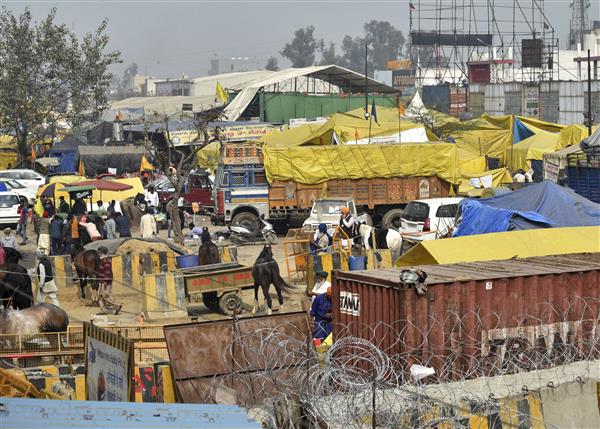
Farmers camp at a toll plaza in Sriganganagar. Tribune Photo
Our Correspondent
Abohar/Sriganganagar, Feb 23
In less than three hours of its opening, a toll plaza was forcibly shut down by farmers when the contractors started collecting toll for the newly constructed Raisinghnagar-Anupgarh-Gharsana highway under the Bharatmala Project.
The farmers staged a dharna and raised slogans against the three farm laws. A Jaipur-based company has been awarded the contract for toll collection on the highway for three months. Project partner Surinder Pareek, a BJP leader and former sarpanch of Netewala village, claimed the NHAI had directed the company to collect toll from vehicles from today. The company opened its counters to collect the toll at 8 am, but the recovery had to be stopped after some farmers reached there.
Ranjit Singh Raju, convener of the Gramin Kisan Mazdoor Samiti and other leaders reportedly posted an audio message for farmers as soon as they learnt about the opening of the plaza. Soon, farmers led by Sheopat Ram Meghwal, a member of the national executive of the All India Kisan Sabha, arrived at the plaza. They interacted with operators and employees of the company and it was agreed that till the farmers’ agitation continues, no toll would be charged.
Lakha stays on stage for hour in Bathinda, police look on Gives call to step up protest | Wanted for Republic Day violence
Sukhmeet Bhasin
Tribune News Service
Bathinda, February 23
Challenging security agencies, R-Day violence wanted accused Lakha Sidhana, who has been on the run since January 26, today addressed a rally at Chief Minister Capt Amarinder Singh’s native Mehraj village in Bathinda and gave a call to intensify the agitation.
Lakha Sidhana had been on the stage for around one hour, but no attempt was made by the police to arrest him. The Delhi Police have announced Rs 1 lakh reward for giving his information.
Daring the police to come and arrest any Punjabi youth booked in the R-Day violence case, Sidhana appealed to people to gherao them if police personnel come to arrest anyone in their village or city. If the Punjab Police accompany them, then Capt Amarinder would be responsible about it.
“The huge gathering at Mehraj is a message for Delhi. Register cases against us, arrest us and beat us up, but we will win this fight,” he added.
Lakha also claimed, “We will not accept the suspension of laws for three or four years as public movements will not be built again. We will win and come back only after repealing the laws.”
Taking a dig at BKU leader Balbir Singh Rajewal, Lakha said, “When the media ask question to him about Deep Sidhu and Lakha Sidhana, he says no comment, he doesn’t stand by us. But we will not allow any police team to arrest any farmer leader.” He said traders, commission agents and everyone should participate as these laws would hit each and everyone hard.
Lakha also clarified that he was not holding any separate programme, he stood by the Sanyukt Kisan Morcha. He appealed to them to plan a bigger agitation.
After addressing the gathering, Lakha ran away on the motorcycle from the spot.
Thousands of people started reaching the venue to hear Lakha Sidhana. Youngsters were seen wearing t-shirt with photos of Sidhana and Deep Sidhu.
AAP MLA from Kotkapura Kultar Singh was also attended the rally, but did not address it.
Agitating farmer unions object to Delhi Police posters at Tikri protest site Posters warn farmers that they will have to vacate the area
Agitating farmer union on Tuesday objected to Delhi Police putting posters that allegedly warned off protesters at the Tikri border site, even as the force claimed these were not new and only informed the protesters that they would not be allowed to enter the national capital.
In a statement, the Samyukta Kisan Morcha, an umbrella body of farmer unions that is spearheading the ongoing agitation against the three agri laws, said it is opposed to the police’s move as the protesters were exercising their constitutional right and appealed to the farmers to continue their sit-in peacefully.
Thousands of farmers, mostly from Punjab, Haryana and western Uttar Pradesh, have been camping at three Delhi border points — Singhu, Tikri and Ghazipur — for nearly 90 days, demanding a complete repeal of the three agri laws and a legal guarantee on Minimum Support Price for crops.
“The Delhi Police has placed some posters at the Tikri border protest site where farmers have been warned that they will have to vacate the area. Such posters are irrelevant as farmers have been staging a peaceful protest by exercising their constitutional rights….
“We will oppose the conspiracy to end the protest with these kinds of threats and warnings,” the SKM said in the statement.
In the posters, the police have not given any deadline to the protesting farmers to vacate the area.
On its part, the Delhi Police said it is a “routine” process.
“The posters were pasted at the border area after the protest started. It is a routine exercise. Police have conveyed to them through posters that they are sitting in the jurisdiction of Haryana and they are not allowed to enter the national capital unlawfully,” a senior police officer said.
Thousands of protesters had clashed with the police during a tractor parade called by the agitating farmer unions on January 26.
After police permitted the rally, many protesters deviated from the agreed route and reached the Red Fort on tractors. They entered the monument and some of them even hoisted religious flags at the ramparts.
The government has projected the three farm laws as major reforms in the agriculture sector that will remove the middlemen and allow farmers to sell anywhere in the country.
However, the protesting farmers have expressed apprehensions that these laws would pave the way for eliminating the safety cushion of Minimum Support Price and scrap the mandis, leaving them at the mercy of big corporates.
The Centre has maintained that the MSP and mandi systems will continue and will also be strengthened. PTI
Capt. Amarinder to lead Congress in 2022 Punjab Polls, says Jakhar By : Babushahi Burea
Capt. Amarinder to lead Congress in 2022 Punjab Polls, says Jakhar
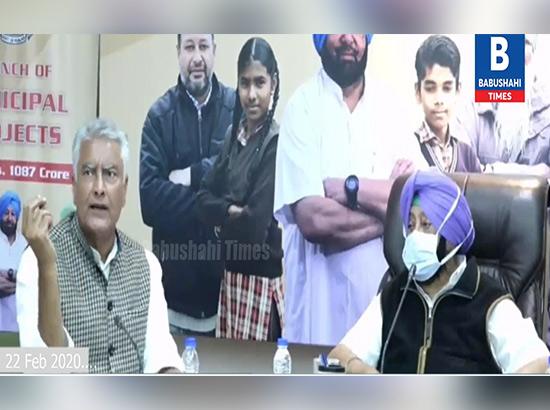
Chandigarh, February 22, 2021 : Punjab Pradesh Congress Committee (PPCC) President, Sunil Jakhar, on Monday said that Chief Minister Captain Amarinder Singh would lead the party in the 2022 assembly polls, as the people of the state had reposed their faith in his leadership with their landslide verdict in Congress’ favour in the recent civic polls.
While participating in the event for the launch of various developmental projects worth Rs 1087 crores by the Chief Minister, under the Smart City and AMRUT schemes, Jakhar said, “the Congress party’s sweeping victory in the civic polls has not only revalidated Captain Amarinder’s leadership in the state but was an endorsement of the faith of Punjabis in his future leadership also”. He said the state Congress had already launched mission “#Captainfor2022”, and the next elections would be fought under his leadership.
Lauding the chief minister, Jakhar said Captain Amarinder had led the state in very difficult times and the people were well aware of his massive contribution. “Punjab is perhaps facing its worst ever crisis – Covid, farmers’ unrest due to the black farm laws, coupled with an unfriendly union government – and only Captain Amarinder Singh had the vision and leadership qualities to the steer the state out of it”, he said.
Lambasting the union government for its stepmotherly treatment to Punjab, Jakhar said the centre had resorted to all kinds of measures, including economic blockade, to punish the state for supporting the farmers’ agitation. He said the federal structure of the country was under extreme threat under the BJP led national government. He also questioned the recent decision of the union government to refuse permission to a jatha to go to Nankana Sahib in Pakistan and accused the centre of being biased against the state.
While complimenting the Chief minister for launching projects aimed at development of urban areas, Jakhar said there had been. a growing though incorrect perception that this government was only working for the rural areas. He said though Punjab is an agrarian economy, the massive development works that have started in the urban areas would dispel this perception.
Jakhar also urged the chief minister to ensure that the Congress manifesto for 2022 should promise making Amritsar – the ‘Guru ki Nagri’ – an iconic city. “Amritsar should be made as one of the best cities in the World on the lines of the Vatican”, he said.
Punjab Youth Congress President, Barinder Singh Dhillon, termed the inauguration of these projects as a grand start after the victory in the MC elections. He said that the landslide victory reflects the enormous faith the people of Punjab have in the leadership of the Chief Minister. He said only Captain Amarinder Singh can take the state forward and maintain social and communal harmony. “You will have to contest the 2022 Vidhan Sabha election as Punjab needs your stewardship”, said Barinder Singh Dhillon.
AAP to hold ‘Kisan Mahasammelan’ in Punjab’s Moga on March 21 Farmers from across Punjab will be invited to participate in the event, says party MP Bhagwant Mann
Punjab’s main opposition party AAP on Monday said it would organise a ‘Kisan Mahasammelan’ in Moga district on March 21 in support of the ongoing farmers’ agitation against the Centre’s contentious agri laws.
Party’s national convenor and Delhi Chief Minister Arvind Kejriwal will be invited to attend the event, it said.
Thousands of farmers, mostly from Punjab, Haryana and western Uttar Pradesh, have been camping at Delhi’s border points for nearly three months to press for the repeal of the three agri laws enacted in September last year and a legal guarantee on the minimum support price (MSP).
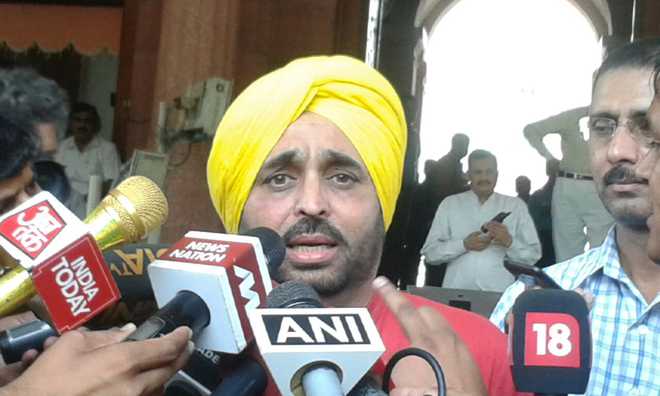
“The AAP has decided to hold a ‘Kisan Maha Sammelan’ at Bagha Purana in Moga on March 21 in order to further strengthen the ongoing farmers’ agitation,” party MP Bhagwant Mann said.
He said farmers from across Punjab will be invited to participate in the event.
“We want Delhi CM Arvind Kejriwal to take part in this ‘mahasammelan’,” he added.
The Aam Aadmi Party has been vocal about its support for the farmers’ agitation. Kejriwal is set to address a ‘Kisan Mahapanchayat’ in Uttar Pradesh’s Meerut on February 28 in support of the protest.
Mann, flanked by AAP’s Punjab unit in charge Jarnail Singh, co-incharge Raghav Chadha and MLA Harpal Singh Cheema, said the Centre should withdraw the three farm laws and provide a legal guarantee on MSP.
The government has said the new farm laws will benefit farmers by freeing them from the clutches of the middlemen and ushering in new technology in the sector.
However, farmers say these legislations will remove the safety net of MSP and leave them at the mercy of big corporates. PTI
Security beefed up at Singhu border The number of volunteers for security check at every entry and exit gates along the way from Singhu village to Kundli village has also been increased
view of the site of farmers’ agitation against new farm laws at Singhu border, in New Delhi. PTI
New Delhi, February 21
In order to avoid any untoward incident at the protest site where farmers are protesting against the three farm laws enacted by the Centre, the police have beefed up the security at Singhu border and adjoining areas.
Around 100 CCTV cameras at both the stages and many locations including the areas outside restrooms earmarked for women protesters have been installed along with heavy deployment of police personnel near the barricades close to the protest site. Two control rooms for monitoring of CCTV cameras have also been set up behind both the stages.
The number of volunteers for security check at every entry and exit gates along the way from Singhu village to Kundli village has also been increased.
“Activities of people moving around are being monitored and volunteers are keeping a close watch on people coming from outside and farmers staying on tractor trollies. Since there are many cuts for entry and exit towards the villages so the volunteers have been deployed at every possible spot. Volunteers are also patrolling on tractors especially after the sun set,” said Maninder Singh, a member of Krantikari Kisan Union in Punjab who is also part of security management at Singhu.
Height of concrete barricades that were setup earlier by Delhi Police close to the protest site (towards Delhi) have been increased by putting barbed wire on them. Whereas barricades put at four spots along the way from Singhu to Singhola village (Delhi-Chandigarh) highway were added with barbed wire after stone-pelting incidents.
Drone cameras are been used by the security forces to monitor the situation. However, Delhi Police personnel along with the paramilitary forces deployed at the protest site have been decreased while the entry of visitors and mediapersons from the main gate is still banned. —IANS
BJP resolution lauds agriculture reforms Massive farm rally in Barnala | It’s fight for livelihoods across India: Ugrahan
On a day the BJP, at its first meeting of new office-bearers, passed a resolution thanking the PM for reforms in the agriculture sector, farm unions held a massive rally in Barnala on Sunday, a clear indication that the farm stir has not lost steam and that the protesters are prepared for a long haul.http://
At the ‘maha rally’, Sanyukt Kisan Morcha leaders gave a call to Punjabis to reach Delhi in large numbers on February 27 when the agitation completes three months.
They appealed to the women to celebrate International Women’s Day (March 8) at Singhu and Tikri.
Seating arrangements for the rally were made on a 9 lakh sq ft area. Despite police arrangements for managing traffic, there were massive traffic jams. Joginder Singh Ugrahan called the January 26 incident a government plot. “A group was acting on the directions of the authorities. Its members had raised the Khalistan issue earlier. This stir is about saving livelihoods not only in Punjab but across India,” he stresssed. It was for the first time that Sanyukt Kisan Morcha leaders spoke from the BKU (Ugrahan) dais.
A 42-year-old Army officer who died of cardiac arrest in Ranchi was cremated with honours in hometown Jammu on Sunday
Jammu, February 21
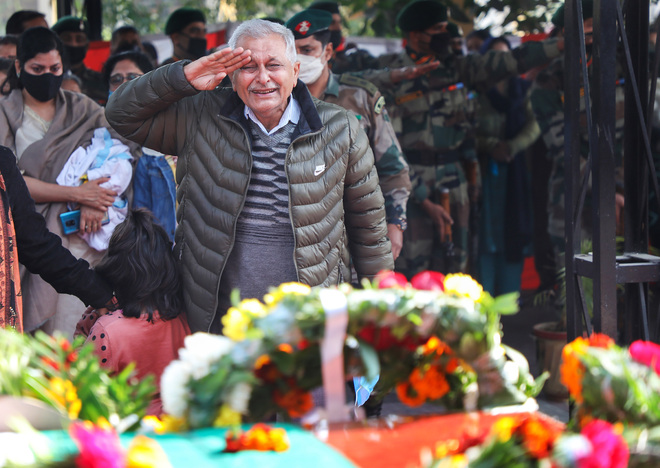
A 42-year-old Army officer, who died of a cardiac arrest in Ranchi last week, was cremated with full military honours at his hometown of Jammu on Sunday, a defence spokesman said.
Col Vikas Gautam, Commanding Officer, 23 Infantry Division Signal Regiment, died at his place of posting in Ranchi on February 18 and his mortal remains were brought to Jammu on Saturday.
Senior Army officers attended the wreath-laying ceremony before the body was consigned to flames at Shastri Nagar cremation ground on Sunday morning, the spokesman said. He said the officer is survived by his wife and two children. — PTI
Defence Colony roads, in different lanes, have caved in. It is not only causing inconvenience to commuters but may also lead to accidents. Today, the road right in front of our house, in Sector D, gave way when a loaded tractor trailer passed over a manhole. The road was blocked for hours. The reason for all this caving in is shoddy work of restoring the roads after laying the sewerage pipe lines. It is obvious that supervision is poor, and the authorities are not seeing the quality of work on ground. It is high time the authorities come on ground and ensure good quality restoration work.
Col RD Singh (retd), Ambala Cantt
BKU’s Ugrahan dares Delhi Police to enter Punjab to arrest accused Thousands attend ‘Kisan Mazdoor Sangh’ rally at Barnala
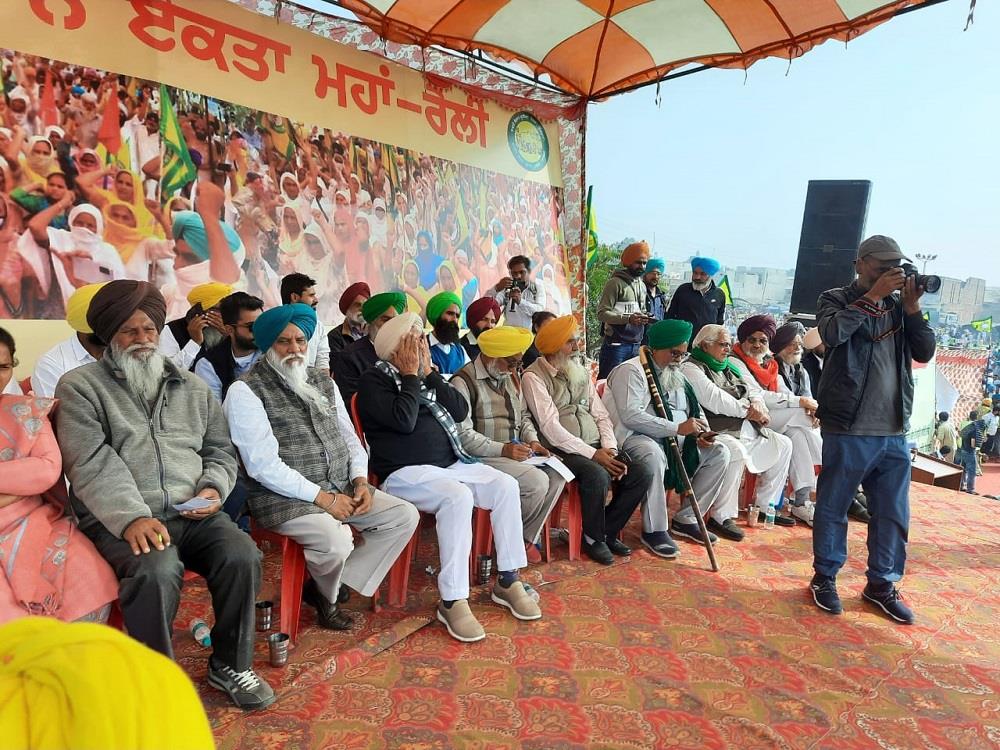
Bharatiya Kisan Union (Ekta-Ugrahan) president Joginder Singh Ugrahan on Sunday dared Delhi Police to enter Punjab for arresting the Red Fort violence accused.
At a massive show of strength by the farmers and farm labourers mainly from the Malwa region of Punjab at Barnala town, he said said the ongoing farmers’ protest was the first time that people of India had mounted a challenge to what he claims is a “fascist and communal government”.
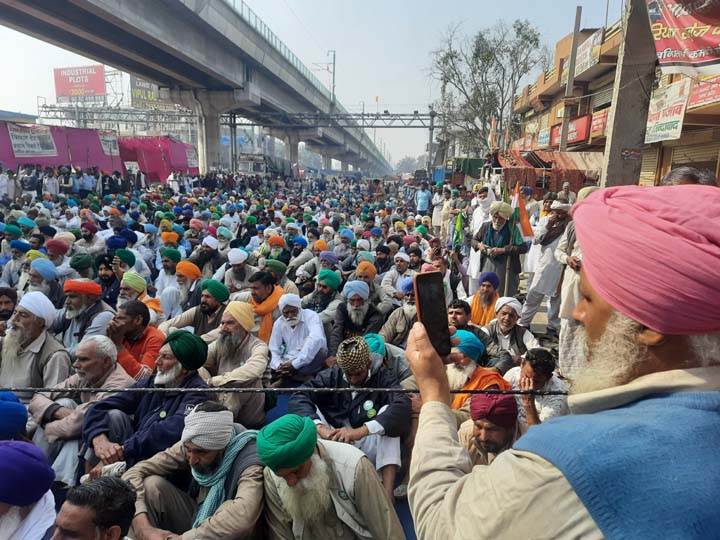
Ugrahan was addressing a ‘kisan mazdoor rally’, which saw thousands gather at Barnala’s grain market against the Centre’s three controversial farm laws on Sunday,
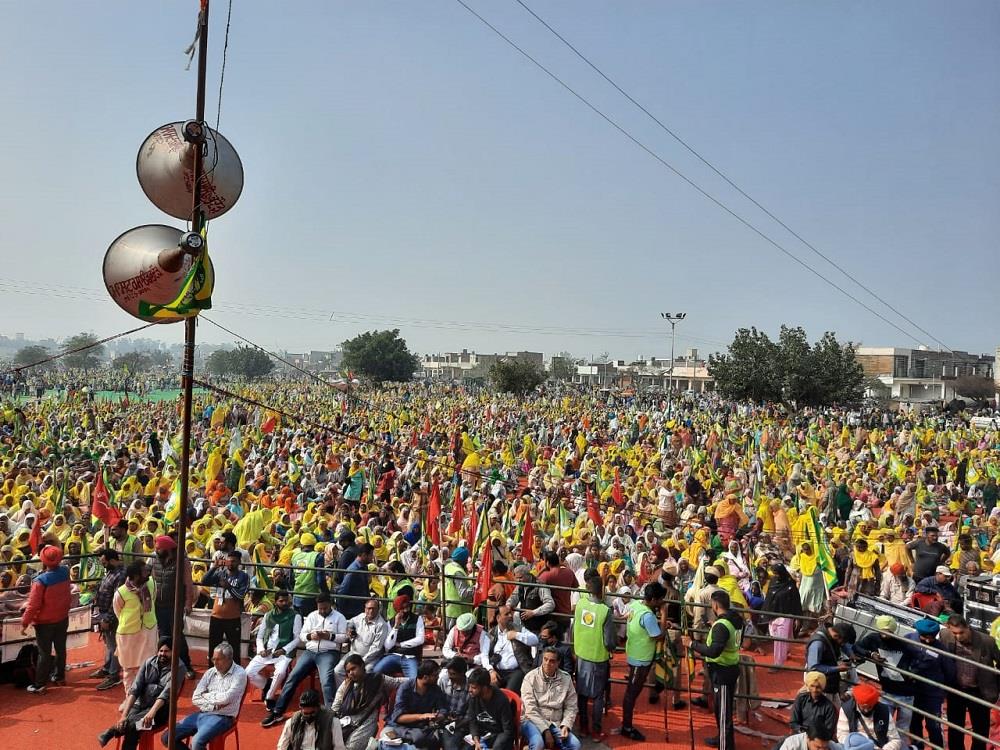
Organised by the BKU (Ugrahan) and the Punjab Khet Mazdoor Union, was one of the largest gatherings held in the state since the farmers’ protest moved out of the state to the borders of Delhi. The union had said it expected over two lakh farmers to attend the rally.
Farmers and their supporters gather at Barnala’s grain market to attend ‘mazdoor kisan rally’ to protest against the Centre’s three farm laws, in Barnala on Sunday. Tribune Photo
“One person needs at least four square feet, so we have laid mats on nine lakh square feet,” Sukhdev Singh Kokri, general secretary of the union, had said on Saturday.
Given the scale of their event, BKU said it had deputed around 300 volunteers for the smooth movement of vehicles and parking, and 400 more volunteers for securing the stage and serving water and tea to those attending the rally.
Farmers and their supporters gather at Barnala’s grain market to attend ‘mazdoor kisan rally’ to protest against the Centre’s three farm laws, in Barnala on Sunday. Tribune Photo
Donning yellow dupatta to signify solidarity, tens of thousands of women too participated.
Sufi singer Kanwar Garewal enthralled the gathering.
Organisers claimed that over two lakh farmers attended the rally.
Besides Ugrahan, leaders of the Samyukta Kisan Morcha comprising Balbir Singh Rajewal, Ruldu Singh Mansa and Sukhdev Singh too participated in the rally.
Expressing serious concern over the threat to the state’s agriculture as a result of the “disruption caused by the three new farm laws”, Punjab Chief Minister Amarinder Singh had on Saturday urged Prime Minister Narendra Modi to ensure urgent resolution of the ongoing farm unrest by the Centre “to the satisfaction of the protesting farmers by addressing their grievances”.
Calling for the fullest respect for the ‘annadaata’, the Chief Minister, through his speech for the virtual meeting of the Niti Aayog, reiterated his government’s stand that agriculture is a state subject and law-making on it should be left to the states in the true spirit of “cooperative federalism” enshrined in the Constitution.
In this context, he pointed to the state amendments already passed to the central legislations by the state Assembly in October 2020. — With IANS inputs
State Stalwarts
DEFENCE MINISTER
Minister Rajnath Singh
ALL HUMANS ARE ONE CREATED BY GOD
HINDUS,MUSLIMS,SIKHS.ISAI SAB HAI BHAI BHAI
CHIEF PATRON ALL INDIA SANJHA MORCHA
LT GEN JASBIR SINGH DHALIWAL, DOGRA
SENIOR PATRON ALL INDIA SANJHA MORCHA
MAJOR GEN HARVIJAY SINGH, SENA MEDAL ,corps of signals
.
.
PATRON ALL INDIA SANJHA MORCHA
MAJ GEN RAMINDER GURAYA ,MADRAS REGIMENT
sanjhamorcha303@gmail.com
PRESIDENT SOUTH ALL INDIA SANJHA MORCHA
COL SS RAJAN BOMBAY SAPPERS,
PRESIDENT UTTARAKHAND ALL INDIA SANJHA MORCHA
COL B M THAPA ,BENGAL SAPPERSS
PRESIDENT HARAYANA STATE CUM COORDINATOR ESM
BRIG DALJIT THUKRAL ,BENGAL SAPPERS
PRESIDENT TRICITY
COL B S BRAR (BHUPI BRAR)
PRESIDENT CHANDIGARH ZONE
COL SHANJIT SINGH BHULLAR
.
.
PRESIDENT PANCHKULA ZONE AND ZIRAKPUR
COL SWARAN SINGH
INDIAN DEFENCE FORCES
DEFENCE FORCES INTEGRATED LOGO
INDIAN AIR FORCE
Air Officer C-in-C WESTERN AIR COMMAND
AIR MSHL S PRABHAKARAN AVSM VM
AOC-IN-C, EASTERN AIR COMMAND
Air Marshal Inderpal Singh Walia
AOC-in-C SOUTH WESTERN AIR COMMAND
Air Marshal Vikram Singh
AOC-IN-C, SOUTHERN AIR COMMAND
Air Marshal J.Chalapati
AOC-IN-C TRAINING COMMAND
AIR MARSHAL SK GHOTIA VSM
AOC-IN-C MAINTENANCE COMMAND
Air Marshal Jagdish Chandra
Flag Officer Commanding in Chief, Western Naval Command
ice Admiral R Hari Kumar, PVSM, AVSM, VSM
Flag Officer Commanding in Chief, Eastern Naval Command
Vice Admiral Sanjay Bhalla, AVSM, NM
Flag Officer Commanding in Chief, Southern Naval Command