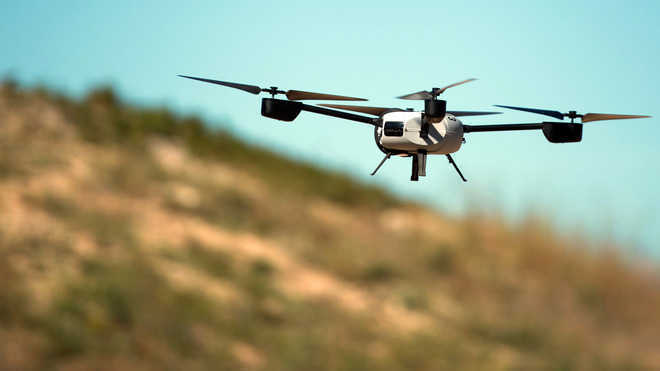
A Pakistani drone entered the Indian territory on Sunday but was forced to return as BSF jawans spotted it and opened fire in its direction in Pathankot district, a police official said.
“The drone which came from the Pakistani side was sighted at Dinda post close to Bamial along the Indo-Pak international border,” Pathankot Senior Superintendent of Police Gulneet Singh Khurana told PTI over phone.
He said the BSF opened fire in its direction after which it returned to the neighbouring country.https://5689023431c42998f02578c5d12ca295.safeframe.googlesyndication.com/safeframe/1-0-37/html/container.html
Asked if the drone dropped anything inside the Indian territory before flying back, Khurana said, “A thorough search operation was carried out at the site, but nothing was found.”
In December 2020, 11 hand grenades dropped by a drone flying in from Pakistan were recovered from a field near the International Border in Punjab’s Gurdaspur district.
The consignment was found in Salach village, located about one km from the border.
The box of hand grenades had been attached to a wooden frame which was lowered from the drone onto the ground with a nylon rope, police had then said.
The first incident of dropping of arms and weapons through drones from Pakistan came to light in Punjab in September 2019 when police recovered AK-47 rifles, magazines and rounds of ammunition, hand grenades, fake currency and other items in Tarn Taran district. —PTI
Farmers’ stir may continue till December: Rakesh Tikait
BKU spokesperson claims three central laws will lead to closure of all small-time neighbourhood shops
Spokesperson of Bharatiya Kisan Union Rakesh Tikait garlands the statue of late farmer leader Mahendra Singh Tikait in Prayagraj, on Sunday, March 14, 2021. PTI
Allahabad, March 14
The Bhartiya Kisan Union-led farmer agitation against the three central farm laws may continue till December this year, the outfit national spokesperson Rakesh Tikait said here on Sunday.
Tikait made the statement while talking to reporters here after his recent visit to the poll-bund West Bengal.
“This agitation possibly will stretch up to November or December this year,” he said.
Talking about his West Bengal visit, Tikait said during their poll campaigning there, the central government people have been asking farmers to give them one fistful of rice.
“I have advised Bengal farmers to ask grain seekers to fix an MSP of Rs 1850 per quintal for paddy before giving them a single grain of rice,” Tikait told reporters here.
He said after Bengal, he was planning to visit other parts of the country to press for the enactment of a law guaranteeing an MSP for various crops.
“In Bihar, the paddy is currently being bought by traders at an abysmally low rate of Rs 750 to Rs 800 per quintal. I want a law guaranteeing the minimum support price for various crops,” said Tikait.
He said he was not going to sit in Delhi alone but was planning to visit all over the country, including Madhya Pradesh on March 14 and 15, Ganga Nagar in Rajasthan on March 17, Ghazipur’s UP Gate border in Delhi on March 18, Odisha on March 19 and Karnataka on March 21 and 22.
During his visit here, Tikait also garlanded a statue of his late father and farmer leader Mahendra Singh Tikait at Tikait Park in Jhalwa near here.
The BKU spokesperson claimed the three central laws will lead to the closure of all small-time neighbourhood shops, leaving only big commercial malls to survive.
“These farm laws will ruin traders and lead to the closure of small business utilities and the collapse of small industries. These laws will bring in big multinational firms like Wallmart,” claimed Tikait.
“Had this government belonged to a political party, it would have talked to farmers and resolved the matter,” Tikait said.
“But this government is being run by big business houses. It is bent upon selling the entire country,” he alleged. PTI
Refer from ECHS to Private Hospital Changed|अब ECHS रेफरल सिस्टम हो गया आसान | Latest ECHS Rules
New Delhi: India is mulling a new national strategy to strengthen the country’s cybersecurity amid allegations that Chinese intrusions may have affected operations at a key stock exchange and supply of electricity in the country’s commercial capital.
The plan will coordinate responses across ministries including Home Affairs, Information Technology, Defense and the National Critical Information Infrastructure Protection Centre in case of an attack and set audit procedures, former Lieutenant General Rajesh Pant, India’s National Cyber Security Coordinator said in an interview. It will be approved by the cabinet committee on security headed by Prime Minister Narendra Modi.
Authorities are investigating a series of recent suspected cyber intrusions which could have led to a power outage in Mumbai, crippled systems at banks and caused a glitch at the country’s premier National Stock Exchange, he said. A report is expected in about a fortnight.
“We also want to know what happened,” said Pant, who served in the Indian army and now coordinates India’s cyber intelligence and reports to the Prime Minister’s Office. He said the breaches were likely malware and couldn’t be classified as attacks without a proper investigation.
At least one connection opened by Chinese state-sponsored hackers into the network system of an Indian port was still active, as authorities blocked attempts to penetrate the South Asian nation’s electrical sector, the U.S.-based research firm Recorded Future said last week. The attempts by the Red Echo group have been occurring since at least the middle of last year, around the time a bloody skirmish between Indian and Chinese soldiers started in the remote Himalayan region, the firm said.
“India will have to work at breakneck speed to put in place stringent security for critical infrastructure,” said Sandeep Shukla, who runs a state-funded cybersecurity project at the Indian Institute of Technology, Kanpur, and has advised the federal government in the past. “There may also be a need for state financial backing to help smaller companies that are part of the grid. Because if one is hacked, entire systems can be compromised.”
The new strategy will lay down protocols for prevention and audit to secure the government’s digitally connected water, health and education systems that are all being treated as critical infrastructure, he said. Infrastructure like nuclear, power and aviation will be considered supercritical.
“In my view, if internet-connected computers are infected by malware, I won’t say it’s an attack but an infection unless it jumps from IT systems to other operation systems,” Pant said. “It’s like a crank caller. Can you stop someone from dialing your number?”-Bloomberg
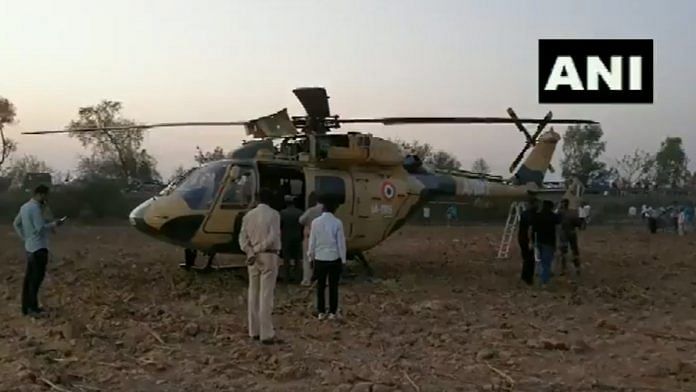
A screengrab showing the Dhruv helicopter at the site of its emergency landing in Gujarat Saturday | Twitter | @ANIText Size: A- A+
New Delhi: An emergency landing of a Dhruv Advanced Light Helicopter with two three-star officers on board, in Gujarat’s Kheda district Saturday, has brought back memories of a tragic 1963 crash that claimed the lives of five top Indian military commanders.
The Dhruv helicopter that made an emergency landing had on board Army Training Command head Lt Gen. Raj Shukla and Indian Air Force South Western Air Command Chief Air Marshal S.K. Ghotia, who were on their back from a Combined Commanders Conference in Kevadia, Gujarat. There were four other officers in the helicopter too.
The aircraft had to make a precautionary landing 30 km short of Ahmedabad. Local police subsequently helped the six officers reach a circuit house in Nadiad, from where they traveled by road to Ahmedabad Saturday evening.
As the incident came to light, many on social media questioned why two top officers were in the same
Following the 1963 crash, new protocols were set regarding top officers flying in the same chopper. However, official sources in the Army said Saturday’s incident involved no protocol violation since the helicopter in question is a twin-engine aircraft. “The protocol (barring more than one top officer in a chopper at a time) is with regard to flying single-engine helicopters,” a source said.
Asked about the emergency landing, sources in the Army said it was a precautionary landing as the nearest helipad was 15 minutes away. “The pilot noticed some warning switches on and thought best to carry out a precautionary landing,” a source added.
Sources in the Army said “maximum number of choppers were deployed” because of the Combined Commanders Conference.
“There were about 24 top officers at the conference besides other dignitaries. The choppers also cannot fly after sunset as per the protocol. Hence, some officers flew together to Ahmedabad,” a second source said.
The 1963 crash happened on 22 November — the same day US President John F. Kennedy was assassinated in Texas. The ill-fated helicopter, Alouette, called HAL Chetak, crashed in Poonch while on a reconnaissance mission.
The officers on board the aircraft were Lieutenant General Daulat Singh, the general officer commanding-in-chief, western command, Air Vice-Marshal E.W. Pinto, air officer commanding, western command, Lieutenant General Bikram Singh, general officer commanding, 15 Corps, Major General K.N.D. Nanavati, Military Cross, general officer commanding, 25 Infantry Division, Brigadier S.R. Oberoi, Military Cross, Commander, 93 Infantry Brigade, and Flight Lieutenant S.S. Sodhi.
A monument has been built at the site of the air crash.
An earlier version of the report referred to HAL Chetak, the aircraft involved in the 1963 crash, as HAL Cheetah. The error is regretted.
New Delhi: Impressed with the performance of the two leased Sea Guardian drones, the Navy, Army and the Air Force will finally jointly procure 30 armed versions of the American unmanned aerial system in what could be a $3 billion deal, ThePrint has learnt.
The decision comes just before US Secretary of Defense Lloyd Austin’s visit to India later this month. Austin’s visit could be a precursor to the impending meet of the ‘Quad’ leaders — US, India, Australia and Japan — which is likely to be held soon.
According to sources in the defence and security establishment, initially one of the three services were not on board about procuring the armed predator drones but now all three are finally on the same page.
They added that the Defence Minister Rajnath Singh-led Defence Acquisition Council (DAC) could take a final decision on this “soon”.
If approved, this would be the first tri-service procurement since Chief of Defence Staff General Bipin Rawat was appointed to steer the Indian armed forces into a more united force, both in terms of operational doctrine and procurement.
The erstwhile Trump administration had expected the deal for 30 armed drones to be announced at the two-plus-two ministerial dialogue in New Delhi on 27 October 2020. However, India did not succumb to the hard American push to seal the deal then.
India to procure armed version of Sea Guardian drones
In 2018, the US had offered India the armed version of the Guardian drones, which were originally authorised for sale as unarmed and for surveillance purposed.
India was earlier eyeing both the unarmed Sea Guardian drones for the Navy and the armed Predator B for attack options, but there was a growing feeling that both surveillance and attack could be done by the same drone.
This was because of the prohibitive price involving American drones. The Navy had initially planned for 22 Sea Guardians which were priced at over $2 billion, but then brought down the number to just 12.
However, since all the three services wanted weaponised drones, a decision was taken to jointly pursue the deal.
According to the deal, India will be acquiring 30 MQ-9 Reaper or Predator B, 10 each for the three services.
The MQ-9B has an endurance of 48 hours and a range of over 6,000 nautical miles. It comes with nine hard-points, capable of carrying sensors and laser-guided bombs besides air-to-ground missiles, with a maximum payload of two tonnes.
The Navy, which is the lead agency for procurement of HALE (High Altitude Long Endurance) UAVs, will seek the Acceptance of Necessity (AON) from the DAC.
In November last year, ThePrint had reported that the Navy had inducted two Sea Guardian drones on lease under emergency procurement.
According to sources, the Navy is really impressed with the two UAVs it took on lease from the US firm General Atomics.
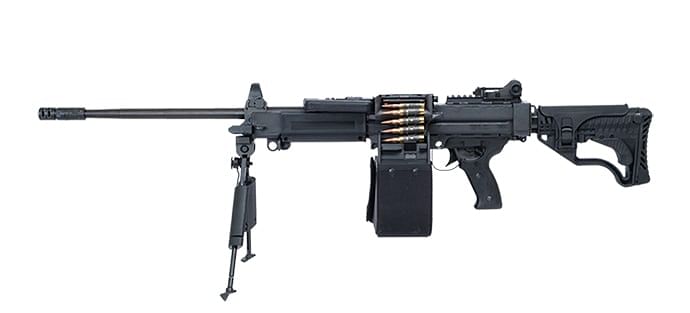
Representational image) Trials are to be held for nearly 41,000 LMG | Source: IWI websiteText Size: A- A+
New Delhi: The much-awaited Army trials for nearly 41,000 light machine guns (LMGs), under the Make in India initiative, has been delayed again as Reliance Armament of Anil Ambani has sought more time to showcase its weapon, ThePrint has learnt.
While trials for the 7.62X51 mm belt-fed LMGs were to begin from 22 February, they have now been postponed to April due to Reliance Armament. The new LMGs are to replace the 5.56x45mm INSAS LMG, which is a derivative of the INSAS assault rifle.
Sources in the defence and security establishment said this is not the first time that Reliance has sought an extension. Sources said Reliance Armament wrote to the Army in February seeking more time to showcase the weapon, which the company says is an indigenous one.
A questionnaire sent to Reliance Defence remained unanswered at the time of filing this report.
The Anil Ambani group is one of the contenders for the project along with Bharat Forge of the Kalyani Group, Adani Group’s PLR systems and the state-run Ordnance Factory Board (OFB).
The Bengaluru-based SSS Defence, which was one of the original contenders, is understood to have pulled out of the trials as it wants to focus on sniper and the carbines contract.
While Reliance has been tight-lipped about who it has tied up with for the contract, it is learnt that a South Korean firm could be in the picture.
Reliance is also said to be working on multiple vendor options, including American and European manufacturers.
Reliance Infrastructure’s annual report for 2019-20 stated that the group has established multiple companies such as Reliance Armaments Ltd, Reliance Ammunition Ltd and Reliance SED to cater to the specific requirements of small arms, ammunition and defence electronics.
It had also said that Reliance Armament has received RFPs (Requests for Proposal) for LMGs, sniper rifles and other small programmes with the Ministry of Home Affairs valued at over Rs 6,000 crore over many years.
Of the other contenders for the LMG project, Bharat Forge has tied up with Bulgarian firm Arsenal, while the OFB has come out with an indigenous product.
Adani Group’s PLR systems is a joint venture with the Israel Weapons Industry (IWI) and they are fielding the Negev NG-7.
The IWI already has a fast-tracked procurement contract from the Army for about 16,000 of these Negev NG-7 and the first tranche has already reached soldiers in the Northern Command.
The Army contract, however, is directly with IWI and not with the Indian joint venture, which now manufactures various Israeli weapons at its Gwalior plant.
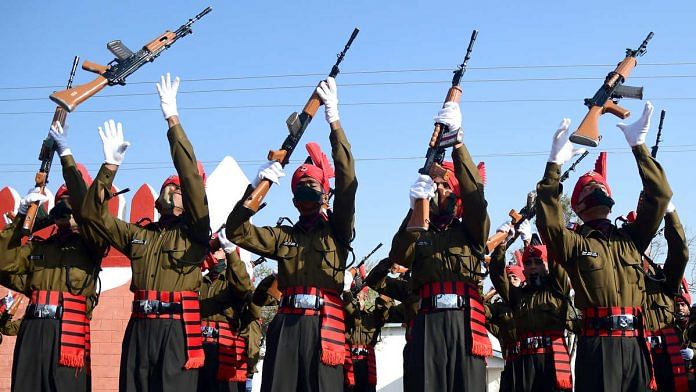
Representational image | Recruits to the J&K Light Infantry celebrate the end of their training |
New Delhi: The Integrated Defence Staff headquarters is giving final touches to its planned Joint Services Training Institutes (JSTIs), which will offer joint training to Army, Navy and Air Force officers in select subjects, ThePrint has learnt.
Intelligence, military law, nuclear biological chemical warfare (CBRN), music and catering are among the subjects in which the officers will be trained jointly, said sources.
The JSTIs will operate from existing institutes where the services currently train. Each JSTI will have one of the three services leading the institute. For instance, the Army will be the lead service for the JSTIs for CBRN and intelligence, said sources.
According to a senior government official, the JSTIs for CBRN, music, catering, military law and intelligence have been established. However, the services are finalising their draft government sanction letter.
“Additionally, the School of Foreign Languages will also function as a JSTI. The institute, which sees officers of the armed forces from other countries, plays a key role in defence cooperation that is an important facet of military diplomacy where expertise in foreign languages such as Mandarin or Russian is critical,” the official said on condition of anonymit
Set up in 1948, the School of Foreign Languages was brought under the administrative control of the Integrated Defence Staff headquarters in 2017.
A joint training command for the three services planned earlier, however, may be delayed, and is likely to be taken up in the next phase amid greater focus on first implementing the major theatre commands, like the Air Defence Command.
ThePrint reported last year the plans to set up a joint training command to meet the training requirements of all the three services.
But now, the focus is on reaching low hanging fruits by merging certain disciplines for joint training of the services to begin with, senior government officials told ThePrint.
Time passes by rapidly, or ‘tempus fugit’ as they say. We joined the military academies in 1967, trained for four years, became officers and served in our service for 20 to 40 years. A decade back, all of us hung our uniform and over a score of us settled in the lovely environs of the tricity and adjoining areas. Bygone years create linkages among people, so have our military linkages connected us in lifelong friendships and camaraderie.
The times were tough but eventful, now that we have arrived safely in ‘flaming June’, the past deserves to be remembered and celebrated. Our continued togetherness could help in making our future equally memorable, something akin to the words of Robert Browning in his poem ‘Rabbi Ben Ezra’ — ‘Grow old along with me! The best is yet to be, the last of life, for which the first was made.’
Thus, we set out to rejuvenate our fond relationship. Nothing could be better than meeting socially, but we decided to create a special format. To call it a ‘course get-together’ was too drab, it had to be special to the tricity fraternity. We decided two names — ‘Double Outdoors’ and ‘Tricity Company Operating Base (COB)’.
The first name was a throwback to our training years when on particular days, the physicals were taxing, say drill followed by physical training and other variants. The COB was a touchback to the environment in which most of us spent years in the Army battling the enemy and the environment. Different indeed, but we still felt that the name should be more specific to our activities during these meets.
Brains racked, we stuck to the acronym COB, but the full form changed to ‘Charcha Over Beer’! That decided, ‘Double Outdoors’ also needed to be addressed, and so a game of golf was proposed prior to the COB. What an idea! One never had such unanimity in agreement, true to the words, ‘Once more (we had decided) on my (our) adventure brave and new: fearless and unperplexed, when I wage battle next, what weapons to select, what armour to indue.’
A monthly affair, hosted by one among us, it would be, weather permitting, a round of golf followed by 90 minutes of ‘charcha’, snacks, accompanied by a potion of one’s choice as a thirst quencher. Months passed by, the fun was loaded, reminiscences, leg-pulling and an all-prevailing spirit of joie de vivre. But then struck the pandemic and all this came to a grinding halt. Sadly, the cruel hands of Covid took away one amongst us.
We took this in our stride and hope for better times to continue, our incomparable COB encouraged by the words: ‘When things go wrong, as they sometimes will, when the road you’re trudging seems all uphill, and you smile but have to sigh, when care is pressing you down a bit, rest, if you must, but don’t you quit.’ We only slipped in patenting it!
Classification for COVID-19 vaccine based on vulnerability to infection: Centre to HC
The government said any specific classification either based upon the nature of trade, profession or otherwise is neither possible nor advisable
New Delhi, March 9
The Centre on Tuesday told the Delhi High Court that classification of citizens for the purpose of COVID-19 vaccination is based upon most rational and non-arbitrary criteria depending upon their vulnerability to the disease either due to age or nature of work or co-morbidity health situation and it may not be desirable to create a separate class consisting of lawyers and others below 45 years of age.
The Centre made the submission in its affidavit filed in response to a PIL initiated by the high court to examine the demand to declare all people associated with the judicial functioning, including judges, court staff and lawyers, as “frontline workers” so that they could receive COVID-19 vaccination on priority and without limitations of their age or physical condition.
The government said any specific classification either based upon the nature of trade, profession or otherwise is neither possible nor advisable.
It said that in order to achieve the first objective of protecting India’s healthcare and pandemic response system, NEGVAC has prioritised healthcare workers, front line workers (personnel for state and central police department, armed forces, home guard and civil defence organisation including disaster management volunteers, municipal workers, poll officers in election bound states), persons aged 60 years and above and those aged between 45 to 59 years with identified 20 co-morbidities for COVID-19 vaccination.
National Expert Group on Vaccine Administration for COVID-19 (NEGVAC) has been established by the government to provide guidance on all aspects of COVID-19 vaccination.
The Centre, in its affidavit filed through Central government standing counsel Anil Soni, said the decision to include individuals above 50 years and 60 years in the priority list is based on vulnerability and the mortality risk of this age group for COVID-19 disease.
It added that a look at prioritisation criteria for vaccination from World Health Organisation (WHO) and other countries showed that a step-wise layered approach is advisable.
The high court is scheduled to hear the matter on Wednesday.
Regarding the issue of export of vaccine to other countries, the Centre said once an epidemic takes form of a pandemic, its management has to be done keeping the entire globe as unit and in most circumstances it is not possible to take either states-specific or country-specific approach.
“…Hence, export of COVID-19 vaccine which facilitates global action to vaccination is important to simultaneously protect the high-risk population in all the countries of the world, thereby breaking the chain of transmission and minimising chances of import of COVID-19 cases from foreign countries as well as neighbouring countries to India,” it said.
On the demand for treating lawyers as frontline workers, the government said any specific classification either based upon the nature of trade, profession or otherwise is neither possible nor advisable.
“Though the government has tremendous respect for the profession and the discharge of duties by these professionals for and on behalf of citizens of India and as part of administration of justice, those lawyers and other associates staff who are either above 60 years or between the age group of 45 to 60 years and are having any of the almost exhaustive list of co-morbidities would, in any case, be covered by the on-going vaccine drive,” it said.
It added that it may not be desirable to create a separate class consisting of lawyers and others below 45 years of age and discriminating other similarly situated citizens engaged in other professions.
“The term ‘frontline workers’ is used only for those citizens who are required to be directly exposed to the COVID-19 infected patients. Thus, it may not be appropriate to discriminate them as against a separate class of lawyers as both are doing their respective duties towards the citizens under similar circumstances,” it said.
The high court had on March 4 asked the Centre to explain the rationale behind keeping strict control over class of persons who can be vaccinated against COVID-19 currently as under the present system those above the age of 60 years or with comorbidities can receive vaccination.
It had said the two institutes which have developed the vaccines COVISHIELD and COVAXIN—Serum Institute of India and Bharat Biotech—have more capacity to provide the vaccines but it seems that their full capacity is not being exploited.
It had also directed the two institutes to file separate affidavits on their capacity to manufacture the vaccines on per day/ week/ month basis and also the current optic of the vaccines and how much unused capacity is lying.
The high court was hearing a PIL initiated by it to examine the demand of Bar Council of Delhi (BCD) to declare all people associated with the judicial functioning, including judges, court staff and lawyers as “frontline workers” so that they could receive COVID-19 vaccination on priority and without limitations of their age or physical condition. —PTI
State Stalwarts
DEFENCE MINISTER
Minister Rajnath Singh
ALL HUMANS ARE ONE CREATED BY GOD
HINDUS,MUSLIMS,SIKHS.ISAI SAB HAI BHAI BHAI
CHIEF PATRON ALL INDIA SANJHA MORCHA
LT GEN JASBIR SINGH DHALIWAL, DOGRA
SENIOR PATRON ALL INDIA SANJHA MORCHA
MAJOR GEN HARVIJAY SINGH, SENA MEDAL ,corps of signals
.
.
PATRON ALL INDIA SANJHA MORCHA
MAJ GEN RAMINDER GURAYA ,MADRAS REGIMENT
sanjhamorcha303@gmail.com
PRESIDENT SOUTH ALL INDIA SANJHA MORCHA
COL SS RAJAN BOMBAY SAPPERS,
PRESIDENT UTTARAKHAND ALL INDIA SANJHA MORCHA
COL B M THAPA ,BENGAL SAPPERSS
PRESIDENT HARAYANA STATE CUM COORDINATOR ESM
BRIG DALJIT THUKRAL ,BENGAL SAPPERS
PRESIDENT TRICITY
COL B S BRAR (BHUPI BRAR)
PRESIDENT CHANDIGARH ZONE
COL SHANJIT SINGH BHULLAR
.
.
PRESIDENT PANCHKULA ZONE AND ZIRAKPUR
COL SWARAN SINGH
INDIAN DEFENCE FORCES
DEFENCE FORCES INTEGRATED LOGO
INDIAN AIR FORCE
Air Officer C-in-C WESTERN AIR COMMAND
AIR MSHL S PRABHAKARAN AVSM VM
AOC-IN-C, EASTERN AIR COMMAND
Air Marshal Inderpal Singh Walia
AOC-in-C SOUTH WESTERN AIR COMMAND
Air Marshal Vikram Singh
AOC-IN-C, SOUTHERN AIR COMMAND
Air Marshal J.Chalapati
AOC-IN-C TRAINING COMMAND
AIR MARSHAL SK GHOTIA VSM
AOC-IN-C MAINTENANCE COMMAND
Air Marshal Jagdish Chandra
Flag Officer Commanding in Chief, Western Naval Command
ice Admiral R Hari Kumar, PVSM, AVSM, VSM
Flag Officer Commanding in Chief, Eastern Naval Command
Vice Admiral Sanjay Bhalla, AVSM, NM
Flag Officer Commanding in Chief, Southern Naval Command