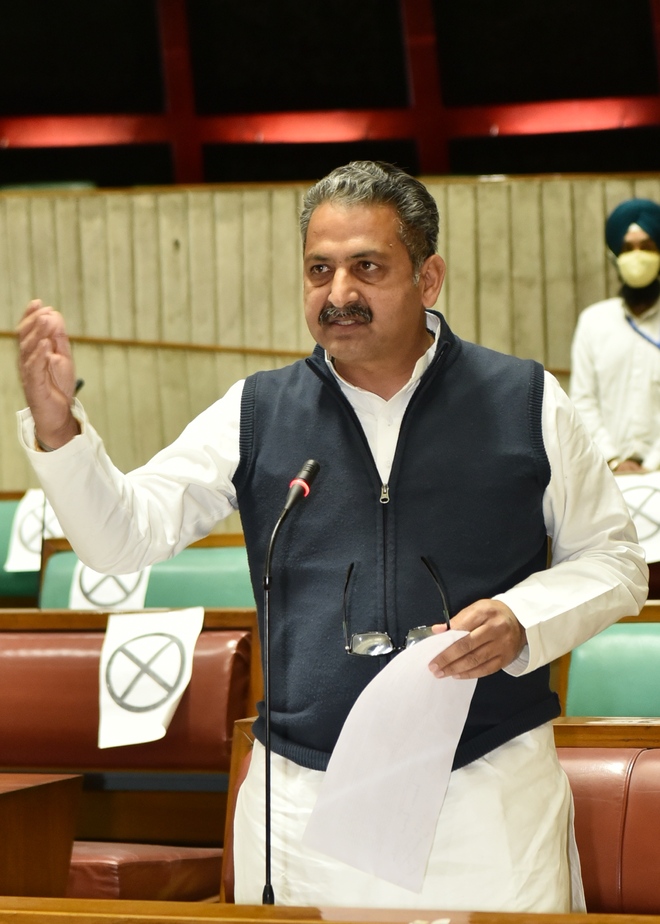
To pacify the protesting farmers demanding higher compensation for their lands for two national highways Delhi-Amritsar-Katra and Jalandhar-Ajmer, the state government has tweaked the rules. This was stated by PWD and Education Minister Vijay Inder Singla here today.
Singla, who was here to list achievements of his government in the last four years, said the government had increased the multiplier factor for land acquisition following which there would be substantial increase in the compensation to farmers.
The NHAI would acquire land in 12 districts for the two projects. Farmers had refused to give their lands for the projects, citing lower compensation. He said in Punjab, the collector rates were lesser as compared to the market rate on demand of people so that they had to spend less on stamp duty at the time of the purchase of land. This was the reason for lesser compensation. Now, the compensation would be near double. — TNS
Rahul Gandhi attacks government for not paying tributes to farmers who died during protest
Attacking the government for not paying tributes to farmers who died during their protest, Congress leader Rahul Gandhi on Thursday said his two-minute silence in the memory of the 300 men who sacrificed their lives is not acceptable to the BJP.
He used the hashtag ‘300DeathsAtProtest’ to highlight that 300 farmers have so far lost their lives in the farmers’ agitation.
“My 2 minute silence for the farmers who died during the agitation is not acceptable to the BJP. I will pay my tributes to the sacrifices of my farmers and labourers again and again. I am not afraid of those who fear my silence,” Gandhi said in a tweet in Hindi.
In another tweet, he again attacked the government over job losses and cited a report claiming that a large number of EPF accounts were shut during the pandemic. He said that this was another achievement of the BJP government’s “eradicate employment campaign”.
“You lost your job and had to close down your EPF account. Another achievement of the Central Government’s ‘eradicate employment campaign’,” he said in a tweet in Hindi.
The unnamed news report claimed that a large number of people lost their jobs during the coronavirus pandemic and 71 lakh EPF accounts were closed in nine months.
Gandhi has been attacking the government over the handling of the farmers’ agitation and the pandemic, claiming many people lost their jobs during the lockdown. — PTI
Talking ‘unofficially’ to both sides for early solution: Governor Malik on govt-farmers stalemate
The protest is also going on in several parts of the country on the issue
Meghalaya Governor Satya Pal Malik. — File Photo
New Delhi, March 18
Meghalaya Governor Satya Pal Malik has said he was talking “unofficially” to the agitating farmers and the government to press for an early solution to the stalemate over the contentious agri laws, adding there was a growing understanding within the two sides that a resolution needs to be found at the earliest.
Malik, who hails from Baghpat in western Uttar Pradesh, asserted the issue of farmers needs to be resolved soon else it will damage the BJP in Western Uttar Pradesh, Haryana and Rajasthan.
He also expressed regret that “no one has uttered even a single word” at the death of agitating farmers during the over 100-day protest by them.
Referring to the deadlock persisting between the protesting farmers and the government despite several rounds of talk Malik said no one is being unreasonable in the government and only those who want to damage the party are opposing an early solution.
“I am of the opinion that there should be a solution to the problem at the earliest, and I am hopeful now of an early solution because there seems to be not much distance between the viewpoints of the two sides
“I am talking unofficially to both the sides pressing for an early solution. There is a growing understanding within the farmer community that a solution needs to be found at the earliest as well as the government,” Malik told NDTV.
Hundreds of farmers have been camping at Ghazipur, Singhu and Tikri on Delhi borders since November with a demand the Centre repeal the three contentious farm laws and make a new one that would ensure a legal guarantee on the MSP.
The protest is also going on in several parts of the country on the issue. The government, however, has held that the laws were pro-farmer.
“No one is unreasonable in the government—neither the Prime Minister (Narendra Modi) nor other people. Only those people will oppose an early solution to the problem, who want to damage the party. I am hopeful of an early solution to this, as otherwise, the issue will damage the party in Western UP, Haryana and Rajasthan,” he added.
“I have been asked by the media why I am talking about the issues despite being on a Constitutional post, and I explained that even if a dog is killed, there are condolence messages pouring in from everywhere and here 250 farmers are dead the border, no one has uttered even a single word,” he added.
“By not talking about it, we have left the entire turf for opponents who are talking and taking political mileage from it,” he said.
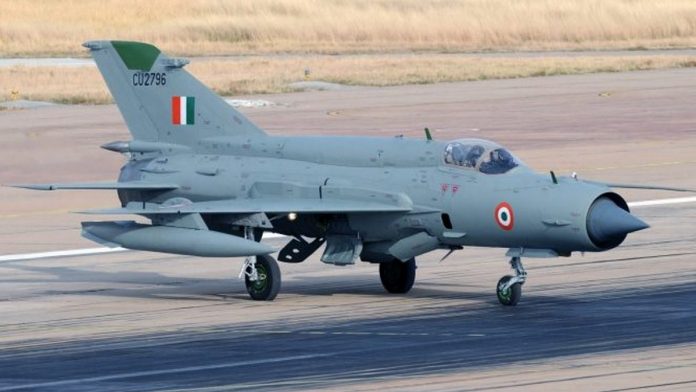
New Delhi: A Group Captain of the Indian Air Force was killed in an accident involving a MiG-21 Bison aircraft at an airbase in central India on Wednesday, the IAF said.
The accident took place when the aircraft was taking off for a combat training mission, the IAF said on Twitter.https://7ca58929acb9def88d401ae6d7c1b5e3.safeframe.googlesyndication.com/safeframe/1-0-37/html/container.html
It said Group Captain A Gupta was killed in the accident.
A court of inquiry has been ordered to determine the cause of the accident.
“A MiG-21 Bison aircraft of IAF was involved in a fatal accident this morning, while taking off for a combat training mission at an airbase in central India,” the IAF said.
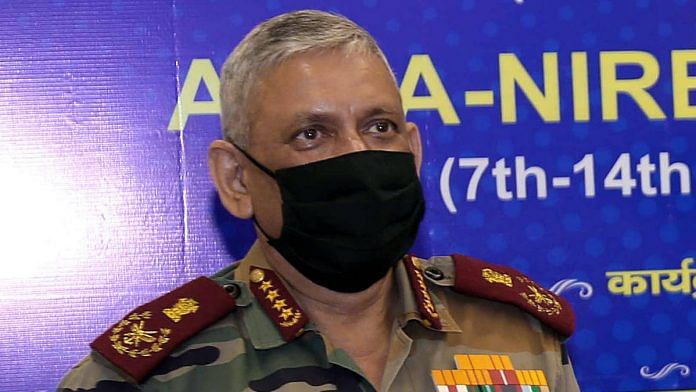
hief of Defence Staff General Bipin Rawat | File photo: ANIText Size: A- A+
New Delhi: The armed forces will completely ban the import of clothing, required to sustain its soldiers at extreme temperatures across the country, if the Indian textile industry is able to innovate and manufacture them, said Chief of Defence Staff (CDS) General Bipin Rawat on Wednesday.
“We are looking at the kind of clothing that can sustain our soldiers in the kind of extreme cold climate (near northern borders of Ladakh) and in the hot, dry and humid climate in the deserts and the north-eastern regions where we have the jungle and semi-mountainous terrain,” he said in his speech at an event organised by industry body FICCI.https://1e8d8684b6697764c6bd0310c28bc2bb.safeframe.googlesyndication.com/safeframe/1-0-38/html/container.html
As of now, a large amount of clothing for the armed forces is being imported but in the past one or two years, there has been a lot of innovation by the Indian industry as far as high altitude clothing is concerned, he said.
“We have now started placing orders for such clothing. And if we find that this thing can take off and support us, we will not hesitate in putting the entire clothing or the entire ‘techno clothing’ that we are using in the armed forces on the positive indigenisation list, which we were earlier calling the negative list for imports,” Rawat said.
“This means we will completely ban the import of these items and make sure that the defence services have to depend only on the Indian industry as part of our Atmanirbhar Bharat support that we wish to give to the industry,” he added.
Techno clothing is special clothing that is developed by incorporating new technology to make it usable in special circumstances and places such as extremely cold areas, biomedical equipment, aircraft, etc.
The government in August last year announced a ‘negative list for imports’ that restricted purchase of 101 defence items such as light combat helicopters, transport aircraft, conventional submarines and cruise missiles from foreign entities.
Rawat said, “As far as defence services are concerned, we have a huge stake in techno textiles. We are large users of textiles that use technology and we will continue to use them in the years ahead.”
Today, soldiers are serving in altitudes at the northern borders where the temperature falls to as low as minus 50 degree celsius in the winters, he said.
“We have our jawans operating in the deserts where the temperature rises to as high as 58 degree celsius in the summers. I’m not saying the same textile should suffice and meet both the parameters,” he added.
Farmer and worker unions engaged in the ongoing battle being fought under the aegis of the Samyukt Kisan Morcha (SKM) with the Central government against three farm laws would take out a joint ‘padyatra’ (foot march) from Hansi to Tikri border to mark the martyrdom day of Bhagat Singh, Sukhdev and Rajguru on March 23. File photo
Ravinder Saini
Tribune News Service
Rohtak, March 17
Farmer and worker unions engaged in the ongoing battle being fought under the aegis of the Samyukt Kisan Morcha (SKM) with the Central government against three farm laws would take out a joint ‘padyatra’ (foot march) from Hansi to Tikri border to mark the martyrdom day of Bhagat Singh, Sukhdev and Rajguru on March 23.
The yatra will be flagged off by Gurjeet Kaur, niece of Shaheed Bhagat Singh in the presence of All India Kisan Sabha (AIKS) chief Dr Ashok Dhawle, Punjab Kisan leader Major Singh Punnuwal, Agriculture Labourers Union national general secretary Dr Vikram Singh and SKM leader Vijoo Krishnan from Hansi tomorrow (March 18). The yatra would culminate at Tikri on March 23.
To end on Bhagat Singh’s martyrdom day
Shaheed Bhagat Singh’s niece Gurjeet Kaur will flag off the ‘padyatra’ at Hansi on Thursday
The padyatra will end at the Tikri border on March 23 on the martyrdom day of Bhagat Singh, Sukhdev and Rajguru
“The padyatra aims at further strengthening the ongoing farmers’ agitation by enhancing public participation in it by making the people aware of the ill-effects of three farm laws. Hundreds of representatives of various unions and social activists will participate in the padyatra. Similar marches will be taken out from Jind, Mathura (Uttar Pradesh) and Khatkar Kalan (Punjab) to reach Singhu border,” said Inderjit Singh, vice-president, AIKS, while interacting with the media here on
Inderjit Singh said that Hansi had been chosen for its historicity with 1857 peasant revolt against unbearable land revenue imposed by the East India Company. The revolutionary ideals of martyrs were equally relevant today as the present day rulers were behaving with the toiling masses not very different from the British imperialism. Three black laws were being imposed while the labour laws were being abolished, he added.
Lt Gen Raju to take up higher responsibilities as DGMO
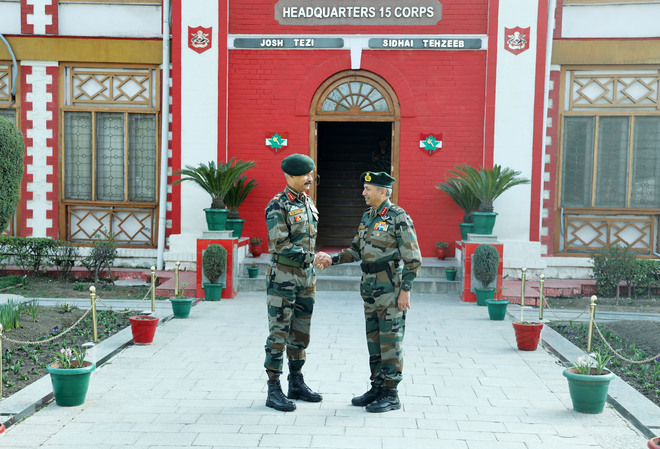
Lt Gen BS Raju hands over the command of Kashmir-based 15 Corps to Lt Gen DP Pandey in Srinagar on Wednesday. PTI
Tribune News Service
Chandigarh, March 17
Lieutenant General DP Pandey has been appointed the General Officer Commanding of the Srinagar-based 15 Corps. Prior to this, he was serving as the first ever Director General Territorial Army at the Army Headquarters.
He took over from Lt Gen BS Raju who has moved to Army Headquarters as Director General Military Operations in place of Lt Gen Paramjit Singh, who has taken charge as Deputy Chief of the Army Staff (strategy).
An alumnus of the National Defence Academy, Lt Gen Pandey was commissioned into the Sikh Light Infantry in December 1985 and has held various command and staff appointments, including General Officer Commanding of the Kilo Force that is responsible for counter-terrorist operations in Kashmir Valley. He also served as a military observer in Cambodia.
In his farewell message to the 15 Corps, also known as Chinar Corps, Lt Gen Raju complimented all ranks for their dedication and hard work and thanked police, central armed paramilitary forces, civil administration and the people for their support to achieve peace.
Lt Gen Raju has strongly propagated for a second chance to the misguided youth as he believed it to be critical to achieving peace.
India has been steadfast in staying on an alliance-free course. Being a founding member of the Non-Aligned Movement, it spelt out its political line in international affairs. NAM has since lost relevance, but multi-polar engagements without any treaty or alliance overtones have been the defining foreign policy architecture for India. It has always stood for strategic partnerships.
PLAN OF ACTION: As India is in the pole position with its vaccine diplomacy, it needs to extract reciprocal benefits from Australia and other Quad members. PTI
Lt Gen Pradeep Bali (retd)
Ex-Commander, Sikkim-based 33 Corps
AMONG all evolving strategic partnerships, Quad seems to be a top priority for the two-month-old Biden administration. The foreign ministers’ meeting of the four Quad nations — the US, Japan, Australia and India — was followed by the first ever summit-level talks, which took place virtually on March 12 between the US President and the Prime Ministers of the other three countries.
The major concern of the three members of Quad, other than India, is primarily to counter and check Chinese influence in the Asia-Pacific and specifically in the South China Sea (SCS) in order to safeguard their geopolitical and maritime interests in this region.
India’s concerns with regard to China go much beyond this. Interestingly, during the recently held fourth session of the 13th National People’s Congress of the Chinese Communist Party, State Councillor and Foreign Minister Wang Yi stated that “China and India are each other’s friends and partners and not threats or rivals. The two sides need to help each other succeed instead of undercutting.”
This wooing of India not only highlights its geopolitical and strategic importance but also the weight it carries, politically, militarily and diplomatically. India has never been in an alliance with any other nation or nations. Post World War II, the Cold War came to be waged by forming alliances like Seato, Cento, Nato and the Warsaw Pact, to name a few. Smaller member countries have gone to the extent of even compromising on some aspects of sovereignty in exchange for the benefits of such alliances.
India, on the other hand, has been steadfast in staying on an alliance-free course. Being a founding member of the Non-Aligned Movement, it clearly spelt out its political line in international affairs. NAM has since lost relevance but multi-polar engagements without any treaty or alliance overtones have been the defining foreign policy architecture for India. It has always stood for strategic partnerships and not any bilateral or multi-lateral unions, be it with Russia or the US.
What price does an alliance extract? During 2003, the US was deeply embroiled in Afghanistan and Iraq, leading to the alliance of the willing. While the military muscle and finances were majorly provided by it, the US was very keen to have other nations show their flags alongside, howsoever nominally, as the operations were outside the UN umbrella.
There was tremendous pressure on India to dispatch troops to Afghanistan and at one stage, it seemed like a done deal. However, India refused military participation outside the UN ambit. Compared to this, countries like Japan and South Korea, despite domestic, public and political opinion being very strongly against any involvement in Iraq or Afghanistan, were compelled to dispatch military contingents (for logistic support in case of Japan).
While the events on the LAC in eastern Ladakh over the past 10-odd months have accentuated the adversarial relations with China, in the past both countries have been largely on the same page on subjects like environment, climate change and trade issues vis-à-vis the US. During the Cold War era, India depended heavily on the USSR for military hardware and diplomatic support in the UN.
However, this bonhomie between the world’s largest democracy and the strongest communist bloc country was bereft of any political concessions and India’s geopolitical autonomy was never in doubt. Whatever be the hues and colours of the government of the day, strategic autonomy is something which has never been diluted or compromised in any way. In 1965, Pakistan initiated operations against India, greatly bolstered by state-of-the-art military equipment and professional military training provided by the US.
India, on the other hand, had to purchase armaments in hard currency from the Soviets, without any alliance or partnership overtures. In 1971, despite the genocide unleashed in the east, the US backed the Pakistan military government till its final ignominious defeat and even sent a carrier task force towards the Bay of Bengal. India had signed a Treaty of Mutual Friendship with the USSR, but pursued its objectives quite independently, realising these through an outstanding military victory. In 1999, too, the Pakistani Prime Minister had to rush to Washington seeking US help to end its ill-fated Kargil misadventure.
All these were periods of trial and stress for India. However, it did not let its autonomy be eroded by adversity and prosecuted its national aims as it saw fit. It did get help from both the US and the USSR at different junctures, but this was never allowed to grow into a patron-client relationship. This strategic autonomy makes India a valued partner in any grouping of nations, Quad being the latest.
The Trump era saw an unprecedented haranguing of European Nato members for their propensity to take a free ride. However, these countries, which include an economic powerhouse like Germany, a nation with widespread interests and assets like France, as well as a “has been’ power like the UK, that still view themselves as world leaders, behaved like chastened schoolboys, realising that Nato was essential for their relevance in international affairs.
Another interesting case is that of the ASEAN nations, which stick together despite major political differences, due to compelling economic realities.
A major takeaway from the Quad leaders’ summit meeting is the focus on Covid-19 vaccine production in India to meet a target of one billion doses, with financial support from the US and Japan. This is a clear recognition of India’s capacity and capability in this vital area with the nations of the Indo-Pacific region looking to benefit from it. Other than the expected flagging of security issues in this region, there was a mention of synergised efforts on the subject of climate change and, interestingly, the setting up of a group of experts for joint development of emerging technologies.
While India is in the pole position right now with its very tangible vaccine diplomacy, it needs to extract reciprocal benefits from the other Quad members, especially the US. India’s security concerns are away from the murky waters of the SCS and centred on the Himalayan heights and this needs to be emphatically emphasised. Also, the US has stayed away from sharing vital niche technology with us and this too needs to be given a concrete positive direction.
State Stalwarts
DEFENCE MINISTER
Minister Rajnath Singh
ALL HUMANS ARE ONE CREATED BY GOD
HINDUS,MUSLIMS,SIKHS.ISAI SAB HAI BHAI BHAI
CHIEF PATRON ALL INDIA SANJHA MORCHA
LT GEN JASBIR SINGH DHALIWAL, DOGRA
SENIOR PATRON ALL INDIA SANJHA MORCHA
MAJOR GEN HARVIJAY SINGH, SENA MEDAL ,corps of signals
.
.
PATRON ALL INDIA SANJHA MORCHA
MAJ GEN RAMINDER GURAYA ,MADRAS REGIMENT
sanjhamorcha303@gmail.com
PRESIDENT SOUTH ALL INDIA SANJHA MORCHA
COL SS RAJAN BOMBAY SAPPERS,
PRESIDENT UTTARAKHAND ALL INDIA SANJHA MORCHA
COL B M THAPA ,BENGAL SAPPERSS
PRESIDENT HARAYANA STATE CUM COORDINATOR ESM
BRIG DALJIT THUKRAL ,BENGAL SAPPERS
PRESIDENT TRICITY
COL B S BRAR (BHUPI BRAR)
PRESIDENT CHANDIGARH ZONE
COL SHANJIT SINGH BHULLAR
.
.
PRESIDENT PANCHKULA ZONE AND ZIRAKPUR
COL SWARAN SINGH
INDIAN DEFENCE FORCES
DEFENCE FORCES INTEGRATED LOGO
INDIAN AIR FORCE
Air Officer C-in-C WESTERN AIR COMMAND
AIR MSHL S PRABHAKARAN AVSM VM
AOC-IN-C, EASTERN AIR COMMAND
Air Marshal Inderpal Singh Walia
AOC-in-C SOUTH WESTERN AIR COMMAND
Air Marshal Vikram Singh
AOC-IN-C, SOUTHERN AIR COMMAND
Air Marshal J.Chalapati
AOC-IN-C TRAINING COMMAND
AIR MARSHAL SK GHOTIA VSM
AOC-IN-C MAINTENANCE COMMAND
Air Marshal Jagdish Chandra
Flag Officer Commanding in Chief, Western Naval Command
ice Admiral R Hari Kumar, PVSM, AVSM, VSM
Flag Officer Commanding in Chief, Eastern Naval Command
Vice Admiral Sanjay Bhalla, AVSM, NM
Flag Officer Commanding in Chief, Southern Naval Command