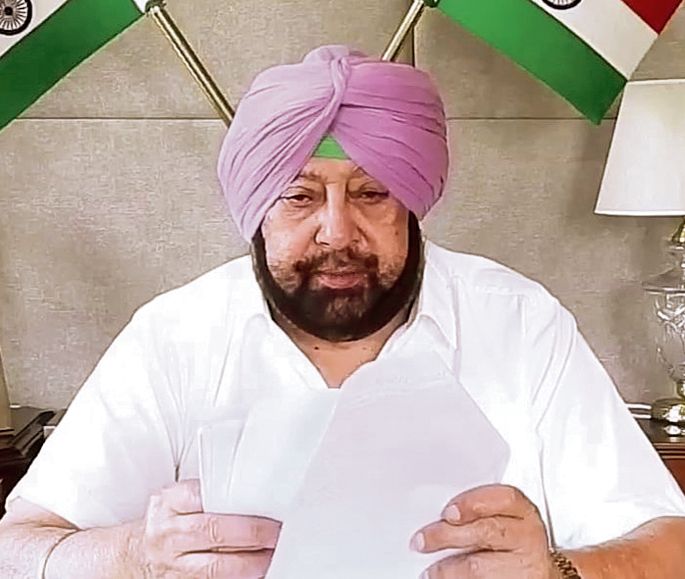
Former minister Navjot Singh Sidhu on Sunday targeted Union Food Minister Piyush Goyal on the issue of Direct Bank Transfer (DBT) to farmers for procurement at his hometown Patiala. About the same time, Punjab CM Capt Amarinder Singh issued a statement also targeting the Centre while seeking restoration of Rural Development Fund (RDF) at 3 per cent of the MSP.
“It is not the first time that Sidhu has held a press conference on important issues. Today, his tone was conciliatory. But the timing is intriguing. It seems more like a fight for political space,” observed a senior PPCC leader. Sources say Sidhu is keen on the post of PPCC chief but his associates maintain he has never sought any position. — TNS
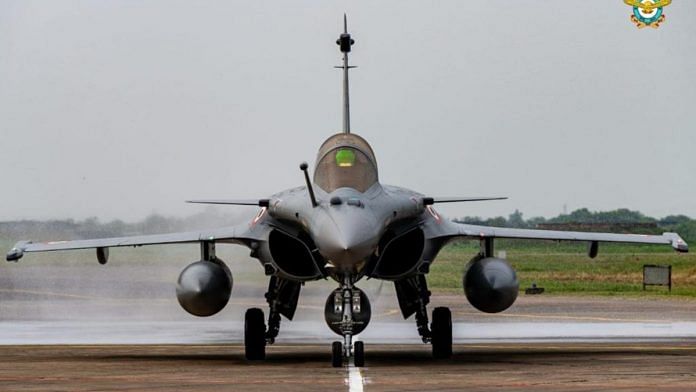
afale jet | Image by special arrangementText Size: A- A+
New Delhi: A fresh controversy seems to be building up over the 2016 Rafale deal with a French media report alleging that the country’s anti-corruption agency, the Agence Française Anticorruption (AFA), found suspicious payments made to a company owned by a middleman who was arrested by India’s Enforcement Directorate in 2019 in connection with the VVIP chopper scam.
The allegation is that the manufacturer of the Rafale aircraft, Dassault Aviation, had paid about one million Euros to Defsys Solutions for 50 models of the aircraft which were to be given as “gifts”. The category of ‘gifts’ by defence companies is treated as a serious matter in France. This resulted in the company having to explain the cost.
Models of Rafale gifted by Dassault Aviation are on display at various commands and bases of the Indian Air Force (IAF), including at the Air Headquarters. The giant model at the Air Headquarters was manufactured in France while the rest were made in India.
The report by Mediapart.fr says it “understands that during a scheduled audit of the group, the agency’s inspectors found that Dassault had agreed to pay one million euros to a middleman just after the 2016 signing of the Rafale fighter jet deal. That middleman is now accused of money laundering in India in another defence deal. The company said the money was used to pay for the manufacture of 50 large replica models of Rafale jets, even though the inspectors were given no proof that these models were made. Yet against all apparent logic, the AFA decided not to refer the matter to prosecutors”.
Industry sources said that Rafale explained the process to the French anti-corruption watchdog and the “query was settled”.
The AFA, which functions in a capacity similar to India’s Comptroller and Auditor General (CAG), was set up in 2017 with the aim of checking whether large companies implemented the anti-corruption procedures set out under Sapin 2, the French anti-corruption law. However, unlike CAG, the AFA also audits private firms.
The report said AFA auditors combing through Dassault’s 2017 accounts found an item of expenditure costing 508,925 euros entered under the heading ‘gifts to clients’.
The amount “seemed disproportionate in relation to all the other entries” under the same heading, said the subsequent confidential report of the AFA audit, which Mediapart claimed it had seen.
“The sum is indeed huge for a gift. Though French law does not set out precise limits, legal precedents suggest that giving a watch or an expensive meal costing several hundred euros can be enough to constitute corruption,” it said.
The report added that Defsys Solutions, which received the payment, belongs to the family of Sushen Gupta, who was arrested by the ED. According to the report, Gupta family members “acted as middlemen in the aeronautical and defence industries for three generations”.
It also highlighted Sushen Gupta “operated as an agent for Dassault, had worked on the Rafale contract and had allegedly obtained confidential documents from India’s Ministry of Defence”, and cited a report by CobraPost.
Defsys Solutions made models, maintains simulators
According to industry sources, Defsys is not a banned company and does business with various defence companies including Israeli ones, besides Dassault Aviation.
According to sources in the French industry, Dassault Aviation gave around 25 models to the Indian side, which are on prominent display at various locations, including at the residence of top officers. This is a historic practice.
The procurement of the models was said to have been done as part of the Make in India initiative.
Defsys is contracted to carry out maintenance of Rafale simulators at both the Ambala base and the Hasimara base where the second squadron of the Rafale will be based.
The simulators are manufactured by Sogitec Industries, a subsidiary of Dassault Aviation.
Pakistan is in a fix. The Imran-Bajwa dispensation is at a loss over the pressing priorities of the nation. Between cotton yarn (plus sugar) and Kashmir, what holds greater significance for the country, the Pakistani establishment is so puzzled to decide that it made a mockery of itself before the world making two conflicting announcements in two consecutive days. On March 31, the Imran Khan government affirmed that it would import cotton from India and admitted that the 19-month-long restrictions had affected its small and medium-sized enterprises (SMEs) adversely. Pakistan’s Finance Minister Hammad Azhar also informed that the Economic Coordination Committee (ECC) has allowed the private sector to import five lakh tonnes of sugar from India. The next day, Pakistan Prime Minister Imran Khan reversed the ECC decision saying that the current circumstances between the two countries were not conducive to trade. The new decision was announced after the Cabinet meeting in which Foreign Minister Shah Mahmood Qureshi reportedly emphasised that the resumption of trade was not possible until India restored the special status of Jammu and Kashmir. Now, what astonished everyone is — what made Pakistan take a U-turn in just 24 hours? Neither the constitutional autonomy of Kashmir was changed between 31st March and 1st April, nor the high-powered committee, ECC, was unaware that article 370 was scrapped way back in 2019. What is even more interesting that the approval document on trade was duly signed by the Pakistan Prime Minister, which rules out the option of making newly-appointed Finance Minister Hammad Azhar a fall guy for the fiasco So the question is who in Pakistan triggered the volte-face on trade with India? Was it the final call of Army chief General Qamar Javed Bajwa that forced Imran Khan from signing off the trade proposal? On the contrary, it was General Bajwa who recently in his speech at the Islamabad Security Dialogue, referring to the geo-economics of South Asia, pushed for stronger trade relations in the region, and recognising the Kashmir dispute, called for burying the past and move forward. Notably, the February 25 announcement by Pakistan to observe the 2003 ceasefire agreement at the Line of Control would not have come about without the nod of General Bajwa. Weeks before that, on 3rd February, the Pakistan army chief in a speech at Air Force academy had highlighted the need to “extend a hand of peace in all directions”. In truth, both General Bajwa and Imran Khan seem on the same page on improving trade ties with India, as a day before the Army chief’s famous speech in Islamabad, the Pakistan Prime Minister also had expressed the same sentiment. Economy in shambles but Pakistan busy in Kashmir gamble Undeniably, the reason behind the change of Pakistan’s stance is the state of its economy, which is in shambles. In 2020, the GDP of the country slipped to minus 1.5%. The country is facing sustained economic sanctions imposed by the global terror financing watchdog Financial Action Task Force (FATF) for sponsoring terrorism. From Saudi Arabia to Egypt to Turkey to Iran, Pakistan has been scurrying for financial assistance. Pakistan’s slide into misery started after the Pulwama attack, when India withdrew Most Favoured Nation (MFN) status to Pakistan, raising the customs duty on all goods exported from Pakistan to 200% with immediate effect. The formal trade between the two countries dropped to almost nil after Pakistan decided to suspend bilateral trade with India in August 2019, following the abrogation of article 370. Essentially, Imran Khan has tied himself into knots by making Kashmir a precondition for reopening the trade. Even though he knows that India won’t change its stance on Kashmir. Perhaps he is also aware that Pakistan needs India more than India needs Pakistan to strengthen its economy. One can only hope that Imran Khan stops playing to the gallery and be serious if he is keen on rebuilding ties with India. First, Pakistan should show its seriousness by dismantling the terror infrastructure on its soil and putting an end to breeding terrorists against India.
INDIA, CHINA NEED TO STRENGTHEN BORDER CBMS, SAYS ENVOY
China’s Envoy to India, Sun Weidong Lesson of last year’s border incident profound and such incident should not be repeated: Sun Weidong India and China need to strengthen confidence-building measures in border areas and avoid a repeat of last year’s border crisis, China’s envoy to India Sun Weidong has said. “Maintenance of peace and tranquillity need our joint efforts,” Mr. Sun said. “The border disputes can only be resolved through dialogue and negotiations… In case of an incident, a timely communication through military and diplomatic channels should be undertaken to avoid any action that may complicate or escalate the situation. We should strengthen confidence-building measures to jointly maintain peace and tranquillity in the border areas. The lesson of last year’s border incident is profound and such incident should not be repeated.” He made the comments in a “virtual dialogue” with columnist Sudheendra Kulkarni, the transcript of which was released on Sunday by China’s Embassy in New Delhi. On last year’s clash in the Galwan Valley which marked the worst violence on the border since 1967, Mr. Sun said: “Neither China nor India would like to see it happen. Both sides are willing to resolve issues and de-escalate tensions through dialogue and consultation.” The disengagement at Pangong Lake was “conducive to building mutual trust and further easing the situation on the ground”. He said both sides had “the political will to resolve the boundary question” and “should actively push forward boundary talks and strive to reach a fair, reasonable and mutually acceptable solution”. While the Chinese envoy called on both sides to view relations “in a comprehensive way rather than limited to one part” and said “the boundary question is not the whole story of China-India relations”, India has made clear that relations cannot continue as normal unless there is peace and tranquillity in border areas. Last year’s crisis, India has said, was triggered by China’s mobilisation of a large number of troops in forward areas and multiple transgressions across the Line of Actual Control (LAC) that went against a number of border agreements that had helped keep the peace. India last year placed curbs on Chinese investment and banned more than 200 Chinese apps, underlining that trade and investment could not proceed as normal in light of last year’s border crisis. Mr. Sun said “complete decoupling” or “selective decoupling”, in his view, “will not be realistic and harm others without benefiting oneself”. “We hope that India will treat all as equals in its opening-up and refrain from imposing restrictions on specific countries or regions, over-stretching the concept of national security to exclude companies from specific countries,” he said. Last year, two-way trade reached $87.6 billion, of which India’s exports to China were $20.8 billion, up 16%. “It shows that the Chinese market will always welcome marketable commodities,” he said. “China has been India’s largest trading partner for consecutive years and India is China’s largest trading partner in South Asia. This is the result of the market functions and enterprises’ choices,” Mr. Sun said.
One way out is to get the Army to depute senior officers (from colonels to generals) with experience in counter-insurgency operations to command the CRPF paramilitary men under the Home Ministry. If the Army can provide officers for the NSG and Establishment 22, which are under the Home Ministry or the PMO, then why not for anti-Maoist operations?
SIMILAR PATTERN: Hundreds of policemen from various cadres have been killed in attacks by Maoists, mostly in the past two decades. PTI
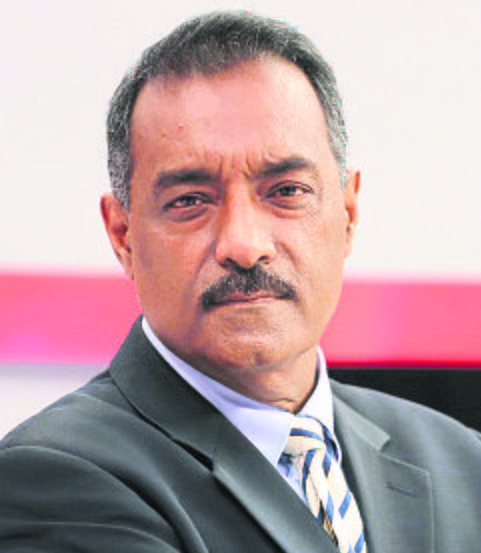
Maroof Raza
Senior Journalist
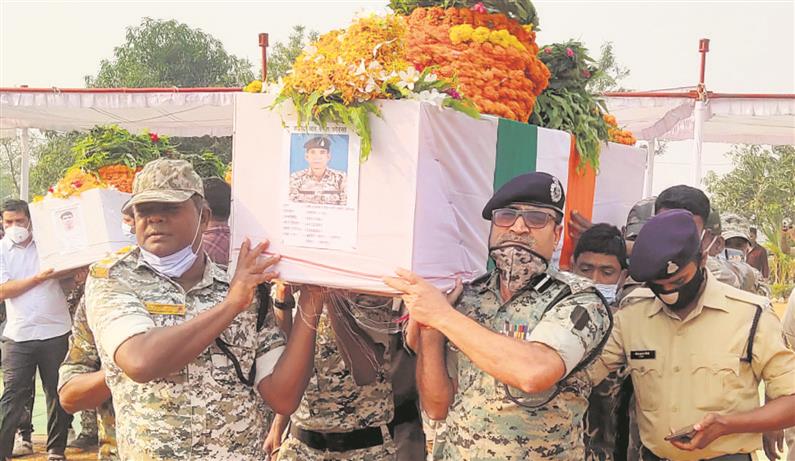
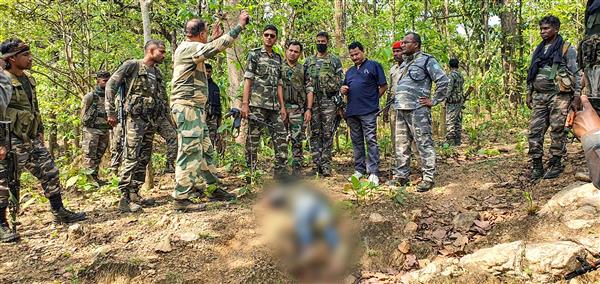
The latest ambush by Maoist rebels on a large contingent of security personnel in Bastar is yet another well-planned and ruthlessly executed attack in a long line of similar attacks in the Maoist-infested regions of central India.
Hundreds of policemen from various cadres have been killed in attacks, mostly in the past two decades, by well-armed Maoist rebels in the region. Often, the pattern of their ambushes is similar to that of the past. It’s either on a large posse of security personnel making their way back to camp after a tiring few days of operations in the jungles and when their guard is down. Or, it is an attack on a police camp, which can never be quite completely fortified.
But there are ways to prevent such massacres. This requires a top-down approach, and not a bottom-up one, to address the challenges across the several states where insurgency has existed for at least three decades, much like the way the Indian Army has been deployed in the north-eastern states.
Maoist insurgents have been expanding their footprint across the heartland over the past three decades and their red line of rebellion now runs from Pashupati (in Nepal) to Tirupati (in south India). At its height, the Maoist insurgency was visible in over 200 districts across, most severely, in central India.
And though our earlier Prime Minister Manmohan Singh has stated on record on more than one occasion that the Maoist insurgency “was the single biggest internal security challenge ever faced by our country”, Delhi’s efforts then and now have been a piecemeal exercise.
One problem is the federal nature of India, and the resistance of state governments. It limits what the Central government can do to tackle the challenges comprehensively. One state’s insurgent cannot be a vote bank for another state! Sadly, politics often takes precedence over the safety of citizens, and, in this case, the overstretched policemen operating in these areas, without an adequate senior police leadership.
A decade ago, a DGP of the CRPF had told me that it was a challenge for him to get enough CRPF senior officers (IGs and DIGs) to move out of the comfortable cities that they were based in to command their forces on the battlefields. Since IPS officers neither have the experience nor the inclination to battle insurgencies, they are reluctant to be based in operational areas and their troops are devoid of effective leadership, unlike the Army officers who have to command their troops from operational areas.https://5bf0bad335ac4e31633b1db594d17f2a.safeframe.googlesyndication.com/safeframe/1-0-38/html/container.html
One way out is to get the Army to depute senior officers (from colonels to generals) with experience in counter-insurgency operations to command CRPF paramilitary men under the Home Ministry. If the Army can provide officers for the NSG and Establishment 22, which are under the Home Ministry or the PMO, then why not for anti-Maoist operations? Moreover, with the Army being so top heavy, the opening of new avenues for officers will be an opportunity for them, many of whom are doing the job that one brigadier or major-general did decades ago in the corps/command/Army headquarters. And those JCO/NCOs retiring at a relatively young age, with experience in CI Ops can be offered the opportunity to serve in the Maoist-infested zones.
There would be the usual objections — from the Army headquarters and the CRPF — about how this can create inter-service manpower and budgeting issues, but if there is a will, there will be a way. A year ago, a Chinese incursion on the LAC led us to abandon the plans and doctrines that seemed to have been etched in stone. What will it take us to wake up to the threats posed on the lives and limbs of the policemen who are sent into the jungles, again and again, to be slaughtered? A decade ago, the then Home Secretary RK Singh wanted to up the ante by asking for 30,000 men from the Army’s Rashtriya Rifle units and helicopters. But he had run into opposition in Delhi, with the Army Chief reluctant to apply “quick-fix-solutions” by using excessive force.
And with the Maoists having shot down an IAF helicopter in Chhattisgarh’s Sukma district a decade ago, the reluctance to use helicopters — even for non-aggressive operations like reconnaissance and movement of troops to reinforce operations — gathered momentum in New Delhi. This must now be reviewed.
Historically, insurgencies have been contained and eliminated by a three-part strategy that involves: (a) The use of necessary military force to counter the aggressiveness of insurgents; (b) and while military operations are being enforced — although this could take from a few months to few years — the government must have ideas and initiatives ready, with plans for infrastructure upgrades that would address the basic grievances of the alienated people, who took to arms in the first place. (c) finally, when military operations are reduced to a minimum and the ground situation is under control with the implementation of such initiatives, then ‘talks’ must be initiated to address the political demands of the locals, with fixed timelines for political deliverables.
Essentially, there are two ways to confront insurgencies. One is to manage it at a low-key level, like New Delhi has done for decades in the North-East. The other is to go hammer and tongs, as the Sri Lankan forces eventually did against the LTTE, to finish off any serious resistance by the Tamil militants.
Above all, to successfully battle an insurgency, all major governmental agencies must be on the same wavelength. For the armed forces to distance themselves from the challenges of this grave challenge by claiming that this is not their battle (while the insurgencies in the North-East and Kashmir are) shows double standards. The PM and the National Security Adviser would do well to exercise their authority to get the forces to participate in and collectively address a problem that cannot have a knee-jerk approach, notwithstanding strong political warnings that translate to little on the ground.
Centre, state must work in sync to quell Maoist insurgency
Even as the powers that be are busy sticking the ‘urban Naxal’ label on all kinds of people, be it students or protesting farmers, the real Naxals keep striking deep in the forest at regular intervals. – File photo
Even as the powers that be are busy sticking the ‘urban Naxal’ label on all kinds of people, be it students or protesting farmers, the real Naxals keep striking deep in the forest at regular intervals. Twenty-two security personnel were killed and 31 others injured in a Maoist ambush in Chhattisgarh’s Bastar region on Saturday. Bastar has been the epicentre of major Maoist attacks in recent decades, including the deadliest one that claimed the lives of 76 CRPF men in April 2010. Several other states are also grappling with the menace. In May 2019, insurgents had triggered an improvised explosive device in Maharashtra’s Gadchiroli district, killing 15 members of a police quick response team.
According to reports, an unverified intel input lured the security forces into the Maoists’ lethal trap. This grave lapse needs to be probed thoroughly so that responsibility can be fixed and another disaster avoided. The Chhattisgarh incident has elicited the usual platitudes from the state and Central governments about giving a ‘befitting response’ and ‘never forgetting the sacrifices of the martyrs’. Undoubtedly, the killings have belied the tall claim that Maoist insurgency is on its last legs.
Naxal/Maoist violence has claimed more than 12,000 lives in the country, including those of around 2,700 security personnel, in two decades. There is no denying that a lot has to be done to break the back of the terrorists, right from snapping their supply of money, arms and ammunition and ensuring development in the infested areas to giving a cutting edge to the security forces in terms of intel, training and equipment. It’s also imperative to weaken local support for the insurgents by providing adequate education and job opportunities to residents. The blame game between the state and the Centre is uncalled for. Both have to work in close coordination to root out insurgency. At the same time, the noxious practice of raising the bogey of Naxalism to vilify protesters has proven to be counter-productive while targeting real culprits.
Covid surge
An alarming second wave demands adult vaccination
April is all set to be a challenging month for the people and government alike with Covid-19 restrictions getting expanded and lockdown measures reintroduced in some states. A sudden surge in coronavirus cases, the steepest since September 16 last year, with the country recording over one lakh cases on Monday, has meant that a return to normalcy is going to take a while longer, ironically when the trajectory was expected to head south aided by vaccine optimism. But with only 10 states accounting for a majority of the cases, the government has preferred instead a national campaign beginning today to ensure community participation, Covid-appropriate behaviour, personal hygiene and sanitation to check the spike even as some countries like France and Bangladesh have seen a weeklong lockdown being implemented. The rise in infections itself has been attributed to a severe decline in Covid protocol, pandemic fatigue and lack of effective containment measures. The impact on employment in business and industry will also unfold gradually, with restrictions impacting the workforce and output. Railway stations in states like Maharashtra have witnessed a rush of migrant workers bound for their home states.
The government, unwilling to fritter away the gains of managing the pandemic, has deputed health teams to visit the states witnessing a surge, with directives to curb the mortality rate and ramp up healthcare infrastructure. Faced with the task of rejuvenating the economy, emphasis is being laid on testing, tracing, treatment and vaccination to prevent the situation from getting out of hand that makes the task of protecting the economically vulnerable groups even more onerous.
The health authorities should get down to micro-managing the vaccination, zeroing in on regions witnessing the spike and taking steps that are required to avoid disruption to life. While the Centre has delegated to the states the discretion to take decisions based on local conditions in this case, frequent resort to restrictive measures will call for scrutiny. A fair bit of responsibility will also lie with the people by ensuring that they abide by the desired norms.
Additional Chief Secretary Sumita Misra at the Karnal grain market on Monday. Tribune photo
Parveen Arora
Tribune News Service
Karnal, April 5
Arhtiyas have opposed the Direct Benefit Transfer (DBT) to farmers against the payment for grain procurement and threatened to boycott wheat buying from April 8 if the payment was not resumed through them.
In a state-level meeting of arhtiyas held here, the Haryana State Anajmandi Arhtiyas’ Association also demanded dues of the last paddy season, 12 per cent interest on the delay in releasing the payment and permission to farmers residing in border areas to sell their crop in Haryana.
Ashok Gupta, state president of the association, said: “The state government had told us that the payment will be transferred as per the will of farmers. A majority of farmers have already given their consent to transfer their payment through arhtiyas while registering their crops on the Meri Fasal, Mera Byora portal. In spite of this, the government has said it will credit the payment in the bank accounts of farmers.”
“The state government has time till April 7 to meet our demands, otherwise we will boycott the procurement from the next day,” he said.
The state government has assured arhtiyas that they would continue to get their commission even if farmers are directly paid for their produce. This, however, is not the concern of arhtiyas.
Gupta said: “Arhtiyas are like ATMs to farmers, who borrow money from us in times of crisis. They pay off the debt after having sold their crop. If the state government pays farmers directly, we won’t get our money back. Payment through arhtiyas is a guarantee that we will get out money back.”
Rajnish Chaudhary, president, Karnal Arhtiyas’ Association, raised another concern related with the DBT scheme. “Last season, the Agriculture Department had transferred the payment to wrong bank accounts. Till now, farmers have not received the money,” he said.
He further said payments were pending because “I” forms were not available online. “The state government should start a portal on the lines of CM window to address the grievances of arhtiyas and farmers.”
After the state-level meeting, a delegation of arhtiyas led by Gupta left for Chandigarh for a meeting CM Manohar Lal Khattar. After having met the CM, Gupta said arhtiyas were adamant on their demand.
Govt’s assurance
The state government has assured arhtiyas that they would continue to get their commission even if farmers are directly paid for their produce. This, however, is not the concern of arhtiyas.
Won’t allow Guru Teg Bahadur’s statue in Delhi, Sikh bodies tell Centre
The Centre’s proposal to set up a ‘memorial’ or a ‘statue’ dedicated to the 400th birth anniversary of Guru Tegh Bahadur outside Gurdwara Sis Ganj Sahib, Chandni Chowk, in old Delhi, has triggered a controversy.
Following reports in this regard, the Delhi Sikh Gurdwara Management Committee (DSGMC) has lodged its protest with the Prime Minister’s Office (PMO) asking it to immediately drop the proposal of erecting a statue or any kind of structure outside Gurdwara Sis Ganj Sahib or anywhere else in Delhi.
Not consulted
We will never allow the Centre to have direct intervention in our religious matters. Neither the SGPC nor the DSGMC was taken into confidence before planning this proposal. — Manjinder Singh Sirsa, DSGMC chief
The DSGMC and Shiromani Gurdwara Parbandhak Committee (SGPC) said the installation of the statue of the Guru would defy the Sikh ‘rehat maryada’ which prohibits creating idols of Gurus.
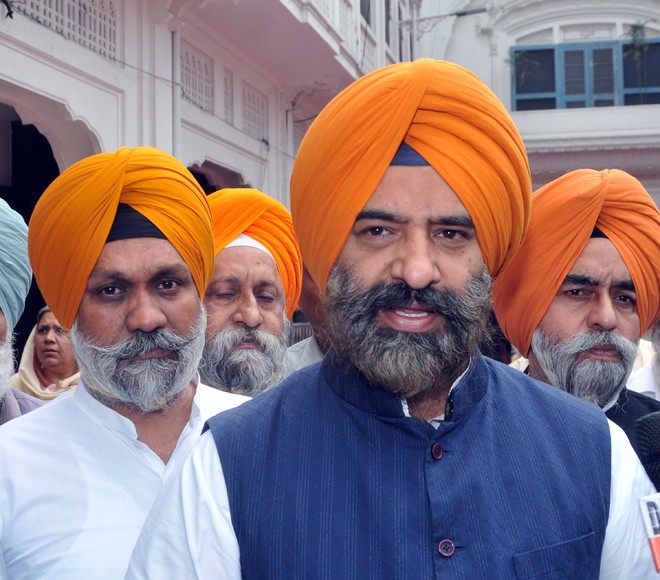
Delhi Sikh Gurdwara Management Committee president Manjinder Singh Sirsa has shot off a letter to PM Narendra Modi contesting that the statue of Guru or any memorial could not be built without taking the Sikh body into confidence.
“We will never allow the Centre to have direct intervention in our religious matters. Nothing can be built outside the historic shrine. The statue culture is certainly against our tenets and any kind of structure about which we don’t have an idea will create unrest. Such a proposal will end up hurting Sikh sentiments and hence this proposal should be withdrawn. Ironically, neither the SGPC nor the DSGMC was taken into confidence before conceptualising a proposal that directly relates to the Sikh religion,” he said.
In response to a call given by the Samyukt Kisan Morcha, activists of BKU (Ekta Ugrahan) today laid siege to a FCI godown in Malaud village.
BKU general secretary Sudagar Singh Ghudani said they wanted the government to withdraw the condition of producing jamabandi (of land) for the purchase of wheat. Stressing the need for purchase of all crops at MSP, farmers demanded that provisions be made for strict legal action against those purchasing wheat, paddy and other crops below decided prices.
They also urged the government to ensure all purchase centres, including FCI, remained operational and adequate funding be provided to all procurement agencies. — OC
Farmer unions protest outside FCI offices
Farmers protest outside the District Food and Civil Supplies Controller’s office in Amritsar. Vishal Kumar
Tribune News Service
Bathinda, April 5
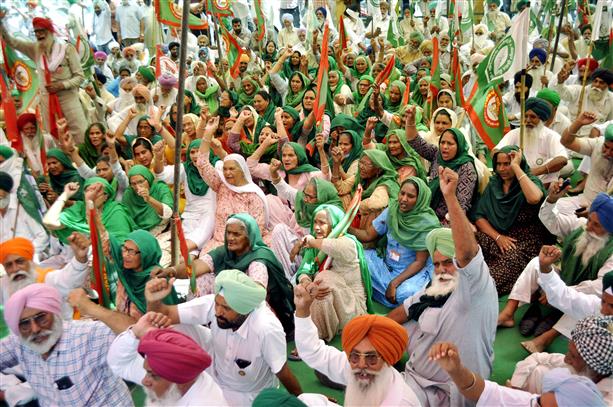
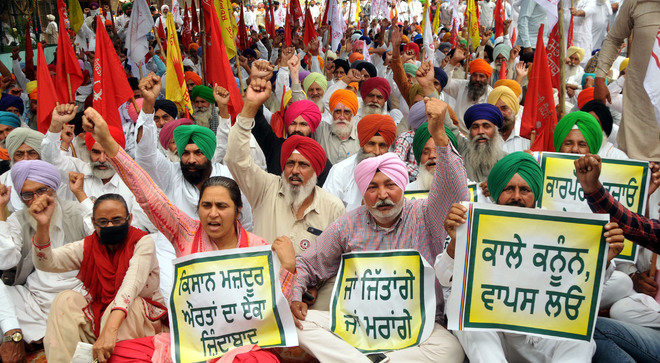
Farmer unions staged protests outside FCI offices against new procurement norms and quality specification announced by the government in Bathinda and Mansa districts. Protesters also raised slogans against the central government for its move regarding the direct transfer of payment for procurement of crops into farmers’ bank accounts.
Scores of farmers, under the banner of Ugrahan, Sidhupur, Dakonda and Lakhowal factions of the Bhartiya Kisan Union (BKU) and other organisations owing allegiance to Samyukt Kisan Morcha, particpated in the protest.
BKU (Sidhupur) general secretary Baldev Singh Sandoha said: “We strongly condemn the Centre’s new procurement norms. These will affect many farmers as a large quantity of wheat would not fall under the moisture content limits fixed by the government. They, therefore, would be coerced to sell it to private agencies on low rates. These are devious plans of the government that is trying to give reins of agriculture sector in the hand of private players. If the decision is not revoked, protests would be intensified in the coming days.”
BKU (Ugrahan) president Ram Singh Bhaini Bagha said: “With such moves, the Centre wants to weaken the government procurement agencies and end the public distribution system (PDS) and APMC mandis. This is being done to help private players enter the market to not only fix the prices as per their business interests, but also exploit the agriculture sector at the expense of farmers. If the decision with regard to DBT and revised procurement norms for wheat are not revoked, we will start the gherao of government procurement agencies’ officials in the coming days.”
Reiterating his full support to farmers and arhtiyas, Chief Minister Capt Amarinder Singh on Monday flayed the central government for “encroaching upon the rights of the states in its bid to dominate them” and castigated it over forcible imposition of the farm laws and the direct benefit transfer (DBT).
“States never faced such problems earlier,” he said, slamming the Centre for allegedly trying to destroy the existing relations and systems that have worked well for more than 100 years in the name of so-called reforms.
Punjab’s farmers and arhtiyas have age-old cordial ties, which the Centre was hell bent on damaging, he said, terming its tough posturing and ill-conceived decisions against the basic spirit of federalism. He said during his earlier tenure, he enjoyed the full confidence of Late PM Atal Bihari Vajpayee and Dr Manmohan Singh in all major policy decisions and development issues related to Punjab.
Centre not sincere
Had the Centre been sincere about finding a workable solution to the problem, it would have either consulted the Punjab Government or farmers. —Capt Amarinder Singh, CM
Virtually launching the two-day kisan mela organised by Punjab Agricultural University (PAU), Ludhiana, the Chief Minister expressed his solidarity with the farmers against the farm laws and stressed the Centre should have taken them into confidence before their enactment.
The Chief Minister categorically said Punjab, which was initially not even a part of the deliberations on the agricultural reforms, was included in the high-powered committee only after he wrote to the Centre. Even after that, there was no mention of these laws at the committee’s meetings.
Pointing out that 144 farmers have died so far during the agitation, he said his government was giving Rs 5 lakh and a job to the next of kin of the deceased farmer, while the Centre continued to be insensitive.
On the growing problem of scarcity of surface as well as underground water, he urged the farmers to go for drip irrigation in a big way to save the state from becoming a desert in the near future. “The fast depleting water table is a major challenge for the state and the only solution is to get out of the paddy-wheat cycle to save this precious resource,” he said. He further stressed efforts should be made to adapt to horticultural crops which have a global market with chances of enormous profitability.
State Stalwarts
DEFENCE MINISTER
Minister Rajnath Singh
ALL HUMANS ARE ONE CREATED BY GOD
HINDUS,MUSLIMS,SIKHS.ISAI SAB HAI BHAI BHAI
CHIEF PATRON ALL INDIA SANJHA MORCHA
LT GEN JASBIR SINGH DHALIWAL, DOGRA
SENIOR PATRON ALL INDIA SANJHA MORCHA
MAJOR GEN HARVIJAY SINGH, SENA MEDAL ,corps of signals
.
.
PATRON ALL INDIA SANJHA MORCHA
MAJ GEN RAMINDER GURAYA ,MADRAS REGIMENT
sanjhamorcha303@gmail.com
PRESIDENT SOUTH ALL INDIA SANJHA MORCHA
COL SS RAJAN BOMBAY SAPPERS,
PRESIDENT UTTARAKHAND ALL INDIA SANJHA MORCHA
COL B M THAPA ,BENGAL SAPPERSS
PRESIDENT HARAYANA STATE CUM COORDINATOR ESM
BRIG DALJIT THUKRAL ,BENGAL SAPPERS
PRESIDENT TRICITY
COL B S BRAR (BHUPI BRAR)
PRESIDENT CHANDIGARH ZONE
COL SHANJIT SINGH BHULLAR
.
.
PRESIDENT PANCHKULA ZONE AND ZIRAKPUR
COL SWARAN SINGH
INDIAN DEFENCE FORCES
DEFENCE FORCES INTEGRATED LOGO
INDIAN AIR FORCE
Air Officer C-in-C WESTERN AIR COMMAND
AIR MSHL S PRABHAKARAN AVSM VM
AOC-IN-C, EASTERN AIR COMMAND
Air Marshal Inderpal Singh Walia
AOC-in-C SOUTH WESTERN AIR COMMAND
Air Marshal Vikram Singh
AOC-IN-C, SOUTHERN AIR COMMAND
Air Marshal J.Chalapati
AOC-IN-C TRAINING COMMAND
AIR MARSHAL SK GHOTIA VSM
AOC-IN-C MAINTENANCE COMMAND
Air Marshal Jagdish Chandra
Flag Officer Commanding in Chief, Western Naval Command
ice Admiral R Hari Kumar, PVSM, AVSM, VSM
Flag Officer Commanding in Chief, Eastern Naval Command
Vice Admiral Sanjay Bhalla, AVSM, NM
Flag Officer Commanding in Chief, Southern Naval Command