









Sanjha Morcha

What’s New

Click the heading to open detailed news

Current Events :

web counter

Print Media Reproduced Defence Related News

The ‘Naya Pakistan’ rhetoric

Imran’s rigidity a hurdle in the way of maintaining peace on our borders
The ‘Naya Pakistan’ rhetoric

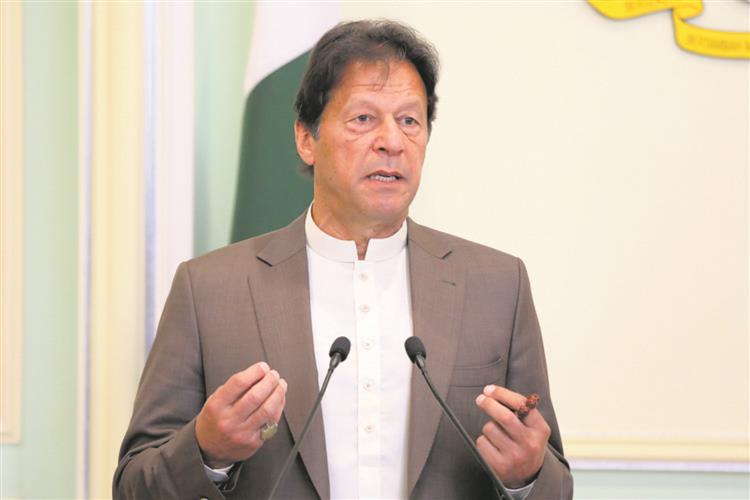
n a bind: India is dealing with one of the most opinionated politicians in Pakistan — Imran Khan. Reuters
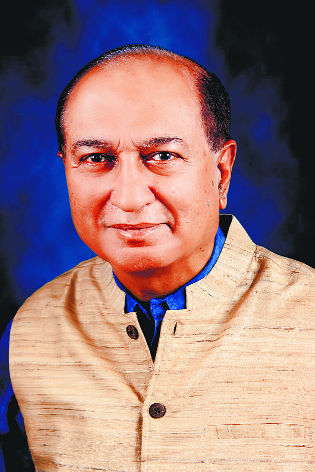
G Parthasarathy

Chancellor, Jammu Central University & former High Commissioner to Pakistan

Tensions with Pakistan have been a continuing feature of India’s problems in its neighbourhood. Are we, however, seeing after a long time, the emergence of a ‘Naya Pakistan’, with its perennially hostile military, favouring a cooling of tensions with India? There has been a feeling in recent days that there are good reasons for cautious optimism in India and Pakistan that the two countries could negotiate ways to live in peace. Most Indians feel that for the past four years, India is dealing with one of the most opinionated politicians in Pakistan — Imran Khan. His Tehreek-e-Insaf Party was ideologically moulded by the anti-India, former ISI chief, Lt Gen Hamid Gul.

China has naturally regarded Imran Khan’s anti-India diatribes as a blessing. It complements the daily dose of anti-India rhetoric dished out by Beijing’s official mouthpiece, the Global Times. All this is having an impact within Pakistan, where there are many who understand the urgent need for economic realism to meet challenges posed by the pandemic. Pakistanis would surely have noted that while their foreign exchange reserves have dwindled to a mere $14.8 billion, Bangladesh, whose people have traditionally been looked down upon by their erstwhile West Pakistani brethren, has steadily growing foreign exchange reserves of $44 billion. Bangladesh has overtaken Pakistan in virtually every financial, social and economic indicator, within half a century of its birth in 1971.

There are now many in Pakistan who believe that it is imperative to focus on economic development with their neighbours. Pakistan army chief General Bajwa, who, like his predecessors, is Pakistan’s de facto ruler, called for measures to boost intra-regional trade and connectivity. A few days earlier, the DGMOs of India and Pakistan had reached an agreement on a ceasefire across the LoC. Meanwhile, the economic coordination committee of Imran Khan’s cabinet, headed by Finance Minister Hammad Azar, recommended that trade with India needed to be resumed to revive the economy.

The cabinet rejected the recommendations of the committee the very next day. Those leading the rejectionists included minister for human rights Shireen Mazari, who has a track record of vitriolic anti-Indian writings and pronouncements, SM Qureshi, the hawkish minister for foreign affairs, and Sheikh Rashid, the interior minister. Mazari asserted: ‘The cabinet stated clearly that there could be no trade with India. The Prime Minister made it clear there can be no normalisation of relations with India, until they reverse their illegal actions of August 5, 2019, on Jammu and Kashmir’. Imran Khan appears determined to ridicule what was an action to cool temperatures in relations with India, initiated by General Bajwa. He was, thereby, sending the message that he remained a ‘hawk’ on J&K. This will, no doubt, please Bajwa’s rivals in the army, who reportedly include the ISI chief, Lt Gen Faiz Hameed, who is in the running to succeed Bajwa. The ISI chief is, no doubt, pledging eternal loyalty to the army chief at the same time.

While his actions may have enabled Imran Khan to strengthen his position amongst those opposed to General Bajwa, he could well find that he has opened the doors for his political opponents like Asif Ali Zardari of the PPP and Maulana Fazlur Rahman of the JUI, who has conservative, Islamist support within Pakistan, to pose a serious political challenge. Imran Khan remembers that in his early days in politics, he had the strong army support to pose challenges to his then rival, Nawaz Sharif. Even as his present relations with General Bajwa are not as cordial as they were earlier, he is making sure that he retains support in the higher echelons of the army. He is, at the same time, working to convince US President Joe Biden that he will facilitate a smooth withdrawal of US forces from Afghanistan, while remaining a trusted loyalist of Presidents Vladimir Putin and Xi Jinping. Both China and Russia have their eyes on Afghanistan’s immense resources.

India needs to play its cards skilfully in this complex scenario. National Security Adviser Ajit Doval, who was posted in our embassy in Islamabad in the early 1980s, developed a perceptive understanding of the complexities of the internal situation in Pakistan. The two countries should have ambassadors in each other’s capital as a first step, for any move forward. It is only natural for Doval to continue guiding any ‘back channel’ negotiations. India’s highly respected, former High Commissioner to Pakistan, Satinder Lambah, did a commendable job as Special Envoy in his ‘back channel’ meetings with General Musharraf’s confidant, Tariq Aziz, after the 2003 Kashmir ceasefire. That entire dialogue process was undermined by Gen Ashfaq Kayani, who succeeded Musharraf as army chief. Imran Khan would be well advised to study details of those talks, instead of shooting from the hip. That dialogue was based on then PM Manmohan Singh’s simple proposition: ‘Borders cannot be redrawn, but we can work towards making borders irrelevant — towards making them just lines on a map’. He added: ‘People on both sides of the Line of Control should be able to move freely and trade with one another’.

The way ahead for maintaining peace on our borders is going to the complex. One hopes that the Biden administration will show wisdom and foresight by ending sanctions on Iran. Teheran has a vital stake in seeing that its eastern borders with Afghanistan are not administered by ISI-backed, Wahhabi-oriented fundamentalists. Democratic processes can be revived in J&K with the revival of statehood for the Jammu region and the Kashmir valley, when the situation stabilises. Pakistan will have to be cautioned by those desiring peace and stability against any effort to resume infiltration across the LoC. This process can also be facilitated if China ends its efforts for ‘salami slicing’ of Indian territory in Ladakh.
Protesting farmers yet again nix move to restart toll plaza

Protesting farmers yet again nix move to restart toll plaza

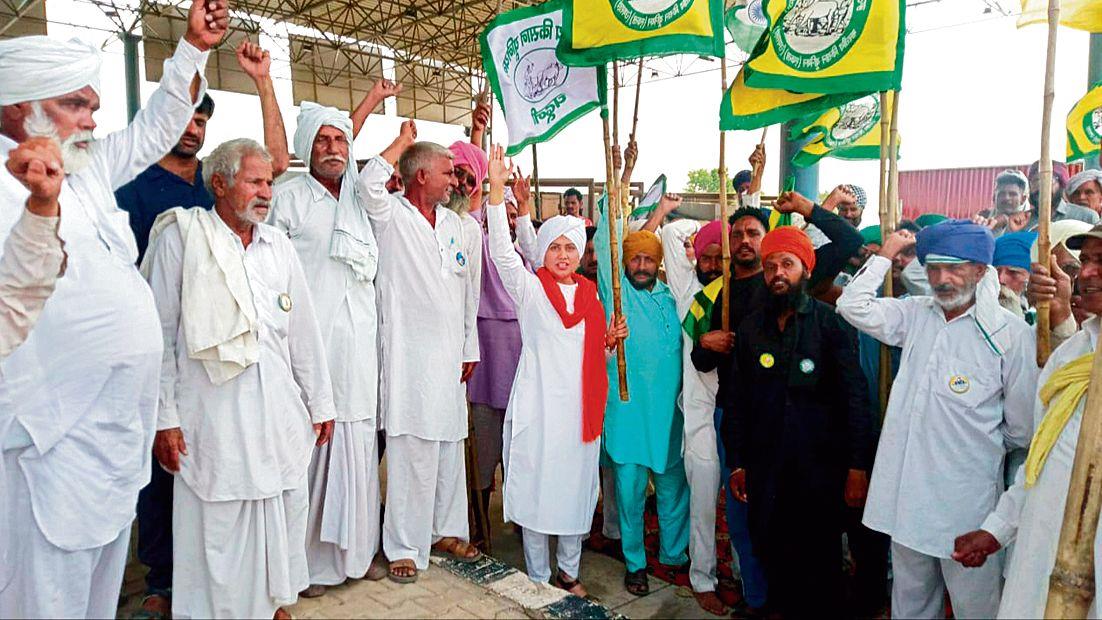
Farmers raise slogans at Aasoda toll plaza in Jhajjar. Tribune Photo

Ravinder Saini

Tribune News Service

Jhajjar, April 14

The administration’s move to reactivate the toll booth on the Kundli-Manesar-Palwal (KMP) expressway near Aasoda village failed within 24 hours as protesting farmers created a ruckus on Wednesday, forcing toll officials to stop charging tax from commuters. This was for the third time in four months that farmers shut the KMP Expressway toll plaza.

The protesting farmers lifted the toll barriers, giving a free passage to the commuters. They also staged a dharna at the plaza and raised anti-government slogans. Bahadurgarh SDM Hitendra Sharma, present on the spot along with a heavy police force, said the farmers were requested not to take law into their hands by closing the toll plaza but they did not pay heed.

The toll plaza was restarted on Tuesday in the presence of the SDM and the police to prevent any untoward incident. The farmers did not come yesterday as they had got together at Tikri border for the Baisakhi fair, said sources.

BKU leader Gurnam Singh Chaduni had appealed this morning to farmers to reach the Aasoda toll plaza to ensure its closure in a peaceful manner. Suman Hooda, a farmer leader, said they would not leave the toll plaza till the administrative officers and police forces remained at the spot.

Meanwhile, the All India Kisan Sabha (AIKS) condemned the toll companies for restarting the collection. “These are provocations to disrupt the stir when harvesting is at its peak,” the AIKS said.


Farmers pay tributes to Jallianwala Bagh martyrs

Farmers pay tributes to Jallianwala Bagh martyrs

Tribune News Service
Amritsar, April 13

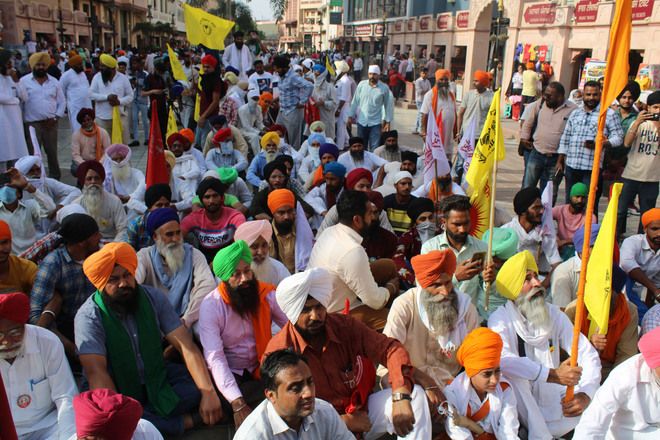
Farmers under the banner of the Sanyukt Kisan Morcha paid tributes to the martyrs of Jallianwala Bagh massacre by organising a gathering on road outside the memorial, which was closed in February last year for renovation.

The farmer leaders said 102 years ago, the British government killed hundreds of peaceful protesters who had gathered to protest against them. The farmers said the present government at the Centre was moving on the same lines as over 350 farmers have died during the ongoing protests at Delhi borders but it had failed to accept the justified demands of the farming community.

The leaders exhorted farmers to take inspiration from the martyrs of Jallianwala Bagh massacre and continue the protest till the three controversial laws were repealed. The farmer organisations also criticised the government’s plan of setting up a ticket counter outside the memorial. They said people would launch another agitation if the government did not abandon its plan to set up the ticket counter.

Leading the protest, farmer leader Balkar Singh Dudala said: “Like the British government, the present rulers, too, are working against the common masses.” He said the three agriculture laws would destroy the farming community and benefit the corporate.

Another leader Rattan Singh Randhawa said: “The farmers’ protest at Delhi borders will soon complete five months. The government is indifferent and focused more on elections. Any sensitive government would have by now addressed the issues of the agriculture sector.” He said the protest would continue till the demands of farmers were accepted. Others who addressed the gathering included Davinder Singh Chattiwind, Harjit Singh Jheeta, Mehtab Singh Sirsa, Bachittar Singh, Hoshiar Singh Jhander and others.


Farmers block highway

Farmers block highway

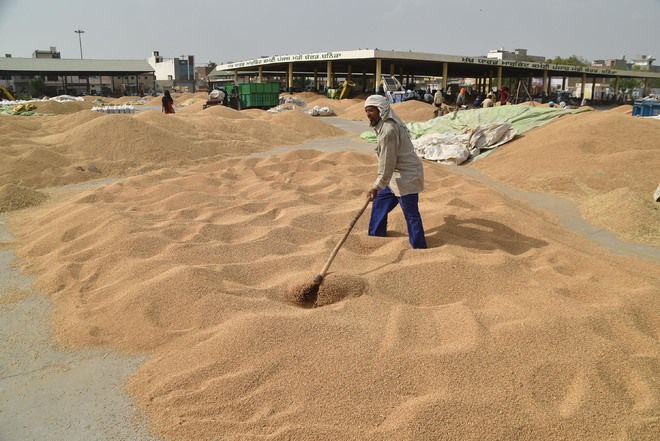
A labourer spreads wheat at the Bathinda grain market. Tribune photo

Bathinda, April 14

Farmers under the banner of BKU (Mansa) faction staged a protest at Goniana Kalan in Bathinda district alleging the FCI had not started wheat procurement there so far.

The protesting farmers raised slogans against the Centre and the FCI. They said the central procurement agency had dragged its feet from around six mandis in the district on the pretext of high moisture content. Farmers blocked Bathinda-Amritsar highway and also raised slogans against the state government.

Union leader Jagshir Jeeda said, “This is a deliberate attempt by the central procurement agency to pester farmers who have brought their produce to the mandi. No one is available here to buy their produce. This approach of FCI won’t be tolerated and if the procurement does not start soon, we will intensify the stir.”

Later, Naib Tehsildar Rajvir Singh reached the protest venue and placated the farmers following which the dharna ended. — T


People who exercise regularly have best chance to beat Covid

The results showed that inactivity is strongly associated with poor Covid-19 outcomes

People who exercise regularly have best chance to beat Covid

Regular exercise or a 30-minute brisk walk in the neighbourhood park or in your society five days a week while following the social distancing norms can improve your chances of beating  Covid-19, reveals a significant study that analysed 48,440 adults who were Covid positive.

On the other hand, patients who were consistently inactive had 1.73 times greater chances of ICU admission, while the risk for death was 2.49 times greater for patients who were consistently inactive.

Other than being over the age of 60 or having a history of organ transplant, being consistently inactive conferred the highest risk for death from Covid-19.

Even patients who were inconsistently active had lower chances for severe Covid-19, suggesting any amount of physical activity has benefit, revealed the findings published in the British Journal of Sports  Medicine.

 “This is a wake-up call for the importance of healthy lifestyles and especially physical activity,” said Robert E Sallis, physician at the Kaiser Permanente Fontana Medical Centre in the US.

“People who regularly exercise had the best chance of beating Covid-19, while people who were inactive did much worse,” Sallis added.

For the study, the team identified 48,440 adults with a Covid-19 diagnosis from January 1, 2020, to October 21, 2020.

They found 6.4 per cent were consistently active and 14.4 per cent were consistently inactive, with the remainder falling in the inconsistently active category. Among all Covid-19 patients, 8.6 per cent were  hospitalised, 2.4 per cent were admitted to the ICU, and 1.6 per cent died.

“What surprised me the most from this study was the strength of the association between inactivity and poor outcomes from Covid-19,” said Deborah Rohm Young from the Kaiser Permanente Southern California.

“Even after we included variables such as obesity and smoking in the analysis, we still saw inactivity was strongly associated with much higher odds of hospitalisation, ICU admission, and death compared with  moderate physical activity or any activity at all,” Young added.

The results showed that inactivity is strongly associated with poor Covid-19 outcomes, Sallis said, while suggesting walking 30 minutes a day, five days a week at a moderate pace, to prevent  Covid-19.

“Exercise is medicine that everyone should take — especially in this era of Covid-19,” Sallis said. — IANS


India in touch with Pakistan: EAM on safety of Indian Sikh pilgrims

Over 800 Indian Sikhs travelled to Pakistan to attend the Baisakhi festival

India in touch with Pakistan: EAM on safety of Indian Sikh pilgrims

New Delhi/Lahore, April 14

India is in touch with authorities in Pakistan regarding safety of over 800 Indian pilgrims whose visit to the neighbouring country has been affected by violent protests in several cities, including Lahore.

“Closely tracking developments. In touch with Pakistani authorities and Sikh Jatha. Will do utmost to ensure security and safe return of pilgrims,” External Affairs Minister S Jaishankar tweeted.

The minister’s response came after president of Delhi Sikh Gurdwara Management committee Manjinder Singh Sirsa, in a tweet, requested Jaishankar to look into the matter of stranded Sikh pilgrims in Pakistan.

Over 800 Indian Sikhs travelled to Pakistan to attend the Baisakhi festival. The Indian pilgrims had reached Lahore via Wagah border on Monday to attend the festival.

On Tuesday afternoon, the visiting Indian Sikhs left for Gurdwara Panja Sahib in Hassanabdal in 25 buses which were escorted by the police and the Pakistani Rangers.

“Owing to the TLP protest that blocked roads, the Sikh yatrees reached Hassanabdal at 4 am on Wednesday after over 14 hours of journey which otherwise is covered in three hours,” an official of the Punjab government told PTI in Lahore.  

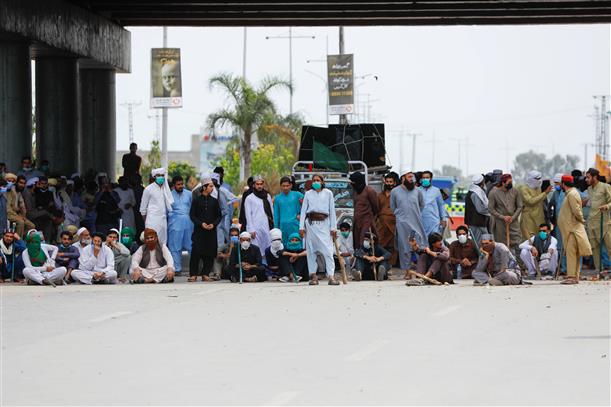
Protests are taking place in several parts of Pakistan by supporters of Tehreek-i-Labaik Pakistan (TLP) demanding the expulsion of the French envoy over the publication of blasphemous caricatures in France.

The Indian pilgrims attended the main event on Wednesday in which several local Sikhs also participated.

The visiting pilgrims are scheduled to visit other holy places in the Punjab province of Pakistan during their 10-day stay in the country. PTI


Bhim Army chief Chandrashekhar Azad, Dalit organisations join protesting farmers in Delhi

While Dalit organisations from Haryana joined the farmers protest at the Tikri border, Azad and a large group of workers from Punjab’s NREGA Mazdoor Association went to the Singhu border, it said

Bhim Army chief Chandrashekhar Azad, Dalit organisations join protesting farmers in Delhi

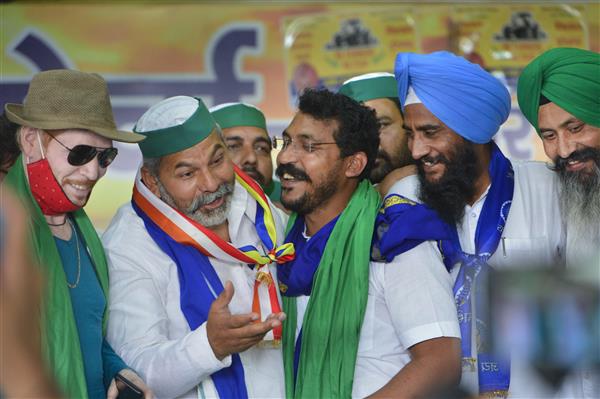
Bhim Army National President Chandrashekhar Azad and BKU leader Rakesh Tikait, during the ongoing farmers protest, at Ghazipur border in New Delhi, Wednesday, April 14, 2021. PTI

New Delhi, April 14

Bhim Army chief Chandrashekhar Azad and several Dalit organisations from Haryana joined farmers camping at Delhi borders as they observed ‘Save Constitution Day’ and ‘Kisan Bahujan Ekta Diwas’ on the occasion of B R Ambedkar’s birth anniversary on Wednesday, the Samyukta Kisan Morcha (SKM) said.

While Dalit organisations from Haryana joined the farmers protest at the Tikri border, Azad and a large group of workers from Punjab’s NREGA Mazdoor Association went to the Singhu border, it said.

Thousands of farmers, mostly from Punjab, Haryana and western Uttar Pradesh, have been camping at three border points of Delhi — Singhu, Tikri and Ghazipur — demanding a repeal of the three farm laws enacted by the Centre in September last year.

“The present government and the RSS-BJP are manipulating and destroying the Constitution in the name of reforms. This pattern is dangerous for both the economy and society. The present farmers’ movement has not only tried to save the Constitution but it is another effort to fight for the strong implementation of the Constitution,” the SKM, a joint front of farmer unions, said in a statement.

It also accused the government of implementing a “divide and rule policy” by splitting the working class into several classes, and asserted that farmers and labourers are united against the present “corporate-government nexus”.

“The marketing system and proper minimum support price (MSP) is the biggest freedom for farmers. In the same way, minimum wage and respectful work of workers protect them from exploitation. At present, both sections have been targeted by the central government.

“Not only the Essential Commodities (Amendment) Act but the other two farm laws will also affect the economy of Dalit Bahujans broadly. Today, labourers and farmers understand this well and they are fighting unitedly against these policies,” the statement said.

The Centre says the new farm laws will free farmers from middlemen, giving them more options to sell their crops.

The protesting farmers, however, say the laws would pave the way for eliminating the safety cushion of MSP and do away with the ‘mandi’ (wholesale market) system, leaving them at the mercy of big corporates. PTI


Quad navies can come together if need arises, says Navy Chief

Quad navies can come together if need arises, says Navy Chief

Ajay Banerjee

Tribune News Service

New Delhi, April 14

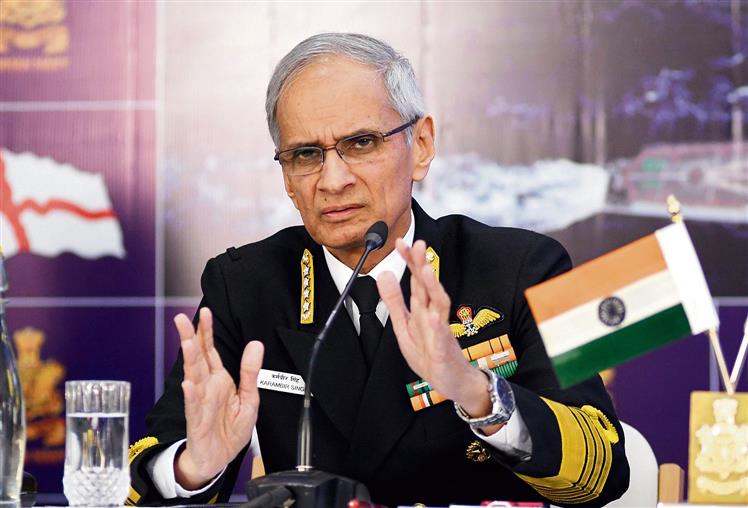
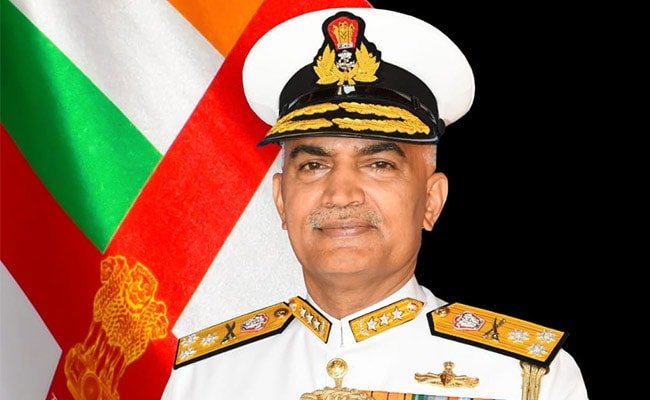
In what could set the tone for future military cooperation to tackle growing Chinese assertiveness, Indian Navy Chief Admiral Karambir Singh on Wednesday said if an ‘opportunity arose’ the Quad navies had the capability and capacity to come together almost in a ‘plug and play’ manner – indicating seamless integration.

The Quad or Quadrilateral is the grouping of India, US, Japan and Australia.

At the Raisina Dialogue 2021, on being asked where he saw Quad, if it could take a military form and was it ready for joint military operations, the Navy Chief said Quad navies already enjoyed a high degree of interoperability and highlighted that the Malabar exercise started with the US in 1992 and it predated the Quad construct. India has bilateral naval exercises with Japan since 2012 and with the Australian Navy for the past six years. “We have robust engagement of Quad navies….So if an opportunity arises, we have the capability and capacity to come together in almost a plug and play mechanism,” the Admiral said as his statement would be deciphered in Capital across the world specially Moscow and Beijing – both are not pleased with the Quad grouping.

Admiral Karambir Singh was joined by Admiral Phil Davidson, Commander of the Indo-Pacific Command, United States, who spoke about the importance of US-India relationship. “It indispensable for the Indo-Pacific”.

The Quad, he said, must fully realise the opportunities and address common interests, including cyber and space. He blamed the Communist Party of China for seeking to exploit the pandemic for military terms. Their intent is to undermine the established rule of law in the Indian Ocean and also the South China Sea.

Earlier, Admiral Karambir Singh said the Indian Navy recognised the expanse of the Indo-Pacific and no one could do it alone, it was best to do it together. “We could see that freedom of navigation gets converted into contested water,” he said.

‘Forces already enjoy interoperability’

At the Raisina Dialogue, on being asked where he saw Quad, whether it could take a military form and was it ready for joint military operations, Navy Chief Admiral Karambir Singh said Quad navies already enjoyed a high degree of interoperability and highlighted that the Malabar exercise started with the US in 1992 and it predated the Quad construct.


The Forgotten Last salute tradition revived by comrades bid farewell to old soldiers in a Pb Village

An old soldier being bid farewell by his comrades in arms in a small village in Punjab. This is what soldiers are made of.

Its time f0r the Ex-Servicemen community to wake up without any expectation from the Central Govt /State Govt .

we must ensure proper respect to be given to the departed soul of any Fauji /ESM by attending funerals and paying tribute by laying wreaths on the the body and giving the last salute .

time to revive the tradition by paying respect in a proper army way and ensure the family also gets Rs 10000/- from the dependent CSD canteen and also Station HQ is supposed to send a rifleman for the salute with biggular .The families normally miss out except the pension claims or bank accounts etc .

The vedio shows the spirit of ESM of a village in paying last respect to the departed soul of an ESM