“China takes note of the recent grave situation in India with a temporary shortage of anti-epidemic medical supplies,” Foreign Ministry spokesman Wang Wenbin said
Photo for representational purpose only. iStock
Beijing, April 22
China on Thursday offered to provide the necessary support and assistance to India to deal with the sharp increase in the COVID-19 cases in the country.
Asked about the spike in the coronavirus cases in India by the official Chinese media, Foreign Ministry spokesman Wang Wenbin told a media briefing here that the COVID-19 “pandemic is a common enemy of all mankind that necessitates international solidarity and mutual assistance”.
“China takes note of the recent grave situation in India with a temporary shortage of anti-epidemic medical supplies,” he said.
“We stand ready to provide India with necessary support and assistance to get the epidemic under control,” he said.
China reported the first COVID-19 case in the central Chinese city of Wuhan in late 2019 and since then the deadly disease has snowballed into a pandemic, affecting more than 143,915,000 people and over 3,060,500 deaths worldwide.
According to Johns Hopkins coronavirus tracker, the US alone has reported 31,862,987 cases and 569,404 deaths from the deadly virus.
The US has alleged that the COVID-19 may have emanated from the Wuhan Institute of Virology (WIV) which is a P-4 bio lab, a charge strongly denied by China.
A team of WHO experts, which probed the origin of the coronavirus, concluded last month that “all hypotheses” included the allegation that COVID-19 could have emanated from a bio lab “remained open”.
World Health Organisation (WHO) Director-General Dr Tedros Adhanom Ghebreyesus, while receiving the report of the international experts’ team which visited Wuhan, said on March 30 that “as far as the WHO is concerned, all hypotheses remain on the table”. PTI
UAE bans travel from India due to worsening COVID situation from Sunday
Travel ban will come into effect from 11.59 pm on Saturday, April 24, and is subject to review after 10 days, reports Gulf News
Photo for representation. — iStock
Dubai, April 22
The UAE has banned travel from India for 10 days from Sunday due to the worsening COVID-19 situation in the country, according to media reports here on Thursday.
The travel ban will come into effect from 11.59 pm on Saturday, April 24, and is subject to review after 10 days, the Gulf News reported.
Passengers who have transited through India in the last 14 days are also not permitted to board from any other point to the UAE, the report said.
However, departure flights will continue to operate, it added.
UAE citizens, diplomatic passport holders and official delegations are exempted from the above conditions, it said.
According to Khaleej Times, people are barred from booking flights from the UAE to Indian destinations after April 24 on the Emirates, Etihad, flydubai and Air Arabia websites.
The UAE is the latest country to impose a travel ban on passengers from India after it recorded the world’s highest daily tally of 314,835 new COVID-19 infections on Thursday. PTI
One side of road at Singhu border to be cleared for oxygen supplies: Farmer leaders
More farmers will start coming back to the protest sites from Friday, says SKM’s Darshan Pal
Chandigarh, April 22
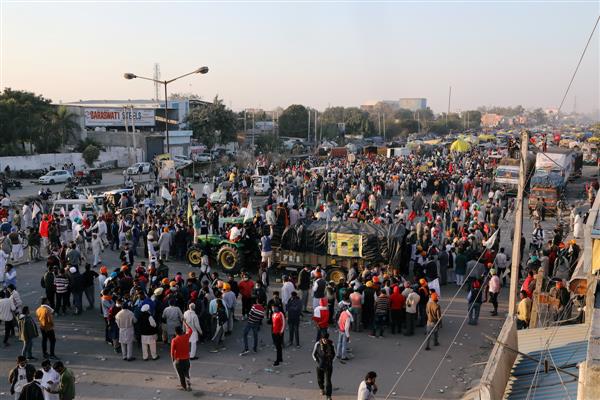
Farmers camping at Delhi’s borders in protest against three new agriculture laws of the Centre on Thursday said one side of the highway at the Singhu border will be cleared for giving passage to vehicles carrying oxygen supplies.
The decision was taken after the leaders of the Samyukt Kisan Morcha (SKM), an umbrella body of farm unions that is spearheading the agitation, met officials of the Haryana government in the evening.
“At the meeting, it was decided to remove the barricades on one side of the highway at the Singhu border to give a free passage to oxygen, ambulance and other such emergency services,” SKM leader Darshan Pal said in a statement here.
He said the protesting farmers will support the fight against the COVID-19 pandemic in every possible way and they are committed to causing the least inconvenience to the citizens.
The meeting was attended by the Sonepat superintendent of police, officials of the Chief Minister’s Office and several SKM leaders, the statement said.
Darshan Pal dismissed the allegation against the protesting farmers of obstructing oxygen supply to Delhi as “baseless”.
He alleged that the police were seen “misdirecting” the trucks carrying oxygen towards the protest sites, instead of guiding the vehicles towards the shortest route to the national capital.
The farmer leader further blamed the government for putting up barricades on the road that were obstructing a free passage of vehicles.
He said more farmers will start coming back to the protest sites from Friday.
A large convoy of protesters will be leaving for the Singhu border from Barwasni in Haryana’s Sonepat district on tractor trolleys, he added. PTI
how to increase Oxygen level in body:::and wear mask
Since the armies of India and Pakistan agreed to adhere to the ceasefire agreement in February, there has been no firing across the Line of Control (LoC) said Army chief General MM Naravane on Monday, and, regarding the standoff with China, he added that the hope is to settle issues through negotiations. Addressing a symposium organised by the Australian Army, where chiefs of Australian, Indonesia, Singaporean and Japanese armies were present, Naravane said “legacy issues and differences need to be resolved through mutual consent and dialogue and not by unilateral actions”. The comments come at a time when India and China are involved in an over 11-month long standoff in eastern Ladakh. While disengagement in the Pangong Tso region took place in February, with both sides pulling back from eyeball-to-eyeball situations, in the 11th meeting between senior military commanders on April 9, China refused to withdraw its troops from the Indian side of the Line of Actual Control (LAC) at Hot Springs and Gogra Post. At the symposium, Naravane said in his address that India has a land border of over 15,000 km, and “active and unsettled borders to our West with Pakistan and to the North and East with China, and of course there are associated challenges”. “Over time we have developed various mechanisms to address these challenges and move forward,” he said, adding that “progress and development of any nation and the well-being of its citizenry are, to a large extent, contingent on peace and tranquillity on the borders”. Regarding Pakistan, he said, “we have recently entered into a ceasefire understanding” with their Army in February “and since then there has been no exchange of fire on an otherwise active Line of Control”. This, he stated, “bodes well for the future”. “With China too, there have been positive developments along the Line of Actual Control, an area where both countries have differing perceptions on the alignment of the land borders. This has led to disengagement of troops in eastern Ladakh. We have recently concluded the 11th round of Corps Commander level talks between the two armies and we hope to settle our other border through further negotiations.” India, he said, “looks to maintain peace and harmony with all its neighbours and in the region”. “Maintenance of peace and tranquillity requires joint efforts. All nations need to come together to uphold rules-based order, respect international laws and norms and develop mutual respect for each other.” He also mentioned that India has “strong historical and cultural linkages” with Nepal and Bhutan, and with Bangladesh, he said, “our relations are anchored in shared history and common heritage” and added that both armies have “strong institutional bonding”. India’s relations with “all its neighbours are on an upward trend,” said Naravane. The Covid-19 pandemic has “exposed our vulnerability to global supply chains, forcing us to re-engineer our dependencies and work towards self-reliance,” the Army Chief commented, and said for India, it has “become a strategic imperative”. “The changing character of war is throwing up new challenges for the armed forces the world over. Our own region is witness, that wars are no longer confined to the customary hard core kinetics but being increasingly contested in the ambiguous grey zone.” Naravane said. “Geo-strategic spaces are being constricted and geo-strategic realities are being altered without physical battles. Conflicts are also steadily moving to the new domains of space, cyber and informatics… The stretching of domains has made the physical boundaries meaningless. Leveraging technology has become a key determinant in future wars.” Indian Army, its chief asserted, is “on the path of modernization towards a technology-oriented Army” and mentioned that niche technologies “need to be acquired to remain and capable to face future threats”.
HOW CHINA IS USING INDIA’S PANDEMIC CRISIS TO KEEP BORDER STANDOFF ALIVE
No movement and no pullback has taken place at the border and after a promising start, talks between the countries have stalled For six days, India has reported over 200 new infections daily. But New Delhi is unable to take its eyes off the border with China. China is using the pandemic in India to keep the border stand-off intact and to accept the status quo. Essentially, China is walking away from disengagement. No movement and no pullback has taken place at the border and after a promising start, talks between the countries have stalled. China seems unwilling to discuss disengagement any further. In February this year, both India and China had agreed to disengage at Pangong Tso – the long and narrow lake in Ladakh which was one of the flash points in the standoff. Disengagement was completed in 10 days after both militaries moved back to their respective sides. A four kilometre long buffer zone was created, and patrols to the Line of Actual Control were suspended temporarily. What About The Other Flash Points? India and China agreed to keep talking about other flash points in February. But now China refuses to disengage further. Hot Springs, Gogra Post and Depsang Plains are the other flash points. Reports say China had earlier agreed to pull back troops from here. But not anymore. According to one report, China still has platoon level strength with vehicles in at least two areas – Hot Springs and the Gogra Post. A platoon is a military unit that is usually made up of two or more squads of troops. Reports say China has at least 60 soldiers in the Gogra-Hot Springs area. So far, India and China have held 11 rounds of military level talks. The last one happened on April 9. It is believed that during that round China behaved as if it is no longer interested in discussing the border dispute. Reports say the Chinese told the Indian side that they should “be happy with what has been achieved”. What Triggered This Shift? Firstly, China reportedly wanted both sides to first de-escalate, then disengage. China wanted a pull back of additional troops first, removal of the back-up, and then disengagement at the frontline. India refused because this situation would have worked in China’s favour. It can move its troops much faster than India, for it has better infrastructure on the Chinese side. If both sides pull back additional troops and there’s another conflict, Chinese support will reach much faster than Indian support, weakening India’s border defences. One analyst believes that tensions can escalate, for the lack of progress in talks, the arrival of summer, and the US drive to strengthen ties with China’s neighbours. China could already be escalating border deployments. Reports say, China has deployed a long range rocket launcher as “a deterrent to India”. An advanced system, it is deployed 17,000 feet above sea level in Xinjiang, which shares a border with India. China has not only deployed a rocket launcher close to the border, it also conducting drills. India is still looking for a diplomatic solution but it may not be easy. The last round of talks ended without a joint statement. Since September last year, India and China have been releasing joint statements to play up the prospect of disengagement. This time, they did not. Instead, New Delhi did some straight talking. On Monday, External Affairs Minister S Jaishankar spoke about the standoff and said that China brought enormous force to the border without provocations. He added that India must “have a return to peace and tranquillity on border, and there are no two ways about it”.
New Delhi: Indian Air Force Chief, Rakesh Bhadauria will flag off 6 Rafale fighters from the Merignac-Bordeaux airbase in France today. The IAF chief visited France on April 20 and will be in the country until April 23 during which he will meet with his counterpart Philippe Lavigne. CAS will hold meetings and discussions with senior military leadership of France and visit operational facilities and airbases. The visit comes after Gen Philippe Lavigne, Chief of Staff, French Air and Space Force (FASF) visited India in February 2020. The two Air Forces have seen significant operational interaction in the recent past. IAF and FASF engage in the bilateral air exercise series ‘Garuda’, as well as hop exercises, the last being Ex Desert Knight 21 held at Air Force Station Jodhpur in January 2021. IAF and FASF also participated in Ex Desert Flag hosted by UAE Air Force along with other friendly countries in March 2021. In all the IAF has ordered 36 warplanes at a cost of Rs 59,000 crore. India had ordered the jets from France in September 2016 under a government to government deal. The additional jets will bolster the capabilities of the Golden Arrows Squadron of the Indian Air Force. This is crucial as it comes at a time when the tensions with China have been escalated along the Line of Actual Control at eastern Ladakh. By April 2021, 16 omni role Rafale jets will be inducted into the Golden Arrows Squadron. On September 10, five French-made multirole Rafale fighter jets were inducted into the Indian Air Force in a glittering ceremony at the Ambala air force base. Nine more would arrive in April and this would take the total number of fighters handed over to the Indian Air Force to 23. While the Golden Arrows Squadron would be complete with 18 fighters, the remaining three would be sent to the Hashimara airbase in north Bengal’s Alipurduar. This would aid in countering the Chinese threat in the eastern front.
DRDO reopens makeshift Covid hospital in Delhi, 5 other facilities to come up across India
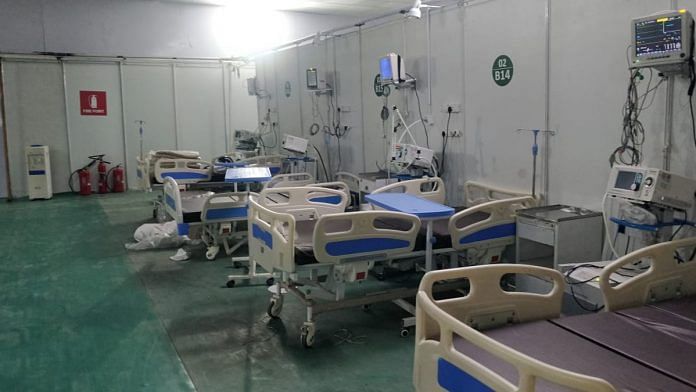
Sardar Vallabhbhai Patel Covid hospital in Delhi, set up by DRDO | By special arrangementText Size: A- A+
New Delhi: With the aggressive second wave of the Covid-19 pandemic crippling health infrastructures across the country, the defence establishment has stepped up aid efforts by setting up makeshift hospitals in various cities.
One such makeshift facility was set up by the Defence Research and Development Organisation (DRDO) in Delhi that began operations Monday. The 500-bed Sardar Vallabhbhai Patel Covid hospital is being manned by a group of 40 professionals from the Armed Forces Medical Service (AFMS) and two doctors from the Central Armed Police Forces (CAPF).https://88dcb069b3808193d43e784d110a7f3b.safeframe.googlesyndication.com/safeframe/1-0-38/html/container.html
Once the hospital, which is situated in the Delhi Cantonment area, began operations there was a massive rush with a number of patients and ambulances turning up at the facility.
DRDO spokesperson Dr Narendra Arya said that while the facility has 250 beds at the moment, it will be expanded to 500 by Thursday.
“Every bed is an ICU-Ventilator one. Only patients requiring ICU or ventilator facility are being admitted. I would request people only with dire need to come to the facility as those who can manage with house care will not be admitted,” he told ThePrint. More beds can be added by DRDO at the facility in the future depending on the situation.
Besides the Delhi hospital, the DRDO is working on setting up three similar facilities in Gujarat, Uttar Pradesh and Bihar.
Furthermore, the state-run Hindustan Aeronautics Limited (HAL) is also setting up two Covid facilities in UP’s Lucknow and Nashik in Maharashtra. HAL has already constructed a facility for the Karnataka government in Bengaluru.
The Sardar Vallabhbhai Patel Covid hospital in Delhi was first built in a record time of 12 days by the DRDO last year after a spike in cases. The facility was then dismantled in February this year after the number of cases came down.
However, with the surge in cases due to the second wave of the pandemic, the central government asked the DRDO to re-open the facility, which was done within six days.
Furthermore, unlike last year when only 250 ICU beds were available at the temporary hospital, this time all beds will cater to those who require critical care.
DRDO officials said the facility is also equipped with centralised air conditioning, fitted with proper filters to contain the spread of the virus.
There are also separate blocks for patients and doctors, and accommodation for the medical team.
The facility also has an administrative block complete with doctors’ rooms, a basic lab and pharmacy, a dedicated pantry for patients, an area catering to visitors or attendants and a reception as well.
It is secured with security staff, closed-circuit television (CCTV) surveillance and access control systems.
The hospital is also equipped with an integrated fire safety and control system, officials said, adding that environmental safety and waste disposal processes have been built into the design of operations, as well.
According to sources in the defence establishment, one Covid temporary hospital will also come up in Lucknow by the end of this week. It will be set up by DRDO and will have a capacity of 600 beds. This hospital is different from the one being constructed by HAL.
While the organisation’s initial plan was to set up two separate makeshift hospitals in Lucknow, it has now been decided that one large facility will be built instead.
The cost of constructing the hospital in Lucknow will be borne by the DRDO. It will also provide beds and oxygen to the hospital, which will have all the facilities for the treatment of Covid patients.
Similarly, two hospitals by DRDO will also come up in Gujarat and in Bihar.
A 900-bed facility is being set up in Ahmedabad at the Gujarat University Convention Centre. DRDO will equip the hospital with all the amenities to effectively treat Covid patients.
The hospital will be run by doctors and other personnel of the CAPF and is expected to be operational in a week’s time.
The organisation is also working on establishing a 500-bed Covid hospital in Patna. A DRDO team has already reached Patna to oversee the preparations to operationalise the hospital for treatment of Covid patients.
The hospital, with 125 ICU beds, was built by the DRDO in August last year but was shut down later after there was a dip in cases.
Hospitals run by all 63 Cantonment Boards also asked to accommodate Cantt residents and those from outside approaching them for treatment.
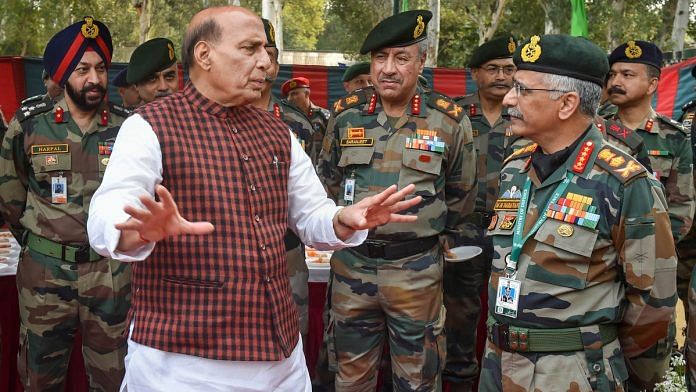
ile photo of Defence Minister Rajnath Singh interacts with Army Chief General Manoj Mukund Naravane in Delhi | PTIText Size: A- A+
New Delhi: Defence Minister Rajnath Singh has asked the armed forces to leverage whatever they can from their resources and help the civil administration fight the fresh Covid-19 wave that has brought the country’s health system under severe stress, ThePrint has learnt.
Sources in the defence and security establishment said the minister met Chief of the Army Staff Gen. M.M. Naravane and Defence Secretary Ajay Kumar Monday and discussed various initiatives that could be taken by the armed forces, besides the Defence Research and Development Organisation (DRDO) and state-run defence public sector undertakings.
According to one of the decisions taken during the meeting, the sources said, the top Army officer in a state capital would call on the chief minister and offer to take in civilians at the hospitals run by the force, wherever possible.
“The military hospitals are for the armed forces. There are still some beds that could cater to the civilians in this mega crisis situation. The force will decide how many civilians can be taken in at their Covid facilities,” a source said.
The top officers will also seek to know what else the state government is expecting and how they can be of any help if possible.
Also, all the 63 Cantonment Boards in the country have been told that hospitals run by them have to accommodate Cantonment residents and those from outside approaching them for treatment, in coordination with district authorities or nodal officers for Covid.
Singh also undertook another review meeting Tuesday, in which it was decided that retired military medical personnel will be contacted to pitch in and help the civil administration.
Besides the defence secretary and the Army chief, Chief of Defence Staff General Bipin Rawat; Navy chief Admiral Karambir Singh; Director General of the Armed Forces Medical Services (AFMS) Surg Vice Admiral Rajat Datta; Secretary (Defence Production) Raj Kumar, and Chairman, Defence Research and Development Organisation (DRDO) Dr G. Satheesh Reddy and other senior civil and military officers attended the meeting via video conferencing.
It is learnt that various state governments have approached the Ministry of Defence asking for makeshift hospitals to be set up on the lines of how the DRDO has done it in the national capital.
ThePrint had reported that the DRDO and state-run Hindustan Aeronautics Limited (HAL) are in the process of setting up more such hospitals in states such as Uttar Pradesh, Gujarat, Bihar and Maharashtra.
“This is not an easy task. There is a requirement of land, infrastructure and money besides medical staff to man these hospitals. The defence is trying to create more beds for those patients who need critical intensive care. Based on requests, the DRDO may set up more makeshift facilities,” another source said.
“The whole idea is to leverage the resources available so that the defence establishment can work along with the civilian establishment to counter this challenge,” said one of the sources cited above.
Incidentally, former Army chief Gen. V.P. Malik had in a tweet on 18 April said the nation was at war as more Indians have died in 24 hours than the entire Kargil battle.
Former Northern Army commander Lt Gen. (Retd) D.S. Hooda said the nation was in a “full blown” crisis and suggested some measures.
Retired military medical personnel to pitch in
Singh was also informed by DRDO chief Dr G. Satheesh Reddy that based on the on-board oxygen generation technology developed for LCA Tejas, a 1000 litre/minute capacity oxygen generation plant technology has been given to the industry and the Uttar Pradesh government has placed order of five such plants with the industry.
Dr Reddy informed that more plants can be supplied by the industry to cater to the hospital requirements.
He further said SpO2 (Blood Oxygen Saturation) based supplemental oxygen delivery system developed for soldiers posted at extreme high-altitude areas can be used for Covid-19 patients as their conditions become similar.
The product will be available soon in the market from the industry as per technology provided by DRDO, a statement by the Defence Ministry said.
Chinese PLA troops march back from the Pangong Tso area in eastern Ladakh | Indian Army | Representational imageText Size: A- A+
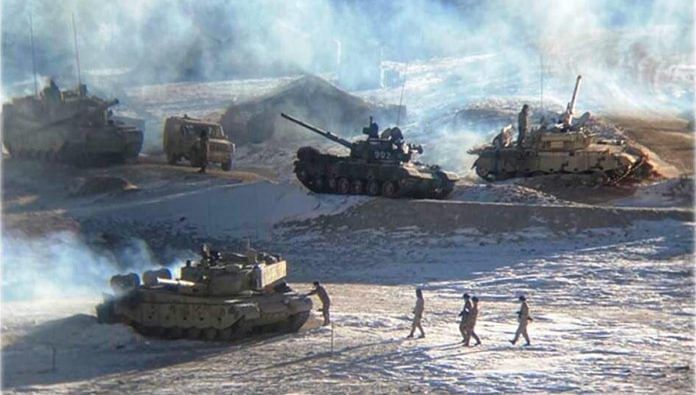
New Delhi: Even as China drags its feet on further disengagement at four friction points in eastern Ladakh, its People’s Liberation Army (PLA) said it has deployed the latest range of advanced rocket launchers with an artillery brigade in the western theatre command, which looks after the borders with India.
A front-page article published in PLA Daily, Chinese army’s official newspaper, Monday said that the brigade is located 5,200m above sea level in the Xinjiang Uighur Autonomous Region (XUAR).
Though this is the first time the PLA has confirmed presence of rocket launchers, the report did not give the type or firing range of the weapon. But it said it was a system with a long-range rocket with precision strike capability and had entered service in 2019.
Referring to the PLA Daily report, the South China Morning Post (SCMP) Tuesday said the move by the PLA is aimed at reinforcing China’s border defence and acting as a deterrent to India.
“An artillery brigade stationed 5,200 metres (17,000 feet) above sea level in Xinjiang military district has intensified its drills using a rocket system during full-wing combat-ready training,” the SCMP said.
The PLA Daily report comes at a time when China changed its stand on further disengagement during the 11th Corps Commander level talks, as reported by ThePrint.
After the surprise breakthrough in February that saw both sides pulling troops and equipment back from the brink in Pangong Tso, China now wants the two armies to de-escalate or withdraw additional troops brought in as back-up to those in the front.
India, however, is insisting on disengagement from the remaining friction areas along the disputed Himalayan frontier first.
Sources in the Indian defence establishment said they are aware of the PLA report, but did not comment further.
Military commentator Song Zhongping, a former instructor in the PLA’s Artillery Corps, the predecessor of Rocket Force, told the SCMP that the new weapon system should be a long-range rocket launcher that can carry multiple 300mm [12-inch] or even bigger rockets with more than 100km of firing range.
“Only a long-range MLRS is powerful enough to act as a deterrent to India, as the Indian troops are also stepping up military deployment along the borders,” he was quoted as saying.
Macau-based military observer Antony Wong Tong said the long-range MLRS mentioned by PLA Daily was likely to be the most advanced PHL-16, or the Type PCL-191 which debuted in the National Day Parade in 2019.