



Sanjha Morcha

What’s New

Click the heading to open detailed news

Current Events :

web counter

Print Media Reproduced Defence Related News

How an Indian Army officer ensured a slain Pakistani soldier’s feats in 1971 didn’t go unnoticed

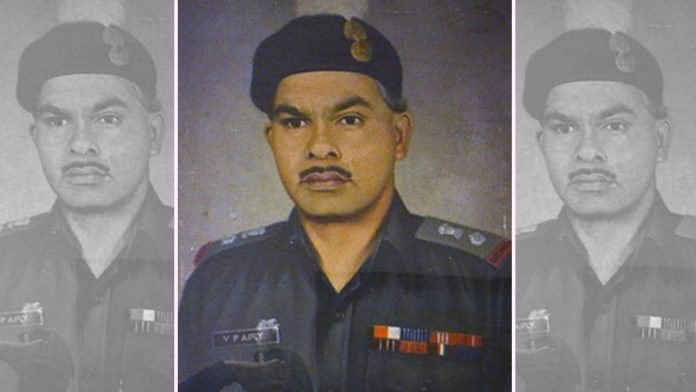
Lt General Ved Prakash Airy was a Lt Colonel at the time of the 1971 war. He died in 2007 | By special arrangement

t General Ved Prakash Airy was a Lt Colonel at the time of the 1971 war. He died in 2007 | By special arrangementText Size: A- A+

New Delhi: When the body of a Pakistani officer was found in the village of Jarpal near the western border a day after the 1971 war ended, rigor mortis had frozen his arms outstretched, in the same position that he had held his sten gun. It was evident he had been rearing to charge ahead right until the moment he died.

It was a moment that struck the Indian Army commanding officer whose battalion had fought and defeated the Pakistani soldier — identified as commanding officer Lt Colonel Mohd Akram Raja — and his unit in a battle lasting several days. It was a moment the Indian officer, the then Lt Colonel Ved Prakash Airy, decided won’t go unrecognised.

So, when Raja’s body was returned to Pakistan on 18 December 1971, Airy sent a note inside his casket. Titled ‘Tribute to a Soldier’, the note described how Raja had died a “real soldier’s death”. “Our hats off to him,” Airy wrote.

The note struck a chord back in the soldier’s country. In the subsequent days, Raja was honoured with the Hilal-i-Jur’at, Pakistan’s second highest military honour.

Over three decades later, Airy’s gesture came back to him in an unexpected ft from the slainfficer’s son. 

The story of Raja and Airy, who went on to become a Lt General, is the kind that emerges from the destruction of war to enter military lore as a testament to soldiers’ honour. In the year that marks the golden jubilee of the 1971 Bangladesh Liberation war, ThePrint brings you this account of two officers from rival countries who never met each other but became a part of each other’s story.


Also Read: 5 heroes of 1971 Bangladesh Liberation War who led India to decisive win over Pakistan


The note 

During the 1971 war, then Lt Col Ved Prakash Airy was charged with commanding a battalion of the Grenadiers in the battles of Bhairo Nath and Basantar River in the Shakargarh Sector on the border with Pakistan.

Airy, who won a Maha Vir Chakra for his role in the battles, and his battalion captured enemy positions after a fierce fight and held on to them despite massive counter-attacks. 

One such counter-attack, in village Jarpal, was led by Mohd Akram Raja, who was commanding 35 Frontier Force Regiment (FFR) of Pakistan Army, according to the note written by Airy.
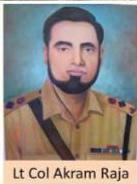
Lt Col. Mohd Akram Raja | By special arrangement

“He was personally leading the attack by being in the front line of assault when he was hit by an MMG (medium machine gun) burst from our position right on the face, killing him on the spot,” his note said.

His body, the note said, was recovered on 17 December 1971, after it was brought to the notice of Indian soldiers by a prisoner of war (PoW) who also helped them identify the officer.

“We found both his arms frozen after death in the position in which he was holding his sten gun, which indicates his determination to get ahead,” he wrote. 

“In this action, Lt. Col Mohd Akram Raja displayed courage, determination and personal bravery of the highest order in keeping with the traditions of the soldiers. This heroic deed of Lt Col. Raja, a brave soldier, should not go unnoticed,” he wrote. 

Speaking to ThePrint, Airy’s daughter Ritu A. Pandit said the note was sent back with Raja’s body. The body, she added, was returned with full military honours — his body was placed in a casket and his ranks were packed into a small silver box. 

Decades later, she said, Lt Gen. Airy received a surprise when his unit went on a United Nations Peacekeeping mission in Lebanon in 2006. During a function to mark ‘Jarpal Day’, to commemorate the 1971 battle, portraits of both commanding officers were exchanged, added Pandit. The portraits, she said, are displayed at two Officers Mess premises in both countries.

But what truly touched her father, Pandit added, was a personal memento sent to him by Raja’s son. “It was his most treasured gift before he died,” she said. 

A soldier’s exploits

Lt Gen. Airy was a soldier who courted much respect for his exploits.

“With utter disregard for his personal safety, under heavy enemy shelling and small arms fire, he went from trench to trench motivating his men. Due to his personal example and bold leadership his battalion remained steadfast and resolute,” reads his Maha Vir Chakra citation.

Pandit said her father had been popular among his men for a stick he carried — called  “doga” — and a white balaclava he always wore. 

Recalling another incident from the 1971 war, she said her father had helped fulfil Pakistani PoWs’ desire to watch Pakeezah after the declaration of the ceasefire and surrender by the Pakistan Army. 

“My father managed to arrange the screening of the film with a makeshift projector and the soldiers managed to watch it,” Pandit said.

There was also a time during the war, she added, when her father had a close shave with death.

“Bullets had scraped his leg, his jacket had a big gaping hole. But my father told his men to be sure that none of them turns back to leave during the war,” she said.

Airy, she added, would tell her how depressing it would be to see his own men dying, “the dark and the smoke making it difficult to locate each other and yet they would be carrying on”.

It was his unit, she said, that helped Airy recover from the debilitating impact of a stroke he suffered in 2006. The stroke caused Airy to lose his memory partially. 

“But when some of his men came to meet him, he was able to remember all the incidents of the war that were narrated to him, even though he couldn’t recall an incident that would have happened two months ago,” she added. 

His team, she said, played a critical role in bringing him out of the “semi-conscious state that the stroke left him with”.

“His unit was dear to him. For him, it was like a family reunion whenever they met him,” she added.

Airy died in 2007. Both his sons are Major Generals in the Army. One of them retired earlier this year. 

Edited by Sunanda Ranjan


Also Read: ‘Didn’t know I’d live to get this’ — 1971 PoW, Vir Chakra awardee receives Vijay Mashaal torch


Like the private armies of the politicians

Today, MLAs bring their own team of government officials, especially policemen of different ranks, to their jurisdiction, by right. They also regularly use, misuse, discard and abuse policemen of various ranks depending on their need in blatant disregard of rules and regulations, propriety and conscience. No evidence is left behind as all dirty paperwork is done by the officials and policemen, who are caught finally, if at all. The same will most likely happen in the Mumbai case.

Like the private armies of the politicians

Unsavoury details: The Waze case points to an unholy nexus between the police and politicians. PTI

BL Vohra

Former DGP, Tripura

Why are state police forces now like the private armies of politicians in power in India? Why is this unholy nexus there between the police and the politicians? We have come to such a pass that the richest businessman of India is being threatened by this unholy nexus in Mumbai due to which the case has drawn so much media attention. Of course, assistant police inspector Sachin Waze is a foot soldier who was backed by the powers that be. However, this nexus is not confined to Mumbai alone. It’s almost everywhere in India. Kolkata, where the police work at the behest of those in power, going to the extent of confronting the CBI sometime back, Rajasthan where illegal phone tapping is done or UP where cases under sedition are registered without solid grounds in many instances, are also such examples. And this has been happening over the years in the regimes of all political parties in our country. The police are politicised and criminalised with the result that the common man is not getting justice which is his right. People at large are disgusted with this nexus and want answers and solutions.

For this, history will have to be gone through first. The British gave us colonial police which used brute force to keep itself in power. The Police Act, 1861, says that the police have to report to the state. Our new rulers at the time of independence made no effort to change the force, from the ruler’s police into the police service for the common man. Even today, 74 years after independence, we are governed basically by the same 160-year-old Police Act.

Former Prime Minister Atal Bihari Vajpayee explained it well at a gathering in which I was present— that initially, in the first two decades or so after Independence, politics was generally pure. In the next generation of politicians, some of them started taking the help of criminals who had money and muscle power to make them win and remain in power. In the third phase, the following generation of criminals became smarter. They thought that why help others to come to power, why not themselves be in power? They succeeded and today we have around 40% MLAs and MPs with a criminal record, a figure which has grown steadily in each election, and they have a bright future also.

In this endeavour, they needed the help of the police badly. Fortunately for them, the structure of the police in the country helped them. They realised that the police were under their control as it was answerable to the politicians in power and they grabbed this opportunity with both hands. They ensured that the colonial police system remains reporting to the political bosses. They went not one, but many steps further also. They took control of the recruitment, postings and transfers, punishments and rewards, dictating against whom to take action or not etc. By formal orders of various state governments, these powers were taken over by the state governments systemically.

Today, MLAs bring their own team of government officials, especially policemen of different ranks, to their jurisdiction, by right. Insulting policemen in public or hounding them are commonplace. They also regularly use, misuse, discard and abuse policemen of various ranks depending on their need in blatant disregard of rules and regulations, propriety and conscience. The beauty is that they leave no evidence behind as they get all the dirty paperwork done by the officials and policemen, who are caught finally, if at all. Same will happen most likely in the present controversial Mumbai case.

What has been the response of the police? Where it is asked to bend, it crawls, not infrequently, because their life in all respects is in control of the political masters. So, instead of showing the rule and the law book to their political masters, they have joined hands with them so that they are not only safe, but flourish themselves also in the process becoming criminals in uniform. Extortions, fake encounters and illegalities have become their norm. On the other hand, we have also seen images in public of policemen in uniform touching the feet of the politicians. The example of standing up to the politicians as a rule by the policemen has to be set by the police leadership. There has been quite a bit of failure on this account, though there still are outstanding examples of officers standing up to the masters. The legitimate question is why then is the leadership failing? Well, the recruitment, training and postings of the officers are the areas to be looked into which can be put in two words, ‘police reforms’. Now this is where the problem lies. The politicians, irrespective of whichever party they belong to, are one unit as far as retaining control over the police is concerned, as it serves their purpose. So, they will never let a law pass or a procedure implemented, changing the present system. They haven’t even bothered about the orders of the Supreme Court on police reforms passed in 2006, circumventing those smartly.

What else is the instrument left with the public to bring police reforms and solve its problems and have police to serve them? A public agitation like the one we had for the freedom of India is the need of the hour now because the cry of the police fraternity supported by many well-meaning people is not having any effect.

The police have to become accountable to the law, the Constitution and to Parliament, and not to the political masters. It is necessary if India has to fast become a five trillion dollar economy for which a safe and secure environment is required for all citizens and investors. Besides, it is essential to give to every Indian, especially the poor, the backward, the underprivileged, the weak and the women, justice, safety and security. But will such an agitation happen on a large scale? We can only pray.


NCC cadets felicitated

NCC cadets felicitated

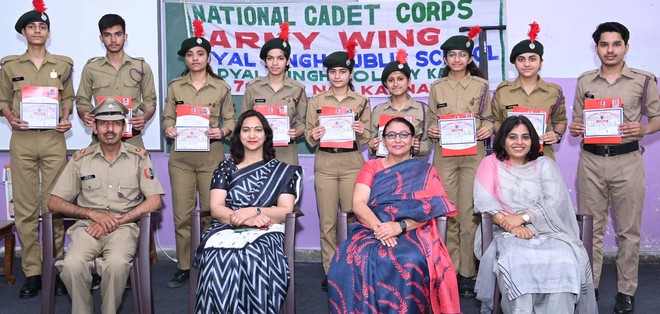
A programme to felicitate NCC cadets was organised at Dyal Singh Public School in Dyal Singh Colony, Karnal.

Karnal: A programme to felicitate NCC cadets was organised at Dyal Singh Public School in Dyal Singh Colony by Haryana Battalion NCC, Karnal. Cadets were honoured with ‘A’ certificates. Ramesh Lather, academic adviser of the school, Sushma Devgun, principal, distributed the certificates. Lather and Devgun encouraged students and said that NCC cadets play an important role in nation building and during natural disasters. Associate NCC officer Kewal Krishan said cadets Vidur Sharma, Akagnsha, Gungun, Himani, Khushi Verma, Meenakshi, Sidhi Narula, Suhana, Aadit Moga, Anshul Sharma, and Kartik were felicitated.

4 students selected for internship

Hisar: Two students of the department of printing and two students of department of computer science engineering have been selected for the last semester internship in the on-campus internship drive of Gurugram-based UrPrinters.com Company and e-pool campus placement drive of Chandigarh-based Signity Solutions Pvt. Ltd. respectively. The camp was organised by the training and placement cell of the Guru Jambheshwar University of Science and Technology, Hisar. Prof Tankeshwar Kumar, Vice-Chancellor, Dr Avnesh Verma, Registrar, congratulated the selected students Dhruv Grover and Ganapuram Vamshi Krishna of BTech printing 2021 batch and Himanshu Vats and Renu Poonia of BTech CSE 2021.

Flower festival at MDU

Rohtak: The captivating flower festival ‘Rang Bahar’ celebrating spring was organised on Sunday at Maharshi Dayanand University (MDU). Vice-Chancellor Prof Rajbir Singh inaugurated the festival with a clarion call to associate with nature, and support environmental causes. MDU VC said India had a rich culture of celebrating nature. The cultural team from the department of music sang songs heralding spring and Holi. Flower shows, selfie competition, photography contest, rangoli, etc were organised as part of Rang Bahar.

Webinar on science and technology

Kurukshetra: Faculty of sciences, Markanda National College, organised a national webinar on the topic, ‘new frontiers in Science and Technology’. Dr Ashok Kumar, principal of the College, emphasised on new boundaries of science and technology for the development of human race in the world. Dr Kuldeep Singh Dhindsa highlighted that in current pandemic situation the capacity building and training of human resource in science and technology was the need of the hour. He elaborated that research and innovation was being given more prominence. He stressed on creation of innovative minds with critical thinking and problem-solving approach. The webinar was attended by all the teaching and non-teaching staff members of the college along with more than 108 participants from five states, two UTs, 42 institutions, six universities and 2 NITs.

Book fair at IG university

Rewari: Indira Gandhi University (IGU), Meerpur, organised a book fair, wherein the publishers and distributors across the country participated. The fair was inaugurated by Vice Chancellor Prof SK Gakhar who said book played an important role in the lives of students. Library in-charge Aditi Sharma said this time the book publications had been invited and allotted place without any registration fees.

Workshop on mathematical tools

Mahendragarh: Central University of Haryana (CUH) organised a week-long online workshop focusing on mathematical and statistical tools wherein expert teachers working in the field of mathematics and statistics provided information about various useful tools used in research and practical use in science, technology, management, humanities, education and other study related areas. Vice Chancellor, Prof RC Kuhad, said data collection and evaluation was crucial in research to gain appropriate conclusions.



Pak officials in Delhi for Indus water talks

Pak officials in Delhi for Indus water talks

Indus Water Commissioner Pradeep Saxena (R) with Pakistani counterpart Muhammad Meher Ali Shah in New Delhi. PTI

Tribune News Service

New Delhi, March 22

A Pakistani delegation arrived here today for a meeting of the Indus Water Commissioners on March 23-24 to discuss routine issues as well as New Delhi’s plans for a series of dams on the Chenab.

On agenda…

  • Pakistan objections on the designs of Pakal Dul and Lower Kalnai hydroelectric plants
  • Supply of information on new Indian projects on the western rivers

This will be the first meeting in over two years as also the first after the reorganisation of J&K and Ladakh into separate UTs and PM Narendra Modi’s announcement of several hydel projects in Ladakh.

The Pakistan team will be led by its Commissioner for Indus Waters Syed Muhammad Meher Ali Shah and the Indian delegation by Indus Commissioner Pradeep Kumar Saxena.

Pakistan fears the dams will give India excessive ability to block the flow of the river, giving it strategic leverage during political tension or war. The World Bank has often cleared India-built dams after asking for minor adjustments to account for Pakistani concerns.

The meeting is part of a graded thaw in India-Pakistan ties that began with last month’s joint ceasefire announcement.


Youth pay tributes to martyrs

To leave for Delhi today to observe martyrdom day

Youth pay tributes to martyrs

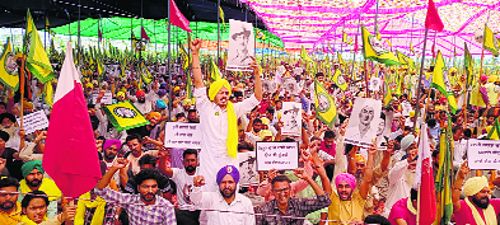
People attend a conference on a call given by farmer unions in Sangrur on Sunday. Tribune photo

Sangrur, March 21

On a call of the BKU Ugrahan and the Punjab Khet Mazdoor Union (PKMU), a massive gathering of youngsters, including thousands of girls, paid tributes to Bhagat Singh, Rajguru and Sukhdev during a youth conference in Sunam today. They also pledged to fight against farm laws.

“We declare that Basanti convoys of the youth will stand in frontlines in struggle against the farm laws and the corporate world. We will carry on the spirit of our martyrs against anti-people decisions of the governments,” said Gurpreet Kaur Brass, a youth leader.

All leaders said the sacrifice of the martyrs was a source of inspiration for the youth till today. Despite gaining Independence, the people were still suffering from the exploitation of big corporate houses as the governments were supporting them.

Youth leader Kala Singh alleged that the Modi government brought the farm laws for the exploitation of farmers and the laws would further multiply the problems of farmers. “A huge convoy of the youth will move to Delhi on March 22 to celebrate the martyrdom day on March 23. Girls will pay tributes to the martyrs in the villages. We also appeal to make the March 26 bandh successful and will also organise flag marches on March 24 and 25,” said another youth leader Ajay Pal Singh Ghudda.

BKU Ugrahan state general secretary Sukhdev Singh Kokri Kalan expressed satisfaction over the youth’s participation in conference.

“Some forces are trying to label the farm struggle as a religious one. Today’s conference is a befitting reply to such baseless propaganda,” said Kokri Kalan. — TNS


Snowfall, landslides shut Jammu and Kashmir highway, 300 vehicles stranded

The minimum temperature in Jammu city settled at 14.9 degrees Celsius

Snowfall, landslides shut Jammu and Kashmir highway, 300 vehicles stranded

Photo for representation only. — PTI

Banihal/Jammu, March 23

The Jammu-Srinagar national highway was closed for traffic on Tuesday following snowfall in Jawahar Tunnel area and multiple landslides between Banihal and Chanderkote, officials said.

Over 300 vehicles have been stranded on both sides of the highway due to the closure.

The Jawahar Tunnel – the gateway to Kashmir – experienced snowfall this morning following which traffic was suspended between Banihal and Qazigund townships, the officials said.

They said incessant rains also lashed most parts of the highway, the only all-weather road linking Kashmir with the rest of the country, for the third day on Tuesday, triggering landslides and shooting of stones from hillocks overlooking the highway at nearly a dozen places between Banihal and Chanderkote.

Deputy Superintendent of Police Traffic (National Highway Ramban), Parul Bhardwaj said a few hundred vehicles were stranded on the highway between Nashri and Chanderkote since Monday night.

“Despite incessant rains and the lurking threat of shooting stones, the men and machinery kept the highway open and the majority of the stranded vehicles in Ramban were cleared last night itself,” he told PTI.

He said a major landslide had struck the highway overnight at Cafeteria Morh, while the road is also closed by debris at many places including Maroog, Monkey Morh, Panthiyal, Digdole, Sherbibi, Shabinbas.

Once the weather improves, all our efforts would be made to ensure early restoration of the highway, the officer said.

Officials said reports of snowfall were also received from other high altitude areas including Peer Ki Gali along Mughal Road connecting the twin districts of Rajouri and Poonch in Jammu region with Shopian in south Kashmir.

The Mughal road was closed for traffic in December and is expected to be thrown open on completion of the snow clearance operation in the first or second week of next month, they said.

They said snowfall was also recorded in the upper reaches of Ramban, Doda and Kishtwar districts, while Jammu city was lashed by overnight rains, resulting in a drop in the temperature.

The minimum temperature in Jammu city settled at 14.9 degrees Celsius against the 16.2 degrees Celsius the previous night, a spokesman of the Meteorological department said. — PTI 


Farm leaders review March 24 rally preparations

Farm leaders review March 24 rally preparations

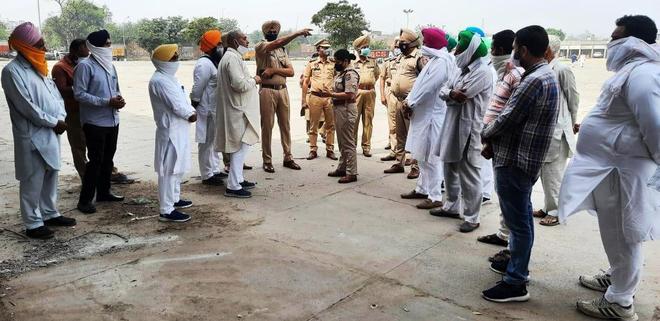
Farm union leaders and police personnel at the venue of the rally in Sirhind Mandi. Tribune photo

Our Correspondent

Fatehgarh Sahib, March 21

Local leaders of the Samyukt Kisan Morcha along with SSP Amneet Kondal and other police officials today took stock of preparations for the “Maha Kisan Mazdoor Ekta Rally” to be held at the new grain market, Sirhind Mandi, on March 24.

The rally is being organised by the Sarpanch Union, Punjab, in collaboration with Bharatiya Kisan Mazdoor Union. They discussed the security plan with police officials and farmer leaders coming from Delhi. The district administration has already granted permission for the rally.

BKU (Ugrahan) district president Prof Dharmjit Singh confirmed farm union leaders Balbir Singh Rajewal, Gurnam Singh Chaduni and Rakesh Tikait’s participation in the rally.

Sarpanch Union, Punjab, state president Gurmeet Singh Gunia Majra; and Kranti Kari Kissan Union, Bhal Majra district president, Harnek Singh said the consent of Ruldu Singh Mansa and Jagjit Singh Dalewal was awaited. He said besides farm union leaders, several artistes, including Babbu Mann, would also participate. They said farmers were holding meetings at village level to make the rally a success.

The farmer leaders said on the pretext of Covid threat the state government was trying to sabotage their rally, but the people would attend the rally en masse. They said if there was any Covid threat farmers protesting at Delhi would have been affected. They called upon all farm unions, traders, labour organisations, supporters and others to participate in large numbers, so that a strong message was conveyed to the central government against the three contentious farm laws.


Farm laws: Shun arrogance, Cong leader Deepender Hooda urges BJP

Farm laws: Shun arrogance, Cong leader Deepender Hooda urges BJP

Deepender Hooda addresses farmers at a toll plaza in Jind.

Tribune News Service

Hisar, March 21

Condemning the alleged disgraceful comments by certain BJP leaders about the protesting farmers, the Rajya Sabha MP and Congress leader Deepender Singh Hooda said the “arrogant behaviour of the BJP leaders would result in their political fall at the Centre and in Haryana”.

Addressing the farmers at the Khatkar toll plaza in Jind today, the MP said the tone and tenor of certain BJP leaders had been disgraceful vis-à-vis the agitating farmers. He said it was the unsavoury language of the ruling party leaders that seemed to have invited the wrath of the farmers.

Deepender visited the families of the two farmers who died at the Tikri border recently. Farmers Man Singh of Dindholi village and Karambir of Singhwal village had died of cardiac arrest. The MP handed over cheques for Rs 2 lakh to each of the families of the deceased and promised government job to one member of these families each.

The Congress leader said though nearly 300 farmers had died during the ongoing agitation, the farmers had not lost their patience and were keeping the stir afloat. The farmer leaders also appreciated the MP for raising the voice of the farmers in Parliament and on other platforms.


‘Lay seige to Bengaluru with tractors to protest farm laws’: Tikait

Thousands of farmers, mostly from Punjab, Haryana and western Uttar Pradesh, have been camping at the Delhi border points

'Lay seige to Bengaluru with tractors to protest farm laws': Tikait

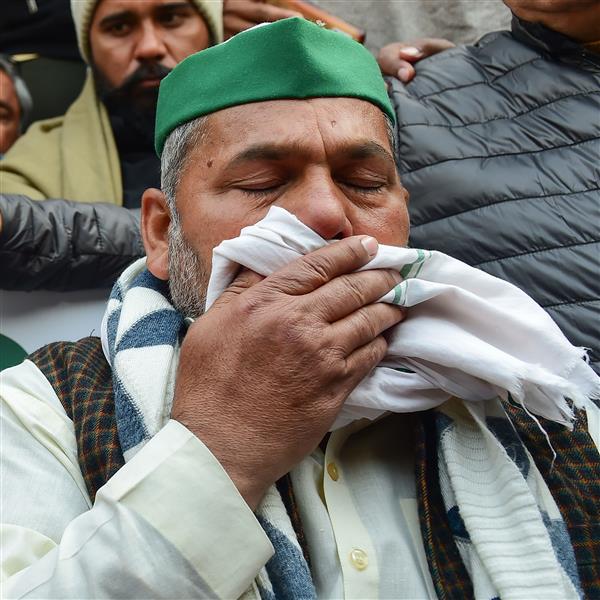
Bharatiya Kisan Union (BKU) spokesperson Rakesh Tikait at Ghazipur border during the ongoing farmers agitation against Centres farm reform laws in New Delhi. — PTI

Shivamogga, March 21

Farmer leader Rakesh Tikait has exhorted farmers of Karnataka to lay siege to Bengaluru with their tractors in protest against the three contentious farm laws passed by the Centre and convert the city to the focal point of agitation, like in Delhi.

“….you have to turn Bengaluru into Delhi. You will have to lay siege to the city from all directions,” he told a farmers’ mahapanchayat here late on Saturday.

Only tractors should be used, like in Delhi, where over 25,000 have blocked entry points to the city, he said.

Thousands of farmers, mostly from Punjab, Haryana and western Uttar Pradesh, have been camping at the Delhi border points —Singhu, Tikri and Ghazipur—for over three months, demanding the repeal of farm laws and a legal guarantee on the Minimum Support Price (MSP) for their crops.

Tikait claimed that lakhs of farmers and their families have laid siege to Delhi by agitating at the border points and said the stir would continue until the three laws are repealed.

“Unless the three laws are repealed, unless there is a law related to the MSP, you need to continue this agitation in Karnataka as well,” Tikait said.

He said though the stir was to repeal the three farm bills, there were other ‘controversial’ bills in the pipeline, aimed at grabbing farmers’ lands, forcing them to work as daily wagers in factories

“Besides these three laws, other bills pertaining to milk, electricity, seed and pesticides will also be introduced,” he said.

Tikait alleged that privatisation of banks would result in farmers who have availed of loans through Kisan Credit Cards, with land as collateral, being asked to surrender them.

“If the farmers do not have money to repay the loans, then they will take away your land,” he alleged.

The government’s target is to ensure that in the next 20 years, all the land goes to the banks and companies and the farmers become labourers, he charged.

The farmer leader, son of illustrious farmer leader Mahendra Singh Tikait, has taken the mantle of farmers’ agitation along with his brother Naresh Tikait around Delhi and has been conducting public meetings in various parts of the country against the farm bills. — PTI


Martyrs’ ideas ‘relevant’ to farm stir: Nodeep Kaur

Martyrs’ ideas ‘relevant’ to farm stir: Nodeep Kaur

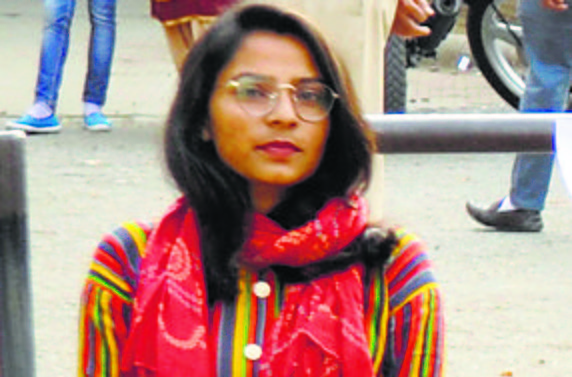
Rights activist Nodeep Kaur

Patiala, March 22

Labour rights activist Nodeep Kaur, while speaking to students at Punjabi University, Patiala, said various organisations would come together and hold a conference in Delhi to discuss the ideas of freedom fighters Bhagat Singh, Rajguru, Sukhdev and their associates, to apply them in relation to protests against the farm laws.

The event was organised by the Democratic Students’ Organisation to commemorate the martyrdom of Bhagat Singh and his associates. Accompanied by activist Shiv Kumar, she said people associated with various organisations should come together to fight the ‘fascist’ government.

She said a conference would be organised at an all-India level on March 30. “We are also meeting trade unions and are in touch with farmer unions,” she said. — TNS