Around 30 lakh retired soldiers will now be moved to a new pension payment system which promises a seamless ‘end-to end online facilitation’ — from the initiation of pension to its disbursement.
Called the ‘System for Pension Administration-Raskha (SPARSH)’, it will be implemented in phases with the first one from August 1, says the instructions issued by the office of the Principal Controller of Defence Accounts (Pensions), under the Ministry of Defence.
The project envisages ‘right payment to the right pensioner at the right time’.
The existing system to sanction and disburse pensions process has several drawbacks. The three armed forces services don’t even have a common form needed for paperwork to initiate pension for a retiring personnel. There is manual intervention in processing the pension and the lacks centralised information for addressing queries of the pensioners.
SPARSH intends to include all processes and functionalities needed for processing the pension. — TNS
Today & over the past few months I’ve received queries on whether deaths caused due to COVID would result in grant of Special Family Pension which is higher than Ordinary Family Pension. The answer is YES since any death occurring due to any infection +
IAF erupts as Chief of Defence Staff calls it Army’s ‘supporting’ force
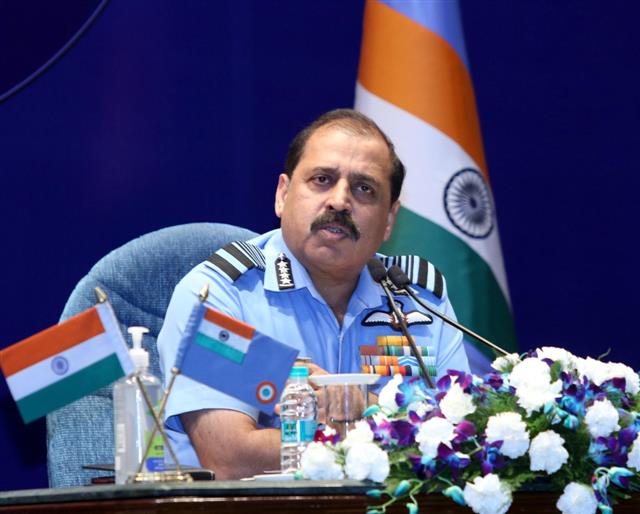
Chief of the Air Staff, R.K.S. Bhadauria, countered this, saying the IAf is not just a supporting arm but has a wider role Air Chief Marshal RKS Bhadauria. (ANI)
New Delhi: The military turf war over the “theaterisation” of the armed forces heated up on Friday. As the Air Force expressed concern on the proposals, Chief of Defence Staff Gen. Bipin Rawat on Friday called the Indian Air Force “a supporting arm” of the military, specifically the Army, just like the artillery and engineering services. However, the Chief of the Air Staff, Air Chief Marshal R.K.S. Bhadauria, countered this, saying the Air Force is not just a supporting arm but has a wider role.
“The Air Force is required to provide support to ground forces. Do not forget that the Air Force continues to remain a supporting arm to the armed forces, just as the artillery supports or engineers support the combat units in the Army,” said Gen. Rawat. “They will be a supporting arm. But they have a charter. They have an air defence charter and supporting the ground forces in times of operations. This is the basic charter which they have to understand,” he said.
Air Chief Marshal Bhadauria said “it is not a supporting role alone” that the Air Force plays. “Air power has a huge role to play in any integrated battle area. It is not an issue of support alone, and there are a whole lot of things that go into any air plan that is made,” the IAF Chief added.
Air Chief Marshal Bhadauria said the integrated theatre command is a much more complex matter. “There are issues in terms of some of the options that are being discussed,” he said, adding: “We must get it right. It is the most important reform that has an impact on warfighting.”
“There are many issues when you set up to integrate theatre commands and many of those issues should be upfront looked at very clearly. We should clearly understand how we are going to structure it. Sort out the principle and sort out important issues and thereafter implement it,” he added.
The defence ministry has set up a high-level committee which includes the three vice-chiefs of the armed forces and the Chief of the Integrated Defence Staff to thrash out differences on theatre commands among the three services and other ministries. The different theatre commands will integrate the assets of the Army, Air Force and Navy in a domain under one commander to give punitive response to any external threat.
The IAF, however, has concerns over dividing its limited number of aircraft among different commands. Air Chief Marshal Bhadauria said that every service has its own doctrine and has the best knowledge of how to employ the capabilities and capacities to get the desired results. “Whenever we have a system, which is integrated we must look at that entire doctrine. The abilities of the services must be brought in, and it must be a synergised result,” he said.
While the Indian Navy has prudently anticipated the need for essential weapon systems well in time and rapidly obtained them, the Army has been riddled with confusion over its procurement policy by Rahul Bedi New Delhi: Of India’s three armed services, the Indian Navy (IN), is undoubtedly the most efficient in its timely procurement of assorted defensive and offensive weaponry and systems to counter critical proliferating enemy threats, like the armed mini-drone attack on the Indian Air Force (IAF) base at Jammu, late last month. Anticipating threats to its surface platforms and shore installations from similar drones and unmanned aerial vehicles (UAVs) the Indian Navy had, in timeliness ordered Israeli SMASH 2000 Plus computerised fire control and electro-optic sight systems in December 2020, to augment the accuracy of rifles against small invading unmanned aircraft systems or UAS. The tender with Israel’s Smart Shooter, for an undisclosed number of these systems – each costing around Rs 10 lakh – was signed following around six months of negotiations, a record time frame in India’s defence procurement procedure that normally takes years to conclude. The delivery of the SMASH-2000 systems, which integrate target acquisition and tracking algorithms with image processing software, to pinpoint and hit their objective at ranges of up to 120m, began earlier this year, and is continuing. Initially, the systems would be installed on Kalashnikov Ak-47 assault rifles that are currently in the Indian Navy service, only to be transferred later onto licence-built Ak-203 rifles expected to eventually replace them. “The Indian Navy had anticipated the incipient danger from armed drones and undertook timely procurement of systems in advance to be able to neutralise them, when needed,” said a senior Ministry of Defence (MoD) official. Surprisingly, negotiations between Smart Shooter and the Indian Army (IA) for SMASH-2000 systems were ongoing despite it periodically facing direct danger from weaponised drones, quadcopters and even UAVs, the official said, declining to be named. The SMASH anti-drone systems are not the Indian Navy’s sole acquisition to have been executed swiftly in comparison to interminable delays in the Indian Army procurements to meet urgent operational requirements. MoD officials who have dealt with all three services over years, said that the Indian Navy had the most ‘practical, pragmatic, result-oriented and least adversarial approach to equipment acquisitions and problem resolving’. It was also the least hierarchical and more relaxed in its dealings with the ministry, guided entirely by its objectives. In 2016, for instance, the Indian Navy had acquired 177 sniper rifles, completing the entire import process in under 24 months. In stark contrast, the Indian Army had initiated its demand for similar rifles in 2009; but over years it had floated, scrapped and then re-issued several tenders for them without concluding the purchase till now. Delayed Weapons Procurement Process Presently, the Indian Army’s critical sniper rifle procurement, intended to replace the Soviet-era Dragonov SVD model that first entered Army service in the mid-1980s, has been further postponed after the rifles were placed on the MoD’s proscribed list of 209 military platforms, equipment and related systems, which are to be progressively sourced indigenously. But in the interim, in what has become routine practice of executing ‘intermediate’ equipment purchases, the Indian Army inducted 24 .338 Scorpio TGT sniper rifles from Victrix Armaments of Italy and M95 rifles from Baretta of the US in February 2019. This followed sustained sniping by the Pakistan Army across the Line of control (LoC) in Jammu and Kashmir, which continues and remains a persistent danger and threat. In enviable deviation from Army’s behaviour with regard to materiel acquisitions, the Indian Navy displayed quiet and dogged efficiency in technically evaluating, testing and eventually, in late 2016, acquiring 177 Sako TIKKA T3 TAC 7.62x51mm bolt action sniper rifles, selected over UK’s Steel Core Designs Thunderbolt SC-76 model, for its Marine Commando Special Forces (SF). The overall $2.98 million contract also included 100,000 rounds of 7.62x51mm match grade ammunition. The Indian Navy’s detailed timeline in summarily finalising this purchase too is revealing. Its request for proposal (RFP), or tender, for these rifles was issued in early 2014, followed by user trials at a firing range in New Delhi’s outskirts in late 2015. Beretta was shortlisted around March that year and price negotiations launched thereafter, which concluded successfully a few weeks later. “Once again, the Indian Navy’s sniper rifle buy was a conscious and pre-emptive procurement for rapidly emerging threats locally and overseas, following the force’s increased anti-piracy deployments in the Gulf of Aden and off India’s eastern and western seaboards,” said the MoD official, cited above. It had prudently anticipated the need for these essential weapon systems well in time and rapidly obtained them, he added. The Indian Army’s bid, on the other hand, to acquire sniper rifles, needed more urgently on the LoC, is riddled with incompetence. In 2009 it floated a tender for around 1,100 sniper rifles under the fast track procedure (FTP) which mandates a 12-month long deadline to conclude procurements. Incredulously, the RFP failed in mandating accuracy standards at a minimum 800m range and absurdly required the rifles to be fitted with a bayonet. It was totally incomprehensible to the handful of vendors to determine why the rifle, purposed for employment at a distance of over 800m, needed a bayonet that is normally used by infantry soldiers in close combat. The unclear RFP also failed to differentiate between a bolt action or semi-automatic sniper rifle model – a critical QR (qualitative requirement) determinant for sniper rifles. Expectedly, the RFP was cancelled after at least one round of trial firings in the respective vendors’ countries including Israel and a tender re-issued in September 2018 for 5,719 sniper rifles and 10.2 million rounds. This too was scrapped ten months later, in July 2019, after four leading overseas rival vendors failed to meet the Indian Army’s unrealistic qualitative requirements (QRs) and delivery schedules. Unrealistic Demands This RFP required one of four shortlisted original equipment manufacturers (OEMs) of sniper rifles from amongst PT Pindad (Indonesia), ROSONBORONEXPORT (Russia), Barrett and MSA Global (USA), to transfer technology for the .339 Lapua Magnum ammunition to India’s state-owned Ordnance Factory Board (OFB) and indigenous private sector companies to locally manufacture an additional 4.6 million rounds. Industry officials at the time said it was ‘commercially unviable by all and any standards’, for any manufacturer of such specialised ammunition to transfer technology for merely 4.6 million rounds. The proposed delivery schedule for the 5,719 rifles, which were being acquired under the ‘Buy and Make’ category of the MoD’s defence procurement procedure, 2016, too posed logistic problems. It required the shortlisted OEM to deliver the first lot of 707 rifles within six months of the contract being signed, and the remaining 4,472 supplied in batches of 1,200 units each over the next 30 months. “No sniper rifle manufacturer produces such large numbers in the time stipulated in the RFP,” said a senior official from one of the OEM’s competing for the tender. The Indian Army fails to realise that such expert weaponry is not mass produced on an industrial scale, he added, declining to be named. Of the intended 5,719 rifles, 5,507 were for the Indian Army’s special forces and the remaining 212 for the Indian Air Force’s Garud Commando force. Official sources told The Wire that the ‘amplified’ sniper rifle ammunition QRs and impractical delivery targets were of a piece with numerous other Indian Army RFPs that had been routinely criticised by successive parliamentary defence committees, as impracticable. The April 2012 Parliamentary Standing Committee on Defence, for example, revealed that as many as 41 of the Indian Army’s tenders for diverse equipment had been withdrawn or terminated due to ‘implausible’ QRs. Former defence minister Manohar Parrikar too endorsed this proclivity on the Indian military’s part in 2016, when he stated that its QRs for equipment and platforms appeared to be straight out of “Marvel comic books”. Many of the technologies demanded and conditions stipulated for varied equipment were “absurd and unrealistic,” the late defence minister had stated. Indian Navy’s Utilitarian Approach “The Indian Navy’s approach to platform, equipment and assorted systems procurement is practical, pragmatic and realistic,” said Amit Cowshish, former MoD advisor on acquisitions. They do not have an adversarial and hierarchical approach to procurements and are interested only in securing their goals within existing financial and administrative realities, he added. The Indian Navy had also taken the lead in introducing the concept of military platform and equipment leasing that is increasingly finding favour now with both the Army and the Air Force. It leased the 5,000-ton Project 670A Skat (Charlie-I) – class nuclear-powered attack submarine (SSN) INS Chakra – from Russia for three years till 1991, when such concepts were not even a concept in the country’s military. Thereafter, it once more leased the more advanced Project 971 ‘Akula’(Schuka-B) – class SSN for ten years in 2012, which too was called Chakra. This boat returned to Russia in June, some ten months before its deadline expired, because of recurring maintenance problems. Chakra will now be replaced in 2025 with a more advanced Russian SSN of the same class, following yet another lease concluded in March 2019 for $3 billion via an inter-governmental agreement or IGA. Indian Navy sources said the new SSN is also likely to be named Chakra. And during the end of 2020, the Indian Navy leased two non-weaponised General Atomics Aeronautical Systems Inc (GA-ASI) Sea Guardian medium-altitude long-endurance (MALE) UAVs from the US to monitor the Indian Ocean Region (IOR), once more ushering in a new and utilitarian concept of equipment induction by India’s military. Leased initially for a year, the UAVs were delivered to INS Rajali in Tamil Nadu, 77 km west of Chennai, and were the first piece of military equipment to be thus hired under the new provisions incorporated in the Defence Acquisition Procedure-2020 (DAP-2020) within weeks of its release last September. Thereafter, the face-off in Ladakh with China’s People’s Liberation Army, or PLA, prompted the Indian Army to lease four Israel Aerospace Industries (IAI) Heron UAVs in February under ‘emergency powers’ granted by the Union government to the military last summer after the Himalayan showdown erupted. Industry sources further said the three-year lease period for these UAVs could be extended by another 24 months. The Indian Navy was also first off the mark in issuing a request for information (RFI) in April 2021 regarding its planned lease of 24 twin-engine utility helicopters and related ground support equipment (GSE) for five years to implement assorted tasks, aiming to meet critical rotorcraft shortages for deployment on frontline warships. The immediate and practical reason behind this move was the continual postponement by the MoD of the 2017 program to indigenously source 111 twin-engine Naval Utility Helicopters (NUHs) to replace the legacy licence-built Chetak (Aerospatiale Alouette III) that were indicted into service in the 1960s. Consequently, the Indian Air Force has followed suit by opening talks with France to lease one Airbus A330 Multi-Role Tanker Transport (MRTT) aircraft for training purposes. The planned lease of the aircraft, which would be operated by the Indian Air Force, but maintained by the French Air Force, is likely to be succeeded by India leasing five additional A330 MRTTs to augment the reach and combat capability of its combat aircraft fleet. In conclusion, the Indian Navy had, over the years, successfully ‘customised’ its procurement procedures to meet its capital and revenue needs and relatively optimised its operational efficiency. “The Indian Navy’s mantra is to pragmatically and expediently come to terms with the MoD’s complex procurement procedures, whilst simultaneously remaining focused on its objectives,” said Cowshish. It appears to operationalise its experience at sea to navigate even the MoD’s choppy waters, he added. Perhaps, the Army and the Air Force could look beyond themselves and try and emulate the Navy’s successes, despite its shrinking annual outlay.
The faculty and staff of Dr BR Ambedkar State Institute of Medical Sciences, Mohali, today extended their felicitations to the medical team from Western Command that had set up facilities at the institute to deal with cases of black fungus among civilians.
The team, comprising about 25 battlefield nursing assistants (BFNAs), had been deployed at the institute for the past 35 days. With the decrease in the number of cases and relative lessening of the burden on the healthcare system, BFNAs will now resume their duties at their respective Army establishments.
Dr Bhavneet Bharti, Director-Principal of the institute, lauded the role of the BFNAs and thanked the Western Command for extending its support in dealing with the turbulent situation. Col JS Sandhu, Director, Civil Military Affairs, Western Command, said the Army would provide all possible assistance to civilian hospitals if the need arose.
Northern Army Commander Lieutenant General YK Joshi on Thursday named a gate at the Udhampur military station in J&K as ‘Nowshera’ to honour the valiant soldiers who made the supreme sacrifice in the Battle of Naushera in 1948 to protect the territorial integrity and sovereignty of the country, a defence spokesman said.
The Army Commander named one of the important gates of the Udhampur military station as ‘Nowshera’ and unveiled it. He paid rich tributes to the soldiers. — PTI
Army jawan, 5 LeT ultras killed in Pulwama gunfight
A house damaged in the encounter at Rajpora, Pulwama. PTI
Tribune News Service
New Delhi, July 2
Security forces today neutralised five Lashkar-e-Toiba (LeT) militants, including district commander Nishaz Lone, in an encounter in the Hanjin Rajpora area of Pulwama district of Jammu and Kashmir. One Army jawan was also killed in the exchange of fire.
Vijay Kumar, IGP, Kashmir, said, “District commander of proscribed terror outfit LeT Nishaz Lone and a Pakistani terrorist have been neutralised in the ongoing Pulwama encounter. A total of five terrorists have been killed in the gunfight.”
Following the information about the presence of militants in Rajora, the security forces, in a joint operation, launched a cordon and search operation, officials involved in the operation said.
“When the security forces were moving towards the targeted house after sealing all exit points, militants hiding inside opened indiscriminate fire,” an officer said, adding that subsequently it turned into an encounter.
He said in the initial exchange of fire, an Army soldier, Havaldar Kashi Rao, was injured. He later succumbed to his injuries at a hospital in the Valley. Soon after, reinforcements were rushed to the area and five militants were killed.
Kumar said the operation was a “big success” for the forces.
Ex-filtration bid in Baramulla, 4 held
Srinagar: The police on Friday arrested four youths trying to cross the LoC to enter PoK in Baramulla district. “An ex-filtration bid has been foiled with the arrest of four youths, who were heading towards the LoC to enter PoK via Gowhallan sector in Uri,” a police spokesman said. Incriminating material, including knives, was recovered from their possession, he said. A case has been registered against them. PTI
Drone strikes in Jammu airbase an act of terror: Air Chief Marshal Bhadauria
Explosives-laden drones were used to carry out attack on Jammu Air Force station on Sunday
Air Chief Marshal RKS Bhadauria. Photo credit: Twitter/IAF
New Delhi, July 2
The drone strikes in Jammu airbase was an act of terror that was aimed at targeting key military assets, Air Chief Marshal RKS Bhadauria said on Friday asserting that the Indian Air Force is in the process of bolstering its capabilities to deal with such security challenges.
The Chief of Air Staff said the IAF has carried out a detailed analysis in terms of implications of drones and other similar capabilities falling into the hands of non-state actors, and taking a series of measures to counter them.
“What happened at Jammu was essentially a terrorist act which attempted to target our assets there. The attempt failed of course. The assets were not damaged. Two explosives were used,” he said in an interactive session at a think tank.
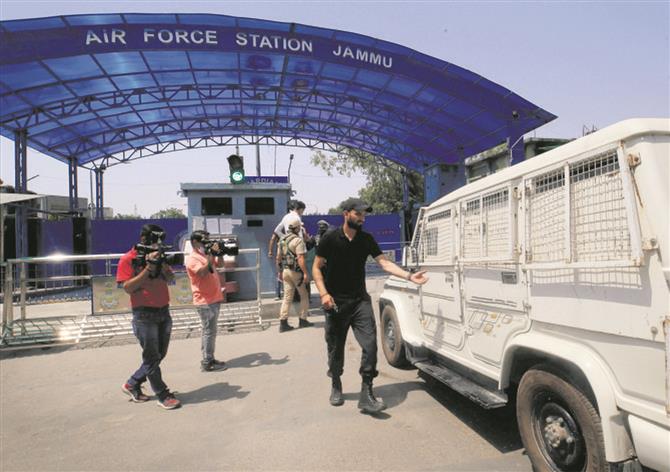
Explosives-laden drones were used to carry out an attack on the Jammu Air Force station on Sunday in the first such instance of suspected Pakistan-based terrorists deploying unmanned aerial vehicles to strike at vital military installations in India.
The Chief of Air Staff said a detailed investigation into the attacks was under way and that all sets of measures would be on the table based on the findings of the probe.
“We have gone over the subject in terms of the implications of this kind of capabilities in the hands of non-state actors and the kind of effect the armed drone capabilities would have in future conflicts,” Air Chief Marshal Bhadauria said.
He said the IAF analysed a large extent the requirements in terms of planning and required systems and infrastructure to enhance its abilities to go for “soft kill” and to have a counter-drone system.
“It should be possible to react in the short notice; detect, quickly react and be able to target it and that targeting is essentially directed energy kind of targeting in terror attack kind of a situation,” the IAF Chief said.
“All these issues have been looked at and many of the projects have already been undertaken and some of the systems were already fielded,” he said.
He said the Jammu Air Force station did not have critical assets and systems to detect drones were not fielded there.
Referring to the attacks, he said there was no visibility when the incident took place.
“Very soon we will have enough systems and we will target.. we will find ways to tackle this threat,” the Air Chief Marshal said. PTI
Cadets from 15 new countries to participate in NCC Republic Day Camp
For first time, selection process introduced for foreign cadets
Photo for representational purpose only. iStock
Vijay Mohan
Tribune News Service
Chandigarh, July 2
The National Cadet Corps (NCC) will be inviting youth delegations from 15 new countries for the Republic Day Camp—2022 celebrations, in addition to such contingents from 10 friendly countries that have regularly been attending the camp in the past.
The new countries are USA, Canada, United Kingdom, France, Japan, Oman, United Arab Emirates, Brazil, Argentina, Australia, New Zealand, Mauritius, Mozambique, Nigeria and Seychelles.
As part of its youth exchange programme, members of similar organisations in Bangladesh, Nepal, Bhutan, Russia, Kazakhstan, Singapore, Kyrgyz Republic, Sri Lanka, Maldives and Vietnam have been attending the Republic Day Camp in India while selected NCC cadets make reciprocal visits to these countries.
About 300 cadets or members of organisations similar to the NCC from these 25 countries would be in India from January 15 to 29 next year, which coincides with Azadi Ka Amrit Mahotsav’ for commemorating 75 years of Independence.
Ten cadets along with their supervisors from each country will attend important events of the Republic Day celebrations. Visits to various places of historical and cultural importance have also been planned, as part of the program and they would also be exposed to yoga and ayurveda.
For the first time, the cadets or youth participating in the Republic Day Camp from foreign countries will compete to get selected based on a process to be organised by the NCC in those countries in association with the Ministry of External Affairs, Defence Attaches in Indian Embassies overseas as well as the youth organisation of the respective country. Partner youth organisations have also been identified. The selection competition will adjudge candidates on their knowledge about India, its achievements in last 75 years, culture and people.
The Republic Day Camp is the most prestigious annual event of the NCC and provides several life-time experiences for the cadets, including the Republic Day Parade on Rajpath and the Prime Minister’s NCC Rally. They also interact with top dignitaries, including the President, Prime Minister, Defence Minister and the Service Chiefs.
Last year, 2,155 cadets, including 710 girls from all 17 NCC directorate in the country had attended the Republic Day Camp. This year however, the number had come down to about a thousand cadets due to the Covid-19 pandemic.
To ensure safety of the youth participating in the program, all protocols and safety aspects of Covid-19 will be followed at the forthcoming camp. The participating countries have also been requested that all the cadets visiting India should be fully vaccinated and have health insurance.
Drone seen over Indian Mission in Pak on eve of Jammu attack, Delhi protests
A drone was spotted hovering over a late-evening get-together on the Indian High Commission premises in Islamabad on June 26, a day before explosives-laden drones were used to carry out an attack on the Jammu Air Force station, the Ministry of External Affairs said on Friday.
Lodging a strong protest, India has asked Pakistan to investigate the incident. “We have taken up the matter officially with the Pakistan government and expect it to investigate and prevent breach of such security,’’ said an MEA spokesperson.
No proof given: Pak
Dismissing the claim as “preposterous”, Pakistan said Indian diplomats had not shared any facts to substantiate these allegations.
The Indian High Commission too has taken up the issue strongly with the Pakistani authorities through a note verbale. Sources said the drone was spotted twice over the High Commission’s premises around 10 pm when the get-together was in progress.
However, spokesperson of Pakistan’s Ministry of Foreign Affairs Zahid Hafeez Chaudhri dismissed the claim as “preposterous” and said Indian diplomats had not shared any facts or proof whatsoever to substantiate these allegations. Chaudhri went on to describe the allegations as “diversionary Indian tactics” and then diverted the topic to Kashmir by stating that Islamabad will continue to stand by the people of J&K in their “struggle for the right to self-determination”.
The drones over Jammu Air Force station and the Indian High Commission’s premises were the first such instances of unmanned aerial vehicles being used against government assets. The MEA said the Jammu drone attack was still being investigated and reiterated its demand to Pakistan for credible, verifiable and irreversible action against terrorist networks on its soil.
BSF targets Pak drone at Jammu border
The BSF on Friday opened fire at a suspected Pakistani surveillance drone after it tried to venture into the Indian territory along the International Border (IB) in Arnia sector of Jammu region. Spotted around 4.25 am, the drone returned to the Pakistani side when the troopers fired half a dozen rounds to bring it down, said BSF officials.
State Stalwarts
DEFENCE MINISTER
Minister Rajnath Singh
ALL HUMANS ARE ONE CREATED BY GOD
HINDUS,MUSLIMS,SIKHS.ISAI SAB HAI BHAI BHAI
CHIEF PATRON ALL INDIA SANJHA MORCHA
LT GEN JASBIR SINGH DHALIWAL, DOGRA
SENIOR PATRON ALL INDIA SANJHA MORCHA
MAJOR GEN HARVIJAY SINGH, SENA MEDAL ,corps of signals
.
.
PATRON ALL INDIA SANJHA MORCHA
MAJ GEN RAMINDER GURAYA ,MADRAS REGIMENT
sanjhamorcha303@gmail.com
PRESIDENT SOUTH ALL INDIA SANJHA MORCHA
COL SS RAJAN BOMBAY SAPPERS,
PRESIDENT UTTARAKHAND ALL INDIA SANJHA MORCHA
COL B M THAPA ,BENGAL SAPPERSS
PRESIDENT HARAYANA STATE CUM COORDINATOR ESM
BRIG DALJIT THUKRAL ,BENGAL SAPPERS
PRESIDENT TRICITY
COL B S BRAR (BHUPI BRAR)
PRESIDENT CHANDIGARH ZONE
COL SHANJIT SINGH BHULLAR
.
.
PRESIDENT PANCHKULA ZONE AND ZIRAKPUR
COL SWARAN SINGH
INDIAN DEFENCE FORCES
DEFENCE FORCES INTEGRATED LOGO
INDIAN AIR FORCE
Air Officer C-in-C WESTERN AIR COMMAND
AIR MSHL S PRABHAKARAN AVSM VM
AOC-IN-C, EASTERN AIR COMMAND
Air Marshal Inderpal Singh Walia
AOC-in-C SOUTH WESTERN AIR COMMAND
Air Marshal Vikram Singh
AOC-IN-C, SOUTHERN AIR COMMAND
Air Marshal J.Chalapati
AOC-IN-C TRAINING COMMAND
AIR MARSHAL SK GHOTIA VSM
AOC-IN-C MAINTENANCE COMMAND
Air Marshal Jagdish Chandra
Flag Officer Commanding in Chief, Western Naval Command
ice Admiral R Hari Kumar, PVSM, AVSM, VSM
Flag Officer Commanding in Chief, Eastern Naval Command
Vice Admiral Sanjay Bhalla, AVSM, NM
Flag Officer Commanding in Chief, Southern Naval Command




























































 Air Chief Marshal RKS Bhadauria. (ANI)