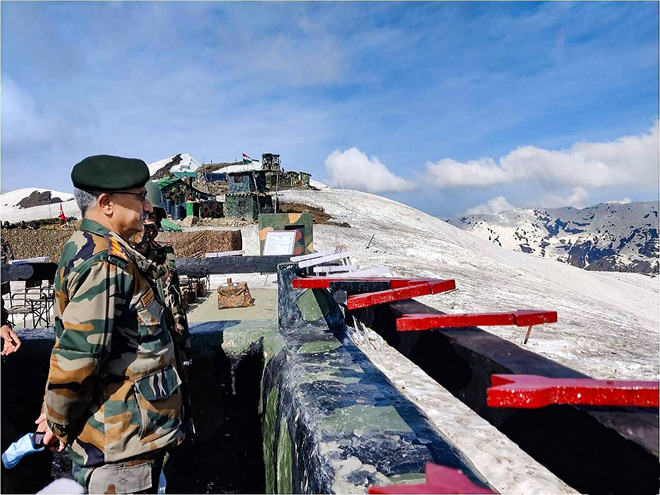
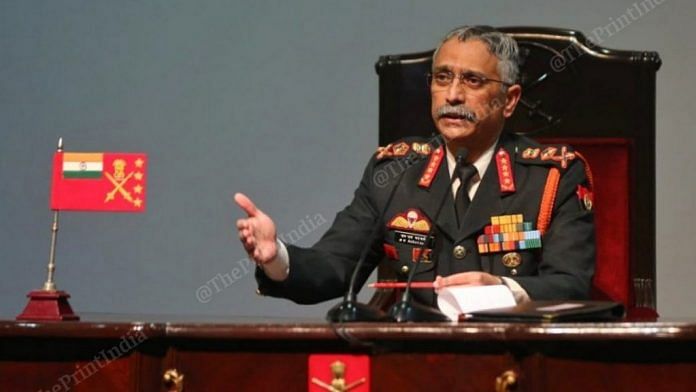
General MM Naravane reviews the security situation along the LoC in Kashmir on Thursday. PTI
Srinagar, June 3
Making it clear that the onus of building bridges with India is on Pakistan, Army Chief General MM Naravane on Thursday said that while the ceasefire continued, steps such as putting a stop to infiltration would help in building trust between the two countries.
He said the longevity of the ceasefire along the Line of Control with Pakistan depended on the actions of the neighbouring country, but asserted that there would be “no slackening” of preparedness as terror infrastructure across the border was intact.
‘Decades of mistrust with neighbouring country’
Asked if Islamabad can be trusted as the ceasefire has been maintained for 100 days, General Naravane said, “There have been decades of mistrust between India and Pakistan. The situation can’t change overnight.”
Terming Covid another kind of war, Naravane said the Army had left no stone unturned in providing relief to the people of the country. He said he was happy that Covid cases were declining.
“The ceasefire along the LoC is there as of now. The onus of making sure that the ceasefire remains is squarely on Pakistan. We are willing to observe the ceasefire as long as they do so,” he told journalists at the end of his two-day visit to Kashmir.
The Army Chief said other activities like terror infrastructure including terrorist camps and presence of terrorists on the other side of the LoC were continuing in Pakistan-occupied Kashmir.
Asked if Islamabad can be trusted as the ceasefire has been maintained for 100 days now, General Naravane said, “There have been decades of mistrust between India and Pakistan. So, the situation on that score cannot change overnight.”
He lauded the troops for the high level of operational preparedness. “On the second day of his two-day visit to Kashmir, General MM Naravane reviewed the security situation along the Line of Control,” the Army wrote on its official Twitter handle. It said the local commanders briefed the Chief of Army Staff on the existing security situation and the measures taken to foil infiltration bids by terrorists. — PTI
Defence Ministry okays Rs 43,000 crore tender for 6 more submarines
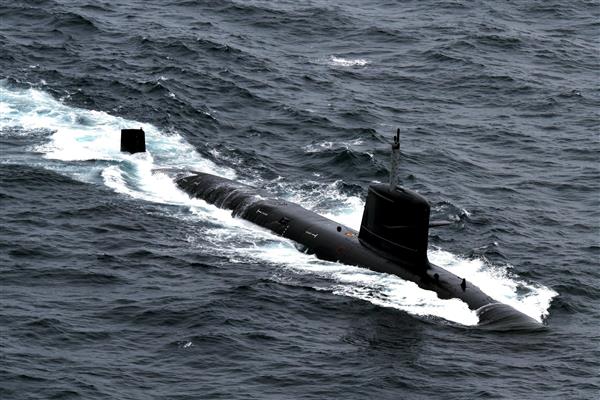
File picture of the Kalvari class submarines which are currently under construction.
Ajay Banerjee Tribune News Service New Delhi, June 4
The Ministry of Defence on Friday okayed the proposal to issue a formal tender for a Rs 43,000 crore project to construct six new-generation stealth conventional submarines in India.
A foreign manufacturer will tie up with an Indian partner under what is termed as ‘strategic partnership (SP) model’ to make these under-sea vessels for nearly $ 5.8 Billion. The SP model entails foreign manufacturers working in India at the facility of its Indian partner.
India has asked for submarines, that will run on a mix of Diesel-electric power, to have air-independent propulsion (AIP). An AIP adds to be submergence capabilities, allowing the submarine to dive for 12-15 days, much more than the 4-5 days endurance of conventional subs.
The Indian Navy would have the option to manufacture six more submarines under the project.
The Defence Acquisition Council (DAC), headed by Defence Minister Rajnath Singh, okayed the move. The DAC is the apex decision making body of the MoD. The case will go to the Cabinet Committee on Security for formal ratification. Known as the ‘project 75-India’, the DAC okayed the next step that is Request for Proposal (RFF) for the submarines.
Under the procurement rule of the MoD, the RFP is the second stage of the tendering process. This will be followed by technical evaluation of bids, cost evaluation and negotiations, technology transfer on offer, before a contract is signed.
The Ministry of Defence owned shipyard Mazagon Docks (MDL) and Larsen & Turbo (L&T) have been shortlisted among bidders. The latter is a private entity and is engaged in making the hulls of the Arihant Class of Indian strategic submarines.
Both will have a tie-up of their own with the original equipment manufacturer (OEM) from the five makers short-listed by the MoD earlier.
The five foreign companies in the race are South Korean company Daewoo Shipbuilding & Marine Engineering, The Naval Group of France, Navantia of Spain, ThysenKrupp Marine Systems of Germany and the Rosboronexport of Russia.
The Naval group in collaboration with the MDL is already making six conventional submarines.
Centre asks states to set up special search committees to find ‘unsung heroes’ for Padma awards
The Centre has asked all states to set up special search committees to find out talented people who could be nominated for Padma awards but so far have been left out of consideration despite their exceptional contributions.
The Narendra Modi government has been honouring many “unsung heroes”, who are contributing to society in different ways, with Padma awards.
The letter from the Union Home Ministry to chief secretaries of all states and Union Territories was sent as the Central government opened the window for receiving applications on the online portal ‘padmaawards.gov.in’ from June 1 to September 15 for the Padma awards to be announced on the eve of Republic Day 2022.
The Home Ministry said it has been observed in the past that while nominations are received in respect of a large number of people, there could be several talented persons who are left out of consideration despite exceptional contribution in their field.
Often many such persons may get overlooked primarily for the reason that they may not seek publicity or attention in the public domain, it said.
“It is, therefore, requested to make concerted efforts in identifying such persons whose excellence and achievements deserve to be recognised and make suitable nominations in their favour. It goes without saying that recognition of such deserving persons will only add to the prestige of these awards.
“In the above background, I request you to kindly send suitable nominations for the Padma awards to be announced on the occasion of Republic Day, 2022. In this regard, it is suggested that you may constitute a Special Search Committee for identifying, considering and finalising your recommendations or nominations,” the letter by Home Ministry Joint Secretary RK Singh said.
The states were told that while finalising recommendations, they should keep in mind that the persons recommended are pre-eminently worthy of the awards, looking at their lifetime achievements.
The criteria for selection should invariably be ‘excellence plus’ and the highest standards should be applied while recommending persons for these awards. The existence of an element of public service in the achievements of the person recommended for the award would be a desirable factor.
As the Padma awards are the second-highest civilian award of the country, it should also be considered whether the recommended person has earlier been given any national award or a state award in his or her field, the letter said.
Efforts may be made to identify talented persons from among women, weaker sections of the society, SCs and STs, and ‘divyangs’ who deserve to be considered for the award.
The decoration is normally not conferred posthumously. However, in highly deserving cases, the government could consider giving an award posthumously if the demise of the person proposed to be honoured has been recent, say within a period of one year preceding the Republic Day on which it is proposed to announce the award, it said.
A higher category of Padma awards can be considered in respect of a person who has earlier been conferred an award, provided a period of at least five years has elapsed. However, in exceptionally deserving cases, a relaxation can also be considered.
Government servants, including those working with PSUs, except doctors and scientists, are not eligible for the Padma awards.
The nominations or recommendations should contain all relevant details specified in the format available on the portal, including a citation in narrative form (maximum 800 words), clearly bringing out the distinguished and exceptional achievements or service of the person recommended in his or her respective fields or discipline.
While recommending a person online, it should be ensured that all the necessary details are properly filled.
The Padma awards—Padma Vibhushan, Padma Bhushan and Padma Shri—are among the highest civilian awards of the country.
The award seeks to recognise ‘work of distinction’ and is given for distinguished and exceptional achievements or service in all fields or disciplines, such as art, literature and education, sports, medicine, social work, science and engineering, public affairs, civil service, trade and industry among others.
All persons without distinction of race, occupation, position or sex are eligible for these awards.
Apart from the state governments, Union Territory administrations, central ministries, NGOs and individuals themselves can send their nominations for the Padma awards. PTI
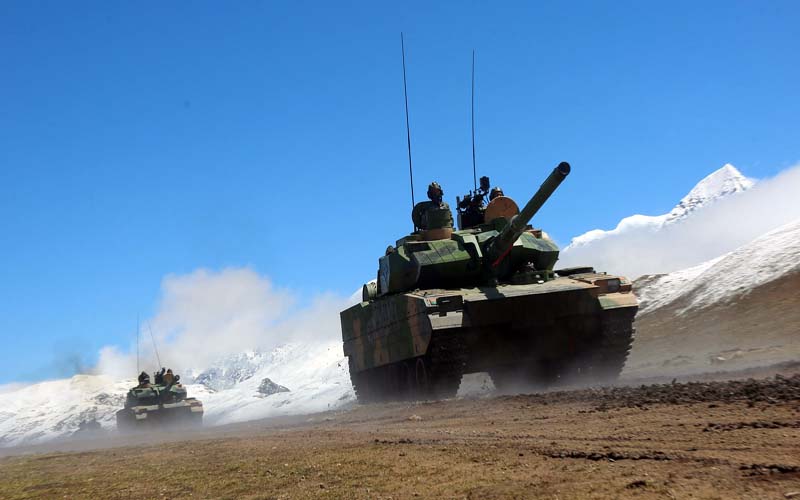
PLA executed its ‘Three warfare’ strategy spear-headed by an array of armoured formations in Ladakh. PLA exercises in last few years have included mechanised manoeuvres and heavy drop of armoured vehicles, simulating capture of passes and lightly held areas in high altitude. It is widely reported that 6 Highland Mechanised Infantry Division and 4 Highland Motorised Infantry Division have deployed assorted AFVs- medium, light tanks and heavy support equipment across LAC in Ladakh to project their coercive messaging potential, as part of psychological warfare.
At the very outset, it can be categorically stated that India has not only stalemated the situation but had also caused criticality for PLA by pre-emptive occupation of dominating features on Kailash range. The operation on Kailash Range had mechanised elements in vanguard and were in face of massed PLA armour across Spanggur gap. According to informed experts stalemate, for initiator claiming to be global hegemony, amounts to loss.
Theme Setting
PLA has injected more versatility in their armoured fleet with introduction of light tank, ZTQ, first fielded during Doklam crisis. Our BMP-2s, ICVs, duly integrated with medium tanks can be adapted for some of the relevant tasks. The Chinese threat, though stemmed currently could manifest again and more such forays can’t be ruled out. Hence, it was axiomatic that a review of mechanised fleet was carried out to meet emerging challenges in Himalayan sector. Consequently, Request for Information (RFI) for 350 light tanks has been issued. Concurrently, customised modernization of existing fleet of medium tanks is also being fast tracked.
PLA’s Mechanised Profile in Tibet
6 Highland Mechanised Infantry Division and 4 Highland Motorised Infantry Divisions are orbatted with two Mechanised Infantry Regiments (Brigades) supported by an armoured regiment. Each Mechanised Infantry Regiment has four mechanised battalions. It has combat support elements – artillery, air defence regiments supported by engineers, EW and CBRN Defence battalions. Division has reconnaissance battalion equipped with eighteen ZBD-04A infantry fighting vehicles armed with ATGMs. Artillery and Air Defence and most other combat support equipment are tracked. Other associated equipment like helicopters, drones and rocket artillery are grouped as per envisaged tasking.
Comparative Evaluation-Medium Tanks
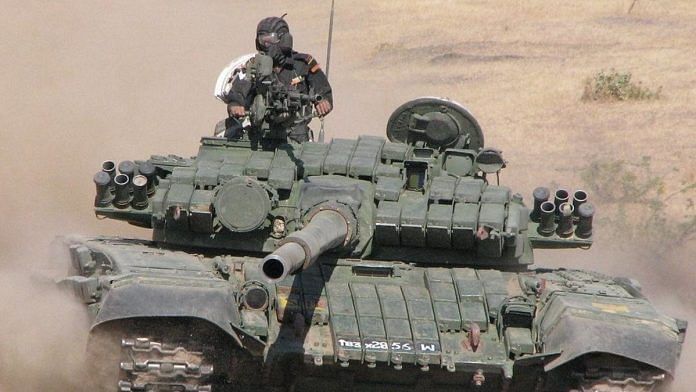
PLA medium tank battalions are equipped with thirty-five ZTZ-99A (Type 99) tanks or earlier versions like Type 96. Chinese tanks follow an evolutionary approach and are reverse engineered from original Russian models and cloned by China North Industries Corporation (NORINCO). Their numbering has typical psychological hype attached. T-54 clone is referred to as Type-59 and T-90 equivalent as Type-99. Current lot of PLA medium tanks weigh around 55 tonnes, 125 mm smooth bore guns and 1000 to 1200 HP engines.
Our medium tanks, T-90s and T-72, in right combination are more than a match for these tanks. It is pertinent to highlight that numerically four of our regiments can match five Chinese regiments as our regiments have nearly 50 A vehicles. However, our main stay- T-72 needs to be equipped with upgraded engine. Additional power is required to compensate for de-rating of engines by approximately 25% in high altitude areas. Russian tanks are customised to operate in extreme cold climate but customised value additions like Auxiliary Power Unit (APUs) have been identified, as part of ongoing modernisation including creating an eco-system of heated garages and repair bays, which needs to be fast tracked.
Comparison-Mechanised Infantry
PLA’s mechanised infantry ismix of old tracked Type 86 ICVs, wheeled WZ-551 APCs (6×6) and limited number of more contemporary VN-1 (8×8) ATGM carriers with Red Arrow missiles. Our BMP-2s are more than a match to PLA ICVs. It is seen that PLA infantry has got used to being transported and operates largely in motorised mode. Although we enjoy marginal edge in our ICVs, yet modernisation in terms of up-gradation of power pack is a critical requirement for operation in high altitude terrain to offset losses in engine power. While India follows traditional philosophy of employment of infantry, largely without vehicles, yet the need is to give them some protection and mobility in form of mechanised/motorised infantry. It is indeed commendable that much needed though belated correctives are underway with induction of Kalyani M4, Mahindra ALSV and TATA LAMV variants.
Appraisal-PLA Light Tank
China added considerable versatility to its mechanised fleet by fielding a light tank, ZTQ-15 also referred to as Type 15 or Xinquingtan. It is essentially lighter medium tank with weight of around 34 tonnes, amounting to sort of hybrid between medium and light tanks. Classically, light tanks are generally in sub 30 tonne class, ideally 25 tonnes, with Power to weight ratio (PWR) between 30 to 35. Type-15 has been fitted with extra wide tracks to offset additional weight and reduce Nominal Ground Pressure (NGP). PWR and NGP are key enablers for agility and trafficability in marginal terrain. To that extent, it is compromise of sorts specially in terms of protection, fire power and mobility.
Type 15 has been utilised in heavy droppings, giving it as an edge for utilisation in quick reaction forces. This tank was introduced in 2017 and 40 tanks have been supplied to Bangladesh, with 140 more in pipe line. The main features of this tank are 105 mm rifled guns and 1000 HP engine. Type 15 though hyped as game changer is neither really light nor replacement for medium tanks, certainly not panacea. In keeping with Chinese reliance on incremental or evolutionary designs, this tank is follow-up and replacement for antiquated Type-62 tanks.
History- Indian Light Tanks
As is well known, we currently don’t have a light tank on our inventory. Historically, light tanks had defining and iconic role in 1947 operations, when Stuart tanks were inducted across Zojila to stem raiders. AMX-13 were again utilised in Chusul during 1962. We had Stuarts, Shermans, AMX-13 and assorted armoured cars in 1965 and earlier operations till 70s. Russian PT-76 tanks, replacement of older light tanks proved their mettle in 1971 operations. Light tanks have their utility in reconnaissance, scouting and out of area contingencies including peace keeping operations. They can be also be utilised in riverine, creeks/marshy back waters, island territories and coastal areas besides high altitude terrain. Light tanks, if applied audaciously and with imagination for reconnaissance in force, can open up possibility for Quid Pro Quo (QPQ) operations.
Quest For Replacement Light Tank
After de-induction of PT-76 tanks in 1989, half-hearted attempts to find replacement were made including trials of Brazilian- Uruthu; British- Scorpion and French light tank in late 80s. Formalised RFI for 200 wheeled and 100 tracked light tanks was promulgated again in 2009 as part of build up for Mountain Strike Corps. Major specifications were 22 tons with gun calibre between 105 to 120 mm. Wheeled variant was to be 8×8 or 6×6 configuration. However, this RFI was retracted. Concurrently, DRDO has experimented with certain variants, utilising BMP chassis with 105 mm gun as also French GIAT TS-90 chassis. Even certain private manufacturers and DPSUs/Ordnance factories have produced prototypes in both wheeled and tracked versions, not finding much traction.
Current RFI and Options
India has projected requirement for 350 light tanks on fast track basis. This would translate to six to seven regiments depending on equipping norms. It will be important to clarify that the requirement is for an ‘Agile’ tank with optimum balance between fire power, weight (light) yet with sufficient protection. Strategic mobility in terms of air portability is an added imperative enabling strategic mobility. Desired profile would be tank of around 25 tonnes with power to PWR of 30-35 and gun calibre of 105-120 mm with missile firing and modern optronics. It is desirable to have tracks with rubber shoes to minimise damage to fragile communication arteries. Modernization in terms of Active Protection System (APS), anti-drone measures and rubberized tracks could be incorporated later. The overriding parameter is ownership of not only TOT but also ‘know-how’ through co-development under Atam Nirbhar route.
Options
Scan of global inventory generates few options ranging from eight wheeled Stryker variants, which were tried out in Yudh Abhyas series of joint exercises and even offered by USA through FMS route but not found suitable. Russia has 2S25 Sprut-SD light tank , weighing 18 tonnes, with 125 mm SB gun and PWR of 28.3 hp/ton. These tanks have also been air dropped in exercises. Israeli Sabrah tank is in keeping with her protection oriented philosophy and weighs 55 tonnes and only suited for desert terrain. Another viable line of development is to utilise expertise gained in production of K-9 Vajra SP gun. This is aligned with S Korean, K21-105 Hanwaha tank. This tank is joint production endeavour with Belgian John Cockerill Defence. Prima-facie, it can be tweaked to meet most RFI parameters, thereby adhering to stipulated deadline. The details of this platform can be accessed on Chankya Forum site and app.
Recommendations
First and foremost requirement is to build a versatile family of ‘A’ vehicles with optimum mix of medium and light tanks with customised support equipment. Consequently, there is urgent need to fast track development process for light tanks. Secondly, we need to find partners and achieve indigenisation and joint production. Thirdly, existing fleet of medium tanks in high altitude areas needs to be modernised, most importantly by upgrading their power packs. Fourthly, ageing ICVs should be given much needed up gradation package including power pack and better protection system. Fifthly, an eco-system for garages, training and sustenance should be set up in these areas. Sixthly, infantry should be provided with protected high mobility vehicles. Seventhly, commonality of platform should be attempted to reduce logistical challenges.
Author
Lt Gen KJ Singh, PVSM, AVSM & Bar is a former Western Army Commander and is currently, Haryana State Information Commissioner, after his tenure as Advisor to CM. He holds the Maharaja Ranjit Singh Chair in PU and is Member- UT Advisory Council. He is a regular columnist.
Lt Gen Manoj Pande to take charge as Eastern Command chief on June 1
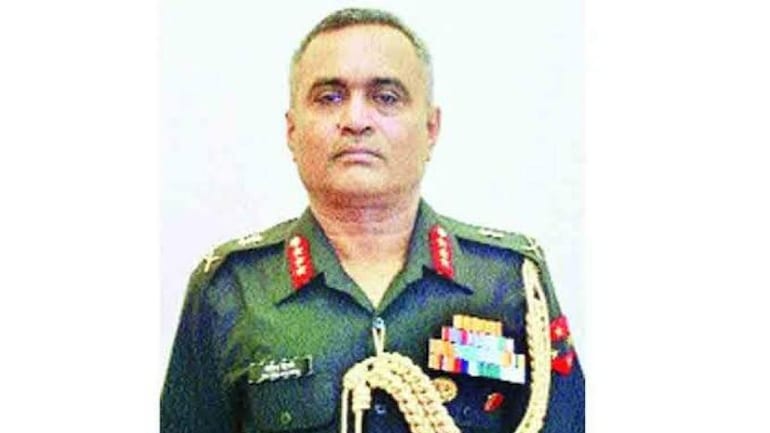
Lt Gen Manoj Pande was commissioned into the Corps of Engineers (The Bombay Sappers) in December 1982. (File photo)
Lt Gen Manoj Pande will take charge as the chief of the Indian Army’s Eastern Command on Monday, succeeding Lt Gen Anil Chauhan. Lt Gen Pande is presently heading the only operational tri-services formation Andaman and Nicobar Command at Port Blair.
An alumnus of National Defence Academy, the General Officer was commissioned into the Corps of Engineers (The Bombay Sappers) in December 1982. He is a graduate of Staff College, Camberley (United Kingdom) and attended the Higher Command Course at Army War College, Mhow and National Defence College (NDC) at Delhi. During his 37 years of distinguished service, Pande has taken active part in Operation Vijay and Operation Parakram.
He commanded an Engineer Regiment along the Line of Control in Jammu & Kashmir, an Engineer Brigade as part of the Strike Corps, an Infantry Brigade along the Line of Control, a Mountain Division in the high altitude area of western Ladakh and a Corps deployed along the Line of Actual Control (LAC) as also in Counter Insurgency Operations area in the northeast.
Lt Gen Pande has tenanted important staff assignments and was posted as Chief Engineer at the United Nations Mission in Ethiopia and Eritrea. He was Director-General at Army Headquarters dealing with subjects of discipline, ceremonial and welfare, prior to assuming the present appointment.
Army gets going on plan to buy over 1,700 ‘future tanks’ that will become its main battle tanks
New Delhi: The Indian Army is set to procure over 1,700 Future Ready Combat Vehicles (FRCVs) in a phased manner under the strategic partnership route, with the induction of the “future tank” expected to be completed by 2030.
According to a Request for Information (RFI) floated by the Army Tuesday, the 1,770 FRCVs will be procured along with transfer of technology, performance-based logistics, engineering support package, and other maintenance and training requirements.
The prospective vendors will have to respond to the RFI by 15 September.
An earlier Request for Proposal floated on the procurement of FRCVs in 2017 stands cancelled.
In April, the Army had also floated an RFI to procure around 350 light tanks in a phased manner under the Make in India initiative, to sharpen its mountain warfare edge amid the ongoing Ladakh stalemate.
Currently, India operates with Russian-designed T-90 tanks, which weigh around 46 tonnes, besides the T-72 tanks. The new procurement will eventually replace the Russian T-72 tanks.
The “state-of-the-art”, “technologically-enabled” FRCVs will be able to operate in different terrains, such as high altitude areas, plains and riverine borders as well as deserts, and have high mobility. They will act as the main battle tanks of the Army.
According to the Army’s requirements, the tanks should ideally be able to defeat the adversary’s tanks, armoured vehicles, unmanned aerial vehicles (UAVs), and destroy or deter attack helicopters. The platform is needed to have multiple anti-aircraft weapons, counter UAVs and a ground role with different calibre assisted with remote control weapon stations.
The RFI also requires the platform to also have different stealth features.
The procurement is in line with the emerging future threat spectrum, the RFI says. The superior modern tank platform, it says, should incorporate niche technologies such as artificial intelligence, and can operate in a network centric and electronic warfare environment.
While tanks have been the dominant battle winning factor of the land forces, it faces new threats from loitering munitions, UCAVs (unmanned combat aerial vehicles) and their targeting have been made easier with a progress in the adversary’s ISR (intelligence, surveillance, and reconnaissance) capabilities, it says.
“….the future tank has to be in sync with technological battlefield advancements,” the RFI says, adding that it needs to upgrade and incorporate systems to negate ISR systems, counter new threats and enhance its operational performance.
The Army says the medium weight-class tank should have an weapon system that can be upgraded and equipped with advanced multipurpose smart munitions, both for main and secondary armaments with gun tube launched anti-tank guided missiles.
‘Will reduce necessity to train on multiple platforms’
A senior Army officer told ThePrint that the FRCVs will provide flexibility to switch to mechanised forces into different terrain at a short notice, as they can be deployed in all terrain.
“It would reduce the necessity to train on multiple platforms. Additionally, the overall inventory would be easier to manage in terms of spares and other reserves,” the officer said.
Lt Gen A.B. Shivane (Retd), former director general, mechanised forces had called it a “game changer”. In a seminar in 2017, he had said the FRCV would replace the Russian T-72 tanks presently in service and would not scuttle the Arjun tank programme.
The RFI clarifies that several new technologies have been sought and the prospective Original Equipment Manufacturer may not have them at present, but they can confirm the provision for their integration into the platform.
Indian troops must be well prepared for any misadventure
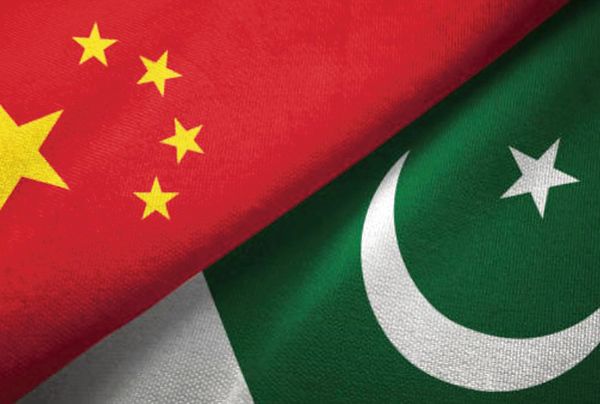
It’s no coincidence that the China-Pakistan military exercise in Tibet comes amid celebrations marking 70 years of the establishment of diplomatic relations between the two countries which share their borders with India. The drill has taken place near the Line of Actual Control (LAC) — the scene of a prolonged standoff between Indian and Chinese troops — weeks ahead of the first anniversary of the bloody clash in Ladakh’s Galwan valley. Both the venue and the timing of the exercise have struck a discordant note for India, bringing under scrutiny the intentions of the two allies. The bilateral show of strength reeks of aggressive posturing apparently aimed at unnerving India. The development is also a grim reminder that the disengagement process in eastern Ladakh has only flattered to deceive, even as Pakistan’s overtures to bring peace along the LoC can’t be taken at face value.
The writing is on the wall: military and economic ties between China and Pakistan are getting stronger by the day and India needs to remain wary of both its neighbours, which have a long history of duplicity. The leaders of the two nations congratulated each other recently on the progress of the $60-billion China-Pakistan Economic Corridor (CPEC), a major infrastructure project that connects Xinjiang province with Gwadar port in Balochistan. Though New Delhi has lodged a protest with Beijing over the CPEC, which passes through Pakistan-occupied Kashmir (PoK), China has asserted that it is an economic initiative that won’t affect its ‘principled stand’ on the Kashmir issue. The argument has failed to convince India of China’s credibility.
The Chinese consolidation of air defence assets along the LAC makes it obvious that peace and tranquillity in the area will continue to be elusive as the neighbour is in no mood for de-escalation. With the Chinese Communist Party gearing up for its centenary celebrations next month, several grand displays of military might are to be expected. That’s reason enough for Indian troops to be well prepared for any mischief or misadventure from across the border or on the high seas.
Army chief in Kashmir ‘to take stock’ as ‘fragile’ ceasefire with Pakistan completes 100 days
File photo of Army chief General M.M. Naravane | Photo: Suraj Singh Bisht | ThePrint
New Delhi: Army chief General M.M. Naravane has reached Srinagar to take stock of the security situation in Kashmir and along the Line of Control (LoC), where the ceasefire with Pakistan has completed 100 days.
Sources in the defence establishment said the chief will be briefed on the operational matters and overall security scenario by 15 Corps Commander Lt Gen. D.P. Pandey and his team.
India and Pakistan agreed to a ceasefire along their tense border in 2003, but it was never followed in letter and spirit after an initial spell of silence. On 25 February, the directors-general of military operations on the two sides decided to strictly implement the ceasefire. The ceasefire, the sources said, has held up since then bar one round of firing between the Border Security Force (BSF) and the Pakistan Rangers along the International Border.
According to official figures, the total number of ceasefire violations this year stands at 592. Of this, 591 took place before 25 February. In comparison, between 1 January 2020 and 1 June 2020, Pakistan violated the ceasefire a total of 1,531 times.
In all, 2020 saw 4,635 ceasefire violations, up from 3,233 in 2019.
Despite the ceasefire, sources in the defence and security establishment said terror camps in Pakistan-occupied Kashmir (PoK) remain in place, if at a reduced scale. Infiltration, they added, has come down, with sources in the security establishment saying there was zero terror infiltration in March, April and May.
Sources in the security establishment describe the ceasefire at the LoC as “fragile”, saying Pakistan will turn up the heat when it feels the time is right.They said peace along the LoC is in favour of both countries, but more so for Pakistan.
“There are multiple factors behind the ceasefire initiative, like the global scrutiny, pullout of US-led forces from Afghanistan, and the need for them to refocus away from the LoC. There is a section within the Pakistan Army that wants peace but they seem to be facing opposition,” said a source.
“Moreover, none of the other peace initiatives is yet to be formalised. Hence, the current ceasefire can be termed fragile,” the source added.
The sources said it is important for other initiatives — like resumption of diplomatic ties with the appointment of high commissioners, and bilateral and multilateral forum talks — to take off for the ceasefire at the LoC to be successful.
Terror infrastructure continues
While there has been no ceasefire violation along the LoC since 25 February, security and defence sources said terror infrastructure like training camps continues to operate in PoK.
However, security sources said the training camps have been scaled down a lot, an assessment that is shared by the defence establishment.
While defence sources said infiltration has come down, sources in the security establishment claimed there was no terror infiltration in March, April and May.
However, they did say that arms and ammunition continue to be pumped into Kashmir through other routes besides the LoC, on a much smaller scale than before.
“The terror infrastructure continues across the LoC, though on a smaller scale. This was actually reduced after the Balakot strike (2019). The terror support to elements in Kashmir continues through hawala operators and other means, though again on a smaller scale than before,” a source said.
Another source added that while a feeling of alienation is still high in Kashmir, the situation remains under control.
“From a security point of view, the situation remains under control. It is at a level that can be managed. There has not been any infiltration since the ceasefire announcements. This is the season of infiltration and hence one needs to be watchful,” the source said.
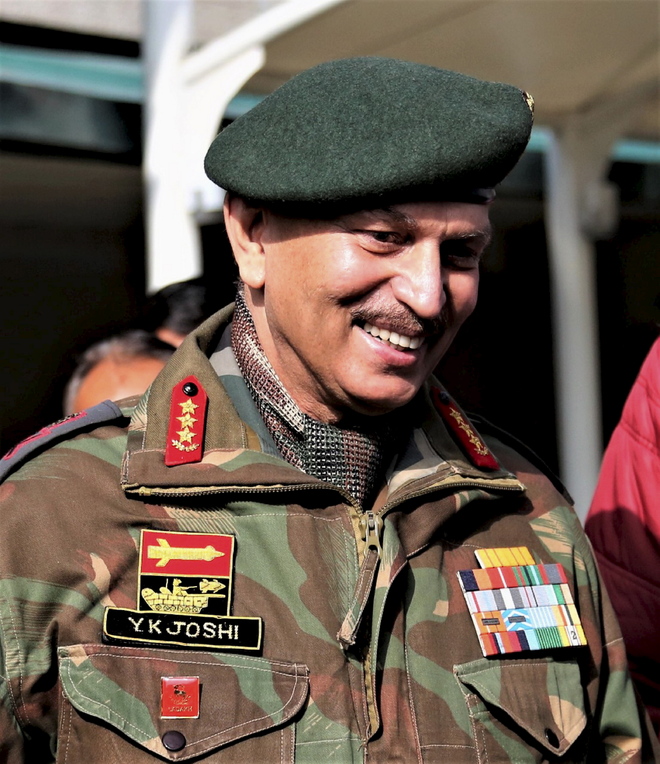
Northern Army Commander Lieutenant General YK Joshi on Tuesday said the ceasefire understanding between India and Pakistan was being followed in letter and spirit by both sides since February 25, but asserted that the Army was not letting its guard down “even for one bit” along the border in J&K.
“The present situation is a reflection of our nation’s behaviour as a responsible member of the comity of nations where we have displayed maturity, restraint and humanitarian outlook during the trying times of Covid pandemic,” he said.
India and Pakistan had on February 25 this year released a joint statement announcing a ceasefire along the Line of Control (LoC), following talks between their Directors General of Military Operations. The two countries had earlier signed a ceasefire agreement in 2003 but it was repeatedly violated.
Kargil war hero Lt Gen Joshi said the direct benefactors of the fresh ceasefire understanding between the two countries had been the people residing along the Line of Control. — PTI
State Stalwarts
DEFENCE MINISTER
Minister Rajnath Singh
ALL HUMANS ARE ONE CREATED BY GOD
HINDUS,MUSLIMS,SIKHS.ISAI SAB HAI BHAI BHAI
CHIEF PATRON ALL INDIA SANJHA MORCHA
LT GEN JASBIR SINGH DHALIWAL, DOGRA
SENIOR PATRON ALL INDIA SANJHA MORCHA
MAJOR GEN HARVIJAY SINGH, SENA MEDAL ,corps of signals
.
.
PATRON ALL INDIA SANJHA MORCHA
MAJ GEN RAMINDER GURAYA ,MADRAS REGIMENT
sanjhamorcha303@gmail.com
PRESIDENT SOUTH ALL INDIA SANJHA MORCHA
COL SS RAJAN BOMBAY SAPPERS,
PRESIDENT UTTARAKHAND ALL INDIA SANJHA MORCHA
COL B M THAPA ,BENGAL SAPPERSS
PRESIDENT HARAYANA STATE CUM COORDINATOR ESM
BRIG DALJIT THUKRAL ,BENGAL SAPPERS
PRESIDENT TRICITY
COL B S BRAR (BHUPI BRAR)
PRESIDENT CHANDIGARH ZONE
COL SHANJIT SINGH BHULLAR
.
.
PRESIDENT PANCHKULA ZONE AND ZIRAKPUR
COL SWARAN SINGH
INDIAN DEFENCE FORCES
DEFENCE FORCES INTEGRATED LOGO
INDIAN AIR FORCE
Air Officer C-in-C WESTERN AIR COMMAND
AIR MSHL S PRABHAKARAN AVSM VM
AOC-IN-C, EASTERN AIR COMMAND
Air Marshal Inderpal Singh Walia
AOC-in-C SOUTH WESTERN AIR COMMAND
Air Marshal Vikram Singh
AOC-IN-C, SOUTHERN AIR COMMAND
Air Marshal J.Chalapati
AOC-IN-C TRAINING COMMAND
AIR MARSHAL SK GHOTIA VSM
AOC-IN-C MAINTENANCE COMMAND
Air Marshal Jagdish Chandra
Flag Officer Commanding in Chief, Western Naval Command
ice Admiral R Hari Kumar, PVSM, AVSM, VSM
Flag Officer Commanding in Chief, Eastern Naval Command
Vice Admiral Sanjay Bhalla, AVSM, NM
Flag Officer Commanding in Chief, Southern Naval Command