Tweaking of system needed to facilitate co-ed training
Photo for representational purpose only. File photo
IN a heartening reaffirmation of the hard-fought gender equality that is being increasingly felt in the defence forces, the portals of the academies for pre-commissioned training are set to open for women. It is another matter though that, as in every other small or big step taken towards parity and overcoming the misogynistic mindset despite proving themselves as worthy defence and combat officers in the past nearly three decades, this battle too has been won through the court. Defending yet again women’s equal right to recruitment in the army, the Supreme Court, in its interim order on Wednesday, cleared one of the last hurdles that still smacks of discrimination. It allowed women candidates to take the NDA and Naval Academy exams scheduled for September 5 this year, subject to the final decision.
Excluding women from taking the test is a grave violation of the broad intent of last year’s orders of the SC that allowed permanent commission to women officers. To prevent the irreparable damage that this miss would have caused to women’s rights, the SC direction to the UPSC to issue a corrigendum is timely. The new rule must be widely publicised so that all eligible and aspiring women candidates could compete for recruitment as cadet officers.
The SC directive should goad the policymakers to take heed and shed their resistance to gender equality. As the SC noted, it is indeed regretful that the Army has been more reluctant than the Air Force and the Navy to fully accommodate women officers in its ranks. It is prone to dithering till ordered to act by the courts. The forces would do well to accept that women officers are very much here to stay and soar to heights and that gender neutrality is non-negotiable. It is time for the forces to adapt themselves towards a compatible co-educational ethos and infrastructure for women in all their institutes of training, and tweak the system, keeping in mind the technical intricacies peculiar to their work culture.
In the time it took to jump out of IAF’s C-119 and park the jeep in Dhaka Cantt, the CO of 2 Para & his men had passed into legion, their exploits forever in texts studied by professional soldiers
Sujan Dutta
Fabric is synonymous with the name of Tangail. The warp and weft of the Tangail saree is known in every Bengali home and the wider world of women who drape the garment. Whether it is cotton or silk or a mix of the two, the Tangail saree, known for its plain body and rich border, handloomed by generations of weavers is now generic.
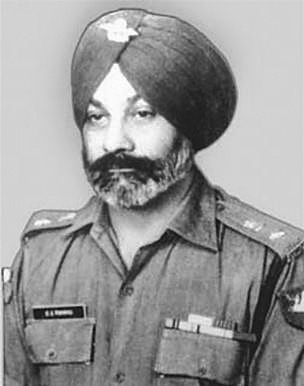
Lt Col (later Maj Gen) KS Pannu
Fabric covered the skies over Tangail, the town the saree is named after, 90-odd kilometres north-west of Dhaka in the early evening of December 11, 1971. Ripstop nylon billowed like domes of military green as Indian soldiers of the 2 Para battalion group made what remains the only airborne operation of its kind led by a commander who was the first out of an Indian Air Force cargo plane with his jeep.
In three days, Lt Colonel Kulwant Singh Pannu, later Major General, would also walk into the Dacca International Hotel, take a wash, and then the “flamboyant Commanding Officer of 2 Para spoke to reporters”, according to military historian Arjun Subramaniam, who has seen the unit’s archives. The hotel was designated a safe zone by the United Nations and the Red Cross.
Two days later, Pannu would also bound off the jeep after parking in the grounds of the headquarters of Pakistan’s eastern command, brush past a stern sentry with his adjutant Capt Nirbhay Sharma and the Bangladesh Mukti Bahini leading light Kader ‘Tiger’ Siddiqui and hand over to AAK Niazi a message from General Nagra: “Abdullah,” it said, “it’s game over, surrender.”
(Major General GC Nagra headed the 101 Communications Zone and knew Niazi).
In the time that it took to jump out of the Indian Air Force C-119 ‘Packet’ and park the jeep in Dhaka Cantonment, Lt Col Pannu and his men had passed into legion, their exploits forever in texts studied by professional soldiers.
“I was returning to Tangail from one of our headquarters at Mohanandapur village when the Indian Army paratroopers started landing near Poongli,” wrote Anwarul Ham, a former ambassador and then second-in-command of the Mukti Bahini in Tangail.https://2c68aeb3d7cef6cbae293b8cb57bd180.safeframe.googlesyndication.com/safeframe/1-0-38/html/container.html
“It was quite a sight. I was 1.5 miles away and I ran to greet them. I introduced myself to Lt Col Pannu. He made two requests: to disperse the crowd of villagers (who were gawking) and to arrange for local volunteers to help carry the load and push the artillery guns and jeeps to the road.”
Three of the four guns had fallen into ponds. One landed on the roof of a village house. The battalion group that had landed comprised elements of a field battery and medics. The drop was spread over a wide area, by one estimate over 20 km.
It was tasked to secure the Poongli bridge and the adjacent ferry on the Louhajang river that branched from the wide Jamuna. Securing the bridge would cut off battalions of Pakistan’s 93 Brigade that were falling back to Tangail and Dhaka from Mymensingh and Jamalpur. The operation was deep behind enemy lines, the battalion group having flown from Kalaikunda and Dum Dum in West Bengal. They had linked up with 1 Maratha Light Infantry, who were already in the thick of operations battling their way through East Pakistan from Tura in Meghalaya.
To fulfil his brief, Pannu had to rally round his men and equipment, moving in a wide arc as night fell. Having rounded up a bulk of his men, he prepared to take the bridge. Four artillery guns could be made operational for the charge. Most of the Pakistanis fled but that same night there were three counter-attacks on Poongli bridge.
“I came face to face with bone-chilling scenes of last night’s battle. Corpses of hundreds of enemy soldiers littered the road, bodies from one side of the bridge to another. We walked with care so as to not step on the dead,” wrote Dr Nuran Nabi, a lieutenant of Tiger Siddiqui’s force in Dhaka’s ‘The Daily Star,’ some 30 years after the event.
The 2 Para group, having linked up with 1 Maratha Light Infantry, then rolled cautiously towards Dhaka on the Mirzapur-Jaydebpur Road, reaching Milestone 26, its destination, by the evening of December 15. They were then tasked to turn west and reach Dhaka through the Mirpur bridge. The bridge was staunchly defended even though, by December 15, the war was collapsing for Pakistan.
“We lost three — killed in action. There were 41 enemy casualties but we were at the gates of Dhaka by midnight,” Nirbhay Sharma, who was adjutant to Pannu and who retired as a Lieutenant General (and then became Governor of Arunachal and Mizoram), has written and said in multiple interviews.
The next day, Pannu, Sharma and Tiger Siddiqui were to take the message to Niazi. Pannu, who had tied up with Tiger Siddiqui after the airdrop in Tangail, had taken him along on the battles through to Dhaka. He wanted him along not only for the camaraderie they had struck, but also because of the clear idea drilled into Indian officers that this was not a country they were to occupy but help the Mukti Bahini.
Such was fate, however, for the men who fought alongside that Tiger Siddiqui had to be arrested by the Indian Army in later weeks for having publicly bayoneted surrendered Razakars (Pakistan’s collaborators) personally in the cricket stadium, an incident that was filmed.
Before the entry to Dhaka cantonment, however, the Indian Army’s Eastern Command Chief of Staff, Lt Gen JFR Jacob, had proclaimed from Calcutta that Indian paratroopers had surrounded the East Pakistan capital. Even if it was an overstatement, it carried weight because by that time Lt General Sagat Singh’s forces from the east had crossed the Meghna river.
The 2 Paras led by Pannu were among the first to actually march into Dhaka and extract that famous confession from Niazi. Niazi could not meet Pannu’s gaze, wrote Nirbhay Sharma. He was unshaven — “Pindi mein baithe haramzadon ne marwadiya. The (expletive) people in Rawalpindi, Pakistan’s General Headquarters, have betrayed me with false promises of help.”
The remarkable thing about Pannu’s leadership was that the Indian Army had only one officer with personal experience of an airborne operation till then: Lt Gen Inder Singh Gill, who as a Lieutenant was a commando in Greece for the Allied Forces in 1942. He was Director of Military Operations at Army Headquarters in 1971.
Lt Col KS Pannu’s MVC citation reads:
“Lieutenant Colonel KS Pannu was commanding a battalion, which was airdropped near Tangail on December 11, 1971. The task involved cutting enemy routes of withdrawal and preventing his build-up at Tangail. This also involved the capture of an enemy position on a vital bridge at Poongli. The drop of the battalion was widely dispersed and Lieutenant Colonel Pannu had to move from one location to another under enemy fire to collect his platoons. It was entirely due to his cool courage, utter disregard for his personal safety and his timely and skilful direction that his battalion captured the enemy position at Poongli.
Under his able leadership, the battalion repulsed numerous counter-attacks, inflicting heavy casualties on the enemy. Lieutenant Colonel Pannu displayed conspicuous gallantry, exemplary leadership, determination and devotion to duty in keeping with the best traditions of the Army.”
Thousands continue to flock to Kabul’s airport, braving checkpoints manned by Taliban fighters as they seek desperately to get on evacuation flights out
Taliban fighters patrol in Kabul, Afghanistan on August 19, 2021. — AP/PTI
Kabul, August 20
Taliban fighters tortured and killed members of an ethnic minority in Afghanistan after recently overrunning their village, Amnesty International said, fuelling fears that they will again impose a brutal rule, even as they urged imams to push a message of unity at the first gathering for Friday prayers since the capital was seized.
Terrified that the new de facto rulers would commit such abuses, thousands have raced to Kabul’s airport desperate to flee following the Taliban’s stunning blitz through the country. Others have taken to the streets to protest the takeover — acts of defiance that Taliban fighters have violently suppressed.
The Taliban have sought to project moderation and have pledged to restore security and forgive those who fought them in the 20 years since a US-led invasion. Ahead of Friday prayers, leaders urged to imams to use sermons to appeal for unity, urge people not to flee the country, and to counter “negative propaganda” about them.
But many Afghans are skeptical, and the Amnesty report provided more evidence that undercut the Taliban’s claims they have changed.
The rights group said that its researchers spoke to eyewitnesses in Ghazni province who recounted how the Taliban killed nine Hazara men in the village of Mundarakht on July 4-6. It said six of the men were shot, and three were tortured to death.
The brutality of the killings was “a reminder of the Taliban’s past record, and a horrifying indicator of what Taliban rule may bring,” said Agnes Callamard, the head of Amnesty International.
The group warned that many more killings may gone unreported because the Taliban have cut cellphone services in many areas they’ve captured to prevent images from there from being published.
Separately, Reporters without Borders expressed alarm at the news that Taliban fighters killed the family member of an Afghan journalist working for German broadcaster Deutsche Welle on Wednesday.
“Sadly, this confirms our worst fears,” said Katja Gloger of the press freedom group’s German section. “The brutal action of the Taliban show that the lives of independent media workers in Afghanistan are in acute danger.” Many Afghans fear a return to the Taliban’s harsh rule in the late 1990s, when the group largely confined women to their homes, banned television and music, chopped off the hands of suspected thieves and held public executions.
Thousands continue to flock to Kabul’s airport, braving checkpoints manned by Taliban fighters as they seek desperately to get on evacuation flights out.
Mohammad Naim, who has been among the crowd at the airport for four days trying to escape the country, said he had to put his children on the roof of a car on the first day to save them from being crushed by the mass of people. He saw other children killed after they were unable to get out of the way.
Naim, who said he had been an interpreter for US forces, said he had urged others not to the come to airport.
“It is a very, very crazy situation right now and I hope the situation gets better because I saw kids dying, it is very terrible,” he said.
The Pentagon said Thursday that about 2,000 people were brought out on American flights on each of the previous two days, and the State Department said 6,000 more were expected to leave that day. But thousands of Americans and their Afghan allies may be in need of escape.
Dozens of other flights have already brought hundreds more Western nationals and Afghan workers to Europe and elsewhere.
Chaos at the airport itself has sometimes hindered flights, but getting to the facility is the major challenge. Germany was sending two helicopters to Kabul to help bring small numbers of people from elsewhere in the city to the airport, officials said.
Australian Prime Minister Scott Morrison noted that Australian citizens have not been able to be evacuated from outside Kabul, and even in the capital the situation is difficult.
“The situation in Kabul does remain chaotic,” he said.
In recent days, some Afghans have protested the Taliban in several cities — a remarkable show of defiance that fighters often met with violence. At least one person was killed Wednesday at a rally in the eastern city of Jalalabad, after demonstrators lowered the Taliban’s flag and replaced it with the Afghan tricolour. Another person was seriously wounded at a protest a day later in Nangarhar province.
The demonstrations have come to the capital as well. On Thursday, a procession of cars and people near Kabul’s airport carried long black, red and green banners in honor of the Afghan flag — a banner that is becoming a symbol of defiance.
Meanwhile, opposition figures gathering in the last area of the country not under Taliban rule talked of launching an armed resistance. It was not clear how serious a threat they posed given that Taliban fighters overran nearly the entire country in a matter of days with little resistance from Afghan forces.
In addition to concerns about Taliban abuses, officials have warned that Afghanistan’s already weakened economy could crumble further without the massive international aid that sustained the toppled Western-backed government. The UN says there are dire food shortages and experts said the country was severely in need of cash with much of the government’s funds abroad frozen.
After the Taliban overran Kabul the market used by many in the capital to exchange money was closed down.
Underscoring the difficulties the Taliban will face in returning the country to normal life, trader Aminullah Amin said Friday that it would stay closed for the time being. There was just too much uncertainty surrounding exchange rates, how the Taliban might regulate the market, and the possibility of looting.
“We have not decided to reopen the markets yet,” he said. — AP
We sneaked past the crowd’: Airline pilot recounts escape from Kabul
Smoke rises next to the US Embassy in Kabul, Afghanistan, on August 15, 2021, as the Taliban wrests control of Kabul. AP/PTI file photo
Skojpe, August 20
As thousands of people thronged Kabul airport in a bid to escape the advancing Taliban on August 15, Kam Air pilot Jovica Rajhl and his colleague had to resort to subterfuge to reach their plane and take off safely.
Rajhl, 54, a North Macedonian, said that ahead of the fall of Kabul, his employer Kam Air, the largest Afghan private airline, had contingency plans to rebase its three Boings 737 and three Airbus 340 to Ukraine’s capital Kyiv.
But the advance of the Taliban was too quick.
Many Afghans in the company were “discussing … plans B and C in case of Taliban arrival … there was a great fear among Afghans”, Rajhl told Reuters on Friday in Skopje, where he lives.
Rajhl said that he and his colleague were told to prepare for a flight to Kyiv on Sunday, August 15, shortly after news reached them that the Taliban had taken over government buildings in Kabul.
“The airport was completely open … all the security people were gone,” he said.
Thousands of Afghans hoping to board planes out of the country flocked to Kabul airport. The capital has swelled with people from other provinces fleeing the advance of the Taliban.
Rajhl’s Boeing 737 was parked away from the main boarding platform, where throngs of people “were climbing and falling from ladders”, he said.
Three Kam Air planes were already blocked by the crowds.
“Our biggest fortune was that no one paid attention to us. One of us was not in uniform but in civilian clothes,” he said.
Passengers from their flight were told to board quickly and as night fell, Rajhl and his crew decided to start engines and perform take-off procedures in complete darkness to avoid drawing the attention of the crowd.
“It was good that the people on the other side (of the runway), and I am sorry about them, could only hear noise but saw nothing moving with its lights on.”
Shortly before takeoff, the crew had been warned via radio that they would have only 10 minutes to depart, after which their “security will not be guaranteed on ground and in the air”.
Rajhl’s plane finally took off at 20:32 local time and, after refueling in Tbilisi, Georgia, made it to Kyiv.
India seals deal with Russia to procure AK-103 rifles
In October 2017, the Army began the process to acquire seven lakh rifles, 44,000 light machine guns and 44,600 carbines
Photo for representational purpose only. iStock
New Delhi, August 20
India has finalised a deal with Russia to buy a sizeable number of AK-103 series of assault rifles for the Indian Army under the provisions of emergency procurement, people familiar with the development said on Friday.
The Army is implementing a mega infantry modernisation programme under which a large number of light machine guns, battle carbines and assault rifles are being purchased to replace its ageing and obsolete weapons.
“A deal has been finalised with Russia for direct purchase of a batch of AK-103 series of assault rifles,” one of the persons cited above said without specifying the number of rifles or the cost of procurement.
There is no official announcement on the deal yet.
The people said the rifles are being procured under the emergency financial powers granted to the three services to make urgent purchases.
In October 2017, the Indian Army began the process to acquire around seven lakh rifles, 44,000 light machine guns (LMGs) and nearly 44,600 carbines.
The government has accorded priority to the modernisation of the armed forces and the infantry modernisation has been initiated as part of the larger process to further enhance the combat capability of the Army.
Meanwhile, Defence Minister Rajnath Singh approved a proposal on putting up relevant details of planned procurements by the three services on their or the defence ministry’s website.
“To promote ‘Ease of Doing Business’ and provide more transparency in the capital acquisition process, aligning with the aspirations of industry, Defence Minister Rajnath Singh has approved a proposal mandating the service headquarters to publish the relevant details on the service headquarters/MoD website within one week of receipt of approvals,” the defence ministry said in a statement.
“The details shared will be subject to sensitivities keeping the security aspect in mind,” it added. PTI
INDIAN ARMY INITIATES INDIGENOUS UPGRADE OF INFANTRY COMBAT VEHICLES
The projected ICV upgrade would include fitting them with more powerful engines, third-generation thermal imager-based gunner and panoramic sights, modern fire control systems and automatic target trackers by Rahul Bedi Chandigarh: The Indian Army (IA) has initiated the indigenous upgrade of 811 of its licence built Soviet-era BMP-2/2K ‘Sarath’ infantry combat vehicles (ICVs) by equipping them with more powerful engines, night fighting capability and varied advanced systems. The force recently despatched a project sanction order (PSO) to 12 domestic private and public sector companies – referred to as Development Agencies (DAs) – to produce a retrofitted prototype within 52 weeks (or by July 31, 2022) for user trials, UK’s Jane’s Defence Weekly reported on August 17. One ICV apiece would be supplied to each potential vendor by the IA for this purpose, the classified 12-page PSO stated. Thereafter, at least two vendors would be selected from amongst those who met the IA’s preliminary staff qualitative requirement (PSQRs) for the upgraded ICVs, and the one that emerged L1, or the lowest bidder, would be shortlisted to series upgrade all 811 platforms, Jane’s stated. The magazine said officials associated with the ICV upgrade stated that the BMP-2 upgrade would be processed under the Buy Indian-Indigenously Designed, Developed and Manufactured (Indian-IDDM) category of the Defence Procurement Procedure-2020 (DPP-2020), which mandates a 50% domestically sourced content for the retrofit. The potential vendors on the IA’s list include Alpha Design Technologies, Bharat Electronics Limited, Bharat Forge, Ordnance Factory Board (OFB) Larsen & Toubro (L&T), Reliance Defence and Infrastructure and Tata. All these companies would be permitted to enter into collaborative agreements with overseas original equipment manufacturers (OEMs) for the project, and according to industry sources many already had already finalised cooperative arrangements Official sources told Jane’s that the projected ICV upgrade would include fitting them with more powerful engines to replace their present UTD20/2 300hp power packs, third-generation thermal imager-based gunner and panoramic sights, modern fire control systems and automatic target trackers. The retrofit would also encompass upgrading the platforms on-board weapon systems that include a 30mm 2A42 auto-canon with dual ammunition feeds, capable of firing 9M113 Konkurs wire-guided anti-tank guided missiles (ATGMs) and a secondary coaxial 7.62x54mm machine gun. Earlier, in July 2017, the Ministry of Defence (MoD) had approved the ongoing Rs 2,400 crore upgrade of 639 BMP-2/2K to BMP-2M standards by the state-owned OFB. This included fitting them with six cylinder four stroke UTD-23 supercharged 360hp diesel engines and thermal imaging fire control systems (TIFCS). Some are also reportedly being armed with the locally developed Nag ATGMs and automatic grenade launchers. Equipping the ICVs with TIFCS’, however, follows a rare admission by the force last year that the BMP2/2K’s, inducted into service 1985 onwards were ‘night blind’ and that their sighting systems, based on Image Intensifier Technology were ‘not fit for modern day warfare’. Many such BMPs had been deployed to eastern Ladakh in response to the enduring standoff, since May 2020 between the IA and China’s People’s Liberation Army along their disputed Line of Actual Control or LAC. The IA has so far acquired 2,691 BMP-2/2Ks since the mid-1980’s, of which around 1,700 were presently operational, doubling in many instances as armoured ambulances, amphibious bulldozers and engineer reconnaissance vehicles. Some ICVs, with modified chassis have also been employed as Nag missile carriers (NAMICA) – capable of carrying up to six locally developed Nag ATGMs – and as part of the medium-range surface-to-air (SAM) Akash air defence missile systems to transport their indigenously designed Rajendra phased array fire control radar. And in June 2020, the MoD had approved the procurement of 156 licence-built BMP-2 ICVs from the OFB Medak unit in Telangana that has been series producing the ICVs since 1987. Officials indicated that OFB Medak is required to complete delivery of all 156 ICVs within 24 months. Weighing 14.3 tons and operated by a three-man crew, including the commander and gunner and powered by a UTD20/3 300hp diesel engine, the BMP-2s are capable of transporting seven fully-equipped infantrymen. The ICVs have an operational range of 600km and are capable of travelling at a maximum speed of 65kph on roads, 45kmph off-road and at 7kmph when engaged amphibiously.. According to Jane’s, the IA had kickstarted its long-delayed upgrade of 811 BMP2 ICVs to meet the challenge posed by the PLA in Ladakh. Senior IA officers, however, had told the magazine that the ICV upgrade was a ‘major project’ to execute locally and faced ‘serious’ financial and technological challenges. It was also possible that the deadline to produce a prototype in 52 weeks by July 2022 could also be rescheduled. Jane’s experts added that the ‘Sarath’ ICVs lacked several mission systems that were fairly standard, rendering an upgrade a ‘necessity to avoid obsolescence’ until a replacement platform was procured or the long-delayed Future Infantry Combat Vehicle or FICV was developed. The financially and technologically ambitious $12 billion FICV program, initiated in 2009 to locally design and build 2,610 20-22 ton ICVs as replacements for the BMP-2.2Ks has been abandoned, revived and once again dumped several times. Meanwhile, industry officials, for their part were sceptical over whether the ICV upgrade would meet the mandated 50% indigenous requirement for the program, as a large proportion of systems needed for its upgrade would necessarily be imported, as developing them locally would not only be expensive but also time consuming. “Hopefully, the elaborate ICV upgrade project will not flounder over the seemingly unattainable requirement for indigenisation in the name of Atmanirbharta or self-reliance,” said Amit Cowshish, former Ministry of Defence advisor on acquisitions. It’s time for the MoD and services to err on the side of practicality in such programs rather than get bogged down in procedural complexities, many of which are unattainable, he added.
There are many fault lines between Taliban and its backers. India can wait it out
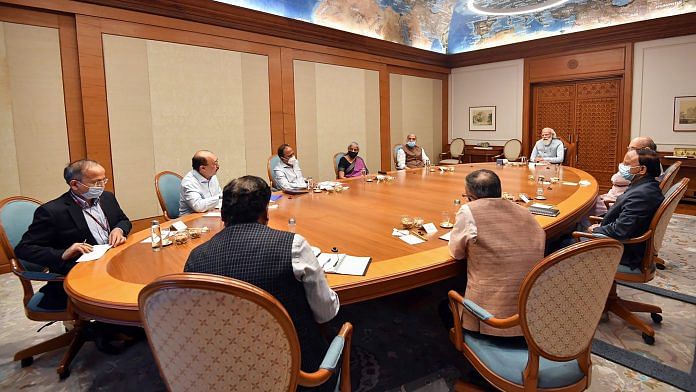
PM Narendra Modi chairs a meeting of Cabinet Committee on Security in the wake of Taliban capturing power in Afghanistan, New Delhi, 17 Aug 2021 | PTI
Rezaul Hasan Laskar reports that some members of the Taliban leadership informally reached out to Indian authorities a few days ago “requesting” that India retain its embassy in Kabul. Sher Mohammed Abbas Stanekzai, a top-tier Taliban leader based in Doha (and an early-1980s alum of the Indian Military Academy Dehradun) assured his Indian interlocutors of the safety of the Indian mission and its diplomats.
This should surprise us, but only mildly. The surprise arises from the antipathy the Taliban has shown towards India’s role in Afghanistan and its complaints (echoing Pakistan’s) about the activities of Indian missions in the country.
Beyond that, Stanekzai’s overture is quite understandable. If and when the Taliban take over the reins of power, their relationship with their backers and allies will undergo a simple, but profound shift. No sovereign likes to be treated as a puppet. The Taliban leadership is acutely aware that their ranks comprise fighters, not administrators, who are now called upon to govern a war-torn land-locked country, with precarious finances and an unsustainable economy. Those who put you on the throne will demand their pound of flesh at the best of times. In the present circumstances, China, Pakistan, Russia and Iran are unlikely to spare any time before they start pressing the new regime to accommodate their interests.
To balance this pressure, the Taliban regime will need counterweights. New allies and also new causes that reduce the leverage its backers have over it. Who can those new allies be? Not the West, for now. Gulf Arab countries, perhaps, but given their past experience in prevailing over their Afghan-inspired radicals, they will not be overly enthusiastic. The relationship with Iran complicates matters even further. So it is understandable that the Taliban will want to engage New Delhi. Of course, on their own terms.
Against such realpolitik considerations there is the fact that for all its attempts to show a less extremist face, the Taliban is led by Haibatullah Akhundzada, a man who is more of a fundamentalist zealot than Mullah Omar was. Then there is the Pakistani element whose primary objective is to remove all traces of Indian influence in Afghanistan. The Taliban regime’s attitude towards India will be determined by these push-pull factors and Stanekzai’s tentative outreach might not end up as its actual policy.
First, closing the embassy and flying Indian officials back was both the prudent and astute thing to do. There are a lot of people in capitals around the world who are now looking stupid after believing in the Taliban’s commitments. We need not add to their number. Informal or formal, the Taliban’s promises are not worth the paper they are not written on. Indian interlocutors must let this be known to Stanekzai and his associates.
Second, whatever Stanekzai might promise and genuinely intend, it is unclear if the Taliban leadership has adequate control over the situation on the ground that can ensure the safety of Indian diplomats. Even if they control Taliban ranks, Pakistani proxies are almost certain to use the chaos to carry out terrorist attacks against Indian targets. Razaul’s report alludes to intelligence assessments on the active presence of Pakistani jihadi groups in Kabul. Like during the IC-814 hijacking, the Taliban will tolerate and protect such terrorists.
Third, maintaining the mission would have meant a de facto diplomatic recognition of the de facto Taliban government in Afghanistan. Diplomatic recognition is not a concession that must be made readily. This is something that they have to earn. And it cannot come so cheaply.
Fourth, New Delhi should not be in any rush to spoil the Taliban’s enjoyment of the company of their backers. As I have pointed out, there are a number of faultlines among China, Pakistan, Russia, Iran and the Taliban. They have managed to suppress the conflicts in their interests so far, but now that Kabul is in Taliban hands, they will begin to emerge. Let the Taliban leadership smart and chafe at the noose around their neck. As the pressure tightens, so will the need for fresh air.
It’s not only the Taliban. India too has the time.
Nitin Pai is the director of the Takshashila Institution, an independent centre for research and education in public policy. He tweets @acorn. Views are personal.
This article has been republished from nitinpai.in with permission from the author.
The next round of challenge seeking startups to join the technology bandwagon in military equipment was launched today. The industry has been asked to address 35 separate technology demands of the armed forces and also the Defence Public Sector Undertakings (DPSUs).
The Ministry of Defence (MoD) is looking at areas such as situational awareness, augmented reality, artificial intelligence, aircraft-trainer, non-lethal devices, 5G network, under-water domain awareness, drone swarms and data capturing.
The technology being sought is designed to ensure military advantage in the foreseeable future. Defence Minister Rajnath Singh launched the scheme today it. Called the Defence India Startup Challenge, this is the fifth round of the challenge and is aimed to enrich Innovations for Defence Excellence (iDEX). The iDEX is a platform for different stakeholders in the defence and aerospace sectors, essentially acting as an umbrella organisation to oversee technology development and potential collaborations in the specific field.
iDEX uses the strong science technology and research talent base of the country. — TNS
Assistant commandant among 2 ITBP personnel killed in Naxal attack in Chhattisgarh
A squad of the ITBP’s 45th battalion, which was out on an area domination operation, was fired upon by a small action team of the ultras, when it was approximately 600 metres away from the camp
Photo for representation only
Narayanpur, August 20
An assistant commandant of the Indo Tibetan Border Police (ITBP) and his colleague were killed in a Naxal attack in Chhattisgarh’s Narayanpur district on Friday, a senior police official said.
The incident took place around 12.10 pm near Kademeta camp of 45th battalion of the ITBP under Chhotedongar police station limits, Inspector General of Police (Bastar range) Sundarraj P told PTI.
As per the preliminary information, a squad of the ITBP’s 45th battalion, which was out on an area domination operation, was fired upon by a small action team of the ultras, when it was approximately 600 metres away from the camp, he said.
“Assistant Commandant Sudhakar Shinde and Assistant Sub Inspector (ASI) Gurmukh Singh, both from the ITBP’s 45th battalion, were martyred in the firing,” the IG said.
After the attack, the Naxals also looted and escaped with one AK-47 rifle, two bullet-proof jackets and one wireless set of the security personnel, he said.
Reinforcement had been rushed to the spot and the bodies of the martyred personnel were being evacuated, he added. PTI
6Army men get Shaurya Chakra for anti-terror operations in Jammu and Kashmir
Recipients of the prestigious award are Major Arun Kumar Pandey, Major Ravi Kumar Chaudhary, Captain Ashutosh Kumar (posthumously), Captain Vikas Khatri, Rifleman Mukesh Kumar and Sepoy Neeraj Ahlawat
Photo for representation. PTI
New Delhi, August 14
India’s third-highest gallantry medal in peacetime, Shaurya Chakra, has been awarded to six Army personnel, including posthumously to one, for displaying bravery in anti-terror operations in Jammu and Kashmir last year.
The recipients of the prestigious award are Major Arun Kumar Pandey, Major Ravi Kumar Chaudhary, Captain Ashutosh Kumar (posthumously), Captain Vikas Khatri, Rifleman Mukesh Kumar and Sepoy Neeraj Ahlawat, according to the Indian Army.
It said four Army personnel were conferred the Bar to Sena medal while 116 others were named for the Sena medal on the eve of Independence Day.
According to the Army, Major Pandey of the 44th battalion of the Rashtriya Rifles led an anti-terror operation in a village in Jammu and Kashmir on June 9 and 10 last year and showed “unparalleled courage” while neutralising two hardcore terrorists.
Major Chaudhary of 55th battalion of the Rashtriya Rifles “exhibited exceptional resoluteness” and fortitude in leading four successful operations by his unit resulting in the elimination of 13 terrorists, the Army said.
An operation led by him on June 3 last year was specifically mentioned in his citation.
Captain Kumar of 18th battalion of the Madras Regiment has been conferred the Shaurya Chakra award posthumously for displaying “indomitable courage” and professional acumen of “highest order” in saving the life of one of his fellow soldier and eliminating a hardcore terrorist in an operation on November 8 last year.
Captain Vikas Khatri from the 16th battalion of the Rashtriya Rifles was deployed as part of a special task of “area domination patrol” in Jammu and Kashmir under the challenging terrain at the height of 12,000 feet on the nights of December 12 and 13 last year.
The Army said he eliminated one foreign terrorist despite heavy retaliation, showing raw courage and bravery.
Rifleman Kumar from the ninth battalion of the Rashtriya Rifles was part of a cordon and search operation launched on the night of July 16 based on specific intelligence inputs of the likely presence of terrorists in a remote village of Jammu and Kashmir.
“Kumar physically wrestled with the terrorist, who was shocked by the ferocity of the assault. He kept attacking the terrorist with the butt of his weapon in spite of sustaining a gunshot wound,” the Army said.
“Unmindful of his injuries, Rifleman Mukesh Kumar neutralised the terrorist from point-blank range ensuring no injuries to own troops or the civilians,” it added.
Sepoy Ahlawat has been conferred the Shaurya Chakra award for showing “exceptional gallantry beyond the call of duty and nerves of steel” during an anti-terror operation in Jammu and Kashmir on June 20 last year, the Army said.
One hardcore Pakistani terrorist was eliminated in the operation, it said.
Detailing about the incident, the Army said a group of terrorists was firing indiscriminately towards the inner cordon of the troops in a bid to escape, taking cover of civilians in the area as human shields.
It said Ahlawat waited for an opportune moment and fired accurately on the fleeing terrorists after exercising extreme restraint and displaying composure in the face of a rapidly escalating situation.
“One of the terrorists was eliminated on the spot. The second terrorist opened heavy fire towards Sepoy Ahlawat at close range. Despite the grave danger, he showed indomitable courage to hold onto his position and continued engaging the second terrorist, injuring him and damaging his sophisticated M-4 Assault Rifle,” it said.
The gallant actions of Ahlawat led to the elimination of a Pakistani terrorist, the Army said. PTI
State Stalwarts
DEFENCE MINISTER
Minister Rajnath Singh
ALL HUMANS ARE ONE CREATED BY GOD
HINDUS,MUSLIMS,SIKHS.ISAI SAB HAI BHAI BHAI
CHIEF PATRON ALL INDIA SANJHA MORCHA
LT GEN JASBIR SINGH DHALIWAL, DOGRA
SENIOR PATRON ALL INDIA SANJHA MORCHA
MAJOR GEN HARVIJAY SINGH, SENA MEDAL ,corps of signals
.
.
PATRON ALL INDIA SANJHA MORCHA
MAJ GEN RAMINDER GURAYA ,MADRAS REGIMENT
sanjhamorcha303@gmail.com
PRESIDENT SOUTH ALL INDIA SANJHA MORCHA
COL SS RAJAN BOMBAY SAPPERS,
PRESIDENT UTTARAKHAND ALL INDIA SANJHA MORCHA
COL B M THAPA ,BENGAL SAPPERSS
PRESIDENT HARAYANA STATE CUM COORDINATOR ESM
BRIG DALJIT THUKRAL ,BENGAL SAPPERS
PRESIDENT TRICITY
COL B S BRAR (BHUPI BRAR)
PRESIDENT CHANDIGARH ZONE
COL SHANJIT SINGH BHULLAR
.
.
PRESIDENT PANCHKULA ZONE AND ZIRAKPUR
COL SWARAN SINGH
INDIAN DEFENCE FORCES
DEFENCE FORCES INTEGRATED LOGO
INDIAN AIR FORCE
Air Officer C-in-C WESTERN AIR COMMAND
AIR MSHL S PRABHAKARAN AVSM VM
AOC-IN-C, EASTERN AIR COMMAND
Air Marshal Inderpal Singh Walia
AOC-in-C SOUTH WESTERN AIR COMMAND
Air Marshal Vikram Singh
AOC-IN-C, SOUTHERN AIR COMMAND
Air Marshal J.Chalapati
AOC-IN-C TRAINING COMMAND
AIR MARSHAL SK GHOTIA VSM
AOC-IN-C MAINTENANCE COMMAND
Air Marshal Jagdish Chandra
Flag Officer Commanding in Chief, Western Naval Command
ice Admiral R Hari Kumar, PVSM, AVSM, VSM
Flag Officer Commanding in Chief, Eastern Naval Command
Vice Admiral Sanjay Bhalla, AVSM, NM
Flag Officer Commanding in Chief, Southern Naval Command