









Sanjha Morcha

What’s New

Click the heading to open detailed news

Current Events :

web counter

Print Media Reproduced Defence Related News

14th round of India-China Commander-level talks likely on Jan 12

Indian side expected to press for disengagement in all the remaining friction points, including resolution of issues in Depsang Bulge and Demchok
14th round of India-China Commander-level talks likely on Jan 12

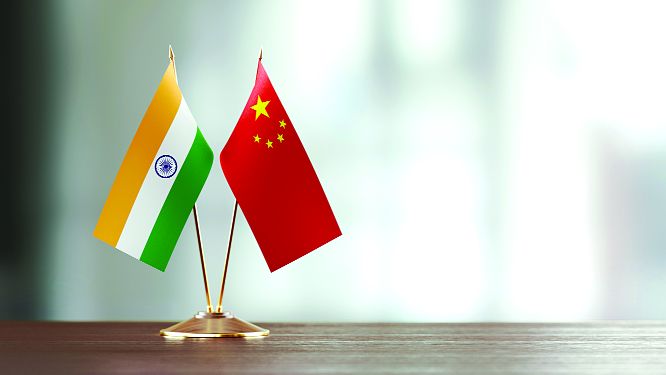
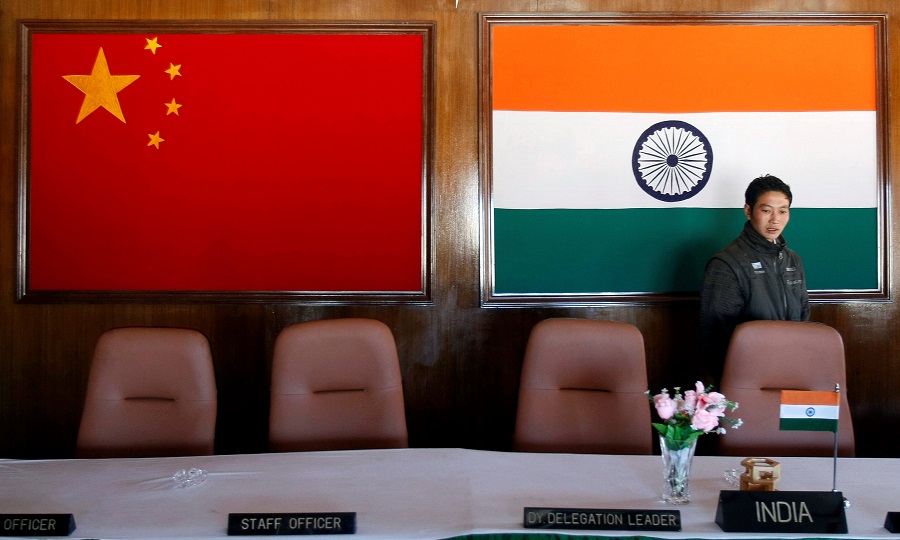
Photo for representational purpose only. iStock

New Delhi, January 7

India and China are likely to hold the 14th round of corps commander-level talks on January 12 with a focus on making some forward movement in the disengagement process in the remaining friction points in eastern Ladakh, people familiar with the development said on Friday.

The talks are expected to take place at the Chushul border point on the Indian side of the Line of Actual Control (LAC) in eastern Ladakh, they said.

The Indian side is expected to press for disengagement as soon as possible in all the remaining friction points, including resolution of issues in Depsang Bulge and Demchok.

The 13th round of talks had taken place on October 10 and had ended in a stalemate.

Both sides failed to make any headway in the talks with the Indian Army saying after the dialogue that the “constructive suggestions” made by it were not agreeable to the Chinese side, which also could not provide any “forward-looking” proposals.

In their virtual diplomatic talks on November 18, India and China agreed to hold the 14th round of military talks at an early date to achieve the objective of complete disengagement in remaining friction points in eastern Ladakh.

It is learnt that the Indian side had sent at least two proposals for the 14th round of talks in the last two months but the Chinese side was not responding to them positively so far.

The talks are likely to take place on January 12, said the people cited above.

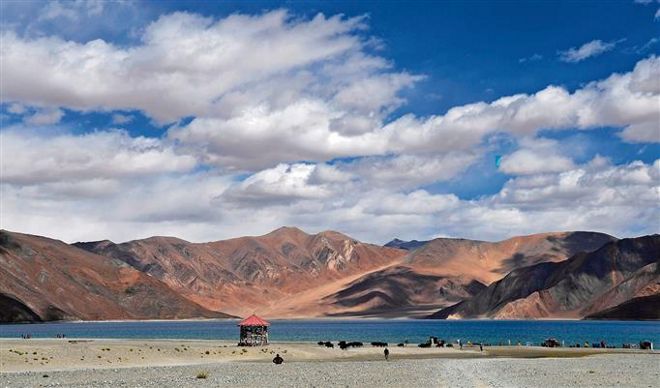
The eastern Ladakh border standoff between the Indian and Chinese militaries erupted on May 5, 2020, following a violent clash in the Pangong lake areas.

Both sides gradually enhanced their deployment by rushing in tens of thousands of soldiers as well as heavy weaponry.

As a result of a series of military and diplomatic talks, the two sides completed the disengagement process last year in the north and south banks of the Pangong lake and in the Gogra area.

Each side currently has around 50,000 to 60,000 troops along the Line of Actual Control (LAC) in the sensitive sector. PTI
Commander-level LAC talks on Jan 12

Commander-level LAC talks on Jan 12

Ajay Banerjee

Tribune News Service

New Delhi, January 7

Three months after India and China blamed each other for the breakdown of military commander-level talks, commanders of the two sides are set to meet again.

According to sources, the meeting has been scheduled for January 12. This will be the first meeting at the level of Lt Generals after October 10 and the 14th round of senior military-level talks since June 6, 2020. Pullback from military posturing along the 832-km LAC in eastern Ladakh will be the main agenda. The existing impasse is over Patrolling Point-15 (PP-15), also referred to as Hot Springs, besides the Depsang Bulge, a 972-sq km plateau. Both places are in eastern Ladakh.

Troop build-up on either side, for now, shows no signs of getting back to pre-April 2020 levels. On October 10, the meeting ended in a deadlock with both countries blaming each other. A meeting of the Working Mechanism for Consultation and Coordination on India-China Border Affairs held in November laid out the agenda for talks again. On January 1, troops of either side exchanged sweets at the Line of Actual Control.

Pullback on agenda

  • Pullback from the 832-km LAC in eastern Ladakh will be the main agenda of the talks
  • The existing impasse is over Patrolling Point-15, also referred to as Hot Springs, besides Depsang Bulge

India reiterates no first use of N-arms

N-powers vow not to strike any country

India reiterates no first use of N-arms

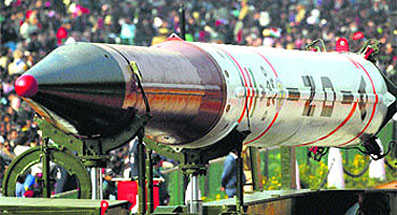
India has welcomed the first-ever joint statement earlier this week by the five “recognised” nuclear powers about avoiding an arms race and not targeting each other or any other state. Photo for representation only.

Tribune News Service

New Delhi, January 7

India has welcomed the first-ever joint statement earlier this week by the five “recognised” nuclear powers about avoiding an arms race and not targeting each other or any other state.

The statement reaffirms the importance of addressing nuclear threats and underscores the desire to work towards creating a security environment more conducive to progress on disarmament with the ultimate goal of a world without nuclear weapons with undiminished security for all, said MEA spokesperson Arindam Bagchi when asked to comment on the statement by leaders of China, France, Russia, the UK and the US, the permanent members of the UN Security Council.

The statement was issued after the NPT review that was to begin on Tuesday was postponed due to the pandemic. Though India and Pakistan have tested nuclear weapons, they are not considered nuclear powers. “India has a doctrine of maintaining a credible minimum deterrence based on a no first use posture and non-use of nuclear weapons against non-nuclear weapon states,” said the Ministry of External Affairs.


The border  warriors

With an ever-increasing influx of terrorists, drugs and weapons entering the Indian territory from the borders, there remains a continuous challenge to recruit fresh blood in the BSF and train them for any counter-insurgency. Tribune reporter Deepkamal Kaur and photographer Sarabjit Singh take a round of the BSF training camp at Kharkan in Hoshiarpur, which is well-equipped with ranges, grounds and instructors for specialised training

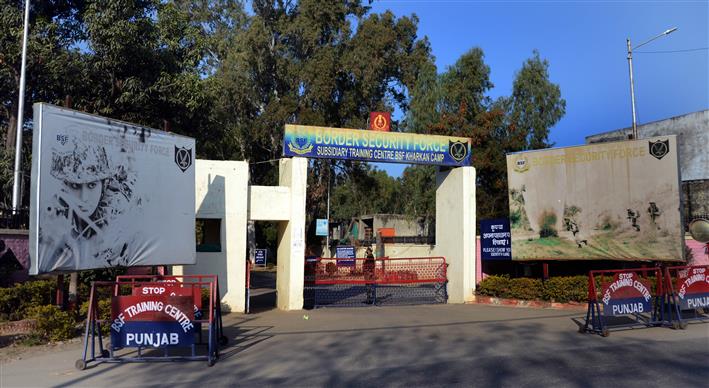
Taking up a daunting task to train its recruits involved in the first line of control, the Subsidiary Training Centre of the Border Security Force at Kharkan in Hoshiarpur has a lot to offer.

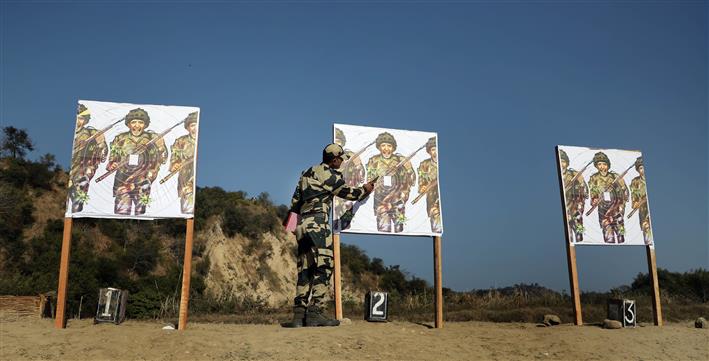
A firing range instructor takes a class of trainees around the target area at Kharkan camp.

Spread in an area of 898 acres along the Una road, multiple batches of more than 1,400 fresh recruits and in-service personnel are currently taking a rigorous training here before they join the 2.50-lakh strong force and are made capable enough to guard the 3,323 km India-Pakistan and the 4,096 km India-Bangladesh borders.

The tough regime for the 10-month training shapes up both their personality and built.

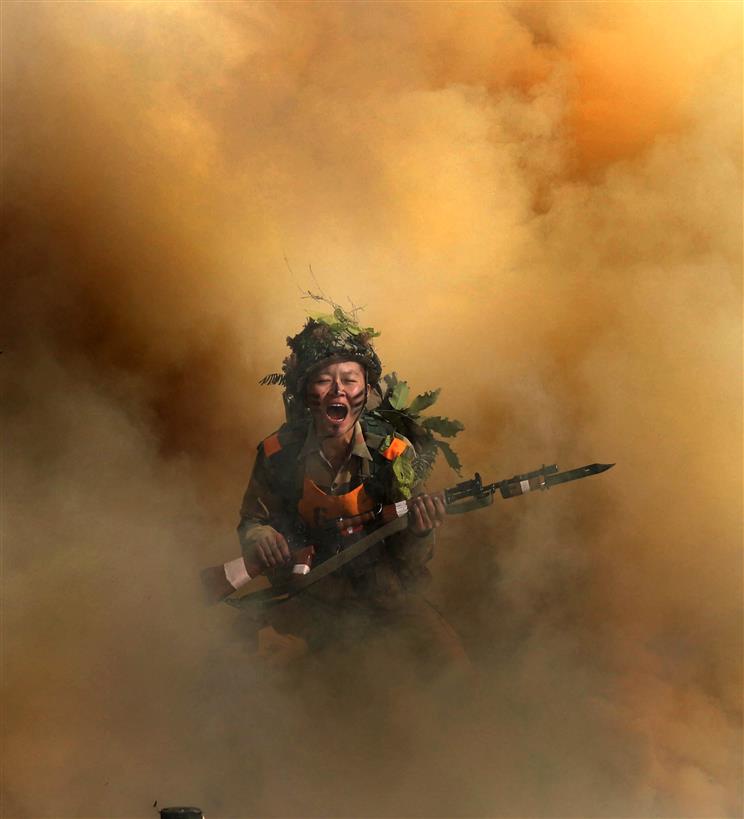
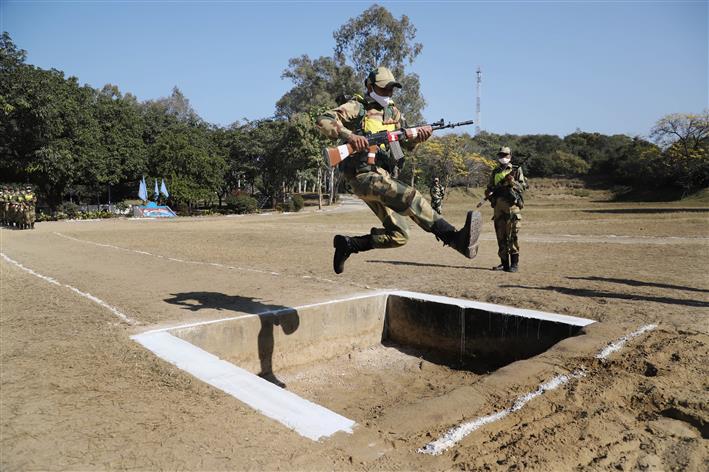
Most of the current trainees, who include over 900 women, hail from Nagaland, Manipur, Mizoram, West Bengal and Maharashtra. The 44-week rigorous training for the freshers includes PT, running, rope climbing, trench jumping, weapon handling, shooting practice, battle inoculation and horse riding.

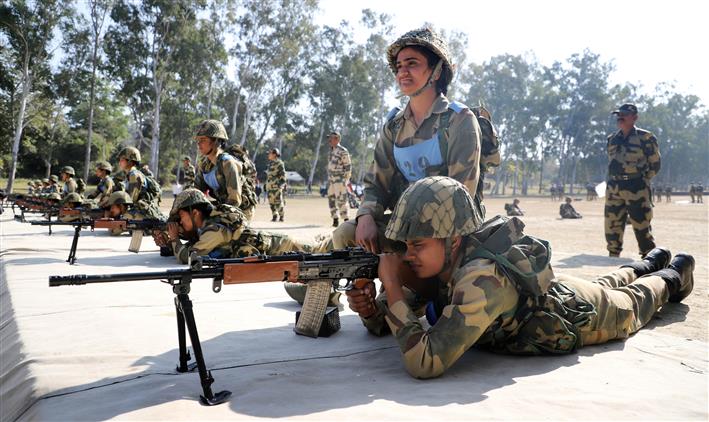
Women trainees hone their shooting skills at the firing range on the STC grounds.

The Kharkan campus is well equipped with shooting ranges, training areas, stadium etc. It encompasses 224.5 acres of forest area around where several herds of monkeys, wild cats and snakes thrive. It is in this jungle that the trainees learn to set up camps. Despite cold weather, recruits have to wake up early in the morning and reach the training grounds even when it is still dark. The tough regime that they are made to follow for the 10-month training shapes up both their personality and built. The instructors training them on the campus share that there is a drastic change in the looks, conduct and posture of the trainees on the occasion of the passing-out parade and when their families catch up with them, it is difficult for them to recognise their wards. 

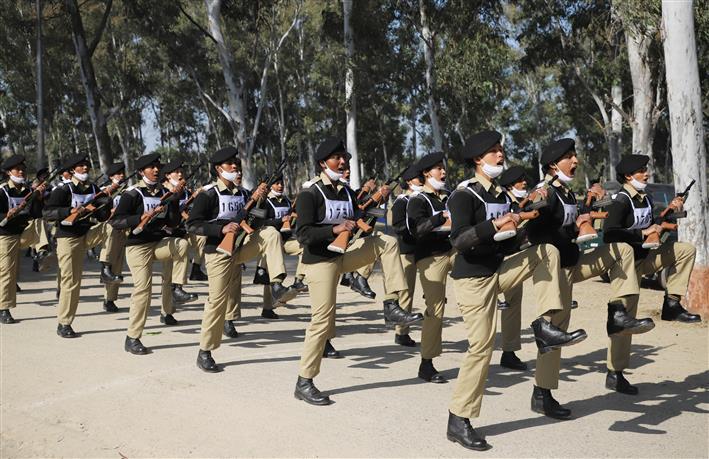
BSF trainees parade with weapons.
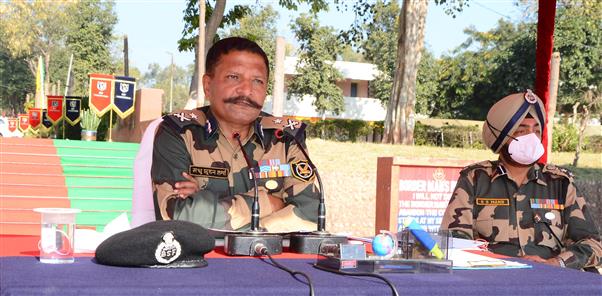
Kharkan Camp IG Madhu Sudan Sharma and Commandant (Training) SS Mand during a meeting.
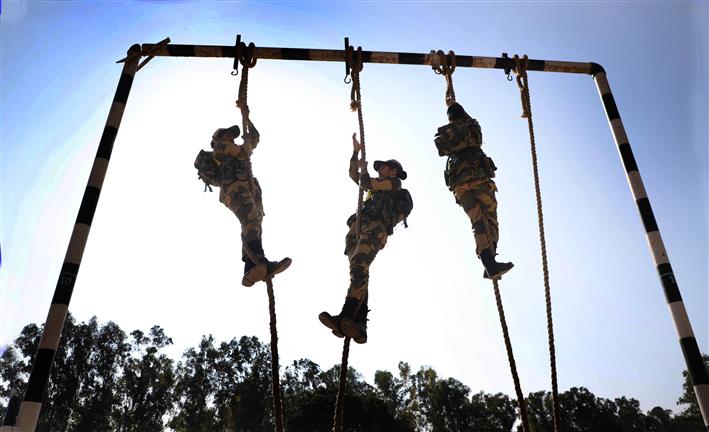
BSF trainees practice rope climbing during a training session.
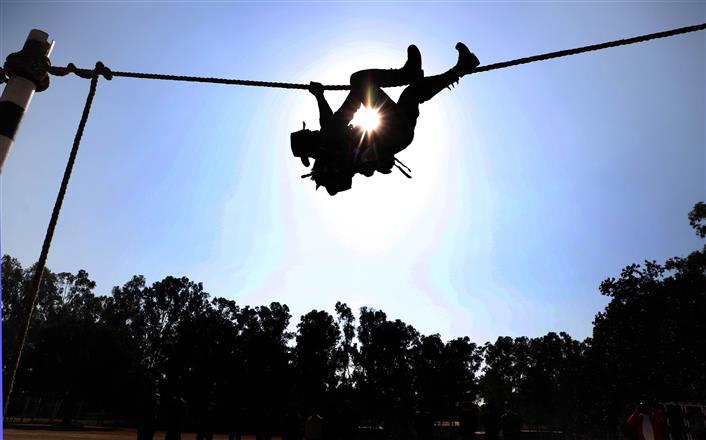
A BSF trainee practices monkey method rope climbing.
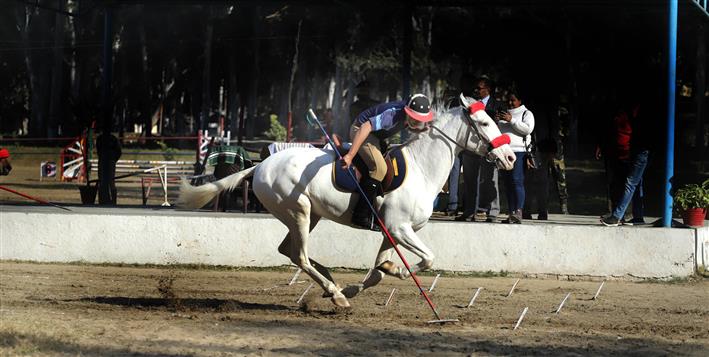
A jockey tries his hand at tent pegging at STC Kharkan Camp.
A women trainee crosses a trench as a part of the daily drill.
The entrance to Sub-Training Centre of the BSF at Kharkan in Hoshiarpur.

IAF developing real-time health monitoring system for pilots that will enhance flight safety

Fitness and sound health of aircrew is imperative as flying, particularly in the fighter aircraft stream, involves physical, physiological and psychological stress

IAF developing real-time health monitoring system for pilots that will enhance flight safety

Vijay Mohan

Tribune News Service

Chandigarh, January 4

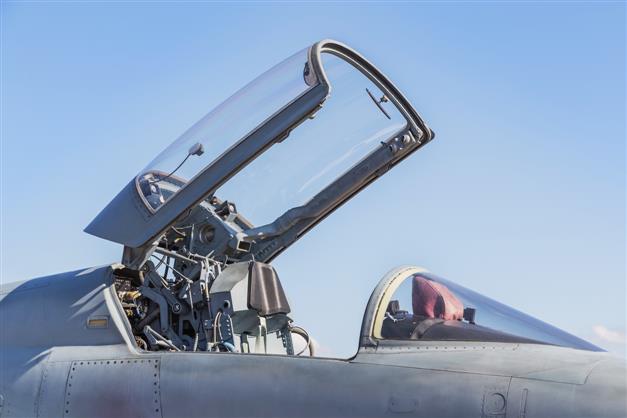
The Indian Air Force is developing a real-time health monitoring system for aircrew that will continuously assess the fitness levels of pilots during flight and relay a warning in case of any abnormality.

According to sources, the Air Force has already drawn up the conceptual requirements for the system and is taking the project forward in collaboration with the industry as well as the medical establishment.

“What we are looking at,” an IAF officer said, ”is a wearable sensor like a wrist band or a stick-on patch that records the pilot’s parameters like blood pressure, temperature, heart rate and oxygen saturation level continuously or at periodic intervals and is integrated with the aircraft’s communication system so that the information is transmitted to ground control.”

In case of any deviation in parameters, the sensors can sound an alarm and air traffic controllers and medical specialists can take preventive or corrective steps by advising the aircrew on how to handle the situation, he added. This is a step further in enhancing flight safety as a large proportion of aircraft accidents are attributed to human factors.

Fitness and sound health of aircrew is imperative as flying, particularly in the fighter aircraft stream, involves physical, physiological and psychological stress. Fighter pilots are exposed to high g-levels, noise, lower oxygen levels and high cognitive workload.

“With in-flight refuelling, the duration of fighter flying has increased, which also enhances associated risks like fatigue and physical discomfort. Remaining confined to restricted cockpit space for a long time with little physical movements also has adverse effects on the body and mind,” an officer said.

Recently, the IAF’s newly inducted Rafale fighter jets had flown non-stop to India from France, a journey covering about 7,000 km in more than eight hours. It was an unprecedented cockpit experience for the IAF.

Even though it was a level flight at sub-sonic speed with much reduced exposure to g-levels, the pilots had to remain alert and carry out all in-flight procedures, besides sitting in the same position in a cramped space for an extremely long time.

A study published by the IAF’s Institute of Aerospace Medicine, Bengaluru, in 2021 revealed that the pain and discomfort following a six-hour prolonged restraint sitting were highly noticeable along with a significant change in the calf circumference and other physiological parameters due to effects of venous pooling. “The effects so observed could have potential flight safety implications and affect mission effectiveness,” the study observed. 


China at it again

Work on bridge, renaming of Arunachal areas reveal intent

China at it again

Indian and Chinese troops exchanged sweets at border posts along the Line of Actual Control (LAC), including areas of eastern Ladakh, to ring in the New Year. For an instant, this goodwill gesture made the prolonged standoff between the two sides recede into the background. Not surprisingly, the mirage of bonhomie has proved to be short-lived. The PLA is relentlessly building infrastructure near the LAC, making it crystal-clear that China is in for the long haul. The Chinese are constructing a bridge on the Pangong Tso lake that will shorten a distance of 180 km on the Tibet-Xinjiang highway, thus helping them deploy troops faster between the north and south banks of the lake.

In another telltale sign of provocative posturing, China recently renamed the Sela pass, eight villages and towns, four mountains and two rivers in ‘Zagnan’ or South Tibet — the name used by Beijing for Arunachal Pradesh. The move comes amid ongoing construction of the Sela tunnel, likely to be ready by June this year, by India’s Border Roads Organisation. The tunnel is expected to facilitate faster movement of Indian troops in Arunachal’s Tawang, a strategically located district bordering China. It was in the Tawang sector that Indian and Chinese troops were engaged in a brief face-off in October last year. That month, the 13th round of Corps Commander-level military talks had ended in a stalemate. No round of talks has been held since then.

New Delhi has rightly been holding Beijing responsible for not walking the talk on ensuring long-term peace and tranquillity in the border areas. While remaining in a state of high alert, India should continue to ramp up infrastructure along the LAC. India’s efforts to bolster its military prowess, including the deployment of a state-of-the-art air defence missile system, are undoubtedly keeping China on tenterhooks. Exercising restraint in the face of provocation will be a challenge, even as every Chinese misadventure must evoke a firm response. Matching the hostile neighbour’s battle-readiness will hold the key to a stable balance of power in the region.


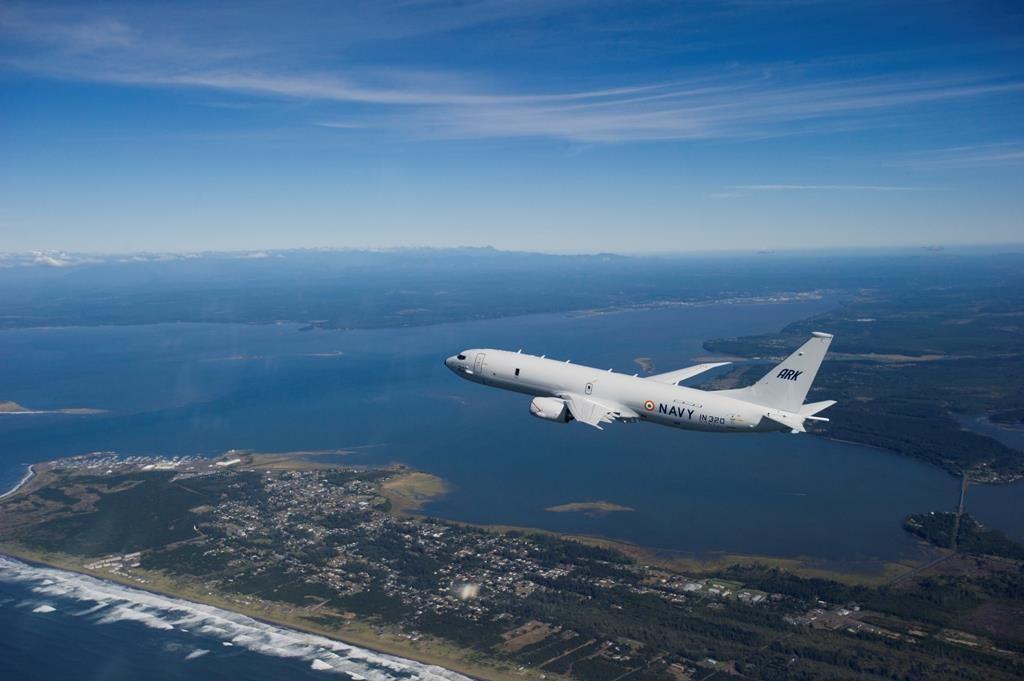
Navy’s Boeing P-8I aircraft begin operations from INS Hansa

Navy's Boeing P-8I aircraft begin operations from INS Hansa

Picture for representational purpose only.

New Delhi, January 4

The Navy’s Boeing P-8I aircraft used for long-range maritime reconnaissance have commenced operations from the west coast of India. The planes will be based at INS Hansa, Goa. The Navy said two aircraft arrived on December 30. — TNS


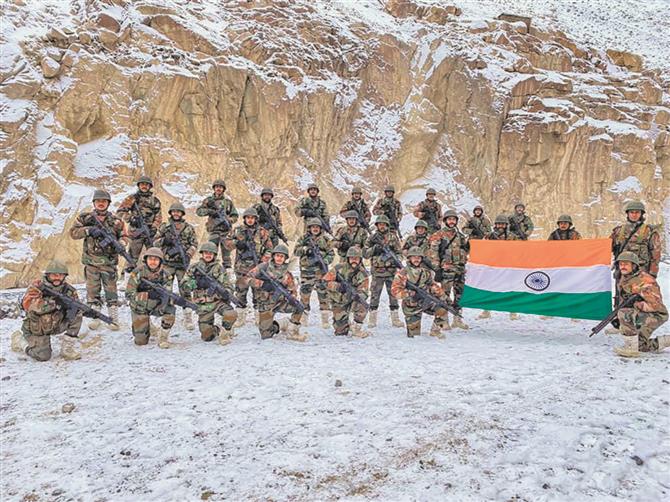
Tricolour at Galwan valley, Army defies Chinese pitch

Tricolour at Galwan valley, Army defies Chinese pitch

Indian soldiers pose with the Tricolour as part of New Year celebrations at Galwan valley in Ladakh. pti

Ajay Banerjee

Tribune News Service

New Delhi, January 4

Within days of Chinese claims of unveiling their country’s flag at Galwan valley, it turned out that the Indian troops too had unfurled the Tricolour there on the New Year’s Day.

Edit: China at it again

Sources in the security establishment released a set of pictures that show fully armed troops of the Indian Army carrying US-made Sig Sauer rifles and holding a large Tricolour as part of New Year celebrations at Galwan valley in eastern Ladakh.

Sri Lanka clears pact with india for oil tanks

Sri Lanka’s Cabinet on Tuesday approved a milestone deal to modernise most of its strategic Trincomalee petroleum storehouses jointly with India. The development comes before Chinese Foreign Minister Wang Yi visits Colombo after bad blood due to a soured deal for fertilisers. 

The move is seen as a flag-for-flag response to a video by the Chinese state media purportedly showing PLA soldiers unfurling their national flag in the region three days back. The two armies had exchanged sweets and greetings on January 1 at 10 spots along the 3,488-km-long undemarcated boundary. Sources say the Chinese flag unveiling and sloganeering was not at Galwan valley where troops of both sides had clashed in June 2020.

The video could have been shot anywhere along the Galwan river valley bed on the Chinese side. There are no geo coordinates to indicate that it was shot at the LAC, claim the sources. The image of Chinese troops shows white-coloured markings on the mountain. There is no marking visible on the mountains at the spot where the Galwan river enters Ladakh from Tibet.

The Galwan river enters India after a sharp westward bend and some 7 km downstream joins the Shyok river for its onwards journey into the Indus. The LAC is close to the bend where the river takes a westward turn. Part of the valley is on the other side of the LAC and some part is in India. The images, which the Indian side clicked, showed a fully occupied post and small platoon of men clothed in winter clothing, snow boots and fully armed.