



Sanjha Morcha

What’s New

Click the heading to open detailed news

Current Events :

web counter

Print Media Reproduced Defence Related News

Returning militants’ bodies to
kin not feasible, top court told

Srinagar, August 29 The J&K police on Monday informed the Supreme Court that it was not feasible to hand over the bodies of people, killed by security forces in encounters, to their families as it would open the floodgates of similar litigations. Even the J&K administration said that handing over of bodies to families could lead to law and order issues. On November 15, Amir Magray, along with two civilians—Altaf Bhat and Mudasir Gul—and a militant were killed in an encounter at Hyderpora locality in Srinagar. Their bodies were buried in Zachaldara Wudar in Handwara, nearly 100 km away from Srinagar, triggering protests and forcing authorities for the first time to return the bodies of Bhat and Gul. Magray’s father Muhammad Lateef filed a petition to seek his body. Lateef claimed Magray was innocent, but according to the police, he was a militant. A Bench comprising Justices Surya Kant and JB Pardiwala, after hearing all parties, reserved judgment in the case. J&K counsel Ardhendumauli Prasad argued before the court, “…there are many terrorists being encountered. If this (returning of bodies) is allowed, the high court will be filled with similar prayers seeking to perform last rites.” “As far as the state is concerned, he (Amir) was a terrorist. It is not in dispute that there are certainly such people who have been buried and they are purposely not buried in native places for the reason that it takes into account the glorification…young minds are swayed..the terrorists sneak in and they say very good things and the younger minds are drawn into terrorism. That is the reason why the state consciously does not bury them in the same town or in the same village,” Prasad said. Since April 2020, the police have not handed over the bodies of militants and civilians killed in anti-militancy operations in Kashmir to their families, citing Covid restrictions. They are instead buried in remote graveyards in border areas. In 2020, at least 158 people, mostly militants, were buried in these locations, while last year, nearly 180 bodies were buried.


Army Chief on a 5-day visit to Nepal to boost defence ties

Will be conferred with the honorary rank of ‘General of the Nepal Army’ by Nepalese President

Army Chief on a 5-day visit to Nepal to boost defence ties
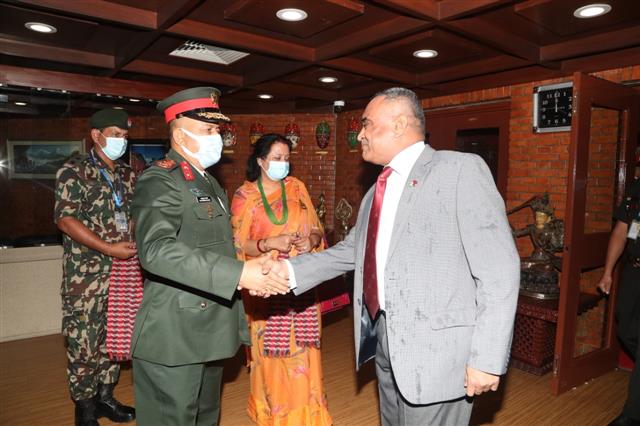
Vice COAS of Nepali Army Lt Gen Bal Krishna Karki (left) receiving Army chief Gen Manoj Pande in Kathmandu on Sunday.

PTI

New Delhi, September 4

In continuation of a seven-decades-old tradition, Army Chief Gen Manoj Pande will be conferred with the honorary rank of “General of the Nepal Army” by Nepalese President Bidya Devi Bhandari at a ceremony in Kathmandu on Monday.

The issue of induction of Gorkhas from Nepal into the Indian Army under the Agnipath scheme is also likely to figure in Gen Pande’s talks in Kathmandu which reportedly conveyed to New Delhi that the recruitment under the new scheme does not conform to existing provisions for it.

The Army said Gen Pande will call on Bhandari, Prime Minister Sher Bahadur Deuba and will hold wide-ranging talks with Nepal Army Chief Gen Prabhuram Sharma, apart from meeting with the senior military and civilian leaders of the Himalayan nation.

“This visit will provide an opportunity to take stock of the existing bilateral defence ties and strengthen cooperation in areas of mutual interest,” the Army said in a statement.

It said Gen Pande will be conferred with the honorary rank of General of Nepal Army on Monday in a ceremony at Sital Nivas, the official residence of Bhandari.

The tradition started in 1950. India also confers the honorary rank of “General of Indian Army” to the Nepal Army Chief. Gen Pande is also scheduled to visit Nepal Army headquarters where he will pay homage to the fallen soldiers and have interactions with the senior leadership of the force.

“During his visit, the Chief of Army Staff will also interact with the student officers and faculty of the Nepali Army Command and Staff College Shivpuri,” the Army said.

The Army Chief is scheduled to call on the Nepalese Prime Minster on Tuesday.

Nepal is important for India in the context of its overall strategic interests in the region, and the leaders of the two countries have often noted the age-old “Roti Beti” relationship.

The country shares a border of over 1,850 km with five Indian states – Sikkim, West Bengal, Bihar, Uttar Pradesh and Uttarakhand.

Land-locked Nepal relies heavily on India for the transportation of goods and services.

Nepal’s access to the sea is through India, and it imports a predominant proportion of its requirements from and through India.

The India-Nepal Treaty of Peace and Friendship of 1950 forms the bedrock of the special relations between the two countries.

“India-Nepal relations are historic, multifaceted and marked by common cultural and civilisational ties, apart from mutual respect and trust,” the Army said.

“India attaches the highest priority to its relationship with Nepal in accordance with its ‘Neighborhood First’ and ‘Act East’ policies,” it said.  


Slowing down of China

BY

MANOJ JOSHI
DISTINGUISHED FELLOW, OBSERVER
RESEARCH FOUNDATION

Formally, China insists that it wants good ties with India and
sees it as a part of its vision for Asia. Practically, however, it
envisages an India with a subordinate status.

T HIS has not been a happy year for the Chinese leadership. The Ukraine war, economic headaches arising from the mortgage crisis compounded by the difficulties of adopting a ‘zero Covid’ policy have hobbled the march to the coming 20th Communist Party of China Congress. Yet, none of these developments have hampered the party general secretary Xi Jinping’s plan to be re-elected for an unprecedented third term. This is being sold as a necessity, given that China is now entering turbulent waters, economically and politically, and needs the steady hand of an experienced helmsman. Xi Jinping has given shape to China’s current pursuit of a great ‘national rejuvenation’ and declared that it cannot be achieved without Taiwan. Meanwhile, China’s immediate troubles have also spurred thinking along longer-term assessments. One scenario is that China is headed for a sharp decline. Its demographic profile has begun to deteriorate at a fast pace, sharply reducing its working age population. The rising household debt-to-GDP ratio at over 60 per cent — a World Bank red line — will undermine its strategy of promoting domestic consumption. But China watchers like Oriana Mastro and Derek Scissors say that China’s decline from its peak will not be precipitous, but gradual, and the Chinese are heavily investing in R&D and infrastructure to offset the decline. Their blunt assessment is that ‘current income and defense spending trajectories suggest that China will have more resources to compete militarily with the United States over the next 10 years than it has had over the last 20.’ Both scenarios make for a China that is dangerous. In the ‘sharp decline’ scenario, Beijing will be in a hurry to cement its Asian dominance and, more importantly, resolve its Taiwan ‘problem’. Chinese military strength, backed by deep reforms and modernisation, has professionalised its military at all levels. The Military Civil Fusion (MCF) strategy had injected considerable civilian expertise into enhancing the supporting infrastructure of the PLA. Its navy is already the largest in the world and could have six or seven aircraft carriers in the next 15 years. Besides debt and demographics, China is also facing a resource crunch which makes it more dependent on imports of food, energy and other strategic raw materials. In the past two years, there have been electricity outages, compelling Beijing to reverse course on plans to do away with dependence on coal. China is by far the largest emitter of greenhouse gases, though it is also an undisputed leader in expanding renewable energy. Being import dependent is not an issue, China is not short of money to finance them. But Beijing has also increasingly belligerent relations with the US, the world’s foremost naval power which has the capacity, if the occasion so demands, to interdict its supply routes. Under Xi Jinping, China has ratcheted up the use of Chinese power. It has been able to make Xinjiang a vast prison camp without a peep from the Islamic countries. It took the risk of destroying Hong Kong’s free status without much of a fuss from the international community. It also conducted an exercise of coercion against India by amassing forces in Tibet and altering the Line of Actual Control. Now, of course, has come the issue of Taiwan whose own industrial capacity, especially in the making of semiconductors, makes it a global resource. Taiwan has some twothirds of the world’s chip foundry capacity and its disruption would have a fallout around the world. Many suggest that a forcible Chinese attempt to incorporate Taiwan is a matter of when, not if. The US-Japanese response to the growth of Chinese power in the IndoPacific is their Indo-Pacific strategy. This includes a quadrilateral grouping, of which India is a part, and which is aimed at shaping a network of democratic countries in the Indo-Pacific in economic, social and political spheres. Linked to this is the formation of the Australia, UK and US (AUKUS) alliance aimed at shoring up the military power ranged against China in the western Pacific. Meanwhile, through the Pacific Deterrence Initiative (PDI), the US is reorganising and revamping its own forces, just as the Japanese are. More recently, Washington has come out with the Indo-Pacific Economic Framework (IPEF), of which India is also a member. It is a flexible programme to tackle issues relating to infrastructure, supply chain resilience, clean energy and digital trade. Faced with the growing military power gap with China, New Delhi, has signed up to Quad and IPEF to balance China. India has a 4,000-km disputed border with China claiming significant Indian territory. In a recent interview, Kevin Rudd has noted that the Chinese view their Indian claim on a par with those of the South China Sea, Taiwan and the East China Sea. The Indian approach so far has been incremental and cautious, as manifested by the somewhat belated Indian critique last week of China for militarising the Taiwan straits. The overall situation offers opportunities, but also comes with dangers for India. Quad’s growing agenda of health cooperation beyond Covid, supply chain resilience, emerging technologies and their standards, maritime domain awareness can be an economic game changer for India. Yet, there is need to be careful in dealing with an assertive and powerful China. Formally, the Chinese insist that they want good relations with New Delhi and want it to be a part of their vision for Asia. Practically, however, they envisage an India with a subordinate status. Many of these issues will play out in Xi Jinping’s third term, and, possibly a fourth term till 203


Assam Rifles jawan held for murder of wife, daughter

The jawan hails from Akhnoor area in Jammu

Assam Rifles jawan held for murder of wife, daughter

Silchar, September 4

An Assam Rifles jawan has been arrested in Assam’s Cachar district for allegedly killing his wife and daughter, police said on Sunday.

Police said neighbours found Manika, 31, and her daughter Riddhi, 12, dead in their official quarter at Srikona camp, about 15 km from here, on Saturday morning.

Police launched a search for the missing husband, Rabindar Kumar, who hails from Akhnoor area in Jammu.

The jawan was found at a temple near his quarter in an incoherent state, from where he was arrested, police said.

Kumar was produced before a local court, which remanded him in judicial custody.

“We have started an investigation to determine the cause of the murders,” police said. 


Army gives out names of 7 soldiers killed in Ladakh accident; 19 injured airlifted to Chandigarh

Prompt surgical procedures undertaken on critically-injured soldiers and all are stable currently, says Army

Army gives out names of 7 soldiers killed in Ladakh accident; 19 injured airlifted to Chandigarh

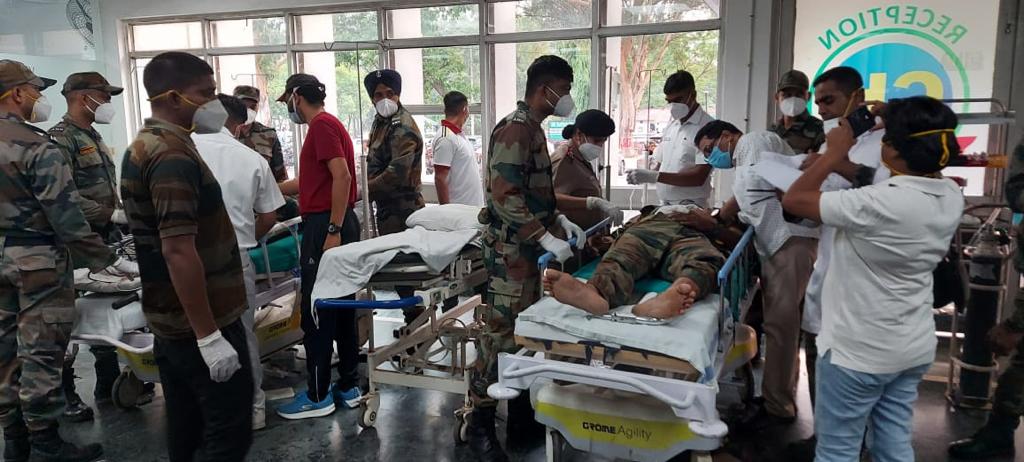
he Indian Army on Saturday night announced that bodies of seven soldiers, who were killed in a road accident near the Line of Control (LoC) in Turtuk sector of Ladakh, shall move to their respective native places for last rites.

The Army also gave out the names of those killed in the mishap. Names are released only after the families of those dead are informed officially.

The bodies will be moved to Delhi from where separate civilian aircraft shall carry the mortal remains to respective places.

Those dead are Subedar Shinde Vijayrao from Satara, Maharashtra; Naib Subedar Gurudayal Sahu from Betul, Madhya Pradesh; Naik Sandeep Pal from Hazaribagh, Jharkhand; Naik Ramanuj Kumar from Patna, Bihar; Naik Jadhav Prashant Shivaji from Kolhapur, Maharashtra and Lance Naik Bappaditya Khutia from Pashchim Mednipur in West Bengal.https://366f5a87110bc7ee62d1d1703d9a468f.safeframe.googlesyndication.com/safeframe/1-0-38/html/container.html

The dead were among a party of 26 soldiers who were moving from the transit camp in Partapur near Siachen to a forward location in Sub Sector Hanif, when the accident occurred.

The vehicle skidded off the road and fell in Shyok River resulting in injuries to all occupants. Seven of the occupants died, 19 other injured are under treatment at Western Command hospital at Chandimandir.


Warship in troubled waters
China’s ill-timed cornering of Sri Lanka

FROM the outset, it made little sense for the Chinese to send a spy
ship to Sri Lanka when the country was reeling under its worstever economic crises. Colombo could have done without getting
caught in strategic rivalry. It was chicanery on Beijing’s part to have
sought permission from a dying regime for a ‘research ship’ — which
spies on a country’s coastal defences on the side — to dock at Hambantota. The Presidential Palace in Colombo was about to be stormed and
President Gotabaya Rakapaksa was literally packing his bags. A new
administration in Colombo under Ranil Wickremsinghe as President
was served a Chinese fait accompli when it took over because the ship
was a few days’ sail away from Hambantota.
After the new regime withdrew permission to dock and with no
alternative port immediately available, the Chinese pulled the strings
to gain a reluctant permission. The matter should have ended at that.
But the Chinese envoy sought to set off Sri Lanka against India in a
series of tweets. Some were laughably naïve, such as equating the Taiwan crisis to the docking of the spy ship. But there was a crude bid to
drive a wedge between India and Sri Lanka by alleging that Sri Lanka had been invaded by its northern neighbour 17 times. He, perhaps,
tabulated all the local skirmishes involving ancient and medieval
kingdoms on either side of the Palk Strait.
The Chinese envoy was also wrong when he faulted India for
raising ‘security concerns’ without any evidence. He omitted to
inform that when Sri Lanka relented and allowed the ship to dock,
three conditions were imposed. It had to keep its Automatic Identification System switched on and was barred from scientific research

in the Lankan waters, which meant that the ‘research’ equipment
on the ship had to be shut down. Lastly, no Chinese crew was
allowed to disembark. In other words, Colombo took care of the
security concerns as far as it could. For now, as the Indian Foreign
Office said, Sri Lanka needs support, not unwanted pressure or
unnecessary controversies to serve another country’s agenda.


Indian Navy to change ensign, fourth time since ’50

Indian Navy to change ensign, fourth time since ’50

The Indian Navy will get a new ensign -– the flag that is hoisted atop all naval warships, ground stations and naval air bases. This is the fourth time since 1950 that the naval ensign will undergo a change. – PTI file photo

Tribune News Service

New Delhi, August 30

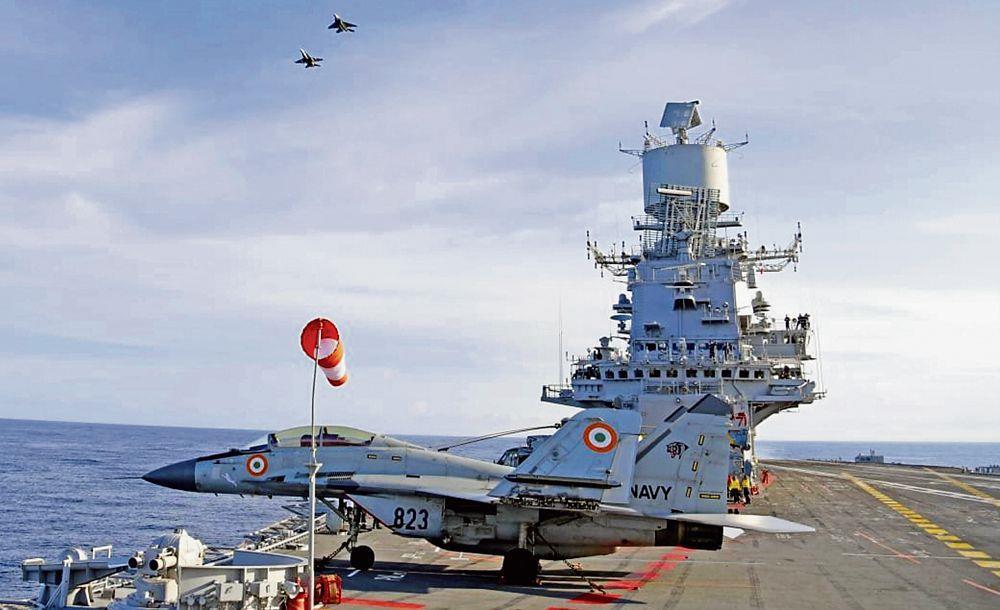
The Indian Navy will get a new ensign -– the flag that is hoisted atop all naval warships, ground stations and naval air bases. This is the fourth time since 1950 that the naval ensign will undergo a change.

“During the event, the Prime Minister will also unveil the new Naval Ensign (Nishaan), doing away with the colonial past and befitting the rich Indian maritime heritage,” the Prime Minister’s Office said in statement on Tuesday.On 26 January 1950, when India became a republic, the Navy crest and flags were changed to represent an independent India. Part of the flag retained the British legacy — the red colour Saint George’s Cross.


34 years of service

34 years of service

PTI

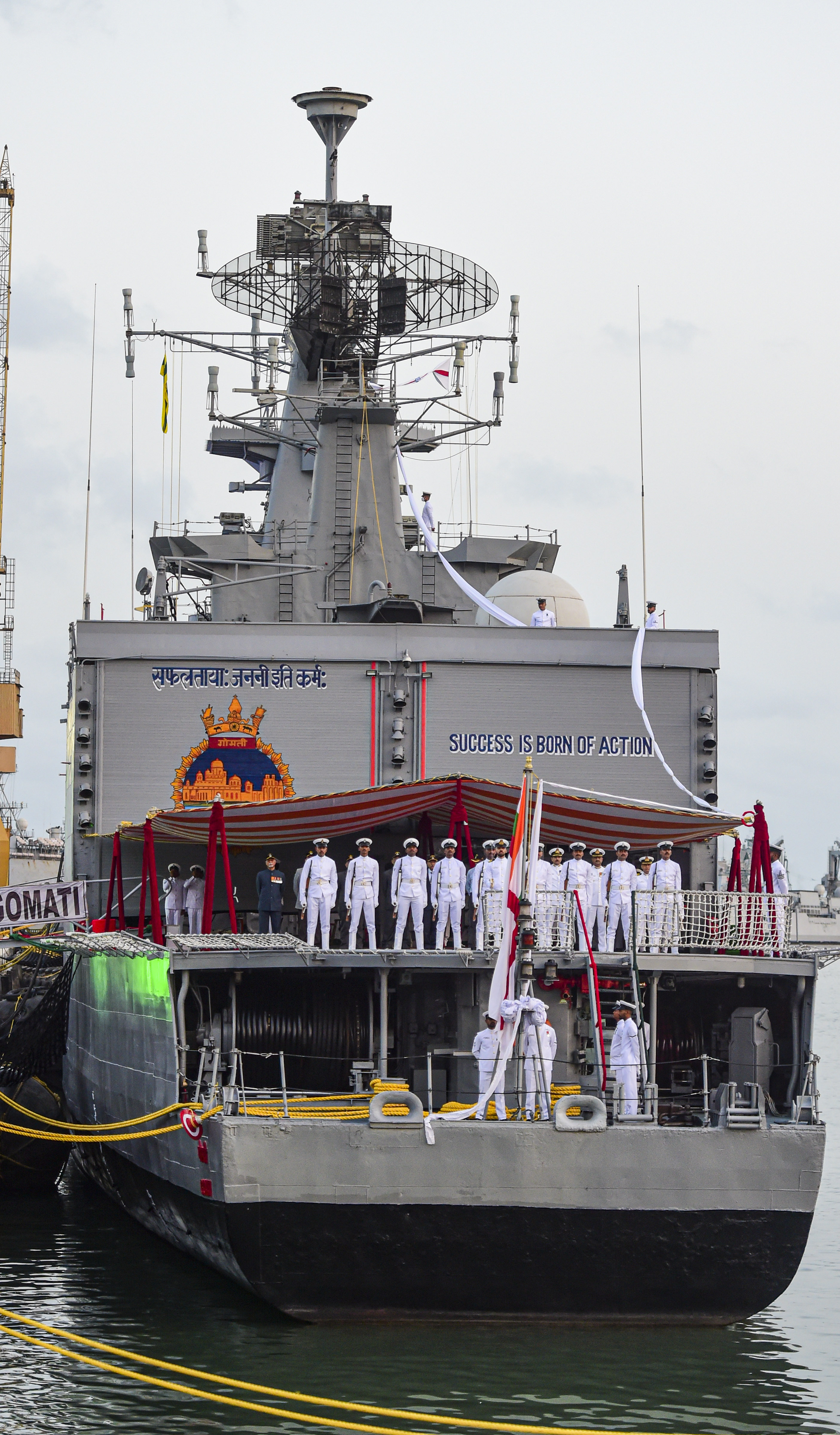
  • The Navy on Saturday decommissioned INS Gomati, a Godavari class guided-missile frigate, after 34 years of service
  • INS Gomati was commissioned on April 16, 1988, by then Defence Minister KC Pant at the Mazgaon Dock.

IAF to raise its first Light Combat Helicopters’ unit at Jodhpur in October

IAF to raise its first Light Combat Helicopters’ unit at Jodhpur in October

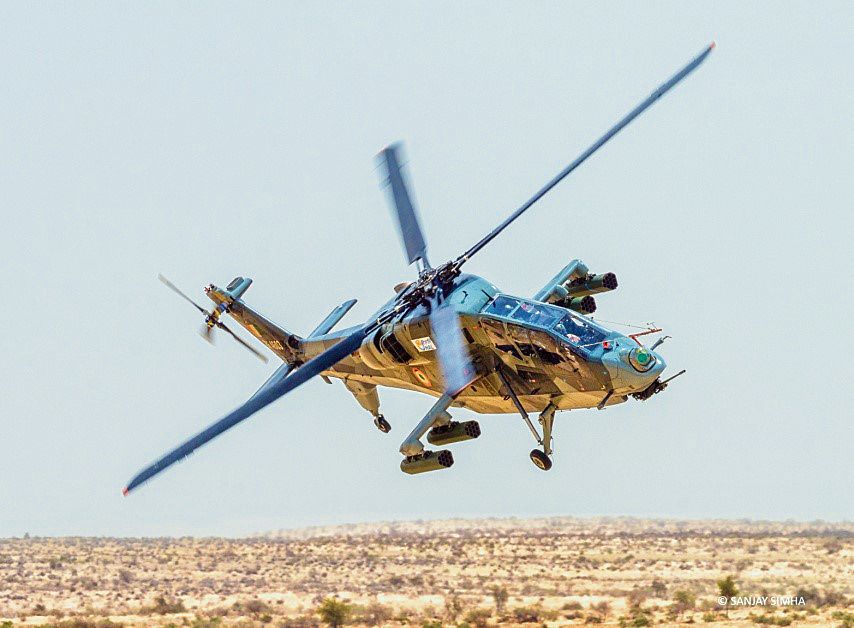
The Indian Air Force (IAF) is to raise its first unit of indigenously made Light Combat Helicopters (LCHs) in October. The LCH is made by Hindustan Aeronautics Limited (HAL).

Tribune News Service

New Delhi, August 30

The Indian Air Force (IAF) is to raise its first unit of indigenously made Light Combat Helicopters (LCHs) in October. The LCH is made by Hindustan Aeronautics Limited (HAL).

The IAF will be inducting 10 LCHs in the first batch.

The IAF operates the three-decade-old Russian Mi-25 and Mi-35 attack helicopters. One of the squadrons of the Russian-made copters is to be phased out while another one is going for a midlife upgrade. The process of induction of 22 Boeing AH-64E Apache attack helicopters has been completed.

Meanwhile, the Army that started the LCJ induction process plans to acquire 95 LCHs, each having 10 helicopters. These will be deployed in the mountains.

In March, the Cabinet Committee on Security (CCS) approved procurement of 15 Limited Series Production (LSP) variants of the LCH at the cost of Rs 3,887 crore along with infrastructure sanctions worth Rs 377 crore. Of the 15 helicopters, 10 are for the IAF and five for the Army.