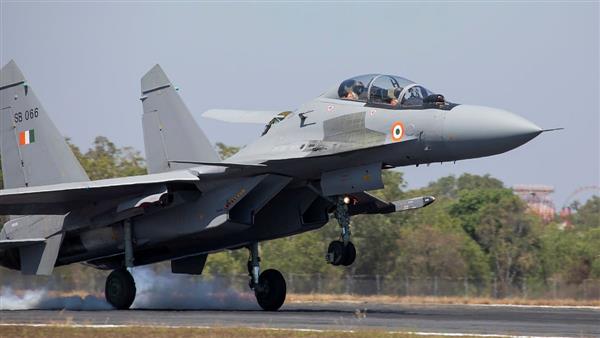
The Indian Air Force on Monday morning scrambled its fighter jets to intercept a Mahan Air commercial flight that had taken off from Tehran in Iran and headed to Guangzhou in China.
IAF fighter aircraft Sukhoi 30 MKI was scrambled from the Punjab and Jodhpur airbases.
The IAF said, “The pilot was offered the option to land at Jaipur or Chandigarh. However, he declared his unwillingness to divert to either of the two airports.
The aircraft was told to circle in the airspace west of Delhi with the Sukhoi’s in proximity, sources added.
“After a while, intimation was received from Tehran to disregard the bomb scare, following which, the aircraft continued on its journey towards its final destination…The aircraft was under close radar surveillance by the Air Force throughout the Indian airspace,” the IAF added.
The plane eventually continued its eastward journey towards China.
All actions were according to the laid down procedure, jointly with the Ministry of Civil Aviation and Bureau of Civil Aviation Security, the IAF said.
Tel Aviv: Pakistan has become the new channel for the supply of weapons to conflict zones across the world, including Ukraine and Armenia, according to Italian geopolitical expert Sergio Restelli. Though Pakistan facilitated the supply of weapons to two war hotspots, its motives are yet to be determined. The Italian advisor argued that Pakistan has been clandestinely helping the United Kingdom to ferry weapons systems to Ukraine amid the ongoing war with Russia. “Pakistan has become the new channel for the supply of weapons to conflict zones across the world. …The question is who is behind these supplies and why is Pakistan providing overflight and landing facilities for such deliveries? The answer remains a mystery,” Restelli asks in an opinion piece in The Times of Israel. “Various flight-tracking websites have shown the UK’s Royal Air Force carrying out regular sorties of C-17 Globemaster heavy lift aircraft from Romania to Pakistan Air Force’s Nur Khan airbase in Chaklala, Rawalpindi, since 6 August 2022, five days before Pakistan Army chief, General Javed Bajwa, landed in the UK,” he writes. Restelli contends that there is no clarity on the kind of weapons or ammunition ferried from Pakistan to Romania. However, the possibility of Pakistan sending ammunition made at the Pakistan Ordinance Factory to Ukraine via Romania cannot be discounted. Earlier in August, media reports had suggested that Pakistani channels were providing ammunition to military groups in conflict ravaged Ukraine. Ukrainian artillerymen were spotted using 122mm HE artillery projectiles made in Pakistani Ordnance Factories (POF). “Ukraine: The massive needs of the Ukrainian Army when it comes to artillery are being met from some unorthodox sources – Ukrainian artillerymen were spotted using 122mm HE artillery projectiles made by Pakistani Ordnance Factories (POF),” Ukraine Weapons Tracker tweeted in August. This tracker, which posted a thread of tweets, claims to debunk, and track the usage of defence material in Ukraine. Though not verified, this handle is being followed by several eminent defence experts. The tracker further claimed that these projectiles were manufactured only a few months ago. “These projectiles were manufactured only a few months ago – highly likely explicitly for export to Ukraine going by factors we won’t detail here. Yet another demonstration of just how Western partners obtain the most needed material for the Ukrainian Armed Forces.” The report of weapons supplies to Ukraine comes even as Pakistan has in recent past tried to cosy up to Russia.
Rajnath Singh flies sortie in newly-inducted Light Combat Helicopter ‘Prachand’
LCH is capable of dodging the enemy, carrying a variety of ammunition, and delivering it to the site quickly, says Defence Minister
Defence Minister Rajnath Singh at a sortie in the newly-inducted indigenously built Light Combat Helicopter ‘Prachand’, in Jodhpur, on Monday, October 3, 2022. PTI
“The LCH is capable of dodging the enemy, carrying a variety of ammunition, and delivering it to the site quickly. The LCH perfectly meets the needs of our armed forces in various terrains,” he said.
“In such a situation, LCH is an ideal platform for both our Army and Air Force,” he added.
The Indian Air Force (IAF) inducted four indigenously-built LCHs, which have been developed primarily for mountain warfare after a requirement for it was felt during the Kargil war in 1999.
The IAF’s newly raised No.143 helicopter unit is operating the platforms manufactured by state-run aerospace major Hindustan Aeronautics Ltd (HAL).
“I was told that the LCH has been designed and developed to suit the needs of the modern battlefield. In various types of testing in its developmental stages, it has shown its ability to deal with all the challenges,” the defence minister said.
“There could hardly have been a better time than Navratri, the festival of worship of Ma Durga, for the induction ceremony of LCH, and a better place than the soil of Rajasthan,” he said.
Singh was speaking at the induction ceremony.
The LCH is an indigenously developed multi-role attack helicopter equipped with advanced avionics and lethal weapon systems.
The helicopter is designed to carry out offensive roles in high-altitude areas like Ladakh and Siachen.
The narrow fuselage with tandem cockpit configuration makes LCH an extremely manoeuvrable and agile platform to effectively undertake offensive operations.
Advanced technologies and stealth features of LCH like low radar cross section and minimal infra-red signatures allow it to go behind enemy lines undetected and attack with precision.
“With a sleek design, high agility, precision and absolute lethality this aircraft is a formidable warfighter,” said an IAF official.
A drone from Pakistan came into the border in Rajasthan’s Sriganganagar and dropped more than 3 kg heroin, PTI reported quoting the police. Later, during search in the area, four packets containing 3.5 kg suspected heroin was recovered, the police said. BSF troops also fired at the drone but couldn’t shoot it down. The incident occurred in the intervening night of Saturday-Sunday. The drone dropped the packets which were recovered later, a police official said. On information by the BSF, the local police launched a search operation in the area to recover any other smuggled narcotics. The sources said the suspected heroin will be handed over to Narcotics Control Bureau (NCB) by the BSF for further investigation.
DRDO DEVELOPING ADVANCED LASER THREAT DETECTION SYSTEM FOR ARMOURED FIGHTING VEHICLES FOR BETTER PROTECTION
The system will comprise sensors and processing units retrofitted on armoured vehicles like tanks and mechanised infantry combat vehicles Chandigarh: The Defence Research and Development Organisation (DRDO) is developing a new advanced laser threat detection system for armoured fighting vehicles meant to enhance the survivability of combat platforms in the battlefield. The system will comprise sensors and processing units retrofitted on armoured vehicles like tanks and mechanised infantry combat vehicles to detect the use of lasers by the enemy for detection and target acquisition and to take counter-measures. The project is being executed by DRDO’s Instruments Research and Development Establishment (IRDE) at Dehradun, which is inviting the industry to design, develop and manufacture the proposed system. IRDE’s research arena includes electro-optical instruments, thermal imagers, night-vision devices and laser-based instruments. According to DRDO sources, the proposed system is required to detect threats at ranges up to six kilometres. It will have four sensors mounted on the vehicle’s turret at different places to provide a 360-degree coverage to detect threats from sources such as laser range finders, laser target designators and laser munition guiding beams. The control units and display screens will be mounted inside, adjacent to the commander’s console, and give out an audio and visual warning to the crew, classify the type of threat and enable them to take counter-measures such as firing smoke grenades to obscure the vehicle and move to a different location, sources said. Earlier, another DRDO laboratory, Laser Science and Technology Centre, New Delhi, had produced a laser threat detection system for the indigenously developed Arjun main battle tank. The Army has in its inventory several other armoured vehicles like the T-72 and T-90 tanks and BMP 2/3 mechanised infantry combat vehicles. The DRDO has been working in the field of lasers for a host of other applications such as protection of high-value assets from aerial attacks, safe ammunition disposal, surveillance, guidance of precision munitions, optical-dazzling, target location and acquisition, detection and identification of explosives, chemical and biological agents and for testing and evaluating various systems. Besides combat operations by the armed forces, some of these systems can also be used by the paramilitary forces and the police for border management and in low-intensity conflict environment.
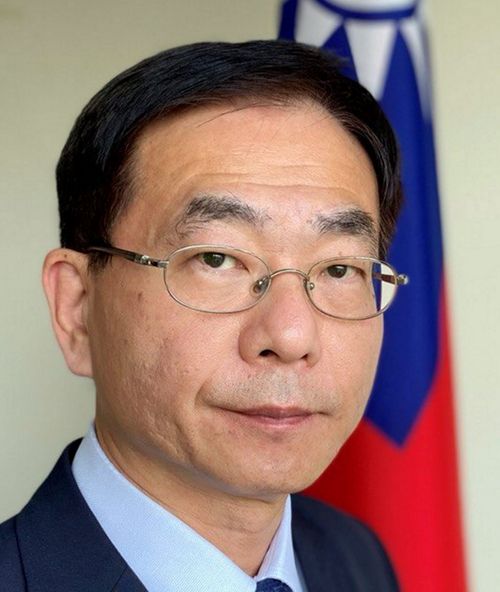
India and Taiwan are threatened by “authoritarianism” and it is high time for both sides to engage in “strategic collaboration”, Taipei’s de-facto Ambassador Baushuan Ger said on Sunday while referring to the possible implications of China’s belligerent military behaviour for the region.
In an interview, Ger said Taiwan and India needed to join hands to “fend off” the “expansion of autocracy” as he cited actions in East and South China Sea, Hong Kong and Galwan Valley to wonder who the “real provocateur” for tensions in the region is.
Collaboration must
Both are threatened by authoritarianism. Collaboration is not only desirable but necessary. —Baushuan Ger, Taipei’s de-facto ambassador
Following a high-profile visit to Taiwan by US House Speaker Nancy Pelosi in August, China has been ramping up its military offensive against the self-ruled island of more than 23 million people, triggering global concerns, including in India. Beijing considers Taiwan as its breakaway province and it saw Pelosi’s trip as a challenge to China’s sovereignty and territorial integrity. Ger said Taiwan appreciated India for standing up for justice, peace and stability in the Taiwan Strait in the wake of China’s military offensive in response to Pelosi’s trip.
“Both India and Taiwan are threatened by authoritarianism; hence, closer collaboration between the two is not only desirable but necessary,” Ger said. “I believe now is high time for us to engage in strategic collaboration, with enhancing trade and technology cooperation being one of the most feasible areas to begin with,” he added.
Say strong ties critical to advance US interests in Indo-Pacific region
Washington, October 2
A strong US-India defence partnership rooted in shared democratic values is critical to advancing US’ interests in the Indo-Pacific, three American senators have said in a legislative amendment that urges the Biden administration to encourage New Delhi to accelerate its transition away from Russian weapons.
Cite China threat along india border
The amendment to the National Defense Authorization Act mentions that India faces immediate and serious threat from the aggression by the Chinese military along the border.
It also mentions threats in the Indo-Pacific region where China which has territorial disputes with many countries.
The relations between India and China have soured over the incursion by Chinese troops in eastern Ladakh in May 2020, leading to a prolonged military standoff that is still unresolved. India has made it clear to China that peace and tranquillity along the Line of Actual Control (LAC) were key for the overall development of the bilateral ties.
“The US should take additional steps to encourage India to accelerate its transition away from weapons and defence systems manufactured in the Russian Federation while strongly supporting India’s immediate defense needs,” said the amendment. It said that for its national defence, India relies on weapons manufactured by Russia. Russia has been a major supplier of military hardware to India.
In October 2018, India signed a USD 5 billion deal with Russia to buy five units of the S-400 air defence missile systems, notwithstanding a warning by the US that going ahead with the contract may invite sanctions under the provisions of Countering America’s Adversaries Through Sanctions Act (CAATSA).
“A strong United States-India defence partnership rooted in shared democratic values is critical to advancing United States interests in the Indo-Pacific region,” the amendment said.
It said the such partnership between the world’s oldest and largest democracies is critical and should continue to be strengthened in response to increasing threats in the Indo-Pacific region so as to send an unequivocal signal that sovereignty and international law must be respected.
China, which has territorial disputes with many countries in the strategic Indo-Pacific region, has been opposing the US’ proactive policy specifically in the disputed South China Sea
The project is being executed by DRDO’s Instruments Research and Development Establishment (IRDE) at Dehradun, which is inviting the industry to design, develop and manufacture the proposed system. IRDE’s research arena includes electro-optical instruments, thermal imagers, night-vision devices and laser-based instruments.
According to DRDO sources, the proposed system is required to detect threats at ranges up to six kilometres. It will have four sensors mounted on the vehicle’s turret at different places to provide a 360-degree coverage to detect threats from sources such as laser range finders, laser target designators and laser munition guiding beams.
The control units and display screens will be mounted inside, adjacent to the commander’s console, and give out an audio and visual warning to the crew, classify the type of threat and enable them to take counter-measures such as firing smoke grenades to obscure the vehicle and move to a different location, sources said.
Earlier, another DRDO laboratory, Laser Science and Technology Centre, New Delhi, had produced a laser threat detection system for the indigenously developed Arjun main battle tank. The Army has in its inventory several other armoured vehicles like the T-72 and T-90 tanks and BMP 2/3 mechanised infantry combat vehicles.
The DRDO has been working in the field of lasers for a host of other applications such as protection of high-value assets from aerial attacks, safe ammunition disposal, surveillance, guidance of precision munitions, optical-dazzling, target location and acquisition, detection and identification of explosives, chemical and biological agents and for testing and evaluating various systems.
Besides combat operations by the armed forces, some of these systems can also be used by the paramilitary forces and the police for border management and in low-intensity conflict environment.
“Hony Capt Govindaswamy, VSM”. from Madras Sapper, whose training capability & methods as a Drill Instructor resulted in The Madras Sappers winning the Best Republic Day Parade Marching Contingent so many times continuously that MEG was awarded a COAS trophy, and “debarred” from participating in the Competition, but went on to train other Regiments which then won the trophy.
Hony Capt Govindaswamy’s methods today drive the excellent levels of Drill in all military trg establishments around India, including IMA & NDA.
Yesterday 30 September was the 242nd Madras Sappers Day.
There is Memorial bust & tablet erected in tribute to Hony Capt Govindaswamy, VSM, at the Madras Sappers War Memorial end of the Drill Square in MEG & Centre.
Salutes to Hony Capt Govindaswamy, VSM of the Madras Sappers, and his memory!!
CDS General Anil ChauhanNewly appointed CDS General Anil Chauhan receives Guard of Honour
CDS, walking with his 95 years old father, to take charge today.
Road ahead for CDS
Jointness of operations can’t brook further delay
With the appointment of Lt Gen Anil Chauhan (retd), a former Eastern Army Commander and Director General of Military Operations, as India’s new Chief of Defence Staff (CDS), the government has finally filled the top post that had been lying vacant after Gen Bipin Rawat died in a helicopter crash in December last year. The prolonged delay in naming General Rawat’s successor had led to doubts being raised about the government’s commitment to the CDS’s mandate of synergising the functioning of the Army, the Navy and the Indian Air Force; restructuring of military commands for optimal utilisation of resources; and improving India’s battle-readiness.
It was in June this year that the Ministry of Defence notified changes in the Army, Air Force and Navy Acts, paving the way for any serving or retired Lt General, Air Marshal and Vice-Admiral under the age of 62 years to be in contention for appointment as CDS. The creation of a larger selection pool had given rise to unsavoury apprehensions about supersession of seniormost officers. The speculation has been laid to rest at last; now, it is Lt Gen Chauhan’s responsibility to begin from where General Rawat left off. As the Secretary to the Department of Military Affairs, the CDS will be expected to ensure greater coordination and understanding between the government and the defence top brass. Talking or working at cross purposes will undermine India’s growing stature as a military power and impact its credibility in the international arena.
It’s the CDS’s job to bring the Army, the Navy and the Air Force on the same page on matters such as defence modernisation and indigenisation. Accomplishing jointness in operations — an indispensable element of 21st-century warfare and military preparedness — requires the establishment of integrated theatre commands. A seamless transition to the new system and striking a balance between the three services will also be among the major challenges for the CDS. Much will depend on how much freedom the new officer will have to exercise his powers and take decisions that can have far-reaching consequences for national security.
State Stalwarts
DEFENCE MINISTER
Minister Rajnath Singh
ALL HUMANS ARE ONE CREATED BY GOD
HINDUS,MUSLIMS,SIKHS.ISAI SAB HAI BHAI BHAI
CHIEF PATRON ALL INDIA SANJHA MORCHA
LT GEN JASBIR SINGH DHALIWAL, DOGRA
SENIOR PATRON ALL INDIA SANJHA MORCHA
MAJOR GEN HARVIJAY SINGH, SENA MEDAL ,corps of signals
.
.
PATRON ALL INDIA SANJHA MORCHA
MAJ GEN RAMINDER GURAYA ,MADRAS REGIMENT
sanjhamorcha303@gmail.com
PRESIDENT SOUTH ALL INDIA SANJHA MORCHA
COL SS RAJAN BOMBAY SAPPERS,
PRESIDENT UTTARAKHAND ALL INDIA SANJHA MORCHA
COL B M THAPA ,BENGAL SAPPERSS
PRESIDENT HARAYANA STATE CUM COORDINATOR ESM
BRIG DALJIT THUKRAL ,BENGAL SAPPERS
PRESIDENT TRICITY
COL B S BRAR (BHUPI BRAR)
PRESIDENT CHANDIGARH ZONE
COL SHANJIT SINGH BHULLAR
.
.
PRESIDENT PANCHKULA ZONE AND ZIRAKPUR
COL SWARAN SINGH
INDIAN DEFENCE FORCES
DEFENCE FORCES INTEGRATED LOGO
INDIAN AIR FORCE
Air Officer C-in-C WESTERN AIR COMMAND
AIR MSHL S PRABHAKARAN AVSM VM
AOC-IN-C, EASTERN AIR COMMAND
Air Marshal Inderpal Singh Walia
AOC-in-C SOUTH WESTERN AIR COMMAND
Air Marshal Vikram Singh
AOC-IN-C, SOUTHERN AIR COMMAND
Air Marshal J.Chalapati
AOC-IN-C TRAINING COMMAND
AIR MARSHAL SK GHOTIA VSM
AOC-IN-C MAINTENANCE COMMAND
Air Marshal Jagdish Chandra
Flag Officer Commanding in Chief, Western Naval Command
ice Admiral R Hari Kumar, PVSM, AVSM, VSM
Flag Officer Commanding in Chief, Eastern Naval Command
Vice Admiral Sanjay Bhalla, AVSM, NM
Flag Officer Commanding in Chief, Southern Naval Command