












































Current Events :








Afriend informed me the other day that Goody Grewal and Vinod Uppal had died of Covid-19 at the Army Base Hospital, Delhi.
The first memory of Goody to cross my mind was of Gentleman Cadet GS Grewal commanding the passing-out parade of the Indian Military Academy, Dehradun, and at the finale marching straight as a lance up to the podium for the conferment of the coveted Sword of Honour.
Fifteen years later, we met at the Defence Services Staff College, Wellington, where Goody was a regular presence at the Sunday morning horse rides. All riders were mounted on their favourite horses and Major Gen RK Ranjit Singh, the Commandant, was set to lead. Late to arrive, Goody lunged towards his horse and in the fog of the hangover of the night before, he brushed past the General, who smiled, doffed his hat and called out, “Good Morning, Goody!”
Goody responded with his trademark jolly laughter and struggled to mount his horse. A brisk-paced, hour-long ride and as always, Goody was back at the Bar in the Officers’ Mess to wash down the last vestiges of the hangover toxins! That too was the lovable man who would superannuate from service at Chandimandir as the GOC-in-C, Western Command.
My last meeting with Vinod on December 3, 1971, was all too brief but among the most unforgettable of my life. We were in our battle location close by the western bank of Munawar Tawi river. In the twilight of dusk, we sat sipping hot tea laced with sugar and rum, the last luxury for several of us. We watched with apprehension as the adjutant ran up to announce that the Pakistan Air Force had struck our forward air bases and we were at war. And shortly, we would be part of ground zero, pounded by some 180 Pak artillery guns of all calibres in one of the fiercest battles fought without let-up, for 96 hours hence.
Vinod was the recipient of a rare war souvenir from that thunderbolt phase of the battle. Vinod was jolted and thrown off balance, similar to receiving a punch smack in the middle of his forehead, but on regaining composure, he removed the steel helmet and smiled; a rifle bullet had penetrated, but possibly being at the terminal stage of its penetrative velocity, it stopped a wee bit short of his forehead! The round base of the spent bullet, firmly lodged but protruding a centimetre outside, a weird tilak as it were! Knowing his jolly temperament, this must have been the staple of Vinod’s merry episodes from the Chhamb battle.
God be with you, my friends, snared in the pandemic’s dance of death.
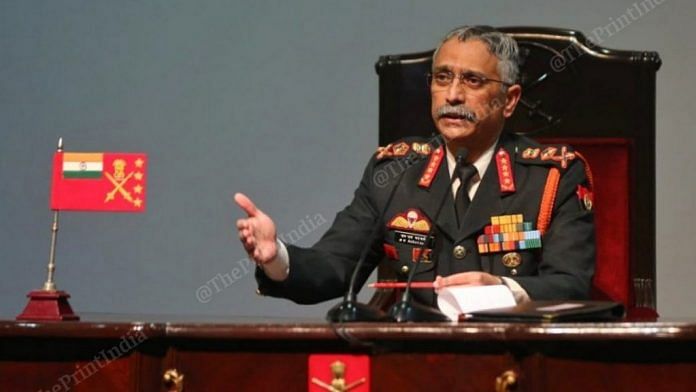
ew Delhi: Chief of Army Staff Gen MM Naravane held a telephonic conversation with his American counterpart Gen James C McConville on Tuesday, focusing on bilateral military cooperation as well as effectively dealing with the coronavirus pandemic.
Officials said Gen Naravane and Gen McConville discussed ways to expand cooperation between the two armies in specific areas in view of the evolving regional security scenario
They also deliberated on effectively dealing with the coronavirus pandemic.
“General MM Naravane #COAS had telephonic interaction with General James C. McConville, Chief of Staff of the Army #USArmy on Tuesday and discussed issues of bilateral defence cooperation,” the Indian Army said in a tweet.
The Indo-US defence ties have been on an upswing in the last few years.
In October last year, India and the US sealed the BECA (Basic Exchange and Cooperation Agreement) agreement to further boost bilateral defence ties. The pact provides for sharing of high-end military technology, logistics and geospatial maps between the two countries.
The firming up of the BECA came two years after the two countries signed another pact called COMCASA (Communications Compatibility and Security Agreement) that provides for interoperability between the two militaries and provides for sale of high end technology from the US to India.
In June 2016, the US had designated India a “Major Defence Partner” intending to elevate defence trade and technology sharing with India to a level commensurate with that of its closest allies and partners.
The two countries had also signed the Logistics Exchange Memorandum of Agreement (LEMOA) in 2016 that allows their militaries use each other’s bases for repair and replenishment of supplies as well as provides for deeper cooperation.
Also read: Army chief Naravane visits eastern Ladakh, Siachen, reviews operational preparedness
The government ordered the defence transformation more to reflect its political will in implementing its election manifesto (like it did with OROP) than an intent to revitalise the defence reforms process. Otherwise, it should have gone for a more holistic integrated review of security, defence development and foreign policy rather than fast-tracking and polishing up the existing products.

ew structure: The appointment of the CDS heralded far-reaching changes. PTI

Long delayed, the India-UK meet was marred by the virulent spike of Covid-19 in this country that resulted in the Indian delegation, led by Foreign Minister S Jaishankar, being confined to a London hotel. A key defence engagement was curtailed, though a British battle strike group led by aircraft carrier HMS Queen Elizabeth will this month embark on its maiden voyage of ‘tilt towards Indo-Pacific’. The mission follows ‘once in decades’ integrated review of British defence and foreign policy which has lessons for India whose strategic and security thinking is still British-oriented.
India is on the cusp of the most wide-ranging defence reforms since the Kargil Review Committee report 2001 was partially implemented. At the heart of tumultuous change is the creation of the post of Chief of Defence Staff (CDS), Department of Military Affairs and Theatrisation — the three combine the most dynamic integration of civil-military staff and jointness in tri-services. On April 7, CDS General Bipin Rawat made a compelling presentation at Vivekanand Foundation, Delhi, about the nuts and bolts of transformation. Even as these fundamental reforms were being implemented, intrusions similar to the ones at Kargil were executed by the PLA across the LAC last year, triggering a set of operational re-adjustments and rebalancing of forces. The stand-off in Ladakh was accompanied by the ongoing pandemic which has exposed the need for greater investment in health and social security even as Rs 21,000 crore was immediately necessary for emergency acquisitions for the new deployment.
The government ordered the transformation more to reflect its political will in implementing its election manifesto (like it did with OROP) than an intent to revitalise the defence reforms process. Otherwise, it should have gone for a more holistic integrated review of security, defence development and foreign policy rather than fast-tracking and polishing up the existing products. As the third largest armed forces (after China and US), India is unique as it has never produced a defence White Paper or a National Strategy doctrine or a Strategic Defence and Security Review (SDSR). Surprisingly, Parliament has never demanded one. The US and even China are required to present such reports periodically.
We can learn from the UK, now a medium power out of Brexit which has in the new era of Great Power competition recently published its Integrated Review (IR) of security, defence and foreign policy based on SDSR 2015, setting out ambitions for the UK’s role in the world for the next decade along with matching resources.
Integrated Review is billed as the most far-reaching policy document since the end of Cold War, engaging all departments of government to produce a united vision of the UK’s role in the world, sketching its interests with priorities for a global Britain. In addition to Integrated Review, two adjunct papers accompany: Defence Command Paper and a Defence and Industrial Security Strategy. Dovetailed is a capability and deterrence review, tied to the Comprehensive spending review and Modernisation defence programme with additional funding of £16.5 billion till 2024-25.
For defence of British interests across multiple domains and acquiring global influence, reliance is put on the Royal Navy’s new carrier battle group with the Royal Marines and a future commando force that will secure shipping lanes and uphold the freedom of navigation operations in a rules-based international system. This month, HMS Queen Elizabeth, accompanied by the battle group will make its Indian Ocean and South China Sea debut in a return after half a century following the suspension of East of Suez operations. The CBG will reflect a meaningful tilt (not pivot) to the Indo-Pacific without weakening response to Europe where Russia remains the greatest threat. China is mentioned as an economic and security challenge. Greater reliance is placed on minimum credible nuclear deterrence to compensate for reduction in conventional capabilities. The nuclear warhead cap has increased from 180 to 260 warheads. The Defence Command Paper makes clear that while NATO will cover Russia, the Indo-Pacific tilt will lean on China. But global Britain will not be able to do another Falklands.
General Rawat’s confidence in India’s capability for prosecution of a full-spectrum war and projection of interests abroad while ensuring prosperity at home are achieved through a whole-of-government approach, but his observation that not having a national security strategy did not mean “we do not possess the framework and experience” struck a jarring note not in sync with his outstanding handling of the transformation process. When the appointment of the CDS suddenly appeared in the Gazette of India on the last day of December 2019 (Rawat was to retire the next day), along with his Charter of Duties, no one was wiser on how the troika of defence and security reforms was born. Especially the DMA, an innovation that is unique to India and seems a perfect fit. Unlike in the US, the UK and other democracies, an Integrated Review or SDSR is ordered periodically by the government, and its team members and mission are widely known. The last significant effort towards defence and security reforms was during the UPA-II by the Naresh Chandra Task Force which recommended a watered-down CDS as permanent chairman, Chiefs of Staff Committee. Though the then Prime Minister Manmohan Singh was keen on its implementation, it never saw the light of day as the then Defence Minister AK Antony was unwilling to allow the diminution of his Defence Secretary by the CDS.
So, it is a minor miracle that Modi 2.0 not only appointed a full-fledged CDS but also the DMA which has made the Defence Secretary irrelevant as most of his charter and responsibility has shifted to the CDS/DMA, leaving mainly the defence policy with him. Why the government kept such a wide-ranging orbit of transformation under wraps, is unclear. Let’s be clear: no SDSR or IR was done, otherwise a two-and-a-half front war might have been avoided. A legitimate opportunity was missed to institutionalise the SDSR and IR for arriving at apex reforms, cohering all departments of the government.

At the crux of Kashmir problem lies the eternal quest of the policy makers in New Delhi to find ways and means to meaningfully integrate Kashmiris with the national and cultural mainstream of India
Yet despite that the people of Kashmir kept themselves at bay with political and cultural events happening in mainland India. Kashmiri Muslim in particular, didn’t even maintain much social or marital relations with Muslims from mainland India for many decades since independence. This state of affairs continued after the advent of separatism and militancy in Kashmir valley that further alienated Kashmiris and made them even less interested in affairs of mainland India.
This is however changing.
A new breed of younger Kashmiri men and women, who are studying in educational institutes of mainland India that include not just Muslim oriented institutions like Jamia, Osmania and AMU but even secular institutions like JNU, DU or many other private educational institutes are not only showing a keen interest in social, cultural and political happenings in urban areas of mainland India, but they are also actively participating in them and expressing their opinion about them.The same Kashmiri Muslim, who showed no interest in Mumbai anti-Muslim or Gujarat anti-Muslim riots in 1990s and early 2000s took an active part in last year’s anti CAA protests in Delhi. Kashmiri student community studying in Jamia and AMU were at the forefront of anti-CAA protests and were its prominent face.
Even prior to that Kashmiris, especially Kashmiri Muslims could now be seen making their presence felt across the wide spectrum of cultural, sporting, activism space in mainland India. From leftist politics of JNU (Sheila Rashid) to TV industry (Hina Khan) to movie industry (Zaira Wasim) to many prominent journalists, activists, influencers, artists, musicians, authors, both Kashmiri Muslims and Kashmiri Pundits are now prominent face of national mainstream activities. They are strongly voicing their opinion and even criticism on various issues that concern Kashmir and people of Kashmir. Unlike in the past they are not keeping aloof and disenchanted but are aggressively making their space in the national discourse.
More recently, Kashmiri Muslims living in Srinagar, Jammu, Delhi and other Indian cities could also be seen using Twitter to amplify request for beds and oxygen cylinders for Coronavirus patients that included not only Kashmiris but also non-Kashmiris from mainland India. Not just high-profile Kashmiris but also ordinary Kashmiris like students, businessmen or Kashmirs working in companies across India could be seen caring and participating like many other Indians in trying to help others amidst raging pandemic.
This is an indication that younger generation of Kashmiri youth despite continuing their grievance against decades state high handedness that has left many unanswered questions relating to suffering of ordinary Kashmiri people, the younger generation of Kashmir is breaking the shackles of the past and is finally seeking a stake in mainland India but on his own terms and in his own way. He or she is not totally disassociating his links with mainland India but has now selectively started rooting himself with those happenings taking place in India, with which he can emotionally and culturally relate to and engage with. This is an important development.
It is also important to note that it is not prudent to expect Kashmiris to integrate with Indian cultural, social and political mainstream in direct and positive manner given the three-decade old history of militancy and related grievances that Kashmiri people have with the Indian state. Yet, the younger generation of Kashmiris is reaching out to mainland India after all these decades.
The common religious interests of Kashmiri Muslims and Muslims of mainland India and their causes and concerns have finally built the bridge between Muslims of Kashmir and mainland India, which will indeed be strengthened over time.
This is evidenced by ever growing number of Kashmiri Muslims visiting and making annual religious trips or pilgrimages at various prominent Sufi shrines of mainland India including shrine of Khawaja Ghareeb Nawaz at Ajmer in Rajasthan, Hazrat Nizamuddin Chisti in New Delhi and Piya Haji Ali shrine in Mumbai, Maharashtra. Kashmiri Muslims are taking small baby steps towards this “new integration” by assimilating themselves with Indian Islamic cultural, political and social issues.
If this “new integration” is to either remain sustained or pick up pace in coming time, this would augur well for Kashmir’s future. If the ordinary Kashmiri, who always has a troubled and difficult relation with accepting Indian cultural and social mainstream reaches out to national mainstream it might help stabilize situation in Kashmir valley and help its people to finally come out of the vortex of hell that has completely destroyed their lives and being in last three decades.

Sometimes actions speak louder than words. And China’s actions so far have avoided crossing the threshold of open warfare
by John Blaxland
Talk of war has become louder in recent days, but the “drumbeat” has been heard for some time now as China’s military capabilities have grown. China does not want war, at least not yet. It’s playing the long game and its evident intentions have become more unnerving.
Scholars like Brendan Taylor have identified four flash points for a possible conflict with China, including Korea, the East China Sea, the South China Sea and Taiwan, but conventional war is not likely at this stage.
Where Tensions Are Currently High
The armistice between North and South Korea has held for nearly 70 years. The pandemic has severely constrained North Korea’s economy and its testing of intercontinental ballistic missiles has ceased, for now. China has a stake in keeping Kim Jong-un’s regime in power in the North, but the prospects of reverting to a hot war have flowed and ebbed.
Just south of Korea, in the East China Sea, China has intensified its military activities around the Japanese-claimed but uninhabited Senkaku Islands. China appears to be wearing down Japan’s resolve to resist its claims over what it calls the Diaoyu Islands.
The United States has assured Japan the islands fall under their mutual defence security guarantee. But a confrontation with China could test US backing and possibly set the stage for escalated confrontation elsewhere.
Similarly, China’s industrial-scale island building in the South China Sea has resulted in extensive military hardware and infrastructure. This will enable the Chinese to consolidate their position militarily and assert control over the so-called nine-dash line — its vast claim over most of the sea.
The US Navy continues to conduct freedom of navigation operations (FONOPS) in the sea to challenge China’s claims. With thousands of marked and unmarked Chinese vessels operating there, however, the risk of an accident triggering an escalation is real.
In 2016, an international tribunal rejected China’s claims to the waters in a case brought by the Philippines. Despite being a signatory to the UN Convention of the Law of the Sea, China has ignored the tribunal’s ruling and continued to intrude on islands claimed by both the Philippines and Indonesia.
Like China’s seizure of the Scarborough Shoal in 2012 that preceded its massive island construction further south, China could conceivably take the unwillingness of the US to challenge its latest moves as a cue for more assertive action over Taiwan.
This is, after all, the main prize Beijing seeks to secure President Xi Jinping’s legacy.
Why Taiwan’s Security Matters
Taiwan presents the US and its allies with a conundrum. It is a liberal open democracy and the world’s leading computer chip maker. It also sits in the middle of what military strategists refer to as the “first island chain” stretching from Japan in the north to the Philippines in the south. Its strategic significance is profound.
Having adopted a “One China” policy since 1979, the US security guarantee for Taiwan is conditional and tenuous. Reflecting growing unease over China’s actions, polls show strong US public support for defending Taiwan.
So far, ambiguity has served US interests well, providing some assurance to Taiwan while discouraging the PRC from invading.
This guarantee has been important for Japan, as well. With its pacifist constitution, and occasional concern over US commitment to its defence, Japan would be closely watching how the US approaches its Taiwan policy.
China Is So Far Avoiding Open War
Meanwhile, China has metamorphosed both economically and militarily. An exponential growth in China’s military capabilities has been matched by a steep rise in the lethality, accuracy, range and quantity of its weapons systems. On top of this, Beijing has ratcheted up its warlike rhetoric and tactics.
Last month, Xi made a muscular speech to the Boao Forum Asia, calling for an acceptance of China not only as an emerging superpower but also as an equal in addressing global challenges.
Sometimes actions speak louder than words. And China’s actions so far have avoided crossing the threshold into open warfare, refusing to present a “nail” to a US “hammer”. This is for good reason.
If war did break out, China would be vulnerable. For starters, it shares land borders with 14 countries, bringing the potential for heightened challenges, if not open attack on numerous fronts.
Then there are the economic concerns. China has significant Japanese, US and European industrial investments, and is also overwhelmingly dependent on energy and goods passing through the Malacca Strait between Malaysia, Singapore and Indonesia, the Indo-Pacific’s jugular vein.
This reliance on the Malacca Strait — referred to by one analyst as the “Malacca dilemma” — helps explain why China has invested so much capital in its Belt and Road Initiative and studiously avoided open conflict, at least until it is more self-reliant.
To avoid outright war, China evidently reckons it is better to operate a paramilitary force with white-painted ships and armed fishing vessels in the thousands to push its claims in the South China Sea and East China Sea and constrict Taiwan’s freedom of action.
It also recently passed a new law allowing its coast guard to act more like a military body and enforce maritime law — again in violation of the UN Convention on the Law of the Sea.
China is also expanding its “grey zone” warfare against Taiwan, which includes cyber attacks, repeated incursions of its air space and territorial waters, and diplomatic isolation to undermine Taiwan’s resolve and ability to resist.
Would America’s Allies Help Defend Taiwan?
This persistent and escalating challenge by Chinese forces has demonstrated Taiwan’s inability to fully control its waters and air space. Beijing is continuing to build a fleet of amphibious capabilities to enable an invasion of Taiwan.
US pundits are also no longer confident the Americans would win in an outright war over Taiwan, with Washington’s top military officer in the region arguing one could happen within six years.
Taiwan lacks allies other than the United States, but Japan is mindful of the consequences of a US failure to defend Taiwan. Its ocean surveillance and coastal defence capabilities would be exposed if China took Taiwan. But Japan’s constitution precludes direct involvement in defending Taiwan.
Under its Anzus obligations, the US could call on Australia for military support to defend Taiwan. The mutual assistance provisions are not automatically invoked, but the implications of Canberra standing on the sidelines would be profound.
Warnings about rhetorical drumbeats of war remind us the US is no longer the world’s only superpower and suggest Australia should prepare for a more volatile world.
Rather than rely solely on the US, Australia should bolster its own defence capabilities. At the same time, it should collaborate more with regional partners across Southeast Asia and beyond, particularly Indonesia, Japan, India and South Korea, to deter further belligerence and mitigate the risk of tensions escalating into open war.

Meanwhile, an official said in Jammu: Indian and Pakistan army exchanged sweets on the occasion of Eid today at Chakan Da Bagh crossing point Mendhar-hotspring crossing along the LoC in Poonch
SRINAGAR/JAMMU: The armies of India and Pakistan on Thursday exchanged sweets at the Line of Control (LoC) in Jammu and Kashmir on the occasion of Eid-ul-Fitr, defence officials said.
“On the occasion of Eid-ul-Fitr, the tradition of exchanging sweets between India and Pakistan on major festivals like Eid, Holi, Diwali and respective National days was revived and meetings were held at the Tithwal crossing on Kishanganga River in Tangdhar, Kupwara and Kaman Aman Setu in Uri to exchange sweets and pleasantries,” a spokesperson said in Srinagar.
Meanwhile, an official said in Jammu: Indian and Pakistan army exchanged sweets on the occasion of Eid today at Chakan Da Bagh crossing point Mendhar-hotspring crossing along the LoC in Poonch.
They said the sweets and compliments were exchanged by both the armies in an atmosphere of bonhomie and festivities in wake of the newly achieved calm along the LoC as a result of renewed ceasefire which has brought warmth between the two neighbours.
The gesture was appreciated by both the armies and expected to promote goodwill and mutual trust, they said.
“Exchange of inadvertently crossed over youths on three occasions in the last two months at the zero line in Tithwal bode well for the future,” the spokesperson said.
The exchange of sweets and pleasantries was conducted with full adherence to all COVID protocols by both sides, they said.

Indo-Pak relations deteriorated after India announced withdrawing special powers of Jammu and Kashmir and bifurcation of the state into two union territories in August 2019
ISLAMABAD: Prime Minister Imran Khan said on Tuesday that Pakistan would not hold talks with India until New Delhi reverses its decision of scrapping the special status of Jammu and Kashmir.
India abrogated the special status of Jammu and Kashmir under Article 370 on August 5, 2019 and bifurcated it into two Union territories.
“Unless India retreats from the steps taken on August 5″, the Pakistani government will not talk to India at all,” Khan said while responding to questions from the public during a live broadcast session.
Earlier in the day, Foreign Minister Shah Mahmood Qureshi said that no talks presently were taking place with India but parleys could be held if New Delhi revisited its policy regarding Kashmir and provided relief to the people of Kashmir.
“Jammu and Kashmir cannot be an internal issue of India as it is on the agenda of the UN and there are several Security Council resolutions on it,” he said while addressing a news conference in Islamabad.
India has repeatedly said Jammu and Kashmir is an integral part of India and the country is capable of solving its own problems.
New Delhi has told Islamabad that it desires normal neighbourly relations with it in an environment free of terror, hostility and violence.
Indo-Pak relations deteriorated after India announced withdrawing special powers of Jammu and Kashmir and bifurcation of the state into two union territories in August 2019.
India has maintained that issue related to Article 370 of the Indian Constitution was entirely an internal matter of the country.
However, lately there has been some improvement when the two countries agreed in February to restore peace on the Line of Control.
It is said that the rival officials have been interacting through the back channel diplomacy to ease tension.
Khan also responded to several questions about domestic issues and defended the performance of his government which came to power in August 2018.
Indo-Pak relations deteriorated after India announced withdrawing special powers of Jammu and Kashmir and bifurcation of the state into two union territories in August 2019
ISLAMABAD: Prime Minister Imran Khan said on Tuesday that Pakistan would not hold talks with India until New Delhi reverses its decision of scrapping the special status of Jammu and Kashmir.
India abrogated the special status of Jammu and Kashmir under Article 370 on August 5, 2019 and bifurcated it into two Union territories.
“Unless India retreats from the steps taken on August 5″, the Pakistani government will not talk to India at all,” Khan said while responding to questions from the public during a live broadcast session.
Earlier in the day, Foreign Minister Shah Mahmood Qureshi said that no talks presently were taking place with India but parleys could be held if New Delhi revisited its policy regarding Kashmir and provided relief to the people of Kashmir.
“Jammu and Kashmir cannot be an internal issue of India as it is on the agenda of the UN and there are several Security Council resolutions on it,” he said while addressing a news conference in Islamabad.
India has repeatedly said Jammu and Kashmir is an integral part of India and the country is capable of solving its own problems.
New Delhi has told Islamabad that it desires normal neighbourly relations with it in an environment free of terror, hostility and violence.
Indo-Pak relations deteriorated after India announced withdrawing special powers of Jammu and Kashmir and bifurcation of the state into two union territories in August 2019.
India has maintained that issue related to Article 370 of the Indian Constitution was entirely an internal matter of the country.
However, lately there has been some improvement when the two countries agreed in February to restore peace on the Line of Control.
It is said that the rival officials have been interacting through the back channel diplomacy to ease tension.
Khan also responded to several questions about domestic issues and defended the performance of his government which came to power in August 2018.

There are wide spread protests but the regime is likely to run roughshod over them
Chinese behaviour is acquiring sinister variations. Whilst, the regime of Xi Jinping has come forward to offer medical aid in the current health calamity engulfing India, media outlets, mouth pieces of the Communist Party of China (CPC) are spewing ridicule at Indian efforts at combating the calamity. Chinese nationals currently in India are being persuaded to record videos of ailing patients in anguish and send them to these media houses.
Well known China watchers from India have identified several such dying scenes on the streets being shown in still pictures. The linked commentaries are not sympathetic at all but instead are bordering on showering apathy and ridicule on leaders. Is this what the world should expect from China, a claimant to being an ancient civilization. Or, once again mind games are being played again as a precursor of things to come.
What is absolutely astonishing is the total silence on part of the WHO in leaving the investigation of the role of Chinese regime in managing and most importantly reporting the pandemic in a limbo. The actions of the Chinese Media houses stem from the failure of the WHO in arriving at conclusions.
Concurrently, one notices strategic manoeuvring by the Chinese Strategic apparatus for deriving tactical benefits from governments in South Asia as they are being ravaged by COVID-19. A delegation led by the Chinese Defense minister visited both Bangladesh and Sri Lanka a few days ago. Long-time Chinese investments in Bangladesh are loans which essentially focus on the strategic power and road sectors. At the heart of the matter would be the continuum to the Chinese Road and Belt projects linking ports in Myanmar with the ports in Bangladesh.
We would recall that it was only two years ago Xi Jinping inked 33 memoranda with the Aung Su Chi government in Rangoon and the piece-de-resistance of this strategic visit by Xi Jinping was to sign 90 years management contract for deepening the port facilities at Kyaukphew at the northern most coast of Myanmar. These loans were most willingly offered by China despite the explicitly counter Rohingiya attitudes of the Aung Su Chi regime. And now that this regime has been toppled by the military junta who remain on the same page with the Chinese.
It is apparent that a communication network has been conceived linking Mandalay and Akyab port with Kyaukphew and eventually joining up with harbours at Chittagong and Cox’s Bazaar, the inlets into the Bay of Bengal. The factors of well-established inland waterway navigation systems over rivers , specially the Meghna River which leads in to Chittagong Harbour would have been recognized by Chinese Strategic planners.
Let us now examine the Island County of Sri Lanka smack into the Bay of Bengal whose ports of Colombo and Humbantota have been on the Chinese radar for a very long period now. Humbantota sitting on the Southern tip of Sri Lanka has already been possessed by the Chinese whose loans were seemingly used for the development of the Airport and the Sea Port. The former, a dream of the current Rajpaksha regime and built during its previous tenure has emerged as a white elephant.
For the port at Humbantota, the previous regime unable to payoff the loans had to lease it to a Chinese Company for ninety years. Although the Indian Government , sensing a strategic threat had prevailed over the Sri Lankan government to sign a treaty which forbid the use of this port for foreign militaries. But a respectful honour of this agreement would always remain in serious doubt as it is widely reported that the Rajpaksha family has received kickbacks for award of the Airport and Sea Port contracts to Chinese proxies. And what is even alarming are the plans of Rajapaksha government for handing over Colombo Sea Port to the Chinese lock stock and barrel and for which a bill is being brought into the Sri Lankan Parliament any time now. There are wide spread protests but the regime is likely to run roughshod over them.
The belief that the Chinese may be hastening steps to gear up for the likely energizing of the QUAD group consisting of the USA, Japan, Australia and India would just be partly likely. On that angle there may be anxieties with the PLA Navy that securing a foothold over ports in Bangladesh and Sri Lanka would be useful at an early stage. But both Myanmar and Bangladesh will not acquiesce very easily and engage in discussions, and not like to be pushed as their countries battle Covid 19. The Bangladesh External Affairs Minister has already rebuked the Chinese Minister for his warning tone on this subject.
The bigger tasks for the PLA Navy would be to protect their own Sea Lanes of communication in the in the seas of the yonder in the South China Sea where large swathes of sea have been claimed by them. That nevertheless does not deter them as far as they achieved a modicum of acquisitions in Sri Lanka.
The time is now ripe for the Indian State to invigorate its own campaign of looking east. With Bangladesh, the diplomatic relations are ripened in the 50th Anniversary Year of the Founding of Bangladesh and seal on which was placed by the visit of Indian Prime Minister. It has been followed up with large consignment of Indian made vaccines and for a similar acquisition from China, Bangladesh had to dole out huge sums. To Myanmar also vaccines have been made available at no cost to them. Above all, India’s studied silence on the unseating of Aung Su Chi government will have its own benefits.


























































