Five more bodies were recovered on Thursday, two days after a team of climbers from the Nehru Institute of Mountaineering were trapped by an avalanche in Uttarkashi, the institute said.
Twenty-two mountaineers are still believed to be missing. The avalanche hit Draupadi Ka Danda II peak at a height of 17,000 feet on Tuesday when the team was returning after summiting.
According to the Nehru Institute of Mountaineering (NIM), the recovery of five more bodies takes the number of bodies retrieved so far to nine after four were recovered on the day of the avalanche. Of the nine bodies, seven are of trainees and two of instructors.
Uttarakhand Police had said on its Facebook page on Wednesday that 10 bodies had been retrieved.
Earlier in the day, the State Emergency Operation Centre (SEOC) here said, without accounting for the five bodies recovered, that of NIM’s 61-member advance training course team, including trainees and instructors, four bodies had been recovered, 30 were safe and 27 still missing.
Earlier in the day, a 14-member team from High Altitude Warfare School based in Gulmarg in Jammu and Kashmir joined the rescue operation for the missing mountaineers.
The team, which specialises in high-altitude rescue operations, will help in the joint efforts by the State Disaster Response Force (SDRF), Indo-Tibetan Border Police (ITBP) and mountaineers from NIM in their efforts to find the missing climbers, the SEOC said.
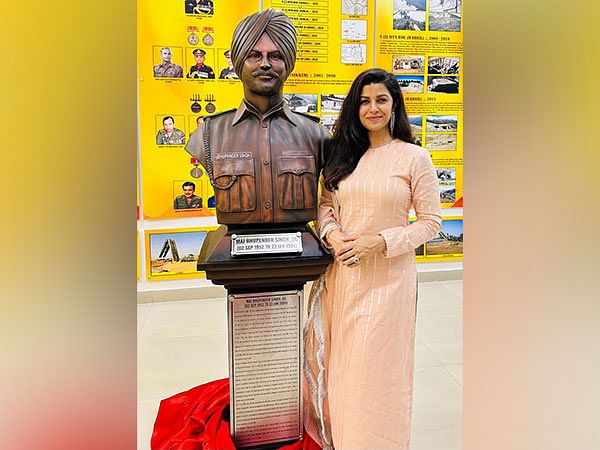
Patiala (Punjab) [India], October 1 (ANI): Actor Nimrat Kaur recently visited Patiala for the inaugural ceremony of her father late Major Bhupendra Singh’s statue in the Patiala regiment.
To celebrate her father’s contribution to the nation, a bronze statue of Major Bhupendra Singh was inaugurated at the Heritage Hall at his parent regiment 64 Assault Engineer Regiment in Patiala.
“It’s a really special moment for us all to be here to honour his memory and partake in this wonderfully noble and incredible gesture by the Indian Army,” Nimrat said.
“Patiala is very close to my heart because I have been in Patiala with my parents in two different tenures that my father had his postings there; when I was a little baby, and incidentally we lived in the same house for both our postings and the second time we were all together as a family as after that we lost him in Kashmir where we couldn’t join him. Patiala is also my favourite because I completed my 5th, 6th and 7th standard in a school there and that really laid the foundation where I am today, as extra-curricular activities, dramatics and incredible values were instilled in me as a child,” she added.
Meanwhile, on the work front, Nimrat, who was last seen opposite Abhishek Bachchan in Dasvi, will be seen in Maddock Films’ next titled ‘Happy Teachers’ Day’. (ANI)
This report is auto-generated from ANI news service. ThePrint holds no responsibility for its content.
Air show: UT admn declares Sukhna Lake out of bounds for 2 days
REHEARSAL ON OCT 6, FOLLOWED BY FINAL EVENT ON OCT 8 TO BE PRESIDED OVER BY PRESIDENT DROUPADI MURMU, A.S. PRASHAR PUNJAB EXPRESS BUREAU Chandigarh, October 4 The UT Administration has declared Sukhna Lake out of bounds for visitors till 6 pm on October 6 and October 8 in view of the rehearsal for the IAF air show and the final event that will be presided over by President Droupadi Murmu, respectively. Apart from this, all kinds of entertainment activities for the general public will also remain closed on these two days. During her twoday maiden visit to Chandigarh, after the air show on October 8, the President will also attend a civic reception at the Punjab Raj Bhavan, where she will also be retiring for the day. On October 9, she will be the chief guest at PEC’s annual convocation, and also lay foundation stones and inaugurate some projects the same day. According to UT adviser Dharam Pal, as regards the air show, which was scheduled from 2.30 pm to 5.30 pm on both October 6 and 8, the entire Sukhna Lake area had been divided into seven zones with separate entry staircases. Each zone has also been mapped with 11 alighting/parking points for smooth movement. He said the public was allowed to attend both the rehearsal and final event, but only with entry passes that can be obtained from the Chandigarh Tourism App. Being organised to mark IAF Day, the event will feature all modern aircraft, including Rafael, Sukhoi Su-30, Jaguar, MiG 29, C-17 Globemaster, IL76, Chinook, Apache and Mi-17, with performances by the Sarang air display and Surya Kiran aerobatics teams. Before commencement of the air show, a halfan-hour programme will be presented by the Akashganga Paratrooper team. On October 9, President Droupadi Murmu will be the chief guest at the annual convocation of the Punjab Engineering College (PEC), which is being held after a two-year Covid-induced hiatus. As many as 669 BTech, 168 MTech and 34 PhD degrees will be awarded during the ceremony. However, students’ parents will not be allowed to attend the event. PEC officials said a pandal will be set up in the football ground, with a seating capacity of around 1,000 people: “Under these circumstances, allowing parents is not possible.” PEC director Baldev Setia said, “The institute is privileged that the President is coming to the convocation. This will also be the closing ceremony for PEC’s centenary year celebrations.” This year, the graduating students will ditch the western graduation robes in favour of traditional Indian attire – a first at any city college.
US’ JUSTIFICATION OF F-16 TO PAKISTAN SHALLOW AND DANGEROUS: REPORT
Islamabad: United States’ double standards stand exposed with its “weakest diplomatic” justification for the “dangerous” F-16 assistance to Pakistan as the same US in the past has given out a clean slate to Islamabad for sponsoring terrorists, media reports said. US assistance to Pakistan’s “terror policy” is “treacherous” as the country had been asking Pakistan to act against terrorist groups operating from its soil, reported Islam Khabar. The irony of the matter is that the F-16 deal comes near the anniversary of the deadly 9/11 Twin Tower attacks. It is not to be forgotten that this is the same attack where the role of Pakistan in sheltering and supporting the al-Qaida chief and its key ally Taliban was widely questioned, reported Islam Khabar. The diplomatic outlook of the US towards Pakistan seems to be toppled now. US previously persuaded global anti-terrorist financing watchdog, FATF, to keep Pakistan on the hook of a greylist. US also used its diplomatic channels to hold back the International Monetary Fund relief deal for Pakistan. US Vice-President Kamala Harris has urged Pakistan to not support terrorists harbouring on its soil. President Joe Biden. Early March this year, the United States House Committee on Foreign Affairs discussed a bill that sought to designate Pakistan as a state sponsor of terrorism, the outlet said. There is well-documented material which suggests that Pakistan was protecting al Qaeda chief Osama bin Laden and deputy chief Ayman al Zawahiri. Apart from these two, Pakistan’s protection of several other anti-US groups like the Haqqani Network is also documented. US exit from Afghanistan was disgraceful which led to the takeover of the South Asian nation by the Taliban soon after the exit. Taliban has since then been putting extreme curbs on women and there are reports of widespread human rights violations. A US think tank, Hudson Institute, in 2017 reported that the “longest war in American history is a proxy war with Pakistan”. The report pointed out Pakistani safe havens for the Taliban “remain the single most difficult challenge to the NATO effort to stabilise Afghanistan.” The report co-authored by former Pakistan Ambassador to the US, Dr Hussain Haqqani, pointed out that despite over USD 25 billion in US assistance by two Presidents over 15 years, Pakistan Army had refused to stop its patronage of the Haqqani Network and the Taliban.
What’s Russian President Vladimir Putin thinking? JOHN LEICESTER Will President Vladimir Putin pull the nuclear trigger? For Kremlin watchers trying to figure out whether the Russian leader’s nuclear threats are just bluffs, there is no more pressing — or tough — question. For now, analysts cautiously suggest that the risk of Putin using the world’s biggest nuclear arsenal still seems low. The CIA says it hasn’t seen signs of an imminent Russian nuclear attack. Still, his vows to use “ all the means at our disposal “ to defend Russia as he wages war in Ukraine are being taken very seriously. And his claim on Friday that the United States “created a precedent” by dropping atomic bombs in World War II further cranked up the nuclear stakes. The White House has warned of “catastrophic consequences for Russia” if Putin goes nuclear. But whether that will stay Putin’s hand is anyone’s guess. Nervous Kremlin watchers acknowledge they can’t be sure what he is thinking or even if he’s rational and well-informed. The former KGB agent has demonstrated an appetite for risk and brinkmanship. It’s hard, even for Western intelligence agencies with spy satellites, to tell if Putin is bluffing or truly intent on breaking the nuclear taboo. “We don’t see any practical evidence today in the US intelligence community that he’s moving closer to actual use, that there’s an imminent threat of using tactical nuclear weapons,” CIA Director William Burns told CBS News. “What we have to do is take it very seriously, watch for signs of actual preparations,” Burns said. Kremlin watchers are scratching their heads in part because they don’t see how nuclear force could greatly help reverse Russia’s military losses in Ukraine. Ukrainian troops aren’t using large concentrations of tanks to wrest back ground, and combat is sometimes for places as small as villages. So what could Russian nuclear forces aim for with winning effect? “Nuclear weapons are not a magic wand,” said Andrey Baklitskiy, a senior researcher at the UN’s Institute for Disarmament Research, who specialises in nuclear risk. “They are not something that you just employ and they solve all your problems.” Analysts hope the taboo that surrounds nuclear weapons is a disincentive. The horrific scale of human suffering in Hiroshima and Nagasaki after the US destroyed the Japanese cities with atomic bombs on August 6 and August 9, 1945, was a powerful argument against a repeat use of such weapons. The attacks killed 210,000 people. No country has since used a nuclear weapon. Analysts guess that even Putin may find it difficult to become the first world leader since US President Harry Truman to rain down nuclear fire. “It is still a taboo in Russia to cross that threshold,” said Dara Massicot, a senior policy researcher at RAND Corp. and a former analyst of Russian military capabilities at the US Defense Department. “One of the biggest decisions in the history of Earth,” Baklitskiy said. The backlash could turn Putin into a global pariah. “Breaking the nuclear taboo would impose, at a minimum, complete diplomatic and economic isolation on Russia,” said Sidharth Kaushal, a researcher with the Royal United Services Institute in London that specializes in defense and security. Long-range nuclear weapons that Russia could use in a direct conflict with the United States are battle-ready. But its stocks of warheads for shorter ranges – so-called tactical weapons that Putin might be tempted to use in Ukraine – are not, analysts say. “All those weapons are in storage,” said Pavel Podvig, another senior researcher who specializes in nuclear weapons at the UN’s disarmament think tank in Geneva. “You need to take them out of the bunker, load them on trucks,” and then marry them with missiles or other delivery systems, he said. Russia hasn’t released a full inventory of its tactical nuclear weapons and their capabilities. Putin could order that a smaller one be surreptitiously readied and teed up for surprise use. But overtly removing weapons from storage is also a tactic Putin could employ to raise pressure without using them. He’d expect US satellites to spot the activity and perhaps hope that baring his nuclear teeth might scare Western powers into dialing back support for Ukraine. “That’s very much what the Russians would be gambling on, that each escalation provides the other side with both a threat but (also) an offramp to negotiate with Russia,” Kaushal said. He added: “There is a sort of grammar to nuclear signalling and brinksmanship, and a logic to it which is more than just, you know, one madman one day decides to go through with this sort of thing.” Analysts also expect other escalations first, including ramped-up Russian strikes in Ukraine using nonnuclear weapons. “I don’t think there will be a bolt out of the blue,” said Nikolai Sokov, who took part in arms control negotiations when he worked for Russia’s Foreign Ministry and is now with the Vienna Center for Disarmament and Non-Proliferation. Analysts also struggle to identify battlefield targets that would be worth the huge price Putin would pay. If one nuclear strike didn’t stop Ukrainian advances, would he then attack again and again? Podvig noted the war does not have “large concentrations of troops” to target. PTI The induction of India’s first indigenous light combat helicopter, capable of offensive operations in high-altitude areas like Siachen Glacier and eastern Ladakh, marks another important milestone in the country’s march towards self-reliance in meeting its defence needs. It also marks the rise of a new self-confident India who no longer needs to import important military hardware to defend itself. To demonstrate to the whole wide world that India-made flying machines are second to none, the Defence minister Rajnath Singh himself flew a sortie in the helicopter before handing it over to the Indian Air Force. The chopper is armed with 20mm turret guns, 70mm rocket systems and air-to-air missiles, and is named ‘Prachanda’. With its tremendous power and versatility, Prachanda will not only enhance IAF’s combat capabilities but is also a big step towards self-reliance in defence production as envisioned by Prime Minister Modi, Singh said. Chief of defence staff General Anil Chauhan and IAF chief Air Chief Marshal V R Chaudhuri, among other top officials, were present at the ceremony. Complimenting the IAF, Prime Minister Narendra Modi said that the formal induction of the light combat helicopter (LCH), designed and developed by Hindustan Aeronautics Limited (HAL), into the Indian Air Force (IAF) in Jodhpur, reflected the collective resolve of all Indians to make the country self-reliant in defence equipment. Rajnath Singh observed that the induction of LCH underlines the fact that just as the country trusts the IAF, the force equally trusts indigenous equipment,” the minister said, citing the examples of the home-grown Tejas fighters, Akash surfaceto-air missile systems and Dhruv advanced light helicopters. The need for LCHs for mountain warfare was first acutely felt during the 1999 Kargil conflict with Pakistan. Two LCHs were even flight-evaluated in eastern Ladakh in 2020 amidst the still-continuing military confrontation with China there. Overall, IAF and Army require an estimated 160 LCHs in the coming years. The Cabinet Committee on Security had cleared the first contract for 15 LCHs (10 IAF and 5 Army), at a cost of Rs 3,887 crore, along with infrastructure sanctions worth Rs 377 crore, in March this year. Defence PSU Hindustan Aeronautics has produced eight of the 15 choppers till now, of which four have been inducted by IAF. The first LCH for the Army, in turn, was handed over on September 29. The raising of the Army’s first LCH squadron commenced in June. As per the delivery schedule, four more LCHs will be handed over by October and the squadron will become operational in the eastern theatre in the first week of November. These LCHs have 45% indigenous content by value, which will progressively increase to more than 55% for the next version. The LCH is touted as the only attack helicopter in its weight class in the world which can land and take-off at an altitude of 5,000-metre or 16,400-feet with a considerable load of weapons and fuel. The phased induction of these 5.8-tonne choppers will boost the capabilities of the Army and IAF against enemy infantry troops, tanks, bunkers and UAVs (unmanned aerial vehicles) in high-altitude areas as well as in other terrains
IAF’s doctrinal aspects should not be compromised by new structures: IAF Chief
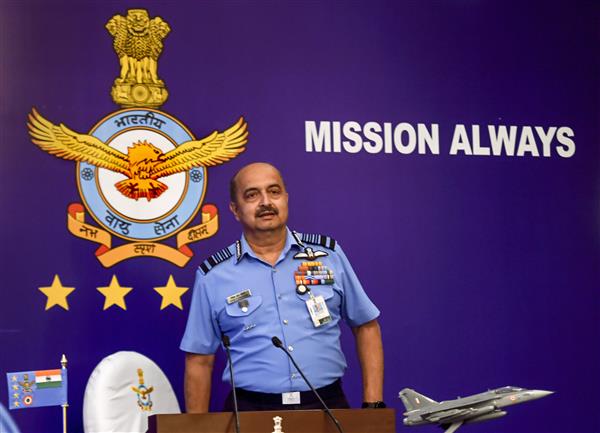
Air Chief Marshal VR Chaudhari on Tuesday made it clear that the Indian Air Force is not opposed to the tri-services theaterisation plan but asserted that the doctrinal aspects of the force should not in anyway be compromised by the new structures.
At a press conference ahead of the Air Force Day on October 8, the Chief of Air Staff said the IAF has certain reservations in respect to the proposed structures and emphasised on reduction in the layers of decision-making process.
He said the IAF has recently updated and revised its doctrine to keep it relevant, noting that no single service can win wars on its own.
With Gen Anil Chauhan taking charge as the new Chief of Defence Staff last week, it is expected that the ambitious theaterisation process of the three services will see forward movement.
“We are not opposing any process of integration and any process of theatre commands. We have certain reservations in respect to the structures,” he said while responding to a question on the plan.
According to the plan, each of the theatre commands will have units of the Army, the Navy and the Air Force and all of them will work as a single entity looking after security challenges in a specified geographical territory under an operational commander.
At present, the Army, Navy and the Air Force have separate commands. “We are fully supporting the integration process; it is only the methodology and the kind of structures that need to be future ready is what we are insisting on,” the Air Chief Marshal said.
“Each service has a doctrine. The doctrinal aspects of the Indian Air Force should not be comprised in anyway by the new structures,” he said.
A plan was firmed up for initially creating an Air Defence Command and Maritime Theatre Command.
There has been a general perception that the IAF is not very keen on the theaterisation plan.
Air Chief Marshal Chaudhari said the new structures should be created taking into consideration future challenges including in the domains of cyber and space, and that there must be clarity on the decision making process.
He said there must be reduction in layers of command and control under the new structures.
The Chief of Air Staff said his force is being transformed into a global aerospace force.
“Air power has the unique capability of undertaking independent strategic operations as well as operations coordinated with sister services and other arms of the national security apparatus,” he said.
Air Chief Marshal Chaudhari said the IAF understands the imperativeness of joint planning and execution in future wars and it is keen on integrating the efforts of the three services.
“We believe that the model of integration that we adopt must be future-ready, it must reduce levels of decision-making, and capitalise on the strength of all three services,” he said.
“We need an organisational structure that is best suited for Indian conditions and our geopolitical imperatives,” he added.
India’s first Chief of Defence Staff Gen Bipin Rawat was spearheading the implementation of the theaterisation model, but the process came to a halt following his death in a helicopter crash in Tamil Nadu on December 8 last year.
“Traditionally, wars were fought on the land, sea and in the air. Today, newer domains like cyber and space are increasingly affecting the conduct of operations even in the traditional realms,” the IAF chief said.
“To absorb these changes, the IAF is on the path of transformation so that we can fight and win tomorrow’s wars,” he said.
The Chief of Air Staff said his force has proved its capability across the entire spectrum of conflict over the years.
“Our focus has been on building indigenous capabilities and also upgrading our older equipment. We are totally in sync with the government’s push towards self-reliance in defence,” he said.
I ndia’s defence exports to various countries have increased manifold in recent years, the latest deal is to export Indian rocket launchers to Armenia. According to reports, India would supply the ‘Pinaka’ multi-rocket launcher system, which can fire a salvo of 12 HE rockets in 44 seconds to Armenia besides anti-tank missiles and a variety of ammunition as part of a package agreement. The complete details of these armaments have not yet been disclosed. Pinaka saw service during the Kargil War, where it was successful in neutralising enemy positions on the mountaintops. While the deal’s value has not been disclosed, the report claims armament worth $250 million or Rs 2,000 crore would be sold over the next few months. The deal was signed earlier this month and supplies are to be fast-tracked. It is not the first time that Armenia has received weapons equipment from India. In 2020, India triumphed over Russia and Poland in a $40 million defence agreement with Armenia providing it with four indigenous ‘Swathi’ counterbattery radars. This disclosure comes days after India called on the “aggressor side” in fresh fighting along the Armenia-Azerbaijan border to “immediately cease hostilities” without directly naming Azerbaijan. Latest fighting erupted between the two sides on September 13. India’s defence exports Meanwhile, it seems the ArmenianAzerbaijan conflict has helped India to boost its arms exports. According to reports, India recently announced figures for the highest-ever defence export growth that swelled by a staggering 334 per cent over the last five years. In fact, India is chasing an even higher target. In 2020, the Narendra Modi government had set a target of Rs 35,000 crore ($5 billion) export in aerospace, and defence goods and services in the next five years. This is part of the turnover of Rs 1.75 lakh crore ($25 billion) in defence manufacturing by 2025 that the government is aiming to achieve. India’s defence exports touched a record Rs 13,000 crore in 2021-22, “eight times” of what it was around five years ago. Besides the strategic importance of the deal with Armenia, the export order is a boost for the indigenous defence industry with the Indian government keen to increase the value of Indian arms exports. India had also signed a contract with the Philippines in January 2022 for the sale of BrahMos missiles. Currently, India exports defence equipment to 75 countries and these include weapon simulators, tear gas launcher, torpedo loading mechanism, alarm monitoring & control, night vision monocular & binocular, light-weight torpedo & fire control systems, armoured protection vehicle, weapons locating radar, high-frequency radio, coastal surveillance radar among others. Armenia-Azerbaijan conflict The issue of the conclave of NagornoKarabakh has always been the bone of contention between Armenia and Azerbaijan ever since the two countries became independent republics, after gaining independence from the erstwhile USSR. The disputed region of Nagorno-Karabakh lies in Azerbaijan and is inhabited mostly by ethnic Armenians. The conflict escalated into a fullscale war in the early 1990s which later transformed into alow-intensity conflict until four-day escalation in April 2016 and then into another full-scale war in 2020. A ceasefire signed in 1994 in Bishkek was followed by two decades of relative stability, which significantly deteriorated along with Azerbaijan’s increasing frustration with the status quo, at odds with Armenia’s efforts to cement it. Azerbaijan, for one, has received backing from its traditional allies and supporters, Turkey and Israel. During the 2020 skirmish between the two combatants, Baku turned the tide in its favour by overwhelmingly deploying Turkish Bayraktar and Israeli kamikaze drones. While Armenia has often turned to Russia for support, Moscow’s preoccupation with the on-going war against Ukraine has resulted in not a very supportive response, this time. In the face of rising hostilities and little military aid, the defence deal with India may prove to be a shot in the arm for a beleaguered Armenia. Azerbaijan-Turkey-Pakistan relationship India’s military assistance for Armenia comes against the backdrop of its regional rival’s bonhomie with Azerbaijan. Pakistan has consistently backed Azerbaijan in the Nagorno-Karabakh conflict and has refused to establish diplomatic ties and legally recognise Armenia as an independent state. Azerbaijan is seen by many as part of an emerging axis with Turkey and Pakistan. It has used Turkish drones to fight war against Armenia, and is also in talks with Pakistan to buy the JF-17 fighter aircraft. In 2017, Turkey, Azerbaijan, and Pakistan had signed a Trilateral Ministers Agreement that established security cooperation, and built upon previous bilateral military aid arrangements. These three countries also conducted a joint exercise named ‘Three Brothers’ last year. The rise of Azerbaijan with increased Turkey-Pakistan military cooperation is a direct warning to India. Azerbaijan has acquired many deadly weapons by increasing friendship with Turkey and Pakistan in the name of Islam. Indian fears that other countries may also go along this route in the name of Islamic countries are not unfounded. However, in spite of these developments, an interesting fact is that India has stronger economic ties with Azerbaijan than with Armenia. Indian company ONGC has also invested heavily in Azerbaijan’s gas sector. The Indian bilateral trade with Azerbaijan in 2019 stood at $1,093 million, while with Armenia it was only $48 million in 2020. Broadly this latest defence deal will place India as one of the emerging global powers with rising defence exports capability. In addition it will also allow it to play a significant role in the central Asian republics and regionally, both. I
The Indian Air Force (IAF) will conduct an air show at Sukhna Lake on October 6 and 8. The one-hour show will include advance fighters, transport aircraft, helicopters and the Suryakiran aerobatics team.
A presentation about the event was given by the Chief Coordination Officer of Air Force Day Parade, Group Captain Kapil GuIiyani, during the second coordination meeting held under the chairmanship of UT Adviser Dharam Pal today. A programme will also be conducted by the Akashganga Paratrooper team.
Light combat helicopter to make public debut at Chandigarh air display
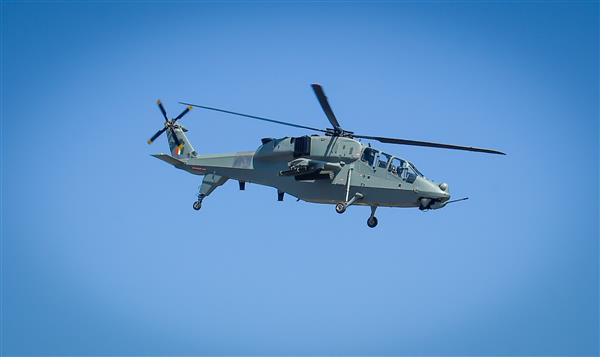
The light combat helicopter (LCH) inducted into the Indian Air Force at Jodhpur on Monday will make its public display at Chandigarh where the IAF is conducting its Airforce Day parade and air display.
The IAF announced that three LCHs from the 143 Helicopter Unit, Jodhpur, will take off to Chandigarh to take part in the display to be conducted over the Sukhna Lake in the afternoon of October 8.
The number of aircrafts on display could be around 90 planes to mark the IAF’s anniversary.
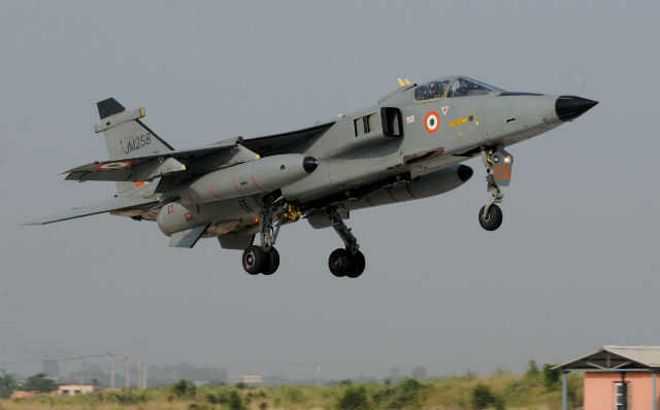
Apart from the LCH, the IAF will display its might with jets like Rafale, the Sukhoi 30 MKI, the MiG 29, Mirage 2000 and MiG 21 also being a part of the flypast.
Helicopters like Mi35, Mi17 and ALH will also be at the flypast along with special operations planes like the C17 and C130.
The Surya Kiran aerobatics team will also do a display.
State Stalwarts
DEFENCE MINISTER
Minister Rajnath Singh
ALL HUMANS ARE ONE CREATED BY GOD
HINDUS,MUSLIMS,SIKHS.ISAI SAB HAI BHAI BHAI
CHIEF PATRON ALL INDIA SANJHA MORCHA
LT GEN JASBIR SINGH DHALIWAL, DOGRA
SENIOR PATRON ALL INDIA SANJHA MORCHA
MAJOR GEN HARVIJAY SINGH, SENA MEDAL ,corps of signals
.
.
PATRON ALL INDIA SANJHA MORCHA
MAJ GEN RAMINDER GURAYA ,MADRAS REGIMENT
sanjhamorcha303@gmail.com
PRESIDENT SOUTH ALL INDIA SANJHA MORCHA
COL SS RAJAN BOMBAY SAPPERS,
PRESIDENT UTTARAKHAND ALL INDIA SANJHA MORCHA
COL B M THAPA ,BENGAL SAPPERSS
PRESIDENT HARAYANA STATE CUM COORDINATOR ESM
BRIG DALJIT THUKRAL ,BENGAL SAPPERS
PRESIDENT TRICITY
COL B S BRAR (BHUPI BRAR)
PRESIDENT CHANDIGARH ZONE
COL SHANJIT SINGH BHULLAR
.
.
PRESIDENT PANCHKULA ZONE AND ZIRAKPUR
COL SWARAN SINGH
INDIAN DEFENCE FORCES
DEFENCE FORCES INTEGRATED LOGO
INDIAN AIR FORCE
Air Officer C-in-C WESTERN AIR COMMAND
AIR MSHL S PRABHAKARAN AVSM VM
AOC-IN-C, EASTERN AIR COMMAND
Air Marshal Inderpal Singh Walia
AOC-in-C SOUTH WESTERN AIR COMMAND
Air Marshal Vikram Singh
AOC-IN-C, SOUTHERN AIR COMMAND
Air Marshal J.Chalapati
AOC-IN-C TRAINING COMMAND
AIR MARSHAL SK GHOTIA VSM
AOC-IN-C MAINTENANCE COMMAND
Air Marshal Jagdish Chandra
Flag Officer Commanding in Chief, Western Naval Command
ice Admiral R Hari Kumar, PVSM, AVSM, VSM
Flag Officer Commanding in Chief, Eastern Naval Command
Vice Admiral Sanjay Bhalla, AVSM, NM
Flag Officer Commanding in Chief, Southern Naval Command