



Sanjha Morcha

What’s New

Click the heading to open detailed news

Current Events :

web counter

Print Media Reproduced Defence Related News

WHY INDIA SHOULD GIVE A LARGER ROLE TO MILITARY IN COMBATING COVID-19

India’s armed forces have 1.5 million trained personnel deployed across the country
Last year, when the United States was battling with the surge of COVID-19 cases, its military docked two naval warships—USNS Mercy and USNS Comfort—on the coasts of New York and Los Angeles. Similarly, France had triggered ‘Operation Resilience’ to respond to the outbreak by involving large number of military personnel. The Great Britain also launched its biggest ever homeland military operations in peacetime to assist overwhelmed local hospitals treating patients. More controversially, in some parts of Europe, troops were deployed to enforce mandatory lock-downs by patrolling the streets, constructing roadblocks and curbing movement.
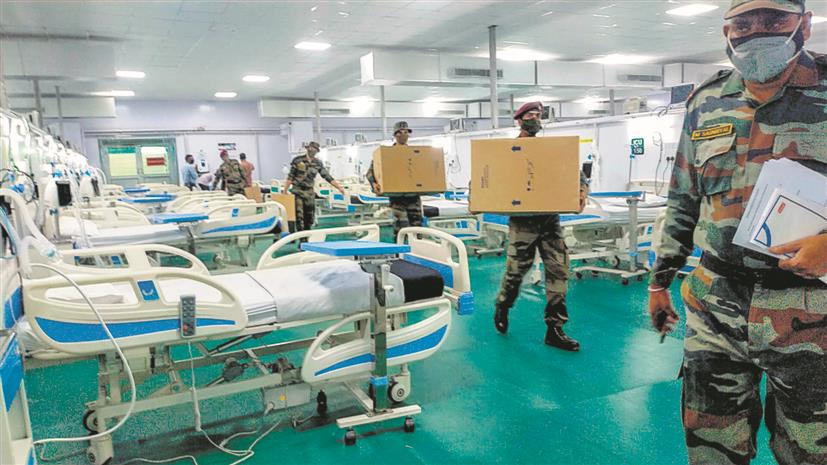
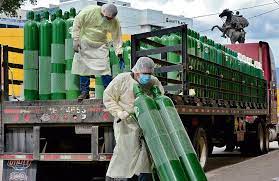
Here, in India, from warplanes to warships, armed forces are being deployed to combat the catastrophic second wave of the pandemic. Besides bringing critical medical oxygen and other lifesaving equipment, Indian military has built multiple make-shift field hospitals.
With record number of new COVID-19 patients, the country is facing shortage of medical facilities like hospital, medical oxygen and medical staff.
It is indeed a war-like situation except this time enemy is not China or Pakistan but rather an invisible virus. And experts believe that there is only a minuscule percentage of their (military) capability has been put to use. Only the military health resources (Army medical corps) have been fully engaged and, there are other capacities available with military and those are not being fully utilised. Less than one-tenth capacity of the armed forces is being engaged.
For example, during 2014 flood in Jammu and Kashmir, Indian Army not only provided relief and rescue to the general public, but also made the then chief minister of state, Omar Abdullah to speak to his officials by using military communication network. The communication infrastructure was totally down because all towers were flooded.
Lt General D.S. Hooda, who was the northern army commander during J&K flood, has a fair idea of what a military can do in the time of health crisis. “While military health resources are fully committed to assist civil administration, there are other expertise and capacities available with the armed forces that are not being fully tapped. Army has experts from other fields like engineering, infrastructure and logistics,” Lt Gen Hooda told THE WEEK. During the massive earthquake in Jammu and Kashmir in 2005, Lt Gen Hooda also led the military rescue and relief efforts in the Uri sector.
In the UK, its armed forces were working on 70 different tasks, from testing in schools to the rollout of vaccines and to support organisational and logistical efforts. China has reportedly mobilized over thousands of military personnel and set a world record of setting up hospitals in Wuhan, the epicentre of COVID-19 pandemic, in five days.
India’s armed forces have 1.5 million trained personnel deployed all over the country and, by now, they all are COVID vaccinated. Some feel that the reluctance on part giving larger role to military could be a reflection on government’s inability to deal with the situation.
But, General Deepak Kapoor, former Army Chief has a different take. He said that if the primary role of the military has been maintained and there is surplus capacity, then it should be roped in. While not in support of giving larger role to military, he said “You would not expect, especially when crisis in Eastern Ladakh has been fully resolved. And summer season is approaching, and there is a possibility of repeat of Chinese misadventure. We need to tackle the Chinese as well on the border.”
In the past, the military has been on the forefront in relief and rescue operations during natural calamities like flood, cyclone and earthquake. Military experts claim that the fight against COVID-19 should be treated as a warlike situation. And every action has to be taken according to the Union War Book. The ‘War Book’ documents the role of each ministry at the time of war.
Some believe that COVID is not only a medical emergency, as it is also a supply and logistic as well information emergency. And the military is equipped to create infrastructure in war footing.
Military engineering services can be used to bring up the capacity of oxygen generation along with creating additional make-shift hospitals and dispensaries. Its strength of over 2000 officers can quickly set up the required infrastructure in short deadline in every place around the country. Even a cricket stadium can be converted into a make-shift hospital, if required.
Meanwhile, combat engineers can be used for creation of structures like Corps of Signals units which will be handy for managing information like setting up emergency command and control room to track the movement of essentials in addition to the civil administration.
On the medical side, the Army has an all-India network of medical store depots that can be used to supply of critical medicine to assist civil administration. “We deliver medicine to our forward most areas, even high altitude Siachen, with a strong supply chain. The Army Medical Corps does carriage of these medicines,” an official said. The official believes that with this, shortage of critical medicine can be handled to some extent.
In addition, military has a huge logistic network with trained manpower. Army has a pan-India movement control network mechanism. And it can be used to track medical supplies. Movement Control Office (MCO) is responsible for assisting in planning, coordination and control of military movements in support of operations, exercises and administrative deployments across the country. “It can also be used in tracking critical medical supplies. It is a complete transparent method,” Lt Gen Hooda said while suggesting a unified command and control centre. Moreover, Army Service Corps has a large number of vehicles and transportation, which can be used for system and logistic support for a dedicated supply chain. Engineers from EME Corps can be utilised for repair and maintenance of heavy medical equipment.
In Agra, the Army and the Air Force helped the district administration set up a new oxygen generation plant to meet the dire shortage of oxygen. Similarly, EME (electronics and mechanical engineers) personnel repaired an oxygen generation plant in Etawah district of Uttar Pradesh.
In order to handle oxygen crisis, military officials believe that there could be a National Control Centre to streamline supply of oxygen. As per logistics principle, whenever there is scarcity of something, there should be a centralised control on it.
“From oxygen plant to movement of container, every movement can be tracked through check post in the dedicated route,” the officer said.
No one can forget incidents of Mumbai’s Elphinstone Road railway foot over bridge collapse and 2010 Commonwealth games bridge collapse, where Army came into the rescue and built those bridges in record time. With its pan-India presence, the Army can help civil administration provide the ground situation in remote areas with number of COVID-19 affected cases and available medical facilities.
Following the UK model of testing and vaccination, the military can be roped in for the inaccessible remote areas. Thousands of British soldiers were supporting community testing. In India, with military’s presence in far-flung areas of northeast to hilly Ladakh, it will play a major role in supporting the civil administration.
During multiple meeting with top military hierarchy, Defence Minister Rajnath Singh had conveyed that the armed forces need to pitch in a big way to assist the government in its fight against coronavirus, like the setting up of COVID facilities, transporting relief equipment and airlifting medical personnel within the country. While directing the armed forces to extend all possible assistance to the civil administration to tide over the crisis, Rajnath Singh also enhanced emergency financial powers to the forces.
The armed forces have approximately 13,000 officers (doctors and nursing officers) and one lakh medical support staff. But, only 600 medical personnel from the armed forces, including doctors, nursing staff and paramedics have been deployed in various COVID facilities run by the defence ministry across the country. More personnel need to be deployed in such centres. It is learnt that since the military hospitals are packed with patients that include serving personnel and their dependents, it is difficult to spare more hands for civil duties. Veteran officers and medical personnel can nearly double the existing resources. While calling medical officers from the frontline formations for their deployment in various COVID-19 hospitals and medical facilities, the government has given extension to the short service commission doctors in the Armed Forces Medical Services, who are due for retirement.
The Indian Air Force carried out 534 sorties from various parts of the country and 84 international sorties to transport cryogenic oxygen storage containers and other medical equipment. The medical equipment has been procured from Singapore, Dubai, Thailand, United Kingdom, Germany, Belgium, Australia, Indonesia and Israel.
It’s not just the IAF, but the Indian Navy, too, is part of mission oxygen now. Nine Indian Navy warships have been deployed for the purpose and bring medical supplies.
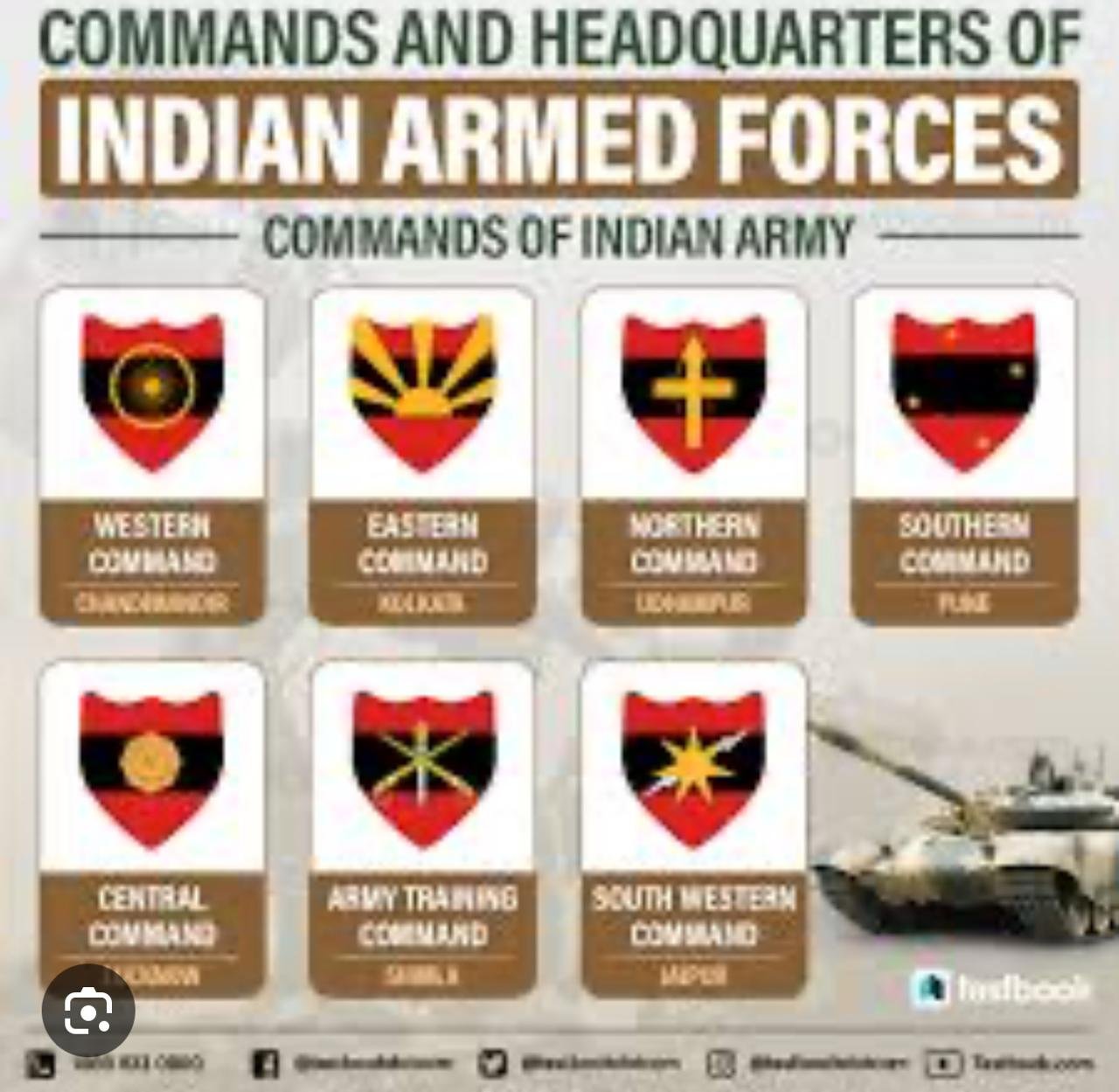
Close to 750 beds in various military hospitals have been set aside for civilian use. The AFMS (armed forces medical services) has also dedicated 19 hospitals, over 4,000 beds and 585 ICU units across the country. More COVID health care facilities and hospitals are being made regularly—a 150-bed hospital has been set up in the hostel of Punjab University by the Western Command.
The DRDO has constructed four COVID hospitals in Delhi, Ahmedabad, Lucknow and Varanasi. Incidentally, except the one in Delhi, all three have been set up in the parliamentary constituencies of the prime minister, the Union home minister and the defence minister. Besides, defence scientists from DRDO’s Nuclear Medicine and Allied Sciences (INMAS) have developed an anti-COVID therapeutic application of the drug 2-deoxy-D-glucose (2-DG).
Now, with the apprehension of third wave of COVID, requirement of medical facilities is going to multiple. And, using military along with civil administration can play a critical role in India’s fight against the pandemic.
Major General Shashi Asthana (Retd), former Director, Operations and Logistics in the Army headquarters, says that the pandemic will have to be fought like war. He says the Army has a strong logistic network as they do the six months of winter stocking for entire northern command. From a pair of socks to ammunition, the Army logistics provides everything on time.
“While the military is engaged in large numbers, there is also a scope to incorporate logistics expertise of the armed forces in crisis management to improve the supply chain,” Asthana said, adding that engineering resources of military can divert manufacturing assembly lines of other gases to oxygen to overcome the oxygen crisis. While recommending to keep the defence services in the decision making loop, Maj Gen Asthana was equally apprehensive about the government’s intention as currently the Indian military has no representation in any of the 11 empowered groups.
Last week, Delhi Deputy CM Manish Sisodia had written to Union Defence Minister Rajnath Singh to lend services of the armed forces to the state to help it set up, operationalise and run COVID health facilities with about 10,000 oxygen and 1,000 ICU beds along with transportation of medical oxygen. The Ministry of Defence, however, turned down Sisodia’s request by saying they (military) are providing “as much help as possible” without compromising their operational readiness.
Calling military for help is also a double-edged sword, politically. Had any elected leader called its help, it would led to criticism from his or her opponents that the administration has failed to perform.
While suggesting that the Army should not take control of the situation, Lt Gen Hooda said, “It is not that the Army is a solution to every problem, but here you have a well-trained and disciplined military force. They can assist by carrying out testing and vaccination roll out to the areas with the Army’s pan-India presence including remote and border areas.”


ARMY STATEMENTS ON TRANSFER OF DELHI’S BASE HOSPITAL COMMANDANT FAIL TO STEM ‘VVIP’ ROW

The Indian Army for the second time in two days issued a statement on Thursday on the controversial transfer of Maj Gen Vasu Vardhan, the commandant of the force’s 1,000-bed Covid care facility in Delhi. Maj Gen Vardhan, one of India’s top pulmonologists, has been on the job for 18 months at the Army’s Base Hospital Delhi Cantonment (BHDC) and has served there with distinction. In a highly unusual and abrupt move, he was transferred to the Research and Referral (R&R) Hospital in the city as an additional officer on May 10. The posting, which effectively renders him without any work, has come just three months before the officer is due to retire, and amid reports that he has had to pay the price for saying no to VVIP requests for the antiviral Remdesivir.
The army in a carefully worded statement says that Maj Gen Vardhan was posted out as part of an “HR Management Plan”. It says that Vardhan retires in three months. In the same time frame his deputy Brig Sandeep Tareja will also be moving out of the hospital as he has been promoted to the rank of major general. This will not be in “the best interest of the establishment that is treating Covid patients” says the statement, and so another officer, Maj Gen SK Singh, has been appointed as the commandant of the base hospital “so that there is adequate overlap and continuity in the top hierarchy of the hospital in these challenging times”. Maj Gen Singh is a plastic surgeon and was a deputy commandant of the AMC Centre and College in Lucknow.

The army also says that Maj Gen Vardhan can use the three months at his disposal to destress and plan his future.
The statement isn’t cutting much ice within the army. A senior officer says, “At a time when we are recalling doctors who have retired from the services to meet the crunch, do you really have the luxury to give a Covid doctor time to destress and send him on a punishment posting because he didn’t oblige the powers that be?”
At the base hospital, there is dismay. Sources say Dr Vardhan, who lost his mother a few days ago, reported back on duty the same day. He has been “an inspiration” at a particularly challenging time when the hospital is overflowing with patients and is short of everything including doctors and nurses. At one time the hospital was even critically low on oxygen supplies. An SOS call that went public was not received well by authorities.
But there have been complaints as well. A retired brigadier, infected with Covid, didn’t get a bed at the base hospital and died on his way to Mohali. A retired lieutenant general had written to the Chief of Defence Staff (CDS) Gen Bipin Rawat as well, complaining that veterans and their families were not being looked after well by the base hospital.


EXCLUSIVE: SATELLITE IMAGES CAPTURE CHINESE RECALIBRATIONS NEAR LADAKH

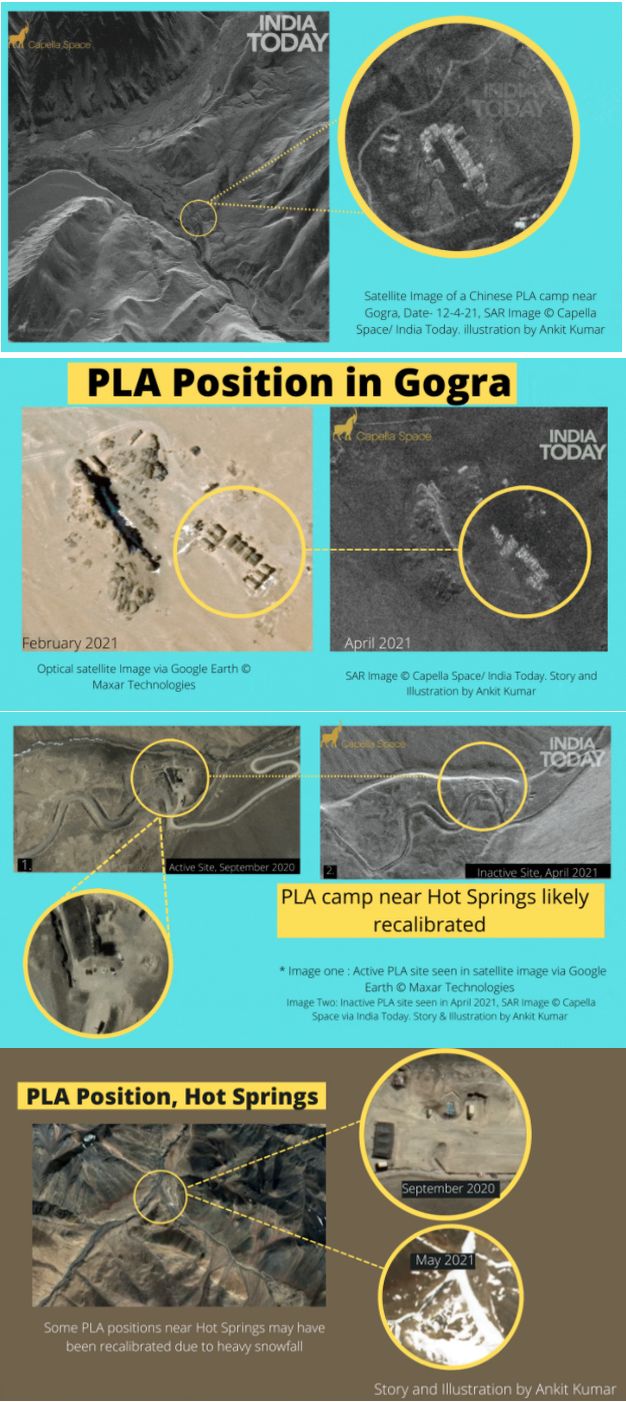
Satellite image showing possible recalibration by PLA near Hot Springs © Capella Space
Satellite imagery from Capella Space shows recalibration of Chinese ground forces along LAC. Some of the forward PLA positions near Gogra post continue to have Chinese posts Depsang is another contested region where PLA has continued to upgrade its infrastructure
As the winter snow melts in the mountains, the Chinese ground forces seem to have recalibrated some of their positions near the Hot Springs and Gogra areas in Ladakh. Analysis of new high-resolution Synthetic-Aperture Radar (SAR) satellite imagery provided to India Today by space firm Capella Space confirms minor adjustments being made by the People’s Liberation Army (PLA) of China.

Satellite images show active PLA posts near Hot Springs © Capella Space via India Today
The latest images attest the presence of the Chinese army near the Line of Actual Control (LAC), although their strength appears to have been reduced in some of the forward positions. The backward PLA positions, however, continue to horde the Chinese ground forces with new accommodations and bunkers.
India and China have been engaged in several military level talks to reduce the friction along the LAC over the last year. While the talks have successfully ensured complete disengagement from the Galwan river valley and the Pangong Lake area, the Chinese army continues to maintain its presence in other contested regions along the LAC.
Some of the forward PLA positions near Gogra post, which witnessed heavy build ups in July 2020, but later saw partial disengagement after military level talks, continue to have Chinese posts and vehicles according to the latest commercial satellite imagery.
A comparison of optical satellite imagery from February 2021 near Gogra post, with the SAR imagery of the same area from April 12 of this year, confirms the status quo in the vicinity.
However, some of the spots earlier seen acquired by the PLA in Hot Springs appear to have undergone minor recalibrations.
Heavy snowfall in the area, logistics and human resource related challenges associated with long-term deployments in difficult terrain may have led to the minor shuffle. However, the backward positions of the PLA near Hot Springs, which saw construction of permanent structures as well as bunkers and adjacent roads last year, continue to be occupied by the PLA.
Depsang is another contested region in Ladakh where Chinese armed forces have continued to upgrade their infrastructure over the course of the past few years. While Ladakh has remained a flashpoint between the two forces, the Chinese have not limited their hyperactivity merely to Ladakh.
Earlier, an India Today report showed increased PLA activity along India’s eastern border. Commercial satellite imagery established construction of new Chinese posts and roads near Sikkim’s Naku La border.
Indian Army Chief General MM Naravane, accompanied by Lt Gen YK Joshi, Army Commander of the Northern Command, and Lt Gen PGK Menon, General Officer Commanding (GOC) of the Leh-based Fire & Fury Corps, visited eastern Ladakh and reviewed India’s operational preparedness earlier last month.


NIA arrests People’s Liberation Army leader for killing Assam Rifles official in Manipur

Mayanglambam Siromani, 32, was arrested for alleged involvement in an ambush on a road-opening party of 4th Assam Rifles in Manipur’s Chandel on 15 November 2017.

Representational image for the National Investigation Agency | Twitter

New Delhi: The NIA has arrested a self-styled lieutenant of the outlawed People’s Liberation Army/Revolutionary People’s Front for his alleged involvement in an ambush and killing of an Assam Rifles official in Manipur, an official said on Friday.

Mayanglambam Siromani, 32, of Manipur’s Kakching district was arrested by the premier investigation agency on Thursday. He had fled India and taken shelter in Myanmar after the ambush.

The case is related to an ambush on a road-opening party of 4th Assam Rifles at Chamol-Sajik Tampak Road in Manipur’s Chandel in 2017 in which one Assam Rifles official was killed and another injured. Two terrorists were also killed in the encounter.

Militants carried out the ambush on November 15, 2017 when a unit of the 4th battalion of the Assam Rifles was conducting a road opening task on the Chamol-Sajir Tampak road in Chandel district.

The NIA probe established that the militants conspired to wage war against the Government of India and in furtherance of this conspiracy, they ambushed the Assam Rifles team, the official said.

Siromani was involved in the conspiracy to attack the road opening party of Assam Rifles. Based on the evidence, he was chargesheeted while being on the run. Further, he was declared a proclaimed offender and a cash reward of Rs 2 lakh was announced for information leading to his apprehension, the official added.

He was an active operative of the PLA/RPF in the 252 mobile battalion of PLA/RPF based in Myanmar.

He along with his co-accused had escaped after the ambush to Myanmar. The accused was produced before a special NIA court in Imphal and taken on police remand for five days, the official said.

Further investigation into the case is underway, he added.


Also Read: China supplying arms, providing hideouts to northeast militants via Myanmar, India alleges


Time to optimally use armed forces during crisis

The demand for handing over control to the armed forces is primarily due to loss of confidence in existing infrastructure, besides inefficient logistics. Shortages have been exacerbated due to profiteering and cornering of resources. The armed forces can help in setting up centralised war rooms and coordinated communications network. The biggest gain would be the elimination of local manipulation.

Time to optimally use armed forces during crisis

UNDER STRAIN: Health infrastructure has been under pressure amid the pandemic. PTI

Lt Gen KJ Singh (retd)

Former GOC-in-C, Western Command

As the nation battles the mega second wave of Covid along with an infodemic tsunami, questions that rankle the hapless and desperate population are — when will the armed forces take over and why are they not being given responsibilities of oxygen supply and managing hotspots like Delhi? Two former Army commanders and many senior veterans have felt that the forces are being utilised sub-optimally. Yet, the government has stated in court that it cannot ask the Army to take over in Delhi. The Delhi High Court has concurred with this argument.

The forces have finite medical resources and the existing medical system in Delhi, even in normal times, works on support from the field hospitals of formations in the vicinity. Unlike civil hospitals, paramedical and nursing support in Military Hospitals (MHs) and Base Hospitals (BHs) has been a cause for concern. This can be attributed to spartan manning norms. The flexibility in the emergency response system was further eroded with the winding up of medical TA (Territorial Army) civil hospitals in 2014.

An objective assessment would establish that niche capabilities, especially in logistics of forces, including the Air Force and the Navy, are being extensively utilised. It is most evident in the transportation of cryogenic oxygen plants and containers. The Corps of Electronics and Mechanical Engineers (EME) has also repaired and resuscitated non-functional oxygen generation plants. In addition, the forces have helped to set up the Defence Research and Development Organisation (DRDO) hospitals, including manning them. It is a matter of concern that locations for the so-called DRDO hospitals appear to have been chosen more for optics and parochial considerations. Even the naming of such temporary facilities has some political overtones. It would be better to honour medics like Maj Laishram Singh (Ashok Chakra) and the Covid Yodhas by naming them

The MHs have raised bed capacities by 10-15% to accommodate civilian patients, subject to availability. It also bears mention that the veterans are up in arms and letters have been shot off to the Raksha Mantri (RM) lamenting this step, even when many veterans are running from pillar to post to find beds. This fact has been acknowledged and put on record by the MoD, which has questioned the very relevance of the Ex-servicemen Contributory Health Scheme (ECHS).

The unfortunate part is that bureaucrats prefer to raise objections and queries, whereas they are responsible for finding solutions. It is indeed time to fix accountability, release adequate funds and reduce the pendency of unpaid bills. The bottom line is that the liability of healthcare for veterans is absolutely non-negotiable. While it is accepted that the system is literally swamped, yet more empathy and better communication will help to alleviate the veterans’ plight to some extent.

The demand for handing over the situation to the armed forces is primarily due to loss of confidence in the existing crumbling infrastructure and inefficient logistics. Shortages have been exacerbated due to most reprehensible tendencies of profiteering and cornering of resources by the power brokers and fixers. The only solution is nabbing them and exemplary punishment through fast-track tribunals. Such criminals should be publicly shamed and socially ostracised. Contrived shortages have fuelled rumours and panic.

The armed forces can help in setting up centralised war rooms and coordinated communications network extending to regional nodes. Oxygen supplies and distribution can be managed by departmental TA units, which have domain competence in supply and distribution. These units can be assisted by a regular technical and logistics unit, which can handle any situation. The biggest gain would be the elimination of local manipulation.

The present government has junked a large number of colonial-era laws, but our response is still driven by the Epidemic Diseases Act, 1897. It is time a contemporary statute is drafted and operationalised. Concurrently, the Disaster Management Act, 2005, should be updated and include an addendum on pandemics and health emergencies. Notwithstanding the fact that ‘emergency’ is abhorred in political lexicon, yet it will be a good idea to lay down norms for national emergencies. With our resilience, we should be able to overcome this crisis, but it is axiomatic that we learn lessons and are better prepared to avert the next lurking challenge. The frequency of such emergencies in all probability is likely to increase in future.

The response has to be institutionalised and driven by statutory and mandated bodies. The NDMA and NDRF are not seen to be active, it will be appropriate that they are empowered in staffing and given due authority. Even states, except a few like Orissa, have notional state-level structures. Our disaster management matrix is based on response time and quantum of force. In all eventualities, the first responders have to be well-trained organic elements, civil defence, Home Guards and the police. In remote areas, the Army, due to its location, could also be concurrent, the first responder. They have to be supplemented with the NDRF, CAPFs, armed forces and NGOs, depending on the scale of tragedy.

The NDRF is the designated primary responder, but has very limited capacities and only nominal ones in public health. Secondary responders include all others with the Army called in only as the ultimate responder. The raising of the NDRF and proliferation of demand for the Army has resulted in marked hesitancy on the part of the forces to get sucked into routine functions. Capability building for disaster relief in the forces needs to be funded. It is worrying that the forces are not represented in any of the 11 empowered committees and even the Supreme Court has not included them in the specially constituted task force, despite a stellar record and domain competence. It is time the expertise of forces is tapped in planning and management of critical functions.


Armed forces rope in Battlefield Nursing Assistants to help in Covid care

The services are pitching in every field of national effort towards Covid-19 relief

Armed forces rope in Battlefield Nursing Assistants to help in Covid care

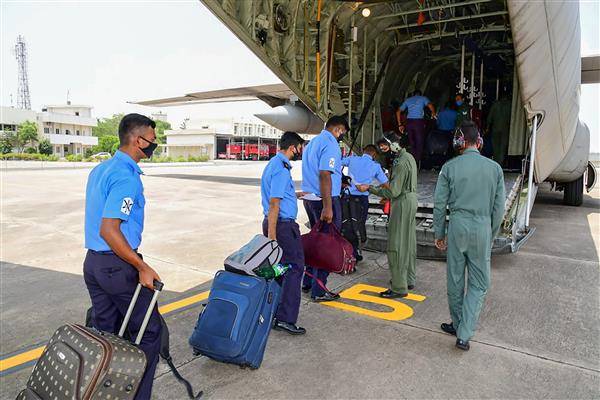
90 personnel, including anaesthesiologists, physicians, medical officers, nursing staff and paramedical staff been flown from various Naval Stations to Ahmedabad for COVID-19 duties. — PTI

New Delhi, May 14

The armed forces have roped in Battlefield Nursing Assistants (BFNA) to help fight the second wave of COVID-19 and have suggested that a similar model can be followed by state governments and hospitals, according to senior officials.

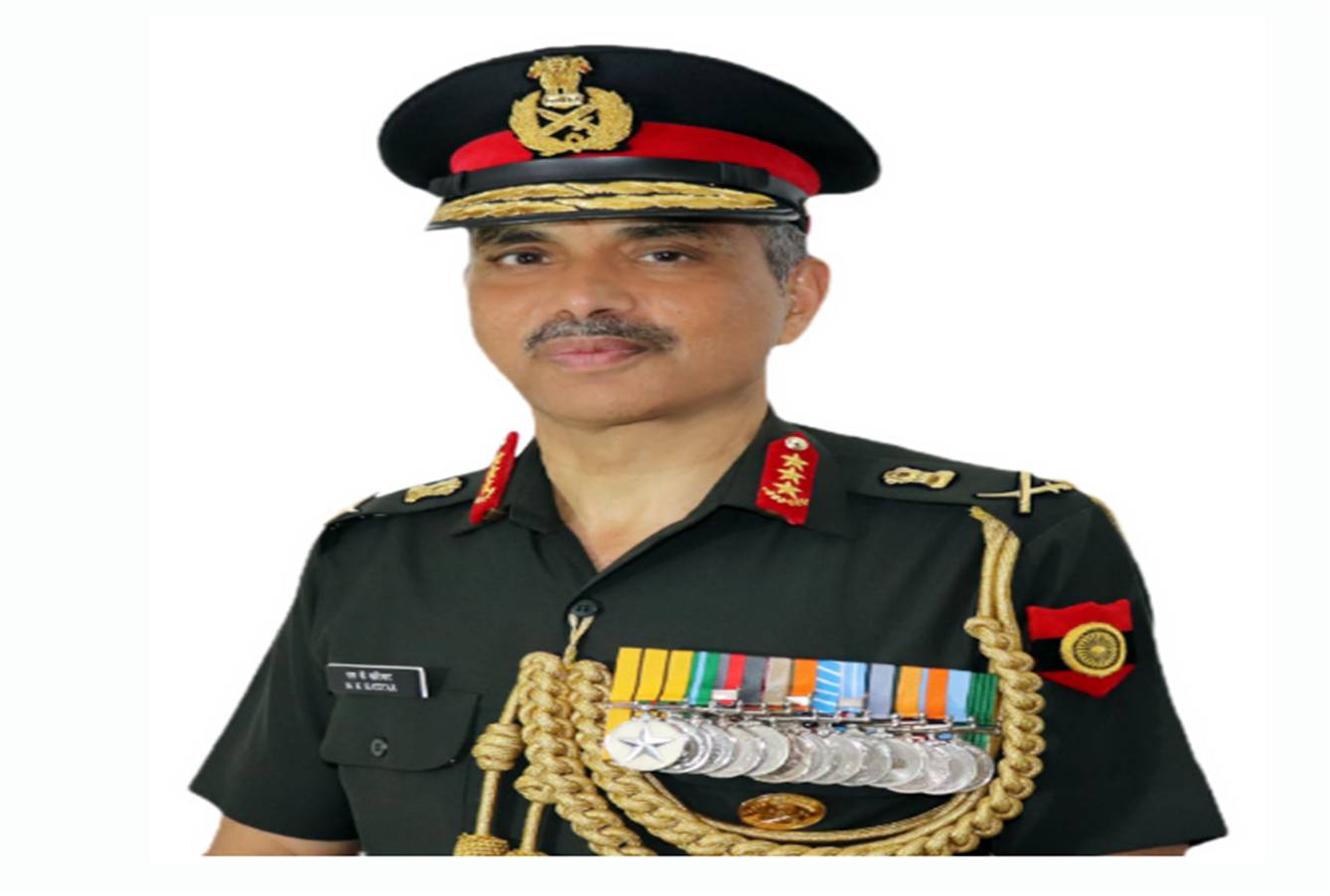
Lt General Madhuri Kanitkar, the Deputy Chief of Integrated Defence Staff (Medical), believes BFNAs can also train young volunteers to help relieve trained nurses of administration duties so that they can be gainfully utilised for more important duties in the fight against the pandemic.

The armed forces are pulling out all available resources to augment its ‘Ops CO-JEET’, a joint effort of the Army, the Indian Air Force and the Navy against the pandemic, and have deployed BFNAs at COVID-19 care centres.

BFNAs are generally trained in providing basic health care facilities in combat situation which include administering injections and helping in breathing exercise, Lt Gen Kanitkar said.

The armed forces are even helping the state administrations by putting to use their personnel and military resources to provide succour to the needy, but more is required to be done in these testing times and, therefore, volunteers from the society are needed to assist the state governments, she said.

Lt Gen Kanitkar also said a large number of Battlefield Nursing Assistants who are trained in basic medical care have been brought in for COVID-19 management.

“We have created a mechanism where we are trying for a dedicated buddy for 25 patients,” the Lt General said.

Already the fresh COVID-19 wave has been treated as a war and the armed forces have launched the operation “CO-JEET” which encompasses psychological measures to allay fears and panic and augmentation of medical facilities to combat the disease.

Carrying on with the belief of ‘conviction theory’ that “in times of stress, if you have someone to talk to, it makes a huge difference”, Lt Gen Kanitkar said the nursing assistants from the Army, the IAF and the Navy would reassure COVID-19 patients that everything will be fine soon.

“In case of need, these soldiers who are already trained in providing basic nursing aid during combat operations would help in respiratory issues by making the patients do breathing exercise,” she said.

The “Co-JEET” operation has engaged the personnel of the three wings of the armed forces—the Army, Indian Air Force and the Navy—to help restore the oxygen supply chain, setting up of COVID-19 beds and providing help to civilian administration in their fight to control the pandemic.

The Department of Defence created a Covid crisis Management Committee. The CO-JEET stands for Co-workers of all the three services who will finally have ‘Jeet’ (victory) over Covid.

Having vaccinated close to 98 per cent of the workforce, the services are pitching in every field of national effort towards COVID-19 relief while maintaining seamless coordination with government machinery to ensure optimisation of medical efforts.https://9da6deb2580e1f386badc826bd09a3c1.safeframe.googlesyndication.com/safeframe/1-0-38/html/container.html

This move is part of the concerted efforts to upgrade the facilities of armed forces’ hospitals which are being run beyond their capacity by the depleted medical manpower, she added


Online medical consultation service by retired military doctors rolled out for entire country

Online medical consultation service by retired military doctors rolled out for entire country

A COVID-19 patient on oxygen support waits to be admitted at Patna Medical College and Hospital, during the second wave of coronavirus in Patna on Friday. PTI photo

New Delhi, May 14

A free online medical consultation service launched by retired military doctors in view of a massive surge in coronavirus cases in India was on Friday extended to citizens across the country, officials said.

The defence ministry roped in retired military doctors to provide online consultations to civilian patients under a telemedicine platform.

The service was rolled out on May 7 for Uttar Pradesh and extended to Rajasthan and Uttarakhand days later as more veteran defence volunteer doctors came on board.

Currently, 85 veteran defence doctors are providing their services on the portal and have provided online consultation to more than 1,000 patients, according to the defence ministry.

“After the successful roll out in three states, ex-defence OPD, now renamed as Defence National OPD, has been rolled out pan-India on May 14 and is available on www.esanjeevaniopd.in,” it said in a statement.

It said the vast experience of the military doctors is being optimally utilised.

“This initiative will go a long way in obtaining necessary medical advice and consultation in the safe environment of patients’ homes, avoiding unnecessary visits to hospitals and increasing the risk of getting infected with COVID and overburdening the limited health resources,” the ministry said.

The service was launched under the e-Sanjeevani OPD platform of the Union health ministry.

The e-Sanjeevani OPD is a flagship telemedicine platform of the government developed by the Centre for Development of Advanced Computing (C-DAC). — PTI


Now, Covid patients at home can have access to oxygen cylinders

Need to apply, along with doc’s prescription, on UT website

Now, Covid patients at home can have access to oxygen cylinders

Chandigarh, May 14

Now, Covid patients recuperating at home in the city can have access to medical oxygen cylinders.

Where to apply

http://chandigarh.gov.in/health_covid19.htm

Cylinder provider

M/s Super Agencies, 40-MW, Industrial Area-I, Chandigarh; Mobile: 9888035000; e-mail: superchandigarh@gmail.com

How much to pay

Refilling charges

  •  Rs295 plus 12% GST for each ‘D’ type cylinder
  •  Rs175 plus 12% GST for each ‘A & B’ type cylinder

Cost of new cylinder

  •  Rs25,000 security for each empty cylinder, which will be refunded after deduction of rent at the rate of Rs100 per day. Besides, the applicant will have to pay refilling charges

Taking notice of problems being faced by patients, who were prescribed oxygen at home but finding it difficult to get it from the market, the UT Administration, with the assistance of the National Informatics Centre (NIC), has developed a facility where the patients can obtain online e-permit for oxygen cylinder.

Yashpal Garg, the nodal officer for oxygen supplies in the UT, said applications for e-permit could be submitted on the website of the Chandigarh Administration from 11 am on Sunday. He said a prescription of the doctor for requirement of oxygen and any address proof of Chandigarh were required to be uploaded at the time of submitting the application.

“The applicant will be intimated once the application is approved; the approval will be valid for two days. Though e-permit may be downloaded from the website, hard copy is not required to obtain a cylinder. The maximum two cylinders may be procured on the basis of the approved application number,” he said, adding that the cylinders would be provided by M/s Super Agencies, Industrial Area-I, Chandigarh. — TNS


BSF recovers weapons dropped by Pak drone

BSF recovers weapons dropped by Pak drone

Arms and ammunition found near the border in Samba. PTI

Jammu/New Delhi, May 14

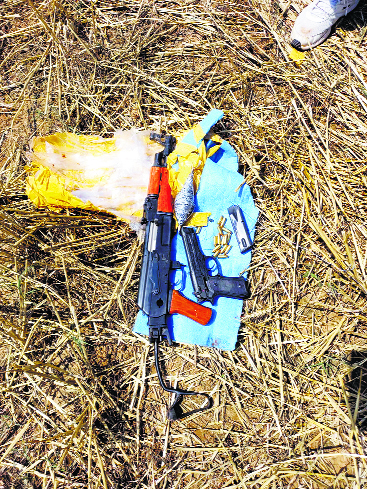
The BSF on Friday recovered an AK-47 rifle, a pistol and some ammunition dropped by a Pakistani drone from the border belt of Samba district in Jammu and Kashmir, officials said. The drone is suspected to have flown back into the Pakistani territory after it dropped the consignment, officials said.

Congratulating the troops, IG, BSF Jammu, NS Jamwal termed the recovery as a “big achievement”, and said the force is ever alert and vigilant on the International Border (IB) to thwart away the nefarious designs of Pakistan.

“BSF troops carried out a search operation in the Samba sector. At about 1215 hours, the troops recovered an item wrapped in a yellow-coloured polythene bag in a field,” a BSF spokesperson said.

After taking due precautionary measures, the packet was opened and one AK-47, one pistol, one magazine, 15 rounds of 9 mm ammunition, one wooden frame, used to attach the payload with the drone, and wrapping material were recovered, the spokesperson said.

The Border Security Force guards the India-Pakistan International Border. He said the recovery was made at a distance of 250 metres from IB inside Indian territory.

The efforts of alert BSF troops deployed in multi-tiered grid have once again resulted in neutralizing the designs of Pakistan, the spokesperson said. Officials said this was the same area where a tunnel was detected on November 22 last year. — PTI/TNS 


Keep outsiders away, CM Capt Amarinder Singh urges villagers

Calls for strict measures in rural areas for 2 mths

Keep outsiders away, CM Capt Amarinder Singh urges villagers

A health worker takes a swab sample of a child at a Patiala village. Rajesh Sachar

Tribune News Service

Chandigarh, May 14

With rural areas, which had largely remained unaffected in the first wave, witnessing a surge in Covid cases, CM Capt Amarinder Singh today urged villagers to restrict the movement of outsiders into villages and let in only those not infected by the virus.

Addressing state residents, the CM called for strict measures in rural areas over the next two months, which he described as “extremely crucial”. “Now villages are seeing a surge in cases, so we need to be very careful,” he said, urging villagers to conduct “thikri pehras” (local vigil) to keep outsiders away and allow only Covid-free people to enter.

Lauds farmers over wheat procurement

The CM lauded farmers over seamless completion of wheat procurement amid the Covid challenges. Compared to 129 lakh MT last year, 132 lakh MT wheat had been procured this year, he said, adding this had resulted in earnings to the tune of Rs26,000 crore to farmers, as against Rs24,600 crore last year.

Exhorting people to “save your mohallas and villages to save yourself, your families and Punjab”, the CM asked them not to delay visiting the hospital if symptoms arose.

“We have teams of doctors everywhere, approach them if you feel unwell,” he said, stressing delay in seeking treatment was landing people in level-3 (critical care) facilities. “While occupancy of level-2 (moderate infection) beds is 50 per cent, it is around 90 per cent at level-3 facilities, and the state government is in the process of adding another 2,000 beds,” he pointed out.

Noting that there were three stages of the disease, of which the first could be managed at home, the CM urged people to visit a doctor at the first sign of symptoms. “Let the doctor decide the course of treatment, don’t get into diagnosis and self-medication,” he said.

He wondered why people were harming the interests of the state and their families by being lax, adding “we don’t want Punjab to go the Delhi and Maharashtra way, which have experienced unprecedented problems in the second wave”.

The disease was wreaking havoc the world over, with even the most advanced countries not immune to it, he said, urging people to help his government save the state.