he Indian Air Force (IAF) Chief, Air Chief Marshal VR Chaudhari, has said there is a need to redefine, reimagine and recalibrate to transform the IAF into a contemporary and future-ready force.
The Indian Air Force (IAF) Chief, Air Chief Marshal VR Chaudhari, has said there is a need to redefine, reimagine and recalibrate to transform the IAF into a contemporary and future-ready force.
He said this at the Air Force Day parade in Chandigarh on Saturday. Incidentally, the theme for this year’s IAF anniversary celebrations is “IAF: Transforming for the Future”. The IAF plans to plug the gaps by phasing out outdated planes and helicopters and adding new equipment and technology.
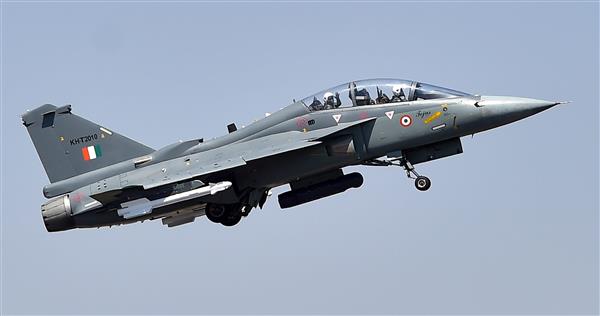
The future of fighter jets after 2028 will be Tejas Mark2 and the advanced medium combat aircraft.
The new set of tactical lift planes, the C295, will be produced by a joint venture between Airbus and Tata.
The airborne early-warning aircraft, vital in war to pick up enemy signals and locations, will be attached to the body of a commercial airline. This is how leading countries are doing it.
Indigenous early-warning systems will be installed on six planes that are expected to join the fleet at the end of this decade. At present, the IAF uses a mix of Russian and Israeli technology.
The IAF is looking at more mid-air flight refuellers. Its existing fleet of Russian IL-78 mid-air refuellers are also used to meet the needs of Indian Navy planes. “The focus will be on cyber and space domain,” the Chief of the Indian Air Force had told the media in New Delhi on October 4. “Tomorrow’s conflicts cannot be fought with yesterday’s mindset,” he had said in Chandigarh.
Force to reckon with
The future of fighter jets — post 2028 — will be Tejas Mark 2 and the advanced medium combat aircraft
The new set of tactical lift planes, the C 295, will be produced by a joint venture of Airbus and Tata
Mi-17 overhaul task tripled; IAF to engage industry for 5 years to overcome manpower shortage
The number of IAF’s Mi-17 medium lift helicopters to be overhauled in the country has been enhanced over three times, prompting the Air Force to rope in the civilian aviation establishment for dealing with additional manpower requirements.
“The overhaul task allotted by the Ministry of Defence to the Air Force for the current planning year is 35 helicopters as compared to 11 for the last planning year,” an IAF officer said. Overhaul of Mi-17s is undertaken at No 3 Base Repair Depot (3 BRD) in Chandigarh.
According to IAF sources, 3 BRD overhauls about 8,000 mechanical rotables and components, which involves about 4.5 lakh man-hours. “The quantum of the task requires over 350 personnel, including supervisors, while the strength available at present is much less,” an officer said.
To meet the task the IAF has decided to outsource certain non-critical and non-core activities associated with the helicopter overhaul process to the civilian industry, for which only Indian entities will be permitted. The industry will be initially involved for a period of five years — from 2023 to 2028.
Six processes have been listed out for the industry. These are dismantling of the helicopter and sub-assemblies, paint removal and cleaning the complete helicopter and its parts, defect analysis of the structure, including visual checks, non-destructive test for cracks, dents, loose or missing rivets, corrosion removal and carrying out necessary repairs, removal of the electrical loom and its refurbishment, followed by testing and relaying, repairing and refurbishing the cockpit and cargo compartment ceiling, side and floor panels, and finally re-painting and marking of the helicopter.
Earlier this year, the IAF had issued an Expression of Interest inviting the industry to be associated with the Mi-17 helicopter overhaul process. The task envisioned was overhaul of 15 helicopters per year for a period of two years.
The IAF operates three variants of the Soviet/Russian origin Mi-17 class, including the latest Mi-17 V5, Mi-17 1V and older versions, which form the backbone of its medium-lift rotary component.
Over 220 Mi-17 helicopters, that began entering service in 1991, are reported to be in service. These gradually replaced the earlier Mi-8 and are extensively used for tactical missions such as troops transport, assault, ferrying and air dropping supplies in remote areas, special operations, search and rescue and disaster management.
Part of 90th anniversary celebrations of IAF I Indigenous LCH Prachand makes 1st public appearance
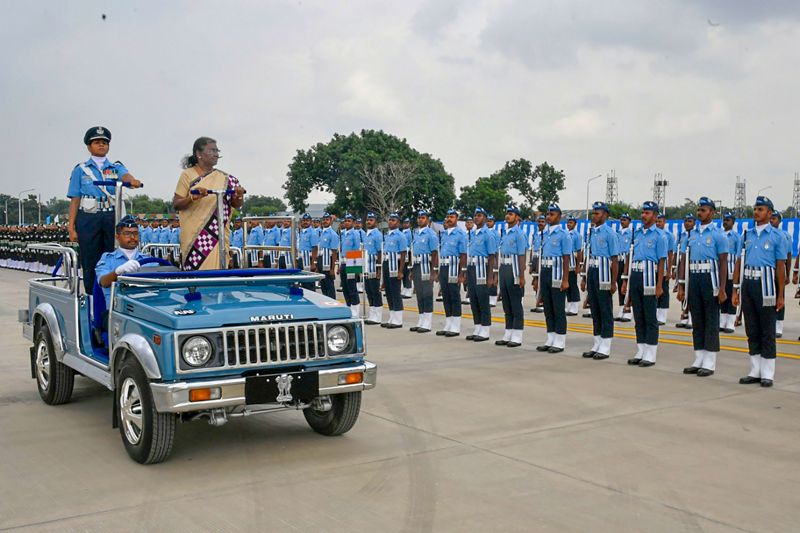
President Droupadi Murmu, Defence Minister Rajnath Singh, Punjab Governor Banwarilal Purohit and Air Chief Marshal VR Chaudhari during the 90th anniversary celebrations of the IAF at Sukhna Lake in Chandigarh on Saturday. Manoj Mahajan/Pradeep Tewari
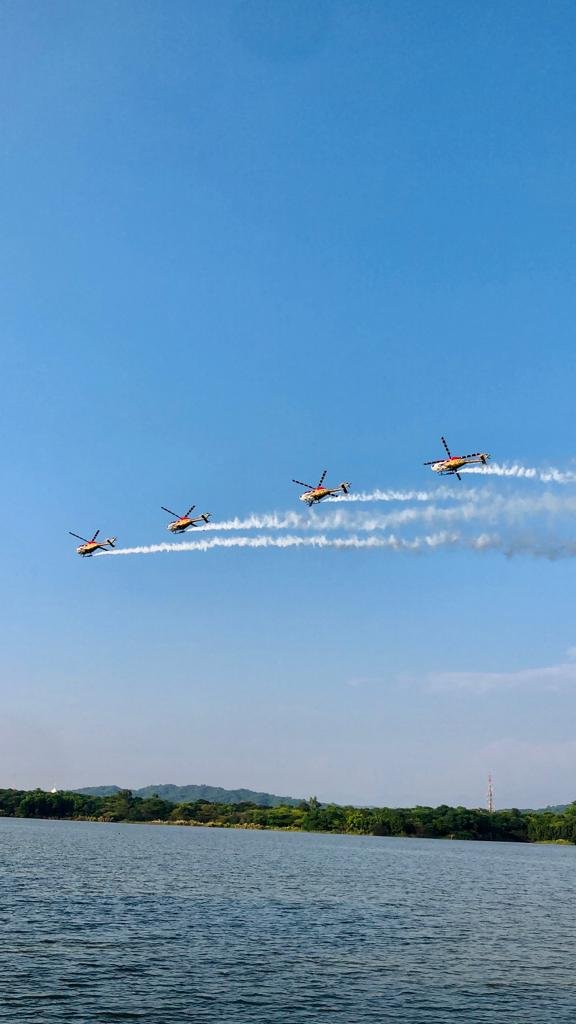
C-130 Super Hercules dispenses flares.Pradeep TewariSarang team members display skills during an air show at Sukhna Lake in Chandigarh on Saturday. Pradeep Tewari
President Droupadi Murmu on Saturday witnessed a spectacular fly past and air display over the Sukhna Lake as part of the 90th anniversary celebrations of the Indian Air Force. It is the President’s maiden visit to City Beautiful since she assumed office in July this year. Also, it is for the first time that Air Force Day parade and fly past has been held outside the National Capital Region.
Air Chief Marshal VR Chaudhari inspects a guard of honour.A ‘Surya Kiran’ team during an air show.
Defence Minister Rajnath Singh, Punjab Governor Banwarilal Purohit, Haryana Governor Bandaru Dattatreya, Chief of Defence Staff Gen Anil Chauhan, Chief of Air Staff Air Chief Marshal VR Chaudhari and Haryana CM ML Khattar were among those present along with a host of civilian and military dignitaries.
‘Aakash Ganga’ team
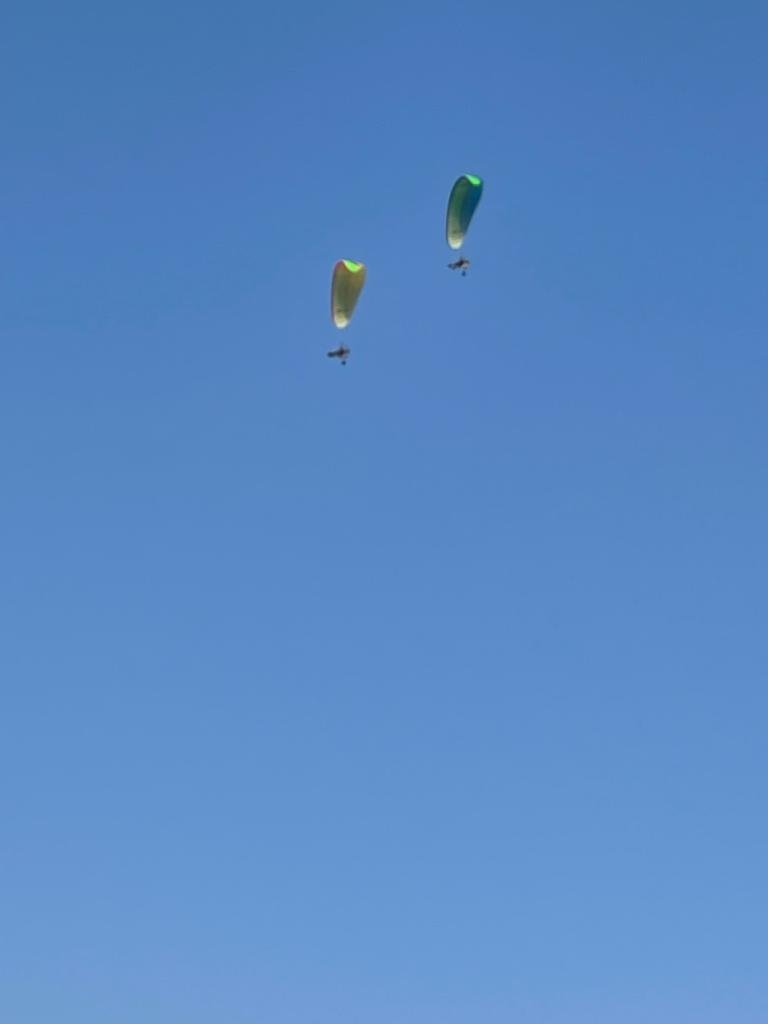
The fly past commenced with an ‘Aakash Ganga’ team of paratroopers in AN-32 aircraft
Mi17 V5 choppers showed capability to undertake fire-fighting ops using ‘bambi bucket’; Mi17 IV helicopters performed helocasting
Rajnath Singh tweeted, “Best wishes to all courageous IAF air warriors…”
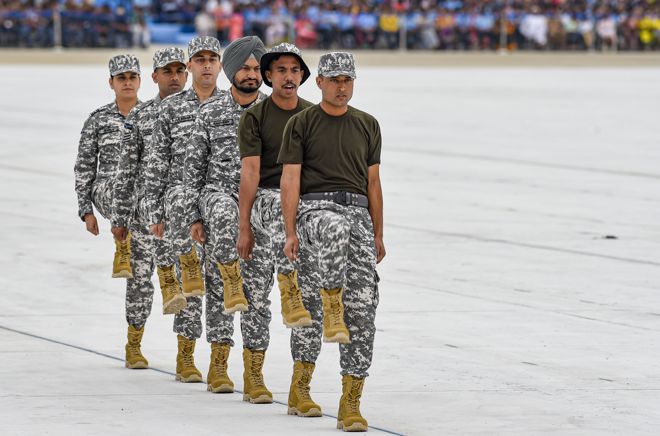
New combat uniform
Air Chief Marshal VR Chaudhari also unveiled a new combat uniform for the IAF
It has a digital camouflage pattern in lighter hues suitable for plains, deserts and hills
Tan-coloured boots; new design made of lighter and sturdier fabric comfortable to wear
Starting with the ensign formation with three Mi-17 helicopters trooping the Tricolour and the Air Force flag, the fly past included almost all types of fighter, transport aircraft and helicopters in the IAF inventory. As many as 70 aircraft operating from eight airbases participated in the fly past comprising several configurations and manoeuvres, with newly inducted indigenous light combat helicopter Prachand making its first public appearance in a three-aircraft formation.
Specialised Streams
The new operational branch will essentially be for manning of force specialised streams of surface-to-surface missiles, surface-to-air missiles, remotely piloted aircraft and weapon systems operators in twin and multi-crew aircraft. —Air Chief Marshal VR Chaudhari
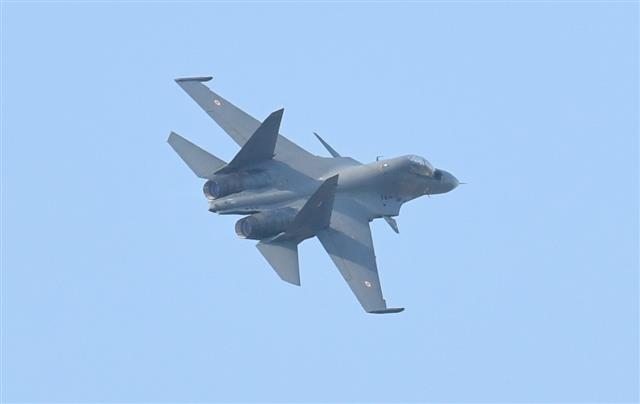
The fighters included the Rafale, Su-30, MiG-29, MiG-21, Jaguar Mirage-2000 and Tejas. Two vintage aircraft, the Harvard and Dakota, also made an appearance.The fly past was capped by a dazzling performance by Surya Kiran formation aerobatic team team flying Hawk-132 jet trainers and the four-aircraft Sarang helicopter display team flying the Dhruv helicopter
Prior to the fly past, para-jumping by IAF’s Akash Ganga skydiving team was conducted. Earlier in the day, the Air Chief reviewed an impressive ceremonial parade at the Chandigarh Air Force Station and took the salute as a trio of Mi-17 helicopters trooped the Air Force flag and three Rudra helicopters flew past in an aerial salute. The parade was commanded by Gp Capt Anup Singh.
Seven former IAF chiefs — Air Chief Marshal NC Suri, Air Chief Marshal AY Tipnis, Air Chief Marshal S Krishnaswami, Air Chief Marshal SP Tyagi, Air Chief Marshal FH Major, Air Chief Marshal NAK Browne and Air Chief Marshal RKS Bhaduria — attended the parade. A large number of serving and retired officers were present too.
Manish TewariManish Tewari is a lawyer and a former Union minister and present MP Ananpur Sahib. The views expressed are personal. Twitter handle @manishtewari
ll indicators point to a crisis of a magnitude greater than the 2008 global recession. (Representataional Image/AP)
In September 2008, Wall Street collapsed and triggered a full blown financial crisis. It marked the beginning of a global recession that brought down a major chunk of the financial industry. What is now conventional wisdom was difficult to predict back then. It was not clear that a recession was on the cards, and nobody thought the oncoming meltdown was going to be the worst since the great depression of the 1930s. Then Lehman Brothers collapsed and Wall Street went into freefall.
The prospect of a similar global recession seems increasingly likely. Credit Suisse, one of the world’s largest investment banks, has had a nightmare September. Panicked investors have driven the group’s credit default swaps (CDS) to a 14-year high. Worryingly, the combined asset value of stressed groups such as Credit Suisse and Deutsche Bank is $2 Trillion. Lehman Brothers — whose collapse plunged the world into a global recession — had an asset value of $600 billion. If Credit Suisse and Deutsche Bank fall, they will in all probability take the global economy down with them.
September 2022 has brought back the ghosts of September 2008. S&P 500 declined by 9.34 per cent, and Dow Jones Industrial Average, fell by 8.84 per cent. They have seen their biggest losses since March 2020. This is also their worst September performance since 2002. Nasdaq dropped 10.5 per cent, its worst September performance since 2008. Global growth forecasts have been snipped. In July, the IMF lowered its global growth forecasts for 2022 and 2023 from 3.6 per cent to 3.2 per cent and 2.9 per cent, respectively. The World Trade Organisation chief, Ngozi Okonjo-Iweala, and economists at the World Economic Forum, have noted that a global recession by 2023 is the most likely scenario facing the world economy.
Indeed, the likelihood of the US Federal Reserve (Fed) persistently raising interest rates to tame inflation could push America into recession. Nobody is holding out for a soft landing anymore. Jerome Powell, US Fed chairman, recently admitted he had no idea how severe a potential recession would be. The math is simple: As the Fed adopts an increasingly hawkish stance, putting pressure on currencies around the world, central banks would be forced to constantly control inflation or protect their currency, leading to an inevitable recession. When President Bush addressed the United Nations General Assembly in September 2008, he sniggered that recession was an American problem to be handled by Americans themselves. In retrospect, he could not have been more wrong. What happens in Vegas does not necessarily stay in Vegas.
Just last week, China’s central bank moved aggressively to protect the yuan. It asked its offshore bank units to ensure sufficient dollar reserves for an intervention to help reverse the yuan’s slide. The yuan has already taken an 11 per cent blow vis-à-vis the dollar this year. The Chinese are looking to offload the dollar in big numbers which could spell pandemonium in the market. This is in response to the dollar’s rapid appreciation — a direct by-product of the Fed’s rate hikes.
Japan, the United Kingdom and Europe have also moved to strengthen their respective currencies. The Japanese central bank intervened to prop up the yen for the first time in 24 years. The European Central Bank (ECB) hiked interest rates by 75 basis points in September, its largest single hike ever. As is clear, Central banks around the world are scrambling to keep up with the Fed’s aggressive tightening. This is due to the fear — a genuine one no doubt — that a weak currency will ramp up the cost of imports and make it that much more difficult to handle inflation. More such hawkish policy by central banks is expected in the coming months.
That said, there is an immediate cause to all this turmoil. Germany, the UK, and Italy are all slated to reel under recession next year because of the Russian invasion of Ukraine. Supply chain shocks from the conflict have brought higher costs with little growth. This is most stark in the UK where the pound touched record lows and households face energy inflation of about 80 per cent. European countries fare no better as Russia’s hold of oil and gas supplies puts them at Putin’s mercy. Russia has already cut gas supplies to Germany, Bulgaria and Poland.
With the winter approaching, Europeans face a race against time to decouple their energy supplies from Russia which is a nigh impossible task to achieve within the next couple of months. Europe’s interconnected nature will hurt it more because of its highly integrated supply chains. A recession is but an inevitability. Sanctions on Russia do not seem to be working and have, in fact, helped Russia to squeeze Europe even more by stopping energy supplies. The Oprichniki in the Kremlin are sniggering at the UK and Europe raising interest rates despite the impending recession threat.
Macroeconomic instability is bound to impact living standards and increase poverty. Multiple crises in the last five years have led to massive food insecurity, particularly in Sub-Saharan Africa. Already, 53 countries around the world face acute food shortages with projections expecting the situation to get worse. In a de-globalising world reeling under the shocks of a pandemic and the Russia-Ukraine conflict, it is difficult to see nations coming together to revive the global economy that has reached an inflection point, chock-full with inflationary pressures and supply chain disruptions.
In India, too, the impact is upon us. The rupee breached the 82 to a dollar mark on Friday. The Reserve Bank of India has revised annual GDP growth number downwards to 7.2 per cent but this number also takes off from a very low base and does not reflect real growth. Current account deficit was 2.8 per cent of GDP in April-June 2022. Trade deficit at $149.47 billion between April-September 2022 is almost double than the corresponding period last year. The fiscal deficit at Rs. 5,41,601 crores for the period April-August 2022 leaves little room for fiscal maneouvre. The single biggest challenge to India’s banking system because of the deteriorating global economic situation is Rs. 8.58 lakh crores owed to various Scheduled Commercial Banks by borrowers, with the bulk of the money being owed by India’s largest corporate houses.
All indicators point to a crisis of a magnitude greater than the 2008 global recession. This is so because the world is fragmented, and national debts are at staggering levels which will debar countries from doing any tinkering once in recession. Fiscal stimuli are difficult when your national debt equals $30 trillion, which is the federal debt of the US government. For now, hedge funds and investment banks are still dancing, but when the music stops playing — to quote the infamous words of a CitiBank CEO during the 2007-09 financial crisis — things will get complicated.
he more substantive strand from Gen Rawat’s tenure is the dismay created when he made an off-the-cuff remark about the Air Force and some less than positive observations about the Navy. This went against the ethos of the inter-service synergy that the CDS was expected to usher in and Gen Chauhan will have to address this matter with empathetic persuasiveness.
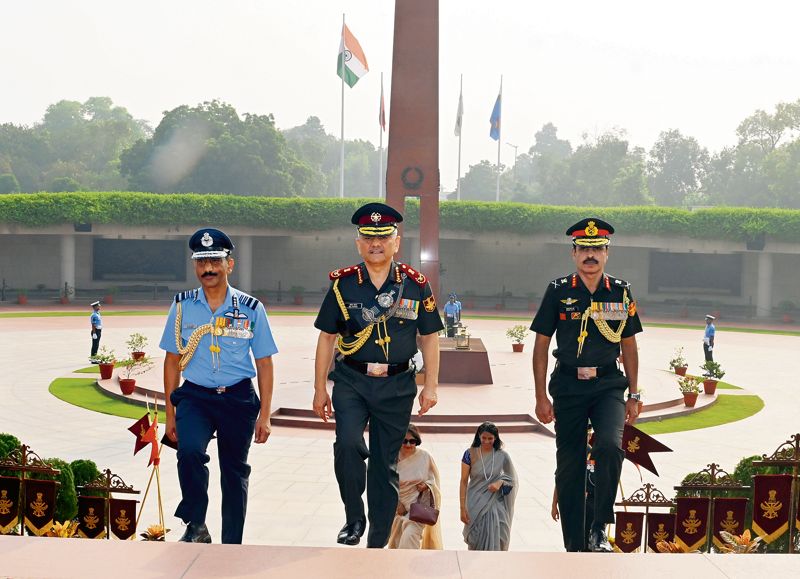
DISTINCTIVE CHALLENGE: The new CDS, General Anil Chauhan (centre), will have to draw a line in relation to the military-political overlap. ANI
C Uday Bhaskar
Director, Society for Policy Studies
ASSUMING charge as the country’s second Chief of Defence Staff (CDS), Lt Gen Anil Chauhan (retd) assured his fauji brethren: “I will try to fulfil the expectations from the three defence forces as the CDS. We will tackle all challenges and difficulties together.”
This statement acquires greater salience on Air Force Day today since nurturing ‘jointness’ or higher levels of inter-service synergy was a major objective when the post of the CDS was announced by Prime Minister Narendra Modi in August 2019.
Given the many national security challenges that need to be addressed, some immediate ones such as the Ladakh standoff and others that are complex, Gen Chauhan will have a wide spectrum ‘must-do’ list. This will not only seek to take forward the work in progress initiated by his predecessor, General Bipin Rawat (whose tenure was tragically cut short in a helicopter crash in December last), but also factor in the multi-dimensional turbulence engendered by the war in Ukraine that began in February.
The CDS has an anomalous institutional profile; in that he is the first among equals along with the three service chiefs as a four-star General. Concurrently, he is Secretary to the Government of India in the Ministry of Defence and Principal Adviser to the Defence Minster on inter-service issues. This is a daunting combination of roles and each hat has its own distinctive challenge for the new incumbent.
Chauhan retired as a three-star Army General and his last appointment was that of an Army commander, Eastern Command in Kolkata.
In an unprecedented move, the government has recalled and re-commissioned a retired officer in a higher rank with much greater civil-military responsibilities. A four-star service chief has a higher defence management exposure that is very different from that of an Army GOC-in-C (and equivalent) and the new CDS will be expected to provide the ‘firm hand on the tiller’ as the Chairman of the Chiefs of Staff Committee, without the benefit of having been a chief. While Gen Chauhan’s professional acumen is commendable, the enormity of what he has been tasked to shoulder is to be noted.
Presumably, an objective review of Gen Rawat’s experience must have been undertaken by Gen Chauhan when he was serving as a military adviser to the National Security Adviser (NSA). However, some issues related to the office of the CDS that attracted comment during the Rawat tenure merit recall and an objective in-house review by the new incumbent may have a bearing on the evolution of this high office with its onerous responsibilities.
The first is related to ceremonial matters. It may be recalled that Gen Rawat assumed office as the CDS in January 2020 in the same rank that he held as the Army Chief — namely that of a four-star General. However, Rawat assumed office with a newly designed rank badge that was incongruous and raised eyebrows — for the CDS was not envisaged as a rank, but a post.
The grapevine has it that this new rank badge was mooted by Gen Rawat when he was the Army Chief and his name was announced as the first CDS. At the time, his peers did not agree to this proposal for it would not have been possible for an Admiral or an Air Chief Marshal to wear such a badge! Some retired senior Army officers had also conveyed their unease with this ‘new badge’ to Gen Rawat, but the horse had bolted and this sagacious counsel was not taken.
Gen Chauhan must have been aware of the flutter that the rank-badge issue had caused and the import of such symbolism in the military. This is a purely military ceremonial matter and the CDS could decide how best to arrive at appropriate in-house closure.
The more substantive strand from Gen Rawat’s tenure is the dismay created when he made an off-the-cuff remark about the Air Force and some less than positive observations about the Navy. This went against the ethos of the inter-service synergy that the CDS was expected to usher in and Gen Chauhan will have to address this matter with empathetic persuasiveness.
More recently, Air Chief ACM Vivek Ram Chaudhari expressed his nuanced ‘reservations’ about doctrine and structures while pursuing theatre commands when there is a paucity of air assets.
The last, but perhaps most, substantive strand is the ‘lakshman rekha’ that the new CDS will have to draw in relation to the military-political overlap.
Eyebrows had been raised when Gen Rawat chose not to attend the Navy Day event in December 2020 and instead participated in a programme with ‘overt religious overtones’ in the company of UP Chief Minister Yogi Adityanath.
The fact that Gen Chauhan was handpicked by the Modi government as the CDS and that the existing rules were tweaked to enable this appointment have attracted notice. While it is the prerogative of the government to choose its military top brass, the CDS is his own ‘sherpa’ in such sensitive matters and will have to evolve the appropriate template of rectitude and restraint to insulate the military from the prevailing socio-political churn that India is experiencing.
Whereas caste and religion have become central to the Indian politics, to its credit, the armed forces have not allowed these determinants to impact military professionalism and commitment to core democratic principles.
When Gen Rawat assumed office, former Naval Chief Admiral Arun Prakash had sagaciously advised, “The military ethos requires that he (CDS) retains his professional independence and upholds his oath of allegiance to the Constitution.” This principle is cast in stone and should remain inviolate.
IAF to determine life extension of Su-30 MKI fighter jets from 25 to 35 years
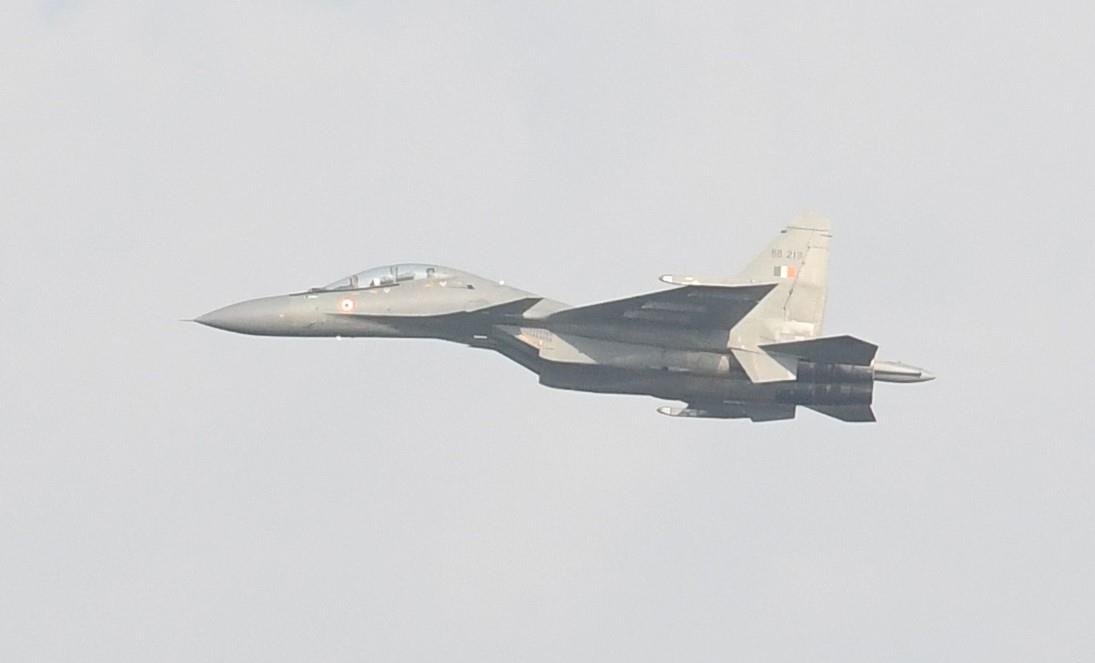
The Indian Air Force has initiated a project to carry out life extension studies on its Su-30 MKI frontline fighter aircraft to determine the feasibility of enhancing its calendar life by at least 10 years from 25 years to 35 years.
The IAF has about 260 Su-30s in its inventory, the first of which entered service in 2002. Life extension of an aircraft is different from upgrading the aircraft. While an upgrade involves enhancing the combat capability by introducing newer systems, life extension requires checking the structural integrity of the platform and its subsystems and assessing how long it can function effectively.
Su-30 MKI fighter jet. Photo: Vijay Mohan
In an expression of interest (EOI) issued on October 4, the IAF has stipulated that only Indian firms having the requisite expertise will be allowed to participate in the project, which will be undertaken at the 11 Base Repair Depot located in Nashik. The IAF has undertaken life extension studies on other aircraft and helicopters, allowing platforms to continue in service for longer periods.
The work will be undertaken in three phases. The first phase would involve study of aircraft structural issues, defectation data and analysis of flight data will be carried out by the depot to determine the life extension checks to be undertaken. This includes corrosion removal on the airframe, repair and strengthening of certain load bearing-areas and a few structural modifications.
In the second phase, the industrial partner, which will be responsible for the process and quality control as well as provisioning manpower, equipment and consumables, will carry out life extension checks on one aircraft under the depot’s close supervision.
In the third phase, life extension checks on the remaining aircraft will be carried out independently by the industry in accordance with pre-defined timelines. According to the EOI, three to five aircrafts will undergo life extension checks per year.
The twin-engine heavy, multi-role Su-30 is assembled indigenously by Hindustan Aeronautics Limited, which has also been involved in several upgrade projects undertaken on the aircraft over the past decade. It now forms the backbone of the IAF’s fighter jet fleet.
Among the most significant modifications of the Su-30 is adapting it to launch the airborne version of the Brahmos supersonic cruise missile, giving it an enormous offensive punch up to a range of about 500 km. Other past upgrades include integration of air-to-air missiles, avionics, mission software and other sub-systems from varied Indian and foreign sources.
Earlier this week, Chief of the Air Staff Air Chief Marshal VR Choudhari had stated that an initial lot of 84 Su-30s would be upgraded indigenously over the next four to five years, for which the Air Staff qualitative requirements have been finalised. This includes a new fire control radar, touch- and voice-controlled avionics and navigation system, electronic warfare suite and self-protection systems
Army wives’ group writes to PM on helicopter crashes
Days after Lt Colonel Saurabh Yadav died in an Army aviation helicopter crash in Arunachal Pradesh’s Tawang, the Indian Army Wives’ Agitation Group has written to Prime Minister Narendra Modi, terming the Cheetah and Chetak series of copters “flying coffins”.
Lt Col Yadav was flying a Cheetah when it crashed on October 5. His co-pilot was injured. The Cheetah choppers are based on a 1950s design and several attempts to induct their replacement have failed to fructify over the past 15 years. These copters, weighing over 3.5 tonne, fall in the light utility helicopter (LUH) class. These are the lightest copters in the Army and IAF fleet.
2 Army personnel killed in field firing exercise in Madhya Pradesh
Two Army personnel were killed and another was injured during a field firing exercise involving a tank in Madhya Pradesh’s Babina, officials said on Friday.
The two personnel were hit when the barrel of the T-90 tank burst, they said.
“During the annual firing at Babina Field Firing Ranges on October 6, a tank barrel burst took place. The tank was manned by a crew of three personnel. The crew was provided immediate medical aid and evacuated to military hospital in Babina,” said an official.
“The commander and the gunner unfortunately succumbed to burns. The driver is out of danger and under treatment,” the official said.
First such initiative by Air Force since Independence
In what is the biggest rejig of the force in decades, the Union Government has approved the creation of a weapon systems branch for the officers of the Indian Air Force (IAF).
The announcement was made by IAF Chief Air Chief Marshal VR Chaudhari in Chandigarh on Saturday during a parade to mark the 90th anniversary celebrations of the Air Force. He said it was the first time since Independence that a new operational branch had been created. The branch will be divided into four sub-streams, each with its own specialisation to carry out launch of weapons, collate information and even operate space assets.
IAF personnel in new combat uniform.
The branch will induct a specialised cadre of officers and be in-charge for all major weapons’ firing, including those launched from some fighter jets, all helicopters and even ground-launched missiles like the S400 imported from Russia. The cadre will also be responsible for UAV and space operations.
Will save Rs 3,400 cr
Creation of weapon systems branch will result in savings of over Rs 3,400 crore due to reduced expenditure on flying training. —Air Chief Marshal VR Chaudhari
This would essentially be for manning of four specialised streams of surface-to-surface missiles, surface-to-air guided missiles, remotely piloted aircraft (better known as UAVs) and all weapon system operators in twin-engine and multi-crew aircraft, the IAF Chief said.
“Creation of this branch will result in savings of over Rs 3,400 crore due to reduced expenditure on flying training,” he said.
The first sub-stream is ‘flying’. Officers in this category will be weapon systems operators in twin-engine and multi-seat aircraft like fighters jets Sukhoi30 MKI — some 265 in the fleet. All attack helicopters also fall in the same category, including the Boeing Apache AH-64E, the indigenous light combat helicopter (LCH) and the Russian Mi -25/35.
The second sub-stream will be called ‘remote’. Personnel will be operators of many UAVs like the Predator from the US or the armed version of the domestic UAV Rustom (now known as the TAPAS-BH) made by DRDO.
Another sub-stream is ‘intelligence’. This shall comprise analysts of imagery obtained through surveillance assets in space or UAVs. Analysts of intelligence inputs, information warfare specialists, observers and signal intelligence collation will be part of it and so will operators of space systems.
The fourth sub-stream is named ‘surface’. It shall have mission commanders and operators of surface-to-air guided weapons and surface-to-surface missiles. The newly imported S-400 missiles from Russia will be part of it and so will be all air-defence weapons like the Akash missile.
Specialised cadre in 4 sub-streams
Flying: Air Force officers in this category will be weapon systems operators in twin-engine and multi-seat aircraft like fighters jet
Kenya’s first woman General leads delegation to Indian Military Academy
In furtherance of traditional India-Kenya ties and defence cooperation, Maj Gen FG Ahmed, Commandant, Kenya Military Academy, visited the Indian Military Academy (IMA), Dehradun, along with a high-level delegation comprising five members from the Kenyan armed forces.
Maj Gen Ahmed is the first woman to hold the rank of General in the Kenya Armed Forces and the Commandant Kenya Military Academy. She was commissioned as a Second Lieutenant in 1985 and posted to the Kenya Air Force.
During its three-day visit that concluded today, the visiting delegation was briefed in detail the training regime being followed at the IMA, including the representation from friendly foreign countries, a spokesperson for the IMA said.
The Commandant of the Kenyan academy appreciated the determined and daring junior leadership, courage of the Indian gentleman cadets at the tactical level and the swift execution of military strategy and plans displayed during the operational tasks assigned to them as part of training.
The Kenya delegation also appreciated the state-of-the art training facilities at IMA being utilised for training the cadets to face the varied challenges of modern day warfare. They also commended the staff for maintaining stellar training standards.
The Kenyan General interacted with Lt Gen VK Mishra, the IMA Commandant, on training and administrative matters and exchanged notes on various aspects of military training.
She also interacted with the cadets undergoing pre-commission training and applauded them for their camaraderie, team work and resilience. She mentioned that IMA has produced top-class military leaders who have risen to highest levels in friendly countries who send their cadets for training here.
State Stalwarts
DEFENCE MINISTER
Minister Rajnath Singh
ALL HUMANS ARE ONE CREATED BY GOD
HINDUS,MUSLIMS,SIKHS.ISAI SAB HAI BHAI BHAI
CHIEF PATRON ALL INDIA SANJHA MORCHA
LT GEN JASBIR SINGH DHALIWAL, DOGRA
SENIOR PATRON ALL INDIA SANJHA MORCHA
MAJOR GEN HARVIJAY SINGH, SENA MEDAL ,corps of signals
.
.
PATRON ALL INDIA SANJHA MORCHA
MAJ GEN RAMINDER GURAYA ,MADRAS REGIMENT
sanjhamorcha303@gmail.com
PRESIDENT SOUTH ALL INDIA SANJHA MORCHA
COL SS RAJAN BOMBAY SAPPERS,
PRESIDENT UTTARAKHAND ALL INDIA SANJHA MORCHA
COL B M THAPA ,BENGAL SAPPERSS
PRESIDENT HARAYANA STATE CUM COORDINATOR ESM
BRIG DALJIT THUKRAL ,BENGAL SAPPERS
PRESIDENT TRICITY
COL B S BRAR (BHUPI BRAR)
PRESIDENT CHANDIGARH ZONE
COL SHANJIT SINGH BHULLAR
.
.
PRESIDENT PANCHKULA ZONE AND ZIRAKPUR
COL SWARAN SINGH
INDIAN DEFENCE FORCES
DEFENCE FORCES INTEGRATED LOGO
INDIAN AIR FORCE
Air Officer C-in-C WESTERN AIR COMMAND
AIR MSHL S PRABHAKARAN AVSM VM
AOC-IN-C, EASTERN AIR COMMAND
Air Marshal Inderpal Singh Walia
AOC-in-C SOUTH WESTERN AIR COMMAND
Air Marshal Vikram Singh
AOC-IN-C, SOUTHERN AIR COMMAND
Air Marshal J.Chalapati
AOC-IN-C TRAINING COMMAND
AIR MARSHAL SK GHOTIA VSM
AOC-IN-C MAINTENANCE COMMAND
Air Marshal Jagdish Chandra
Flag Officer Commanding in Chief, Western Naval Command
ice Admiral R Hari Kumar, PVSM, AVSM, VSM
Flag Officer Commanding in Chief, Eastern Naval Command
Vice Admiral Sanjay Bhalla, AVSM, NM
Flag Officer Commanding in Chief, Southern Naval Command