T he Army, which has made three tranches of Emergency Procurements (EP) in the last few years, is preparing for a fourth round of EP which will be entirely from the domestic industry, Army chief Gen. Manoj Pande said on Thursday. He also said that in the next seven to eight years, orders worth ₹8 lakh crore could be placed with Indian industry. “Emergency Procurements are done to address critical operational requirements. Three tranches of EPs were executed under which 68 contracts worth ₹6,000 crore were placed. We are now in the 4th EP for indigenous equipment. Our industry has risen to the challenge,” Gen. Pande said speaking on the sidelines of the DefExpo2022. “We also need to indigenise to modernise. It should not be seen as an impediment, but as an opportunity.” Emergency financial powers were granted to the armed forces by the Defence Ministry in the past under which they could procure weapons systems up to ₹300 crores on an “urgent basis without any further clearances to cut short the procurement cycle.” Gen. Pande said the EP also gives them an opportunity to test various systems in the field before going in for larger acquisition through the capital budget route. The RussiaUkraine war taught us lot of lessons, the Army Chief said on becoming selfreliant. Not just maintenance and spares but also in terms of new acquisitions. He said the Army was working on indigenisation of ammunition while looking for alternate sources with regard to spares. Elaborating on efforts in this direction, Gen. Pande said in the last three to four years indigenous contracts have grown almost three times. Last year, Acceptance of Necessity (AoN) for various contracts to the tune of ₹40,000 crore were issued from the domestic industry. “Similarly, last year, Army signed contracts with indigenous industry to the tune of ₹47,000 crore. In the next 78 years, contracts worth about ₹78 lakh crore could be placed with Indian industry. So in terms of a viable market, there is great potential in the industry….” Gen Pande said. He said priority areas for indigenisation are intelligence, surveillance and reconnaissance, mobility solutions in forward areas, special armaments like loitering munitions and artifi cial intelligence. Army’s 4th round of emergency procurement to be from India Indian pavilion: Visitors viewing exhibits at the Defence Expo 2022 in Gandhinagar. VIJAY SONEJI Army chief Gen. Manoj Pande says the domestic industry has risen to the challenge of meeting defence demands D
It would be incorrect to surmise that air power would have been a game-changer; however, it would certainly have been a face-saver and India’s armed forces may have possibly come out of the conflict in both sectors bruised, but not beaten and humiliated.
Air Vice Marshal Arjun Subramaniam (retd)
President’s Chair of Excellence, National Defence College
Much water has flowed under the bridge of recrimination over the last 60 years when it comes to carrying out a post-mortem of the 1962 defeat at the hands of the Chinese. Today, both Indian and Chinese militaries are powerful and technologically enabled entities facing off against each other along the Line of Actual Control. Although there is an element of uneasy stability that has been restored after the Galwan crisis, there are still some enduring lessons from 1962 that will hold true in any contemporary high-altitude conflict scenario that could unfold in the form of a limited conflict between the two Asian giants.
The three important lessons that still have an enduring relevance among several others are the necessity for bold strategic and operational leadership that translates into decisive tactical action on the ground, the continued relevance of firepower and the decisive impact of offensive air powe
Even in an environment of complete strategic hubris at the political level and shell-shocked higher echelon leadership at the Army level, two examples of sound operational leadership that forced the Chinese to reconsider their offensive plans after suffering heavy attrition were in the Chushul sector of eastern Ladakh and the Walong sector in North-East Frontier Agency (NEFA). More importantly, the effective use of the non-kinetic elements of air power enabled both these sectors to give a bloody nose to the Chinese. In the Chushul sector, bold requirements of the need to deploy armour to coerce the Chinese, who were without armour, was conveyed by Brigadier TN Raina, Brigade Commander of 114 Brigade at Chushul, to a supportive Army Commander, Lt Gen Daulat Singh. Wasting no time, the IAF swung into action as An-12s were speedily modified to carry the AMX-13 tanks and land them at the Chushul airfield so that they could be deployed in a blocking position during the second phase of the conflict that began on November 18. This move forced the Chinese to abandon their plans for an attack on Chushul and announce a ceasefire on November 21, 1962.
In Walong too, after a heroic defence of the forward post of Kibithoo in late October, the 11th Brigade under Brig NC Rawlley withdrew to Walong and consolidated its position and counterattacked Chinese positions in November. Unable to sustain its operations in the face of overwhelming numbers thrown in by the PLA, the Brigade executed a fighting withdrawal southwards after inflicting heavy casualties on the Chinese. Clearly, the losses suffered by the Chinese at Chushul and Walong dictated the timing of the final ceasefire offered by Mao Zedong. In Walong too, one of the reasons why the 11th Brigade could sustain its operations and recycle its troops was because of excellent air support from the IAF’s Dakotas and Otters.
The first comprehensive aerial reconnaissance mission in the region was undertaken by Canberra fighter-bomber-reconnaissance aircraft of No. 106 Squadron on December 14, 1959, nearly two years after it came to be known to the Indian Government that China had built a road through Aksai Chin. Routeing via Daulat Beg Oldie (DBO) and braving bad weather, the single aircraft mission brought back clear pictures of the Tibet-Xinjiang highway. Late Air Marshal Randhir Singh, who commanded the squadron during the tumultuous period of 1959 to 1962, recollected several intrusive missions that he and his flight commander Squadron Leader Jag Mohan Nath carried out into Aksai Chin and across the McMahon Line in NEFA, bringing back valuable information about troop deployments and the build-up of forces. Sadly, not much of the information was taken seriously by the powers that be.
On the issue of the non-use of offensive air power, much has been written over the years on the reasons why it was so. Air Marshal Vinod Patney was posted to a Toofani squadron (29 Squadron) at Tezpur during the 1962 conflict. He recollects being familiar with the valleys of the NEFA where they would regularly train for close air support (CAS) and interdiction missions. He recollects that joint structures for CAS with 33 Corps were in place in the form of a Tactical Air Centre (TAC) with forward air controllers. While effective CAS may have been a difficult proposition once the forces were engaged in a close-contact battle, particularly in the narrow valleys of Namka Chu, Tawang and Lohit, he maintains that the IAF could have effectively interdicted massed Chinese troop concentrations and logistics lines on the Tibetan side, north of Thagla Ridge, as the terrain on that side was devoid of the dense vegetation that marked the Indian side of the McMahon Line. Air Chief Marshal Anil Yashwant Tipnis reiterates that the terrain in Ladakh was ideal for both CAS and interdiction and that the relatively modern IAF Hunters, operating from Pathankot, were familiar with the terrain in eastern Ladakh and waited for orders that never came! Air Marshal Randhir Singh reiterated that the Canberra bombers with their heavier bombload could have chipped in with both shallow and deep interdiction missions.
In the absence of any sound operational assessment of the People’s Liberation Army Air Force (PLAAF) by the IAF, the Indian Government and then PM Jawaharlal Nehru relied on several external inputs that advocated caution, an approach that was not contested either by the IAF or army leadership. It would be incorrect to surmise that air power would have been a game-changer; however, it would certainly have been a face-saver and India’s armed forces may have possibly come out of the conflict in both sectors bruised, but not beaten and humiliated.
The last game-changer in 1962 that holds strong even today is the ability to mass fire with artillery at decisive points with the aim of causing shock, dislocation and inflict serious combat attrition. The collapse at Namka Chu was primarily because of this massed fire that the Chinese rained down on the Indian Army’s 7 Brigade before they mounted an infantry assault. Though the Indian Army has strengthened its deterrent posture all along the LAC, there is still great asymmetry in the realm of artillery. Strong operational leadership, accelerated deployment of enhanced ground-based firepower and offensive air power around the Tactical Battle Area and in depth to cause serious combat attrition will be the game-changers in the
Arunachal helicopter crash: Four army personnel, including two pilots, killed
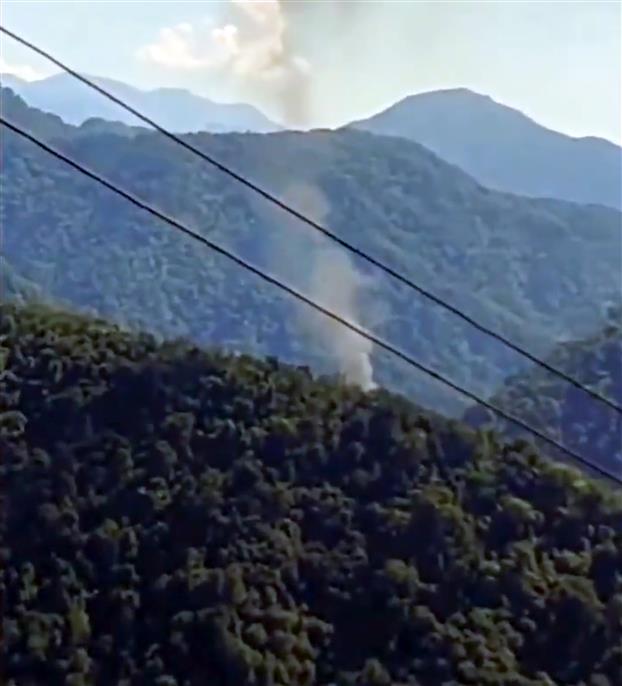
Four Army personnel, including two pilots of Army Aviation, died in a helicopter crash in Upper Siang district of Arunachal Pradesh on Friday morning, a defence official said. Search is on for one remaining person.
The copter, an indigenous ALH-WSI, crashed near village Migging, 25 kms away from the Tuting headquarters in the Upper Siang district of the hill state.
Ministry of Defence Spokesperson at Tezpur, Lt Col Amrinder Singh Walia said “A total of five personnel were on board, the search and rescue teams have recovered the mortal remains of four individuals”.
Besides the two pilots, there were three other ranks who were technicians. The copter had taken off from Lekabali crashed at 10.45 am today.
Army Helicopter crashed near Tuting, . Maj Vikas Bhambu, QFI, Maj Mustafa and three technicians on bd. Another tragedy. A joint search and rescue operations of Army and Airforce was launched immediately which included three copters and columns of the Indian Army on foot.
The site of accident is remote. The cause of the crash at this stage is not known. Details are being ascertained.
Pakistan’s Election Commission disqualifies former PM Imran Khan for 5 years
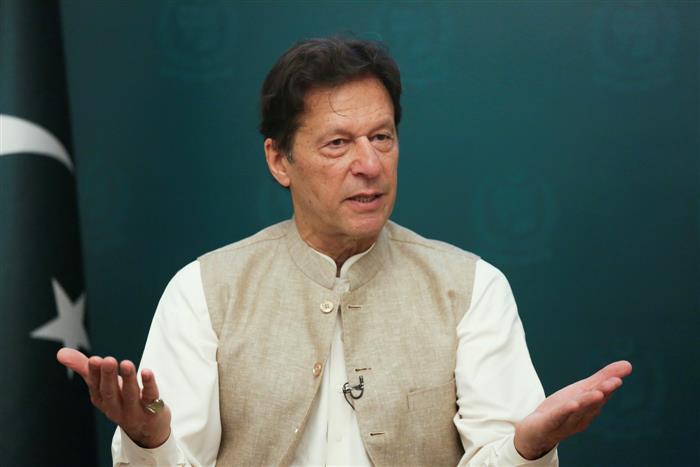
Pakistan’s Election Commission on Friday disqualified former Prime Minister Imran Khan for five years in the Toshakhana case for hiding proceeds from the sale of gifts he received from foreign leaders.
After the ruling, the Pakistan Tehreek-e-Insaf (PTI) Chairman cannot become a Member of Parliament for five years.
The ruling coalition government lawmakers had filed a case with the Election Commission of Pakistan (ECP) in August against 70-year-old Khan seeking his disqualification for failing to reveal the proceeds from the sale of gifts that he purchased at a discounted price from the state repository, also called Toshakhana.
The ECP after hearing the case had reserved its judgment on September 19 on the conclusion of the proceedings.
The four-member Bench of the ECP, headed by Chief Election Commissioner (CEC) Sikander Sultan Raja, on Friday unanimously ruled that Khan was involved in corrupt practices and was disqualified as a member of the parliament.
The ECP also announced that action would be taken against him under the corrupt practices laws.
Asad Umar, Secretary General of Khan’s party, announced that the decision would be challenged in the Islamabad High Court.
Fawad Chaudhry, another PTI leader, rejected the verdict and asked Khan’s followers to stage protests.
Khan, who came to power in 2018, apparently received expensive gifts from rich Arab rulers during official visits, which were deposited in the Toshakhana. Later he bought the same at a discounted price as per the relevant laws and sold the same at hefty profits.
Though morally apprehensive for rulers like Khan, who always takes a high moral ground and leaves no occasion to castigate his opponents as “corrupt”, the purchase and sale were legally allowed.
The former premier informed the ECP during the hearing that the sale of the gifts that he had procured from the state treasury after paying Rs 21.56 million fetched about Rs 58 million.
The gifts, among others, included a Graff wristwatch, a pair of cufflinks, an expensive pen, a ring and four Rolex watches.
According to his opponents, Khan failed to show the sales in the income tax returns, making him liable.
The case filed with the ECP seeks his disqualification under Articles 62 and 63 of the Constitution which suggests disqualification if someone is not truthful.
Established in 1974, the Toshakhana is a department under the administrative control of the Cabinet Division and stores precious gifts given to rulers, parliamentarians, bureaucrats, and officials by heads of other governments and states and foreign dignitaries.
Medium-range ballistic missile Agni Prime successfully test fired from Odisha coast
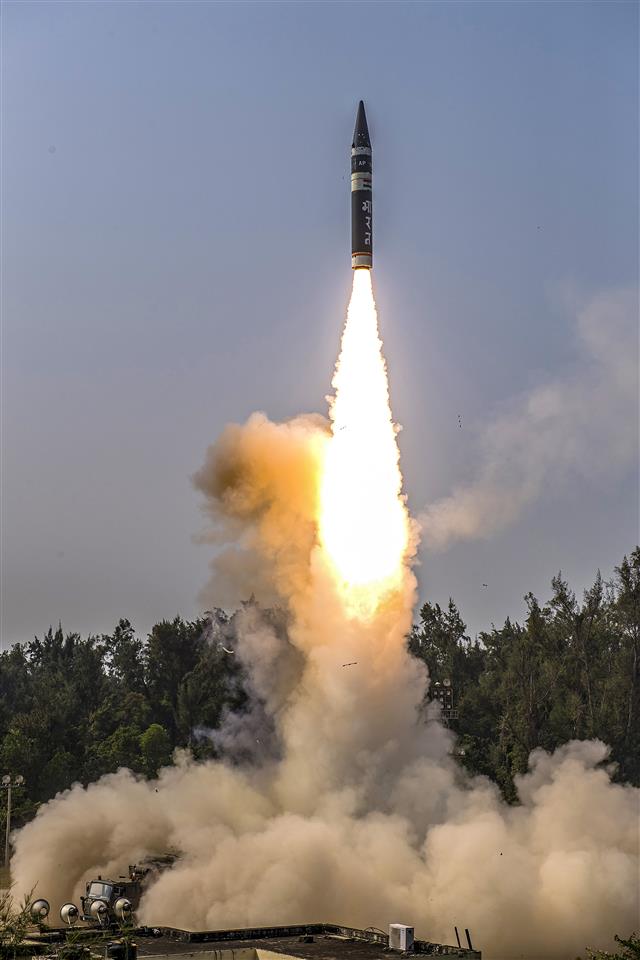
India on Friday successfully test-fired indigenously-developed new generation medium-range ballistic missile Agni Prime from the Odisha coast, Defence Research and Development Organisation (DRDO) sources said.
The sleek missile was test fired from a mobile launcher from the APJ Abdul Kalam Island around 9.45 am, they said.
The solid-fuelled canisterised missile met all mission parameter during the test, they added.
All its navigation was tracked and monitored by radars and telemetry equipment positioned along various points, the officials said.
The missile’s strike range is between 1,000 km and 2,000 km, they said.
The last trial of the missile was conducted on December 18 last year from the same base, which was also successful.
Adani Defence to acquire Indian legacy MRO biz Air Works
Adani Defence Systems & Technologies Ltd. (ADSTL), a subsidiary of Adani Enterprises and the defence manufacturing arm of Adani Group, has recently inked a definitive agreement to acquire one of India’s oldest MRO companies Air Works which currently has a presence across 27 cities for an enterprise value of Rs 400 crore ($48.2 million). The Adani Group which currently operates seven airports in India is expected to strengthen its civil aviation portfolio with this move as Air Works is one of India’s largest independent aircraft maintenance, repair, and overhaul (MRO) companies with a 70-year-old legacy. Also Read – Antonoaldo Neves appointed CEO of Etihad Aviation Group This development also follows that of Adani Group setting up one of India’s first comprehensive aircraft MRO facilities in Nagpur that is slated to offer maintenance services in partnership with Indamer, an aviation services company. Air Works was established in 1951 and has been a partner to global aviation OEMs, aircraft owners and operators, lessors, airlines, and the Indian defence services. It offers MRO services, heavy checks, line maintenance, cabin and interior refurbishment, exterior finishing and painting, avionics upgrades, retrofits, maintenance training, and redelivery checks. Also Read – SkyPallet enhances processes at Air Europa Cargo Ashish Rajvanshi, CEO of Adani Defence & Aerospace spoke about the important role of maintenance, repair and overhaul in both the defence and civilian aerospace sectors. He said, “Given India’s growth trajectory and the Government’s focus to network the nation through a massive mesh of air connectivity, it is inevitable that the primary growth of India’s airline and airport sector lies ahead of it. Air Works has impeccable proven capabilities and over its 70-year aviation legacy has successfully delivered several India-first and industry-first projects. Combine this with the Adani Group’s capabilities and what we get is an entity that truly represents what an Atmanirbhar Bharat in a critical sector should look like” Also Read – Lufthansa Group raises 2022 earnings/cash flow forecast Speaking to The STAT Trade Times on what changes for the 1500-strong team at Air Works, D Anand Bhaskar, MD & CEO, of Air Works Group told the publication, “What changes are capital and secondly the fact that they are into manufacturing and we are into servicing and therefore that combination will be potent. We are already into all four sub-sectors of aviation including Rotary Wing, private jet Fixed Wing, commercial, and defence so that itself gives us a very unique positioning in the market, which we can cross-utilize. What capabilities we have in general aviation, we can use in defence, what (capabilities) we have in defence, we can use in civil aviation and similarly for commercial. So that’s a big advantage that we already have. Now we want to take that advantage to a new level where we are joining hands with a company which has capabilities in manufacturing. So manufacturing along with servicing will be a potent combination, especially for defence aircrafts.” Also Read – Avianca Cargo gets CEIV Fresh certified With the Indian MRO market slated to grow from $1.7 billion to $5 billion by 2030, Bhaskar added that this development signals green shoots for the Indian MRO sector. “There is a huge growth potential now for India’s MRO sector owing to, thanks to government’s focus in the last seven years. Now Indian aircrafts no longer go out of the country for aircraft maintenance. In fact, we have been attracting business from countries like Vietnam, Myanmar, Bhutan, and UAE into the country which is a big change in itself. Now we can take this business to a different level, what with investments coming in, now OEMs tie-ups can happen, and we can move into components and engines which is the field to be in. That is where most of the forex is going out of the country, which we can then try to capture within the country.” Air Works has developed extensive operational capabilities within the country for key defence and aerospace platforms. “From the first P-8I aircraft Phase 32 checks to Phase 48 checks and MRO on the landing gear of the Indian Air Force’s 737 VVIP aircraft, Air Works undertakes base maintenance for ATR 42/72, A320 and B737 fleet of aircraft from its EASA and DGCA-certified facilities at Mumbai, Delhi, Hosur and Kochi,” a company release cited.
PUNJAB EXPRESS BUREAU Chandigarh, October 20 Banwarilal Purohit, Governor of Punjab and the Administrator UT Chandigarh, flagged off trucks loaded with sweet greetings and blessings from Rotarians at Punjab Raj Bhavan in the presence of Past Rotary International President Rajendra K. Saboo, District Governor VP Kalta, Past District Governors Madhukar Malhotra, Praveen Chander Goyal, President Vinod Kapoor of Rotary Club Chandigarh, and members of Inner Wheel and many other senior Rotarians. Every year the number increased and this year, the participation of the Rotarians beyond Chandigarh had been tremendous and on a call from Rajendra K Saboo, and the District Governor V P Kalta of District 3080, the response was manifold and this year Rotarians and Inner wheel members, have managed to send seven tones of pure desi ghee sweets worth Rs.35 lakh to the forward areas. Rotary President Vinod Kapoor informed that the project was conceived five years back in 2016 by Usha Saboo, wife of former world president of Rotary International Rajendra K Saboo, and the Rotary Club of Chandigarh made it to an annual feature. ‘Aap Hain to Hum Hain’ is the essence with which the sweets are sent to the jawans in forwarding areas to acknowledge their dedicated service to the nation. Current Rotary District Governor V P Kalta, expressed gratitude to every Rotarian in Rotary District 3080 which comprises Chandigarh, parts of Punjab, Haryana, Himachal, UP and Utrakhand for their overwhelming response to the project.
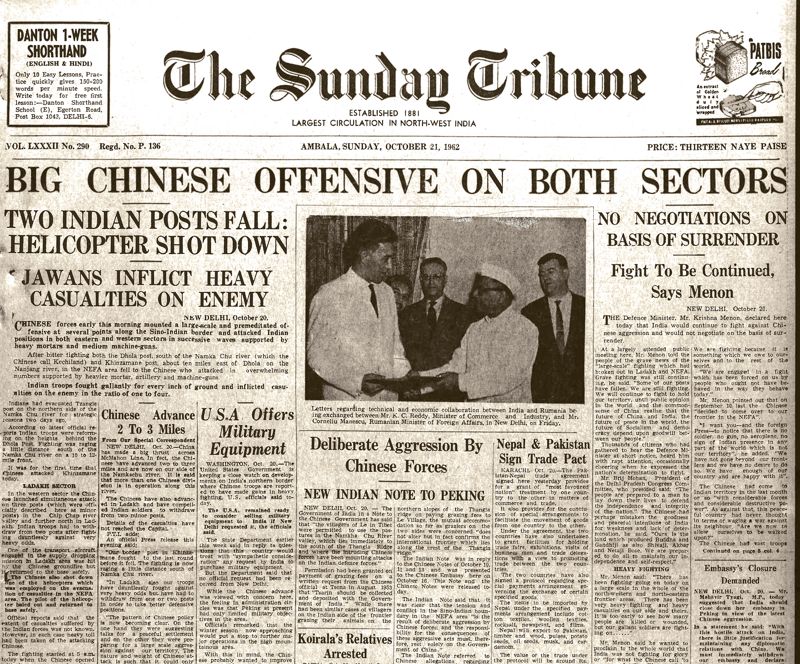
On the night of October 19-20, 1962, ill-equipped and ill-clad Indian troops on the NEFA front were subjected to intense Chinese attacks that wiped out many frontline positions. Shockingly, the GOC of 4 Corps, Lt Gen BM Kaul, regarded as Nehru’s man, was entrusted to ‘throw the Chinese’ out despite being unsuited for the job. Instead, Kaul rushed to Delhi to report to his political masters about the tactical mess in NEFA, and never returned, as the Chinese hordes attacked Indian positions right across the McMahon Line. In Delhi, where the deployment of troops and battle plans were being handled, there was shock and confusion. Nehru and his lackeys would argue thereafter that China had stabbed India in the back. But there were enough warnings from the late 1950s of what Mao and the communist leadership were planning to do.
There were enough warnings from the late 1950s of what Mao and the communist leadership were planning to do.
First, despite Nehru’s effort to appease China with the Panchsheel Agreement of 1954, which led India to abandon initiatives to support the independence of Tibet, as the agreement recognised ‘Tibet as a region of China’, Chinese claims beyond the traditional southern boundaries of Tibet had not ceased, whether at Aksai Chin or beyond the McMahon Line of Tawang. Skirmishes like the Longju incident in 1959 were ignored. Second, China’s steady military buildup on the Tibetan Plateau with ground and air forces with Soviet assistance following a deal between Mao and Khrushchev didn’t alarm Delhi, nor did IAF’s air photographs of China’s military and nuclear facilities in Tibet, which defence minister Krishna Menon chose to ignore. Third, China was angry at the escape of the Dalai Lama from Tibet — with US assistance — into India in 1959, and then he and his followers getting refuge in India — though they were originally expected to go to the US — offended China. Peking (now Beijing) saw the Tibetan issue as its internal matter following China’s occupation of Tibet in 1952.
What offended China even more was India’s increasing engagement with the US. The Americans used India as a launch pad to infiltrate CIA-trained and armed Tibetan rebels groups back into the Tibetan Plateau. They were supplied arms and weapon systems even by India. And finally, an increasingly aggressive Nehru, who under pressure at home, announced that the boundaries with China were settled ‘map or no map’, and that he’d asked the Indian Army ‘to throw out the Chinese’ from Indian territories, never mind Chinese premier Chou en-Lai’s 1960 visit to India, and his proposal to settle the boundary dispute with China keeping the Aksai Chin area and India the area south of the McMahon Line. And when South Block pushed in ill-equipped small teams of military men well beyond the disputed boundary on the Himalayas, as a lookout post under its forward policy, communist China attacked India, as the world was engrossed with the Cuban missile crisis.
What followed was the rout of the Indian Army on the NEFA front. In eastern Ladakh, our Army put up a much better show, holding on to most of their frontline positions. There were many exceptional acts of gallantry by our soldiers, even though our Generals failed their men, with the exception of Lt Gen(s) Daulet Singh and Bikram Singh in Ladakh and Umrao Singh in 33 Corps. The dismal roles of General Thapar, COAS; Lt Gen LP Sen, GOC Eastern Command — who chose to stand aside as the civilians in Delhi made a mess of things — and, of course, Lt General Kaul, can never be condoned. Nor can the decision of Nehru not to use the IAF, at the advice of his intelligence chief BN Malik, on the assumption that it would upset the Chinese further. It remains one of the major strategic errors of the conflict. A post war study, ordered by General Thapar’s successor, Gen JN Chaudhuri, on the debacle in NEFA, known as the Henderson Brooks-Bhagat report, apparently puts the blame on the Generals and not so much on the civilians, as it wasn’t in their mandate, say those who’ve seen it.
So, the question today is: Have we learnt our lessons from the 1962 War? It will be fair to say that we have. There are several examples to support this view. For one, as early as 1967, when the Chinese began muscle-flexing in Nathu La and Cho La, the GOC there, Maj Gen Sagat Singh, warned his superiors that he wouldn’t accept any intrusions beyond his fenced boundary. And when they did, he let his troops mow down the Chinese, giving them 340 casualties and a message that India wouldn’t hold its fire. The Chinese went quiet for 20 years till 1987, when they again intruded around Somdorong Chu. The then Army Chief, General Sundarji, had, in a swift response, airlifted troops and surrounded them, leaving Rajiv Gandhi in a flux. It soon led to a quiet Chinese withdrawal, and in 1988, a much-publicised visit of Rajiv Gandhi to Beijing, followed by a series of bilateral diplomatic initiative. India’s swift response to Chinese intrusions in 2020 have shown that New Delhi would be willing to trade blows — as our troops did in the Galwan valley — if push came to shove. And the use of air power wasn’t ruled out, this time.
Where we still have to learn from the past is to understand the Chinese intentions better. No amount of diplomatic dialogue will get Beijing to give up control over Aksai Chin. It is strategically important to China, being a source of the key rivers in that region, of uranium and from where the all-important highway G 219 passes, linking the capitals of two of China’s most vulnerable regions, Xinjiang and Tibet. What then is the way forward? One option is to accept the swap proposal of 1959-60 that will let China keep Aksai Chin and allow India to keep Arunachal Pradesh (earlier NEFA) by accepting the boundary lines on an ‘as-is-where-is’ basis. As there are strong leaders in both China and India now, they could settle the boundary and survive politically. But will they?
India making efforts to achieve USD 22 billion turnover in defence production by 2025: Rajnath Singh
Defence Minister Rajnath Singh on Thursday said the central government is making efforts to achieve a turnover of USD 22 billion by 2025 in defence production. Speaking at the ‘Invest in Defence’ event as part of the ongoing Defence Expo 2022 in Gujarat capital Gandhinagar, Singh also appealed to investors to approach him or defence ministry officials without any hesitation to resolve issues. He appealed to private players to come forward and invest in the Indian defence industry, saying it is at an important juncture. Not just large corporates, even start-ups and MSMEs (micro small and medium enterprises) are now associated with the defence sector. This is the golden period for the defence sector, he said. “The Indian defence industry is the sunrise sector of the future,” the minister said. “The government is making efforts to take domestic defence production from the current USD 12 billion to USD 22 billion by 2025. We may even surpass this target of USD 22 billion. There is no dearth of opportunities in the defence sector. India is marching ahead in fulfilling the demands of the world in this sector,” he said. The Centre has taken several steps and implemented many reforms to boost local production in the defence sector, Singh said.
AFGHAN TALIBAN’S RISE TO POWER RESULTS IN TERROR ATTACK SURGE IN PAK BY 51 PER CENT
Islamabad: Due to the rising power of the Taliban in Afghanistan, Pakistani soil has witnessed a 51 per cent increase in the number of terrorist attacks in the last year, Islamabad-based think tank, Pak Institute of Peace Studies (PIPS) findings revealed on Wednesday. As a result of the withdrawal of the US forces from Afghanistan in August last year, followed by Taliban capture, as many as 433 people were killed and 719 injured in 250 attacks in Pakistan till August 2022, Dawn reported citing the data published by the think tank. Pakistan also witnessed 165 attacks that killed 294 people and wounded 598 others from August 2020 to August 14, 2021. “The mindless jubilation over Taliban victory is now turning into a rude shock because the evolving security situation under the erratic Taliban rule indicates Pakistan is about to face yet another ordeal viz-a-viz terrorism,” the think-tank said. Notably, the terror outfits with active presence in Afghanistan include Tehreek-i-Taliban Pakistan (TTP), Al-Qaeda, Islamic State in Khorasan (IS-K), Islamic Movement of Uzbekistan (IMU), and East Turkistan Islamic Movement (ETIM), according to Dawn. Quoting the United Nations High Commissioner for Refugees (UNHCR), the think tank reported that more than 300,000 Afghans have fled to Pakistan since the Taliban took control of Afghanistan. In the latest findings, two papers were released which evaluated the withdrawal of US forces from the war-torn country and its impact on Pakistan in terms of terrorist violence as well as cross-border movements that are taking place due to the rise in terrorist activities in the region. The data revealed that Pakistani authorities claim that about 60,000 to 70,000 Afghans entered Pakistan since August last year. The Taliban’s takeover of Afghanistan, which was widely celebrated in Pakistan in August last year, has worsened the terror situation in the country. In 2021, militants, mainly belonging to the Pakistani Taliban, killed 48 policemen and injured 44 others in the province of Khyber Pakhtunkhwa. Most of the violent incidents took place in the last few months of the year (after the Taliban takeover). Despite repeated attempts, Pakistan has been unable to get firm guarantees from the Afghan Taliban that they would take action against the Pakistani Taliban operating in Afghanistan. Taliban also refuses to accept the Durand Line as the boundary between the two countries.
State Stalwarts
DEFENCE MINISTER
Minister Rajnath Singh
ALL HUMANS ARE ONE CREATED BY GOD
HINDUS,MUSLIMS,SIKHS.ISAI SAB HAI BHAI BHAI
CHIEF PATRON ALL INDIA SANJHA MORCHA
LT GEN JASBIR SINGH DHALIWAL, DOGRA
SENIOR PATRON ALL INDIA SANJHA MORCHA
MAJOR GEN HARVIJAY SINGH, SENA MEDAL ,corps of signals
.
.
PATRON ALL INDIA SANJHA MORCHA
MAJ GEN RAMINDER GURAYA ,MADRAS REGIMENT
sanjhamorcha303@gmail.com
PRESIDENT SOUTH ALL INDIA SANJHA MORCHA
COL SS RAJAN BOMBAY SAPPERS,
PRESIDENT UTTARAKHAND ALL INDIA SANJHA MORCHA
COL B M THAPA ,BENGAL SAPPERSS
PRESIDENT HARAYANA STATE CUM COORDINATOR ESM
BRIG DALJIT THUKRAL ,BENGAL SAPPERS
PRESIDENT TRICITY
COL B S BRAR (BHUPI BRAR)
PRESIDENT CHANDIGARH ZONE
COL SHANJIT SINGH BHULLAR
.
.
PRESIDENT PANCHKULA ZONE AND ZIRAKPUR
COL SWARAN SINGH
INDIAN DEFENCE FORCES
DEFENCE FORCES INTEGRATED LOGO
INDIAN AIR FORCE
Air Officer C-in-C WESTERN AIR COMMAND
AIR MSHL S PRABHAKARAN AVSM VM
AOC-IN-C, EASTERN AIR COMMAND
Air Marshal Inderpal Singh Walia
AOC-in-C SOUTH WESTERN AIR COMMAND
Air Marshal Vikram Singh
AOC-IN-C, SOUTHERN AIR COMMAND
Air Marshal J.Chalapati
AOC-IN-C TRAINING COMMAND
AIR MARSHAL SK GHOTIA VSM
AOC-IN-C MAINTENANCE COMMAND
Air Marshal Jagdish Chandra
Flag Officer Commanding in Chief, Western Naval Command
ice Admiral R Hari Kumar, PVSM, AVSM, VSM
Flag Officer Commanding in Chief, Eastern Naval Command
Vice Admiral Sanjay Bhalla, AVSM, NM
Flag Officer Commanding in Chief, Southern Naval Command