Sharing the government’s future plans for the defence sector, he asserted that the target is to increase defence production in India from $12 billion to $22 billion by 2025 Singh said that the target is to increase defence production in India from $12 billion to $22 billion by 2025. Defence Minister Rajnath Singh has termed the current era as the ‘Golden Era’ for the Indian defence sector. He was speaking at the Defence Expo in Gandhinagar. He also invited investors to pump money into the country’s defence production, which is growing at a fast pace. Sharing the government’s future plans for the defence sector, he asserted that the target is to increase defence production in India from $12 billion to $22 billion by 2025. “This provides unparalleled opportunities for growth to industry in the coming years,” he added. “To increase the participation of domestic industry in the defence sector, the government has reserved 68 per cent of the defence capital acquisition for domestic procurement for the year 2022-23, which is approximately Rs. 85,000 crores and 25 per cent of this has been reserved for domestic private industry”, he said. As per the defence ministry, the event was organised to promote investment in the defence sector in the country both by the Indian industry as well Foreign OEMs. It highlighted the requirements of the Armed Forces and policy reforms undertaken by the Government for ease of doing business in the defence sector. Compared to the past, he mentioned that this approach has drastically changed now and these two concepts are integrated, and they strengthen each other. “Today, the nation is integrating and moving forward with these two capabilities, which complement each other, and making unparalleled improvements in both,” said Singh. He added that economic and strategic capabilities are essential for the development of science and technology, health, agriculture, trade and commerce. The minister further emphasised on the fact that the measures have yielded results in increase in defence exports in the past few years.
U.S. EXPECTS SUSTAINED ACTION AGAINST TERRORIST GROUPS FROM PAKISTAN
Washington: After US President Joe Biden’s “Pakistan one of most dangerous nations in the world” remarks, America once again reiterated that it expects sustained action against terrorist groups from Pakistan. US State Department spokesman, Vedant Patel on Monday (local time) in a media briefing told reporters, “We seek a strong partnership with Pakistan on counter-terrorism and expect sustained action against all militant and terrorist groups. And we look forward to the cooperative efforts to eliminate all regional and global terrorist threats.” Earlier, US President Biden said Pakistan may be one of the “most dangerous nations in the world” during an address in California while speaking about the changing global geopolitical situation. The US president reasoned that he thought so as Pakistan has “nuclear weapons without cohesion”. According to the transcript, available on the White House website, of Biden’s address at a Democratic Congressional Campaign Committee reception in California, he said: “… And what I think is maybe one of the most dangerous nations in the world: Pakistan. Nuclear weapons without any cohesion.” Notably, Pakistan on Saturday summoned the US Ambassador Donald Blome for clarification after President Biden described Pakistan as “one of the most dangerous countries in the world.” Meanwhile, the US on Sunday (local time) backtracked on President Joe Biden’s alarm over Pakistan’s ability to secure its nuclear arsenal and said that the country can secure its nukes. Today again Patel said, “I will reiterate again that the US has always viewed secure and prosperous Pakistan, its critical to US interest and more broadly to US values, our long-standing cooperation.” Pakistan has always sold its false narrative of being the victim of terror, however, its doublespeak has been caught many times. Moreover, many of the terrorist groups were deliberately created by the Pakistani state to serve its purposes. However, its ability to control the various terrorist outfits is uneven and some of them have turned against their creator. It establishes the fact that using terrorist outfits for state objectives can have very negative consequences for the stability of the state itself. “Few countries have suffered from terrorism like Pakistan and have shared interest in combatting threats – to regional instability and internal security like TTP,” said Patel. Notably, Pakistan is miffed at the Taliban on several issues, but more so on the militant group, Tehrik-e-Taliban Pakistan (TTP) which it considers a grave threat. The TTP is protected by the Afghan Taliban, sheltered mostly in border areas in Afghanistan and now regrouping in Pakistan’s Swat and nearby tribal areas. Earlier, External Affairs Minister S Jaishankar raised questions over the “merits” of the US-Pakistan relationship and said that Washington’s ties with Islamabad have not served the “American interest”. “It’s a relationship that has neither ended up serving Pakistan well nor serving the American interests,” Jaishankar said at an event organized by the Indian American community in Washington. Defence Minister Rajnath Singh promptly conveyed to US Defence Secretary Lloyd Austin India’s concerns over Washington’s decision to provide a sustenance package for Pakistan’s F-16 fleet. “It’s really for the United States today to reflect on the merits of this relationship and what they get by it,” Jaishankar asserted. “For someone to say I am doing this because it is all counter-terrorism content and so when you are talking of an aircraft like a capability of an F-16 where everybody knows, you know where they are deployed and their use. You are not fooling anybody by saying these things,” Jaishankar noted. “If I were to speak to an American policy-maker, I would really make the case (that) look what you are doing,” Jaishankar strongly asserted.
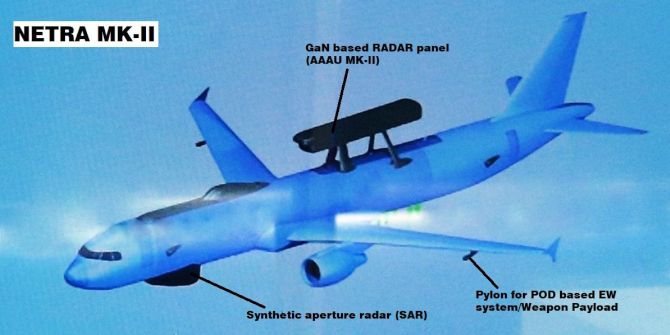
A plethora of models were on display on future assets to be inducted into the Indian Armed Forces that include AEW&C with two types of platforms, Multi-Mission Maritime Aircraft, SIGINT and ISTAR systems. AEW&C / MMMA Centre for Airborne Systems (CABS) has released an Expression of Interest to participate in Mission System of Airborne Surveillance System Program as a Development cum Production Partner (DccP) for AEWC MK-II project as per a DRDO release. The Cabinet Committee on Security (CCS) in Sept 2021 cleared a nearly Rs 11,000 crore project of the Defence Research and Development Organization (DRDO) to develop six new Airborne Early Warning and Control (AEW&C) aircraft for the Indian Air Force. This is in addition to the nearly $3 billion deal for procuring 56 C-295MW multi-mission maritime transport aircraft for the IAF, which was also cleared by the Committee, to replace the ageing fleet of Avro 748 transport aircraft that first flew in 1961.
ISTAR Development India is “actively pursuing” the acquisition of ISTAR, a high-tech ground surveillance aircraft and battlefield support system, Indian Air Force Chief VR Chaudhari said on October 8. Air Chief Marshal Chaudhari’s comments indicate that the estimated $3 Billion procurement of five ISTAR (Intelligence, Surveillance, Target Acquisition and Reconnaissance) aircraft under the India-US Defence Technology and Trade Initiative (DTTI) framework is on track. The ISTAR is a key force multiplier.
TEJAS ON MIND, ARGENTINE ARMED FORCES CHIEF TAKES CLOSE LOOK AT HAL’S PROWESS
A top-level Argentinian delegation is visiting the ongoing DefExpo 2022 in Gujarat’s Gandhinagar as both countries continue to explore new partnerships in the defence sector. Led by Lieutenant General Juan Martin Paleo, Joint Chief of Staff of the Argentine Armed Forces, the touring party visited the Hindustan Aeronautic Limited (HAL) stall at Asia’s largest defence event. HAL Director (Operations) E P Jayadeva and D K Sunil, Director (Engg and R&D) briefed Lt Gen Paleo and other senior officials about the various futuristic defence products on display. The Argentinian General also had a good look at the indigenously designed and developed Light Combat Helicopter (LCH) ‘Prachand’ which was inducted into the Indian Air Force (IAF), earlier this month. India’s Tejas continues to remain in contention for Buenos Aires’ order of 12 fighter jets, a final decision on which could be taken in the coming months. Pakistan’s JF-17 fighter jets developed jointly with China, South Korea’s FA-50, Russia’s MiG-35 and the US F-16s also remain in contention as the Argentine Air Force desperately looks to acquire a new fighter. With Argentina and the United Kingdom engaged in a territorial dispute over the ownership of the Falkland Islands, India is offering a modified variant of the TEJAS MK-1A to the South American country with the replacement of parts manufactured in the UK. This is the second high-level visit of defence officials from the Latin American nation to India this year. In March, Argentine Air Force chief Brigadier General Xavier Julian Isaac and Daniela Castro, the Secretary of Research, Industrial Policy and Production for Defence, were here with the aim of consolidating bilateral cooperation in the defence industry. The delegation held meetings with Defence Secretary Ajay Kumar and Indian Air Force chief Vivek Ram Chaudhari and also visited the aircraft, helicopter and engine manufacturing facilities of HAL which manufactures Tejas. Extensive discussions on bilateral defence cooperation continued during External Affairs Minister S Jaishankar’s visit to Buenos Aires this August. India’s state-of-the-art modern fourth-generation fighter aircraft was high on the agenda when Jaishankar met Argentina’s Defence Minister Jorge Taiana and Secretary for Strategic Affairs Mercedes Marco del Pont in the Argentine capital. Both countries reviewed their ongoing cooperation in the strategic sectors of defence, nuclear energy and space and reiterated their commitment to work together for mutual benefit. It was also agreed to enhance cooperation in the defence sector within the framework of the MOU on Defence Cooperation signed in 2019. “EAM, acknowledging Argentine interest in the Made in India Tejas fighter aircraft for Argentine Air Force, highlighted the importance of the proposal in enhancing the strategic quotient of the bilateral relationship,” said the joint statement following the Joint Commission Meeting between both the countries on August 26.
When the CPC-PLA duo realised the blunder committed by its 1914 predecessors, it came back with a vengeance to forcibly capture independent Tibet in 1950. The main subsequent sufferer, Delhi, too misread the potential CPC-PLA diabolical scheming to suppress India and usurp her land at an opportune moment.
Abhijit Bhattacharyya
Author and Columnist
Didn’t sovereign India have a full-fledged diplomatic mission in sovereign Tibet’s capital Lhasa and trade missions at Gartok, Gyantse and Yatung in 1947? Was Beijing a sovereign state under the Communist Party of China (CPC) in 1947? Sovereign China was established on October 1, 1949, and full-fledged diplomatic relations between New Delhi and Beijing were established on April 1, 1950. Hence, the Himalayas always constituted the natural boundary between an age-old sovereign Tibet (not China) and geographical India.
It would, therefore, be preposterous to get carried away by the Goebbelsian falsehoods of CPC autocrat Mao Zedong and his successor dictators that the present Hindustan-Han Himalayan border problem is the legacy of British imperialism. Does the CPC forget fast, or is it fast enough to fox the people to forget facts fast?
The fact is, long before the advent of the Europeans in South Asia, it was the imperial rulers of the Middle Kingdom who were in a state of ceaseless conflict in the land between Beijing, Gansu and Tibet, which ultimately surged with the unprovoked invasion of the Lama land by the decaying Manchu ruler’s ruthless General Chao Er-feng in 1910. This effectively gave the Chinese the first-ever entry to the Tibet capital against the Buddhist rulers’ wishes. That’s the beginning of the Himalayan odyssey, which subsequently hit Delhi hard by the Dragon from across the highland, which thus far constituted the natural and benign border-cum-barrier for thousands of years.
Tibet had always been an independent theocracy till 1950-1951, notwithstanding the sporadic Han invasion to forcibly capture this Himalayan land. Indeed, the history of Lhasa’s political geography is well known and well documented. And factually, the Tibet-China border fluctuation and territorial dispute constitute the core issue around the Himalayas, which wasn’t the making of either the British or the post-1947 Bharat.
Hindustan’s Himalayan frontier has never had any problem whatsoever. If anything, Delhi was forcibly dragged into the Lhasa-Beijing dispute in the early 20th century, as a peripheral and secondary factor; it had never had any issue with its shared Himalayan border with the sovereign Tibet.
It’s the existence of the ancient sovereign Tibet which became an eyesore to the newly-born Han state in October 1949. This political Tibet was perceptively defined by Hugh Richardson, the last British and first Indian Head of Mission in Lhasa, as a territory of half a million square miles, wherein ruled the “Tibetan Government continuously from earliest times down to 1951.” This indisputable fact and reality of history is one that Indians usually didn’t bother to stress upon, or forgot while taking on the 1949-born CPC dictatorship and its private militia-type People’s Liberation Army (PLA).
What stands as geopolitical Tibet today was actually broader, longer and larger, encompassing both the Qinghai and Sichuan provinces of Beijing’s empire, which ethnographically were Tibetan from antiquity; but diabolical and destructive ethnic cleansing drastically changed them into a Han habitat centre
Thus, the early 20th century’s India got entangled with the tussle of the two independent nations of Tibet and China indirectly as it was the diplomatic venue of her British rulers in 1913-1914 at the Simla Conference. Interestingly, the British here weren’t the aggressor or combatant, but appeared as the mediator between the Lhasa-Beijing fight with a distinct Beijing tilt, as found in the original Simla plan, wherein “Thibet” was referred to as forming a “part of Chinese territory.” Both London and Beijing were agreeable to Tibet being a part of China, but retaining her suzerainty under Chinese sovereignty.
Nevertheless, since the Chinese refused to sign the 1914 Simla Accord, they lost the opportunity of an international law document stipulating Tibet as a part of, and under, Chinese sovereignty. The end result was a reversion to status quo. The 1912 declaration of Tibet’s sovereignty by the 13th Dalai Lama got fresh validity, which subsequently was never repudiated or rejected by any international diplomatic document. By not signing the Simla Conference documents, the dragon became the end loser as sovereign Tibet emerged unchallenged.
In retrospect, when the CPC-PLA duo realised the monumental blunder of its 1914 predecessors, it came back with a vengeance to forcibly capture and crush independent Tibet in October 1950, exactly a year after gaining independence in the aftermath of a two-decades-long civil war.
In one stroke, the huge Tibet became occupied land under the CPC-PLA dictatorship in 1950-1951. And, unlike today’s diplomatic cacophony on Russia’s Crimea annexation, there was no West or EU, NATO, USA or UN to sanction the Chinese aggressor or to supply tanks, missiles, bombs, guns and HIMARS rocket launchers to Tibet for fighting or taking action against the CPC-PLA’s naked aggression and occupation of a sovereign landlocked state on the world’s roof.
For that matter, the main subsequent sufferer, Delhi, too misread the potential CPC-PLA diabolical scheming to suppress India and usurp her land at an opportune moment.
Much has been made out post the 1950 CPC-PLA’s Tibet conquest. Beijing went ballistic in its India-China border dispute as a “legacy of British imperialism” and attributing its origin to the Simla Convention which made the McMahon Line as the Himalayan boundary.
However, close scrutiny reveals that the “sole original ground of Beijing objections, so far as frontiers were concerned, was the line proposed for boundaries between” (sovereign) Tibet and (remote) China, not for India. In the eyes of the CPC-PLA, how could a sovereign Tibet border, claimed by sovereign China, be allowed to be passed on, or handed over, to India peacefully?
True to the CPC-PLA design, which couldn’t be deciphered by Delhi for seven decades, things haven’t changed one bit. Transformation and transfer of the Himalayan border sharing from Lhasa to Delhi in “superior” Han rulers’ eyes is as reprehensible and odious as it was before. If anything, the insatiable CPC-PLA appetite for Indian land doesn’t show any sign of abatement even today.
Sixty years after the Chinese invasion of India, the stage is set to install Xi Jinping as China’s lifetime ruler, even as the CPC-PLA’s hardline approach to New Delhi is more than visible. And any Indian thinking otherwise, ie a change of heart of 21st-century China’s leader, the “Second Mao”, will be under the delusion that India won’t lose any more land or will regain her lost sovereignty or that the Himalayan border will shortly be back to being a pristine and benign abode of peace and tranquillity as it existed during the days of sovereign Tibet as the neighbour of sovereign India from 1947 to 1950.
Unfortunately, whereas the sovereign Buddhist land of the lamas is unacceptable to the Hans, sovereign democratic Delhi as a neighbour, too, is an intolerable eyesore to the CPC-PLA dictator(s) of the 21st century.
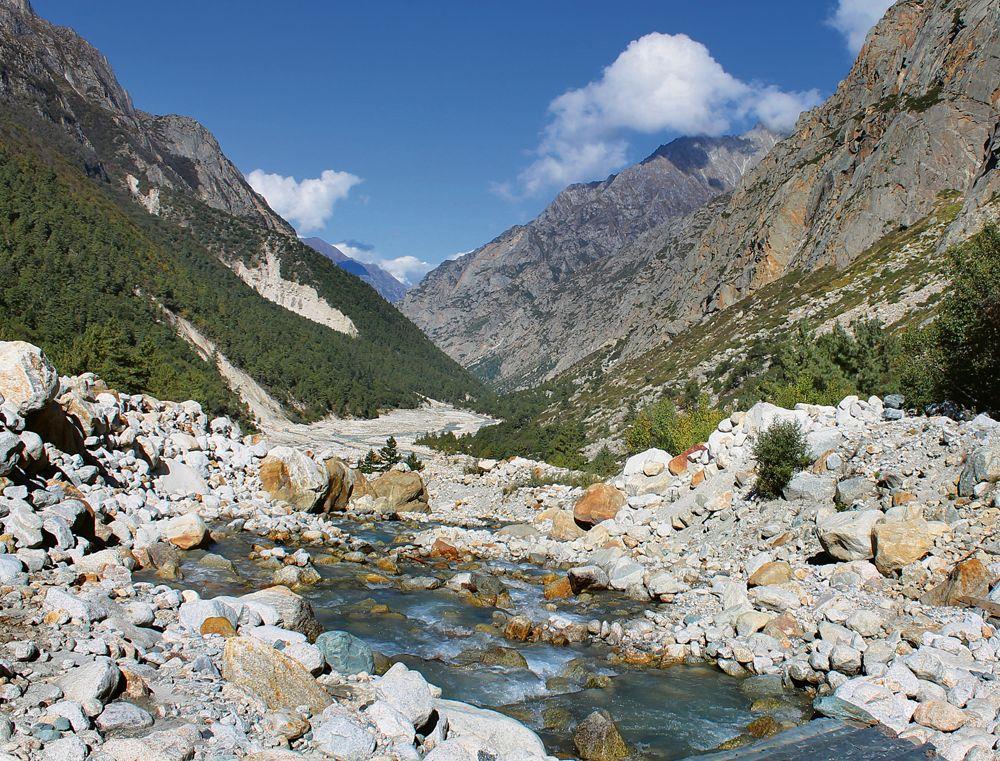
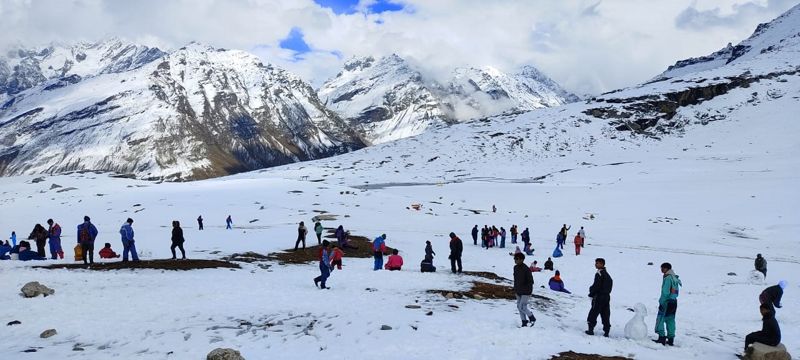
The tourists are having a gala time frolicking in snow at Rohtang Pass near Manali and venturing ahead to Baralacha and Shinkula Passes in Lahaul and Spiti. The higher reaches of the region received fresh snowfall recently due to which the high mountain passes have donned a white mantle.
Permit is necessary for Rohtang Pass, while tourists can head to Shinkula and Baralacha Pass without permits between 9 am and 3 pm. After the opening of the Atal Tunnel, the tourists can go to Baralacha and Shinkula from Manali and return back the same day.
The 13,058 feet high Rohtang Pass is the first choice of the tourists visiting Manali but with only 1,200 vehicles allowed daily as per the guidelines of the National Green Tribunal (NGT) and formalities to seek a permit, the tourists are preferring to head towards 16,040 feet high Baralacha Pass in Lahaul valley by crossing the Atal Tunnel to witness snow. The number of tourists going towards Baralacha and Shinkula is more than those visiting the Rohtang Pass.
Keeping in view the inclination of tourists to head towards Baralacha, Himachal Tourism Development Corporation has started its luxury bus service for Baralacha.
Darcha is 101 km from Manali and the Baralacha Pass is on the Leh road is 45 km from Darcha. Tourist places like Patseu, Zingzingbar and Bharatpur City are also the centre of tourist attraction. Shinkula Pass is 40 km from Darcha on the Zanskar-Padum route and it connects border areas of Ladakh to Himachal.
Though the tourists witness snow at Baralacha and Shinkula, there are no adventure activities at these passes unlike Rohtang. The tourist vehicles are not allowed beyond Darcha in adverse weather conditions, which is very frequent in the Lahaul valley. Further there are no basic amenities in Baralacha and tourists have to return to Manali after spending a few moments.
Stay arrangements for tourists are available at Darcha, Jispa, Gemur, Keylong and Sissu in Lahaul. Though the tourism business was not up to the expectation during Dasehra, tourism businessmen are hopeful that the coming Diwali and winter season will be better.
Meanwhile, those associated with the tourism industry have demanded that the cap on vehicles and NGT barrier in Gulaba should be removed now as the traffic to Lahaul was going through the tunnel. They have urged the government to approach the NGT seeking review of its decision of capping the number of vehicles and charging Rs 500 per vehicle to go to the Rohtang Pass. They added that Rohtang Pass was a world famous tourist attraction and efforts should be made to maintain its grandeur. Him Anchal Taxi Operators Union, Manali, had already filed a petition in the Supreme Court demanding that the number of vehicles visiting the Rohtang Pass should be raised
The new CDS appointment circumvented Parliament, led to ambiguities
There is nothing in the Army, Navy, or Air Force Acts that speaks of any appointment, much less about its position in the chain of command, such as that of the Chief of Defence Staff. This can lead to a command crisis. The solution would be to bring in standalone legislation to do so.
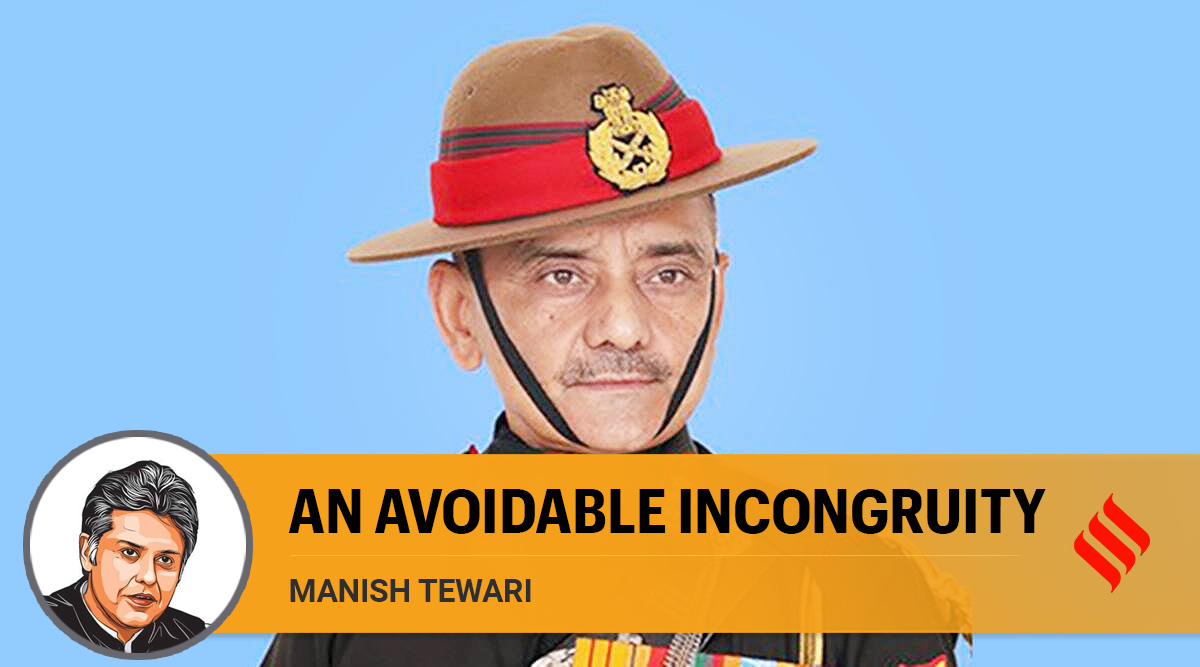
On September 28, former Eastern Army Commander Lt General Anil Chauhan (Retd) was appointed the Chief of Defence Staff (CDS). I do not know him and nor does this piece intend to cast any aspersions on him.
The objective of this article is to delineate the avoidable incongruity created by circumventing Parliament and through a modification in the rules and regulations. The Army, Air Force and Navy Acts constitute the governing law. Any change, let alone reform of the magnitude of creating the position of CDS, and its implications on higher defence management should have been routed through amendments to the principal Acts.
Nothing in these Acts provides for the kind of seminal changes effected through the notifications since 2019 — one dated December 28, 2019 and other dated June, this year — that institutionalised the CDS, and as a result, the appointment criterion stood amended. Section 191 of the Army Act empowers the Centre to make rules to give effect to its provisions. This rule-making power inter-alia extends to matters relating to removal, retirement, release or discharge from service, assembly and procedures of courts of inquiry, court-martials and punishments. There is nothing in this Section that provides for the creation of a position that de facto ostensibly supersedes the Chief of Army Staff. In the Airforce and Navy Acts, the provision for a CDS has been made by amending the requisite regulations, and not even the rules. Regulations, as a function of delegated legislation, are thus considered non-statutory in character.
Amendments to rules that do not take into consideration the scheme of the parent act have the potential to create legal black holes. For instance, Section 88 of the Army Act defines “superior military authority”. Where would the CDS fit into this scheme of things? Should he not be the ex-officio superior military authority for any disciplinary proceedings for the purposes of Section 88 (b), given that, as Secretary of the Department of Military Affairs, he exercises superintendence over the Armed Forces of the Union, Integrated Headquarters of the Ministry of Defence and Territorial Army, to name but a few.SUBSCRIBER ONLY STORIESView All
Similarly, in terms of the amendments made on December 28, 2019, certain rules including 14, 15, and 15A of the Army Act and the analogous rules in the Airforce and Navy enactments are not to apply to the CDS. Rule 14 provides for termination of service by the Centre on account of misconduct. Rule 15 provides for termination of service if the officer is unfit for service due to inefficiency or physical disability. Rule 15A allows the release of an officer on medical grounds. How will the CDS be removed from office were an unfortunate eventuality to arise? In Rule 16-A Sub Rule 4 the new provision inserted gives powers to the Centre to extend the tenure of the CDS till the age of 65 and nowhere is the process of removal delineated.
On June 6, another gazette notification was issued by the government amending the Service Rules. The amendment to Service Rules of the Army states that the central government, in the public interest, may appoint a CDS out of a pool of serving or retired officers in the rank of Lieutenant General or General. A similar change was made to the Navy and Air Force rules. If a retired three-star officer returns as a four-star, it does not really make the CDS primus inter pares, or first among equals, given his operational remit and statutory tasking. He is de facto a notch above.
There is also a contradiction between the extant service regulations and the appointment of the current CDS. For instance, the Pension Regulations for the Army, Part I (2021), classify officers into “Active List” and “Retired List”. Section 4 (ii) states that an officer is on the “Active List” if he is in the army before retirement and the list shall not include recalled or re-employed servicemen. Similarly, Section 4 (xi) states that an officer is on the retired list once he retires and he shall be deemed to be on the list even if recalled. Should the current CDS be considered on the active or retired list?ADVERTISEMENT
There is nothing in the Army, Navy, or Air Force Acts that whispers, let alone speaks of any appointment, much less about its position in the chain of command, such as that of the Chief of Defence Staff. This can lead to a command crisis, especially during a National Security Situation. The following extract from the press release dated December 24, 2019, proclaiming the cabinet decision on creating a CDS speaks of this ambiguity: “The Chief of Defence Staff, apart from being the head of the Department of Military Affairs, will also be the Permanent Chairman of the Chiefs of Staff Committee. He will act as the Principal Military Adviser to Raksha Mantri on all tri-Services matters. The three Chiefs will continue to advise RM on matters exclusively concerning their respective Services. CDS will not exercise any military command, including over the three Service Chiefs, so as to be able to provide impartial advice to the political leadership”.
What happens if there is a difference of opinion on a crisis situation between the Principal Military Advisor (CDS) and the three service chiefs, individually or collectively? The short answer would be that the Defence Minister would take the final call. However, in strictly regimented and hierarchical organisations is such design abstruseness desirable?
A more elegant solution, therefore, would have been to bring standalone legislation before Parliament creating the institution of the Chief of Defence Staff, spelling out his role and responsibility and making consequential amendments to the other Service Acts, wherever necessary. It is still not too late to do so.ADVERTISEMENT
The writer is a lawyer, Congress MP and former Union Minister for Information & Broadcasting. Views are personal
CM meets agitated GOG’s : During inauguration of Bio-Gas plant at Lehragaga with a lie that he does not know scrapping of scheme:
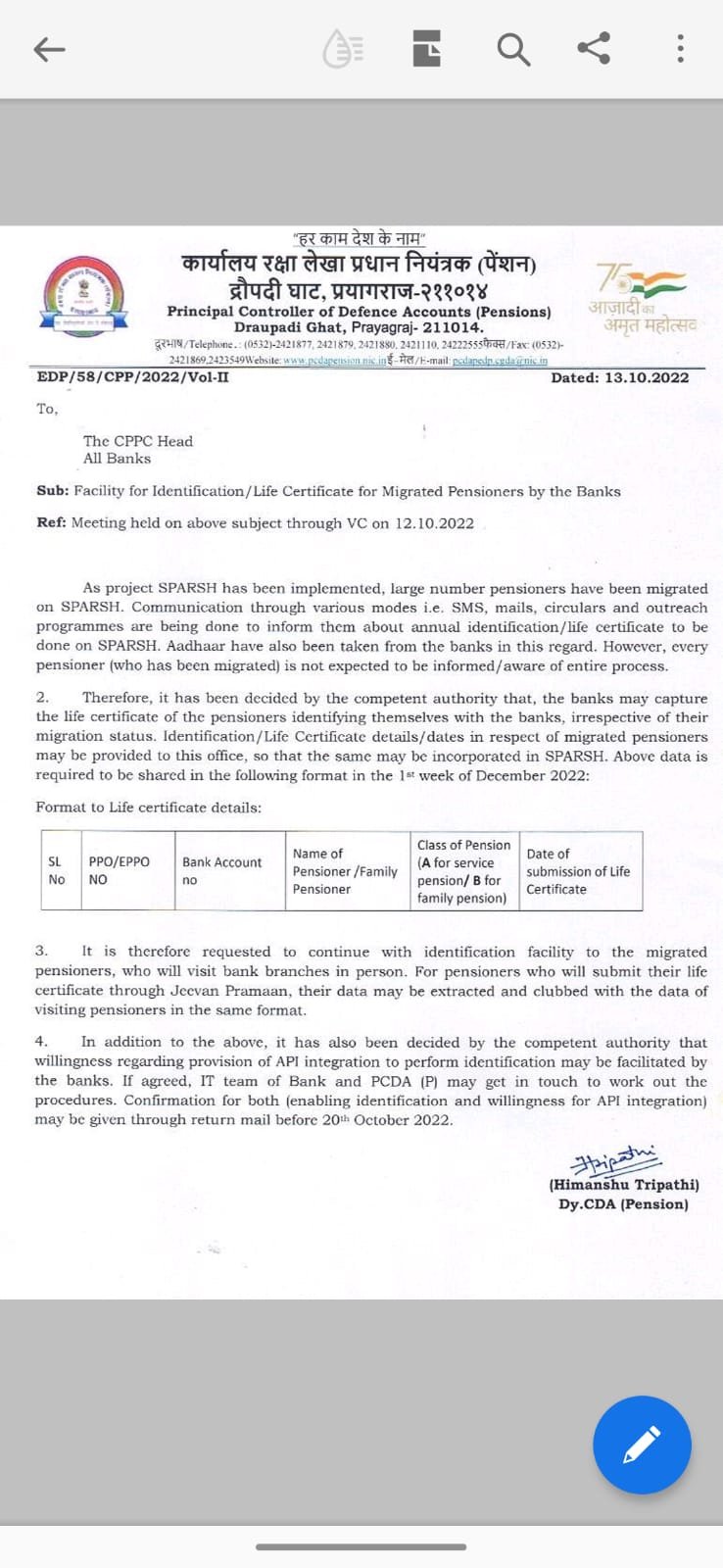
Correcting an anomaly in the interpretation of rules for enhancement of pension, the Armed Forces Tribunal has directed the government to hike the emoluments of an 88-year-old retired Lieutenant General with effect from earlier dates.
The Tribunal’s orders could have ramifications for other retired officers over 80 years of age whose pension enhancement may have been prejudiced over the years due to the “incorrect” interpretation of Ministry of Defence (MoD) rules by the Principal Controller of Defence Accounts (PCDA).
In his petition, Lt Gen Gorakh Nath, who retired after 38 years of service, had contended that the MoD’s letter on the subject issued in November 2008 unambiguously stated that pension is to be enhanced by 20 per cent from 80 years of age, by 30 per cent from 85 years of age and by 40 per cent from 90 years of age.
However, while executing the letter, pension authorities used the phrase “on attaining and on completion” instead of “from”, which gave a completely different connotation to the eligibility criteria for grant of enhanced pension. This denied him enhancement of pension by 20 per cent for one year and then again by 30 per cent for another year, he had averred.
“It is more than clear from the terms of the policy that benefit was to accrue to the pensioners who have attained the age of 80 to 85 years and implementation of the word ‘from’ has been clearly used in the communication made by the MoD to the concerned authorities,” the Tribunal’s bench comprising Justice Anjana Mishra and Lt Gen PM Hariz, observed.
“The interpretation adopted by the PCDA, which is contrary to the policy as stated in the MoD letter defeats the spirit of the legislation so as to cause detriment to the beneficiaries, cannot be accepted by this tribunal as the correct interpretation to be adopted,” the bench ruled.
The Tribunal has directed the government to enhance the officer’s basic pension by 20 per cent for 12 months from the beginning till the end of 80th year of age, enhance the basic pension by 30 per cent for 12 months from the beginning till the end of 85th year of age, and grant six percent interest on the arrears payable to him.
State Stalwarts
DEFENCE MINISTER
Minister Rajnath Singh
ALL HUMANS ARE ONE CREATED BY GOD
HINDUS,MUSLIMS,SIKHS.ISAI SAB HAI BHAI BHAI
CHIEF PATRON ALL INDIA SANJHA MORCHA
LT GEN JASBIR SINGH DHALIWAL, DOGRA
SENIOR PATRON ALL INDIA SANJHA MORCHA
MAJOR GEN HARVIJAY SINGH, SENA MEDAL ,corps of signals
.
.
PATRON ALL INDIA SANJHA MORCHA
MAJ GEN RAMINDER GURAYA ,MADRAS REGIMENT
sanjhamorcha303@gmail.com
PRESIDENT SOUTH ALL INDIA SANJHA MORCHA
COL SS RAJAN BOMBAY SAPPERS,
PRESIDENT UTTARAKHAND ALL INDIA SANJHA MORCHA
COL B M THAPA ,BENGAL SAPPERSS
PRESIDENT HARAYANA STATE CUM COORDINATOR ESM
BRIG DALJIT THUKRAL ,BENGAL SAPPERS
PRESIDENT TRICITY
COL B S BRAR (BHUPI BRAR)
PRESIDENT CHANDIGARH ZONE
COL SHANJIT SINGH BHULLAR
.
.
PRESIDENT PANCHKULA ZONE AND ZIRAKPUR
COL SWARAN SINGH
INDIAN DEFENCE FORCES
DEFENCE FORCES INTEGRATED LOGO
INDIAN AIR FORCE
Air Officer C-in-C WESTERN AIR COMMAND
AIR MSHL S PRABHAKARAN AVSM VM
AOC-IN-C, EASTERN AIR COMMAND
Air Marshal Inderpal Singh Walia
AOC-in-C SOUTH WESTERN AIR COMMAND
Air Marshal Vikram Singh
AOC-IN-C, SOUTHERN AIR COMMAND
Air Marshal J.Chalapati
AOC-IN-C TRAINING COMMAND
AIR MARSHAL SK GHOTIA VSM
AOC-IN-C MAINTENANCE COMMAND
Air Marshal Jagdish Chandra
Flag Officer Commanding in Chief, Western Naval Command
ice Admiral R Hari Kumar, PVSM, AVSM, VSM
Flag Officer Commanding in Chief, Eastern Naval Command
Vice Admiral Sanjay Bhalla, AVSM, NM
Flag Officer Commanding in Chief, Southern Naval Command