he Financial Action Task Force (FATF) on Friday allowed Pakistan to exit its grey list after four years against the backdrop of its ties with the West. – File photo Tribune News Service
New Delhi, October 21
The Financial Action Task Force (FATF) on Friday allowed Pakistan to exit its grey list after four years against the backdrop of its ties with the West. Russia was banned from all deliberations of the body. Nicaragua too exited the list along with Pakistan, which had been under a close FATF monitoring since 2018. Tanzania, Congo and Mozambique were added to the list.
An on-site visit by a FATF team in August had found that Pakistan was broadly in compliance with all 34 action points it had been asked to improve upon. Pakistan can now more effectively tackle money laundering and terror-financing, said FATF chief Raja Kumar of Singapore.
Pakistan’s Minister of State for Foreign Affairs Hina Rabbani had reached Paris earlier this week with a team representing the country. Off the grey list, Pakistan will now be able to get more foreign direct investment, which had shown a downward trend recently.
We will keep working to fulfil the vision of Guru Sahibs: PM Modi to Sikh sangat
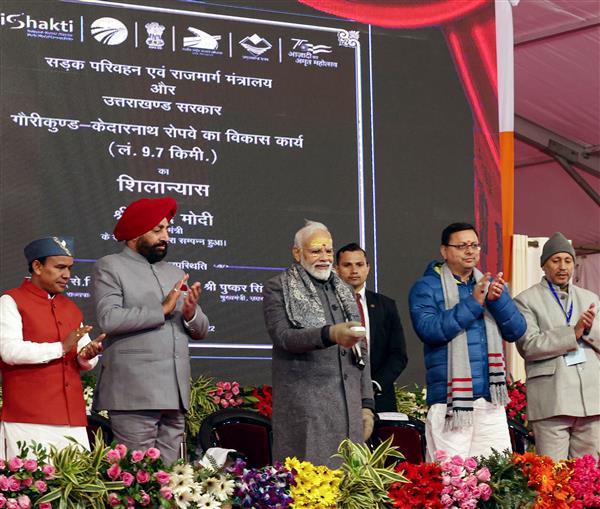
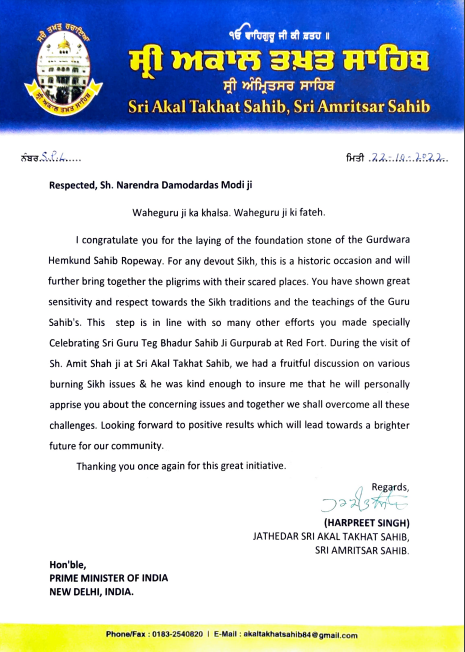
Prime Minister Narendra Modi today thanked Jathedar Sri Akal Takhat Sahib, members of the Sikh community including leading spiritual personalities for their appreciation of the Hemkund Sahib Ropeway project.
The PM assured the Sangat that he would keep working to fulfil the vision of Guru Sahibs.
Earlier today, the Press Information Bureau tweeted Giani Harpreet Singh, Jathedar Sri Akal Takht Sahib’s congratulatory letter to the PM and said, “Giani Harpreet Singh ji has congratulated & thanked PM @narendramodi for laying the foundation stone of the Gurdwara Hemkund Sahib Ropeway. The Hemkund ropeway will connect Govindghat to Hemkund Sahib
The PIB also tweeted a similar letter of thanks issued by Delhi Sikh Gurdwara Management Committee on the 12.4 km long Ropeway Project.
Haryana Sikh Gurdwara Management Committee also appreciated the PM’s efforts in the direction as did several Sikh organizations.
Honey-trapped govt employee still cannot believe that the woman he loved was a Pakistan agent:::warning for serving & ESM too
Jailed Ravi Prakash Meena, a class-4 employee at the Sena Bhawan in Delhi, is not able to believe that the woman he loved was a Pakistani agent. Honey trapped, the 31-year-old is accused of sharing sensitive and strategic information about the army.
He was “madly in love” with the agent who befriended him on Facebook, said an intelligence officer here familiar with the investigation into Meena’s case.
From Sapotara in Rajasthan’s Karauli district, Meena was apprehended in October first week, making him the 35th person arrested by the state police since 2017 for allegedly sharing sensitive information after being honey trapped by Pakistani agents, including those from the Inter-Services Intelligence (ISI).
In Meena’s case, the officer said, “The Pakistani agent, who went by the name Anjali Tiwari, posed as an Indian Army officer posted in West Bengal. Even after his arrest, and looking at the evidence, Kumar could not believe that the woman was a Pakistani agent.”
On October 8, following his arrest, Director General of Police (Intelligence), Rajasthan, Umesh Mishra, had said that Meena was sharing confidential and strategic information about the army with her.
He was providing information to the agent through social media in exchange for money which was deposited in his bank account, Mishra had said, adding that he has been charged under the Official Secrets Act.
Of the 35 people, including civilians and security personnel, six were arrested in 2017, as many in 2019, five in 2020, eight in 2021 and 10 so far this year, according to Rajasthan Police data.
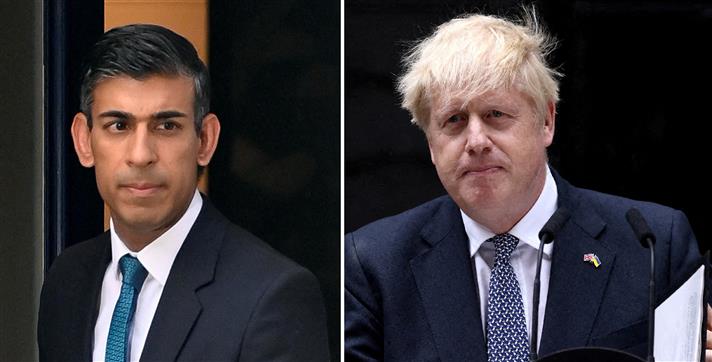
UK PM race: Rishi Sunak, Boris Johnson camps claim hitting 100 MPs mark
Rishi Sunak supporters claimed on Saturday that the Indian-origin former chancellor has hit the threshold of 100 members of Parliament required to make it to the shortlist for the race to replace Liz Truss as the Conservative Party leader and British Prime Minister.
The 42-year-old frontrunner’s tally continues to grow as former prime minister Boris Johnson flew back from his Caribbean holiday and his camp also claimed that he has the requisite minimum of 100 MPs for a possible leadership bid.
Neither Sunak nor Johnson has officially declared their intention to contest the leadership election, with Leader of the Commons Penny Mordaunt the only candidate to formally announce her candidacy so far.
However, the former finance minister has taken a comfortable lead with some heavyweight Tory ministers and MPs from different factions of the Tory party throwing their weight behind him and the betting odds also continuing to rise in favour.
“Rishi had the right plan in the summer and I think it is the right plan now,” former deputy prime minister Dominic Raab told the BBC.
“I think he is the best placed candidate to provide some stability, to provide confidence for the millions of workers and businesses up and down the country,” he said.
Raab warned against a comeback by the partygate scandal-hit former leader Johnson, just over three months after being forced to resign, pointing out that the UK Parliament is still conducting an inquiry into whether he misled Commons over the lockdown law-breaking parties at Downing Street.
“We cannot go backwards. We cannot have another episode of the Groundhog day, of the soap opera, of partygate. We must get the country and the government moving forward,” he said.
It came as Johnson was pictured by ‘Sky News’ on a flight back to London from the Dominican Republic with his wife and children, having indicated to allies of his intention to have another go at 10 Downing Street.
The tally of MPs publicly supporting him for the comeback publicly stands at 53, with former Home Secretary Priti Patel among his high-profile backers and his loyalists are confident that he would hit the 100-MP mark required by 2 pm local time on Monday to make the shortlist.
“Boris has the mandate to deliver our elected manifesto and a proven track record getting the big decisions right. I’m backing him in the leadership contest,” she tweeted.
If only one candidate is left standing by then on Monday, then the online Tory membership vote due to happen next week for a winner announced next Friday, will not have to take place.
If any one candidate secures 156 MPs, then the race would be automatically narrowing to a shortlist of two — given the Tory MPs Commons tally of 357 and not enough to support a third candidate’s minimum 100.
Meanwhile, there is widespread speculation among backers of both candidates that Sunak and Johnson may strike some kind of a deal.
According to ‘The Daily Telegraph’, Sunak is expected to reject any offer of a Cabinet role during the leadership race, given he is the frontrunner and had resigned from a Johnson government once already this year.
But no categorical statement of rejection has been issued, leaving open a job acceptance if Johnson does indeed emerge triumphant.
A local court today rejected a bail application of the Army man suspected to be involved in the alleged Chandigarh University video leak case.
Chandigarh University ‘video leak’ case
While rejecting the bail application of Sanjeev Singh, the court observed that the defence counsel could not produce relevant arguments supporting the bail plea, whereas the prosecution had substantial evidence for rejecting the application.
Earlier, a Kharar court had rejected Sanjeev’s bail application. The bail applications of the girl allegedly involved in the case was also rejected. They both will remain in judicial custody.
The court had granted bail to Sunny Mehta and Rankaj.
Sunny Mehta was released from jail two days ago though he was granted bail on October 12. The court had opined that Section 67 (A) of the IT Act envisaged that whoever published or transmits or causes to published or transmitted in the electronic form any material which contained sexually explicit act or conduct was liable for punishment, whereas the accused had not committed any of these offences and did not have any connection or relation with the girl for more than a year and a half. Therefore, no offence under Section 67 (A) of the IT Act was made out against the applicant. Further, the offence under Sections 354 (C) of the Indian Penal Code and another offence under the IT Act were bailable. The court also observed that there were no criminal antecedents of the applicant.
The applicant was a young boy of 23 and belonged to a respectable and law-abiding family. In case the applicant would remain with criminals in jail, his future and entire career would be spoiled, the court had observed.
Arunachal helicopter crash: Body of last missing Army personnel recovered, toll rises to 5
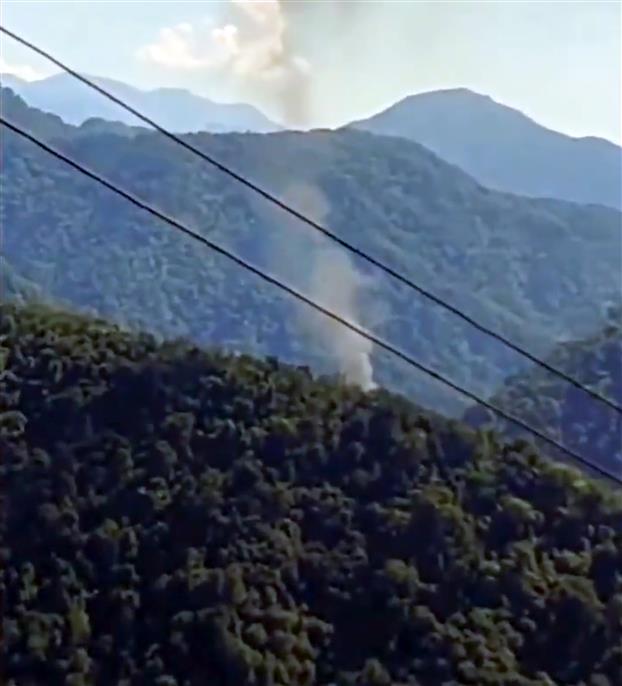
The toll in the Army helicopter crash in Arunachal Pradesh rose to five with the on Saturday, a defence spokesperson said.
Pilots sent Mayday call moments before Indian Army helicopter crash
The advanced light helicopter (ALH), carrying five Army personnel including two pilots, was on regular sorties when it crashed at 10.43 am on Friday near Migging, around 25 km south of Tuting, he said.
The bodies of the four other personnel were recovered on Friday evening from the crash site in a densely wooded mountainous area, around 35 km from the border with China, defence spokesperson Lt Col AS Walia said.
The deceased Army personnel were identified as pilots Major Vikas Bhambhu and Major Mustafa Bohara, CFN Tech AVN (AEN) Aswin KV, Havildar (OPR) Biresh Sinha and NK (Ppr) Rohitashva Kumar, he said.https://cb55146fa059c2335569ba6dfe2756cc.safeframe.googlesyndication.com/safeframe/1-0-38/html/container.html
The cause of the crash is not yet known and details are being ascertained, the officer said.
“It is reported that the weather was good for flying operations. The pilots had more than 600 combined flying hours on ALH-WSI and over 1,800 service flying hours between them. The aircraft was inducted into service in June 2015,” Lt Col Walia said.
Prior to the crash, the Air Traffic Control (ATC) had received a ‘May Day’ call suggesting a technical or mechanical failure, he said
“This will form the focus of the Court of Inquiry, which has been immediately constituted to investigate the causes of the accident. Names of the personnel will be released after notification to the next of kin,” Lt Col Walia said.
The Army helicopter, also known as HAL Rudra, had taken off from Likabali in Lower Siang district.
The HAL Rudra is an attack helicopter manufactured by Hindustan Aeronautics Limited (HAL) for the Indian Army. It is a weapon system integrated (WSI) Mk-IV variant of the Dhruv advanced light helicopter (ALH) and is the first armed helicopter produced indigenously in India
This is the second accident involving an Army helicopter in Arunachal Pradesh this month.
A Cheetah helicopter crashed in Tawang district on October 5 and claimed the life of one of its two pilots. According to official records, Arunachal Pradesh has witnessed 13 crashes since 1995, and 47 people were killed in them.
High drama marks closure of China’s key Communist Party Congress as ex-president Hu escorted out
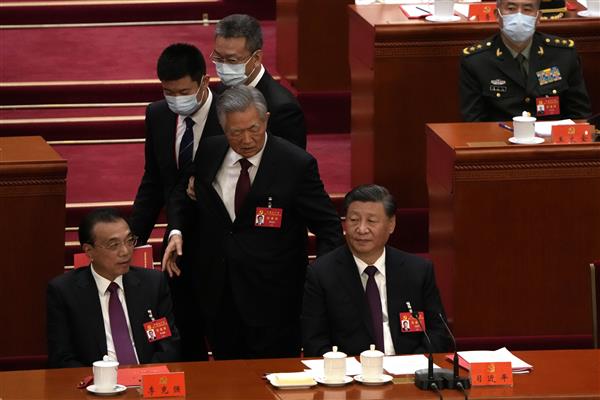
Former President Hu Jintao walks past Chinese President Xi Jinping, right, and Premier Li Keqiang during the closing ceremony of the 20th National Congress of Chinas ruling Communist Party at the Great Hall of the People in Beijing, Saturday, Oct. 22, 2022. AP/PTI
High drama ensued at the concluding session of the ruling Communist Party Congress here on Saturday as former president Hu Jintao was escorted out of the podium under the full glare of the media.
Hu, 79, sitting next to President Xi Jinping in the front row with other top leaders at the ornate Great Hall of People was persuaded to leave the meeting by two men, presumably security guards.
The incident happened just as the local and foreign media was ushered into the meeting attended by over 2,296 delegates and officials.
In over a minute-long video, which went viral on social media, Hu, who handed over the power to Xi in 2012 in a smooth transition after completing a 10-year tenure, appeared reluctant to depart as the security men kept persuading him to leave.
The frail-looking former president, who had a sheaf of papers in his hand, appeared talking to the two men much to the disquiet of the leaders, who sat through the whole episode motionless.
Finally, when he began walking, Hu was seen saying something to Xi who in return acknowledged nodding his head and patted Premier Li Keqiang. Then he began a long walk to the exit door accompanied by the two men. His exit was not explained.
Hu not only attended the opening ceremony of the Congress, but was also present throughout the session.
All Chinese Communist Party (CPC) meetings are held in extreme secrecy and it is indeed very rare for such an incident to take place.
The once-in-a-five-year Congress of the party which concluded its four-day session on Saturday is special in many respects as it cemented Xi’s status by amending the party’s Constitution to grant him more powers.
Xi, 69, will be completing his 10-year tenure this year.
All leaders before him, including Hu, retired after ten-year tenure.
The 20th Congress concluded its session by electing the powerful Central Committee comprising over 370 members.
The Committee will meet on Sunday to elect a 25-member Political Bureau which in turn would elect seven or more members to the Standing Committee.
The Standing Committee will elect the General Secretary.
Xi, the outgoing General Secretary of the party besides being President and head of the military, is widely expected to be endorsed for the post for a third five-year term.
ince the whole proceedings of the Congress are held under a blanket of secrecy, it is not clear how smooth the process of Xi’s endorsement will be.
Beijing and several parts of China witnessed rare protests with with banners hung on overpasses of major thoroughfares, protesting against Xi’s unpopular zero-COVID policy and authoritarian rule.
The banners were later removed by security officials.
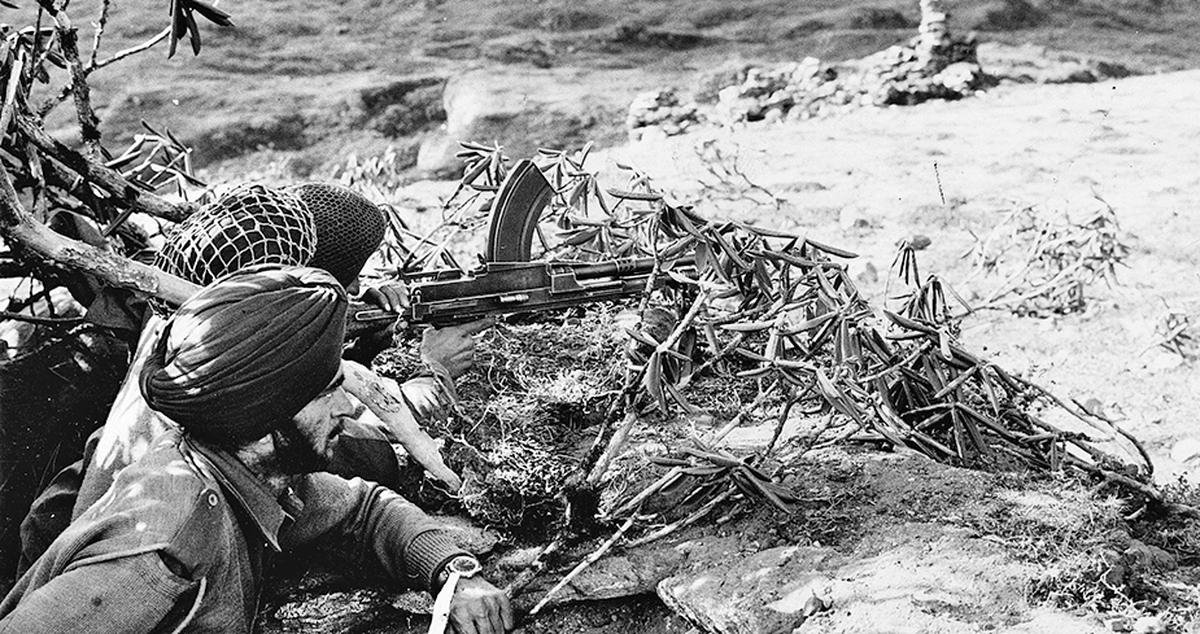
On the 60th anniversary of the IndiaChina war, which began with a Chinese attack on October 20, 1962, China’s military and media are paying renewed attention to a war that was largely previously sidelined in official Chinese military histories. In the weeks and months leading up to Thursday’s anniversary, the People’s Liberation Army (PLA) has showcased the war in an exhibition marking its 95th anniversary, as well as published a new military history of the war titled “One Hundred Questions on the ChinaIndia Border SelfDefence Counterattack”. China offi cially calls the war that it launched with a massive onslaught as a “counterattack” to justify its actions. The PLA exhibition, in Beijing’s Military Museum, blames India for the conflict. “China and India have never formally demarcated their borders in their past. There is only a traditional customary line formed according to the administrative jurisdiction of both sides,” it says. “After August 1959, the Indian Army invaded Chinese territory many times, causing armed border conflicts. In October 1962, the Indian Army launched a largescale attack and Chinese border defence forces were forced to flight back in self defence. It lasted 33 days and the military recovered the Chinese territory occupied by the Indian Army after August 1959.” Galwan clashes The exhibition also highlighted the June 2020 Galwan Valley clash. The renewed focus in 1962 has coincided with the downturn in relations and the return of the border dispute to the front and centre of the relationship. The war has sometimes between described by Chinese observers as a “forgotten” war that did not receive the attention of the war against Japanese occupation or Korean War which have been a staple of Chinese television dramas and films. The new war history has been put together by Zhang Xiaokang, daughter of former PLA General Zhang Guohua, who headed the Tibet military region and planned the Chinese offensive in the eastern sector. Extracts of the book that were first published in January were this week once again published by the popular Chinese website Guancha. It said “generations of soldiers and military fans have always been interested” in the war. The main focus has been on stories of PLA war veterans. While General Zhang Xiaokang is the focus of the book, commentaries this week highlighted other 1962 Generals. An October 16 article focussed on Ding Sheng and the PLA’s early offensive strategies, noting that it had drawn on its experience in the Korean War. An October 9 commentary by Feng Ping, an account that focusses on Chinese history, quoted the writings of another PLA General, Tang Yinfa, who was a PLA political commissar in Tibet, on his observations of the Indian Army, which he noted were “very strong” but hampered by “a chaotic command system and the disconnect between politics and military in decisionmaking, with decisionmaking in the hands of civilian officials who do not understand the military at all”. An October 7 analysis examined the world’s response to 1962, particularly attacking “the duplicity of ‘big brother’ Soviet Union” that said “the unanimous position of the Politburo of the Communist Party is on the side of China” but “did not take a public stand on the war”. “The Soviet Union was downright twofaced. On the surface, it remained neutral and intended to be close to China, but in fact supported India,” it said. “India believed it had the support of the two superpowers, the United States and the Soviet Union.” It also explained in unusually candid terms why China announced a unilateral ceasefire and withdrew, which Beijing today points to as a sign of its “goodwill” but the commentary noted was likely driven by “already achieving the goal of deterring India” and “very difficult material supply” during a “famine”, following Mao Zedong’s disastrous Great Leap Forward, when China could not afford to “consume more materials” in a conflict.
‘IAF has a road map for all 3 structures within space domain
the Indian Air Force (IAF) has a road map for all three structures within the space domain, which are communications, surveillance, and positioning and navigation, and it is prioritising on the communication capabilities right now, said Air Chief Marshal (ACM) V. R. Chaudhari on Thursday. “We have a road map on what we need for the future [the space domain]. Right now, our first focus is on building communications systems on our next INSAT7C [satellite],” ACM Chaudhari said. On the unmanned efforts being perused by the IAF, he said that, right now, the IAF was focussing on some of the unmanned technologiess such as Medium Altitude Long Endurance Unmanned Aerial Vehicles and High Altitude Long Endurance UAVs, while noting that the concept of MannedUnmanned Teaming is a bit futuristic for now. ‘IAF has a road map for all 3 structures within space domain’
IAF and HAL conclude ₹6,800crore contract
The Indian Air Force and the Hindustan Aeronautics Limited on Thursday concluded a ₹6,800crore contract for 70 HTT40 indigenous Basic Trainer Aircraft. In all, 451 Memoranda of Understanding (MoU), transfer of technology agreements and product launches took place during the Bandhan ceremony at the 12th DefExpo. It envisages investment worth ₹1.5 lakh crore, the Defence Ministry said.
State Stalwarts
DEFENCE MINISTER
Minister Rajnath Singh
ALL HUMANS ARE ONE CREATED BY GOD
HINDUS,MUSLIMS,SIKHS.ISAI SAB HAI BHAI BHAI
CHIEF PATRON ALL INDIA SANJHA MORCHA
LT GEN JASBIR SINGH DHALIWAL, DOGRA
SENIOR PATRON ALL INDIA SANJHA MORCHA
MAJOR GEN HARVIJAY SINGH, SENA MEDAL ,corps of signals
.
.
PATRON ALL INDIA SANJHA MORCHA
MAJ GEN RAMINDER GURAYA ,MADRAS REGIMENT
sanjhamorcha303@gmail.com
PRESIDENT SOUTH ALL INDIA SANJHA MORCHA
COL SS RAJAN BOMBAY SAPPERS,
PRESIDENT UTTARAKHAND ALL INDIA SANJHA MORCHA
COL B M THAPA ,BENGAL SAPPERSS
PRESIDENT HARAYANA STATE CUM COORDINATOR ESM
BRIG DALJIT THUKRAL ,BENGAL SAPPERS
PRESIDENT TRICITY
COL B S BRAR (BHUPI BRAR)
PRESIDENT CHANDIGARH ZONE
COL SHANJIT SINGH BHULLAR
.
.
PRESIDENT PANCHKULA ZONE AND ZIRAKPUR
COL SWARAN SINGH
INDIAN DEFENCE FORCES
DEFENCE FORCES INTEGRATED LOGO
INDIAN AIR FORCE
Air Officer C-in-C WESTERN AIR COMMAND
AIR MSHL S PRABHAKARAN AVSM VM
AOC-IN-C, EASTERN AIR COMMAND
Air Marshal Inderpal Singh Walia
AOC-in-C SOUTH WESTERN AIR COMMAND
Air Marshal Vikram Singh
AOC-IN-C, SOUTHERN AIR COMMAND
Air Marshal J.Chalapati
AOC-IN-C TRAINING COMMAND
AIR MARSHAL SK GHOTIA VSM
AOC-IN-C MAINTENANCE COMMAND
Air Marshal Jagdish Chandra
Flag Officer Commanding in Chief, Western Naval Command
ice Admiral R Hari Kumar, PVSM, AVSM, VSM
Flag Officer Commanding in Chief, Eastern Naval Command
Vice Admiral Sanjay Bhalla, AVSM, NM
Flag Officer Commanding in Chief, Southern Naval Command