Sanjha Morcha

What’s New

Click the heading to open detailed news

Current Events :

web counter

Print Media Reproduced Defence Related News

Tap potential of air power to the hilt by Air Marshal Brijesh Jayal (retd)

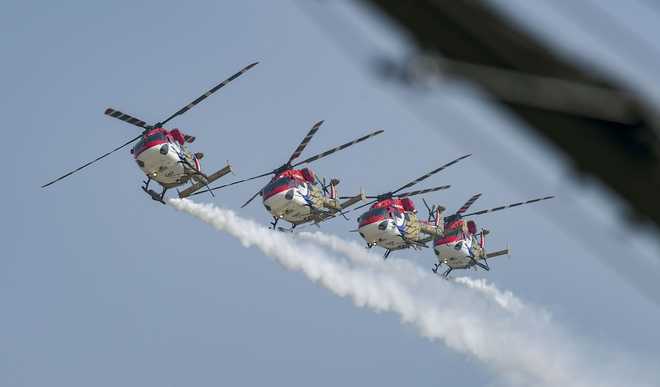
The strategic import of the Balakot air strike will not be lost on the Pakistan army, which will be compelled to rethink its strategy in view of India’s willingness to use air power in the interests of national security. For the first time in decades, the Indian security establishment has overcome its hesitation to use air power in the proxy war waged by Pakistan.

Tap potential of air power to the hilt

Mindset: The traditional diffidence to use air power, anticipating retaliation, has been a stumbling block.

Air Marshal Brijesh Jayal (retd)
Former Air Officer Commanding-in-Chief, South Western Air Command

THE Balakot air strike by the IAF’s Mirage-2000 aircraft has strategic security implications that transcend its immediate tactical significance. A formation of the IAF aircraft penetrated Pakistan’s air defences and successfully completed its mission despite the fact that the neighbouring country was on high alert after the Pulwama attack. Clearly, the IAF’s mission planning, tactics and execution proved too good for Pakistan’s air defence system. This is not for the first time that Pakistan’s air defences have been found wanting. They were also caught by surprise when US commandos neutralised Osama bin Laden in 2011, virtually in the neighbourhood of Pakistan’s military establishment. The question arises: why would the Pakistan Air Force, which is professionally recognised, neglect its air defences when it considers India an enemy with a strong air force?

Let’s rewind to the 1962 war when the Chinese army was threatening the Assam valley. At that time, White House intelligence reports had concluded that if India were to use combat air power, this would have a significant impact on the ground war. Yet US Ambassador John Galbraith advised India’s Defence Minister and the Prime Minister against the use of offensive air power, for fear of Chinese air force retaliation on Indian cities (such as Kolkata) and economic targets. Based on this advice, India failed to commit the IAF to an offensive role. The IAF top brass, too, failed to prevail upon the political leadership, even though air combat forces were available, joint structures with the Army were in place and there were the obvious limitations of the Chinese air force operating out of high-altitude airfields in Tibet.

This diffidence to use air power, anticipating retaliation, has somehow embedded itself in the psyche of the Indian security establishment. The mindset that the use of air power is escalatory manifested itself again during the Kargil conflict when the IAF was limited to operating within our own airspace and specifically forbidden from crossing the Line of Control (LoC). One keeps hearing similar sentiments expressed by security experts during debates in the electronic media.

The Pakistani military establishment has been quick to exploit this defensive Indian mindset and the window of opportunity it affords them. Knowing well, especially after the 1971 war, that India will always have an edge in conventional warfare, it has chosen the proxy war route to bleed India in Jammu and Kashmir ‘with a thousand cuts’. As this approach has paid them dividends and the Indian security establishment has come to live with the inevitability of the proxy war, Pakistan has built considerable ‘assets’ in the form of separatists and radical groups in J&K and other parts of the country. That it has well established training facilities like Balakot shows that this security template is there to stay. Indeed, it has used this template in Afghanistan as well.  Going nuclear has added to Pakistan’s confidence of being able to deter India while relentlessly pursuing their objective of targeting India and keeping its security forces tied up through the proxy war.

The strategic import of the Balakot mission will not be lost on the Pakistan army’s GHQ in Rawalpindi as India’s willingness to use air power to further its national security interests compels the former to rethink its strategy. It also puts a burden on them to commit resources and professionalise their air defences.

There are lessons for us as well. For the first time in decades, the Indian security establishment has overcome its hesitation to commit air power in the proxy war waged by Pakistan. One can only hope that having overcome this psychological barrier, the national security establishment will now be open to tapping the full potential and flexibility of air power in the interests of national security and not try to confine it to the Theatre Commands.

Even as Wg Cdr Abhinandan Varthaman has been released, there are three questions the nation must ask itself and not be satisfied with woolly answers: Why was the IAF pilot flying a dated MiG-21 when his adversary was in a contemporary F-16? Why is the IAF so hopelessly short of its combat strength with many squadrons equipped with aged and obsolete aircraft? And can we stop politicising the Rafale purchase and let the induction process move ahead so that the morale of the IAF is not dented?


CAG report shows IAF wanted only Rafale, competitive bidding was just a charade

Rafale failed on several parameters but the Air Force, impressed by Mirage aircraft in Kargil war, remained insistent on jets from Dassault.

File photo of a Rafale fighter aircraft | PTI

The CAG report tabled in Parliament recently tells us that the Indian Air Force wanted the Rafale fighter jets from day one. In fact, it wanted a jet from Dassault Aviation.

But the question is: Why?

Let us go back to the Kargil war in 1999. The Dassault Mirage 2000 aircraft proved its capabilities and impressed the Air Force very much. In August 2000, the Air Force proposed the acquisition of 126 upgraded Mirage 2000 jets. This was shot down by the defence ministry as the Defence Procurement Procedure (DPP) 1992 did not allow for a single-vendor purchase. The Air Force re-submitted its proposal in December 2001, saying it should be treated as a repeat purchase.

However, the insistence of the government to not get into a single-vendor deal led to a request for information (RFI) being issued for the acquisition of 126 medium-range combat aircraft. It largely consisted of single-engine jets: Dassault Mirage 2000-5 Mk.2, Lockheed Martin F-16, Mikoyan MiG-29, and Saab JAS 39 Gripen. Only the MiG-29 had twin engines.

But once Dassault closed the Mirage production and insisted on fielding only the Rafale, the acquisition was expanded to what became the Medium Multirole Combat Aircraft or the MMRCA. This also got Boeing F-18 and the Eurofighter Typhoon into the competition. Russia changed its offering to the MiG-35.


Also read: India favoured Rafale also because of its ‘nuclear advantage’


The Request for Proposal (RFP) was issued to all these contenders in August 2007, with a demanding Air Staff Qualitative Requirement (ASQR), which led to most of the contending jets not satisfying it, warranting certain India-specific enhancements.

This was a drastic change from the IAF’s own argument as reported by the Comptroller and Auditor General (CAG) in March 2001 while re-submitting its proposal for Mirage 2000, in which the IAF had argued that “while other available options such as Rafale, Eurofighter, F-35, etc., were technologically superior to Mirage 2000, the excess combat capability of these aircraft would remain underutilised as Air Force requirement was a comparatively modest aircraft for shorter range missions.”

Although the IAF ran flight trials, none of the contenders were completely in compliance with its ASQR. The CAG report states: “In the Technical Evaluation conducted in May 2008, five of the six aircraft could not meet all the ASQR parameters. Four aircraft had one to two deviations. Rafale aircraft could not meet 9 ASQR parameters prescribed in the RFP.” On three separate occasions in 2009, the Rafale was rejected, but it managed to remain in the hunt in complete violation of the Defence Procurement Procedure.

Four aircraft were eliminated after the flight trials — the F-18, F-16, MiG-35 and the Gripen — because they did not meet the ASQR parameters of “growth potential” and “design maturity”. The CAG says: “There was no objective, verifiable or measurable criteria prescribed for evaluation of these parameters.”

However, the Rafale, which did not satisfy 14 parameters, made it to the IAF’s down select along with the Eurofighter. It is apparent that the IAF did not want certain jets. It didn’t want the American jets as it argued that “it could face difficulties in case sanctions were imposed by (the) USA”.


Also read: Buying complex weaponry is no easy business, but Rafale shows India’s process is broken


The IAF has since bought aircraft and helicopters from the US — the C-130, C-17, Apache and Chinook. The Indian Navy bought P8 aircraft. The Russian MiG-35 was not in the game at all as the IAF didn’t want Russian jets, which are notorious for high maintenance and operational costs — one of the reasons why lifecycle cost was the criteria in the RFP, as Russian jets are cheaper in direct acquisition costs but costlier in the long run.

A comparison can be taken from the CAG report on heavy lift helicopter acquisition. Total Life Cycle cost quoted by Boeing for Chinook helicopters was $1.47 billion and that by Rosoboronexport for Mi-26 was €8.40 billion. Direct acquisition cost was $1.20 billion and €1.06 billion, respectively.

The CAG report says that Dassault was non-compliant in ASQR, RFP and in violation of the DPP. It did not give complete information, and the columns it had left blank were filled by the Indian committee looking into lowest bidder (L1) under various assumptions.

Dassault Aviation was declared L1 and Eurofighter, which had provided all the details, was found to be L2! It was only during negotiations that it became apparent that the costs were going way beyond the quote, and the Dassault was no longer L1.

According to the CAG report, a team of defence ministry officials had submitted a report in March 2015, saying that Dassault’s bid should have been rejected at the technical evaluation stage. It said, “The acceptance of additional commercial proposal after bid submission date for capabilities, which were already prescribed in the RFP, was unprecedented and against the canons of financial propriety.”


Also read: The 4 IAS officers in the thick of the Rafale deal controversy


Yet, just days later on April 10, 2015, Prime Minister Narendra Modi announced a deal for 36 Rafale. Was the PM not aware of the defence ministry’s report? Or did he go ahead regardless hoping for a better deal? CAG report does not indicate a better deal. It is Dassault that laughed all the way to the bank.

Various reasons are attributed to why the IAF wanted the Rafale — comfort with Dassault, Indo-France strategic ties, procuring weapons from France that are seen as sanctions proof and also a nuclear weapons delivery role.

This raises questions on the gaps that exists in understanding the needs and reasons of the IAF and the armed forces in general for certain weapons systems with the civilian leadership. If the IAF wanted only the Mirage and later the Rafale, then why wasn’t a government to government deal done earlier? DPP-2006 allows for an inter-governmental agreement.

If an IGA had been done in 2007, the Rafale jets would have been a lot cheaper and the Air Force would have already had the 126 jets it requires. In fact, the total requirement is 200-250 Rafale kind of jets. There was no need to have a sham tender that made a mockery of procedures and rules, because this has sent a very wrong message to weapons’ manufacturers across the world.

India is going to run what is dubbed MMRCA 2.0. It has got responses from the same contenders as MMRCA 1.0. The CAG report will be read by foreign suppliers. They will see how the MRCA tender played out. A competing vendor told noted defence journalist Saurabh Joshi, “If you’re permitting cheating, at least have the decency to not make the rest of us work so hard.” Will they respond to the RFP that’s due to be released?

Yusuf T. Unjhawala is the editor of Defence Forum India and a commentator on defence and strategic affairs. He tweets @YusufDFI

From interviews to news reports, catch ThePrint live in action on our YouTube channel. Subscribe here .


Army jawan dies of heart attack

Army jawan dies of heart attack

Sepoy Masar Deen

Nurpur, February 17

The family of Sepoy Masar Deen (35) was shattered as soon as the news of his sudden demise reached Riyali village in Fatehpur on Sunday. He had a heart attack yesterday and died in a Manipur hospital. He was with the Assam Rifles 25-Battalion and is survived by his wife and three sons. Sources said the body would arrive at the village tonight.

Prem Sharma, naib tehsildar, has announced relief for the bereaved family. — OC


Worried about husband’s safety, Army jawan’s wife kills self

Worried about husband's safety, Army jawan's wife kills self

Photo for representation.

Ahmedabad, February 18

The wife of an Army jawan allegedly committed suicide in Gujarat’s Devbhoomi Dwarka district as she had become anxious about his safety, the police said on Monday.

Meenakshi Jethwa (22) had become worried about her husband Bhupendrasinh’s safety especially in the wake of the attack on a CRPF convoy earlier last week, they said.

She was found to have hanged herself from the ceiling of her house in Khambhaliya town Saturday.

Her husband, posted at Gulmarg in Jammu and Kashmir, was visiting home on leave when the incident took place.

The couple had got married only two years ago.

Meenakshi did not want him to return to Kashmir, said a local police official.

Jethwa had told his wife about how he once narrowly escaped an avalanche while on duty. This, in addition to the February 14 attack in which 40 CRPF jawans were killed, made her all the more apprehensive, the police official said.

“As the date of his departure neared, she got depressed and hanged herself,” the police official said, adding that further probe was underway. – PTI


The Pulwama massacre We need measured diplomacy and purposeful action

The Pulwama massacre

The withdrawal of the most favoured nation (MFN) status to Pakistan is largely of symbolic value. Pakistan had never reciprocated with MFN status for India, which means it maintained discriminatory trade barriers against India. The 200 per cent duty on imports from Pakistan may pinch slightly more. Along with it, the recall of the High Commissioner in Islamabad, and the briefing by the Foreign Secretary to envoys from all major countries may have achieved its initial purpose of exposing the deep decline in bilateral ties. There have been other successful initiatives in the past: persuading China to drop its objections to Pakistan getting listed by the Financial Action Task Force and the sharp drop in US military aid, though that can also be traced to the shift in the Afghan security calculus.

Indian diplomacy is offering an alternative to inter-state hostilities, but Pakistan PM Imran Khan, who would tweet on every minor communal discord in India, is deafeningly silent. Even the Kartarpur initiative was marred by the hidden communal agenda of stopping non-Sikh pilgrims. With peace remaining elusive, the Pakistan government will fail to fulfil its promise of economic prosperity to the electorate if India relentlessly turns the diplomatic screws. However, the Pakistani media’s glorifying reportage of the Pulwama massacre bodes ill. For, like the Indian media, it has rapidly slipped down the slope of jingoism, turning the dominant political narrative fervidly anti-India.

It is getting tougher for India to do business with such a neighbour. This reinforces the need to remind China about the languishing Wuhan spirit of reconciliation, to recognise India’s restraint and allow the UN to list Jaish-e-Mohammed chief Masood Azhar a global terrorist. India will lose its moral and diplomatic upper hand if it reduces its anguish to mere breast-beating jingoism. There is really no need to talk about retaliation or to settle scores overnight. What needs to be done should be done quietly and purposefully without the government or the Opposition trying to take political mileage out of this ghastly incident.


Pakistan seeks urgent UN intervention to de-escalate fresh tensions with India

Pakistan seeks urgent UN intervention to de-escalate fresh tensions with India

Shah Mahmood Qureshi. File photo

Islamabad, February 19

Pakistan has sought the UN’s urgent intervention to “defuse tensions” with India, the Foreign Office said on Tuesday, following one of the worst terror attacks in Jammu and Kashmir in which 40 Indian soldiers were killed.

On February 14, 40 Central Reserve Police Force (CRPF) personnel were killed in Kashmir’s Pulwama district in a suicide attack claimed by Pakistan-based Jaish-e-Mohammad terror group.

The attack has heightened bilateral tensions with both New Delhi and Islamabad calling back their envoys.Pakistan Foreign Minister Shah Mahmood Qureshi sent a letter to UN Secretary-General Antonio Guterres on Monday, seeking his help to reduce the tensions between the two countries, Pakistan Foreign Office said.

“It is with a sense of urgency that I draw your attention to the deteriorating security situation in our region resulting from the threat of use of force against Pakistan by India,” Qureshi wrote in the letter.ndia has rejected any third-party interention in the Kashmir issue and has maintained that all outstanding matters in Indo-Pak ties should be resolved bilaterally.Qureshi, in his letter, said the Pulwama attack on Indian CRPF soldiers was ostensibly and even by Indian accounts carried out by a Kashmiri resident.

He said attributing the attack to Pakistan even before investigation was absurd.

He alleged that for domestic political reasons, India deliberately ratcheted up its hostile rhetoric against Pakistan and created a tense environment.

Qureshi wrote that India has also hinted that it might abandon the Indus Waters Treaty, asserting that it would be a grievous error.

“It is imperative to take steps for de-escalation. The United Nations must step in to defuse tensions,” Qureshi said.

He said India must be asked to conduct an open and credible investigation in the terror attack.

“You may also consider asking India to refrain from further escalating the situation and enter into dialogue with Pakistan and the Kashmiris to calm the situation down,” he wrote.

The foreign minister requested that the letter should be circulated to members of the Security Council and General Assembly.

Pakistan has repeatedly asked the UN to intervene in Kashmir. Former Pakistan Prime Minister Nawaz Sharif had also sought the US intervention, saying America was the “most relevant” party to get involved in the Kashmir issue.

The US, however, has time and again reiterated that it is for India and Pakistan to discuss and decide on the pace and scope of their bilateral relationship. PTI


Pakistan rejects India’s charge on Pulwama terrorist attack

Pakistan rejects India's charge on Pulwama terrorist attack

Pakistan’s Foreign Office, after keeping quiet for hours, issued a statement after midnight. PTI

Islamabad, February 15

Pakistan has condemned the terrorist attack in Jammu and Kashmir’s Pulwama district and said it is a matter of grave concern even as it rejected India pointing out Islamabad’s link to the incident without investigations.

At least 42 CRPF personnel were killed and five injured on Thursday in one of the deadliest terror attacks in Jammu and Kashmir when a Jaish suicide bomber rammed a vehicle carrying over 100 kg of explosives into their bus in Pulwama district.

Pakistan’s Foreign Office, after keeping quiet for hours, issued a statement after midnight.

The attack in Pulwama in Jammu and Kashmir “is a matter of grave concern,” it said.

“We have always condemned heightened acts of violence in the Valley,” the FO said.

Pakistan also rejected that it was in any way involved in the attack.

“We strongly reject any insinuation by elements in the Indian government and media circles that seek to link the attack to the State of Pakistan without investigations,” the FO added.

India on Thursday slammed Pakistan over the Pulwama terror attack carried out by Jaish-e-Mohammed (JeM) and asked the neighbouring country to stop supporting terrorists and dismantle terror infrastructure operating from its soil.

India also strongly reiterated its appeal to all members of the international community to support the proposal to list terrorists, including JeM chief Masood Azhar, as a designated terrorist under the 1267 Sanctions Committee of the UN Security Council, and to ban terrorist organisations operating from territories controlled by Pakistan.

The White House asked Pakistan to immediately end “support” and “safe haven” to all terror groups as it strongly condemned the Pulwama terrorist attack.

“The United States calls on Pakistan to end immediately the support and safe haven provided to all terrorist groups operating on its soil, whose only goal is to sow chaos, violence, and terror in the region,” White House Press Secretary Sarah Sanders said in a late night statement on Thursday.

Condemning the attack, the US State Department said in a statement that it was “resolutely committed” to working with the Indian government to combat terrorism in all its forms. PTI


2 militants killed in Budgam

2 militants killed in Budgam

wo Hizbul Mujahideen militants were killed in a gunfight with security forces. File photo

Tribune News Service

Srinagar, February 13

Two Hizbul Mujahideen militants were killed in a gunfight with security forces on Wednesday in central Kashmir’s Budgam district, the police said.

The militants were killed following a gunfight at Gopalpora village of Budgam. They have been identified as Hilal Wani and Shoaib Lone, both residents of south Kashmir’s Kulgam district, the police said.

The police in a statement said the two slain militants were involved in several terror attacks and arms and ammunitions were recovered from their possession.

The police said Hilal was a senior commander and had been categorised as an ‘A++’ militant — signifying that he was in the list of most-wanted militants and also carried a bounty of Rs 12.5 lakh.

The gunfight erupted at Gopalpora when the security forces received information from “reliable sources” about the presence of militants in the village following which a cordon and search operation was launched.

A senior police officer said the search was launched late in the night and contact with militants was established early on Wednesday morning. “When we were conducting the searches, militants fired from a house which was retaliated,” the officer said.

The firefight continued for several hours and concluded at 7 am with the killing of both the militants, the official said, adding that the militants were planning to carry out an attack in the area even as the specifics of it were not immediately known.

The bodies of the militants were later handed over to their families after medico-legal formalities.

Hilal Wani was ‘A++’ ultra 

  • Hilal Wani and Shoaib Lone, both residents of Kulgam district, were killed following a gunfight at Gopalpora in Budgam
  • The police said Hilal was a senior commander and was categorised as an ‘A++’ militant — signifying that he was in the list of most-wanted militants and also carried a bounty of Rs 12.5 lakh


UPA denied Army coup bid in House

Ajay Banerjee

Tribune News Service

New Delhi, February 6

Even as the ruling BJP today accused the Congress-ruled UPA-II government (2009-2014) of “leaking” information of a “fake” Army coup to the media, records of Parliament show the Manmohan Singh-led government had then made it clear that “troop movement” was purely for training purposes.

The issue had cropped up in April 2012 when a newspaper ran a story alleging that the Army, then headed by General VK Singh, made an unauthorised movement of troops towards Delhi on the night intervening January 16 and 17, 2012.

Around the same time, the General, who is now a minister in the Modi government, had challenged his date of birth in the Supreme Court.

A reply in Parliament given by then Defence Minister AK Antony on April 25, 2012, said on January 16, 2012, one of the units of 50 Para Brigade carried out mobilisation to practice mounting from an alternative airfield other than Agra, during “fogged-out conditions/non-serviceability” of the Agra airfield due to operational reasons.

Agra is the home base of the Para Brigade. This column came to the location of one unit at Gurgaon on January 17, 2012. Mobilisation practice was under the 50 Para Brigade. The 33 Armoured Division based at Hisar was to carry out an exercise with troops in March-April 2012, Antony had said.

As a precursor to this exercise, a Mechanized Infantry battalion was mobilised by the formation commander towards Bahadurgarh (north-west of Delhi) to validate its loading, movement and occupation in poor visibility conditions.

The battalion reached the area of Bahadurgarh during morning hours on January 17, 2012, and proceeded to occupy the designated dispersal area as per standard operating procedure. Having validated their mobilisation drills, both Columns moved back subsequently.

There was no report received in the Ministry of Defence from intelligence agencies on January 16/17, 2012, as regards such troop movement, Antony had said.

The movement was aimed at refining the mobilisation drill and ensuring operational preparedness of the Army despite adverse weather conditions.

At a meeting of the parliamentary panel later, Defence Secretary Shashi Kant Sharma said the movement was a routine activity, which did not require any permission from the government. He is learnt to have told the panel that no standard operating procedures had been breached.


Army Chief General Bipin Rawat reviews preparedness of Indian Army along LAC

Army Chief General Bipin Rawat called Arunachal Pradesh Governor Brig (Retd) B D Mishra and held talks with him at Raj Bhavan here.

Bipin Rawat

Army Chief General Bipin Rawat   |  Photo Credit: PTI

Itanagar: Army Chief General Bipin Rawat reviewed the preparedness of the Indian Army along the Line of Actual Control (LAC) during his two-day visit to Arunachal Pradesh and Nagaland, Defence sources said Monday. Arunachal Pradesh shares a 1,080 km border with China, 520 km border with Myanmar and 217-km border with Bhutan.

The Army chief started his North East tour with a visit to the Spear Corps headquarters, Rangapahar Military Station, Dimapur in Nagaland on Sunday, they said. Gen Rawat reviewed the operational preparedness of Spear Corps and expressed satisfaction with the preparedness along the Line of Actual Control (LAC) and lauded its people friendly counter-insurgency operations, officials said.

Acknowledging that the troops have been ensuring peace and tranquility in the region by their dedicated hard work in difficult terrain and operational conditions, he told officers and troops during interaction to work tirelessly and in a professional manner to accomplish their task.

The Spear Corps, besides undertaking extensive counter-insurgency operations in North-East is also responsible for operations along the LAC in Arunachal Pradesh that borders China. The Army chief called Arunachal Pradesh Governor Brig (Retd) B D Mishra and held talks with him at Raj Bhavan here.

Praising the state people for helping the Indian Army in a big way, Gen Rawat stressed on their united efforts in national interest. Acknowledging the efforts of the governor in facilitating recruitment of states youth, he had said the armed forces boast of many Arunachalees who are good officer.

Indias sovereignty and territorial integrity are intact because of the Indian Army, the governor said. The Army chief left for New Delhi on Monday after concluding his two-day visit to the North East.