Dinesh Kumar in Chandigarh
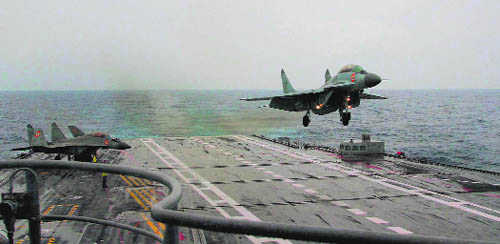
The Indian armed forces are structured across 19 Commands, 17 of which are single service commands. The system of individual Service operational Commands is a legacy of the British. Successive governments haven’t brought about changes in the defence management system. Modern warfare demands unified commands. All three Services will require a unified structure to create an interoperable integrated environment

Should a war break out with China or Pakistan, multiple single Service operational Commands belonging to the Army, Navy and the Air Force will be pressed into service with none of their Command HQ located in the same city. Also, an operational Command of one Service will have overlapping geographical jurisdiction with more than one Command of another Service. And, there will not be a centre-point of tri-Service coordination. For example, a full-fledged conventional war with Pakistan will ensure the involvement of seven different operational Commands: 4 Army Commands, 2 Air Force (IAF) Commands and one Navy Command. The Army will activate the Udhampur-based Northern Command (looking after J&K), the Chandimandir-based Western Command (mainly Punjab), Jaipur-based South Western Command (mainly Rajasthan, part Gujarat) and the Pune-based Southern Command (part Gujarat, Maharashtra, Goa).
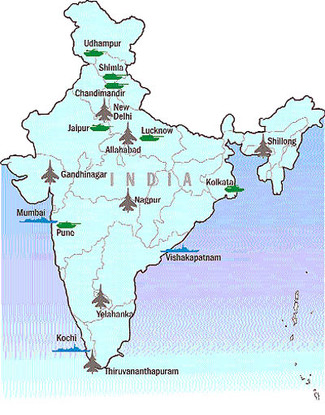
The IAF will likely activate its New Delhi-based Western Air Command, which incidentally with its area of responsibility spread across J&K, Punjab and part of Rajasthan, has jurisdiction of the equivalent of more than two Army Commands: Northern, Western and part of Southwestern. The second Command the IAF may activate is the Gandhinagar-based Southwestern Air Command (area of responsibility is part of Rajasthan, Gujarat and Maharashtra) while the Navy will engage its Mumbai-based Western Naval Command in the Arabian Sea. Each of these will likely take instructions from respective Service chiefs and coordinate with their respective Operations directorate in the absence of both a Chief of Defence Staff (CDS) and a Joint Operations Directorate. As is evident, none of the seven operational Commands are co-located which resultantly is expected to adversely impact on coordination in intelligence sharing, planning and execution in the fast-paced technology-intensive battlefield environment of the 21st century. Also, the number of Commands belonging to each service located along the India-Pakistan border differs; the geographical jurisdiction of various Commands of the three Services have little commonality, and in most cases, the Command of one Service either overlaps or is linked with two or more Commands of the other Service.It will be a similar situation in the case of a war with China in which three Army Commands (Udhampur-based Northern Command, Lucknow-based Central and Kolkata-based Eastern) and three Air Force Commands (New Delhi-based Western, Allahabad-based Central and Shillong-based Eastern) will be engaged. In the high probability of a naval dimension to a future Sino-Indian war, also likely to be involved is the Navy’s Vishakapatnam-based Eastern Command and the Port Blair-based Andaman and Nicobar Command, the latter being India’s sole tri-Service Theatre Command, and whose commander-in-chief reports to the Chairman Chief of Staff Committee (COSC). In all, eight operational Commands will be involved.
Compare & contrast
Contrast the response to a Sino-Indian war with that of China, whose armed forces are structured across a total of just five joint theatre Commands. In the event of a conventional war with India, Beijing is expected to employ one theatre Command: the Chengdu-based Western Theatre Command. In case of a naval dimension, Beijing may employ the South China Fleet component of its Guangzhou-based Southern Theatre Command. The system of individual Service operational Commands is a British legacy. India has only made either incremental or cosmetic changes since Independence. As a result, as of today the Indian armed forces are structured across a total 19 Commands, 17 of which are single service commands. (See box).The other two are tri-Service Commands: the Andaman and Nicobar Command, a ‘geography-based’ Theatre Command established in October 2001 with headquarters in Port Blair, comprising a modest force level of an Army brigade, an IAF transport helicopter Unit, Naval patrol vessels and maritime reconnaissance aircraft and Coast Guard patrol vessels for the 572 island archipelago located about 1,200 km from the Indian mainland and barely 45 km and 180 km, respectively, from the southern tip of Myanmar’s Coco islands and the northern tip of Indonesia. They lie astride the western end of the Malacca Strait. The second, the Strategic Forces Command (SFC), with HQ in New Delhi, is an ‘equipment-based’ Functional Command armed with nuclear missiles.
Least integrated
The Kargil Review Committee observed, “India is perhaps the only major democracy where the Armed Forces Headquarters is outside the apex governmental structure.” In contrast to other major countries in the world, where the three Services are coordinated at the top under a CDS or equivalent, the three Services are not coordinated at the top and their respective Chiefs end up wearing three diverse hats: a ‘staff hat’ as the Chief of Staff, an ‘operational hat’ as the Commander-in-Chief and also a ‘ceremonial hat’.Around 70 countries, including major and medium military powers, have a Chief of Defence Staff or equivalent. India, with the world’s fourth largest armed forces, is the only country of its size that doesn’t have the CDS.The three Services are notionally coordinated in the institution of Chairman COSC, which, however, is a rotational post held by the senior most Service Chief as a mere figurehead with no operational resources and no command authority. He is only a coordinator for most tasks which are administrative and that also by a democratic process of agreement. Considering this, it is unclear how the Chairman COSC will operationally handle the Andaman and Nicobar Command (ANC) in the event of a major military operation if the Commander-in-Chief of the ANC belongs to a Service other than that of the Chairman.
Parallel campaigns
Since Independence, war plans and procurement of equipment have been based on single Service appreciation and have involved overlaying the application of the other Service. Hence plans have been based more on creating a feeling of ‘mutual cooperation’ rather than based on a jointly appreciated integrated course of action. Be it strategic or tactical doctrines, training, equipment, procurement or logistics, each Service tends to operate almost in isolation. The debate in India to appoint a CDS and create joint Services Commands dates back several decades. Politicians, bureaucrats and the armed forces continue to talk even though successive military engagements by India have exposed deficiencies. The Sino-Indian War of 1962 was a disaster as has been recorded by several informed authors, including the still classified Henderson Brooks Report which was posted on the Internet in 2014 by Neville Maxwell, an Australian journalist and author of ‘India’s China War’, a book that revealed the incompetence of India’s key political and Army leadership of that time. It was also a war in which India did not utilise its air power and kept its fighter aircraft grounded despite the latter having the potential to make a difference considering that vintage Chinese aircraft had severe restrictions on payload capacity owing to their air bases being located on altitudes higher than 10,000 feet.The 1965 India-Pak war was a case of utter lack of coordination between the Army and IAF, which again has been recorded in the Official War History and also several books authored by retired defence officers and other writers. The Army saw the role of the IAF more as an air artillery and lack of coordination led to IAF fighters killing Indian soldiers in friendly fire. The 1971 India-Pakistan War appeared relatively better coordinated. Even so, while speaking at the Defence Services Staff College soon after the 1971 War, Field Marshal Sam Hormusji Framji Jamshedji Manekshaw, who led the Army to victory, tellingly remarked that the area Commands in India were dysfunctional and needed to be reduced to joint Commands which would operate under a CDS.
Recent conflicts
During the 1987-89 IPKF or Indian Peace Keeping Operations (named Operation Pawan) in Sri Lanka, an Overall Force Commander (OFC) from the Army was appointment with component commanders subordinated to him from the Eastern Naval Command and the Southern Air Command. However, this worked in theory more than in practice. For, the Navy and IAF Commanders-in-Chief (C-in-C) responsible for providing forces declined to delegate command and instead got the component commanders designated as liaison officers with no role other than act as a via-media in the headquarters of the OFC and the C-in-C. In As for the 1999 Kargil War, the differences between the Army and the IAF are well known. In one of its report, the Parliamentary Standing Committee on Defence has noted that it was lack of synergy which caused difficulties to the armed forces. Successive governments in India, irrespective of their political leaning, have rarely been pro-active in making changes in India’s defence management system. Changes have been the consequences of disastrous events and surprises. And even then, the reforms have been reactive and marked more by incrementalism than radical reforms and initiatives to deal with threats.
Cosmetic changes
It took India’s defeat in the 1962 War to make the government embark on modernising the armed forces which included raising 10 Army Mountain Divisions. Some incremental changes in India’s defence management system have followed after the 1999 Kargil War. Drawbacks within the Army during the large scale mobilisation of troops after the December 2001 terror attack on Parliament led the Army to embark on a Cold Start Doctrine. In 2008, soon after the 26/11 terror attacks by Pakistani terrorists in Mumbai, embarrassing revelations of chinks in India’s coastal security led the government to place the Coast Guard under the operational command of the Navy. The 1980s witnessed some major acquisitions and modernisation — some as a pro-active measure and some as reaction to Pakistan’s acquisitions. The 1980s also witnessed the Indian armed forces embarking on unprecedented ‘Out of Area’ tri-service missions — Operation Pawan in Sri Lanka (1987-89) and Operation Cactus in the Maldives (1988). Towards the end of the decade, the Army was fighting an intensive proxy war with Pakistan in J&K after having earlier engaged in Operation Bluestar (1984, Amritsar). India has increased its military ties with the US, Western Europe, nations in Southeast and East Asia and the Middle East. The country has also participaed in UN peace support operations. Clearly, the role of the Indian armed forces has expanded to new realms requiring a hard look at existing structures.
Recommendations
No Indian government has ever conducted a strategic defence review. The only exercise was the report prepared by the Kargil Review Committee commissioned soon after the 1999 Kargil War. The findings of the committee, which essentially studied the sequence of events and made recommendations for the future, was tabled in Parliament in February 2000. It led the government to constitute a Group of Ministers (GoM) Committee in April 2000 to examine the changes that needed to be made in the national security structure. The GoM Committee in turn constituted four Task Forces, each of which examined Defence Management, Border Management, Internal Security and Intelligence Reforms.Among the recommendations made by the GoM were three key proposals: (i) Integration of the Services both with each other and with the Ministry of Defence (MoD); (ii) creation of a CDS as a single point military advice to the civil political executive; and (iii) creation of Joint Operational Commands. The government ended up taking measures that were either cosmetic or incomplete. On integrating the Services with the MoD, the government did so with word play by introducing the nomenclature ‘Integrated Headquarters of the Army” (and likewise for the Navy and the IAF). Thus the only integration lay in the word ‘integrated’ — a cosmetic measure, whereas what the recommendation suggested was appointment of officers from the Services to the MoD. Then again, instead of appointing a CDS, the government took the half measure of creating a Headquarters Integrated Defence Staff or HQ IDS in October 2001. This is being headed by a Chief of Integrated Staff (CIS), a three star general, as an interim measure until a CDS was nominated pursuant to the Cabinet Committee on Security partially approving the GoM Committee recommendation. The HQ IDS works as a tri-Service secretariat to a non-existent CDS which remains elusive in the absence of any subsequent decision by three successive union governments formed since the report’s preparation. As for the third recommendation of making Joint Operation Commands, the government simply upgraded the Navy’s Fortress Andaman and Nicobar (FORTAN), established in 1976, to the Andaman and Nicobar Command (ANC) with a full-fledged C-in-C to be headed by a Lieutenant General equivalent belonging to either of the three Services and reporting to the Chairman COSC. Thus, although a Theatre Command was created, it did not involve any major addition of resources; only a change in nomenclature with its C-in-C reporting to the Chairman COSC instead of to the Flag Officer Commanding-in-Chief of the Eastern Naval Command as was being done in the past. However, several years later the ANC has still not been fully integrated according to a report prepared by the Parliamentary Standing Committee on Defence and it still remains dependent on the Eastern Naval Command for vessels and other weapon platforms and systems.

dkumar@tribunemail.com