Sanjha Morcha

What’s New

Click the heading to open detailed news

Current Events :

web counter

Print Media Reproduced Defence Related News

Top LeT commander, aide ‘killed’ in Kulgam encounter 2 civilian protesters shot by security men at the site in Arwini area

Top LeT commander, aide ‘killed’ in Kulgam encounter
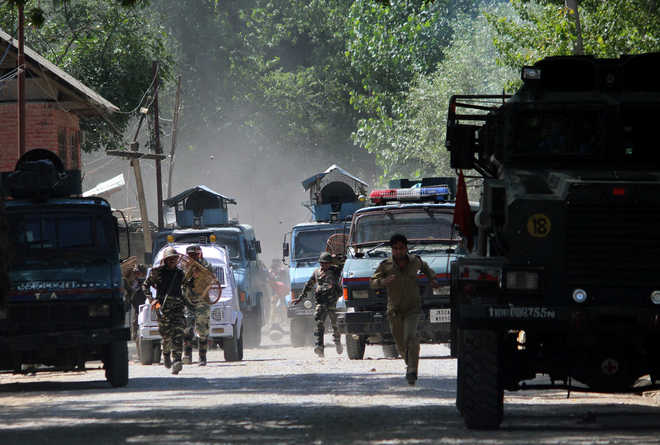
Security personnel chase away stone-throwers from the encounter site at Arwini village in Kulgam district on Friday. Tribune photo: Amin War

Suhail A Shah

Anantnag, June 16

A top Lashkar-e-Toiba (LeT) commander is among two militants believed to be killed in an ongoing encounter in the Arwini area of south Kashmir’s Kulgam district, 42 km south of Srinagar.Two civilians have also been shot dead, allegedly by security forces, during clashes that erupted around the site of the encounter.Though the firing has stopped at the encounter site, the bodies of militants are yet to be retrieved and the operation is still not over, officially.According to reports, security forces cordoned off the Malik Mohalla locality in Arwini early Friday morning on a tip-off regarding presence of militants in the area.“There has been intermittent exchange of fire throughout the day and we believe two militants have been gunned down. The exchange of fire has halted since around 4 pm now,” a senior police official said.Though the bodies are yet to be retrieved, the police believe that one among the slain militants might be a most wanted Lashkar commander, Junaid Mattoo.Mattoo’s name was in the 12 most wanted militants list issued recently by the Army in Kashmir. He carried a bounty of Rs 10 lakh on his head.“Efforts are on to retrieve the bodies from the rubble of the house they were hiding in,” police sources said.Local sources said at least three houses had been razed to ground by the bombardment carried out by security forces.Meanwhile, as the encounter was on hundreds of local youth assembled and in a bid to give trapped militants an escape route engaged security forces by stone-throwing. Security forces fired live ammunition, pellets and tear-smoke shells to disperse the protesters leaving two civilians dead and more than 30 injured, at least 10 of them with bullet wounds.The slain civilians have been identified as 22-year-old Muhammad Ashraf Khar of Khar Mohalla in Arwini and 14-year-old Ahsan Dar of Shamsipora village in neighboring Anantnag district.Both of them have been shot in the chest as confirmed by the health officials at District Hospital, Anantnag, and Sub-District Hospital, Qaimoh, Kulgam district.Chief Medical Officer (CMO), Kulgam, Dr Muhammad Shafi confirmed the killing of Ahsan Dar at Qaimoh Sub-District Hospital and said different hospitals in Kulgam treated around 10 other injured youth. “Five of them had firearm injuries,” he said.In Bijbehara Sub-District Hospital 10 more injured were treated, four of them with bullet injuries.“Two with bullet injuries and three others with pellet injuries in their eyes have been shifted to Srinagar for specialised treatment,” Block Medical Officer (BMO), Bijbehara, Dr Showket, said. In Anantnag district Hospital nine injured, two of them with bullet injuries, were treated.“They were all stable while one of the injured, Muhammad Ashraf, succumbed to his injuries here,” Medical Superintendent (MS) of the hospital Dr Majid Mirab said. A combing operation of the encounter site was on while this report was filed.

Bodies yet to be retrieved

  • Though the bodies are yet to be retrieved, the police believe that one among the slain militants might be a most wanted Lashkar commander, Junaid Mattoo
  • Mattoo’s name was in the 12 most wanted militants list issued recently by the Army in Kashmir. He carried a bounty of Rs 10 lakh on his head

GORKHA STIR Violence, arson back in Darjeeling GTA office, rly station set on fire; several government vehicles damaged

Violence, arson back in Darjeeling
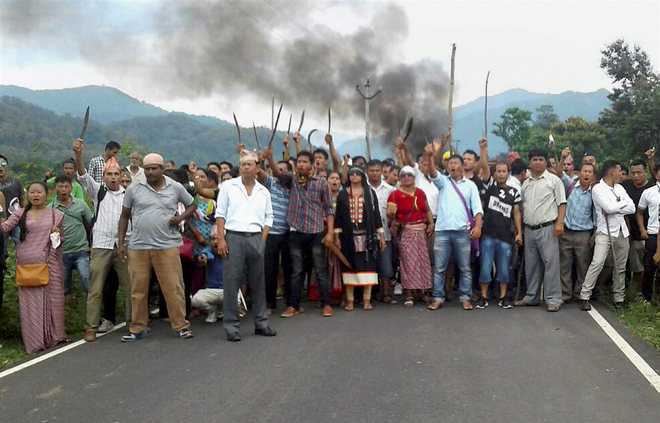
Gorkha Janmukti Morcha activists block a road at Panighata in Siliguri on Thursday. PTI

Darjeeling, July 13

A GTA office was set on fire and several vehicles were damaged in Darjeeling today as the indefinite shutdown in the hills entered the 29th day.The Gorkhaland Territorial Administration (GTA) office for travel and tourism in Chowrastha of Mall Road in Darjeeling was set ablaze by pro-Gorkhaland supporters early morning. Several government vehicles were also damaged near the Darjeeling station by unidentified men last night.A railway station in Gayabari area of Kurseong was set on fire by pro-Gorkhaland supporters this morning. A forest bungalow near Teesta river was also set on fire today.The convoy of state tourism minister Gautam Deb was also attacked on the way to Darjeeling’s Panighatta where the minister was going to attend a programme on the occasion of poet Bhanubhakta Acharya’s birth anniversary.Meanwhile, responding to the call of the Gorkhaland Movement Coordination Committee (GMCC), a writer and a singer returned the awards given to them by the state government.The GJM and pro-Gorkhaland supporters today celebrated the birth anniversary of noted Nepali poet Bhanubhakta Acharaya. Hundreds of Pro-Gorkhaland supporters today took out colourful rallies reciting poems written by Bhanubhakta Acharya and carrying placards in favour of separate state of Gorkhaland. Internet services remained suspended for the 26th day.Except medicine shops, all the shops, restaurants, schools, colleges, hotels and private offices remained closed. The police and the security forces maintained a tight vigil at all entry and exit points.

‘Hold tripartite meet’

CPM general secretary Sitraram Yechury on Thursday said Union Home Minister Rajnath Sigh must convene a tripartite meeting of representatives of the Centre, state government and GJM leaders to restore peace in the region. — TNS & PTI

Gorkhas return awards

  • Expressing support for a separate Gorkhaland state, Gorkha public figures gave up their awards on the birth anniversary of Nepali poet Bhanubhakta Acharya
  • Those who gave up their awards are Nepali writer and translator Krishna Singh Moktan, musician Karma Younzon and Principal of Kurseong College Prakash Pradhan
  • “More than any award, it is Gorkhaland which is important for us. Once it is formed,I will receive many awards from it,” said Younzon,who received the ‘Sangeet Samman’ last year

117 kg nilgai meat, 40 guns seized during raid on ex-Army officer’s house

117 kg nilgai meat, 40 guns seized during raid on ex-Army officer's house
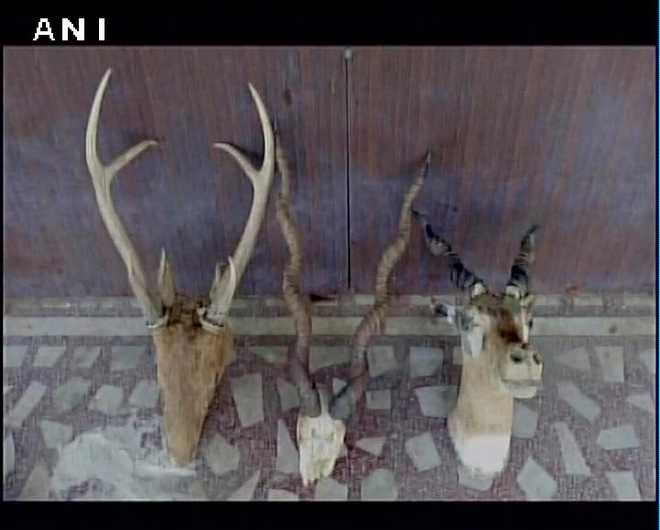
These deer heads were among the things seized from the retired Colonel’s house. ANI photo

Meerut, April 30

At least 117 kg nilgai meat, animal skin, ivory and 40 guns have been seized from the house of a retired Army officer here during a 17-hour-long joint raid conducted by the Directorate of Revenue Intelligence and the forest department.

(Follow The Tribune on Facebook; and Twitter @thetribunechd)

A team of DRI officials reached the Civil Lines residence of Colonel (retd) Devindra Kumar yesterday in the afternoon and the raid continued till 3:30 am.

Kumar’s son Prashant Bishnoi is a national-level shooter.

A DRI official said the raid was conducted in connection with a disproportionate assets case. Five skulls of deer, horns of sambar deer, antlers of antelopes and black bucks, animal skin and ivory were seized from a makeshift warehouse in Kumar’s residence.

Chief Conservator of Forests Mukesh Kumar said: “The meat of blue bull was seized from a refrigerator. A sample was taken and it will be sent to laboratory for testing”. Action will be taken against the retired army officer and Bishnoi under relevant provisions of the Wildlife Protection Act, 1972, though no case has been registered against them yet, he said. — PTI


Pakistan’s back in the Great Game

Washington’s disinterest and Beijing’s ascent are helping Islamabad gain ground in Afghanistan

The horrific suicide bomb attack in Kabul on May 31 that left 150 dead, and subsequent similar attacks at a funeral a few days later briefly brought Afghanistan back into the news. But only briefly since the British elections, the string of terrorists’ attacks in that country and general consternation with Trump’s antics and shenanigans meant that Afghanistan soon receded from public attention. This has meant that Pakistan’s game of gaining ‘strategic depth’ has gained substantial traction and the constitutional framework set in motion with the ouster of the Taliban in 2001 is in real danger of unravelling.

America’s failure to stabilise Afghanistan has led to a sense of fatigue about that country as reflected in the minuscule coverage of the terrible acts of terrorists’ violence that has grown unabated in recent years. America has also been distracted by its domestic political wrangling that marked the presidential election campaign, and has worsened with the coming into office of Donald Trump. This has allowed Pakistan to rearrange regional power equations quite dramatically, ably supported by China who brought in the Russians onto the same side. While the Islamic State Khorasan Province (ISKP) has made its appearance in the eastern Afghan province of Nangrahar, its influence and ability to launch terrorist strikes has been exaggerated to achieve this. American missteps and the Iranian tendency to adventurism has meant that over the past decade, Iran and the Taliban have become close tactical allies. The result is that despite stepped up terrorists attacks aimed at civilians, the Taliban is being presented by these countries as a moderate player that should have a key role in any peace process.

Russia has admitted to opening up lines of communications to the Taliban and even initiated a dialogue process along with China and Pakistan. The Afghan government strongly objected and had to be brought in along with regional stakeholders, India and Iran. Neither the US, the main military and economic player in Afghanistan, nor NATO were part of these talks. Russia took the stand that while violence was unacceptable, the Taliban were very much relevant players. Expectedly, the talks went nowhere; but helped build the case that it was the Taliban alone who held the veto over any attempted peace process.

The disputed elections of 2014 led to the US-backed uneasy coalition between President Ashraf Ghani and his challenger Dr. Abdullah Abdullah, who was given a new title, chief executive; but if anything, dissonance in governance has only enlarged. Initially Ghani made bold moves to placate Pakistan in the belief that it would lead to peace. What Afghanistan saw was increased violence, especially suicide attacks on civilians in crowded places leading to hundreds of causalities. The aim of damaging the credibility of the Afghan government by showing up its inability to protect its citizens was achieved very substantially. This has allowed Pakistan to emerge as the key interlocutor on behalf of the Taliban even as it continued to deny that it had anything to do with them. Exhaustion and distraction meant that the US and other western countries were happy to buy this fiction if it allowed them to quietly exit Afghanistan.

President Ghani’s failure to build a cohesive and inclusive government, or to establish working relations with parliament, whose term has incidentally expired, has meant that the Afghan government is internally hobbled and unable to deliver on good governance. The agreement that set up the National Unity Government with Abdullah in 2014 required that within two years the constitution would be amended to provide for a prime minister, has not happened. The largely non-Pashtun Jamiat from whose ranks Abdullah, foreign minister Rabbani and many more joined the government, has started speaking up as an opposition party. They led a big anti-government demonstration two days after the May 31 terrorist attacks leading to police firing with six dead including the son of the deputy speaker of the upper house of parliament. The next day, at his funeral, attended by Abdullah, Rabbani and others, three bombs went off killing nine persons. Jamiat leaders like Governor Atta of Balkh blamed persons within the government for the complicity in the May 31 bomb blast. And for the same reason, Rabbani boycotted his own government’s Kabul Peace Process presided over by President Ghani.

Trump’s effectively ceding leadership to China on many fronts has meant that Pakistan is emboldened enough to try and push the Afghan government hard enough for them to acknowledge that Pakistan would have de facto control over Afghan affairs, something it tried to do after 1989 Russian withdrawal. At present, the momentum seems to be favouring them as neither is the Afghan government united nor are the security forces in a condition to take the initiative back from the Taliban. If these trends are not reversed, Afghanistan could see increased violence that could potentially spill over its borders.


Grievance redressal camp for ex-servicemen, widows

Grievance redressal camp for ex-servicemen, widows
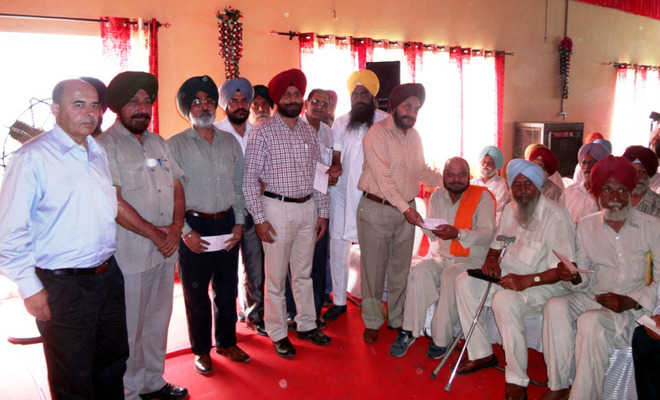
Director Defence Services, Brig Jatinder Singh Arora, distributes cheques among ex-servicemen during a camp at Raikot on Thursday. A Tribune Photograph

Our Correspondent

Raikot, May 11

A panel of office-bearers of the District Defence Services Office, Ludhiana, redressed problems of over 400 ex-servicemen and widows of defence personnel from various localities of the subdivision during a camp organised here today.Director, Defence Services, Brig Jatinder Singh Arora, presided over the function and district welfare officer, Lieut-Col (retd) Jasbir Singh Boparai, was the convener of the camp. The organisers distributed cheques to beneficiaries of various schemes being launched by the Union and the state governments for families of ex-servicemen from time to time.Illustrating modalities for availing welfare schemes for the defence personnel, the speakers including Brigadier Arora, Lieutenant Colonel Boparai, Wing Commander Gurpreet Singh Mangat, Major Bahadur Singh and Major Gurdeep Singh, said members of families of defence personnel and ex-servicemen should consult officials at the district defence welfare office in Ludhiana according to their convenience.The speakers highlighted salient features of various schemes and facilities being provided to families of ex-servicemen and defence personnel from time to time.Concessional supply of durable and consumable items, education for wards of ex-servicemen and reservation in various departments of the Union and state governments, were cited among special facilities.


Dilemma of a two-front war by Maj Gen Ashok K Mehta (retd)

Obsessed with Pakistan, India has grossly neglected the real adversary. In point-to-point skirmishes and standoffs, battle- hardened Indian soldiers will deter, if not defeat, the PLA. However, across a broad front spectrum in an unlikely all-out war, it is advantage China.
Dilemma of a two-front war
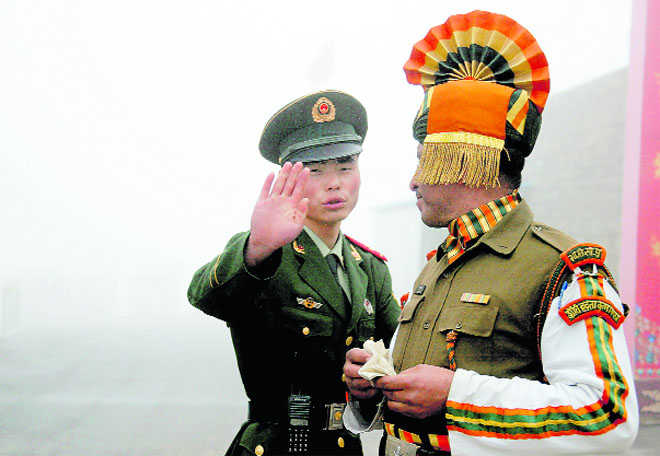
CHINA THREAT: This file photo taken on July 10, 2008, shows a Chinese soldier (L) next to an Indian soldier at the Nathu La border crossing between India and China in Sikkim. AFP

At a time when China is threatening to teach India another lesson and warning not to engage in a two-front conflict over the standoff in Doklam, our Service Chiefs, it seems, are not on the same page about fighting a two-front war especially as Beijing might try to emulate the New Delhi-Thimpu alliance in “disputed territory” with one with Islamabad in PoK. While General Bipin Rawat has more than once asserted the Army’s preparedness for a two-front war, Air Chief Marshal BS Dhanoa has highlighted the critical shortfall in the number of fighter squadrons — 32 against the required 42 squadrons — to dominate a two-front conflict, saying: “It is akin to a cricket team playing with seven players instead of 11”. The deficiency in air assets has existed for decades but this is the first time an Air Chief has related it to a two-front war. The Chief of Naval Staff, Sunil Lanba, when asked about the disparity in preparedness of the services, said: “The way national security is being handled is not commensurate with the security environment which is extremely serious at the moment”. Recently, Gen Rawat told a military audience that the military was not getting enough funds for modernisation — repeated ad nauseum by every Chief — due to the perception that expenditure on defence is a burden on the economy. This set the cat among the pigeons as Finance Minister Arun Jaitley, a regular fill-in for Defence Minister, is believed to have told Gen Rawat: “Don’t worry about funds. When you run out, call me”. In the mid-1990s, when the Naval Shipyard order books had gone dry, CNS, admiral Vijay Shekhawat went public about the Navy’s operational deficiencies, prompting Defence Minister Mulayam Singh Yadav to invite him to discuss dwindling fleet numbers. Ad hocism has become the hallmark of modernisation of the military.

Power differential

The Chinese are constantly reminding India about the power differential — military, economic and infrastructural — between them. Being obsessed with Pakistan, India has grossly neglected the real adversary. The reason for this is the institutionalised absence of strategic thinking and higher political direction of war and conflict in the face of growing threats and challenges to internal and external security. Prime Minister Modi’s boast about big  defence reforms is hollow: had he been serious about defence, he would have named a full-time Defence Minister. The appointment of a Chief of Defence Staff has not overcome the hesitation of history — read bureaucracy. The country has never produced a “Defence White Paper” or done a “Strategic Defence and Security” review. Something called the “Raksha Mantri’s Directive” masquerades as higher political direction on deterrence and war. This bit of literature drafted by the military has its origin in 1983, with periodic face-lifts to make it contemporary. The Parrikar doctrine covering surgical strikes was included in the Joint Military Doctrine, scripted by the Integrated Defence Staff, which attracted extraordinary flak from the defence community for being substandard. In its present organisation, each service essentially fights single-service combat. In the last border skirmish at Kargil, the Army’s operation was called Vijay while the IAF campaign in support was named Safed Saagar. So much for jointness.  So the Raksha Mantri’s Directive passes off as political guidance by the highest echelons of government. When I once asked a former Air Chief how he evolved his service’s span of responsibility, he replied: “Most of the time, from speeches made by the Prime Minister during the Combined Commanders’ Conferences.” Are we surprised that while President Xi Jinping who heads the Central Military Commission, has personally ordered and supervised the reorganisation of the combat formations facing India, reducing them from three commands to one command — a single Western Theatre Command headed by the powerful Gen Xhao Zongqi — the China front in India is managed by four Army and three Air commands deployed at seven locations. 

Integrated command

A forward-looking proposal made by a defence committee recommending three integrated operational commands — North, West and South instead of 17 single service commands — was shot out of hand by (no guesses) the Air Force. The CDS and accompanying Joint Staff ordered by the UK in 1984 was a fait accompli. It was introduced by a political class which understood defence and strategic security. In India, countless defence reforms are languishing for want of decision making. It is instructive to recall how the two-front strategy was formally enunciated in December 2009 by the Army Chief Gen Deepak Kapoor. It followed the 2008 Mumbai terrorist attack, after Prime Minister Manmohan Singh ordered the Service Chiefs to prepare for war. Defence Minister AK Antony then had “preparation for a two-front war” added in his Directive but did little to implement it. Both in 1965 and 1971 wars with Pakistan despite the collusive threat from China, there was no cross-border intervention by China though sizeable formations of the Eastern Command remained deployed against it and forces could not be switched to the west or east for fighting in East Pakistan in 1971. In a real two-front war, swing forces in east and west will not be able to reinforce either front and only dedicated formations will fight the war. Given the paucity in current force levels, inadequate sophistry of combat support and terrain and infrastructure handicaps, it will be an uphill task to match the PLA’s strength and versatility across a 3,488-km front of undefined borders. In point-to-point skirmishes and standoffs, battle-hardened Indian soldiers will deter if not defeat the PLA. Across a broad front spectrum in an unlikely all-out war, it is advantage China unless India is prepared to rethink its “no first use” nuclear doctrine. As an offset in the western front, Gen Rawat has suggested creating a two-front situation for Pakistan: either in Afghanistan or Iran. Doklam may go the 1986 Sumdorong Chu way; the 10-month-long standoff challenging the Chinese intrusion at Thandrong, west of Tawang over the interpretation of watershed, without a shot being fired. India need not invoke its doubtful capacity to fight a two-front war; instead, speedily augment its deterrence against China. This may not win votes for Modi but it will prevent Chinese pinpricks that he famously called “toothache”.The writer is the founder-member of the Defence Planning Staff.
Report offensive WhatsApp, FB posts, Army tells its staff Alarm over messages airing discontent over pay panel hike

Report offensive WhatsApp, FB posts, Army tells its staff
Barring the forces, all central employees have got 7th pay panel hike

Ajay Banerjee

Tribune News Service

New Delhi, April 28

Faced with criticism on social media, the Army has asked its personnel to report back any “vitriolic, abrasive or negative” posts against the force or its individuals.The message has been posted on internal website ‘Army wide area network’ (AWAN). Additional Director General Public Interface, a senior officer under the Military Intelligence wing stationed at South Block, New Delhi, has been listed as the person to be contacted. A WhatsApp number has also been provided where the “offensive” messages can be reported. Posted earlier this week, the message also provides an email-id — of the official Army web-server — and two Delhi-based MTNL landline numbers.Sources said posts on WhatsApp groups in recent weeks airing “discontent” over the pending 7th Central Pay Commission proved to be the trigger. These messages reportedly questioned the government as well as top brass of the three forces for their “failure” to sort out the matter, pending since September last year.Barring the forces, all central government employees have received hiked salaries. The forces had raised six objections, including disability pension, risk area allowance, increased pay and accordance of status, but the matter could not be resolved despite several meetings with the Ministry of Defence (MoD).Last week, the MoD approached the Supreme Court to contest a lower court’s verdict okaying the grant of non-functional upgrade hike in salary without getting promoted. This has been given to all central staff minus the forces. The moment the appeal was filed in the SC, messages started doing the rounds on WhatsApp groups naming “three officers who were behind the appeal”. 

J&K FOCUS Evolving Situation in J&K: Summer 2017 (Part I) by Lt Gen Ata Husnain

Since the turn of the millennium, most military experts have advised the Indian government and the Indian Army to view J&K related issues with a longer and wider perspective. The longer perspective is needed because the year-on-year review and concept does not lead to the desired strategic effect; and the wider perspective is required because all departments of government need to play a joint role without abdicating responsibility only to the Army. The advice has been taken in parts but a comprehensive long term strategy has somehow been elusive.

The coming together of the BJP-PDP alliance created hope since it could see more equitable balance between the Jammu and Kashmir regions with Ladakh also having its aspirations in line. However, since 2015, those hopes have been belied due to circumstances that prevented any fructification of efforts of the new alliance. The success of a political initiative is contingent on the stability of the security environment. That has remained elusive chiefly due to the avowed intent of the adversaries to disallow cementing of the political alliance and initiative; that intent has been avidly executed through the use of street power, terrorist operations and focused propaganda to lead to alienation. Thus the Indian strategy for the current season can only take a short term view because stabilisation of the security situation before anything long term is the key.  That means a greater focus on security, greater role for the Army and lesser scope for political initiatives.

This is the reason why there are few initiatives from the government despite pleadings by different delegations that have made way to the Valley. The age old dictum probably applies – one cannot begin looking for peace from a position of weakness as much as one cannot keep reminiscing about initiatives that have become history. So is the Indian position really weak from a security point of view and are the peace delegations being realistic at all? These are worthy issues to analyse as we head into the campaigning season of 2017.

Most analysts like to quote statistics to analyse the security situation but it is more the nature of incidents and how they have been handled that dictates the course of the security environment. North Kashmir has been quiet in the hinterland and infiltration attempts are taking place in some non-traditional areas; entirely expected. The Army should by now have strengthened the counter-infiltration grid for the summer. A surge in terrorist strength is the last thing that the security set up can currently afford; it will have a cascading effect.

It is Central and South Kashmir where the local flavor of terror has increased in content, the security forces have suffered attrition, and the J&K police has been targeted with a view to reduce its effectiveness through demotivation and thereby dilute the intelligence grid. The targeting of Lt Umar Fayaz, a Kashmiri officer on leave was designed to send an ominous message to those seeking to be part of the Indian system. An effective response to this has been the success of 14 young Kashmiris in the Civil Services examination, hundreds of them lining up at other recruitment centres despite separatists’ call, and the runaway success of the Army’s Super 40 coaching initiative for the entrance examination to IIT/JEE (being increased to Super 50).

Yet no one can miss the sullen silence in Kashmir’s youth. None reveal their minds but the parallel track to the turnout at recruitment rallies and skill development initiatives is also a grim reality. Losing sight of this would not help and therefore the security domain has to research sufficiently to ascertain the real factors that drive alienation so vehemently. While many have taken to the streets to demonstrate this alienation, there are others who nurse a grudge and do not display it. The Army’s outreach has always been very cordial but the real challenge for it today is with regard to recapturing the old relationship while also being strong against those who treat law and order with disdain, support flash mobs at encounter sites or target detachments of security forces as it happened in the Major Nitin Leetul Gogoi affair.

Apt to mention here that a major lesson emerging for a military mind observing South Kashmir over a period of time is the fact that the Army withdrew prematurely after a tenuous stabilisation, without going the full way. It treated military resources in the south as a bank to draw from and hence the imbalance today. The space in the Kulgam-Shupiyan belt was lost due to declaration of premature victory. It needs immediate reoccupation. As and when Kulgam had a Rashtriya Rifles headquarters the area was always more secure. The maximum gravitation of the approximately 100 local youth who have taken to militancy is to this area.

With no remorse for targeting of locals who have joined the Indian system, there appears a change in the ethics in the militancy too. That is worrisome because Amarnath Yatra, the iconic pilgrimage, will commence within a few weeks. Its security will be of paramount importance. There are rogue elements across the borders that would not stop at anything to see the targeting of India and Indians.

This commentary is Part 1 of the two-part analysis on the evolving situation in Kashmir.


Attari post gets modern surveillance equipment

AMRITSAR: After the central government’s failure to install fullbody truck scanners at the Attari Integrated Check Post (ICP) even five years after the proposal was mooted, the customs authorities have acquired modern hand-held detectors for identification of narcotics and explosives traces.

COURTESY: LASER­DETECT.COMThe I­scan equipment, which has the ability to detect traces of explosives and narcotics.

Imported from Israel, one of the equipment called I-scan will be utilised to check the baggage of Samjhauta Express passengers as well as goods trains from Pakistan. “I-scan, which is capable of detecting traces of explosives and narcotics, will come in handy for checking both trucks and scanning baggage of the passengers,” says a customs official, on the condition of anonymity.

The official further added that the testing of I-scans is currently going on and the gadget will be put to use within a week’s time.

Along with three I-scans, which cost around ₹30 lakh, the customs authorities have also bought another device called video boroscope, which will help in checking cavities in the trucks.

The department says it has acquired four video boroscopes.

TRUCK SCANNERS STILL MISSING

The authorities have failed to set up the much hyped full-body truck scanners at the Integrated Check Post (ICP), which was inaugurated to facilitate trade between India and Pakistan in 2012.


More troops for Darjeeling

More troops for Darjeeling
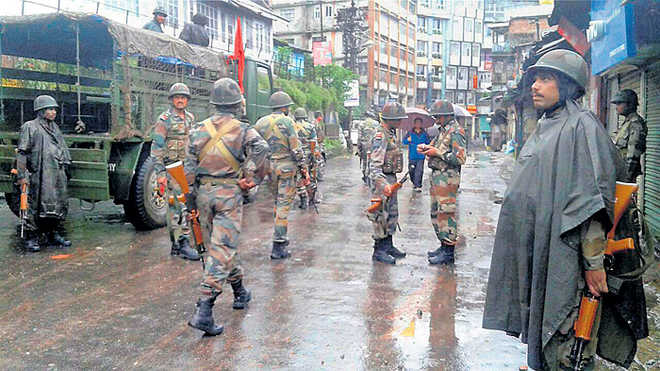
Army men patrol Darjeeling town. An additional column of the Army has been deployed at Kalimpong. PTI

Kolkata, July 10

An additional column of the Army was today deployed in the troubled Darjeeling Hills of West Bengal, taking the number of Army columns in the hills to three.While one Army column each was deployed on Saturday at Darjeeling and Sonada, troops were today deployed at Kalimpong to prevent arson by agitators.Protesters want Gorkhaland, a separate state to be carved out of West Bengal consisting of areas falling in the erstwhile Darjeeling district (split into Darjeeling and Kalimpong districts in February this year). Responding to a call by the Gorkha Janmukti Morcha (GJM), which is spearheading the movement, indefinite bandh is being observed in the hills since June 12 to press for the demand.The GJM-led coordination committee of hill-based political parties was supposed to meet on July 18 to take a fresh call on the continuance of the agitation. However, for reasons best known to the GJM leadership, the meeting of the coordination committee will  be held tomorrow.This has triggered speculation that the GJM may withdraw the indefinite strike and hold talks. At least five civilians have lost their lives till now in the agitation, the government property worth several crore has been destroyed by protesters who have been setting fire to government establishments. — TNS