


















Sanjha Morcha

What’s New

Click the heading to open detailed news

Current Events :

web counter

Print Media Reproduced Defence Related News

‘Wall of heroes’ set up at Central varsity

Jammu, July 28

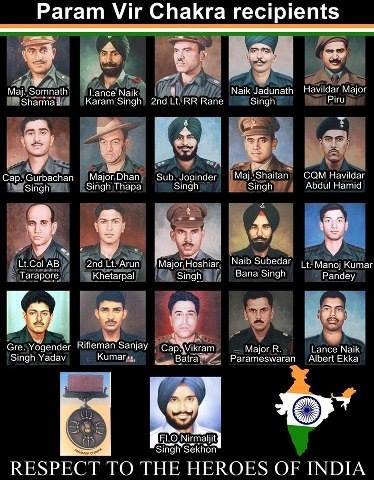
The Central University of Jammu (CUJ) has inaugurated a ‘wall of heroes’, displaying photographs of Param Vir Chakra recipients, as part of the Union HRD Ministry’s ‘Vidya Veerta Abhiyan’.The event has been organised by the National Service Scheme (NSS) of the CUJ in collaboration with the 26 Infantry Division, Jammu.The wall which is titled as “Our Heroes” was inaugurated by Prof Ashok Aima, CUJ Vice Chancellor, and Maj Gen SK Sharma, YSM GOC of 26 Infantry Division, at a function held on the campus to commemorate Vijay Diwas.In his address, Prof Ashok Aima emphasised the valour and sacrifices of soldiers during war and how it is important for students to realise its value. He said the university would constantly interact with the Army and security forces for exchange of knowledge and values.He also directed the National Service Scheme (NSS) to chart out a programme where the university could constructively engage with the war veterans and ‘veer naris’.While delivering the keynote address, Maj Gen SK Sharma highlighted that war was not just the business of the Army or other forces, it was the collective effort of a nation to defend its core values and interests.More than 15 war veterans from various units who fought in Tiger Hills and Tololing and five ‘veer naris’ were felicitated by the Vice Chancellor and the GOC. — TNS


Sikkim standoff: India ‘trampled’ on Panchsheel pact, says China

Sikkim standoff: India ‘trampled’ on Panchsheel pact, says China
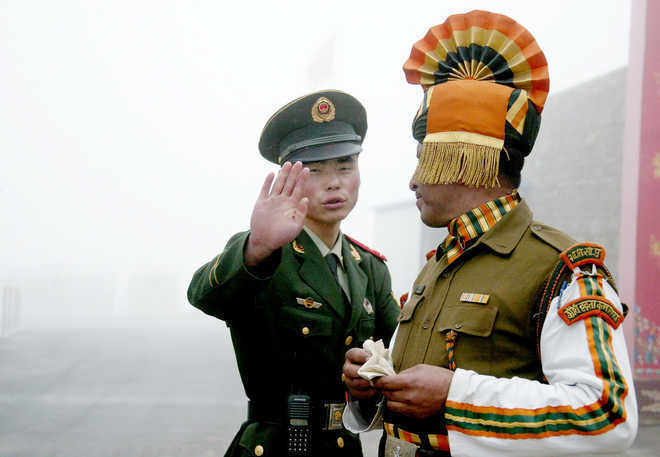
Indian soldiers showing a banner, asking Chinese troops to withdraw. Photo for representational purpose only. Tribune file

Beijing, July 5

Upping the ante on the Sikkim standoff, China on Wednesday accused India of “trampling” on the Panchsheel principles and asked New Delhi to “correct its mistakes” as soon as possible by pulling back troops.

(Follow The Tribune on Facebook; and Twitter @thetribunechd)

China also claimed that India was “misleading the public” by saying that Chinese troops are building a road close to the Chicken’s Neck in the Sikkim sector which could endanger India’s access to its north-eastern states.

“I want to point that the relevant actions by the Indian side violated the purposes and principles of the UN Charter in defiance of the international law and international norms. As we all know, in the 1950s, China, India and Myanmar proposed the five principles (Panchsheel) of co-existence,” Chinese Foreign Ministry spokesman Gen Shuang told reporters here.

“However to the surprise of everyone, the Indian side trampled on the basic norms governing the international relations proposed by itself by illegally crossing into other country’s territory,” he said.

The Five Principles of Peaceful Coexistence, known as the Panchsheel, are a series of principles which have formed the bedrock of the relationship between India and China. Their first formal codification in treaty form was in an agreement between China and India in 1954.

Geng said this time the Indian troops crossed the delineated boundary into the Chinese side and nature of the incident was “very serious”.

“China and India have been in contact through the Special Representatives mechanism to solve the boundary question but this incident, I believe, violates the spirit upheld by the Special Representatives mechanism and goes in contrast to the efforts made by the two countries,” he said.

China has already lodged a protest with India on this, Geng said.

“Indian border troops are still staying on the Chinese territory,” he said.

The situation is yet to be resolved and “India should pull back the troops that is precondition to avoid worsening of the situation”, Geng said.

“Troops should be pulled back as soon as possible to demonstrate the sincerity to improve bilateral ties so as create conditions for the normal development of bilateral relations,” he said.

“If the Indian side refuses to correct its mistakes in a timely fashion, how it proposes to win the trust of its neighbours and how it is supposed to play a bigger role in the international affairs,” he said.

“We once again urge the Indian side to abide by the boundary convention and respect the Chinese sovereignty and immediately withdraw the border troops and properly deal with the incident in a timely fashion,” Geng said.

The Chinese Foreign Ministry spokesperson claimed that the incident has nothing to do with the tri-junction between China, India and Bhutan.

“In disregard of the 1890 Sino-Britain convention, the Indian side said that Doklam is located within the tri- junction of the three countries, that is misleading the public,” he said.

“The 1890 convention said that the Sikkim section of the boundary commences from East mountain and the incident (of road building) took place about 2,000 metres away from Mount Gipmochi,” Geng asserted.

The Indian side is actually “misleading the public” by saying that the incident took place at the tri-junction point, Geng said, defending China’s road building which India and Bhutan have objected to.

India has expressed concern over the road-building, apprehending that it may allow Chinese troops to cut India’s access to its northeastern states.

Geng also said that besides former Prime Minister Jawaharlal Nehru endorsing the 1890 Sino-British convention on Sikkim in a letter to his Chinese counterpart Zhou Enlai in 1959, the Indian Embassy in a note to the Chinese government in February, 1960, also endorsed it.

“The note said that the boundary between Sikkim and China’s Tibet has already been delineated and there is no dispute about that in the map and in practice,” he said.

Quoting the note, Geng said, “The Indian government would like to add one more thing that the boundary has already been demarcated as well on the ground.”

“The above mentioned was written in black and white in the note from India,” Geng said.

Asked about Nehru, in his letter to Zhou, pointing out that Chinese maps showed Bhutanese territory as part of Chin, Geng said, “there is no such consent as you mentioned”.

The former prime minister had pointed out to China that it was claiming sizable part of Bhutan’s territory.

“It is not clear to us what exactly is the implication of your statement that the boundaries of Sikkim and Bhutan do not fall within the scope of the present discussion,” Nehru wrote in the letter to Zhou.

“In fact, Chinese maps show sizable areas of Bhutan as part of Tibet,” Nehru had said.

Geng said, “Since the illegal trespass of the border troops, both sides have expressed stern position. The fact is that the Sikkim section of the China India boundary has already been delineated.”

Since India’s Independence, the Indian government has repeatedly affirmed the fact that the Sikkim section has been delineated by this convention, he said.

Geng’s remarks come a day after, in unusually blunt remarks, China’s Ambassador to India Luo Zhaohui said “the ball is in India’s court” and it was for the Indian government to decide what options could be on the table to resolve the standoff.

Asked about remarks by official Chinese media and think- tanks that the conflict can lead to a “war” if not handled properly, the ambassador had said ,”There has been talk about this option, that option. It is up to your government policy (whether to exercise military option).”

Asked about Prime Minister Narendra Modi’s comments that not a bullet has been fired at the India-China boundary for two decades, Geng said, “I want to point settlement of the boundary serves the fundamental interests of the two sides.” “It is also a strategic target, two sides are working to achieve. We have been trying to explore ways to resolve the boundary question with in the Special Representatives mechanism and we have jointly taken measure to maintain peace and tranquillity in the border areas,” Geng said.

“What is shocking is that the India border troops entered into the Chinese side of the delineated border in the Sikkim section which is serious in nature,” he said. PTI


clip

clip

clip

clip

clip


Military muscle, and cutting flab by LT GEN NS BRAR (RETD)

LT GEN NS BRAR (RETD) MILITARY FARMS, POSTAL SERVICES AND BASE WORKSHOPS ARE ALL PREDOMINANTLY, IF NOT ENTIRELY, MANNED BY CIVILIAN NON-­COMBATANTS WHO CANNOT BE ASSIGNED COMBAT ROLES

The announcement of redeploying 57,000 personnel for combat duties as recommended by the Shekatkar Committee — which was tasked “to ensure India’s combat capabilities and potential are enhanced, with a better teeth-to-tail combat ratio, and to re-balance the overall defence expenditure in view of the escalating salary and pension bills” — is said to be farreaching. The Prime Minister had wanted the military to be “agile, mobile and driven by technology”. As conveyed publicly, it was to cut the “flab”. While the objective is laudable, and desirable, the approach may not produce any tangible results.

The entities being addressed — military farms, postal services and base workshops — are all predominantly, if not entirely, manned by civilian non-combatants who cannot be assigned combat roles. The saving on their establishment costs would need to be redirected towards meeting the outsourcing costs, because such services cannot be dispensed with. Undoubtedly, the military farms would release substantial land which, having been engulfed by urbanisation, constitutes prime real estate. As to how this land will be handled and utilised is another matter.

Military force structuring and budgetary allocation are centred on two yardsticks: ‘Teeth to Tail Ratio’ and ‘Revenue to Capital Expenditure’. National security is ultimately a question of evaluating security threats and national interests, and deciding on capabilities to meet or secure them. Capabilities in turn mean expenditure. The first must take the shape of a ‘Strategic Defence Review’ and define our military capabilities to be created and maintained. As this is over the long term, corresponding long-term budgetary commitments have also to be stated. In our context, we are unique in never having formally articulated our security concerns and how we intend to address them. The unilateral cut in the induction of Rafale fighters and putting on hold and then scaling down the raising of the mountain strike corps — both requirements originally arrived at after a decade of debate — are symptomatic of the absence of such an approach.

Stephen Cohen, an authority on South East Asia and the Indian Armed Forces, sums it up in his book, ‘Arming Without Aiming’.

WHAT NEEDS PRUNING

Teeth to Tail Ratio is generally perceived to be the ratio of combatants to support personnel. Besides the uniformed support services, the vast manpower embedded in the defence support establishments — Defence Research and Development Organisation, Director General of Defence Estates, Director General of Quality Assurance, Ordnance Factory Board, ordnance factories, defence public sector undertakings and so on – all forming part of the defence expenditure — need to be taken into account. This ‘tail’ too needs major pruning and restructuring. Interestingly, defence civilians account for 40% of the defence pension budget. The recommendations of the committee on these structures is unlikely to see implementation.

In our context, the army is invariably seen as a manpower-heavy organisation fit for cutting ‘flab’ and therefore defence revenue expenditure. It is not well appreciated that our security commitments, emanating primarily from unsettled borders, and the role of the army are manpower-intensive. This will only increase post-Doklam.

Given the requirement of maintaining a young age profile of the forces, and consequent retirement of a large proportion between 35 and 45 years of age, one of the repeated recommendations which could affect substantial savings is inducting this manpower laterally into the central police organisations such as BSF, CRPF and SSB. This would provide trained manpower and defer the military pension commitment for 15-25 years as also cut the overall pension commitment. This forms part of the committee recommendations.

IN LIGHT OF THE CUT

The perceived imbalance in the other area related to revenue-vs-capital expenditure is due to our overall allotment for defence declining in real terms over the years and the corresponding expenditure on maintenance (pay, pension, fuel) progressively increasing. The defence budget this year is the lowest in GDP terms since 1962. The ratio of revenue to capital expenditure thus appears disproportionate. The Kargil operation with the army chief stating, “We will fight with what we have,” said it all.

The decade of the 1980s saw the highest defence expenditure as a percentage of GDP. With no systematic acquisitions and replacements for the next three decades, the balloon of equipment turning obsolete and requiring substantial capital expenditure stares us in the face today. Depleting fighter strength of the air force and submarines of the navy are publically acknowledged. Shortages in ammunition and war-like stores leading to “hollowness” in war wastage reserves in the armed forces are revenue expenditures adding to the perception of excessive demands for revenue expenditure. Rationalising the classification of expenditure heads would perhaps give a truer picture of defence expenditure.

This committee is not the first and certainly not the last. All have recommended major structural changes and refining budgetary approach to spending on defence.

Needless to say, their implementation has been half-hearted and selective, if at all. Incremental tinkering is unlikely to make it “agile, mobile and driven by technology”. That will require political will.


PUNJAB NEWS :::09 MAY 2017

2 pvt producers got Rs 900 cr for no generation of power

Ruchika M. Khanna

Tribune News Service

Chandigarh, May 8

Two private power producers in Punjab were paid an estimated Rs 900 crore during 2016-17 as fixed charges and not for generating electricity, a technical audit has revealed.Twelve other power-generation plants — owned by the National Thermal Power Corporation and National Hydro Power Corporation — got Rs 600 crore as fixed charges for non-purchase of power during the time these were ready to generate at optimum capacity.(Follow The Tribune on Facebook; and Twitter @thetribunechd)The fixed charges paid to the 14 companies form the basis of the technical audit of all power purchase agreements (PPAs) signed by the cash-strapped Punjab State Power Corporation Limited (PSPCL) on behalf of the Punjab Government.Power Minister Rana Gurjit Singh, after assuming office, had said that he wanted to review all power purchase agreements by the previous SAD-BJP government. The Capt Amarinder government said the review should be carried out within four months.A preliminary examination of PPAs revealed that the fixed cost paid to Nabha Power Limited was Rs 1.44 per unit of power not bought by the state, and Talwandi Sabo Power Limited Rs 1.20. In comparison, most public sector plants supplying power to Punjab were getting 50 paise to Re 1 per unit as fixed cost, barring one or two, where the fixed cost was as high as Rs 1.46 (from the gas-based plant).The penalty clause in these PPAs will also be examined in the audit.

No jeans, tops for women teachers in Punjab

Order says bright suits, fashionable dresses ‘excite’ school kids; regular checks mus

maninder Pal

Tribune News Service

Chandigarh, May 8

Diktats on what to eat or wear, especially in case of women, may sound medieval. But the Punjab Education Department, incidentally headed by a woman Cabinet minister, has done just that by issuing an order stating “jeans, tops, bhadkeela pehrawa (bright suits) and fashionable dresses” worn by women teachers in government schools “excite” students and have a bad influence on them.(Follow The Tribune on Facebook; and Twitter @thetribunechd)Laced with vocabulary reflecting patriarchal mindset and “specifically” addressing dressing culture of women employees, who constitute more than half of the employment base of the department, the order directs all district officials to conduct regular checks in schools to ensure no woman teacher wears such clothes.“We are receiving complaints that teachers in government schools, especially female teachers, are delivering their duties while sporting bhadkeela pehrawa. Some lady teachers wear jeans, tops and other many more exciting fashionable dresses during their duty hours. This affects students,” reads the circular issued to all Circle Education Officers and District Education Officers of the state.Teachers termed it a “Talibani farmaan” (Taliban decree) that was “reactionary” and “immature” in nature.A report on whether the dress code is being followed in schools or not is to be regularly submitted to the office of Director, Education (Senior Secondary).“As it affects students, dress code should be implemented. Regular checks should be conducted to ensure it is being followed,” reads the order.

Will withdraw letter: GovtLetter has been issued without my nod and knowledge. We will withdraw it —SS Kahlon, Director Public Instructions Such vocabulary should not be used. This letter’s been issued with reference to old order of 2012. We’ve summoned officials who issued letter. —TPS Sidhu, Joint Secy, Education Reactionary, immature: TeachersNot only unnecessary and immature, this order is reactionary in nature and reflects patriarchal mindset of those sitting in high offices. It reflects authorities’ immaturity pertaining to gender issues— Surjeet Singh of Government Teachers’ Union, Punjab

SGPC honours Capt at Golden Temple

Sikh body had denied him siropa in 2002 during his previous tenure as Chief Minister

GS Paul

Tribune News Service

Amritsar, May 8

The Shiromani Gurdwara Parbandhak Committee (SGPC) honoured Capt Amarinder Singh here today during his maiden visit to the Golden Temple after taking charge as the Chief Minister, 15 years after it had denied him a siropa (robe of honour) during his previous tenure as the CM.Kirpal Singh Badungar was heading the Sikh body in 2002 as well. Former SGPC presidents Bibi Jagir Kaur and Gurcharan Singh Tohra had condemned the then management for snubbing the CM.Badungar was not present today due to health reasons, according to SGPC chief secretary Harcharan Singh. The SGPC chief had recently said that Capt Amarinder would be welcomed at the shrine.The CM reached the Golden Temple at 7.15 am. Despite his foot injury, he completed a round of the parikrama and offered prayers at the sanctum sanctorum.He was honoured with a siropa by the shrine’s head priest, Jagtar Singh. Thereafter, he was presented with a siropa, a shawl, Golden Temple’s framed picture and a set of religious books by the shrine’s manager, Sulakhan Singh, in the presence of Harcharan Singh and SGPC secretary Dr Roop Singh.Later, the CM paid tributes to the martyrs at Jallianwala Bagh. He was accompanied by PPCC chief Sunil Jakhar; Cabinet ministers Navjot Singh Sidhu, Manpreet Singh Badal and Rana Gurjit Singh; local MP Gurjit Singh Aujla; Congress MLAs Sunil Dutti and Inderbir Singh Bolaria; and party leaders Jasbir Dimpa and Dinesh Bassi.He also paid obeisance at the Durgiana Mandir and Ram Tirath Sthal before leaving for Hoshiarpur.Khalsa College suicide: CM promises justiceAmritsar: Capt Amarinder Singh on Sunday met Khalsa College students who had locked horns with the management over the suicide by a student, Harpreet Singh. The CM directed Principal Secretary (Higher Education) Anurag Verma to probe the incident and ascertain the management’s role. He assured Harpreet’s father Yadwinder Singh that anyone found guilty of abetment to suicide would be punished. The CM said the police had formed an SIT to investigate the case. In a letter to the CM, Yadwinder sought Rs 50-lakh compensation and a job for his younger son. The letter was also signed by gram panchayat members and residents of Harpreet’s village, Gumti Kalan. An FIR has already been filed against the college principal, registrar and head of its agriculture department. Harpreet’s attendance at college had been low as he was attending coaching classes with the aim of getting admission in the MSc course in another institution. TNS

‘Non-VIP’ minister

  • Finance Minister Manpreet Singh Badal stood in the queue for ordinary devotees before entering the sanctum sanctorum, whereas the CM and his other Cabinet colleagues preferred to take the VVIP passage to pay obeisance at the Golden Temple.

Denied honour in 2002, Amarinder given ‘siropa’ inside Golden Temple CM promises fair real estate policy

It was Capt’s first visit to the shrine after becoming Punjab CM

SAYS WILL ALSO EXAMINE WHAT STEPS CAN BE ‘LEGALLY’ TAKEN TO HELP HOTELIERS HIT BY SUPREME COURT’S LIQUOR BAN ALONG HIGHWAYS

AMRITSAR : Contrary to its 2002 stand, the Shiromani Gurdwara Parbandhak Committee (SGPC) on Monday honoured Punjab chief minister Captain Amarinder Singh with a ‘siropa’ (robe of honour) at the Golden Temple here on Monday.

HT PHOTOChief minister Capt Amarinder Singh also visited Durgiana Temple in Amritsar on Monday.

The chief minister, who reached the Golden Temple early in the morning, did a ‘parikrama’ of the holy shrine before offering prayers at the sanctum sanctorum, where head granthi Giani Jagtar Singh presented him the ‘siropa’. Later, the SGPC executive members and office-bearers also honoured him inside the information office.

However, SGPC chief Kirpal Singh Badungar remained absent due to health issues, said the sources. SGPC chief secretary Harcharan Singh was though present throughout.

Amarinder was denied the ‘siropa’ during his visit to the shrine after becoming the chief minister in 2002, which had evoked a sharp reaction. Though the SGPC honoured him with the ‘siropa’ in 2004, but it was not inside the sanctum sanctorum. This time, when Amarinder became the chief minister, SGPC chief Kirpal Badungar had announced beforehand that the CM will be given ‘siropa’ when he visits the Golden Temple.

CM SEEKS BLESSINGS

From the Golden Temple, Amarinder went to Jallianwala Bagh and then to the Durgiana Mandir. The CM and his colleagues later visited Sri Ram Tirath Sthal to offer prayers before leaving for Hoshiarpur, to inaugurate a new tractor manufacturing facility.

In statement, Amarinder said it was a gratifying experience for him to visit the holy shrines, “which are a fountainhead of peace for millions of people from around the world”.

He said he and his colleagues wished to express their gratitude to God for their victory in the recent Punjab assembly elections. He said they had come to these temples to pray for the state, and its peace and development.

Among those who accompanied him were the newly appointed state Congress chief Sunil Jakhar, Amritsar MP Gurjit Singh Aujla, cabinet ministers Manpreet Singh Badal, Rana Gurjit Singh, Navjot Singh Sidhu and Sadhu Singh Dharmsot. MLAs of Amritsar district and Jalandhar Cantt legislator Pargat Singh were also present. HOSHIARPUR: Chief minister Captain Amarinder Singh on Monday said the new real estate policy in the state would be made in consultation with all stakeholders, promising a fair play to hotel associations and property dealers here.

The CM was presented a memorandum by the two associations on Monday in which they kept their demands regarding the formulation of new real estate policy. Amarinder said he would examine what steps his government could “legally” take to help the hotel industry recover from the “adverse impact” of the Supreme Court ban on sale of liquor along the highways.

INAUGURATES TRACTOR PRODUCTION FACILITY

The CM also inaugurated a new state-of-the-art tractor production facility of International Tractors Limited (ITL), describing it as a major asset for the state’s progress. Rolling out the first tractor, the CM termed the new plant as a major achievement for Punjab, which was heavily dependent on agriculture for its growth and development. The ITL claimed that the new facility was world’s largest integrated tractor plant, with a total capacity of 3 lakh tractors annually.

Inspecting the plant, the CM said that the high-end tractors being manufactured at the plant under the brand name of Sonalika would be beneficial to the state’s farmers, who needed modern equipment to improve their crop yield and quality.

The inaugural event was attended by the top management of the company, including chairman LD Mittal, vice-chairman Amrit Sagar Mittal and managing director Deepak Mittal.

On the occasion, the management presented a cheque for ₹1.01 crore for the Chief Minister’s Relief Fund. They also presented a tractor to the CM who gifted the same to Citrus Estate in Chhauni village, which he had visited earlier in the day.

To mark the CM’s visit, ITL announced the adoption of Chhauni Kalan to transform in a world-class village.

Ensure security of Sikhs in US, CM tells Centre

Chandigarh, May 8

Concerned over the spurt in attacks on Indians, including Sikhs, abroad, Chief Minister Captain Amarinder Singh has urged the Centre to ensure their protection and take up such issues in “right earnest”.Amarinder had raised concern over the recent killing of a Kapurthala man, Jagjeet Singh (32), in the US in a suspected hate crime case.He was stabbed to death by an unidentified person allegedly over cigarettes outside a grocery store in California.In response to the CM’s tweet, External Affairs Minister Sushma Swaraj said she had spoken to the Indian Ambassador in Washington, Navtej Singh Sarna, on the issue.Raveen Thukral, media adviser to CM, said Amarinder was concerned over the recent spurt in hate crimes against Indians, mainly Sikhs, in the US and other parts of the world.The CM has said the US alone had witnessed several such attacks on Sikhs, who have been at the receiving end of the growing bigotry in the country and demanded immediate steps to ensure their protection. The Centre, he said, needed to adopt a more proactive stance to put pressure on the US to crack down on racist elements and provide fool-proof protection to the Sikh community. — PTI

Need-based changes in Cong unit on cards

Need-based changes in Cong unit on cards
Sunil Jakhar

Tribune News Service

Chandigarh, May 8

Punjab Pradesh Congress Committee (PPCC) chief Sunil Jakhar today hinted at rationalising the state body, wherever required.He will formally take over as the state Congress chief at the PPCC office here on May 10. Chief Minister Capt Amarinder Singh, Punjab affairs in-charge Asha Kumari and Congress secretary Harish Chaudhary would be present.A former Congress Legislative Party (CLP) leader and three-time MLA from Abohar, Jakhar will replace Capt Amarinder as the PPCC chief. Capt Amarinder had resigned from the post during a meeting with Congress vice-president Rahul Gandhi on April 12.Jakhar said the present PPCC team appointed by Capt Amarinder had done extremely well. “As some of the leaders have been become ministers or have been given other responsibilities in the government, some changes may be required.”On his agenda would be to share information on the foodgrain scam, scam in setting up of private thermal plants and other matters raised by him in the run-up to the Assembly elections. “The government is already on the job and I will be sharing the information as and when required,” Jakhar added.

Chandigarh-based doctor adopts martyr’s daughter

Tribune News Service

Amritsar, May 8

MP Gurjeet Singh Aujla along with Dr Gurmohan Singh (a Chandigarh-based nephrologist) and Jaspal Singh Sandhu, a local businessman, and others visited the family of Naib Subedar Paramjit Singh, who was killed by the Pakistani army along the Line of Control in the Poonch Sector.Motivated by Aujla, Dr Gurmohan has adopted the martyr’s elder daughter, Simrandeep Kaur, and offered to bear the expenditure of her education and marriage.The Deputy Commissioner of Kullu and his wife have already adopted the younger daughter, Khushdeep Kaur. Talking about his inspiration, Dr Gurmohan Singh said he had seen a dream 33 years ago in 1984 that he should adopt the families of soldiers and policemen who were in killed in trains and at the railway station, but it didn’t materialise due to lack of funds and other issues. He had earlier adopted a Dalit girl in Chandigarh. He offered to sponsor the study of Simrandeep Kaur in the best school in Chandigarh, Amritsar or any other school of the family’s choice. He also proposed to open a bank account in the name of Simarndeep and deposit the first instalment to meet her expenses.Speaking on the occasion, Aujla said that Paramjit would be remembered alongwith those who laid down their lives for the country and it is an honour for them to do something for the family. He said the bravehearts of their nation were standing shoulder to shoulder with the armed personnel of India.Dr Gurmohan Singh said Naib Subedar Paramjit Singh laid down his life for the nation and it was their duty to help his dependents.

70 yrs on, holy city holds on to its British legacy

HOUGH RECHRISTENED AFTER INDEPENDENCE, MANY ROADS, OTHER PLACES STILL KNOWN BY THEIR COLONIAL NAMES

AMRITSAR: Even as the British rulers left the country around 70 years ago, their legacy still survives, especially in the holy city.HTHall Gate, built in 1873 and named after the then deputy commissioner CH Hall, was renamed Gandhi Gate after Independence. In view of the original name’s popularity, the Punjab tourism department has mentioned it on signboards on both sides of the gate.

Although various places, predominantly roads, were given Indian names by the administration subsequently, these remain only on paper. In practice, the original names given by the British rulers remain popular among locals and tourists alike.

On entering the walled city from the west side, there is a famous gate that was constructed in 1873. The gurbani slogan ‘Amritsar Sifti Da Ghar’ (Amritsar is a home of values) is installed atop it. The gate is famous as Hall Gate after the then deputy commissioner CH Hall. Even as it was rechristened Gandhi Gate after independence and the new name can be seen written on it, the old name persists.

In view of its popularity, the Punjab tourism department has in fact mentioned the old name on boards on both its sides. Even the famous market situated along the stretch between this gate and the historic Town Hall building is popular as Hall Bazaar.

The Civil Lines, one of the posh localities of the city, was developed by the British officers on the north side of the old city. Lawrence Road constructed near the historic Ram Bagh garden in 1870 was named after the British official John Lawrence. The officers used this road to commute, and Indians were not allowed to reside near it. However, the legendary Punjabi poet Bhai Vir Singh, who belonged to an affluent family, managed to build his house on this road. In view of his contributions, the civic body renamed this road after him, but only on paper. The signboards still call it Lawrence Road.

The road connecting the Sadar police station to the cantonment area was named after the then finance commissioner FC Mcleod in 1853. Although the administration renamed it after Pundit Lal Chand Changotra, people are oblivious to this fact. The same has been the fate of Queens Road and Cooper Road (both between Bhandari Bridge and the district courts), Mall Road (Novelty Chowk to Court Chowk), Taylor Road (connecting Mall Road to Court Road), and Albert Road (between the railway station and Mall Road).

QUEEN VICTORIA TRUMPS MAHARAJA RANJIT SINGH

The Ram Bagh garden, developed by Sikh ruler Maharaja Ranjit Singh in the memory of Guru Ram Das, founder of the holy city, was renamed Company Bagh by the British administration. Even today, this new name remains popular.

In 1887, the colonial rulers installed a statue of Queen Victoria on the chowk situated on the way to the Golden Temple near the Dharam Singh market. Both the chowk and the market were rechristened after her. Later, the Queen’s statue was removed, and recently the Punjab government installed a huge statue of Maharaja Ranjit Singh here. The locals, however, still call it by the colonial name, which as the names of other places has been passed down from one generation to the other since 1947.


The Hundred Kills Syndrome Can Only Be A Contributary Factor Towards Peace In Kashmir: More Is Needed In Other Domains Tooby Lt Gen Ata Husnain

IMG-20170304-WA0044
SNAPSHOT

The combination of military effectiveness and public introspection needs to be taken to the next level through effective harnessing of soft power.

The situation perhaps is ripe for it but are there enough takers to undertake the challenge with sensitivity and an eye on the future.

The Security Forces (SF) have reached a landmark achievement in 2017 which is being touted around a bit. They have eliminated a hundred hardcore terrorists in this calendar year, in less than seven months thus far. A fine military achievement that no one can contest. A round of appreciation is needed as especially in the last few weeks there have been successful encounters almost every day and the fatal casualty ratio between terrorists killed and SF personnel martyred has been showing constant improvement after the abysmal level to which it had sunk in February this year.

For those who may be excited by numbers, it is not my intent to dampen their enthusiasm, but wish to inform them that just in South Kashmir in 1999 the Army’s Victor Force of the Rashtriya Rifles (RR) was killing on an average 35-40 terrorists a month. Yet, it is as challenging today as it was then and you can take that as authentic since I was then controlling operations in South Kashmir. When I examine the environment in the same area of responsibility today, I find the General Officer Commanding, his commanders, officers and men perhaps have an even more daunting task with lesser strength of terrorists but perhaps more challenges than even we then had.

Before any analysis of the reasons for this success, it needs to be emphasised that any pragmatic analyst of conflict will advise the SF two things. First, there are miles to go before they sleep. For no fault of theirs the situation had drifted and alienation enhanced. They have to be conscious that military hard power’s achievements in the form of enhanced terrorists killed must create the conditions for the return of soft power as the means to stabilise and resolve conflict; the achievements also enhance resistance by the unarmed anti-national elements.

Second, the SF need to be mindful of the fact that wily minds across the Line of Control (LoC) are already working on creating a surge in terrorist ranks; space created by military achievement can quickly roll back. The only positive I can deduce at this stage of the analysis is that we have all the means available to prevent such a surge, and we should never shy away from employing additional forces and concepts to maintain military dominance. Military dominance is a term always likely to be misconstrued as the negative employment of hard power. That mistake must never be made.

In the same breath about mentioning success, the SF needs to be sensitive to the failure or relative failure to prevent the tragedy of the attack on the innocent victims of the Shri Amarnath Yatra. Such aberrations are a part of the security scenario and highlight the fact that a hundred successes will be offset by one failure. There is a need for better coordination as never before between agencies and different forces. Shedding the colour of the uniform and all egos achieves manifold more.

Why the success has come the SF way is important to analyse. No doubt there has been much hard work and in my opinion the return of the effectiveness of the intelligence grid is the biggest contributory factor. It proves the resilience of the Jammu and Kashmir Police (JKP) and intelligence agencies, and their ability to bounce back from a deep abyss. Without actionable intelligence it is difficult to keep the terrorists on the run. It is not just a question of scoring numbers in the quantum of terrorists killed but also preventing them from being effective by raiding potential hideouts and disallowing their mobility through check points, patrolling, night ambushes, cordon and search and river control.

The second reason for the high numbers is the achievements on the counter infiltration grid where in a short spurt the Army neutralised a dozen attempts and eliminated a large number of infiltrators. The trend this year has seen the activation of Uri and Naugam routes. The Army should be prepared for surge attempts at the Shamshabari. Machil, Keran and Tangdhar will be attempted in the next few weeks.

If praise for JKP, intelligence agencies and the regular Army at the LoC is due, no one can take away the credit from the RR and Central Reserve Police Force (CRPF) in the hinterland. Operating in an environment, where no standard operating procedure currently applies, it is difficult to refine drills and coordinate for a fresh situation every other day. The CRPF has done a fine job despite not being adequately equipped for the duties it is performing.

All the success in the field of hard power has to finally translate into a successful run of soft power to sustain a campaign against the hybrid sponsored proxy conflict. People in rest of India continue to be frustrated by the ups and downs of the situation in Kashmir Valley. Frustration translates to verbal abuse, especially on social media, and that has a negative response in the Valley, furthering alienation. People with no orientation to this type of conflict cannot understand why hard power, the use of the gun and the elimination of the terror groups, does not result in total success in integrating Kashmir to rest of India. We are yet far from educating our people that the centre of gravity in such conflicts is not the armed elements but the people who must return to the fold. To do that, a totally different approach has to be followed and that has nothing to do with appeasement which many misconstrue.

While deeply regretting the unfortunate loss of innocent lives due to the attack on the Amarnath Yatra, it was heartening to see the post incident handling of the situation. Although the attack on the Yatra, which resulted in loss of seven innocent lives was a negative blip in the security picture, we had very restrained statements. Even the social media did not go as negative as could have been expected from such a traumatic event.

The visibility of the Chief Minister and the Deputy Chief Minister was a contributory source for the confidence. The visit to the incident site at night, personal oversight over the handling of casualties at the hospital and attendance at the airport ceremonies did show that the government was in control.

What never fails to impress me is the maturity of the people of Jammu. In 2008, there was a display of negative reaction. What may not have gone home to the people of Kashmir is the fact that Jammu’s response to all the violence in the Valley remains muted and ever mature. That should indicate how much of a place citizens of Kashmir have in India. It also should reinforce the argument, which I repeatedly make that the stabilisation of Kashmir lies in the route through Jammu, a notion appreciated and commented upon most positively by the Jammu-based media. It is something the civil societies and the level-headed citizenry of the two regions need to make together as they understand each other far better than anyone else in rest of India.

The confidence generated by the post event handling should give a fillip to the political handling of the Valley. Already the Chief Minister has put her party members on notice and demanded that the representatives from the Pulwama, Shupian and Kulgam based constituencies can no longer shy away from their responsibilities because of the security situation. This brings me to my age-old observation that unless grassroots politics returns to the rural areas of Kashmir, the space will remain occupied by the vigilantes, mosques and rabble rousers.

A conscious effort has to be made by the political and administrative authority to bring the SF and the political functionaries together. Experimentation on this was done in 2011-12 with the Awami Sunwai (townhall-type public meetings) programmes, which at the beginning were oriented to the Army’s initiative but progressively were joined by political representatives. The security and organisational platforms were provided by the Army for these representatives to then travel and meet the public in faraway areas. It created tremendous hope and helped in resolving some of the longstanding administrative issues, which the people could not otherwise place before the political leadership.

Negative events sometimes help turn the tide and create a groundswell which is not in favour of chaos and turbulence. Perhaps the Shri Amarnath Yatra tragedy is one such event. In the sacrifice of the innocent pilgrims we may yet find a trigger which can bring more introspection within those who have believed in the effectiveness of the gun.

The combination of military effectiveness and public introspection needs to be taken by the scruff of the neck to the next level through effective harnessing of soft power. For that you need a mechanism which is sensitive towards strategic communication and its ability to turn the tide. The situation perhaps is ripe for it but are there enough takers to undertake the challenge with sensitivity and an eye on the future.


Gen: Valley back to normal soon

Gen: Valley back to normal soon
“Since infiltration is sustaining militancy, this supply line needs to be cut Gen Bipin Rawat, Army chief

Arun Joshi

Tribune News Service

Srinagar, June 27

The worsening spectre of violence in Kashmir notwithstanding, the Army Chief is optimistic that things would soon fall in place in the Valley.“I have no doubt whatsoever that things would improve soon and people would get to experience normal life again. They are our people, we know what is hurting them and how to swab their wounds inflicted by violence,” Chief of Army Staff Gen Bipin Rawat said.(Follow The Tribune on Facebook; and Twitter @thetribunechd)Along with its bullet-for-bullet approach, the Army is also actively engaging itself in the “pro-people” process of healing wounds and reaching out, especially to the youths. “There would be relentless operations against terrorists. Their lifespan would be cut short so others do not follow them, and parents too are conscious of the dangers ahead for their children if they join militancy. The idea also is to eliminate the fear of terror among the masses,” he said.Gen Rawat is clear that the Army’s primary task in Kashmir is to bring down infiltration to the zero, or near close, level. Since “infiltration is sustaining militancy, this supply line needs to be cut”.More than the sneaking in of militants through the Line of Control, infiltration is seen as a multi-purpose psychological tool with Pakistan. It sends a message that Islamabad is behind Kashmiris and would not mind sacrificing its own nationals. This also encourages and reassures the militancy-inclined youth in Kashmir that they are not alone in this “fight”


A comrade-in-arms, and more by Lt Gen Raj Kadyan

A comrade-in-arms, and more

Raj Kadyan

THE runway at Agartala had a general east-west alignment before 1947. After the creation of erstwhile East Pakistan, the border ran west of the airfield. Resultantly, the aircraft had to cross over the border. To avoid this, another runway was constructed parallel to the border.  My company had been deployed to guard the airfield since mid-November 1971. On our west was Chandpur village, occupied by the enemy. The area was thickly wooded. Around 7.30 pm on December 3, the field telephone in my bunker rang. It was urgent summons from the battalion headquarters. Shortly, a jonga with headlights off halted at the end of the runway and I was off. Having told us that Pakistanis had attacked our western airfields, the Commanding Officer tasked my company to capture Chandpur the next morning. It was past 10 pm when I got back. I called my order group to issue necessary instructions. Bhawani Singh, all of 22, was my quiet companion. He must have possessed sixth sense. By the time I returned to the bunker around midnight, he had cleaned my carbine, checked magazines for ammunition, primed two grenades and ensured their safety pins were in place. My field upholstery was laid out neatly; a bottle had been filled with water. He ensured that my identity discs were worn on my person. In one corner, was his own kit in complete readiness. He brewed tea on the stove and gave it to me in a mug. Free of these worries, my mind went over operational details. We spoke little. Before withdrawing to his nearby dug-out, he quietly reminded me to write a letter to the family. I also told him to write to his parents; he was to be married in three months. At the crack of dawn, on December 4, we launched the attack. Bhawani was next to me, carrying the radio set. Many lives and limbs were lost but we managed to capture the objective and began to reorganise to face a possible counter attack. Bhawani and I dug a 30-inch trench and crouched in it with our weapons. We remained under shelling throughout the day and continued to suffer casualties.  At dusk there was a call from the battalion headquarters wanting to know the map reference of our position. The map was with the mortar officer, some 30 ft away in his trench. Bhawani volunteered to fetch it. He had hardly gone halfway when a shell landed near our trench throwing mud all over. I heard his groan. I jumped out and rushed to him. He was hit in the chest by a huge splinter; his entrails were out. I took his head in my lap and shouted for the stretcher bearers. Four of them from the medical platoon were the only medical help. They came quickly, but Bhawani was gone — the 10th casualty of the day. Tears welled up in my eyes on the loss of a close companion, a comrade-in-arms. In military glossary definition he was an orderly. In common parlance, he was a sahayak.


Capt announces police job for daughter of slain soldier

Capt announces police job for daughter of slain soldier
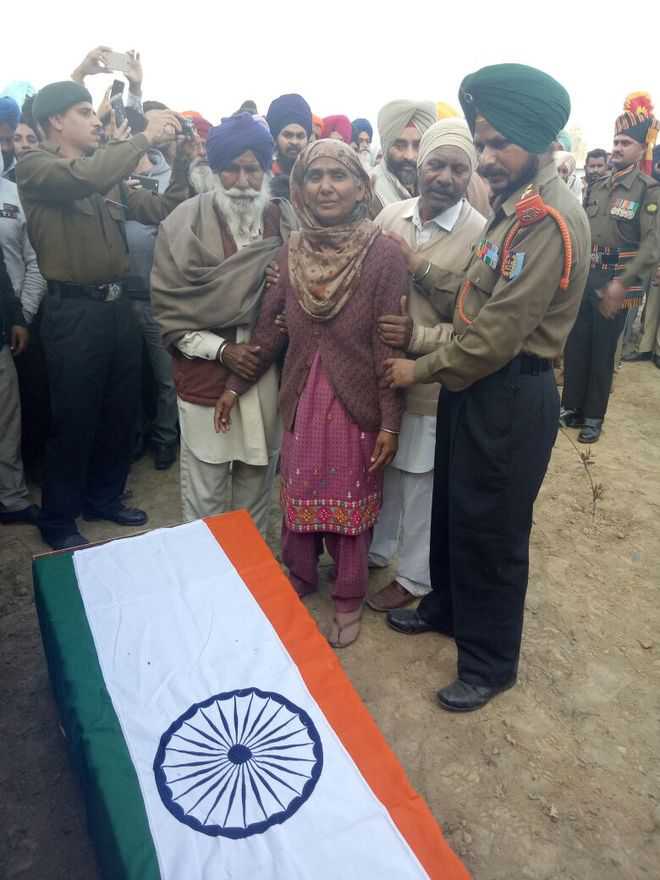
Chief Minister Capt Amarinder Singh with the family of JCO Paramjit Singh at their house in Veinpoin village, Tarn Taran, on Sunday. — Tribune photo

Tribune News Service

Tarn Taran, May 7

Punjab Chief Minister Captain Amarinder Singh on Sunday announced a police job for the elder daughter and a reserved a job for the elder son of Naib Subedar Paramjit Singh, who was recently killed during a ceasefire violation by the Pakistani army at LoC in Jammu and Kashmir.The Chief Minister, who visited Paramjit Singh’s family at Vein Poin village here, said his government would soon table before the Cabinet a comprehensive policy standardising compensation for any Punjabi of any force who lays down his life in fighting for the nation.Condoling the death of Paramjit Singh, Captain Amarinder said the jobs for the two elder children, which the family had sought from the government, would be in addition to the compensation already announced for the deceased’s next of kin.

The Captain Amarinder Singh-led government had earlier announced a total compensation of Rs 12 lakh, including Rs 5 lakh for the wife and children of the deceased, Rs 2 lakh for his parents and a plot worth Rs 5 lakhs.

Image result for Amarinder announces jobs for children of soldier killed by Pakistan forces

In addition, another Rs 1 lakh was announced for renaming the local rest house in the soldier’s name.The Chief Minister on Sunday also announced a school and a stadium in the area in the name of the jawan.Amritsar MP Gurjit Singh Aujla had also announced that he would adopt the second daughter of the deceased soldier, whose elder daughter, 16-year-old Simrandeep Kaur, has been adopted by a bureaucrat couple from Himachal Pradesh.Both Simranjit Kaur and son Sahildeep Singh, 12, will be provided government jobs by the state government on completion of their education, the Chief Minister told mediapersons.Asked if the government was not discriminating against the third child of the deceased, he said it was not possible to provide individual compensation to every family member, but he made it clear that all promises made to the family would be fulfilled by his government, which would extent more help to them if needed.

Responding to questions, the Chief Minister said the central government was not doing enough to protect the men manning the country’s borders. Tough steps need to be taken to prevent the recurrence of such brutal killings at the border, he stressed, adding that India should retaliate with thrice the force to any incursions into our territory.

The Chief Minister was accompanied by his cabinet colleagues Rana Gurjit Singh and Navjot Singh Sidhu, as well as Punjab Congress president Sunil Jakhar. 

http://

IMG-20170507-WA0038 IMG-20170507-WA0039 IMG-20170507-WA0040 IMG-20170507-WA0041


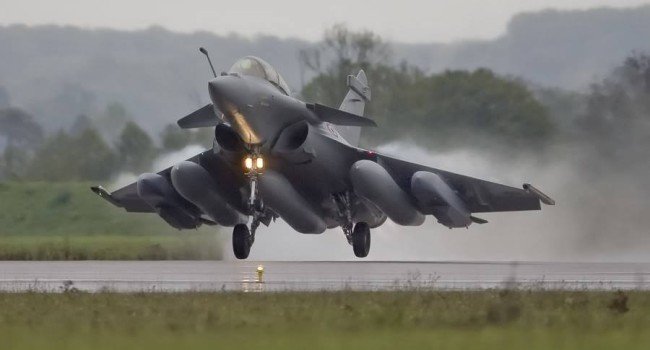
IAF Chief Dhanoa Flies Rafale Jet in France

Dhanoa flew the fighter at the Saint-Dizier airbase – a prominent installation of the French air force, an IAF official said.

New Delhi: Chief of the Air Staff, Air Chief Marshal BS Dhanoa paying homage at Amar Jawan Jyoti, India Gate in New Delhi on Monday. PTI Photo (PTI1_2_2017_000074B)


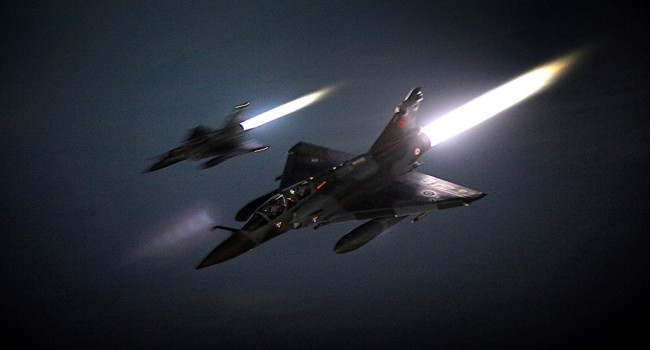
New Delhi: Chief of Air Staff B S Dhanoa on Tuesday flew a sortie in a Rafale fighter jet from a French airbase to gain first-hand experience of the aircraft, 36 of which are being procured for the Indian Air Force.

Dhanoa is a on a four-day visit to France to ramp up cooperation between the air forces of the two countries in a range of areas.He flew the fighter at the Saint-Dizier airbase – a prominent installation of the French air force, an IAF official said.

India is procuring the Rafale multi-role fighter jets from French aviation major Dassault under a Euro 7.87 billion (approx Rs 59,000 crore) deal inked in September last year Air Chief Marshal Dhanoa will also take stock of progress in their supply.

The fighter jets are capable of carrying nuclear weapons and will be equipped with the latest missiles that will give the IAF greater “potency” over arch-rival Pakistan.

The Rafale combat aircraft will come with various India- specific modifications including Israeli helmet mounted displays, radar warning receivers and low band jammers, among others.

The Inter-Governmental Agreement for the supply of the jets was signed in September last year, 16 months after Prime Minister Narendra Modi announced India’s plans to buy 36 Rafale aircraft in fly-away condition.

According to the deal, the delivery of the jets will start in 36 months and will be completed in 67 months from the date the contract is inked.


Choosing a President S Nihal Singh India deserves better

Choosing a President
Not the best: Are we condemned to suffer mediocrities as our face to the world?

CONTRARY to folklore, the selection of the country’s President is an intensely political affair. In its long innings, the Congress has played politics in its choices with men of the distinction of S. Radhakrishnan gracing the office in contrast to the nonentities it selected to suit its political requirements. The only occasion there was a consensus on the choice was with Sanjiva Reddy because of the political turmoil then roiling the country.It is no surprise then that the BJP, in power under its own steam, should play politics with its choice for the highest titular post in the land even while making a show of seeking consensus with the Opposition parties. It was equally clear that in selecting Mr Ram Nath Kovind, a somewhat obscure loyalist with strong BJP and RSS affiliations and a Dalit to boot, it was making a political point and scattering the Oppositiion parties seeking to come together. We had men such as the Congress-appointed Fakhruddin Ali Ahmed signing on the dotted line to bless Indira Gandhi’s Emergency.Essentially, the BJP had three points to make. One, it was seeking to dispel the impression of being an upper caste and trading community party known for encouraging inter-caste tension and an anti-Dalit cast of mind. Second, it had the general election of 2019 in mind in fielding a Dalit. Third, it struck a blow to Opposition unity, such as it has been, to get Bihar’s CM and JD (U) leader, Mr Nitish Kumar, to defect even before Opposition parties were scheduled to meet.Thus in immediate terms, the BJP’s tactic has paid off. The Opposition parties were reduced to naming a Dalit, Ms Meira Kumar, the former Lok Sabha Speaker, to make a symbolic fight knowing full well that the BJP’s candidate had the votes, now with the maverick Shiv Sena and the JD (U), among others, on board.Yet the pity is that the Congress and the BJP when in power play political games for their parties’ advantage when the country should choose a towering and recognised personality to represent the country with distinction at home and around the world. This comes at the cost of India’s image PM Modi’s government is otherwise so adept at creating.Mr Kovind, despite his experience and record, is nowhere near the ideal President the country deserves. In the process, India is missing out on projecting its true potential to the world. Instead of chalking out a bold course in contrast to Congress practice, the BJP has chosen to copy it to select a well-meaning slogger because of his caste to keep alive the concept of Hinduising India. By all accounts, the RSS played a key role in the final stages of making the choice. The nature of the organisation being what it is, its single-minded devotion to creating a Hindu rashtra cannot be faulted. Rather, the RSS underpinning in the BJP and in the government’s staffing at the national level and in the states is such that it has a stranglehold on policymaking. Mr Modi’s choices are therefore limited. He must put up with men like Yogi Adityanath as his party’s CM in Uttar Pradesh as with the other red lines drawn by the RSS in areas closest to its heart. The choice for President was one such red line and like a faithful member of the RSS, as he once was, Mr Modi capitulated.   The office of President has evolved over the decades as has the role of Governors. Its past splendour has a hollow ring today, with more and more holders of office being proxies of the ruling power, rather than following the spirit of the Constitution in exercising an oversight over the government’s actions and policies. There have been exceptions, for instance KR Narayanan, who have expressed reservations and displeasure over particular policies. Even more than those holding the President’s office, Governors as a rule are proxies of the ruling party at the Centre. Indeed, there can be a valid case for the abolition of Governors’ office, substituting it by an administrative mechanism serving the same purpose without the expense and formalities involved. But the country still needs a titular head as a symbol and a meeting point for all its citizens. As is clear from the latest decision of the ruling party, that symbol is well on the way to oblivionn greatly aided by the record of the Congress.  Is the country so engulfed in partisan politics that even a party with a majority of its own in the Lok Sabha after three decades cannot chart a new course to keep the office of President above political horse trading? The BJP apparently thinks in electoral cycles to complete its dominance over national politics. The Oppositiion parties, particularly the Congress, are too shell-shocked by the scale of their defeat in recent elections to concentrate on national objectives. The traditional remedy offered by the wise is to turn to civil society. But it has proved to be a broken record time and again. Unless provoked by a victory or defeat on the cricket field or touching the heartstrings, as in the case of the aspiring self-made woman who was brutally raped and died, civil society stays silent more often than not. The choice of the President is not evocative enough to excite passion except among the political class that lives in its own bubble. Are we therefore condemned to suffer mediocrities as our face to the world? The Congress is more culpable on this score than the BJP’s rather recent acquisition of power. But the BJP cannot escape censure because it is in a sense the new avatar of power long exercised by the Congress. It must distinguish itself not merely by seeking a cleaner India but in getting rid of the cobwebs of the past by introducing a healthier set of political principles.The choice of Vice-President remains open and we must await the next surprise the BJP has to offer. This much is clear. Mr Hamid Ansari will be a hard act to follow.