Sanjha Morcha

What’s New

Click the heading to open detailed news

Current Events :

web counter

Print Media Reproduced Defence Related News

The Army Desperately Needs to Upgrade its Family of Small Arms::Lt Gen Syed Ata Hasnain

The Army Desperately Needs to Upgrade its Family of Small Arms
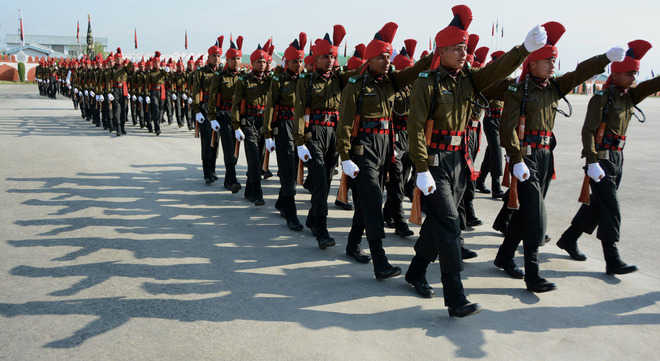
Indian Army recruits stand in formation as they hold their INSAS rifles. (File Photo/Getty)

As a military professional my focus towards the basic personal weapon of the Indian Army and the Infantryman’s mainstay was missing for almost thirteen years after I was commissioned. I was happy with the 7.62 mm Self Loading Rifle (SLR) as it was a far cry from the .303 that I had seen and fired as a youngster when my father was commanding our unit.

The issue of personal weapons finally caught my fancy when I rejoined my unit in Op Pawan (Sri Lanka/IPKF). We had a few captured 7.62 mm AK 47s which were reserved for the Ghatak platoon and for a couple of scouts while we conducted jungle bashing.

The captured AK series, worn and grimy from LTTE over use, carried a romantic aura about it. The greatest thing was that it could fire in automatic mode. Why is that important? In the jungle or urban terrain, response at close quarters is a recurring phenomenon. Automatic high rate of fire from a weapon with an enhanced capacity magazine has far greater chances of success, especially in the crucial two minutes of the first contact.

new-insas
Rifle 5.56 mm INSAS. (Courtesy: ofbindia.gov.in)

In Op Pawan the Army’s leadership was dynamic in response, even though resources were still of the socialist order. Since AK 47s were not easily available the Ordnance factories quickly gave us 7.62 mm SLR 1C, a modified rifle with a slightly shortened barrel and surgically intervened breach blocks to give a burst capability. My first success in an ambush was with this weapon which I found ingenuously outstanding given the resource position of those days. The only problem with Model 1C was that it overheated very early.

By the Nineties I found myself attending meetings in Army Headquarters about the upcoming wonder, the 5.56 mm INSAS Rifle and family of small arms associated with it. It had artificial furniture and plastic see through magazines which looked very fancy. The feel appeared good and it was a novelty. I felt a change from the aging 7.62 mm SLR would be advantageous. Although I had an experience with 5.56 mm caliber, in the thick jungles of the Wani in Sri Lanka I continued to live by some dictums which I had learnt at the academy but never applied in my mind thereafter. In one instance I saw one of my ‘bhullas’ (Garhwali soldiers) peppered with six rounds fired by an LTTE cadre from an M-16 (5.56 mm) assault rifle. M-16s were popular in Sri Lanka; in fact anything could be popular after the 7.62 mm SLR. But this ‘bhulla’ was running around attending to casualties and least concerned with his injuries. Six bullets in his abdomen did not trouble him until I forced him to start acting like an actual casualty. That is the day I lost confidence in the 5.56 mm variety of small arms. It is true that the terminal effect is dependent on the range at which a bullet is fired and the amount of explosive content it contains. Yet, somehow a mindset seemed to grip me on this.

Indian army soldiers displays a collecti
Indian Army soldier with AK-47 rifles. (File Photo/Getty)

Why am I discussing all this? The reason is simple; the INSAS family which never really matured is now on the way out. In J&K too it is the AK-47 which is depended upon. But the easing out can only happen once the leadership of the Indian Army can finally decide what family of small arms it wants as its next generation small arms weapon system. Reportedly, this issue will be discussed at the ongoing Army Commanders’ Conference this week. It’s been discussed before but a dilemma seems to be gripping the minds of the leadership. The higher leadership comes from my generation which was taught that in battle it is far advantageous to maim or injure your adversary rather than kill him. That forces the adversary to deploy men to tend to the casualty, carry him out to a safe place, evacuate him to the rear areas and thereafter perhaps care for him for life. All this is heavy in resources at all stages, and resource depletion of your adversary is what you always aim in conflict. However, conventional conflict it appears is passé; hybrid is in and it caters for both situations – conventional and sub conventional. I can hold my own in a debate to justify the return to 7.62 mm caliber with an appropriate architecture and composition of the ammunition. The 7.62 mm also has a psychological effect on the adversary when the nature of fatal inflicted injuries is observed. However, anyone who knows small arms also knows that the parameters in consideration have to be weight (of weapon and ammunition), the recoil effect (can’t have a horse buck at the shoulder), the range, the comfort of carrying and firing (ergonomics) and the length of the barrel. Throw in a couple more such parameters and the designer has more issues than he can handle. For me, recoil is a very important factor. In burst mode one can’t afford only the first bullet hitting the target and the rest going astray.

I am not sure if there is a case for a compromise caliber such as 6.8 mm which some foreign analysts speak of. An examination of this would also be interesting. The Indian Army’s dream personal weapon of twin caliber capability with changeable barrels to cater for different calibers has resulted in the acute delay in the final decision. There appear to be no takers for this variety which the General Staff had desired.

Indian soldiers stand beside a display o
AK-47 assault rifles. (File Photo/Getty)

Many in the media are attempting to analyze the benefits of different calibers and other characteristics of small arms. This is interesting and a welcome change because the romance of military technology is usually associated with armour and artillery systems and not infantry weaponry. An issue which no one appears to have considered is the equipping of Infantry and other Combat Arms personnel with specialist small arms of a higher technical order than those of the personnel of other Arms. No doubt in conventional operations it is primarily infantry personnel who will require to use these weapons extensively in offensive/assault mode. Those away from frontlines would primarily be involved in defensive operations in rear areas. However, if the Hybrid variety of operations is considered there may be equally robust operations against well entrenched terrorists in rear areas. The issue to be considered should be the cost effectiveness of going in for one type of product across the board. No doubt uniformity in personal weapons contributes to the overall management of maintenance and logistics but this aspect need not be given undue consideration. The equipping of infantry units with a state of the art weapon which near about meets the dual parameters of both conventional warfare and hybrid operations would be the most recommended option.

Some inexperienced analysts are speaking of 1000 meter range for infantry small arms; they also appear to be mixing all this with the need of sniping which is a completely different domain. Effective ranges for infantry small arms have almost always revolved around the 300 meter mark with increase to 500 meters with stabilization due to a bipod and some more due to tripod stabilization. A target acquisition device in the form of a latch on telescope and an accuracy enhancer in the form of laser assistance are almost mandatory in the modern world.

The AK 47 type of options of burst rapid and controlled burst fire along with single shot continues to be the favourite. Indian infantrymen operate very largely in the mountains and jungle terrain and therefore the weight of the weapon and its ammunition must remain important considerations. A weapon upwards of 4 kg would not be acceptable. In fact sub 4 kg with all latch on accessories is the figure one would be satisfied with. 25-30 round magazines would be desirable when burst modes are adopted. The 20 round 7.62 mm SLR magazine was robust and less prone to malfunctioning; an improvement on that is what is looked for rather than the rather disappointing plastic magazines with conventional spring mechanism that the INSAS went in for.

Whatever it be, the Indian Army has remained in various stages of self-doubt while equipped with the INSAS family. Let us hope that with renewed interest in a new family of weapons and slippages now causing virtual panic the senior hierarchy will finally come to a decision on a subject which should be considered as important as the acquisition of aircraft, tanks and guns.

About the writer

LT GEN SYED ATA HASNAIN

8

A Sherwoodian and a Stephanian, Lt Gen Syed Ata Hasnain, PVSM, UYSM, AVSM, SM, VSM & BAR (Retd) is proud of his educational background as he is of his parentage and his Regiment. A second generation soldier whose father was also a General Officer of the Indian Army, the Hasnain family is fiercely loyal to its Regiment – The Garhwal Rifles. One of Indian Army’s highest decorated General Officers, he was awarded honours for command of troops in every command assignment. The Hasnain family has 10 decorations to its credit, the maximum in any military family with the PVSM being awarded both to father and son, one of the rare achievements. The General has exposure to diverse military situations through service in Operation PAWAN (IPKF in Sri Lanka), Operation MEGHDOOT (Siachen Glacier), Eastern Ladakh, Punjab insurgency, Line of Control (J&K) and the North East. Even abroad he was a witness to the horrific situation in the near genocide in Rwanda(Central Africa) as part of United Nations Forces. The crowning glory was his command of 21 Corps (Strike) and 15 Corps (J&K), ending his career as the Military Secretary of the Indian Army where he introduced his famous HR mantra – ‘Play Friend Not God’. Now associated with two major Delhi based think tanks Vivekanand International Foundation and Delhi Policy Group, the General brings his musings to the public synthesizing his military experience and strategic outlook to express ideas on a range of issues. He speaks frequently at corporate conferences, international institutions such as the Rajaratnam School of International Studies and the training establishments of the three Services, besides the Lal Bahadur Shastri Academy of Administration, Mussorie, National Academy of Customs Excise & Narcotics, Faridabad.


Union cabinet approves OROP for 16 lakh personnel

The union cabinet on Wednesday approved the One Rank One Pension (OROP) scheme for close to 16 lakh defence pensioners even as it leaves out those who would take voluntary retirement in future.

In a statement, the union government said that the benefit will be given with effect from July 1, 2014 and pensions will be re-fixed for those who retired before July 1, 2014 in the same rank and with the same length of service.

The benefit, it said will also be extended to family pensioners including war widows and disabled pensioners.

However, as in the past when the government notified OROP last year, it again made it clear through the union cabinet decision that “personnel who opt to get discharged henceforth on their own request will not be entitled to the benefits of OROP” and that “It will be effective prospectively”.

This has invited sharp criticisms from the ex-servicemen fraternity even as Constitution of Judicial a committee headed by former Patna High Court Chief Justice L Narasimha Reddy has been formed to look into any anomalies in implementation of OROP. The committee will give its report in six months. The arrears will be paid in four half-yearly installments. However, all the family pensioners including those in receipt of Special/Liberalized family pension and Gallantry award winners shall be paid arrears in one installment.

While in future, the pension would be re-fixed every five years, the government said that the financial implications on account of grant of OROP including Pre-Matured Retirees (PMR) cases would be to the tune of Rs 10925.11 crore for payment of arrears and annual financial implication would be Rs 7488.7 crore. Till March 31, 2016, 15.91 lakh pensioners have been given the first installment of OROP, according to the Ministry of Defence (MoD), which amounts to Rs. 2,861 crore.

MoD has sad that the information is being gathered for processing on priority basis, the cases of nearly 1.15 lakh pensioners who have not got their installments due to gaps of information such as the length of service being assessed and others.


India, Afghanistan hold bilateral talks

India, Afghanistan hold bilateral talks
Foreign Secretary S Jaishankar with Deputy Foreign Minister of Afghanistan Hekmat Karzai during a meeting at South Block in New Delhi on Tuesday. PTI

New Delhi, April 26

Ahead of the Heart of Asia conference on peace and stability that will host for the first time, Foreign Secretary S. Jaishankar held a bilateral meeting with Afghan Deputy Foreign Minister Hekmat Karzai here on Tuesday.

“Beginning with the bilaterals. Before Heart of Asia meeting, FS meets Afghan Deputy Foreign Minister Hekmat Karzai,” external affairs ministry spokesman Vikas Swarup tweeted.

The meeting comes ahead of the much expected bilateral meeting between Jaishankar and Pakistani Foreign Secretary Aizaz Ahmed Chaudhry.

On Tuesday afternoon, India will host the Heart of Asia Istanbul Process conference aimed at bringing peace and stability to Afghanistan.

Apart from India, the Heart of Asia initiative involves 13 other countries – Afghanistan, Azerbaijan, China, Iran, Kazakhstan, Kyrgyz Republic, Pakistan, Russia, Saudi Arabia, Tajikistan, Turkey, Turkmenistan and the United Arab Emirates.

There are 17 supporting countries – Australia, Canada, Denmark, Egypt, Finland, France, Germany, Italy, Iraq, Japan, Norway, Poland, Spain, Sweden, Britain, the US and the European Union (EU) – as well as 11 regional and international organisations supporting this process, including the UN, the Organisation of Islamic Cooperation (OIC), the North Atlantic Treaty Organisation (NATO), the Shanghai Cooperation Organisation (SCO), and the South Asian Association for Regional Cooperation (SAARC).


NIA likely to let off Pragya Thakur

MALEGAON BLASTS Agency does not have enough proof against the ascetic, co-accused Lt Col Purohit to be in charge sheet

Rajesh Ahuja

NEW DELHI: One of the most prominent faces of alleged Hindu terror in India, religious leader Pragya Thakur, is likely to get off the hook in the 2008 Malegaon blasts case for lack of proof, sources said on Saturday.

Another key accused in the case, Lt Col Prasad Purohit, is expected to be named in the charge sheet.

Sources in the National Investigation Agency (NIA) said it didn’t find concrete proof linking Thakur to the blasts that killed seven people, but had “enough evidence” against Purohit.

He was allegedly involved in the setting up of Abhinav Bharat and met some of its members to discuss terror plans. The NIA is in the process of finalising the charge sheet, which will be submitted in a special court next month.

“The evidence against Pragya looks very weak and she may not be charged,” said an investigator.

The agency also decided to drop Maharashtra Control of Organised Crime Act (MCOCA) provisions against the accused because of procedural lapses by the Maharashtra Anti-Terrorism Squad (ATS).

“Our investigation is still not complete. And as far as MCOCA is concerned, even if, for the sake of argument, it is not invoked, we have enough provisions available under the Unlawful Activities (Prevention) Act,” NIA chief Sharad Kumar said. He is expected to take a final call on the charges soon. But sources said dropping MCOCA will weaken the case as confessions of the accused before a police officer will no longer be admissible as evidence in a court.

This will strengthen opposition parties, who accuse the NDA government of going slow in cases where Hindu terror suspects are involved. Several such cases — such blasts in Malegaon (September 2006 and September 2008), Samjhauta Express (February 2007) and Mecca Masjid (May 2007) — have been dogged by slow prosecution and hostile witnesses.

Of around a dozen witnesses in the 2008 Malegaon blasts, two retracted their statements five years ago. One made a complaint before the Maharashtra human rights commission, alleging coercion. Two more witnesses, Yashpal Bhadana and Dr RP Singh, recently alleged the same in front of a magistrate. “There are a few more witnesses who have told the NIA that they gave statements under duress. Our probe is getting hampered by this,” said the investigator.

Former NIA prosecutor in the case, Rohini Salian, had alleged that an officer of the agency asked her to ‘go soft’ on the accused after the NDA came to power.

Thakur has been in judicial custody since October 2008. She was arrested on charges of being a key conspirator in the case and is one of the 14 accused named in a Maharashtra ATS charge sheet. The case was handed over to the NIA in 2011, along with six other cases of alleged Hindu terror.


CHINA WILL STOP BACKING PAK THE DAY IT IS HURT BY TERROR: VK SINGH

NEW DELHI/GORAKHPUR: India considered reviewing clearance for Chinese investment in a tit- for- tat response on Monday after Beijing snubbed New Delhi by blocking a move to have Pakistan-based Jaishe-Mohammed militant group chief Masood Azhar on the UN sanctions list.

Official sources said the move to review security clearance for Chinese firms investing in India is meant to send a message to Beijing for its action in the UN four days ago. India has reasons to be upset because Azhar is the lynchpin in the audacious Pathankot airbase attack in January.

“Pakistan has an important place in Chinese diplomacy … China’s intervention in that case must be seen in this context. China will stop supporting Pakistan when it starts being affected by terrorism,” junior foreign minister and former army chief VK Singh said in Gorakhpur.

India and China share an uneasy relationship since the 1962 war between the two Asian giants over longstanding territorial disputes in Arunachal Pradesh and Jam mu and Kashmir’s Ladakh region that the Chinese claim to be theirs. The Chinese intimacy with Pakistan, supplying India’s bitter rival with arms and tipping the regional balance, has been a diplomatic thorny point too.

But the two neighbours tried to mend fences since Narendra Modi rode to power in 2014.


PATHANKOT ATTACKS NIA team ready for Pak visit, set to send fresh LRs

NIA team ready for Pak visit, set to send fresh LRs
Sharad Kumar, NIA Director General

Tribune News Service

New Delhi, April 19

The National Investigation Agency (NIA) is learnt to have readied its team that would visit Pakistan for its probe into the Pathankot airbase terror attack.New Delhi would also be sending a fresh Letters Rogatory (LRs) to the neighbouring nation for confirmation on the evidences shared with the Pakistan JIT during their recent visit to India.Indicating that a team was ready to travel to Pakistan with all possible proof against the handlers of the attack, including JeM chief Masood Azhar, NIA Director General Sharad Kumar said, “We are awaiting a clearance from Islamabad. We have handed over all documents sought by the JIT and I believe the evidence provided to Pakistan can stand scrutiny in any court of law internationally.”The LRs are being despatched notwithstanding indications from the Pakistani side that it was not yet ready to receive Indian investigators.The NIA has also put the pictures of the four dead terrorists on its official website and sought help from the general public to identify them. Sources in the NIA confirmed that the agency was flooded with emails, some of which originated from Pakistan, giving information about the attackers.The agency, during its interaction with Pakistan’s Joint Investigation Team, had sought details about the residences of the terrorists whose names had been shared with the visiting team. However, there was no response from Pakistan.


Parrikar raps service HQs for taking action against personnel who complain to him directly

Senior Army officials conversant with the military law said that action has been initiated in many cases against complainants based on rules and regulations mentioned in the Defence Services Rules. – manohar-parrikar1Senior Army officials conversant with the military law said that action has been initiated in many cases against complainants based on rules and regulations mentioned in the Defence Services Rules. (source: PTI)

Defence Minister Manohar Parrikar rapped the headquarters of the three services — Army, Navy and Air Force — for taking action against personnel who make representations to him and whose complaints he forwards to the services for inquiry.

In a letter written to the Vice Chief of Army Staff, Vice Chief of Naval Staff and the Vice Chief of Air Staff, the Ministry of Defence has conveyed the strong reservations of the Defence Minister that instead of informing him about the inquiry held into the complaints, the respective services have been initiating action against the complainants.

The MoD letter, accessed by The Indian Express, says the minister receives representations and complaints from various persons including serving armed forces personnel. Based on the nature and gravity of the complaints, directions of the Defence Minister are communicated to service headquarters for looking into or inquiring into the allegations made in these complaints. “Of late it has been observed that on certain occasions instead of apprising the ministry/RM of the findings of the inquiry conducted, action has been taken against the complaining officials including attachment at other formations/establishments,” the letter states.It goes on to say that, “RM has taken a serious note of the matter and has directed that henceforth service headquarters shall restrain from taking action against complaining officials. If any action needs to be taken as per procedure, the same shall be furnished to the Ministry for seeking approval of the RM when the complaint is addressed to RM and inquiry has been ordered by him”. Compliance of these instructions have been ordered at all levels of the three services. Speaking to The Indian Express, a senior official of the MoD said that Parrikar has also directed that all inquiries in complaints which have been marked by him should be conducted in a time bound manner. The minister has not been satisfied by the slow response to the complaints and the inordinately long time taken by the chain of command to respond to him. Senior Army officials conversant with the military law said that action has been initiated in many cases against complainants based on rules and regulations mentioned in the Defence Services Rules (DSR) which forbid the breaking of chain of command while communicating. “However, many officers as well as jawans have been writing directly to the Defence Minister after finding that their complaints are not being addressed at lower levels,” he said. Recently, an Army officer of the rank of Colonel even met the Defence Minister personally, after seeking time from him, to air his grievance after his repeated complaints to even the Chief of Army Staff did not receive the attention that they deserved.


Three security force bunkers removed from Handwara market

Srinagar, April 19

Municipal authorities in violence-hit Handwara town in north Kashmir today removed three security force bunkers from the main market, fulfilling one of the long pending demands of local residents.

“Three bunkers, which were constructed on top of shops in Handwara main market, have been removed by municipal authorities,” a police official said.

He said the main bunker, located in the round-about of the main market, has also been vacated and taken over by municipal authorities.

“This bunker will also be demolished and the task will be completed by 2 PM today,” the official said.

The municipal authorities also erected a board on the premises of the bunker, marking the place for conversion into a public park.

The locals had been demanding removal of the bunkers for quite sometime but the Army had put its foot down, saying it was strategically important for the troops.

However, the demand for removal of these bunkers intensified after last week’s violence triggered by alleged molestation of a girl by an army soldier.

Three persons were killed in security forces firing while dealing with the protestors.—PTI


Ex-servicemen slam Pak team’s visit to Pathankot air base

Tribune News Service

Ambala, March 29

Members of the Ex-Servicemen Welfare Committee today criticised the BJP government for permitting Pakistan’s Joint Investigation Team to visit the Pathankot air base to probe the terrorist attack. They said, by doing so, the government has insulted the martyrs who laid their lives for the country.Subedar Atrar Singh Multani, president, Ex-Servicemen Welfare Committee, said, “It was unfortunate the Government of India has allowed the Pakistan team, including the representatives of ISI, to visit the Pathankot air base. It will bring down the moral of the security forces.”He said it was like asking the culprit to investigate its own crime, adding that any positive outcome from the visit was highly unlikely.JP Mehta, senior president of the committee, said “The government has compromised national security by allowing access to the Air Force base. Pakistan will never punish or hand over Hafiz Saeed, Masood Azhar or Lakhvi to India, who have been the mastermind behind the terrorist activities in the country.”