



Sanjha Morcha

What’s New

Click the heading to open detailed news

Current Events :

web counter

Print Media Reproduced Defence Related News

Pakistan has given US nothing but lies and deceit, says Trump

Pakistan has given US nothing but lies and deceit, says Trump
Donald Trump. AFP file photo

Washington, January 1

Issuing a tough warning to Pakistan, US President Donald Trump today alleged that this South Asian nation has given America nothing but lies and deceit and has given safe haven to terrorists.

“The United States has foolishly given Pakistan more than 33 billion dollars in aid over the last 15 years, and they have given us nothing but lies & deceit, thinking of our leaders as fools,” Trump said in a strongly worded tweet.

“They give safe haven to the terrorists we hunt in Afghanistan, with little help. No more!” Trump said in his first tweet of the year.

(Follow The Tribune on Facebook; and Twitter @thetribunechd)

This is the strongest warning that has come from the US president.

In his new South Asia Policy unveiled in August, Trump had called for tougher measure against Pakistan if it did not cooperates the US in its fight against terrorism. PTI


FIR in times of AFSPA by Lt-Gen Harwant Singh (retd)

AFSPA is in place in J-K. The FIR against the Army personnel, acting in self-defence, has been perhaps done under political pressure. But it sends a wrong message.

FIR in times of AFSPA

Lt-Gen Harwant Singh (retd)

Former Deputy Chief of Army Staff When the Armed Forces Special Powers Act (AFSPA) is in place, for initiating any action against the military, while it carries out assigned duties, sanction from the Central government is essential. This is so because of the nature of the prevailing environment, level of insurgency and the fact that the situation is grave and well outside the capacity of police to control that the military is called in.  The military is able to handle such situations — not that it is better armed than the police for handling such contingencies — because of the salutary effect the military it has on unruly crowds. This is so because the military is required to deal with such situations firmly and take proper action when required. Thus, the military does not fire in the air to control mobs. When absolutely necessary, it fires the minimum number of bullets to incapacitate rather than kill miscreants. In the recent case of the military opening fire on a violent mob in Shopian district of the Kashmir Valley, where two miscreants were killed and another injured, the police has filed an FIR against the military unit. The mob had indulged in stone-pelting, attacked military vehicles and personnel, wounding a few, and attempted to snatch weapons from soldiers. That had left no option for the military other than to use force. When a violent mob goes as far as to attack military personnel, tries to snatch weapons from soldiers, troops have to resort to firing. To halt the on-rushing attackers, there is little time to aim the weapon to merely incapacitate them. Even so, minimum force is used, as in this case.Once during the late 1990s, on noticing a funeral profession approaching, a convoy of four military vehicles was halted by the convoy commander and vehicles parked on one side to let the funeral procession pass. Sentries were positioned next to the vehicles. As the procession came close to these vehicles, some miscreant rushed forward and tried to snatch weapons from the sentries. Fire had to be opened due to which some miscreants died. The Governor wanted to hold a magisterial inquiry (it was the time of Governor’s rule), but the corps commander, Lt-Gen Zaki, insisted that, if required, only a military court of inquiry would be held.Given the general state of hostility of the local population towards the security forces, no reliable and truthful witnesses would be available during any court of inquiry. That is the reality in the Valley. Troops are operating in J-K under very difficult environments. In the Kashmir Valley, the population is alienated and political class keeps alive this climate of alienation and is ever ready to exploit local sentiments to its advantage. Separatist leaders have been having a free run in their anti-national activities and financing stone-pelters from funds received from across the border. Stone-pelters have also been interfering with troops’ actions while engaged in firefights with terrorists. Also, there are continuing attempts by Pakistan to keep the pot on the boil. The Indian military is fighting on two fronts in J-K. One, on the LoC against Pakistan’s attempts to push more terrorists across this line and otherwise keep this line alive through small arms and artillery fire and two, fighting with those who manage to infiltrate, local terrorists and stone-pelters. The military, when deployed to restore law and order, relies essentially on its salutary effect on unruly mobs. It is this one factor which comes into play and often the army is able to control an adverse situation without having to resort to use of force (fire in this case). However, when the army is constantly or too frequently employed on such tasks as is the case in the Kashmir Valley, then that salutary effect is lost. After all, familiarity breeds contempt. The Army’s undertaking, ‘Sadbhavna’, where troops often undertake tasks such as making playfields for schools, drainage in villages and a range of similar activities, has further lowered it salutary effect with possibly no other gain, which is too obvious to miss: for a keen observer. There is enough state and central police available in the country and, as such, there should be no requirement to call the Army. Unfortunately, the civil administration collapses at the first sign of trouble. One saw this during Jat agitation, then again during the arrest of Ram Rahim and now Karni Sena has proved this point in more than one state.   The only advantage the Army has over the police, state and central, is its discipline, willingness to accept risk during counter-terrorist operations and its leadership operating upfront. After all, for such tasks, the Army is no better armed than state and central police. The Indian government has had no definite and firm policy to resolve pending issues of J and K, which have continued to sustain this anti-national atmosphere. Sustained pampering of the population, through faulty policies and dishing out a range of sops, has resulted in the current state of affairs. The recent amnesty offered to the stone-pelters has merely encouraged them and others to continue to indulge in this activity against the security forces. The point that these stone-pelters directly interfere with the security force’s engagement with terrorists is a serious violation of law and calls for stringent legal action and not amnesty. Political expediency, poor administration and weak-kneed policies of the Central government and failure to come to grip with the root causes of this continuing state of affairs are the underlying factors leading to the current state of affairs. The inability of the administration to instill the fear of law amongst the local population, rampant corruption and exploitation of anti-national sentiments by the political class continue to prevail. Nothing stands more to sustain this argument than allowing complete breakdown of law and order, resulting in the exodus of Pandits from the Valley. It was the time of Governor’s rule, which did nothing to restore order in the Valley, while the Central government remained a mute spectator.     AFSPA is in place in J and K and for the police to file an FIR against the Army personnel, acting in self-defence, preventing miscreants from damaging government property (military vehicles), snatching weapons from soldiers has been done perhaps under local political pressure. But this action by the police sends out an altogether wrong message. Though the BJP is a coalition partner in the government in J and K, along the way it seems to have lost the plot and its orientation. Today, unfortunately, there is no Chanakya to tell the nation and the Prime Minister that the day unruly mobs can snatch weapons from his soldiers, deployed to control them, then that day will be the beginning of the end of the Republic.  


World’s largest amphibious aircraft makes maiden flight in China

World’s largest amphibious aircraft makes maiden flight in China
Chinas domestically developed AG600, the worlds largest amphibious aircraft. — Reuters.

Beijing, December 24

China’s domestically developed AG600, the world’s largest amphibious aircraft, performed its maiden flight on Sunday from an airport on the shores of the South China Sea, the latest step in a military modernisation programme.(Follow The Tribune on Facebook; and Twitter @thetribunechd)China has stepped up research on advanced military equipment as it adopts a more muscular approach to territorial disputes in places such as the disputed South China Sea, rattling nerves in the Asia-Pacific region and the United States.State television showed live images of the AG600 lifting off from Zhuhai airport in the southern province of Guangdong, which sits on the South China Sea coast.It returned about an hour later and taxied to its stand accompanied by martial music and greeted by crowds waving Chinese flags.Xinhua news agency said the aircraft was the “protector spirit of the sea, islands and reefs”.It had previously been scheduled to make its first flight earlier this year but it is unclear why it was delayed after ground tests took place in April.State-owned Aviation Industry Corp of China (AVIC) has spent almost eight years developing the aircraft, which is roughly the size of a Boeing Co 737 and is designed to carry out marine rescues and battle forest fires.However, state media has also noted its potential use in the South China Sea, where China, Vietnam, Malaysia, the Philippines, Taiwan and Brunei all have overlapping claims.The AG600’s chief designer, Huang Lingcai, was quoted in the official China Daily earlier this month as saying it can make round trips without refuelling from the southern island province of Hainan to James Shoal, claimed by China but which is located close to Sarawak in Malaysian Borneo.Powered by four turboprop engines, the AG600 can carry 50 people during maritime search-and-rescue missions, and can scoop up 12 metric tons of water within 20 seconds for fire fighting trips, according to state media.The aircraft has received 17 orders so far from Chinese government departments and Chinese companies. It has a maximum flight range of 4,500 km (2,800 miles) and a maximum take-off weight of 53.5 tonnes.It can use conventional airports and also land and take-off from the sea.China is in the midst of a massive military modernisation programme, ranging from testing anti-satellite missiles to building stealth fighters and the country’s first indigenous aircraft carrier, to add to an existing one bought from Ukraine. — Reuters.


Civil-defence meet held to resolve land exchange issue

Ambika Sharma

Tribune News Service

Solan, February 2

The district administration of Sirmaur will explore the possibility of providing 112 bigha to the defence authorities in lieu of surrendering 300-m defence lan, which was an impediment in completing a five-km Banogdhar-Kyari Road.Since the requisite 112 bigha contiguous stretch of non-forest land was difficult to be found in the district, a proposal to provide this land in some other district would be explored.A meeting convened under the chairmanship of Deputy Commissioner (DC), Sirmaur, Lalit Jain, took a significant decision in this regard to end this stalemate as the completion of the road was awaited since decades.After deliberating on this issue along with the defence officials at a meeting held at Nahan today, it was decided to explore this option.The DC informed that a sum of Rs 10 lakh had already been incurred on constructing this road under the Pradhan Mantri Gram Sarak Yojana, but work was stuck up due to a 300-m defence land. People of as many as 12 villages, Jabbal-ka-Bagh, Jalapadi, Ramkundi, Simbalbara, Rorrawali, Ladli, Gadda Dharkyari, Bubbidhar, Bikram Kainsal, Majholi, Kotdi, Gadpedla and Bhalgo, as well as the residents of Ward Number 12 of Nahan were badly affected by the non-completion of this road.It is worth mentioning that the local MLA and Speaker Vidhan Sabha, Dr Rajiv Bindal, had met the Defence Minister in Delhi on January 19 and submitted relevant papers concerning this issue to find an early solution.Bindal said faulty land settlement executed by the Land Settlement Department about 45 years ago had led to this land dispute between the civilians and the defence authorities in Nahan .Though the issue had been raised several times with the defence authorities, no solution had come forth. It had also been deliberated upon with former Defence Minister Manohar Parrikar following which the defence authorities had agreed to transfer the land if they were provided a substitute land in lieu by the state government.Dr Bindal, in his recent meeting with the Defence Minister, had urged her to speed up the process so that an early solution could be chalked out. However, providing 112 acre in exchange was a Harculean task for the state as finding such a huge stretch of contiguous land at a location suitable to the defence authorities was not an easy task.Though the issue had also figured in the civil-military liaison meet, the availability of a suitable land had acted as a deterrent in resolving the issue, said Deputy Commissioner Lalit Jain.

Road project hanging fire

  • The district administration will explore the possibility of providing 112 bigha to the defence authorities in lieu of 300-m defence land, which is an impediment in completing a five-km Banogdhar-Kyari Road
  • A meeting convened under the chairmanship of the DC, Sirmaur, took a significant decision in this regard to end this stalemate as the completion of the road wasawaited since decades
  • The DC informed that a sum of Rs 10 lakh has already been incurred on constructing this road under thePradhan Mantri Gram Sarak Yojna, but work is stuck up due to a 300-m defence land

18 Army Goodwill Schools’ teachers felicitated

Jammu: Lt Gen D Anbu, GOC-in-C, Northern Command, awarded 18 teachers of various Army Goodwill Schools of the state at an award ceremony held in Udhampur on Tuesday. These teachers were selected after a stringent process based on their teaching ability and use of modern teaching aids. The awards were sponsored by the Satya Bharti Foundation and included cash prize, trophy and a certificate. Muhammad Ashraf Magrey of Army Goodwill School, Ziran, won the first prize in the senior secondary-level category thanked the Army for providing a platform for the teachers to showcase their teaching abilities and making a positive contribution in improving the education scenario of the state. tns


May lose IAF job if tattoo: HC

New Delhi, January 28Tattoo-sporting candidates cannot be guaranteed a job in the Indian Air Force (IAF).This stipulation has now got judicial stamp with the Delhi High Court upholding the decision of the Air Force cancelling a man’s appointment for the post of airman as he had carved a permanent tattoo on the external side of his forearm.The Air Force grants relaxation and permits certain kind of tattoos, including in case of tribals, which are as per customs and traditions.A Bench of Justices Hima Kohli and Rekha Palli, however, noted that the tattoo engraved on the body of the candidate was not in conformity with the relaxation granted by the IAF and he had also failed to submit a photograph of his tattoo at the time of submitting his application, as prescribed in the advertisement issued by the IAF.The counsel for the IAF clarified that only a permanent body tattoo on the inner face of forearms, reverse side of palm; and in case of tribals, tattoos as per their customs, were permitted.


Work to integrate BrahMos on 40 Sukhoi fighter aircraft starts

New Delhi, December 17

Work has begun to integrate the BrahMos supersonic cruise missile on 40 Sukhoi combat aircraft, which is expected to fulfil critical needs of the Indian Air Force in the wake of evolving security dynamics in the region.The air-launched variant of the BrahMos, the world’s fastest supersonic cruise missile, was successfully test-fired from a Sukhoi-30 combat jet on November 22, marking a major milestone to enhance the precision-strike capability of the Air Force.(Follow The Tribune on Facebook; and Twitter @thetribunechd)The work to integrate the BrahMos missile on 40 Sukhoi combat aircraft has begun. A timeline for the project is being set, official sources said without elaborating.  It is learnt that the project is expected to be completed by 2020. The fleet of 40 Sukhoi jet will undergo structural modifications at the state-run aerospace major Hindustan Aeronautics Ltd (HAL) for integration of the missile on them. The 2.5-tonne missile flies almost three times the speed of sound at Mach 2.8 and has a range of 290 km. The range of the missile, an Indo-Russia joint venture, can be extended up to 400 km as certain technical restrictions were lifted after India became a full member of the Missile Technology Control Regime (MTCR) last year.“It is a very important project considering IAF’s evolving requirement to boost air power when the possibility of a two-front war cannot be ruled out,” said an official.After the test firing of the air-launched version, the IAF had said the missile coupled with the superlative performance of the Su-30 aircraft will give the force a strategic reach and will allow it to dominate the ocean and the battlefields. The integration of the missile on Sukhoi aircraft is a very complex process involving mechanical, electrical and software modifications of the Su-30 jet. BrahMos is a joint venture between DRDO of India and NPO Mashinostroyenia of Russia. — PTIHeaviest weapon on Sukhoi-30

  • BrahMos will be the heaviest weapon to be fitted on India’s Su-30 fighter aircraft
  • The fleet will undergo structural modifications at state-run Hindustan Aeronautics Ltd
  • With this, IAF capability to strike from large stand-off ranges on any target on sea or land will rise manifold
  • BrahMos is named after two rivers: Brahmaputra and Moskva (flowing in western Russia)

290 km the missile’s range — extendable up to 400 km as certain technical restrictions were lifted after India became a full member of the Missile Technology Control Regime in 20162.5 tonne the missile’s weight, which flies almost three times the speed of sound at Mach 2.82020 year by which the missile- Sukhoi integration project is expected to be completed


Time hasn’t come for AFSPA rethink: Rawat

Time hasn’t come for AFSPA rethink: Rawat
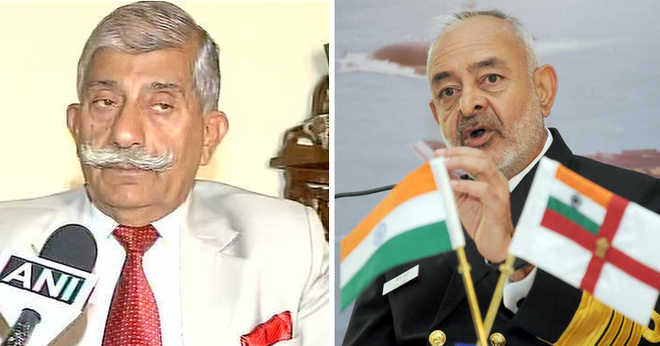
Army Chief General Bipin Rawat. — File photo

New Delhi, January 28

Time has not come for any rethink on AFSPA or making some of its provisions milder, Army Chief Gen Bipin Rawat has said, asserting that the Army has been taking adequate precautions in protecting human rights while operating in disturbed areas like Jammu and Kashmir.His remarks come against the backdrop of reports that several rounds of high-level discussions have taken place between the defence and home ministries on the “need to remove or dilute at least some provisions” of the Armed Forces Special Powers Act (AFSPA).(Follow The Tribune on Facebook; and Twitter @thetribunechd)


The Act gives the security forces special rights and immunity in carrying out operations in disturbed areas. There has been a long-standing demand from various quarters in J&K and the North-East to withdraw it.“We have never been strong in applying the force the way it could be applied (under AFSPA). We are very concerned about human rights. We are absolutely concerned about collateral damage. So do not get too much concerned because we are taking adequate measures and precautions,” he said. “The AFSPA is an enabling provision which allows the Army in particular to operate in difficult areas and let me assure you that the Army has got quite a good human rights record,” Gen Rawat added. — PTI


Sikh battalion Subedar’s advice saved Valley in ’47

Sikh battalion Subedar’s advice saved Valley in ’47
Punjab Chief Minister Capt Amarinder Singh speaks at Military Literature Festival in Chandigarh on Friday. TRIBUNE PHOTO: RAVI KUMAR

IAF attack at Longewala was massive

  • The IAF attack on Pakistan army tank column at Longewala during the 1971 war was important as it destroyed a large number of tanks, recollected Air Marshal Vinod Patney (retd). In the audience sat Brig Kuldip Singh Chandpuri (retd), who as a Major led a company of the 23 Punjab Battalion, to prevent tanks from coming. The IAF had taken over at first light and destroyed 28 tanks. “There were a large number of tanks and we had only four hunter aircraft that launched an attack in streams. Twenty-eight tanks were hit,” said Air Marshal Patney, speaking at a session “Use of air power in 1971 war”. This was done using atechnique last used in the World War-II (1939-45), he said

Ajay Banerjee

Tribune News Service

Chandigarh, December 8

The Kashmir valley was saved in 1947 due to military action stemming from a strong advice given by a Subedar of the 1st Sikh battalion of the Indian Army to his officer.On realising that it was impossible to defend just the Srinagar airfield from the Pakistan army-backed armed raiders, the Subedar suggested to his boss Lt Col Dewan Ranjit Rai: “Sahib let’s go find the enemy rather than wait for them to arrive.”Punjab Chief Minister Capt Amarinder Singh, a noted historian, narrated this anecdote at a session on the first Indo-Pak war (1947-48) on the opening day of the Military Literature Festival here this morning.Col Rai heeded the advice and moved his troops towards Baramulla, some 34 miles north-west of Srinagar. That, Capt Amarinder said, changed the course of the fight. In all, 462 marauders were killed. In the meantime, the troops of the 1st Patiala moved up to Zoji La and held onto the pass for the six months, stopping the ingress of the raiders from the eastern flank. The two — 1st Sikh and 1st Patiala (now rechristened 15 Punjab) — secured a total of 27 gallantry awards among themselves, including 1 PVC, the highest war-time gallantry award.Capt Amarinder said on October 25, when VP Menon, the then secretary of states, led a delegation to Srinagar, “there was panic”.Dr Harish Khare, Editor-in-Chief of The Tribune Group of Newspapers, said: “Who did what to whom remains a matter of subjective interpretation even after 70 years. We have an Indian version, a Pakistan version and rather mischievous British version.”“Many questions remain unanswered. What was the role of British leadership? Could things be different had an Indian General been given command of the Army (a British was the commander then). Could there have been a better timing for accepting a ceasefire? Many of the present narratives flow from the mistakes we made, not made, or presumed to be made,” said Dr Khare.Lt Gen AK Mukherjee (retd) narrated how a company of 13 Field Regiment wore the uniform of 1st Sikh and when artillery guns arrived they reverted to being gunners (their original role). They fought a very decisive battle to save Uri.Brig IS Gakhal (retd), who is from the Sikh Regiment, narrated interesting anecdotes on role of the 1st Sikh. Brig MS Gill (retd) listed the surprise caused by tanks at Zoji La that led to the advance towards Drass and Kargil. Maj Gen Shivdev Singh (retd) suggested that the battles of Jammu, Kashmir and Ladakh could not be seen in isolation when studying the war.


PATHETIC CASE OF CAPT VIJENDRA SINGH GURUNG ,3 ASSAM RIFLES:::T SEWA COMES TO RESCUE

IMG-20180125-WA0069 IMG-20180125-WA0070
Dear Sir,
1.   The pathetic case of Capt Vijendra Singh Gurung, 3 ASSAM was brought to notice of T SEWA. He is a short service commissioned officer. Had his schooling in King George’s Military School, Chail, HP. He was an excellent sportsman and got commission as Short Service Commissioned Officer.
2.   He was commissioned into 3 ASSAM. His battalion was deployed in Akhnoor Sector prior to 1971 War. Due to poor leadership of GOC 10 Inf Div, we lost Chamb in the Chamb Jaurian sector of J&K in the Indo –Pak 1971 war. He was taken as Prisoner when pakis overran our defences in Chamb sector on the very first night of 03 Dec 1971 along with many others. As was expected he was tortured for more than one year in Paki jails. He was lucky in that he was repatriated back to India in 1973 due to intervention of World Red Cross unlike 54 PWs who are still languishing in Paki jails till date. If you see the list of those 54 PWs most of them are captured either in Hussainiwala of Punjab or in Chamb in J & K.
3.       Due to inhuman torture, Capt Vijendra Singh Gurugng became a mental wreck. What happened thereafter is very heart wrenching. He for what reason was not given psychiatric treatment in the MHs or Command Hospitals and was not granted permanent commission. This is how our system works.
4.       He now leads a pathetic life in Dehradun. Brig RS Rawat, President T SEWA Uttarakhand, Lt Col Anil Joshi his Chail School mate and others gave details about the way this SS Officer livestoday. He works as a labourer and lives in a hut of 8 ft x 6 ft. He cooks his own food by burning firewood he collects from here and there. I do not know why he does not get medical treatment as discharged SS officer in MH.
5.       The Nation has forgotten him, the Army has forgotten him and painfully his own ASSAM Regt has forgotten this brave officer. But T SEWA has not forgotten this war hero. We in T SEWA will help him as much as we can. We cannot allow even our worst enemy to undergo the kind of life Capt Vijendra Singh Gurung is undergoing as on today. T SEWA will do whatever it can. But every one of us have to chip in our bit and see this officer lives a decent life till his last days. I have recommended to National Executive Committee of T SEWA to sanction Rs 10,000 per month to this officer for life.
6.       Brig RS Rawat has met him and saw for himself what kind of hut he is living and how he is surviving. I do not think even street children live like this. It is a shame for our Ex-Servicemen community to let our own brother to live like this. Let the Nation forget him. Let the Army which earns crores forget him. But T SEWA, you and I cannot forget Capt Vijendra Singh Gurung.
7.       My humble request to all of you to pledge a small amount of Rs 100 to be sent to T SEWA for helping Capt Vijendra Gurung. Whatever you send specifically for him will be sent to Brig RS Rawat who will further hand over the amount to him. Let me see how many of us will come to help this unfortunate officer. Your donation may be sent to T SEWA –Corpus. When you send the money either by cheque or NEFT or standing instructions to your bank to remit the money every month to T SEWA, kindly in your letter or e-mail mention that it is specifically for Capt Vijendra Singh Gurung.
Warm regards,
Brig CS Vidyasagar (Rtd)
President, T SEWA
94931981380