

Current Events :




















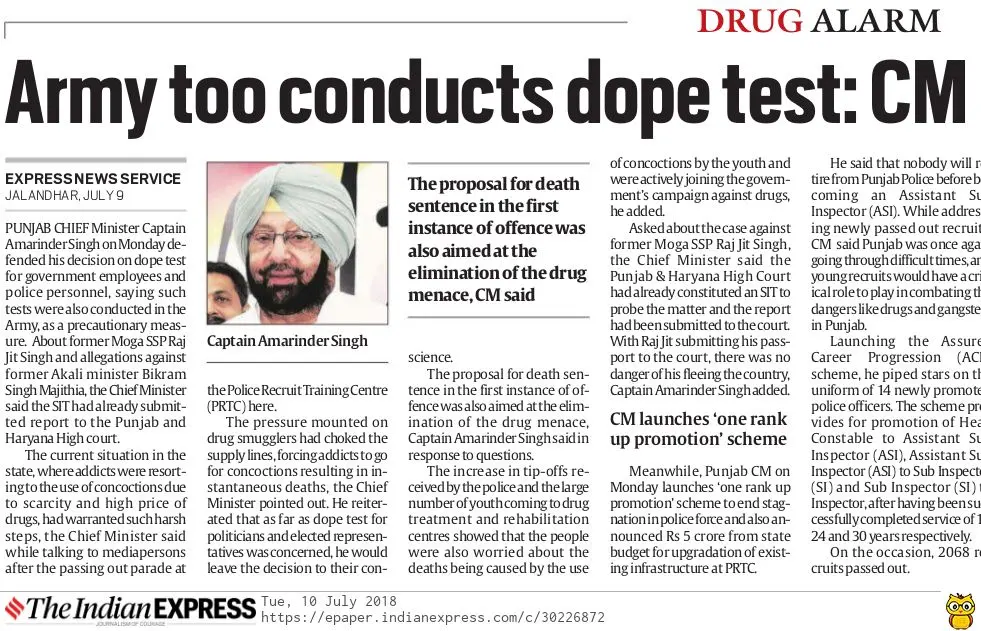
JAHAN KHELAN (HOSHIARPUR) : Punjab chief minister Amarinder Singh on Monday defended his decision on dope test for state government employees and police personnel, saying such tests were also conducted in the army as a precautionery measure.

The current situation in the state, where addicts were resorting to the use of concoctions due to scarcity and high price of drugs, had warranted such harsh steps, he said, while speaking to media after the passing out parade at the Police Recruit Training Centre here.
“The pressure mounted on the drug smugglers and mafia had choked the supply lines, forcing addicts to go for concoctions, which were resulting in instantaneous deaths,” the chief minister said.
Amarinder reiterated that as far as dope test for politicians/ elected representatives was concerned, he would leave the decision to their conscience.
Replying to a question he said, the proposal for death sentence in the first instance of offence was also aimed at the elimination of the drug menace.
The state cabinet had recently recommended to the Centre to allow death penalty for drug peddlers and smugglers.
The increase in tip-offs received by police and the large number of youth coming to drug treatment and rehabilitation centres showed that the people were also worried about the deaths being caused by the use of concoctions by the youth and
were actively joining the governments campaign against drugs, he added.
To a question on the allegations against former Akali minister Bikram Singh Majithia, the chief minister said the SIT had submitted its report to the court and the matter was before it.
Reiterating his demand for in toto implementation of the MS Swaminathan Report, Amarinder said the recent hike on MSP announced by the Centre was nothing but a “political gimmick”.
The chief minister, further in response to a question on the
problem of gangsters in the state, made it clear that law and order would be maintained in the state at all costs.
“Many of the gangsters had already been eliminated while the rest had been warned to give up or face the consequences of their actions,” he said.
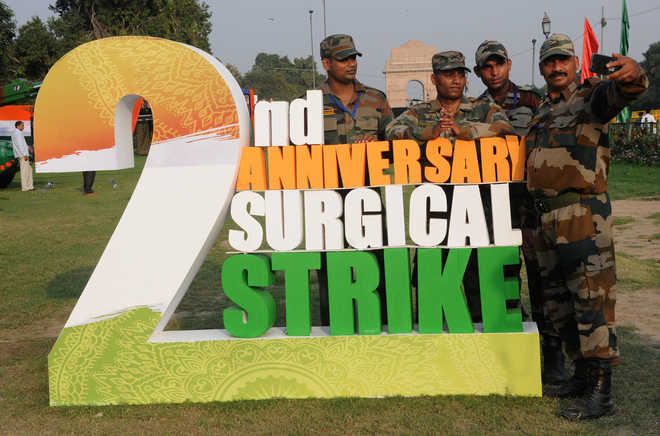
THE first-rung leadership of Independent India was understandably wary of the armed forces. The men and the institutions were handed down unaltered by the British who not too far back were utilising these very resources to stifle the Independence movement. The army-led takeovers in Pakistan and Myanmar added to their wariness. Without patriotism as a mobilising tool, Nehru’s post-colonial nationalism comprised an inclusive Indianness in communion with a wider community of recently liberated nation. Military and its valour as mobilising elements were incorporated after the eye opener in the 1962 war. Since then, politicians have experienced electoral joy in invoking the military: two stellar examples are Lal Bahadur Shastri’s slogan of Jai Jawan Jai Kisan and Indira being equated with Durga for the dissection of Pakistan.
But not even the Vajpayee government, with a similar DNA as the current dispensation, had not gone so grossly over the top. Perhaps they are banking on the proverbial short memory to eulogise a military operation that pales before the many acts of valour by the Indian armed forces since Independence. No wonder the serving and former military officers, who know better, have been uneasy about this naked display of political upmanship. The videos streaming out of our urban centres confirm the apprehension that the idea was to use the soldier as a prop for the BJP’s political propaganda. Pakistan next door offers a vivid example of what happens when the lines between the military and the civilian sphere are consciously blurred. The public display of militarised religious symbolism, Pakistan found out, was one of the major means for the promotion of the culture of militancy and radicalisation. South Block’s enrolment of the army as a proxy election campaigner will not just shortchange the electorate by glossing over the more critical bread and butter issues. Rajnath Singh had found his attempt to become the UP chief minister badly derailed after the BJP once too often whipped up patriotic frenzy over the Kargil war. Elections are still at a distance and the danger of overkill is a likely possibility.
M Aamir Khan
Tribune News Service
Srinagar, July 1
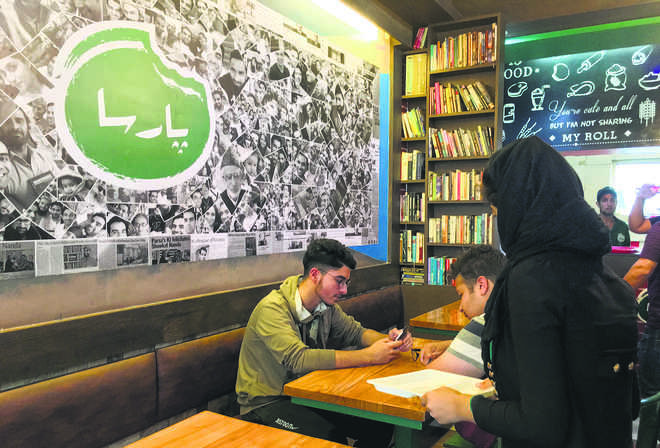
It may be a common sight elsewhere but one does not usually come across waitresses serving food at restaurants in the Kashmir valley. But scarf-clad Iqra, a spunky 19-year-old, is changing all that even as she breaks social taboo and makes heads turn at one of Srinagar’s most popular restaurants.After the death of her father last year, Iqra was forced to look for a job as she needed to support her family — an ageing mother and a younger brother. The search for employment landed her at the eatery, Parsa’s, where she gladly accepted the job.“I lost my father at a young age and he was the sole bread earner. Now, I have been working here for the past few months and so far I have not faced any problem. If women outside Kashmir can do this job, why can’t we?” said Iqra, a resident of Sonwar.Just like his customers, Managing Director of Parsa Foods and Beverages Javid Parsa said he, too, had never seen a waitress in the Valley.“We once had a female manager but I haven’t come across a waitress. The staff have adjusted well now. Customers, too, are appreciative,” said Parsa. “In fact, Iqra had inspired another girl to work as a waitress. However, she quit after objections from her family.” Iqra said women in the Valley should not shy from work usually handled by men. “Women should not feel awkward doing unconventional jobs,” she said, her smile reaching her bright eyes.
NEW DELHI:rmy Chief General Bipin Rawat on Sunday said that the youth fighting for freedom itself doesn’t know what they want. Speaking on Pakistan instigated violence in Kashmir, Army Chief said, “Pakistan wants these types of trouble (violence) to continue in Kashmir. They want that peace shouldn’t return in this area. They’re trying to radicalise the youth of Kashmir. Pakistan has decided to bleed India with a thousand cuts. This is a stated policy of Pakistan”
Read more at:
http://timesofindia.indiatimes.com/articleshow/65923470.cms?utm_source=contentofinterest&utm_medium=text&utm_campaign=cppst
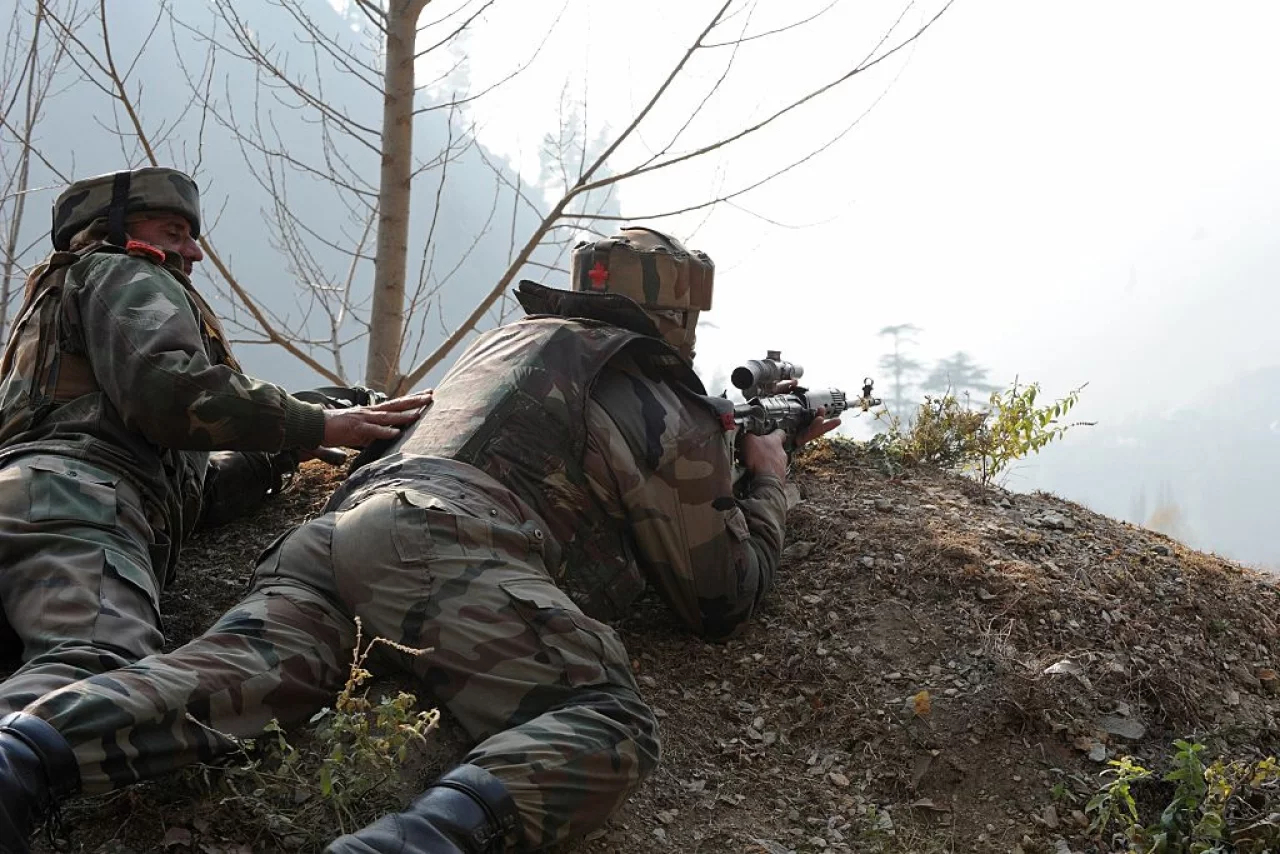
The Indian Army reportedly carried out a successful surgical strike against a camp belonging to the Khaplang faction of the National Socialist Council of Nagaland, or the NSCN(K), killing five rebels and destroying the camp on Wednesday afternoon.
According to news reports, commandos of the elite anti-terror unit, the 12 Paras, launched the strike at the camp that was located at Shwelo, three kilometres inside Myanmar. Five militants of the outfit were killed and the camp was destroyed.
Soldiers of the 12 Para went swiftly inside Myanmar and reached the came at about 2 pm on Wednesday (27 June). The rebel camp was attacked by mortars, grenade launchers and rocket launchers. The Indian soldiers didn’t suffer any injuries or casualties.
NSCN(K) information Secretary Isak Sumi has reportedly confirmed the strike. He said: “The Indian Army in huge number crossed Chenmoh village and arrived at the international boundary some kilometres away from the Naga Army forward post and on realisation that their presence has already been detected they resorted to blank firings randomly for several minutes to which the Naga Army responded and prevented any further advance. Casualties could not be ascertained. The incident occurred yesterday around noon”.
Thursday’s was the second successful surgical strike on North East rebel group bases inside Myanmar. A number of militants of the NSCN(K), the ULFA (Independent) and Manipuri insurgent outfits are based in the remote and forested areas in northwest Myanmar over which Myanmarese Army have little control.
RUPNAGAR: In a setback to the district, the army plans to shift its proposed centre for Service Selection (North) from Rupnagar to Jalandhar. Planned during the previous SAD-BJP regime, the decision to shift is because of poor rail/road connectivity of Rupnagar, sources said. A plot of 203 acre had been earmarked for the centre at the Birla Farm near the Indian Institute of Technology campus. The army is in possession of the land and senior officers had visited the site to sort out the issue of water disposal.
Since the proposal was made, a Selection Centre has been functioning provisionally from Kapurthala. Other suchcentres are in Bengaluru, Bhopal and Allahabad.
Sources said another factor that went against Rupnagar is that the town has no military units to provide security. Also, there are no medical establishments/military hospitals that are essential to conduct medical tests of candidates. “All these facilities are available in Jalandhar,” a source said.
Former Punjab minister Daljit Singh Cheema termed the proposed shifting to Jalandhar as unfortunate. “Former Punjab chief minister Parkash Singh Badal made great efforts to bring the Centre to Rupnagar . It will be grave injustice to the historic city, if the centre is shifted,” he said, adding that the state government must take up the matter with the Centre. Assembly speaker Rana KP Singh also expressed his concern over the proposal to shift the centre.
Our Correspondent
Tarn Taran, June 27The district police on Wednesday booked a medical store owner, his wife and their two accomplices who had allegedly assaulted an ex-serviceman, Jasbir Singh (53), at Noordi village here on Tuesday.The district administration has started a probe into the incident. Deputy Commissioner Pardeep Sabharwal marked an inquiry to Additional Deputy Commissioner (General) Sandeep Rishi. The latter visited the Civil Hospital on Wednesday and recorded the victim’s statement.Jasbir has been protesting against drug abuse in his native village. This did not go down well with the suspects. Assaulted at his residence, he was admitted to the Civil Hospital with injuries on legs and arms.“I have been complaining about the sale of drugs by the medical store owner and his wife for the past several years, but nothing was done by the police to nail the couple,” he claimed.Medical store owner Gurdeep Singh, wife Raj Kaur, Happy and Kala were booked. No arrest has been made so far.Jasbir alleged that Gurdeep was a drug peddler. He claimed that his brother-in-law, Ranjit Singh (45), had died of drug overdose five years ago, following which he had become an anti-drug crusader. The Tarn Taran police said raids were on to nab the culprits.
Tribune News Service
Amritsar, June 19
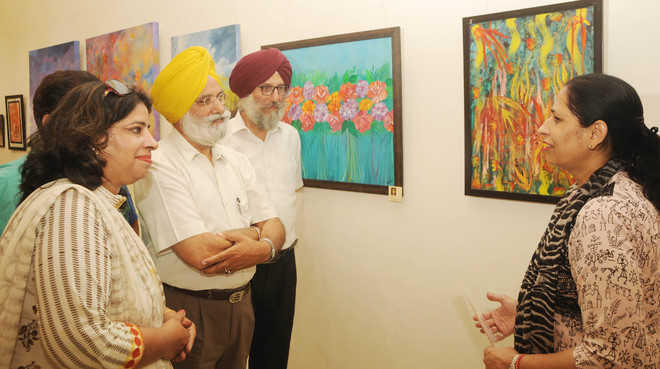
With an aim to promote sculptures and murals among the art lovers in the city, the IAFA in collaboration with Impressions, an art group, hosted a national exhibition featuring artists from across the country.The exhibition has art works by 16 artists, with sculptures and murals in 3D and graphic art as well. “3D art has developed as commercially viable option for artists in almost all genres of art. Since its introduction to the Indian art scene, many senior and upcoming artists are working in this format. But the lack of presenting opportunities and exposure is a limitation we are working to remove,” says Aruna Sharma, an artist and member of Impressions art group. Sharma’s paintings are also a part of the exhibition.Murals and sculptures from the IAFA-owned collection are already on display at one of the galleries, the effort is to highlight the genre among aspiring art students.“A workshop on mural making is being held in art gallery everyday for this month. Dedicated efforts are being made to educate young artists about latest media and other developments to enable them in popularising the art form,” says Sharma. The exhibition was inaugurated by IAFA chairman Rajinder Mohan Singh Chhina.
Chhattisgarh-cadre officer Chief Secy; two advisers to Vohra appointed
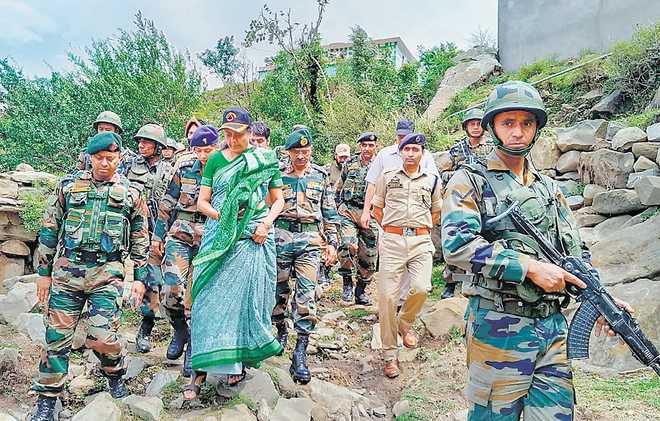
Tribune News Service
Srinagar, June 20
A day after his recommendation, Governor NN Vohra on Wednesday issued a proclamation imposing Governor’s rule in the state under Section 92 of the Constitution of Jammu and Kashmir, following President Ram Nath Kovind’s approval.The Governor had sent the recommendation after the PDP-BJP coalition government collapsed in the state with the BJP pulling out. That was followed by Chief Minister Mehbooba Mufti, submitting her resignation.Editorial: An unmourned alliance exitsBefore the recommendations, Governor Vohra consulted leaders of all major political parties to find out possibilities of an “alternative alliances”. This is the third time that J&K has been brought under Governor’s rule under NN Vohra since January 2015, following the Assembly elections held in November-December 2014, when no party got a clear majority in the 87-member House. The PDP with 28 and BJP with 25 seats formed a coalition government led by Mufti Mohammad Sayeed on March 1, 2015. The state came under Governor’s rule from January 9 to March 1, 2015. It was again imposed following the death of Mufti Sayeed on January 7, 2016, when Mehbooba Mufti refused to take over. She finally took oath on April 4. Earlier, Governor’s rule under Vohra was imposed from July 11, 2008, to January 5, 2009, after the Congress-PDP coalition collapsed. Meanwhile, 1987-batch Chhattisgarh-cadre IAS officer BVR Subrahmanyam has been appointed as the new state Chief Secretary in place of BB Vyas, who has been appointed adviser to Governor Vohra. Former IPS officer Vijay Kumar will be another adviser.Subrahmanyam, considered an expert in internal security matters, served as private secretary to former PM Manmohan Singh during 2004-2008. He worked with the World Bank from 2008 to 2011 before again joining the Manmohan PMO in 2012. He was in the PMO after Narendra Modi became the PM in 2014 and stayed till March 2015. Vyas was given a year’s extension last month. Due to superannuate in November 2017, he was given two extensions till May-end to remain Chief Secretary.