









Sanjha Morcha

What’s New

Click the heading to open detailed news

Current Events :

web counter

Print Media Reproduced Defence Related News

Jawan who crossed LoC after surgical strikes seeks retirement

Jawan who crossed LoC after surgical strikes seeks retirement

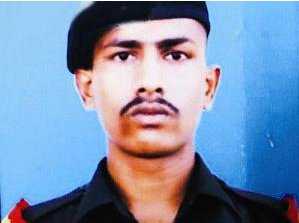
Photo courtesy: Twitter @Deb4Desh

Pune, May 22

Soldier Chandu Babulal Chavan, who had “inadvertently” strayed across the Line of Control (LoC) in 2016 after the surgical strikes and spent nearly four months in captivity in Pakistan, has sought premature retirement.Chavan, 24, who was admitted to the psychiatry ward in Military Hospital at Kirkee here, has written a letter to his seniors requesting them to relieve him from service, saying he is “disturbed”.The soldier, from 37 Rashtriya Rifles, had gone missing on September 29, 2016 after he “inadvertently” crossed the LoC, following which the Pakistan Army had taken him into custody. He was handed over to the Indian Army four months later.After returning, Chavan, who hails from Dhule district, faced a sentence for leaving his post without informing his seniors and was later transferred to the Armed Corps Centre at Ahmednagar in Maharashtra. Chavan, who was discharged from the hospital yesterday, said he was seeking retirement as he was “disturbed after whatever happened to him in the last two years”. “I have written to my seniors and requested them to prematurely discharge me from my duties and give me pension,” he told PTI.Chavan said the Army provided him all possible help and he had no complaints.A Southern Command officer, however, said they have not received any letter from Chavan.”We are yet to know the fact as no letter from him has been received so far,” the officer said.Indian Army Special Forces had conducted a Surgical Strikes along LoC on September 29, 2016, and had caused severe damage on Pakistani Terrorist outfit Lashkar-e-Taiba(LeT). PTI 

J-K truce might hold longer than expected by Pravin Sawhney

Inter-Services Public Relations DG Asif Ghafoor’s offer of the Pak army’s willingness to engage with India in talks could open up vast avenues for peace in the subcontinent.

J-K truce might hold longer than expected

Pravin Sawhney

Editor, FORCE

The conditional ceasefire announced by the Central government in Jammu and Kashmir during the month of Ramzan should hold longer than expected by most. Not because the Modi government has had a change of heart on its Kashmir policy, but because the Pakistan army is likely to give enough time to the international community (the US, China and Russia) to persuade India to move towards conflict resolution, however, slowly.Interestingly, the director-general of Pakistan’s Inter-Services Public Relations Directorate, Maj-Gen Asif Ghafoor, while recently interacting with visiting Indian journalists, said the Pakistan army is willing to join its civilian leadership in talks with India. This development, a first, could open up vast avenues for peace in the subcontinent.For one, the bilateral talks, if they happen, would not get hampered by Pakistan’s impending general election or the existing political upheaval there or the possibility of misrepresentation of Pakistan’s viewpoint by its civilian leadership. For another, the Indian ceasefire and concomitant positivity from the Pakistan army to enter direct talks would open up an entirely new phase in the bilateral relationship: from Confidence Building Measures (CBMs) which have failed to bring peace, to conflict resolution, including military CBMs which hold enormous promise to eventually tackle the most difficult issue about the future of Kashmir.Ghafoor’s sensational offer followed his army chief, Gen Qamar Javed Bajwa’s call to seek a resolution of all disputes with India, including J&K, by peaceful means. The Pakistan army has been trying since 2009 to open direct talks with India. In 2009, quite unexpectedly, the ISI chief, Lt-Gen Shuja Pasha, attended the Iftar party given by the Indian High Commission in Islamabad. There he met India’s defence attaché and floated the idea of having parallel talks with the Pakistan army alongside the civil dispensation. The idea did not go far.Moreover, the ‘comprehensive bilateral dialogue’ format agreed to by the Modi government in December 2015 was unprecedented, in that the Pakistan army had its way while allowing India to save face. After the fiasco over the Ufa statement where India had insisted that only terrorism would be discussed by the two NSAs, on October 22, 2015, Rawalpindi replaced Pakistan’s civilian NSA, Nawaz Sharif’s appointee Sartaj Aziz, with the recently retired Lt-Gen Nasser Khan Janjua, considered close to the army chief, Gen Raheel Sharif. Therefore, while India had its way of holding talks between the NSAs in Bangkok, for the first time it was talking with the Pakistan army.With a civilian government in Islamabad, India had difficulty in talking with the Pakistan army for a number of reasons. The Pakistan army is seen as the enemy directly responsible for the proxy war in Kashmir. India prides itself as a democracy; hence, with an elected government in Islamabad, direct talks with the army would not be in order. Also, India would not like to set a precedent by holding high-level government talks with the Pakistan army, fearing that with time, the Indian military — which is outside the security policymaking loop — would want to be inside it. Finally, Indian diplomats do not like the idea of sharing their exclusive space with military officers; notwithstanding the fact that the present warfare has complex nuances which the diplomats are ignorant about.Despite India’s politically correct arguments for talking with Islamabad and not Army Headquarters in Rawalpindi at the same time, the truth is that results will only accrue when the real power centre in Pakistan is addressed directly. This is how Pakistan works and India can do little about it. For example, years of structured bilateral talks under the rubric of Composite Dialogue with Islamabad have never moved beyond confidence building measures. The CBMs, by definition, are as good as the political will available on the two sides. When a civilian government in Pakistan talks peace with India, it has to look over its shoulders for its army’s nod.There is a bigger problem. The BJP’s ideological mentor, the RSS, maintains that unification of India, Pakistan, Bangladesh and Afghanistan, without the use of force, is possible. Unlike Vajpayee, who spoke in generalities, Prime Minister Narendra Modi is a hardcore rightist, so there is little possibility of his government talking about the Kashmir resolution which would usher in permanent peace and stability. True to his ideology, Modi, while reviewing the unrest in Kashmir following the killing of Hizbul commander Burhan Wani in July 2016, made it clear that India would only talk about the return of PoK and Gilgit-Baltistan with Pakistan.Notwithstanding all this, there is still a way forward. The two sides could talk security-related issues under the February 1999 Lahore Declaration’s memorandum of understanding. Instead of the strategic restrain regime suggested by the Pakistan army after the 1998 nuclear tests, the two sides could start with humble beginnings. A review of impending defence technologies which are expected to alter the strategic and operational (war-fighting) balance, to include space, cyber and sea-based deterrence, would be of interest to the Pakistan army. India’s argument that it would not discuss defence issues with Pakistan is no longer valid after the Pakistan and Chinese military have developed credible inter-operability (ability to fight together).Moreover, since the US, Russia and China have their own interests in securing peace between India and Pakistan, they would impress upon India to take the correct path to end unnecessary bloodshed on both sides. Perhaps, a beginning could be made at the coming SCO military exercise which would see the armies of India, Pakistan, Russia and China exercising together.


Nathu Khan’s Umeed by Brig Gurinder Singh (Retd)

Nathu Khan’s Umeed

Brig Gurinder Singh (Retd)

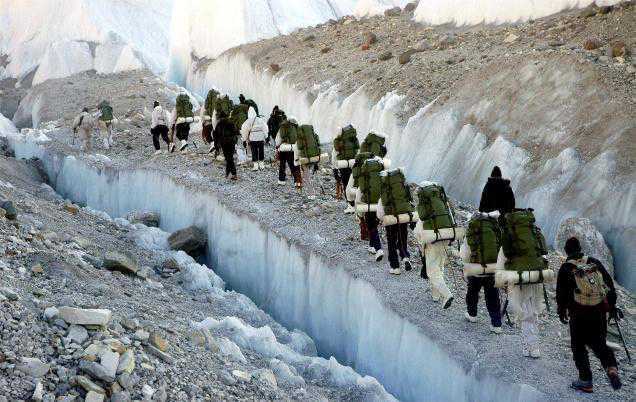
IN 1988 my battalion moved to Siachen Glacier. We all were anxious and overawed by exaggerated stories/rumours about life in the highest war zone of the world. It was already September, there was not enough time before the long and severe winter would set in and some of the posts would remain cut off for six months. When it came to occupy a small, precariously located post to be manned by eight men led by a Havildar, the Company Commander made an emotive invocation for volunteers to step out. Even before he finished, Havildar Nathu Khan offered to be the post commander.The next day at 3.30 am, Nathu Khan led his men to the post and got down to taking over the operational responsibility. The post, 30 ft by 20 ft and dominated by enemy fire and observation, lay in the avalanche-prone zone. A wonderful view down the slopes was the only consolation. Over the next few days, Nathu and his men double-checked every bit of stocking of ration, medicines, kerosene and other provisions. They all wrote letters back home to wives, mothers and children (there were no mobiles then) before they were cut off in end November.Then it began to snow heavily and isolation began to test Nathu’s team. The men faced the vagaries of weather cheerfully, but the routine of shovelling tons of snow every few hour and very restricted space for movement were irksome. Much to the relief of the men, the sun shone for three continuous days in the first week of February. The same month, a minor avalanche hit the post and destroyed a bunker. There were no casualties but some rations and provisions were swept away. Nathu kept his flock together in the safest bunker till the avalanche warning receded. When he took stock of the losses, it emerged that apart from some rations, the entire stock of matchboxes were lost in the landslide. With at least three months to go, the only source of fire was a lone wick burning at the top of a kerosene-filled bottle. Nathu and his men resolved to keep the wick burning. It was always guarded by one of the men through blizzard and windy conditions, till the route opened in May.A year after the glacier tenure, Nathu chose to seek premature retirement. By then I had become his Company Commander. I tried to persuade him not to leave but in vain. Later, he invited me to his village in Sikar for the inauguration of his house. After all the guests had left, I asked him about his experience on that isolated post and how he kept the wick burning for three months in those severe conditions. Looking in the distance, he said: ‘I secretly thought of the batti as the beti I never had (Nathu has three sons), and named it Umeed. I decided to care for it the way I would for my daughter — aur beti kab saath chhodti hai?’


CM slams opposition for row over history books

SAYS DECISION TO REALIGN SYLLABUS WITH NCERT TAKEN IN AKALI RULE, SGPC WAS PART OF DISCUSSIONS SINCE MARCH 2017 TOO

CHANDIGARH:Slamming the opposition parties Shiromani Akali Dal (SAD) and Aam Aadmi Party (AAP) over the issue of Sikh Gurus in school history books, Punjab chief minister Capt Amarinder Singh on Monday rejected their allegations, warning them against harming the interests of the state by playing with religious sentiments.

The CM lambasted SAD president Sukhbir Singh Badal for making “baseless statements” and condemned AAP for “joining the vilification campaign against the government without bothering to verify the facts of the matter”.

He pointed out that it was during the Akali regime in 2014 that the decision to realign the courses with the National Council for Educational Research and Training (NCERT) syllabus was taken and the Shiromani Gurdwara Parbandhak Committee (SGPC) was party to all the discussions.

“It was on January 9, 2014, that an expert committee was proposed to be set up to discuss the issue of realignment and to finalise the history syllabus from Class 9 to 12,” Amarinder further said.

The CM said after assuming charge, his government had written to SGPC in March 2017 for discussion on the issue of the history course realignment and the body deputed Prof Paramveer Singh of Panjabi University, Patiala, for this. He flayed SGPC head Gobind Singh Longonwal for deliberately hiding the facts.

“The Class 11 history book they are talking about has not been printed yet. The history of the Sikh gurus has been retained in the realigned syllabus, with no cutting or pruning,” he said.

‘SAHIBZADAS’ CHAPTER MY RECOMMENDATION’ Following the “syllabus realignment”, the entire period from Guru Nanak Devi to Guru Gobind Singh and the martyrdom of the four Sahibzadas is now being taught in Class 11, the chief minister said, adding that the history of four Sahibzadas was incorporated on his recommendation.

Information on the Sargarhi battle and the Sikh general Sham Singh Attariwala was incorporated in the Class 10 history book on my suggestion,” he said.

PSEB TO PUT CLASS 11 BOOK ON WEBSITE

The Punjab School Education Board said on Monday it will upload the new Class 11 history book on its website, after opposition parties accused it of removing chapters related to the era of Sikh gurus from Class 12 books. “The new book of Class 11 will be uploaded on PSEB website in next 10 days and thereafter, it will be released in the printed form,” a senior PSEB official said.

The SAD and Aam Aadmi Party have accused PSEB of deleting the history of Sikh gurus from the history book of Class 12.

SAD PANEL TO DECIDE COURSE OF ACTION

The Shiromani Akali Dal (SAD) on Monday decided to hold a meeting of its core committee on May 3 to formulate an action plan to force the Congress government to reinsert all 23 deleted chapters related to the era of the Sikh gurus back into the Class 12 history book.

Presiding over a party meeting here, SAD president Sukhbir Singh Badal said the Congress government was belittling the glorious history of the Sikh gurus.


Why the inter-Korean meet has ignited anxieties

North Korean leader Kim Jong­un’s peace offensive has put both South Korea and the US on the defensive

The summit between South Korean President Moon Jae-in and North Korean leader Kim Jong-un takes place today — the same day China’s President Xi Jinping will host Prime Minister Narendra Modi. While the Xi-Modi informal summit is designed be a closed-door brainstorming, the inter-Korean summit has the defined goal of denuclearising North Korea. It is also meant to set the stage for the first-ever summit between a sitting North Korean leader and a serving US president.

REUTERSKim Jong­un’s deft nuclear diplomacy has earned him enormous visibility. The royal treatment he got in Beijing could be the sign of things to comeCompared to the calm, duck-paddling style in India-China diplomacy, hectic footwork in the Korean peninsula has ignited enormous enthusiasm and anxieties. A hotline between the two leaders was commissioned on August 20. A day later, Kim announced his decision to stop all nuclear and missile tests, and to close test sites. Such unilateral concessions from a trigger-happy Kim were described as a “meaningful step forward” and a “big progress” by Moon and Trump. While sceptics allude to North Korea’s track record of similar pledges in 1994, 2005, 2007 and 2012 not fructifying and believe that Kim is bluffing, enthusiasts are celebrating this as a victory of Trump’s “maximum pressure” strategy that may see him go down in history for having finally resolved the Korean nuclear crisis.

Meanwhile, Kim’s deft nuclear diplomacy has earned him enormous visibility. His getting the royal treatment during his March 25-27 visit to Beijing could be the sign of things to come. Kim hosted Mike Pompeo, Trump’s CIA director, over Easter holidays. In this hype, Kim has said nothing about giving up nuclear weapons or stopping tests of medium range missiles. But given his incessant testing of nukes and missiles, and his verbal blitzkrieg last year, his halting of nuclear and missile tests is being labelled as major achievement for the Trump administration.

Having achieved his robust nuclear deterrence , Kim wants to draw political dividends from it. The plenary session of the Workers’ Party on “policy issues in a new stage” last Friday marked a shift in Kim’s “byongjin” (or dual push) policy of simultaneously pursuing nuclear weapons and economic development. Compared to “juche” (or self-reliance) policy of his grandfather and father, “byongjin” had been the buzzword ever since Kim took over.

Kim’s peace offensive has put both Seoul and Washington on the defensive. Pyongyang, that has been demanding withdrawal of US forces from the Korean peninsula, has also not reacted to Moon’s assertion that this issues was not on the table. Kim continues to hold his cards carefully, fuelling curiosity among his adversaries, which now defines his nerveracking adventurous nuclear diplomacy.


NCC interactive session

Tribune News Service

Chandigarh, April 26

The NCC of Panjab University organised an interactive session with the Commanding Officer (CO), 2 Chandigarh Battalion, for the cadets of the university. An annual report of all activities undertaken was presented. CO MK Sharma boosted the morale of the cadets with his motivational thoughts. Lt (Dr) Kuldeep Singh, Coordinator NCC, extended a vote of thanks to the CO for his support to the NCC Panjab University during his tenure. On the occasion, DIG Hemant Kumar (BSF), 50 cadets and others were presen


Militants target CRPF patrol in Anantnag, passerby killed

Militants target CRPF patrol in Anantnag, passerby killed

Our Correspondent

Anantnag, April 26

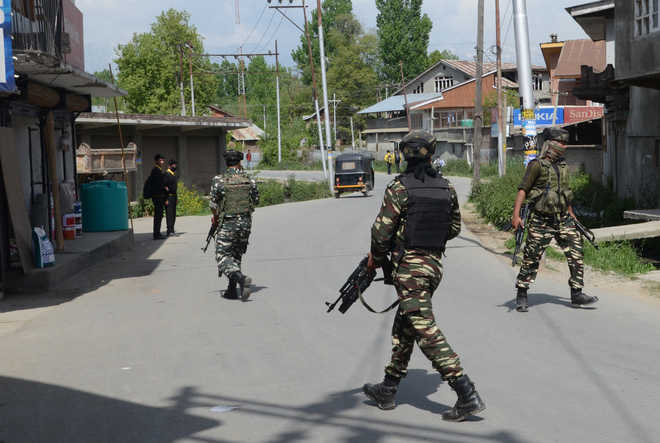
A civilian was killed after car-borne militants opened fire at a road opening party of the Central Reserve Police Force here on Thursday.The civilian had been identified as Shakeeb Shabir Shah from Shopian district. A hunt had been launched to nab the militants, said the police.“At 2.20 pm, the militants, travelling in a Santro car, opened fire at security forces in the Laizbal area of the town, along the Khannabal-Pahalgam road,” Senior Superintendent of Police Altaf Khan said, adding that one of the bullets hit Shakeeb, who was passing by in a Tata Sumo. Shakeeb succumbed to his injuries while being taken to Srinagar.Meanwhile, the Army fired in air and burst teargas shells when some students of the Islamic University of Science and Technology (IUST) in Awantipora threw stones at Army personnel near the campus.“University students threw stones at an Army party while it was laying and repairing cables near the campus,” a police spokesperson said.He said the Army fired in air and the police rushed to the spot. However, students and university administration refuted the police claims. They termed the Army action as completely uncalled for and unprovoked.Mushtaq A Siddiqui, VC, took note of the “unprovoked” use of teargas shells. “There was no provocation from the students as normal classwork was on in the varsity when the incident occurred. Protests started only after the firing incident,” Siddiqui said in a press release.Three hurt in Kulgam grenade attackAnantnag: Two policemen and a civilian were injured in a grenade blast in Kulgam district on Thursday evening. The injured have been rushed to a hospital. A police official said militants hurled a grenade at a police station at the main town in Kulgam around 8.10 pm. “The grenade exploded outside the premises of the police station,” the official said. OC


Proteins repair muscles after workout, try these six plant-based sources

HEALTH You need to follow it up with proteins to see some visible weight loss results. Proteins are the building blocks of the body. They are required for the maintenance of our tissues, muscles, blood cells, hormones, among others

One of the biggest problems many vegetarian fitness enthusiasts face is that they can’t eat lean meat and eggs for proteins. But don’t let that stop you because we have found the best plant-based proteins to keep your fitness levels up. We promise you amazing weight loss results with these.

Protein is needed to repair muscles after an intense workout. These are the best sources of plant-based proteins. ■ ShutterstockWHY DO WE NEED PROTEIN?

What do you think of when you hear the word proteins: mega shakes guzzled down by bodybuilder-type gym rats, protein bars and milkshakes? While that association might be the easiest to make, it’s not the only one. Protein is not just for gym junkies, who workout to a plan to lose weight or stay fit. It is essential for all those trying to lead a healthier lifestyle.

“Dietary protein is digested and absorbed in the body in the form of amino acids. These amino acids derived from the dietary proteins are used by the body for various functions like enzymes, hormones and antibodies,” says Indrayani Pawar, team leader – dietician team, Hinduja Healthcare Surgical.

Simply put, proteins are the building blocks of the body. They are required for the maintenance of our tissues, muscles, blood cells, hormones, among others. And if you’re exercising, protein is needed to repair muscles and avoid muscle loss after a workout. Heard of the term ‘gains’? (It’s when each and every muscle in your body becomes more prominent after an intense workout.) And these gains are harder to come by if you’re a vegetarian.

Why? Because animal based proteins are absorbed easily by our body. But that doesn’t mean that vegetarians can’t build muscles. In fact, a lot of vegans (who obviously don’t have milk and milk products too) are able to build body mass and even participate in marathons across the world.

6 best sources of plant-based proteins, according to Pawar.

Dals (lentils) and pulses: These are low-carb and high protein with lots of fibre, iron and potassium.

Tofu: Have it pan-fried or stirred into curries, tofu is an excellent source of protein. Opt for organic variety to make the most of it.

Nuts (almonds, walnuts): Whether you’re munching on some roasted almonds or adding them to your smoothie bowls, nuts are a great source of protein. It’s also the perfect snack after a workout.

Oilseeds (groundnut, flax seeds, sunflower seeds, pumpkin seeds, chea seeds etc): Like nuts, oilseeds too can be had on their own or added to your meals.

Beans: These are not only a good source of proteins but they also contain amino acids, which play a big role in healthy muscle synthesis.

Cereals & millets (jowar, bajra, quinoa, rajgeera): These ancient super foods are loaded with proteins.


New ministers take charge, ward off ‘evil eye’ on bungalows, offices

CHANDIGARH: When it comes to plush homes and offices, old enmities don’t count. All you need to do is ward off the evil eye! Punjab’s new jails and cooperation minister Sukhjinder Singh Randhawa took charge on Tuesday accompanied by chief minister Captain Amarinder Singh. But he had already performed ‘paath’ (recitation of religious hymns) at his office at the civil secretariat on Sunday.

PHOTOS: KESHAV SINGH/HT■ Sunder Sham Arora, MLA from Hoshiarpur, after taking charge as minister at Punjab secretariat in Chandigarh.Not very long ago, this office belonged to Rana Gurjit Singh, a former power and irrigation minister, who had to quit for alleged involvement in a scam in sand mining auctions. There is no love lost between the two.

Randhawa says he chose the office as it is convenient for visitors. But he remains wary of Rana’s controversies.

About portfolios, he said, “Both power and irrigation are not easy to handle. I am happy having cooperation and jails department. I can do a lot for farmers and improve the condition of the jails,” he said.

There is also a twist in the tale of old Majha rivals. The new revenue minister, Sukhbinder Singh Sarkaria, is amused at the media reports over the personal assistant of his predecessor in the SADBJP regime, Bikram Singh Majithia, having been allotted to him. But he was not keen on occupying the office of Majithia on the seventh floor, which is currently with rural and urban development minister Tript Rajinder Bajwa. All three are from the Majha region. The old bond between the two leaders saw Bajwa give up the office on the fifth floor to Sarkaria.

Bajwa says he wanted to move out of the seventh floor office owing to mobile connectivity issues. “It is difficult for an old man like me to be on the seventh floor, that too without mobile signal. But I gave up my office as Sarkaria is like my younger brother,” he said.

The three other ministers allotted office on the seventh floor are relatively younger — food and civil supply minister Bharat Bhushan Ashu, animal husbandry minister Balbir Singh Sidhu and power minister Gurpreet Singh Kangar.

Sarkaria’s fifth-floor office was earlier with SAD leader and former rural development minister Sikander Singh Maluka. And one minister who would not occupy it is Kangar. The bitter rivalry between Maluka and Kangar dates back to many elections over Rampura Phul seat. In fact, Kangar’s entry to the cabinet, a senior party leader said, was a “reward for standing up to might of Badals and Maluka in Bathinda”.

But it is the story of a “revolving” bungalow between two Badal families that’s seen as the most interesting. Majithia’s former official residence located in the upscale and high-security Sector 2 of Chandigarh, adjacent to the CM’s residence, is now with finance minister Manpreet Singh Badal. Majithia is the brother-inlaw of SAD president and former deputy CM Sukhbir Singh Badal, Manpreet’s estranged cousin.

According to Manpreet, the house was with him when he was finance minister in the SADBJP government, and Majithia took it after he left the SAD. Majithia’s new address in the capital is the MLA hostel.

Speaking of ministers and houses, technical education minister Charanjit Singh Channi has been able to keep the palatial house he was allotted as leader of opposition (right next to that of the CM) in Sector 2.

On “astrological” advice, Channi even got the swimming pool in the house, made by his predecessor Rajinder Kaur Bhattal, closed. But it has not got him plum portfolios. As for Bhattal, she lost both the house and the election, but won a waiver of Rs 84 lakh penal rent from the Captain government for overstaying in the official bungalow from the ministers’ pool. VERKA TAKES UP DALIT REPRESENTATION CHANDIGARH: The discontent within Congress in Punjab over the recent cabinet expansion reached the high command in New Delhi with Dalit leader and MLA Raj Kumar Verka expressing “anguish” over Scheduled Caste members not being given adequate representation.

“I apprised Congress president Rahul Gandhi of the sentiments of the community,” Verka claimed.


Indian Air Force Tests Capability To Handle Nuke Warfare During Mega Exercise

Indian Air Force Tests Capability To Handle Nuke Warfare During Mega Exercise

A major focus of the exercise was to check combat capability of the indigenously developed Light Combat Aircraft or LCA Tejas and their performance was satisfactory.

The primary aim of the exercise was to sharpen India’s war waging capability. (File photo)

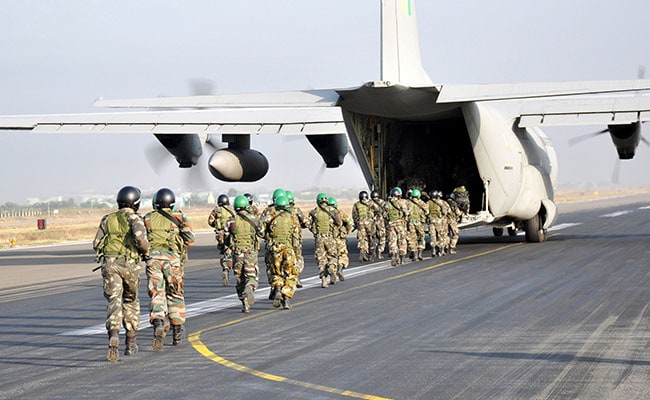
NEW DELHI:  The Indian Air Force or IAF tested its capability in dealing with a possible scenario of nuclear and biological warfare during a 13-day-long mega military exercise whose aim was to sharpen its war waging capability in the wake of fast evolving regional security situation.

Official sources said the focus of the Gagan Shakti exercise from April 8 to 20 was to check the viability of IAF’s operational plans to deal with any kind of challenge including nuclear warfare and a possible situation of a two-front war with China and Pakistan.

A major focus of the exercise was to check combat capability of the indigenously developed Light Combat Aircraft or LCA Tejas and their performance was satisfactory, IAF sources said.

They said eight Tejas were deployed during the exercise and some of these had reported minor technical issues, adding each of the six Tejas had flown six sorties daily like any other platforms including Sukhoi, Mirage 2000 and MiG 29 jets.

The sources said aim of the exercise was to test IAF’s combat readiness in a real time scenario, adding it had never carried out an exercise of this scale earlier.

A key focus of the exercise was to check IAF’s readiness to deal with a biological, chemical and nuclear war and we were satisfied with our capability to deal with such situations, they said.

They also said all types of aerial weapons, including standoff and precision weapons were deployed to validate their use in the air operations matrix.

As part of the massive drill, the IAF deployed its entire assets for the pan-India exercise with fighter jets, equipped with strategic weapons like Brahmos and Harpoon anti ship missiles, carrying out deep penetration strikes to revalidate its strategic reach.

During the exercise, the sources said over 11,000 sorties were flown which included nearly 9,000 sorties by fighter aircraft.

The combat drill was carried out at a time when China was increasing its assertiveness along the borders with India and while Pakistan has been continuing its skirmishes along the Line of Control in Jammu and Kashmir.

The exercise covered all terrains including desert, high altitude areas like Ladakh and maritime sphere.

During combat drills near Sino-India border, the IAF significantly focused on inter valley transfer of troops considering various possible situations of conflict and taking a lesson from the Doklam standoff.

Ensuring serviceability of fighter aircraft and various missile systems were a priority area and the IAF succeeded in its endeavour, officials said.

The serviceability of surface-to-air missiles were around 97 per cent while serviceability of fighter jets were close to 80 per cent, they said.

Serviceability refers to availability of an aircraft or a weapon system for deployment. The IAF has been struggling to maintain high serviceability levels of its platforms due to difficulty in getting required spares.

6COMMENTS

Similarly, the IAF could ensure high levels of dispatch reliability which refers to ability to make the serviceable flying platforms airborne as and when required, the officials said.