Ropar MP Prem Singh Chandumajra has said the Army’s proposed Selection Centre (North) would not be shifted from here to Jalandhar. Recently, media reports stated that the Army was mulling to shift the proposed centre to Jalandhar citing many reasons, including poor rail and road connectivity, lack of military hospital and no army unit in vicinity to provide inherent security to the centre.Chandumajra said Union Defence Minister Nirmala Sitharaman had assured him that the centre would be set up at Ropar only.
Northern Command chief Lt Gen Ranbir Singh in Kupwara.
Srinagar, July 11
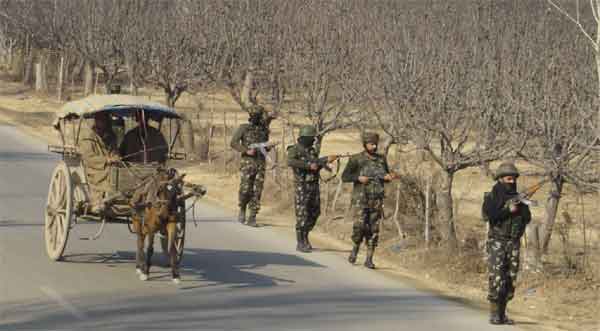
Northern Army chief Lt Gen Ranbir Singh, while concluding his tour to Kashmir, visited the forward areas of the Valley to review the prevailing security situation and strategy for counter-infiltration and counter-terrorist operations.Accompanied by Chinar Corps chief Lt Gen AK Bhatt, the Army chief visited forward posts in the frontier district of Kupwara where he was briefed on the counter-infiltration grid and operational preparedness of the formations. The Army chief was appreciative of the measures and the standard operating procedures instituted by the units and formations to meet the challenges posed by the inimical elements.During his interaction with the soldiers on ground, he lauded them for their high level of morale and round-the-clock vigil which they maintain to thwart infiltration bids by the terrorists. The Army chief exhorted them to continue to work with same zeal and dedication to defeat the enemy’s hostile designs. — TNS
“Students of Sainik School, a pride of Punjab, have brought accolades to Punjab with their achievements. They shine like a star in country and abroad,” said Punjab Education Minister Om Prakash Soni, who presided over the award distribution ceremony of 57th annual athletics meet at Sainik School here.
The Education Minister said 1,100 military officers, including 50 Lieutenant Generals and Major Generals, have been serving the country after passing out from Sainik School. Congratulating the students, he said they were very fortunate to study in such prestigious institutions. “Students studying in such coveted institutions never fail in their life and definitely get higher posts in their career, he said.
After giving away prizes to the winners of the three-day athletics meet, Soni said they were the founders of future, hence they should work diligently and with full dedication to achieve their goals.
Cadets held a march past under the banner of their respective houses coupled with wonderful presentation of the world famous bands of school.
In the Army, it is not unusual to find real brothers or cousins serving together in the same unit, especially in caste and region-based regiments as parental and sibling claim is given due consideration while assigning battalions. Not only multiple pairs of brothers, but also father and son serve in the same company and battalion. As a young officer, I saw a Havildar who chose to be the Guard Commander at the Quarter Guard on the last day of his service with his son (who had joined the battalion a week earlier) as a sentry.Subedar Prem Singh was one such proud father whose son Subhash joined our paltan while he was still in service. While Subedar Prem, stout and handsome, had been a wrestler of repute in his youth, Subhash was thinly built and barely met the basic Army physical standards. He managed to pass the mandatory physical tests with some push from his colleagues, a bit leniency of the officers and abusive threats from his father.Subhash had an uncanny knack of misinterpreting a simple order and executing it in exactly the opposite manner and justify it too. He surprised everyone with his misadventures where ever he was assigned any duty. But his father continued to harbour high hopes for him. In 1985 when our battalion was in Dagshai (HP), Subedar Prem’s request for the family quarter was accepted. He arranged Subhash to proceed on leave with the instruction ‘Maa ko le aana’. The ever obedient son left for his home in Ghaziabad. Meanwhile, Subedar saheb took charge of his new quarter, arranged furniture and prepared himself to live with the family for some time before retiring a year later. He was determined to spend some quality time after years of separation. He also made plans to take the family to Shimla and Kasauli.On the day of Subhash’s return, Subedar saheb dyed his greying moustache and whatever hair on his mostly bald head. He double-checked every detail at the newly allotted quarter and reached the Dharampur Railway Station well ahead of the scheduled arrival of the narrow gauge train from Kalka. He also arranged some chai-pakora to welcome memsaheb at the platform.Finally the train arrived and Subhash alighted from the train with a couple of suitcases and then extended his hand to help Maa get down. An 80- year-old lady emerged and slowly walked towards the reception party. Furious, Prem Singh dragged Subhash to the side and shouted, ‘Arre, maine teri Maa ko lane ke liye kaha tha meri nahi, nalayak!’ (I asked you to bring your mother not mine). Unapologetic, Subhash retorted, ‘Apne bola tha maa ko lana, meri ya teri ka nahi kaha tha’ (you asked me to bring mother, but didn’t specify whose). In 2006, Prem Singh came to my house and presented me a can of homemade ghee. When I asked him the reason, he said: ‘Subhash thik-thak pension aagaya hai aap logon ki meharbani se.’
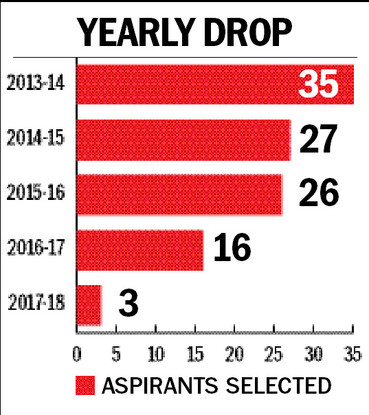
While intake of officers into the armed forces from Punjab has witnessed an encouraging trend over the past few years, there has been a consistent decline in the number of officers from the state getting selected into the Air Force at the graduate level.In 2013-14, as many as 35 graduate candidates from Punjab joined the IAF for pre-commission training, which has come down to just three in 2017-18, according to data compiled by the state government in June.The number of such candidates joining IAF academies was 27 in 2014-15; 26 in 2015-16; and 16 in 2016-17. These figures are based on the claims received for the grant of Rs 1 lakh that the Punjab Government gives to every person from the state who joins a service training academy. This does not include intake into the tri-service National Defence Academy at the 10+2 level, where some cadets later opt for the Air Force. The Air Force, having an authorised strength of 12,581 officers, including women, faces a shortage of 206 officers. At 1.6 per cent, this shortage is the lowest compared to 12 per cent for the Navy and 15 in the Army.Even as there are several factors that determine selection in the armed forces, experts seem unable to pinpoint the reasons for the sudden decline in graduate selections in the IAF from Punjab.According to a serving IAF officer, the medical parameters for the Air Force, especially the flying branch, are more exacting and stringent than the Army, which results in higher number of rejections.Education and grooming is also a major factor as the IAF requires at least 60 per cent marks at the graduate level for most branches, including flying, engineering and administration. “A consistent decline in intake can also be indicative of the quality of candidates,” he said.“Apparently, students are branching out into other streams that they consider more lucrative, given the large number of institutions offering a multitude of professional courses that have cropped up in the region,” says Dr Rakesh Dutta, a professor of defence studies.“This is a tremendous drop, and an alarming trend that needs to be studied,” he says. The increasing number of bright youngsters from Punjab opting to go abroad for higher studies or jobs adds another dimension to the issue. “For Punjabis, family tradition and the prestige associated with the uniform was the prime motivator, rather than money, for joining the services,” says Wing Commander DP Sabharwal (retd), a trainer and a career counsellor. “The present generation of young officers complains not only of an unhealthy equation with their civilian counterparts, but also a decline in status, perks and social life,” he adds.The intake also depends upon the annual vacancies available. Though the overall intake into the services, according to official sources, has witnessed a decline over the past three years (1,961 in 2015 to 1,858 in 2016 and 1,773 in 2017), this is not proportionate to the sharp decline in the graduate selection in the IAF from Punjab.
Key factors
Medical parameters for the IAF, especially flying branch, are more stringent than the Army
The IAF requires at least 60% marks at the graduate level for most branches
Increasing number of bright youngsters are opting to go abroad for higher studies or jobs
A unique Kashmiri translation of 40 poems by Bhai Vir Singh on the heritage and glory of the Valley will be unveiled by J&K Governor NN Vohra today
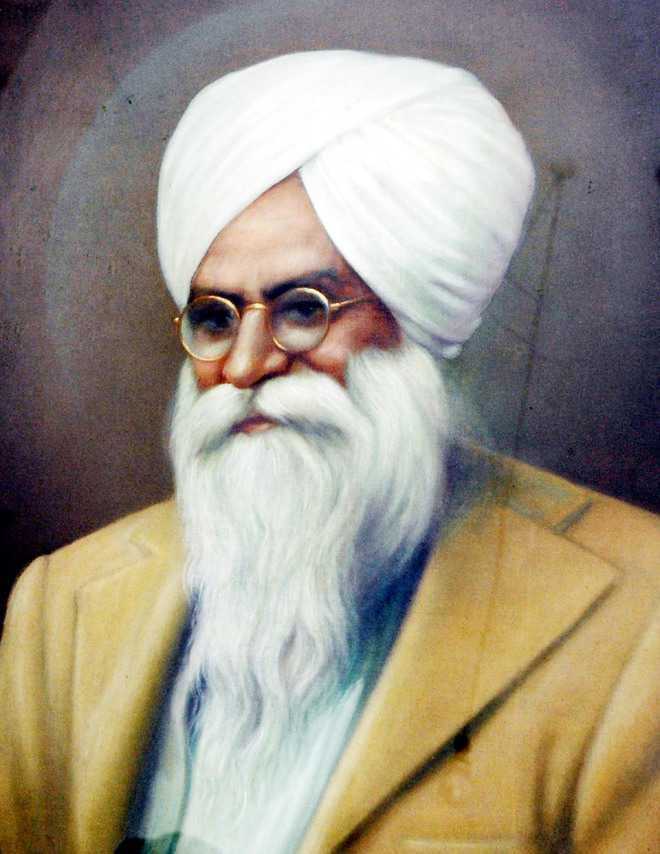
Father of Modern Punjab Literature Bhai Vir Singh
Aditi Tandon
Tribune News Service
New Delhi, July 1
As Kashmir gets back to normalcy, a Delhi-based Punjabi literary centre has prepared its own contribution to the ongoing national efforts aimed at healing the Valley of its wounds. Bhai Vir Singh Sadan has published a unique Kashmiri translation of the Punjabi poems the Father of Modern Punjab Literature Bhai Vir Singh wrote over a span of many years starting 1922 when he first visited the Valley. From then on, he returned to Kashmir every summer to capture its virgin beauty in thoughts and words.The title of the anthology — “A Valley Nonpareil” — is a literal translation of Bhai Vir Singh’s famous poem describing Kashmir as “Tukdi jag ton niari”.Featuring 40 poems, each illustrated by a photograph of the location that inspired the work, the book will be unveiled by Jammu and Kashmir Governor NN Vohra at a special ceremony in Srinagar tomorrow. Each verse bears the Kashmiri and English translation of the original Punjabi poem on Kashmir by Bhai Vir Singh.The work brings to life the Valley’s diverse heritage using the poet’s tender verse which often laments how Kashmir’s beauty has become its bane. The works mirror Kashmir in all its glory as the poet reflects on the Punjabi love legend of Heer and Ranjha unfolding on the banks of Chenab, captures the beauty of Kashmiri damsels, relishes the cadences of Valley’s countless streams and even rues the axing of grand Kikars.A rare gem in the work is a photograph of Bhai Vir Singh basking in the beauty of Alpathar he visited on September 7, 1927 — a picture Sadan’s Director Mohinder Singh dug out from the archives as evidence of how the Valley inspired generations of saints, artistes and writers alike. Yet another Bhai Vir Singh poem the book reproduces is on Gulmarg. It carries as an illustration a postcard the poet himself wrote on August 10, 1928.Then there is an especially heartwarming longish “Dumel de Panian da Naad” in which Bhai Vir Singh traces the heritage of Kashmir and its rendezvous with Lord Rama, Lord Krishna, Lord Budhha and Guru Nanak.Referring to the association of Sikh Gurus with the Valley, the poet dwells on Guru Nanak’s dialogue with Pandit Brahm Das in Srinagar on his way to Kailash Parbat. He then captures the Valley’s age-old tradition of peaceful coexistence by writing of how Gurdwara Matan Sahib and the temple in the memory of Brahm Das stand side by side in Kashmir, as testimonies to its s all embracing culture.“How could such a land and beautiful Valley become a centre of conflict?” wonders the poet.The book has a preface by former Prime Minister Manmohan Singh, a foreword by NN Vohra and an introduction by eminent litterateur Dr Surjit Patar.
The Northern Railways has decided to start Captain Service in long route trains operating in the region to felicitate passengers. According to the Railways authorities, the decision was taken in view of increased rush of passengers during the festive season.
They said this service would be provided in more than half dozen long route trains operating from the Northern Region.
The railway authorities said the ticket checker deployed in trains would be given additional charge of Captain in long route trains. “The Captain will be given a complaint book and passengers can inform him about the problems being faced by them while travelling. The mobile number of the Captain will also be displayed on the reservation chart,” a railway official said.
In fact, the rush of passengers is expected to increase manifold during the festive season in the coming some days. “A badge will be given to the train Captain, so that passengers can easily recognise him. Passengers can register their complaints with the Captain. They can also give their feedback and suggestions about their travelling experience in trains,” said Ludhiana Railway Station Director Abhinav Singla.
He said the railways expect to improve its service on the basis of suggestions and feedback given by passengers. “We are duty bound to provide best possible service to passengers. We appeal to the passengers to give their valuable suggestions to the train Captain about the facilities provided in the trains, so that we can improve in future,” Singla said.
2016 surgical strike video surfaces: How Indian Army destroyed terror camps
NEW DELHII: Video footage of surgical strikes across the Line of Control (LoC) that took place on September 29, 2016 was aired on TV news channels on Wednesday.
The eight-minute-long video shows how the Special Forces of the Indian Army crossed over the LoC and destroyed the targets on the Pakistani side of the LoC.
The footage was reportedly shot from drones and Unmanned Aerial Vehicles (UAVs), and was shot on thermal imaging cameras used by
Ever since the surgical strikes took place, the opposition had been raising questions and demanading proof of the military action.
The strike were conducted in 2016 when the the Indian Army destroyed terrorist launch pads and killed many terrorists.
“The operation was monitored from a control room in Udhampur, Headquarters of Indian Army’s strategic Northern Command,” Lt Gen (retd) D S Hooda, the then Northern Army Commander told Times Now.
“One of the major challenges that the team that went across, faced was that the camps were located close to Pakistan Army posts,” Hooda added. He further said that the “feed was also going to Delhi”. “The whole operation lasted for six hours. The first target was hit at midnights and the last at about 6-6.15,” he added.
A day after the video’s release, the Congress on Thursday accused the Modi government and the BJP of politicising the September 2016 surgical strikes to garner votes.
Addressing a press conference, Congress chief spokesperson Randeep Surjewala charged that while on the one hand the Modi government is seeking credit for the sacrifice and valour of the armed forces, on the other it has failed to provide direction and vision to deal with Pakistan .
He also accused the government of meting out “step-motherly treatment” to the armed forces by not providing them with state-of-the-art equipment and slashing their budgetary allocation.
As the Modi Government seeks to politicise the bravery of our soldiers and their determination in conducting the surgical strikes through ‘headline management’, the Nation demands answers,” Surjewala said.
TOP COMMENT
Randeep Surjewala is trying very hard to keep the Congress relevant, but the more he speaks, the more irrelevant it becomes!!madan rao
“Is the Modi government endangering our ‘security infrastructure’? Is the Modi government guilty of putting the life of our soldiers in danger? Is the Modi government using our ‘soldiers’ as ‘political fodder’ – using their sacrifice for vote garnering?,” he asked.
By making public the videos of the strikes, has the government not somehow endangered lives of armed forces participating in them as also civilians living along the Line of Control, he asked
The political co-habitation between BJP and PDP in J&K has come to an end. There is no dearth of the inevitable ‘I told you so’ experts who claim that they had predicted it long ago. Equally, there are those who claim that they had the prescience to know of its failure from day one. However, in dealing with the vexed and long-festering problem in the State, which has defied solution for all these years, choosing a new direction was a bold and correct decision. As such, the experiment failed, is no reason that it should not have been tried.
The question now is what next? It has been suggested that the security forces must go ‘all out’ to hunt down the 200-odd terrorists reportedly present in the Valley. True that. But it ignores the fact that when – and if – the SF are able to do so, there is no denying that more will trickle in from across the border, following the same methodology that these 200 have done. The supply line is unending.
Another view is that the Hurriyat leaders being the real source of the problem, and a conduit for the inflow of funds and other wherewithal for the terrorists, must be imprisoned. This fetches a cautionary call by some. It is argued by the soft pedal group that the present Hurriyat leaders are soft, and if they are taken away, a more hard-line leadership is likely to take over. However, this apprehension is unfounded. Among the terrorists or their supporters, there is nothing known as a soft or there is nothing known as a soft or hard category. Their mindset is all the same, working against the interests of the country. Since money link of the present Hurriyat leaders with their mentors or handlers in Pakistan has already been established, they must be incarcerated without delay, and must be kept away from circulation in the State. The reality of their active involvement in fuelling unrest cannot be overlooked on a mere apprehension that their successors would tow an even harder line.
In the aftermath of sudden political developments, the flow of debate lost sight of the real issue. Killing terrorists in not synonymous with finishing terrorism. More will keep coming despite our best efforts to check their infiltration. For indoctrinated militants, who are determined to kill and are prepared to die, no security system can ever be fool-proof. Countering terrorism is akin to tackling the menace of malaria. Swatting mosquitoes in not the solution; their source of breeding has to be neutralised. That brings us to the basic question. We have to deter Pakistan from sending terrorists and from perpetrating violence in the Valley.
Read more at: http://www.indiandefencereview.com/news/the-kashmir-valley-what-next/
Arrested Army Major Was “Obsessed” With Officer’s Wife, Killed Her: Cops
The 30-year-old woman had left home on Saturday morning
Accused Major Nikhil Handa was arrested from Meerut
Police said woman run over by car to make it look like an accident
An Indian Army Major was arrested in Uttar Pradesh’s Meerut today in connection with the murder of the wife of a fellow officer. The 30-year-old woman was found dead on Saturday with her throat sliton a street in the Delhi Cantonment area. Major Nikhil Handa, who is currently posted in Nagaland’s Dimapur and arrested from Meerut, is being brought to Delhi for further investigation. According to the police, he was “obsessed” with the woman and wanted to marry her.
Major Handa and Shailza Dwivedi, wife of Major Amit Dwivedi, met about three years ago in Nagaland, where both the officers were working together, the police said. Ms Dwivedi then moved to Delhi after her husband was transferred.
“He knew her since 2015… He was obsessed with her… He wanted to marry her,” said senior police officer Vijay Kumar.
Ms Dwivedi had left home on Saturday morning for a physiotherapy session at the Army Base Hospital in Delhi Cantonment, the police said.
30-year-old Shailza Dwivedi was found dead inside the Delhi cantonment.
An official vehicle assigned to her husband had dropped her outside the hospital. When the driver went to pick her up, he was told that she had not turned up for the session on Saturday, the police said. Half-an-hour later, she was found dead.
The police said they had got a call from passers-by about a body on the road. It appeared that she had been run over by a car, but when the police examined the body, they found her throat was slit.
Preliminary investigations indicated that Ms Dwivedi was last seen getting into another car from outside the hospital, the police said. 39COMMENTS
Today, the police said Major Handa reached Delhi on Saturday to meet Ms Dwivedi and picked her up from Delhi Cantonment in his Honda City car. They said he ran her over to disguise the murder as an accident. “He called her on Saturday, slit throat with a knife and ran his car over body,” Mr Kumar said.
State Stalwarts
DEFENCE MINISTER
Minister Rajnath Singh
ALL HUMANS ARE ONE CREATED BY GOD
HINDUS,MUSLIMS,SIKHS.ISAI SAB HAI BHAI BHAI
CHIEF PATRON ALL INDIA SANJHA MORCHA
LT GEN JASBIR SINGH DHALIWAL, DOGRA
SENIOR PATRON ALL INDIA SANJHA MORCHA
MAJOR GEN HARVIJAY SINGH, SENA MEDAL ,corps of signals
.
.
PATRON ALL INDIA SANJHA MORCHA
MAJ GEN RAMINDER GURAYA ,MADRAS REGIMENT
sanjhamorcha303@gmail.com
PRESIDENT SOUTH ALL INDIA SANJHA MORCHA
COL SS RAJAN BOMBAY SAPPERS,
PRESIDENT UTTARAKHAND ALL INDIA SANJHA MORCHA
COL B M THAPA ,BENGAL SAPPERSS
PRESIDENT HARAYANA STATE CUM COORDINATOR ESM
BRIG DALJIT THUKRAL ,BENGAL SAPPERS
PRESIDENT TRICITY
COL B S BRAR (BHUPI BRAR)
PRESIDENT CHANDIGARH ZONE
COL SHANJIT SINGH BHULLAR
.
.
PRESIDENT PANCHKULA ZONE AND ZIRAKPUR
COL SWARAN SINGH
INDIAN DEFENCE FORCES
DEFENCE FORCES INTEGRATED LOGO
INDIAN AIR FORCE
Air Officer C-in-C WESTERN AIR COMMAND
AIR MSHL S PRABHAKARAN AVSM VM
AOC-IN-C, EASTERN AIR COMMAND
Air Marshal Inderpal Singh Walia
AOC-in-C SOUTH WESTERN AIR COMMAND
Air Marshal Vikram Singh
AOC-IN-C, SOUTHERN AIR COMMAND
Air Marshal J.Chalapati
AOC-IN-C TRAINING COMMAND
AIR MARSHAL SK GHOTIA VSM
AOC-IN-C MAINTENANCE COMMAND
Air Marshal Jagdish Chandra
Flag Officer Commanding in Chief, Western Naval Command
ice Admiral R Hari Kumar, PVSM, AVSM, VSM
Flag Officer Commanding in Chief, Eastern Naval Command
Vice Admiral Sanjay Bhalla, AVSM, NM
Flag Officer Commanding in Chief, Southern Naval Command
































































































TOP COMMENT
Randeep Surjewala is trying very hard to keep the Congress relevant, but the more he speaks, the more irrelevant it becomes!!madan rao