Sanjha Morcha

What’s New

Click the heading to open detailed news

Current Events :

web counter

Print Media Reproduced Defence Related News

Lt Gen Joshi visits troops on Diwali eve

Lt Gen Joshi visits troops on Diwali eve

Lt Gen YK Joshi, GOC, Fire & Fury Corps, interacts with troops in western Ladakh on Tuesday. Tribune Photo

Tribune News Service

Jammu, November 6

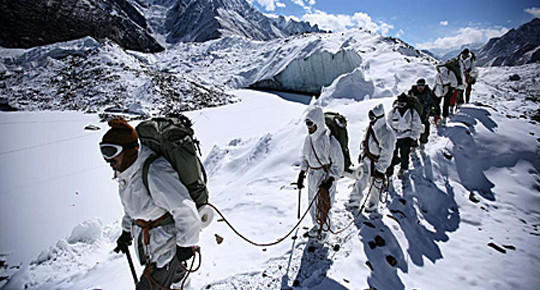
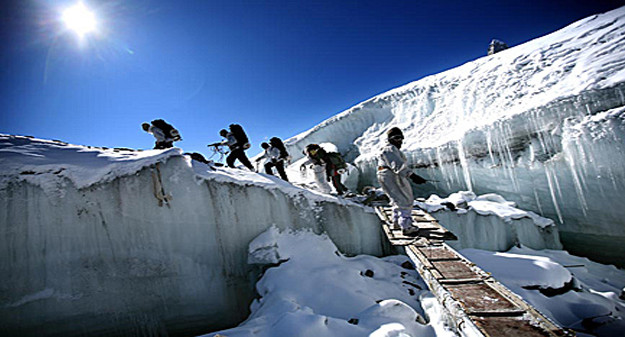
Lt Gen YK Joshi, General Officer Commanding (GOC), Fire & Fury Corps, on Tuesday interacted with troops deployed in sub-zero temperature on the rugged and mountainous locations of western Ladakh on Diwali-eve.

Lt General Joshi greeted the troops and their families on Diwali.

He complimented the soldiers for their service to the nation in remote and inhospitable terrain and weather conditions.

Later in the day, the GOC paid homage to martyrs at the Kargil War Memorial, Drass, and also interacted with troops.


Pak in habit of misusing fora for narrow political gains: India at UN

Pak in habit of misusing fora for narrow political gains: India at UN

First Secretary in India’s Permanent Mission to the UN Paulomi Tripathi was responding to Pakistani envoy Maleeha Lodhi’s remarks at the session.

United Nations, October 31

India has slammed Pakistan for raising the Kashmir issue at a UN General Assembly session, saying it has become Islamabad’s habit to misuse any forum for “narrow political gains” and asserting that the right to self-determination cannot be abused to undermine a nation’s territorial integrity.

First Secretary in India’s Permanent Mission to the UN Paulomi Tripathi was responding to Pakistani envoy Maleeha Lodhi’s remarks at the session that the struggle of the Kashmiri people for their right to self-determination had been suppressed for decades.

Lodhi said the Kashmir issue would remain on “the UN agenda until the Kashmiri people are allowed to exercise their will, according to the agreed method prescribed by the Security Council–a plebiscite under the auspices of the United Nations”.

“We reject the unwarranted reference made by one delegation to the state of Jammu and Kashmir which is an integral part of India,” Tripathi said at a UNGA Third Committee session on Tuesday on Elimination of Racism, Xenophobia and Right of People to Self-determination.

She said it had become Pakistan’s habit to misuse any forum for narrow political gains.

“In reality, it is the people of India as well as those of our region and beyond who have to suffer most egregious violation of human rights inflicted by terrorism emanating from beyond our borders,” she said.

“The right to self-determination cannot be abused and misrepresented with the aim of undermining the sovereignty and territorial integrity of a Member State,” Tripathi said.

She asserted that self-determination had long been recognised as the right of peoples of non-self-governing colonies and trust territories to independence and self-government. Pointing out that there were still 17 non-self governing territories which are in various stages of decolonisation, Tripathi said the international community must step up efforts to reach the conclusion of this long-drawn process.

She described Palestine as the “unfinished task” in the realisation of the right of people to self-determination, saying India is committed to the cause of the people of Palestine and the country had substantially scaled up bilateral development partnerships and increased contribution to the UN Relief and Works Agency for Palestine Refugees in the Near East (UNRWA).

On the issue of racism, Tripathi said despite efforts made in combating racism, racial discrimination, xenophobia and related intolerance, these pernicious ills continued to persist in different forms and manifestations.

“Rise of exclusionist ideologies inciting discrimination and violence threaten to subvert the globalised economic order and social cohesion,” she said stressing that there is need for comprehensive legal and administrative responses to counter emerging challenges.

She voiced India’s concern over the alarming rise in use of digital space for dissemination of racist and xenophobic material as well as for recruitment, networking and fundraising by groups espousing these ideologies.

“We must acknowledge that racial equality and freedom of expression need not be pursued in a zero-sum manner,” she said, adding that private entities, including conventional and social media and civil society, needed to develop and observe codes of conduct that embodied commitment to racial equality and non-discrimination.

Immunities enjoyed by the social media platforms for contents by users must be counterbalanced with responsible content moderation and norms for removing objectionable contents on voluntary basis, Tripathi said.

She further said that complementary domestic action and international cooperation is necessary to effectively implement the Convention on Elimination of All Forms of Racial Discrimination and the Durban Declaration and Programme of Action to realise inclusive growth envisaged in the 2030 Agenda for Sustainable Development. PTI


Indian Army on diet

THE INDIAN ARMED forces is bulging and greying.

That is partially owing to what it first thought would make the services attractive to young talent. Following repeated representations by the armed forces, the Union government substantially raised salaries and perks of its personnel through multiple pay commissions and the recent One Rank, One Pension policy. This, however, has led to a problem of plenty, as even officers who have been superseded during promotion are not leaving the force. Earlier though, such officers would opt for early retirement rather than work under junior officers. According to the Army headquarters, the number of officers who took premature retirement after being superseded every year came down to 170 from around 300 in the last two years. Thus, the Army has more senior officers and fewer vacancies.

Also, owing to ballooning salaries and pension bills, the government has no money for modernisation of the defence forces. While the ideal ratio between revenue and capital expenditure in the defence budget should be 60:40, it is 83:17 now. For instance, in this year’s defence budget, the Army’s revenue expenditure (salaries, excluding pensions) was Rs1,28,076 crore, while the capital allocation for modernisation was only Rs26,688 crore.

So, Army chief General Bipin Rawat plans to make the 13 lakh plus Army leaner and meaner by whittling down troops and turning it into a technology-driven force. Four committees, headed by the military secretary and director generals of perspective planning, financial planning and infantry, were formed this April to conduct studies on restructuring the Army headquarters, force reorganisation that includes pruning, cadre review of officers and review of terms and conditions of junior commissioned officers and other ranks. This month, six regional Army commanders along with Rawat met in Delhi and brainstormed on the recommendations of the committees. The recommendations have been sent to the ministry of defence.

Restructuring became a priority in 2016, when defence minister Manohar Parrikar set up a committee under Lt General (retd) D.B. Shekatkar to suggest measures to trim, redeploy and integrate the manpower under the defence ministry to have an “effective military”. Shekatkar was an obvious choice because he, as additional director general of perspective planning, was involved in the 1997 exercise of reducing 50,000 troops. The government accepted 65 of 99 recommendations made by the Shekatkar panel, including redeployment of 57,000 troops to combat formations.

To begin with, the Army plans to cut 50,000 troops in the next two years and another one lakh in five years. Rawat wants to start with an overhaul of the Army headquarters in Delhi. The Directorate General of Military Training, which has nearly 40 officers and hundreds of supporting staff, can easily be merged with the Shimla-based Training Command of the Army, as their functions like training plans for operations, war games and joint training overlap.

The next step would be shutting down its divisional headquarters, comprising about 10,000 officers and men. The committees suggest closing down 25 of 40 plus division headquarters, except those functioning in Jammu and Kashmir and under the mountain strike corps on the eastern border. That would save around 350 officers and several thousand men working under them, who could then be redeployed in operational areas to improve the Army’s teeth-to-tail ratio, an officer explained. Combat troops fighting on the frontlines are the ‘teeth’ of the Army, and the supply or maintenance or support troops are its ‘tail’. Military experts say that against a fighting element of approximately 9 lakh soldiers, there are 4.5 lakh uniformed personnel in the combat support services along with six lakh civilian employees.
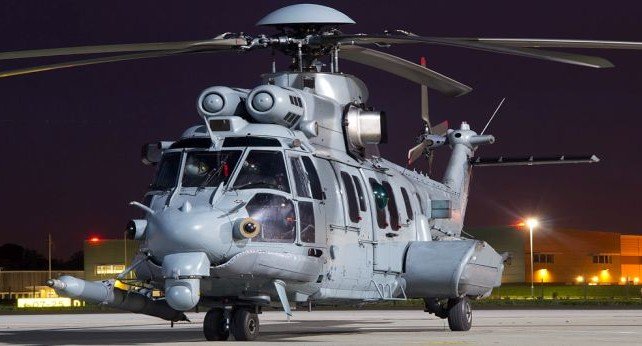
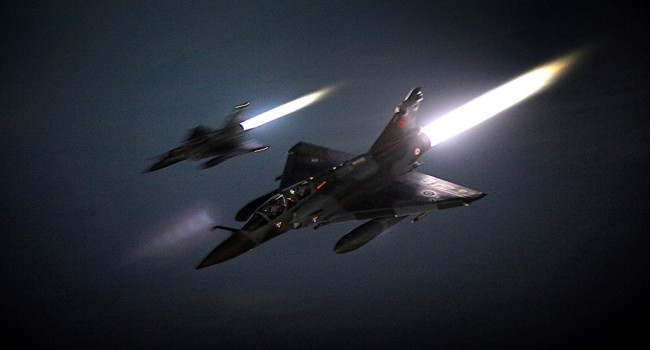
Lt General Vinod Bhatia, former director general, military operation, who was part of the Shekatkar Committee, said the need to rightsize the Armed forces is to meet the imperatives of raising cyber and space commands and to cater to the growth of army aviation, electronic warfare and unmanned aerial vehicle units, which are the future of the Army.

The Military Engineering Service (MES), with more than 80,000 personnel, is another white elephant. Seventy per cent of its Rs14,000 crore budget is spent on salaries. The MES, said officials, can be easily reduced to one-third of its strength by outsourcing the maintenance services to cantonments and military stations in peaceful areas. Likewise, the corps of Electrical and Mechanical Engineering (EME), the third largest force in the Army after the infantry and artillery, can be brought down to 30,000 from around 42,000 personnel. Vehicle repair and servicing can be outsourced to the manufacturers, who now have service stations in most border areas. Only the maintenance of specialist vehicles should be given to the EME. The Army Service Corps, which provides ration to soldiers, too, needs to close its butcheries and resort to procurement through trade. Also, those in the Corps of Signals can be redeployed to fight cyber and electronic warfare.

Also, the military secretary, who is conducting cadre review of officers, will suggest measures to reduce the intake of permanent cadre and to enhance the recruitment of short service commissioned officers. “We should induct more short service recruits (say five years), as it will not only reduce pension bills, but also make the armed forces young and stronger,” said Lt General Mohinder Puri, former deputy chief of Army.

Lt Gen Bhatia, on the other hand, talked about synergy in armed forces. “Indian military is among the least ‘joint’ major militaries in the world, and can optimise resources especially by in-house reforms enabling joint intelligence, planning, training, communications, logistics and force development prior to structured joint operations,” he said. A proposal for creation of two joint theatre commands—western theatre command for Pakistan and an eastern one for China—is under consideration with the government.

India is not the only nation in attempting to prune its armed forces. In 2012, the United Kingdom announced to cut the strength of its army to 82,000 combatants by the end of this decade. Similarly, China is planning to reduce three lakh of its 23 lakh army personnel by 2020. The Russian army has done away with large-size divisional headquarters, and the US had announced a reduction of 80,000 troops by 2017.

But, downsizing an army is not an easy exercise. China took three years to deliberate before the reforms were made public. In India, with elections round the corner, the government will have to be cautious. States like Punjab, Rajasthan, Uttar Pradesh, Haryana, Bihar and Madhya Pradesh, from where the armed forces get maximum recruits, would be annoyed. The Congress has already criticised the move. Congress leader Abhishek Manu Singhvi said, “Instead of creating the promised two crore jobs per year, the Modi government is hell bent on destroying more jobs.” Shekatkar, however, said that giving jobs was not the real task of the Army. Major (retd) Ved Prakash, chairman of the ex-servicemen cell of the Congress, said the government should spell out its plan—whether the move is only to enhance combat strength of our armed forces or it intends to retrench people.

BJP spokesperson on economic affairs Gopal Krishna Agarwal, however, said it was the Army’s decision, and not the government’s, to downsize the troops. “We are trying to expedite the modernisation of defence forces,” he said. “To my knowledge, several pending proposals for defence procurement have been cleared by the government.”


Nepal Army pulls out of BIMSTEC military drill: Report

Nepal Army pulls out of BIMSTEC military drill: Report

Prime Minister Narendra Modi and other BIMSTEC leaders at the signing ceremony of BIMSTEC convention and the adoption of Kathmandu Declaration in Kathmandu on Friday. PTI photo

Kathmandu, September 8

The Nepal Army has withdrawn from the first BIMSTEC military exercise to be held in India following a political row in the country over the participation in the event, a media report said on Saturday.

Prime Minister KP Oli asked the national defence force not to participate in the drill, compelling the Nepal Army’s leadership to rollback its earlier decision to take part in the first ever military exercise of the regional grouping initiated by India.

The decision was taken just a day before the Army squad was set to travel to Pune, where the drill will commence on Monday, the Kathmandu Post reported.

The government’s decision came after strong criticism from different quarters, including influential leaders from ruling Nepal Communist Party.

The Bay of Bengal Initiative for Multi-Sectoral Technical and Economic Cooperation (BIMSTEC) is a regional grouping comprising Bangladesh, India, Myanmar, Sri Lanka, Thailand, Bhutan and Nepal.

The armies from all seven members states had agreed to send a 30-member squad for the six-day exercise. The event was dragged into controversy as no diplomatic or political level agreement was made before deciding to take part in the exercise.

“The government directed the NA not to participate in the drill,” Kundan Aryal, the press advisor to Oli, was quoted as saying by the newspaper.

A senior Army official said even though they had not received a formal directive, the 30-member squad had been stopped from departing. Three Army officials who had already travelled to Pune to help plan the conference will also be returning soon, the Army officer said.

Cross-party leaders in Nepal had raised their concerns against the exercise after Prime Minister Narendra Modi, during his address at fourth BIMSTEC summit in Kathmandu last week, welcomed Nepal’s presence in the drill.

“There is no point in our Army Chief participating in the exercise which our government hasn’t approved,” Minister for Law and Justice Bhanu Bhakta Dahal told the Post. PTI 


India’s run with raksha mantri post by Lt Gen Bhopinder Singh

Sadly since Independence, India’s tryst with this sensitive post has been increasingly time serving, patronising or political.

In the Indian narrative of the 26 ministers of defence till date, only Jaswant Singh could claim any functional and emotional affinity with the military. (Representational image)

 In the Indian narrative of the 26 ministers of defence till date, only Jaswant Singh could claim any functional and emotional affinity with the military. (Representational image)

Militarily, India is arguably the fourth most powerful country after the United States, Russia and China. The executive head of the US military is “secretary of defence” Jim Mattis, a former four-star Marine Corp general. Sergey Shoygu is the “Russian minister of defence of the Russian Federation”, and a four-star general of the Russian Army. In the complex Chinese system of the apex body of “state councillors”, Chang Wanquan is also a career general of the People’s Liberation Army. All three countries are vying for global dominance and security assertions that requires a hybrid framework of economic-military-geopolitical-geostrategic imperatives. These levers are carefully deployed in various degrees, permutations and combinations to further the respective sovereign interests. Besides the defence ministries, there are security experts in other ministries in both China and Russia, and even in the US, eight out of the 24 Cabinet-level officials have served in the US military. This affords strategic culture, military logic and sensitivities of the armed forces in the course of national governance.

In the Indian narrative of the 26 ministers of defence till date, only Jaswant Singh could claim any functional and emotional affinity with the military. Perhaps the strictly enforced civilian control over the military in early years, with the appointment of known military baiters like V.K. Menon, the apolitical stance of the serving soldiers and the veterans, ensured that it was sub-optimally represented in the political leadership ever since. The lacunae went unnoticed initially as the national priorities veered around self-sufficiency, defensive posturing and at best, a regional ambition that could be managed in terms of the security wherewithal offered by the well-oiled and regimented set-up of the Indian armed forces inherited from the British. 1962 was a wake-up call of the unpreparedness and it took a relatively more progressive minister of defence, Y.B. Chavan (1962-66), at the helm for the Indian armed forces to recover and gloriously deliver 1965, 1967 and 1971 in quick successions. This was again followed by an era of either direct control by the Prime Minister’s Office or by regional satraps who had neither the understanding, strategic nuance or “connect” with security matters.

Today India stands at the cusp of immense possibilities and fancies, a place on the global map for its wares, “soft power” and influence, albeit, with more pacifistic undertones as compared to the Chinese. This opportune moment is borne of the economic vibrancy unleashed in the early 1990s, and the geopolitical churn that has seen India emerge as the “pivot” for the free world. Oddly the timing also coincides with an equally unfortunate tag as the “world’s largest arms importer”, with a lopsided development reality that celebrates success with missile technology but cannot develop a perfunctory rifle for its military! Beyond development and inadequacies of materials and weaponry, there have been unresolved issues of force integrations, work conditions, status, personnel nature, etc. all pointing to a consistent relegation of the military issues to the backburner by all political dispensations. The ghosts of Bofors have continued with the “coffingate”, Westland helicopters, Tatra vehicles, etc. to now Rafale getting mired in political and acquisition-related controversy, which has little to do with the “unformed” fraternity themselves. Politico-bureaucrat combine (with some from the institution itself) have failed the forces with a combination of inaction, corruption or simple, disinterest beyond condescending platitudes and selective invocation of the “soldier” as an electoral prop.

The armed forces necessitate a strict command-and-control culture, with defined hierarchies and inviolable traditions that ensure that it retains its “kinetic abilities”. Historically, the military shuns political posturing, usurpations and disdains “voicing” its own opinion publically as that is left to the defence minister to manage the same with the required rectitude, restraint and to-the-point manner without any loaded political import. There has been an unfortunate change in recent times without any meaningful benefit to the institution. The phenomenon of photo-ops of ministers undertaking the Siachen visits, flying in fighter planes or sitting in the front seat of the official cars are all expressively designed for the constituency beyond the armed forces. The spit and polish of decorum, choona-lined cantonments, physical mannerism and “officer-like qualities” are not elitist trappings or colonial hangovers, they are euphemisms for discipline, order and the unflappable conduct that behooves a “soldier”, hence the collective frown when a defence minister takes a guard of honour wearing casual footwear — unfortunately the supposed simplicity does not win battles, only votes beyond the cantonments. It is the deeply-embedded concept of izzat or pride (not hubris) that stands diminished when a soldier is asked to collect garbage in the hills, even though the same soldier would not blink an eyelid to put himself or herself in harm’s way to protect the citizenry, be it in a natural, civil or combat operation. It is this concern of compromise to its security and sanctity of its culture and facilities that rankles the only governmental institution that has retained its professional efficacy by withstanding the larger societal morass by keeping its cantonment doors closed till recently.

Given the avowedly apolitical mandate of the institution, onus is on the defence minister to avoid partaking expansive political debates beyond military matters as such conversations willy-nilly appropriate and reflect on the apolitical soldier. Due to the military’s unique wiring and operational style, the conduct of the defence minister cannot be equated to lateral ministers of agriculture, finance, railways, etc. The domain, stakes and sensitivities of the raksha mantri are not more or less important than other ministries; they are simply different. It is this heightened and holistic sense of institutional empathy, and not the selective and theatrical outrage on the ostensible “morale” of the soldier, that begets the ideal construct of the raksha mantri. Noise around controversies like Rafale should be insulated from the soldier, and a genuine concern of the “ways of the institution” should override all other considerations, with the buck starting with the raksha mantri. Sadly since Independence, India’s tryst with this sensitive post has been increasingly time serving, patronising or political.


Linking PAN To Aadhaar Stands, Not Mandatory For Bank Accounts: Supreme Court

The top court, however, ruled that it is not mandatory to link bank accounts with Aadhaar, the 12-digit personal identification number.

The Supreme Court on Wednesday allowed linking of Aadhaar with PAN or Permanent Account Number, which is mandatory for filing of income tax return (ITR). The top court, however, ruled that it is not mandatory to link bank accounts with Aadhaar or Unique Identity Number, a 12-digit personal identification number issued by the Unique Identification Authority of India. The Supreme Court said benefits under the Aadhaar project should be in the nature of welfare schemes and it cannot be made compulsory for services such as bank accounts, mobile connections or school admissions.
Here are 10 things to know about Aadhaar linking with PAN and bank accounts:
  1. Wednesday’s ruling by the top court means that individuals will not be required to mandatorily link their bank accounts with Aadhaar.
  2. The top court also said that no private company or bank can ask for an individual’s Aadhaar.
  3. The much-awaited verdict on the Aadhaar matter comes after a clutch of petitions challenged the Constitutional validity of the system on the grounds that it violates privacy. (Also read: Aadhaar is treated as unique, says Supreme Court)
  4. The Aadhaar verdict was announced by a five-judge constitution bench comprising Chief Justice Dipak Misra, Justice A.K. Sikri, Justice A.M. Khanwilkar, Justice D.Y. Chandrachud and Justice Ashok Bhushan.
  5. The bench had reserved the verdict after hearing the petitions for over 38 days starting January 17 this year.
  6. The compulsory linking of the Aadhaar card with bank accounts, PAN card, welfare schemes and a host of other utilities violates the fundamental right to privacy, a spree of petitions had alleged challenging its validity.
  7. The bench also said that private companies cannot access Aadhaar data. Seeking biometric details does not violate the right to privacy, said Justice Bhushan.
  8. More than 21.08 crore PANs issued by the Income Tax Department have been linked with Aadhaar till Monday, news agency Press Trust of India cited reported citing official figures. The number of total issued PANs stands at over 41.02 crore.
  9. Aadhaar is a unique 12-digit identification number issued to individuals by the Unique Identification Authority of India after storing their biometrics data. The UIDAI uses iris and fingerprint scans to obtain biometric data from an applicants and stores it in a database.
  10. PAN is a 10-digit alphanumeric number issued to assessees by the Income Tax Department. Quoting of PAN for filing income tax return is mandatory. The taxman had in June this year ordered an extension in the due date for linking Aadhaar with PAN to March 31, 2019.

(With agency inputs)


Memorials & funerals for the living

Memorials & funerals for the living

JP Singh

We Indians believe in hero worship and indulge in too much emotionalism, especially in the event of mishaps, tragedies and national calamities. We forget altogether the practical importance, utility and impact that spur-of-the-moment decisions have on the living.

Holidays are declared, be it on the national, state or village level, but does the common man observe mourning during these holidays? Does he remember the departed leader? Do holidays demonstrate the ‘Work is Worship’ philosophy of the great leaders we are honouring? If not, then holidays are a tremendous waste of national time and energy.

Monuments and memorials are our pride and tradition. They express our homage to these great people. But do they truly speak about their history and deeds? They should reflect the enormous sacrifices they made for their country and become a source of inspiration for the present and future generations.

Miles of area is covered with samadhis of our leaders, to whom we owe a great deal — our very freedom — and whom we hold in high esteem.But the practical utility and impact becomes nothing for the common man. It is but a place of homage and respect, visited by a few dignitaries once or twice a year; and these memories fade away with time.

Soon the older samadhis are frequented less and less and new heroes take the place of older ones. Let us make all these memorials, ‘living memorials’. They could be smaller in size but bigger in the ideals of the great man they portray. Let them be attached to an institution or organisation that believes in and venerates the cause for which the man lived and died. Art galleries, museums, auditoriums for seminars and workshops for cultural training and associated programmes could reflect this cause. A true and living example for the world to emulate — functional and useful for all, i.e. hospitals and learning institutions.

We cannot build Taj Mahals as tourist spots for all. Future generations should learn and take inspiration from the lives and work of these great men and women, the cause for which they lived and suffered for us.

Memorials should be planned and designed while keeping in view the personality, objectives and dreams of those who are no more with us. The institute, organisation or monument should not eclipse the real character and personality but be a part and parcel of it.

Let the example come from the top. Let the big foundations and big business houses and the government take the first step, with enough funds at their disposal.

Otherwise, these samadhis and memorials, like other graveyards and cemeteries, will say only one thing:

‘Oh! Passersby/One day you will be here as I’.

Part of the same Mother Earth — not richer in any way, perhaps a little higher (the height of the samadhi) — the same Universal Soil.


4 CRPF men killed as Naxals blow up vehicle in Chhattisgarh’s Bijapur

4 CRPF men killed as Naxals blow up vehicle in Chhattisgarh's Bijapur

Naxals had recently put up posters in Bastar region calling for boycott of the Assembly polls. File

Raipur, October 27

Four personnel of the Central Reserve Police Force (CRPF) were killed and two injured after Naxals blew up a mine-protected vehicle (MPV) in poll-bound Chhattisgarh’s Bijapur district on Saturday, police said.

The incident occurred around 4 pm near Murdanda camp of the CRPF under Awapalli police station, when its 168th battalion was out on “area domination” operation, Bijapur Superintendent of Police Mohit Garg said.

When the MPV carrying six personnel was around 1 km away from the camp, ultras triggered a powerful land mine blast, he said.

“Four paramilitary personnel were killed and two others were injured in the blast,” he said.

Reinforcement was rushed to the spot immediately and the injured personnel were being evacuated, the official said, adding they were retrieving the bodies from the site.

The attack took place on a day when Chief Minister Raman Singh launched the ruling BJP’s campaign for the first phase of polls on November 12 in neighbouring Sukma district.

The first phase of election will cover 18 constituencies in eight Naxal-affected districts — Bastar, Kanker, Sukma, Bijapur, Dantewada, Narayanpur, Kondagaon and Rajnandgaon.

Naxals had recently put up posters in parts of Bastar region calling for boycott of the polls. PTI


Ex-soldier commits suicide in police lock-up in Rajasthan

Ex-soldier commits suicide in police lock-up in Rajasthan

Photo for representation only.

Tribune News Service

Jaipur, August 23 
A 60-year-old ex-Army man allegedly committed suicide in police custody on Thursday in Rajasthan’s Bharatpur district, hours after he was arrested on charges of being drunk.
The SHO along with seven policemen have been shifted from Bharatpur’s Kumher Thana to police lines.
According to police sources, Prahlad, died by tearing his blanket to make a rope and hang himself in the Kumher police station.

A huge crowd staged a noisy protest outside the police station as the news spread. His family alleged that police beating forced him to take his own life.
Inspector General of Police Malini Agrawal and Superintendent of Police Kesar Singh Shekhawat visited the police station amid the tension.
Agrawal told IANS that Prahlad’s body had been brought to the Bharatpur District Hospital for autopsy. — With IANS