The Gartang Galion bridge in the Nelong valley in Uttarkashi that Bhotia tribesmen used to go to Tibet for trade. Photo courtesy: Tilak Soni
Ajay Ramola
Tribune News Service
Mussoorie, May 22
Uttarkashi district, besides being a famous centre of religious learning of the Hindus since ancient times, was also known for the trade route to Tibet. The first big market ‘Bada Haat’ used by Indian traders for selling Chinese goods was established here. The trade from the district was completely stopped after the war with China in 1962 and was not resumed in 1992 when it was restarted from the Lipulekh pass.A big trade market fair was held at ‘Bada Haat’ every year where Bhotia tribesmen from the district brought different kinds of goods from Tibet to be sold during the fair held in January. The Bhotia tribes lived in villages of the Jadung and Nelong valleys. They used to trade at ‘Bada Haat’ in Uttarkashi and exchange goods according to their requirements. The festival is still held in Uttarkashi but the trade with Tibet has discontinued since the Chinese aggression in 1962.The remnants of the border trade can be seen in the expansive Nelong valley, a cold desert like landscape similar to Ladakh situated at an altitude of around 11,000 feet. It falls under the Gangotri National Park in Uttarkashi district. Many structures related to the old trade route, including a wooden bridge known as Gartang Galion and the Lal Devta temple, where the trading Bhotia tribe used to offer prayers before crossing over to Tibet, still exist in the area.The infrastructure that was developed in those days suggests that the trade with Tibet was the mainstay of the local economy, say old residents of Uttarkashi.Sheep and goats and products made out of their skins such as socks and warm clothes were an essential part of the trade.Agricultural implements, tobacco, snuff, blankets, tea, coffee, barely, rice, spices, copper products, indigenous medicines, salt etc were traded by Bhotia traders on the basis of the barter system. The women of this tribe were good weavers of carpets, blankets and woollen clothes and were known to sell clothes made of yak wool and skins.The Bhotias with Mongoloid features are good climbers and can reach high altitudes with ease. Their keen sense of direction helps them in the trade considering the difficult Himalayan terrain. The Bhotias are found in the districts of Almora, Chamoli, Pithoragarh and Uttarkashi and the trade with China flourished through the routes in these districts. Rang Bhotias are subdivided into Byanse, Darmi and Chaudensi. Rang and Johari Bhotias belong to Pithoragarh district while Tolcha and Marcha Bhotias are from Chamoli district. Jad Bhotias, who mostly lived in Uttarkashi district, used to go to Tibet for the trade through passes in the Jadung and Nelong valleys. Besides trade, they had cultural and religious links with Tibet.Jad Bhotias involved in the trade followed the main Jad river upstream passing through two camping spots of grazers, namely Hilding and then Do-Sumdo. They then reached the Thaga pass that forms one of the important corners of the Bhot Pradesh triangle. The traders following the path right from Do-Sumdo via Tirpani reached the Himalayan border at the Jelu Khaga pass. From here, they crossed into Tibet and reached Chhabrang Zong, which was the first Tibetan trading centre on the route. Another centre Tholing is 10 km northeast and serves as an important trade junction from where several other trade routes lead to western Tibet.The places such as Nelong, Naga, Neela Pani and Sonam in the district developed into flourishing trading stopovers. The ban on the trade with Tibet had badly affected the local economy, especially of the Bhotia community. The trade with China from Uttarkashi completely stopped though it is continuing from Pithoragarh in the Kumaon region.Uttarkashi residents say neither the state government nor the Union government has made any efforts to resume the trade with China from the district. On the contrary, the government has restricted the movement of Indian and foreign tourists by introducing an inner line permit clause. Indian tourists have to seek several permissions to enter the Nelong Valley while foreign tourists cannot go there.Ajai Puri, president of the Uttarkashi Hotel Association, says it is preposterous that while we are inviting Chinese entrepreneurs to invest under the Make in India programme, the Central government has not worked towards resuming the trade with China through the district and not allowed the movement of people. He says the trading community demands opening of trade routes to Tibet and mainland China so that the nation and local people could benefit.
Restricted area clause affects tourism in Uttarkashi district
The Nelong valley in Uttarkashi district where the entry of tourists is restricted. Even Indian tourists require a permit to visit the valley while Foreign tourists are barred. Photo courtesy: Lokhender Bisht
Ajay Ramola
Tribune News Service
Mussoorie, May 22
The archaic Inner Line and restricted areas clause that was imposed in the region above Harsil and Nelong Valley in Uttarkashi district following the Chinese aggression in 1962 is affecting Uttarakhand tourism. At the same time, it is benefiting neighbouring Himachal Pradesh, say local businessmen.The restricted area clause does not define clearly as where the tourists, especially foreigners, can venture into leading a lot of inconvenience to the administration and the tourists.The Inner Line permit is required above the Harsil region but there is no check post established to stop tourists, especially foreigners, going to the region right up to Gangotri. Foreigners are seen staying overnight at Dharali, Bharon Ghati and other destinations right up to Gangotri.Indian tourists have to obtain a permit for the Nelong valley, which is completely out of bounds for foreign tourists. Foreigners due to such an ambiguity prefer Himachal Pradesh instead which allows an easy access to its tourist spots on the border with China.An Inner Line Border Permit required for trekking is easily provided in Himachal Pradesh to trekkers who want to walk through from Chitkul village in Himachal to Harsil while they find it difficult to obtain the permit from Uttarkashi for the same trek, said Tilak Soni, an adventure tour operator running a firm Where Eagles Dare.The presence of Gangotri National Park means the Indian tourists have to apply for special wildlife permit apart from inner line security permit to visit Nelong Valley. Gangotri National Park officials do provide access to the area till 23 km beyond the first recognised check post in the Nelong valley, which does not serve the purpose as they are asked to return the same day which is not possible in such a terrain.Lokendar Bisht, BJP state member of the working committee, said he had met the Union State Minister for Home Kiran Rijjiu during his visit to Uttarkashi and raised the issue.Rijiju had asked the district administration to send a proposal in this regard via state government. Uttarkashi District Magistrate Ashok Kumar Pandey said the process of seeking an inner line permit for the Nelong valley should be streamlined and converted into a single-window system as tourists have to seek permission from various departments.Pandey recommended the removal of the inner line permit clause from Harsil Market and 50 km area around it right up to Wilson Cottage.
Tibet border trade lifeline of tribal economy
British developed nomadic business through high Niti and Mana passes to keep an eye on expanding Russian influence
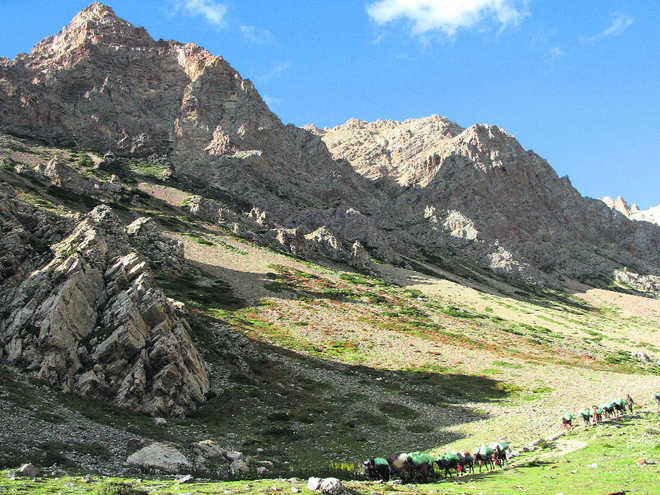 Indian traders along with mules carrying goods coming from Taklakot in Tibet after taking part in the trade. Photo courtesy: Keshav Bhatt
BD Kasniyal
Pithoragarh, May 22
The British in the Kumaon region became aware of the traditional trade between people living in Indian border villages and those in Tibet through several high Himalayan passes after a Jesuit missionary, Father Antonio de Andrade, visited the Tibetan mart of Tsaprang through the Niti pass in Garhwal in 1624. Father Andrade mentioned that the Niti and Mana passes were well-known trade routes to Tibet in those days.Another British settlement officer of Garhwal in 1896 also mentioned that the trade with Tibet was an important source of income and local employment in the border districts of the Kumaon and Garhwal regions in those days. According to him, the trade also provided a market for local produce of the region as well. The British, considering the significance of the border trade, later secured the easiest way to Tibet through these regions so that the trade could prosper.According to experts, the Tibet border trade was in vogue even in the third century BC. Edwin T. Atkinson in his gazetteer has mentioned that there was an ancient route from Patliputra to Taxila via Kalsi in the third century BC. According to the historian, borax for the use of goldsmiths of northern India was imported from Tibet in the 6th century AD. Borax was used in making ink to write on birch bark or locally made hand paper. “Pearls, corals and glass beads were exported to Tibet in exchange for borax import in those days,” says Dr Lalit Pant, researcher on the border trade.The British were fully convinced that it was only through these passes to Tibet from the Kumaon and Garhwal regions that they could keep an eye on advancing Russians. They decided to develop the trade with Tibet via these passes and sent Francis Young Husband with five other officers and 100 troops to Tibet in 1903 to facilitate mobility of Indian traders to the neighbouring country for the trade. “Even a survey was done for laying a railway line from Pilibhit to Tanakpur that was to be further connected with the Lipulekh pass via a road,” says Pant. The border trade with Tibet through high Himalayan valleys in Uttarakhand used to commence through the Byans, Chaundas, Garbyang, Darma and Johar passes in Pithoragarh district and the Niti pass and Mana pass in Chamoli district. “The significant passes of Lipulekh (16,500 ft), Darma (18,550 ft), Limpia (18,150 ft), Kungri Bingri (18,300 ft), Unta Dhura (17,950 ft), Mana (17,590 ft) and Niti (16,600 ft) were used for the trade with Tibet,” say experts.Dr RS Tolia, former Chief Secretary and a local from the Johar valley in Pithoragarh district, says the British in the early nineteenth century were fully convinced that the trade with Tibet sustained agriculture, animal husbandry, cottage and pharmacology industry in the lower valleys of Kumaon and Garhwal and generated employment for thousands of people. He adds cereals and grains of coarse varieties were the main exports to Tibet while salt, borax, wool, valuable stones and herbs were the main imports before the trade closed in 1962 following the war with China. “Charles W Sherring, the British commissioner in 1906, has mentioned that a trade worth 67,000 British pounds was commissioned from the Kumaon region alone,” says Tolia.Goods worth Rs 86,000, including raw wool Pasham, yak tail, sheep and goats and borax, were imported from Tibet in the first year of the resumption of the trade in 1992 while Indian traders exported Rs 12.06 lakh worth of textile, coffee, vegetables, jaggery, mishri (sugar candy) and Phaphar flour to Tibet, says HC Semwal, District Magistrate, Pithoragarh.Tea sipping, broken stone pieces matter of mutual trustThe traditional trade between Indian traders and their counterparts in Tibet was done on the basis of the ‘Gamgya’ system that was based on mutual faith. The system was established when the traders from both countries met during a small ceremony called ‘Suljimulji’ where a small cup of tea or wine was brought in. The first sip of tea or wine was taken by a Tibetan trader called ‘Mushye’ while the Indian trader called ‘Mitra’ had the second sip. After the tea-sipping ceremony, a few precious gifts were exchanged between the two. Later, an ordinary stone was broken into two parts. While the Tibetan trader kept the one part of the broken stone, the other part remained with his Indian partner,” says Dr Lalit Pant, an expert on the border trade.Pant says in later years, the representatives of the two traders or their generations were recognised by these stone parts. If the two parts fitted well, the identity of the representatives was established and the two would begin trading with each other. “The trading on the basis of this system between tribal Sauka and Rang traders and their counterparts in Tibet continued for centuries till 1962,” he adds.Pant says besides the ‘Mushye’ traders in Tibet, Dokpa nomads were the other important participants in the trade before 1962. The Dokpa nomads lived in the interior parts of Tibet with their herds of animals and visited the Taklakot mart for the trade. “These Dokpas used to exchange their raw material, including wool, with grains brought by Indian traders during the trading season. As the Dokpa traders would come with herds of animals, they were not allowed entry into the Indian mart at Gunji. A mart was set up at Gunji in the Indian side after the trade resumed in 1992,” says Pant.HC Semwal, District Magistrate, Pithoragarh, says the activities for the border trade begins in May when trade passes are sought from the Indian Ministry of External Affairs and issued to the traders. The traders are provided space in a mart where they store their goods and bank facilities at Gunji till the trade concludes in the last week of October. The ITBP provides them security till they cross over to Tibet from the Lipulekh pass.
0 0