Sanjha Morcha

What’s New

Click the heading to open detailed news

Current Events :

web counter

Print Media Reproduced Defence Related News

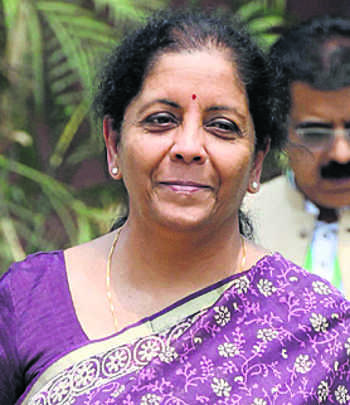
Army, Nirmala back disability pension tax Say some misusing exemption, need to arrest trend

Army, Nirmala back disability pension tax

Finance Minister Nirmala Sitharaman

Tribune News Service

New Delhi, July 2

In a stinging response to the ongoing controversy over removing tax exemption to disabled soldiers, Finance Minister Nirmala Sitharaman’s office today tweeted a statement claiming it to be the “response of the armed forces on the issue of taxability of disability pensions”.

Later, the official Twitter handle of the Indian Army also tweeted the same statement. Sources confirmed it was an official statement of the Army Headquarters.

The statement says some people have been misusing the facility given to disabled soldiers as their pensions are exempt from income tax. It says: “Those who have found leverages in the existing system for seeking financial gains through their disabilities need to be scrutinised and taken to task, where ever necessitated… Over the years, there has been rise in personnel seeking disability even for life style diseases. The trend, if not checked at this stage, is a cause of worry, as the Army cannot have large number of personnel with medical disabilities in the rank and file.”

Sitharaman was the Defence Minister in the first term of the Narendra Modi government.

In June, the government had come out with a circular saying income tax exemption will be allowed to only those disabled soldiers who have been invalidated or incapacitated during military service.

At present, income tax exemption is claimed by all soldiers who get a disability pension. The new circular issued by the Central Board of Direct Taxes yesterday has clarified that tax exemption for disability pension will be “available only to armed forces personnel who have been invalidated from service on account of bodily disability attributable to or aggravated by such service and not to personnel who have been retired on superannuation or otherwise”.

In other words, those who retire after full service with some disability will not get income tax exemption. There have been instances of income tax exemption being availed by those who retired with disability.

The Armed forces personnel who acquire disabilities due to various factors of service get disability pension, which is calculated as per the degree of disability a person faces. For example, a person who lost two fingers of a hand due to bullet hit will get a lesser pension than a person who has lost a leg or an eye.

‘A Cause of Worry’

Those who have found leverages in the existing system for seeking financial gains through their disabilities need to be scrutinised and taken to task… Over the years, there has been rise in personnel seeking disability even for life style diseases. The trend, if not checked, is a cause of worry. Army statement


IAF Contingent Lands At France’s Air Force Base For Garuda Exercise

An Indian Air Force contingent landed at Air Force Base in France’s Mont-de-Marsan for the Indo-French joint exercise Garuda.

IAF Contingent Lands At France's Air Force Base For Garuda Exercise

NEW DELHI: 

An Indian Air Force contingent landed at Air Force Base in France’s Mont-de-Marsan on Friday for the Indo-French joint exercise Garuda.

Base Commander Air Base Mont-De-Marsan Colonel Gaudillere received the Indian Air Force contingent on arrival.

“IAF contingent landed at Air Force Base, Mont-de-Marsan, France, today. The IAF contingent was given a warm welcome by the French Air Force. The Air warriors of IAF are ready for flying operations,” IAF said in a tweet.

The exercise will take place between July 1 and July 14 in France.

In a video posted on Twitter by the IAF on June 24, Bareilly Air Force Base Commander Air Commodore M Ranade had said, “The Indo-French joint exercise Garuda is going to be conducted in France very shortly.”

“This is the sixth edition of the exercise which is intended for both the air forces to exercise together and learn best practices each one has to offer,” he added.

“A contingent of 4x Su-30 MKI, 2x C-17 and 1x 1L-78 tanker of the Indian Air Force will fly to France to participate in this exercise,” he said.

COMMENT

India and France had recently held naval drills in the Arabian Sea under the Varuna series wargames in which Indian naval fighters along with the Rafale-M of the French Air Force took part.


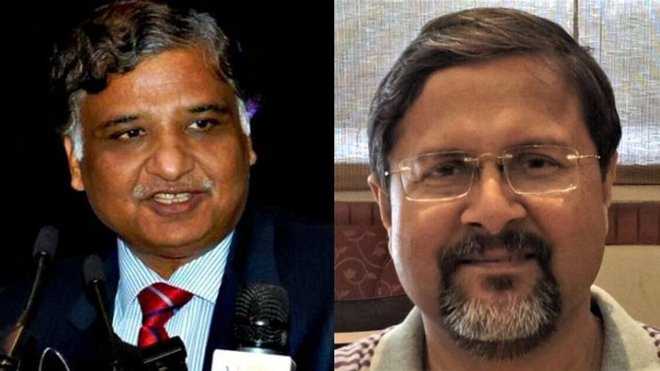
Balakot strategist Goel to head RAW, Kashmir expert Kumar IB

Balakot strategist Goel to head RAW, Kashmir expert Kumar IB

Arvind Kumar & Samant Goel

Tribune News Service

New Delhi, June 26

The government today decided to appoint two senior IPS officers of 1984 batch Samant Goel and Arvind Kumar as the next heads of India’s external (RAW) and internal (IB) intelligence agencies, respectively.

Prime Minister Narendra Modi, as the chairman of the Appointments Committee of the Cabinet (ACC), has also cleared a proposal relating to empanelment of the 1986-batch IPS officer in the rank of Director General.Sources in the North Block said Home Minister Amit Shah, as the other member of the ACC, had signed the file before leaving for Jammu and Kashmir today.

According to two separate orders from the Department of Personnel and Training (DoPT), the ACC has approved their appointments for a fixed two-year tenure.Goel, a Punjab-cadre officer, and Kumar from Assam-Meghalaya cadre will take charge on June 30. Goel replaces incumbent Anil Kumar Dhasmana, who is retiring after two-and-a-half years of tenure and Kumar replaces Rajiv Jain. Both Dhasmana and Jain were appointed in December 2016 and were given a six-month extension as the country moved into election mode.

Before his appointment as RAW chief, Goel was heading operations for the agency and was instrumental in planning the February 2019 Balakot air strikes and also the 2016 surgical strikes.

Kumar has been involved in tackling Left-wing extremism at the IB. He currently holds the post of Special Director, Kashmir, in the agency and has been closely involved in formulating and executing the Centre’s approach on terrorism in the valley.

Goel has spent a considerable part of his career in Punjab where he was posted to oversee security, intelligence and the border range. The IPS officer came to Delhi on his first assignment at RAW in 2001 and has stayed back.

Punjab link

Punjab-cadre officer Samant Goel has spent a considerable part of his career in his parent state, where he was posted to oversee security, intelligence and the border range. The IPS officer came to Delhi on his first assignment at RAW in 2001 and has stayed back


MIAN HEAD LINES :23 JUN 2019″ OPEN FOR DETAILS

  1. OROP: IS CGDA AN EXTRA-CONSTITUTIONAL AUTHORITY-1

  2. MOHALI: NEWLY COMMISSIONED NDA CADETS AND OFFICERS HONOURED AT AFPI

  3. ARMY PLAN TO MOVE TRAINING HQ FROM SHIMLA TO MEERUT RUNS INTO RETIRED OFFICERS, POLITICIANS

  4. MILITARY MATTERS :IN THE COLONEL’S SHOES BY LT-GEN RAJ SUJLANA (RETD)

  5. CHECKS AND BALANCES OF MILITARY COMMAND BY MAJ GEN AMRIT PAL SINGH (RETD)

  6. ARMY TO GO ‘ALL OUT’ IN KASHMIR

    TROOPS FULLY PREPARED FOR EMERGING SECURITY CHALLENGES: ARMY CHIEF BIPIN RAWAT

    IAF OFFICIALS, ARMS DEALER BOOKED FOR GRAFT

    MILITANT GUNNED DOWN IN BARAMULLA ENCOUNTER ZOOM

    ARMY CHIEF REVIEWS SECURITY SITUATION ALONG LOC

    TEARFUL ADIEU TO IAF OFFICERS 

    FATF: INDIA SAYS PAK MUST TAKE VERIFIABLE STEPS AGAINST TERRORISM

    OF OATH, SLOGANS & HOUSE DECORUM BY  Mani Shankar Aiyar


Indian Navy Recruitment 2019: 2700 Vacancies for Sailor Posts,

ndian Navy Recruitment 2019: 2700 Vacancies for Sailor Posts, 12th Pass Apply @joinindiannavy.gov.in

By SHILPA KOHLI

JUN 13, 2019 19:44 IST

Indian Navy Recruitment 2019: 2700 Vacancies for Sailor Posts

Indian Navy Recruitment 2019: 2700 Vacancies for Sailor Posts

Indian Navy Sailor Jobs 2019: Indian Navy has recently announced huge number vacancies for the recruitment to the post of Sailor for FEB 2020 Batch Course Commencing February 2020.

Online applications from unmarried male candidates have been invited for Indian Navy Sailor Posts. Eligible and Interested candidates can apply on the official website www.joinindiannavy.gov.in till 10 July 2019.

Indian Navy Sailors are main workforce in Indian Navy and a good career option for Secondary and Senior Secondary passed candidates. A total of 2700 vacancies have been notified out of which 2200 vacancies are for India Navy SSR (Senior Secondary Recruit) and 500 are for Indian Navy AA (Artificer Apprentice).

Indian Navy Sailor SSR AA selection will be done on the basis of candidate’s  performance in Computer-based Examination, followed by Physical Fitness Test (PFT) and fitness in Medical Examinations.

Candidates can get all the details in this article regarding Indian Navy 10+2 Recruitment 2019 such as application procedure, vacancy details, educational qualification etc.

Important Dates:

Last Date of Online Application: 10 July 2019.

Indian Navy Sailor 2019 Vacancy Details

  • Sailor – Senior Secondary Recruit (SSR) – 2500 Posts
  • Sailor – Artificer Apprentice (AA) – 500 Posts

Eligibility Criteria for Indian Navy Sailor Posts

  • Senior Secondary Recruit (SSR) –  12th passed with Maths & Physics and at least one of these subjects:- Chemistry/ Biology/ Computer Science from the Boards of School Education recognised by MHRD, Govt. of India
  • Artificer Apprentice (AA) – 12th passed with 60% or more marks in aggregate with Maths & Physics and at least one of these subjects:-Chemistry/Biology/Computer Science from the Boards of School Education recognised by MHRD, Govt. of India.

Selection Process for Indian Navy Sailor Posts

Selection of recruits is based on State wise merit of their performance in Computer-based Examination, subject to qualifying Physical Fitness Test (PFT) and fitness in Medical Examinations.

Indian Navy Sailor Notification PDF

Indian Navy Sailor Apply Link

How to Apply for Indian Navy Sailor Posts Job 2019

Online applications will be accepted through the official website of Indian navy i.e. www.joinindiannavy.gov.in upto till 10 July 2019.


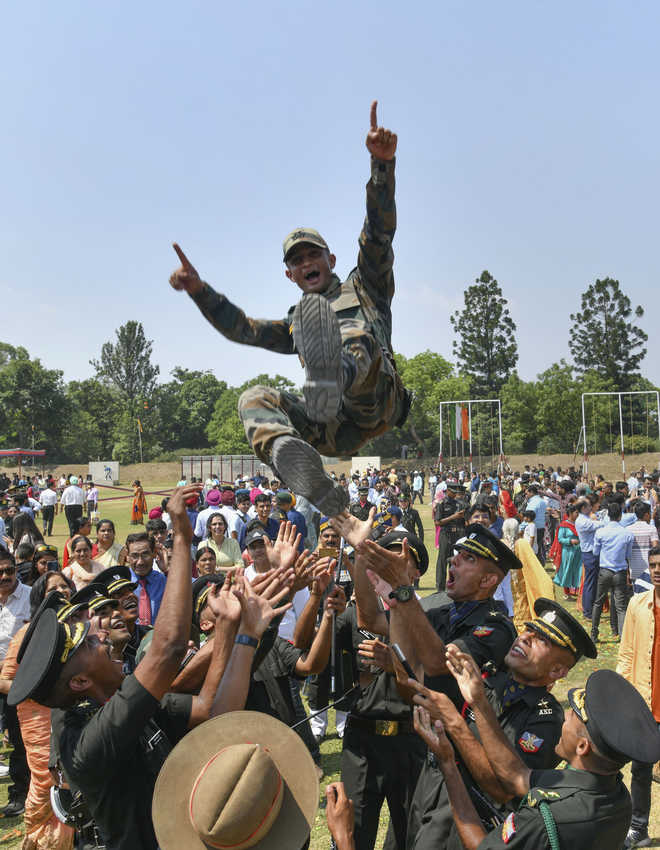
382 IMA cadets commissioned into Army

382 IMA cadets commissioned into Army

Cadets at the Indian Military Academy who joined the Indian Army celebrate after a passing out parade, in Dehradun on Saturday, June 8, 2019. PTI

Dehradun, June 7

As many as 382 cadets were on Saturday commissioned into the Army after a passing-out parade at the Indian Military Academy here.

GOC-in-C (South-Western Command) Lt Gen Cherish Matheson took the salute.

Seventy-seven candidates from nine other nations, including Afghanistan, Mauritius, Maldives and Fiji, too passed out from the academy after completing their training.

Lt Gen Matheson asked the officers to maintain discipline, stressing that no war can be won without it.

He recalled his time at the academy, when 39 years ago he also stood at the drill square like these cadets.  

Three Army helicopters showered petals on the cadets before they entered the Chetwode building and crossed the “Antim Pag” (final step) there.

Akshat Raj was rewarded with the prestigious sword of honour for his overall performance and Surendra Singh Bisht bagged the gold medal in the order of merit. It was a proud moment for Colonel Kanwar Pal as his son Bhuvnesh Rawat, 24, was among those commissioned as an officer in the Indian Army.

“I am feeling proud as my son is also an officer in the Indian Army now,” said Colonel Pal, who is an engineer in the Army.

The ceremony wasn’t without grim moments as one Gurtegh Singh Kanthola from Chandigarh broke down remembering his father who had died just six months ago.

An air of jubilation was all around as the young cadets began doing “josh” push-ups and displayed several other gestures to express their happiness. It was a ceremony full of euphoria as three Army helicopters showered petals at the young officers at the IMA stadium. — Agencies


When military officers cosy up to politicians Rahul Bedi by Rahul Bedi

The perilous penchant for tailoring operational missions to meet the ruling administration’s political demands has degenerated into a symbiotic, and mostly accepted, relationship between military officers and politicians. The latter use service personnel for political profit, while the soldier pursues career betterment and re-employment after retirement.
When military officers cosy up to politicians

Law enforcement: The Army, in particular, has been turned into an instrument for permanent crisis management.

Rahul Bedi
Senior journalist

The politicisation of India’s 3.5 million-strong military is a fiercely debated subject today. But in this passionate and largely irresolvable argument, the uniforms’ culpability in pleasing the politician is rarely dwelt upon. This is because it has become an axiom that the military remains sacrosanct, commits no wrong and its behaviour is unchallengeable and beyond reproach. Inversely, the services also wallow in the portrayal of themselves as the politician’s hapless handmaidens. But in recent years, they have conveniently tailored many of their operational postures and missions to meet the ruling administration’s political demands, regardless of the situational requirement.

This perilous penchant has degenerated into a symbiotic, and mostly accepted, relationship between military officers and politicians: the latter use service personnel, especially from the Indian Army, for political profit, while the soldier pursues career betterment and re-employment after retirement. This cosy relationship is further cemented by the soldier and politician jointly ‘inventing’ triumph and manufacturing success through an increasingly pliable media. Doubtlessly, this furthers their respective interests, but ends up insulating public opinion from insider reality.

In the process, the Army, in particular, has been turned into an instrument for permanent crisis management, deployed to contain insurgencies in the North-East, Kashmir and earlier in Punjab. Its role has been reduced to that of a better-trained, 

-equipped, -disciplined and more feared constabulary in olive green.

It continually substitutes the vast state police forces and federally managed paramilitaries that collectively outnumber the Army twice over but have proven woefully inadequate in ensuring security. And though the Army considers its employment in counter-insurgency and related hybrid warfare operations to be an indicator of operational flexibility, many insiders concur that this law- enforcement role detracts majorly from its primary function as a military force.      

Over decades, the lament of senior officers also is that the military’s standards and value systems have irrevocably plummeted, in keeping with the overall societal deterioration in probity and ethics. Handily, this decline is explained away as a harsh fait accompli, an inescapable reflection of the national decline in norms and ideals.

But the Indian society in general, confronted with an apocalyptic and irreversible decay in political, official and public standards, still somehow expects better from its soldiery. It continues to desperately seek some form of uniformed noblesse oblige, which unfortunately is now a distant mirage.

Till the eighties, military officers were considered upright, respected in society and eagerly sought after by girls. Retired soldiers talk nostalgically of the days when a mere note from the commanding officer on behalf of any jawan to the local authorities back in his village, carried weight and ended up resolving niggling administrative complications. Those were times when the esprit d’ corps in the apolitical services was strong and invitations to riotous and swinging regimental officers’ messes, much sought after. Salaries were low, but the lifestyle lavish and large-hearted in what was largely a gentleman’s army, rive with regimental tradition and chutzpah.

Hoary colonial traditions, too, contributed to this environment, making military service even more attractive in a swiftly changing social milieu, particularly after Independence.

In reality, many officers were eager and enthusiastic lads trapped inside grown bodies, all of who were seeking to indulge passions like shikar, riding, polo and outdoor living and danger at state expense. And, much like Freemasons officers, rarely, if at all, discussed politics and religion and if passed over for promotion retired gracefully, confident of their assured status in society. Promotions were merit-based, with undeserving candidates adhering to the Peter Principle and rarely ever crossing their limits of incompetence. Service chiefs and senior commanders brooked no political interference in operational matters and were listened to with respect by the ruling establishment.

The flamboyance, bravery and tactical brilliance of all ranks in the first three wars with Pakistan is well recorded and the subject of study in combat institutions around the world. It is rarely acknowledged, even at home, that in 1971, India’s military single-handedly achieved what even the US, with all its weaponry and hi-tech wizardry, has not managed since World War II: it created a nation — Bangladesh.

The fabled Sam Manekshaw amply vindicated the military’s and the soldiers’ operational independence. After touring the teeming refugee camps in East Bengal in early 1971, crammed with Bengalis fleeing the Pakistan army’s pogrom in East Pakistan, General Manekshaw (later Field Marshal) was asked by an agitated PM Indira Gandhi what the Army would do to control the situation. ‘Nothing’, quipped Manekshaw, to the horror of Gandhi’s entourage of civil servants and ministers, as no one had ever dared to respond so brusquely to the despotic leader. The level-headed Manekshaw then unwearyingly informed her that it would take at least 10 months before his force would be ready for combat for an assortment of tactical and strategic reasons. To her credit, Gandhi listened and Bangladesh came into being.

The disastrous 1962 war with China, however, in which India came off worse and one that heaped ignominy on the country and scarred the Army, was widely acknowledged as a political and diplomatic catastrophe. Over half a century later, the reality behind this rout remains secreted in the inquiry report authored by Major Gen TB Henderson Brooks and Brigadier PS Bhagat, which even Prime Minister Narendra Modi’s brash and macho BJP government has shirked from disclosing.

But after the 1971 victory, India’s military enjoyed an exalted status. But it was one it would gradually lose due in large measure to its internal dynamics, which today are studiously ignored.

In its single-mindedness in seeking parity with their civilian counterparts, the services’ professionalism and apolitical stance began to gradually unravel under successive cadre reviews in 1979, 1984 and 2001-02 executed to enhance career prospects. One of the major casualties was that operational and command and control responsibilities for officers were reduced. It perpetuated a situation where one and two-star officers discharged duties and responsibilities previously performed by junior and mid-ranking personnel. Pressure on promotions, too, created a situation in which many senior ranks served 12-18 months on their posts, leaving them little time to effect any meaningful changes.

Alongside, internal shenanigans in the Army in the late 1990s spawned a ‘caste system’ that effectively ‘Mandalised’ the force, further fuelling resentment and diluting standards. This new complex policy of quotas for combat and support arms upset decades of established practice, whereby merit was the sole criterion for promotion. This enduring ‘Mandalisation’ further depreciated the flagging officer morale, creating unnecessary rifts and frustrations within the Army and prompting competent and independent-minded officers to quit service after becoming eligible for their pension. The Army is imminently undergoing another seismic restructuring but that, as they say, is a far longer and complex saga.




Three live mortars found at Ram Darbar

Three live mortars found at Ram Darbar

Tribune News Service

Chandigarh, April 13

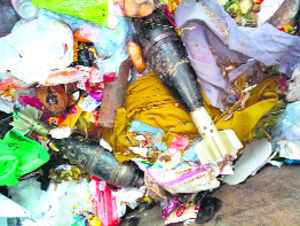
Panic gripped Ram Darbar after three live mortars were found lying in a heap of garbage in the area on Saturday morning.

Garbage collectors noticed the mortars lying near the vegetable market, after which various police teams rushed to the spot. Cops cordoned off the area and the traffic on the adjoining roads, including Ram Darbar-Poultry Farm chowk road, was diverted.

An earth mover was pressed into service to dig a pit to safely place the ammunition in it. The Army was also informed about the recovery of live mortars. An Army team later took the live mortars in its custody. A DDR has been lodged at the Sector 31 police station.

Priest with live cartridges caught at airport

Tribune News Service

Mohali, April 13

The police have nabbed a Barnala-based priest and spiritual guru, Gulam Haider Ali Quadri, with 13 live cartridges at the Chandigarh International Airport here today.

He was produced before a court, which sent him to 14-day judicial custody. He was sent to the Patiala jail.

Giving details, Inspector Baljeet Singh, SHO of the Airport police station, said Gulam Haider Ali Quadri was heading for Kolkata. While passing through the departure scanning section, the CISF detected ammunition in his baggage and detained the priest. Later, the police were informed about it. On checking the baggage, the CISF and the police recovered 13 live cartridges of .32 bore revolver.



Inspector Baljeet Singh said during preliminary interrogation, the priest claimed that he had a licensed revolver, which has been deposited with the police due to the poll code, and the cartridges were mistakenly left in his baggage. He said his weapon licence story had been verified and ascertained that he had deposited the weapon due to the model code of conduct.

The Inspector said even though the priest had a licensed weapon, they had to arrest him as he did not possess documentary evidences to support the ammunition in the baggage.

The police have booked Gulam Haider Ali Quadri under Section 25-54-50 of the Arms Act at the Airport police station, said the police.


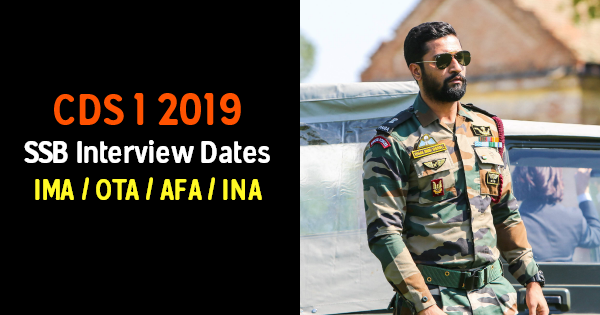
CDS 1 2019 SSB Interview Dates – IMA, OTA, AFA, INA

CDS 1 2019 SSB Interview Dates

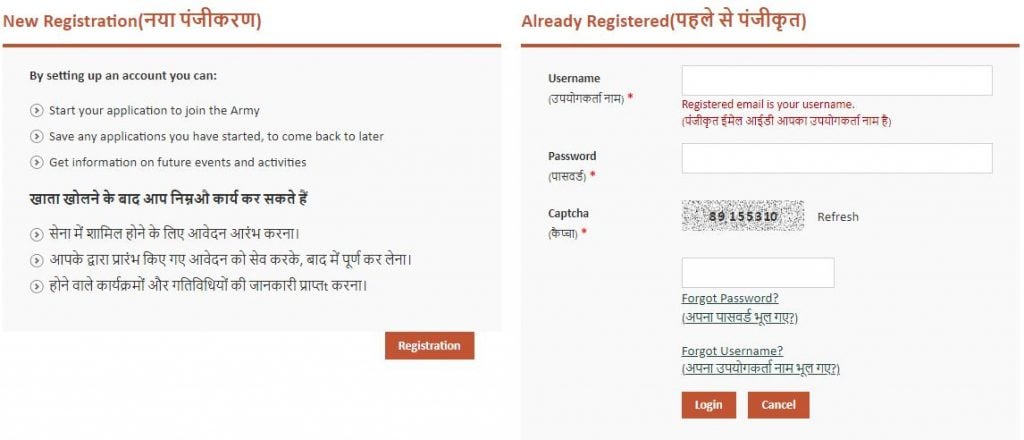
UPSC has recently published the CDS 1 2019 result, around 7953 candidates have cleared the CDS 1 2019 written exam for IMA, OTA, AFA and NA. As many candidates who have cleared the CDS 1 2019 written exam are waiting for the CDS 1 2019 SSB interview dates for IMA 148, INA 2020, AFA F(P) 207 Course, OTA Men 111th SSC and OTA Women 25th SSC SSB interview Dates, in this article we are going to explain the complete procedure of CDS SSB interview date and what actions are required from successful candidates. Official Statement: All the candidates who have successfully qualified in the written exam are required to register themselves online on the Indian Army Recruiting website joinindianarmy.nic.in within two weeks of the announcement of written result. The successful candidates would then be allotted Selection Centres and dates, of SSB interview which shall be communicated on the registered email ID. Any candidate who has already registered earlier on the site will not be required to do so. In case of any query/Login problem, e-mail be forwarded to dir-recruiting6-mod@nic.in.

ssb interview book
5 Days SSB Interview

CDS 1 2019 Courses:

  1. 148th Course IMA (Jan 2020) – Candidates can select the SSB Interview dates for IMA 148 SSB Interview at joinindianarmy.nic.in. Candidates of IMA-148 (DE) Course (CDSE (I)-2019) who have successfully cleared the UPSC written exam are requested to register on www.joinindianarmy.nic.in if not already registered. Selection centre will be allotted ONLINE soon and it will be notified on the same website in a months time.
  2. INA (Jan 2020): Candidates are suggested to keep an eye on the joinindiannavy and joinindianarmy website for the same.
  3. Indian Airforce 207 F(P)-: AFSB Interview date will be updated on AFCAT CDAC website.
  4. 111th SSC Course (NT) Men/25rd SSC Women (NT) (April 2020) : CDS 1 2019 OTA SSB interview will take some time and it usually happens after IMA SSB Interview. Centre allotment and seeking choice of SSB dates for Short Service Commission courses (Men and Women) commencing in April 2020 will be tentatively carried out by week of August – Sep 2019.

Note:  SSB Interview UPSC Entries (NDA and NA/IMA/SSC Non Tech (Men)/SSC Non Tech (Women). Candidates of UPSC Entries viz NDA and NA, IMA, SSC Non Tech (Men) and SSC Non Tech (Women) successful in UPSC written exam are not required to carry their UPSC admit card/application at the time of SSB interview. They are required to carry identity proof with requisite documents mentioned in the call up instructions of the SSB centers. Their credentials will be checked against details received from UPSC.

SSB Psychology Tests

Note: 

  1. You must register on joinindianarmy.nic.in website with the same email ID used for UPSC registration.
  2. In case you have registered with a different email id or not able to register with the correct email id, contact dir-recruiting6-mod@nic.in and joinindianarmy website.
  3. Candidates opted for Indian Air Force and Indian Navy must keep an eye on the respective official website. The respective website will also publish the SSB dates.
  4. While registering, make sure you enter the correct details.
  5. The date selection would be open in few weeks for CDS 1 2019 SSB interview.
  6. Remember, OTA SSB for CDS 1 2019 will take time because the OTA course will start in April 2020 but other courses like IMA will be in Jan 2020.
  7. Once the SSB dates are live, the official website will put up a notice. Keep checking the official websites.
  8. Instead of worrying about the SSB dates, this is the right time for you to prepare for the SSB interview.

cds 1 2018 ssb dates

IMPORTANT – Download eBooks for SSB Interview Preparations

Defence Exams and Interview Books:


Pakistan claims India planning another attack in April

Pakistan claims India planning another attack in April

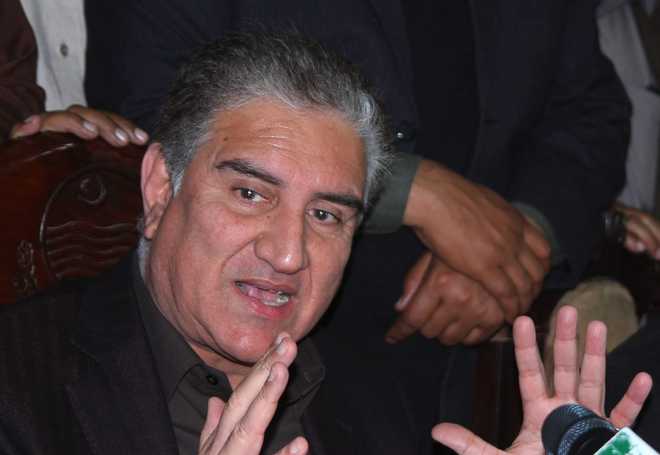
File photo of Shah Mahmood Quresh. AFP

Islamabad, April 7

Pakistan Foreign Minister Shah Mahmood Qureshi on Sunday claimed that his government has reliable intelligence that India is planning another attack against the country between April 16-20, according to a media report.

Tensions flared up between India and Pakistan after a suicide bomber of Pakistan-based Jaish-e-Muhammed (JeM) killed 40 CRPF personnel in Kashmir’s Pulwama district on February 14.

Amid mounting outrage, the Indian Air Force (IAF) carried out a counter-terror operation, hitting the biggest JeM training camp in Balakot, deep inside Pakistan on February 26. The next day, Pakistan Air Force retaliated and downed a MiG-21 in an aerial combat and captured an IAF pilot, who was handed over to India on March 1.

Qureshi during a press conference in Multan said that the government has “reliable intelligence that India is devising a new plan”, Dawn newspaper reported.

“Preparations are being made, and there are chances of another attack against Pakistan. According to our information, the action could be taken between April 16-20,” the paper quoted Qureshi as saying.

“A new mishap could be staged…And its purpose will be to justify their [India’s] offensive against Pakistan and to increase diplomatic pressure against Islamabad,” he alleged.

“If it happens, you can imagine the impact of the occurrence on the peace and stability of the region.”

Qureshi said that Pakistan has already briefed the United Nations Security Council’s permanent members over the issue and stated Pakistan’s apprehensions.

“We want the international community to take notice of this irresponsible behaviour and reprimand them [India] for taking this route,” he said. PTI