










Sanjha Morcha

What’s New

Click the heading to open detailed news

Current Events :

web counter

Print Media Reproduced Defence Related News

Why the IAF wants the S-400 missile | India Today Insight

The technological leap offered by the System-400’s capabilities far outweighs the risk of sanctions from the US and the loss of status of major non-NATO ally.

S-400 missile system

The S-400 missile system at the Almaz-Antey plant in St. Petersburg. The surface-to-air missile system will be delivered to India next year. (Photo:Sandeep Unnithan/India Today)

In a massive blue-roofed test facility outside St Petersburg, grim-faced lab coat-wearing technicians swing open 20-foot tall metal doors. Thick white clouds spread out. The long, green silhouette of an 8×8 truck lumbers out, bellowing furiously, its headlights shining through the fog, four giant missile canisters stacked horizontally on the chassis like large logs of wood. This scene from the test facility of Russian missile maker Almaz-Antey’s plant could be straight out of a Jurassic Park or Transformers movie franchise.

The 8×8 Transporter Erector Launcher (TEL), which launches Russia’s most controversial arms export in recent years-the System-400 (S-400) long-range air-defence missile-is being stress-tested in temperatures that are 50 and 70 degrees Celsius below zero. Last October, India signed a $5 billion (Rs 35,000 crore) deal with Russia to buy five systems of this missile that NATO calls the SA-21 ‘Growler’. The deal was concluded against strong objections from the US. Washington has objected to India buying the missile partly because it has applied sanctions on Russian arms firms, but it’s mainly because of the formidable capabilities of the S-400 missile. The missile, the US fears, will jeopardise future arms sales of high-performance aircraft, such as the F-35, to India.

The S-400 system is highly mobile-all radars, missiles and launchers are mounted on 8×8 cross-country trucks, which makes them harder to detect and destroy. The entire system can be made ready to fire in a matter of minutes. The S-400’s crown jewel is its 92N6E electronically-steered phased array radar, dubbed ‘Grave Stone’, that can track 300 targets over 600 kilometres away and, based on the threat and range, shoot four different missile types at them. Each S-400 system has four types of missiles from the 400-km range, 200-km range, 100-km and 40-km range, forming a nearly impenetrable interlocking grid of missiles. It can detect and destroy targets flying as low as 100 feet to as high as 40,000 feet.

The S-400 long-range air-defence missile is being stress-tested in temperatures that are 50 and 70 degrees Celsius below zero. (Photo:Sandeep Unnithan/India Today)

These missiles can address multiple aerial threats, from combat jets to cruise missiles and air-launched smart bombs, and are resistant to electronic jamming.

The Indian Air Force (IAF), which has closely studied the S-400 system for the past five years, was impressed by these capabilities. The IAF’s air defence missiles can currently only engage targets 40 kilometres away. The Medium-Range Surface-to-Air Missile or MRSAM to be acquired from Israel next year will increase its engagement range to nearly 80 kilometres. The S-400 on the other hand, more than quadruples the IAF’s missile reach.

“Deploying one S-400 system allows you to cover an entire spectrum of aerial threats,” says a senior IAF official. The missile system offers such a quantum jump in its capabilities that, the official says that the IAF advised the government to purchase it even at the risk of incurring US wrath. India also rejected US counter-offers of the Patriot Advanced Capability-3 (PAC-3) and Terminal High Altitude Area Defense (THAAD) to stop the sale.

The deal was directly concluded between the Indian and Russian governments in just two years, considerably shorter than the Indian defence ministry’s circuitous negotiations and acquisition cycle. Interestingly, transfer of technology and defence offsets, usually insisted on by the defence ministry for large volume deals, were waived. A new payment route for India to pay for the purchase, bypassing US banking networks, was recently formalised.

The IAF sees in the S-400 an answer to many of its existential woes-a dwindling fighter jet fleet and the increasing sophistication of enemy fighter aircraft. The force has only 32 fighter squadrons as opposed to a sanctioned 39.5. This is seen as inadequate for its primary tasks of securing Indian airspace from intruding enemy aircraft and conducting aerial warfare by bombing enemy targets. This crisis is likely to be exacerbated by 2027 when over 100 MiG-series fighter jets are phased out, leaving the IAF with just 19 fighter squadrons. The only acquisition by then would be two squadrons of 36 Rafale fighter jets-to be delivered by 2021. The IAF’s potential adversaries, China and Pakistan, have inducted cutting-edge fighter jets like Block 52 F-16s and, in the case of the People’s Liberation Army Air Force (PLAAF), the fifth-generation J-20 fighter. In case of war, the IAF would be hard-pressed to deploy its fighter jets in defensive and offensive roles.

This imbalance changes with the acquisition of the S-400. The missile system can undertake a bulk of the airspace defence role. From their locations in India, the S-400’s radars can look deep inside Pakistani territory and pick up enemy aircraft almost as soon as they are airborne. Deployed along the eastern border with China, the missile system can monitor fighter jets taking off from airfields along the Tibetan plateau. “In case of hostilities, the S-400s will free up our multi-role fighters for other tasks like air-to-ground bombing missions, instead of tying them up in the air superiority role of shooting down enemy fighters,” says a senior IAF official.

Russian officials confirmed that deliveries of all five systems will be completed by 2024 at the rate of one system a year, beginning 2020. The first S-400 mobile launcher could even be rolling down Rajpath as early as January 26, 2021. An air defence silver bullet if there was ever one.

READ | India will do what is in its national interest: Jaishankar to Mike Pompeo on S-400 deal

WATCH | Enter the Growler: S-400 missile ground report from St Petersburg


Army begins repair work of damaged fence along LoC

25-30 feet snow this winter has damaged fencing in parts of Gulmarg, Nowgam, Kupwara, Keran Machil, Gurez sectors


The repair of fencing is a regular process, especially after winter. This year, due to heavy snowfall at many places, the fences got damaged. Army officer

GUREZ: As snow in the higher reaches has started melting, the army with the help of porters has started replacing and repairing the double fencing (normal fence and smart fence).

The record of 25-30 feet snow, the highest since 2006, along the Line of Control in north Kashmir this year led to the damage to the fencing in Gulmarg, Nowgam, Kupwara, Keran Machil and Gurez sectors.

Gurez, which is one of the most-used routes among infiltrators, and Tulali Valley, the remotest area of Jammu and Kahsmir, has porters fixing the fence. The second layer of the smart fencing has been completed here.

“The smart fencing is more durable than the fencing which was in place earlier. The repair of fencing is a regular process especially after the winters. This year, due to heavy snowfall at many places, the fences got damaged,” said a young army officer, who has spent around seven months at a forward post overlooking the Baktoor Valley.

“We even repaired the poles which were used during winters to move from one post to another by tying ropes,” he added.

NO ENCOUNTER NEAR LOC IN GUREZ There has been only one encounter in north Kashmir’s Uri sector, close to LoC, in the first six months when a foreign militant was killed in Boniyar sector. Officials, however, said the militant was active in south Kashmir and wasn’t a new infiltrator. Officials, however, are investigating whether he had been near the LoC to receive the fresh group of infiltrators or not.

Union minister of state for home Nityanand Rai in response to a question in Lok Sabha on Wednesday had said that the net infiltration across the border has reduced by 43% after a surgical strike on terror camps in Pakistan.

Army officials manning the Line of Control told Hindustan Times that militants made attempts to sneak into the Valley many times.

“We spotted the militants in the PoK near LoC. We didn’t let them enter our area,” said an officer posted on the LoC in Gurez. “This winter, there was very heavy snowfall in the region which started in October and continued till April but we didn’t lower the guard.”

Officials and locals said no encounter took place on the LoC in Gurez but few militant groups have managed to sneak into the Valley from north Kashmir. “It’s very difficult to have zero infiltration,” officials said.


Centre award for BRO’s Himank Project

Srinagar, July 5

The Centrehas awarded the Himank project of the Border Roads Organisation (BRO) for steadily making roads motorable to the Line of Actual Control (LAC)in the Ladakh region.

Constructing motorable roads and bridges to the LAC inLadakh is a tough task asharsh weather, limited working season and high altitudes pose a challenge, a BRO statement said.

Recognising this work, the Centre has awarded 50 Border Roads Task Force with the “Best Task Force Efficiency Shield”, the statement said. — TNS


Army warns of not spreading fake video of imposter with combat uniform

The Indian Army has cautioned people not to believe an imposter who is seen in a video wearing Army combat uniform and spreading disinformation.

The Additional Director General PI of the Indian Army, through its twitter handle said, “Imposter wearing Indian Army combat uniform in video spreading disinformation”.

‘Be Cautious – Be Vigilant’, the Army said.

“Soldiers of #IndianArmy are committed to uphold the core values of our Constitution and the rich history of courage, valour and sacrifice,” the India Army added. The Army also shared the photo of the fake video saying “Please do not spread this fake video of IMPOSTER”.


Army to go ‘all out’ in Kashmir

Express News Service

NEW DELHI:   After the recent success in eliminating terrorists in the Valley, the Army is planning to bring about changes to its Counter Terrorism strategy in Kashmir. “We are working to rearrange the tactics of active engagement and dominance on ground. The aim is to reduce the stop-over time of the terrorists on the move, which at present is of 4-5 hours. They will either be forced to move out and commit mistakes or compelled to lie low,” said a senior Army officer. 

Army has planned the tweak based on the analysis of the way Operation ‘All Out’ has led to the elimination of a large number of terrorists including the commanders. “We have been able to reduce the average active life of a terrorist to six months because of the pinpointed information about their movement. We have also been able to generally map the areas which have a majority of terrorists,” shared an officer.

ALSO READ| Troops fully prepared for emerging security challenges: Army Chief Bipin Rawat


A total of 318 terrorists were killed in 2018 and 232 militants killed in 2010. Terrorism has got concentrated in the South Kashmir and out of the 50 youth picking weapons against the security forces till now most are from the four districts viz.

Pulwama, Shopian, Kulgam, and Anantnag. The maximum of 14 have come from Pulwama alone. Also, the second highest is from Shopian and Kulgam with 9 each. 8 joined from Anantnag.  “Out of the total of 280 active terrorists from Kashmir 60 to 70 are from Pulwama and Shopian,” said the officer.

Eye on Yatra

Amarnath Yatra is to begin in the first week of July for which Army is busy making security arrangements. “We have plans ready to hold the advantage point and the heights on the way to the holy cave. Two to four battalions will be put into operations,” said the senior officer. 

  
Stay up to date on all the latest Nation news with The New Indian Express App. Download now
(Get the news that matters from New Indian Express on WhatsApp. Click this link and hit ‘Click to Subscribe’. Follow the instructions after that.)

OROP – Reinventing The Subterfuge? by Prakash Katoch

Newly appointed Defence Minister Rajnath Singh has constituted a Committee headed by Comptroller General of Defence Accounts (CGDA) to examine the equalization of pensions of defence personnel with effect from 01 Jul 2019 under One Rank, One Pension (OROP) scheme, giving one month to the Committee to forward its recommendations.

Above apparently is following a recent clarification sought by CGDA from the Ministry of Defence (MoD) “whether any logic exists to initiate the process of OROP revision (equalization) once the pension of past and current pensioners was initiated on January 1, 2016”. Issue to note is that though executed after the 7th Central Pay Commission, OROP for soldiers was implemented with effect from July 1, 2014, and a gazette notification said pension would be equalized after five years; which implied with effect from July 1, 2019. Equalization implies soldiers who retire in same rank and with same length of service will be on a par in terms of pension.

The last minute CGDA query when pensions are to be equalized with effect from July 1, 2019, and constituting another Committee by the Defence Minister (on behest of MoD) raises the questions: one, did MoD ask CGDA to begin the process of equalization of pensions; two, if yes, who is CGDA to question it, and; three, if not, who prompted the CGDA to seek such clarification now? Clearly, this is deliberate mischief between MoD’s Department of Ex-Servicemen Welfare (DESW) and the CGDA taking advantage of a new defence minister who would be unaware of the background of OROP.

Though the government has been reiterating that OROP has been granted, Prime Minister Narendra Modi is perhaps unaware it was not the case, and instead a one-time raise in pension was given, as explained in these columns (OROP – is it really granted?: https://hillpost.in/2015/09/orop-is-it-really-granted/104218/), which also explained the politico-bureaucratic obduracy in giving military pensioners their due. Defence-cum-Finance Minister Arun Jaitley found it impossible to actualize OROP annually (as required) despite his educational qualifications and available technology, with banks calculating everything on daily basis including flexi deposits.

It is well known that while Manohar Parrikar, when Defence Minister wanted to award ‘full’ OROP, Jaitley made it a prestige issue to deny it, the talk of the town being he could never recover from losing his deposits when defeated in elections at Amritsar to an Army veteran during 2014. That notwithstanding, if government was convinced that OROP was fully implemented, where was the need to appoint the one-man Reddy Commission on OROP to look into the anomalies. L Narasimha Reddy was retired Chief Justice of Patna High Court, heading the one-man committee, submitted his report to the government on October 26, 2016. His recommendations obviously were not to the liking of the bureaucracy, due to which it was put in the freezer.

20 months after Reddy Commission submitted its report, the then Defence Minister Nirmala Sitharaman stated in July 2018, ‘We are examining the report of retired chief justice of Patna High Court, L Narasimha Reddy”. Parliament was also informed that another committee has been appointed to examine recommendations of the Reddy Commission report (sic). On January 3, 2019, the Supreme Court issued a notice to the Centre on a public interest litigation alleging inordinate delay in removal of anomalies in the “initial implementation” of OROP, as ordered by the MoD in November 2015. Next in run up to the recent general elections, Sitharaman stated publicly on March 4, 2019, that the Centre would “shortly” review the scheme to review anomalies of OROP.

The new Committee appointed by the Defence Minister is akin to going around the mulberry tree with no full-stops in sight. Here a few additional issues are relevant, which perhaps are not known to public at large. The protests against non-implementation of OROP are attributed to officers through vested news, which it is not. Officers are only 1% of retirees; non-equalization of OROP hurts soldiers most. There is plenty discussion about little funds left for military modernization on account of pay, allowances and pensions but following needs to be considered in this context:

  • The past five annual defence budgets have been ‘negative’ in actual terms and lowest since 1962.
  • While announcing defence budgets, it is clarified that separate provision is made for pensions, which is sensible because 60,000 personnel retire annually from the Army alone. So why the hue and cry.
  • Despite voids of a National Security Strategy and a Strategic Defence Review (SDR), the Army has been instructed to cut down 1,00,000-1,50,000 manpower. But there are no cuts in the 6.5 lakh civilian-defence employees who at an average cost five times more than their uniformed counterparts.
  • Dispassionate analyses ‘overall defence expenditure’ in the country would indicate that almost 70% DRDO-OFB-DPSUs, with returns that are hardly commensurate. Enormous funds can be saved there.
  • Compared to the cries to reduce the military strength without a SDR and without reducing CI commitments, the central armed police forces are expanding rapidly, with enormous funds at disposal of Ministry of Home Affairs.

NDA III is to announce its first budget on July 6. Logically, annual defence allocation of 2.5 to 3% of GDP for next five years is needed since without a strong military no country can even push its national interests at the bargaining table. The fact that India spent $8.6 billion on the recent general elections (https://edition.cnn.com/2019/06/08/asia/india-election-spending-intl/index.html), double than 2014 Indian elections and $2.1 billion more that 2016 US presidential elections, indicates there is no dearth of money in our country. A government that seeks votes from martyrdom of soldier but denies then their dues can only be described as pathetic. Defence Minster Rajnath Singh needs to put an end to the unending subterfuge on OROP, and take a decision once for all.


‘Booze Brigadier’ to egg & tent scams: Indian military must check falling standards in ethics

Abuse of privileges by senior officers in the form of misuse of vehicles, use of soldiers as domestic help and fudging electricity bills is rampant.

Indian Army | Representational image | Commons

While many in the Indian armed forces are calling a price cap on cars sold at military canteens “ill treatment” and some others are questioning the perks they enjoy, they need to look at a recent incident in the UK where a naval officer ‘misused’ his official car and was ‘removed from command’. The two aren’t comparable, but they call into question the expectations people have of military men and women.

Error in judgement or ethics

Two weeks ago, Commodore Nick Cooke-Priest, the Captain of Royal Navy warship HMS Queen Elizabeth, was removed from command for an ‘error of judgement’ in ‘misusing’ his official car.

The military veterans, media and the public in the UK were divided on the subject. Some felt that the ‘misdemeanour’ hardly warranted the sacking of a highly regarded Captain who commanded a £3-billion aircraft carrier, which can carry up to 36 fighter jets with a maximum crew strength of 1600 and is the most modern ship in the Royal Navy fleet.

Some others felt that military ethics are absolute and there can be no compromise on that, irrespective of rank, appointment and professional calibre.


Also read: Indian armed forces upset as Modi govt imposes curbs on car sales at military canteens


My own tweet on the subject, highlighting the falling ethical standards in our armed forces, led to a lively debate on Twitter. It was a pleasant surprise that the Twitterati and the veterans were unanimous in their views on upholding highest ethical standards in armed forces irrespective of the compromised standards in other government institutions and the society.

Military leadership & best practices

In the recorded military history of five millennia, the fundamentals of military leadership – the value system, the leadership traits, the principles, and the code of conduct – have remained unchanged. Unchanged, because the military has dynamically selected the best practices from the society, used them to develop its leaders, and applied them absolutely through enforceable rules, regulations and military law to bridge the gap between military ideals and omnipresent human failings.

Ethics – the understanding of moral right or wrong – guides military leaders in taking the right decisions. The military is the state’s instrument of last resort and can use ‘force’ on its behalf. If it does not strictly adhere to the moral conduct, the consequences will be horrendous, particularly when military is employed for internal security.

Violation of military ethics

Our officer corps have a stellar reputation in peace and war. In battle, they have led from the front. However, a lot of character shortcomings have been reported particularly among senior officers, Colonels or equivalent and above.


Also read: In his hyper-nationalistic election speeches, Narendra Modi is writing India’s security doctrine


Over the years, there have been numerous reports on violation of military ethics by officers. We have had ‘Booze Brigadier’ and ‘Ketchup Colonel’ cases along with numerous instances of alleged fake encounters.

A number of senior officers have faced court-martial, notable among them was a director general of the Army Service Corps, a Lt Gen, who was awarded three years rigorous imprisonment (later reduced to dismissal by the Armed Forces Tribunal) for procuring inferior dal‘Tent scandal’, ‘egg scam’ and ‘golf cart scam’ are some of the ridiculous names for cases of petty corruption. Abuse of privileges by senior officers in the form of misuse of vehicles, use of soldiers as domestic help and fudging electricity bills is rampant.

The highest custodians of military morals, the service chiefs, apart from a host of other senior officers, are no exception. A General-rank officer has been found guilty of molesting a subordinate woman officer. Two Army chiefs and one Navy chief and several other generals, including Army commanders, were allegedly allotted flats in the now-notorious Adarsh Housing Society in violation of the rules. If that is not enough, service chiefs in connivance with the Ministry of Defence are known to have got an authorisation to keep personal staff post-retirement. With what face can a chief act as the moral custodian of his service when he has got a dubious perk ‘authorised’?

The cascading effect

It is a non-valid excuse that the declining standards of probity in public life have an effect on the military. The military is expected to avoid this pitfall through a structured leadership development programme, which is backed by rules, regulation and enforcement of the law.

The reasons for the current decline in ethical standards are a flawed leadership development programme and a compromised leadership failing to enforce the rules.


Also read: Don’t politicise Indian armed forces. Just look at what it did to our police


Mutual trust between the leader and those being led is the most important factor in a battle. This trust is built over a period of time during training. In a rules and regulations-bound organisation with strict enforcement laws, the subordinates are constantly watching their leaders. They are very keen to see whether the leader adheres to the strict rules and regulations as well as the privations that s/he enforces on them. This why the ‘role model’ who ‘leads by example’ never fails in the military. In an evolving society, probity of the leader is always measured. The military is no exception. In the military, ‘integrity’ also stands for an ‘integrated personality’ with no duplicity.

Duplicitous conduct of the officer corps, particularly with respect to ‘integrity’, has a cascading effect on the psyche of the subordinates, leading to lack of faith and trust – a most dangerous situation in a battle. This is why the ‘good’ Captain of HMS Queen Elizabeth had to be ‘removed from command’. It is high time that the Indian military puts its house in order with respect to falling standards in morals and ethics.

Lt Gen H S Panag PVSM, AVSM (R) served in the Indian Army for 40 years. He was GOC in C Northern Command and Central Command. Post retirement, he was Member of Armed Forces Tribunal. Views are personal.

From interviews to news reports, catch ThePrint live in action on our YouTube channel. Subscribe here


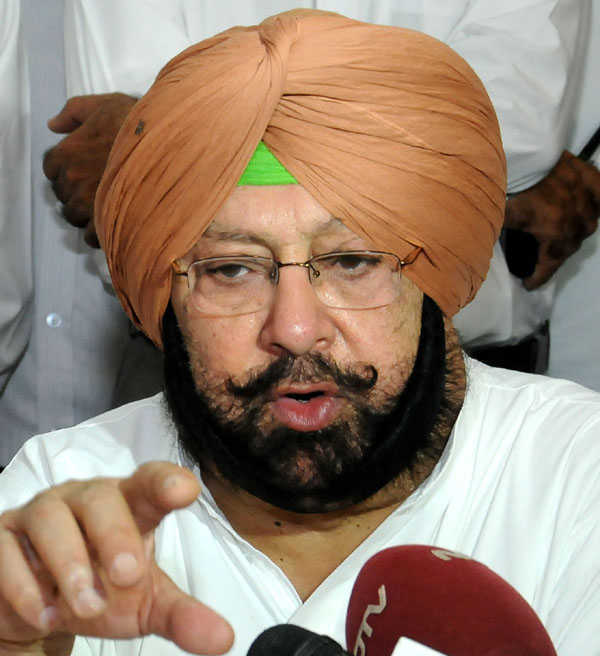
There’s only national security line, says Capt

There’s only national security line, says Capt

Amarinder Singh. Tribune file photo

Tribune News Service
Chandigarh, April 27

A day after a television channel ran the slug ‘CaptainBacksModiHardline’ after an interview with him, Punjab Chief Minister Amarinder Singh issued a clarification saying that he was against “terrorism and threats to India’s security, much like his Congress party’s stand.

Amarinder Singh said there was “no Modi hardline, only a national security line” that the Congress stood by. He said the news channel’s misinterpretation was “ridiculous” and that he had excoriated Prime Minister Narendra Modi’s government and his Bharatiya Janata Party for trying to appropriate the armed forces’ actions at Balakot.

He quoted himself as saying in the interview: “The Prime Minister has no business claiming this victory. These kinds of operations have been happening at the Pak border for the last 50 years. Who says this has not been done before? It was done in 1947, 1965, 1971, and during the Kargil operations”.

He claimed he also defended Congress party’s promise of withdrawing AFSPA— saying it was aimed at maintaining peace—as well as to do away with the controversial sedition law. On the latter, he said that there were a number of laws in the country that dealt with such situations.

“We have to de-escalate somewhere,” he said.


Fighting tactical battles for one-upmanship by Pravin Sawhney

Separate doctrines of the Army and the Air Force, and with each service doing its own training, are evidence that no amount of modernisation would help if the focus of the service chiefs remains on tactics. Success in war between India and Pakistan depends on the operational level of war.

Fighting tactical battles for one-upmanship

Face-off: Had India retaliated to the Pakistan Air Force’s counter-strike, an escalation was assured.

Pravin Sawhney
Strategic Affairs Expert

SPEAKING at a recent seminar, the Air Force chief, Air Chief Marshal BS Dhanoa, while referring to the February 26/27 Balakot air spat, raised the critical war-winning issue. He said: “Did they (Pakistan Air Force) succeed in their objective? The answer is a clear ‘No’, as the attack was thwarted, while we achieved our objective in Balakot. This is the main argument.”

This is the wrong argument. If the Indian Air Force (IAF) had followed the correct argument, it would not have lost seven lives in the Mi-17V helicopter on the morning of February 27 when the air exchange was going on. Since the helicopter was not hit by Pakistani fire, it is reasonable to suspect that it went down by friendly fire.

The correct argument is that the IAF breached Pakistan-controlled airspace on February 26 for hitting ‘non-military’ targets in Balakot. These were tactics (battle). The Pakistan Air Force (PAF) struck the next morning and also breached India-controlled airspace. This was done by the PAF in order to maintain balance at the operational (war-fighting or campaign) level of war. The operational level of war is where tactical battles in a particular area or theatre are given a coherent design and tackled as a whole. Moreover, since escalation was not the motive of the PAF either, it goes to its credit that they managed to miss military targets in the area which has extremely high density of Indian Army troops. Destruction of Indian Army installations would have compelled the Modi government to escalate, resulting in war, which neither side wanted.  

The success in war between India and Pakistan depends on the operational level of war. A country can be successful at the operational level of war because of good higher defence management, firepower, joint training and mindset despite fewer numbers in terms of manpower and equipment, which is the case of the Pakistan military vis-à-vis the Indian one. Since air power, given its reach and flexibility, is central to success at the operational level, PAF’s quick retaliation was expected to maintain its air power credibility.

Yet, the IAF was not prepared for the inevitable. Had it been ready, the IAF would have seized control of airspace management after its February 26 strike, since it is its responsibility in war. The air corridors would have been marked and assigned, and all ground-based air defence networks (of the Air Force and Army) would have followed war protocols, waiting for the enemy’s counter-airstrike. Clearly, no one told the ill-fated helicopter not to take off on a routine peace-time flight, and the ground air defence observers, too, were caught on the wrong foot. 

The issue, thus, is about tactics and operational level of war. The Pakistan military, learning from the Soviet Union, has always given importance to the operational level. This is why in the 1965 and 1971 wars, despite being more in bean-counting of assets, India never won in the western sector. Proof of this are the ceasefire line and the Line of Control, which otherwise would have been converted into international borders.

The situation, regrettably, remains the same today. Separate doctrines of the Army and the Air Force, and with each service doing its own training is evidence that no amount of modernisation would help if the focus of service chiefs remains on tactics. For example, after the Balakot operation, a senior Air Force officer told me that the PAF would not last more than six days. He believed in tactical linear success. What about the other kinetic and non-kinetic forces which impact at the operational level?

This is not all. Retired senior Air Force officers started chest-thumping about the Balakot airstrike having set the new normal. Some argued that air power need not be escalatory, while others made the case for the use of air power in counter-terror operations like the Army. Clearly, they all were talking tactics, not war. Had India retaliated to the PAF’s counter-strike, what it called an act of war, an escalation was assured. It is another matter that PM Narendra Modi had only bargained for the use of the IAF for electoral gains.

Talking of tactics, Air Chief Marshal Dhanoa spoke about relative technological superiority. Perhaps, Wing Commander Abhinandan Varthaman would not have strayed into Pakistani airspace if his MiG-21 Bison had Software Defined Radio (SDR) and Operational Data Link (ODL). The SDR operates in the VHF, UHF, Ku and L bandwidths and is meant to remove voice clutter. The ODL provides the pilot with data or text, in this case from the ground controller. The officer, separated from his wing-man, and without necessary voice and data instructions, unwittingly breached the airspace and was captured by the Pakistan army. There are known critical shortages of force multipliers in addition to force levels in the IAF. Surely, the IAF Chief can’t do much except keep asking the government to fill the operational voids. But, he could avoid making exaggerated claims since his words would only feed the ultra-nationalists, and support the Modi government’s spurious argument of having paid special attention to national security.

The same is the case with Rafale and S-400. These would certainly help, but would not tilt the operational level balance in India’s favour. For example, the IAF intends to use S-400 in the ‘offensive air defence’ role rather than its designed role of protecting high-value targets like Delhi, for which it was originally proposed. For the protection of high-value targets, the Air Headquarters has made a strong case to purchase the United States’ National Advanced Surface to Air Missile System (NASAMS). This is ironic, because while S-400 can destroy hostile ballistic missiles, NASAMS can’t do so. It can only kill cruise missiles and other aerial platforms. The thinking at the Air Headquarters is that since there is no understanding on the use of ballistic missiles — especially with Pakistan — both sides are likely to avoid the use of ballistic missiles with conventional warheads lest they are misread and lead to a nuclear accident. So, NASAMS may probably never be called upon to take on ballistic missiles.

Given the direction of the relationship between the India and Pakistan, this assumption may not be the best to make when procuring prohibitively expensive high-value assets.