Sanjha Morcha

What’s New

Click the heading to open detailed news

Current Events :

web counter

Print Media Reproduced Defence Related News

The sea inside her

For Himachal girl Pratibha Jamwal, 29, who was one of the six women to circumnavigate the earth, the voyage was a test of grit

Sarika Sharma

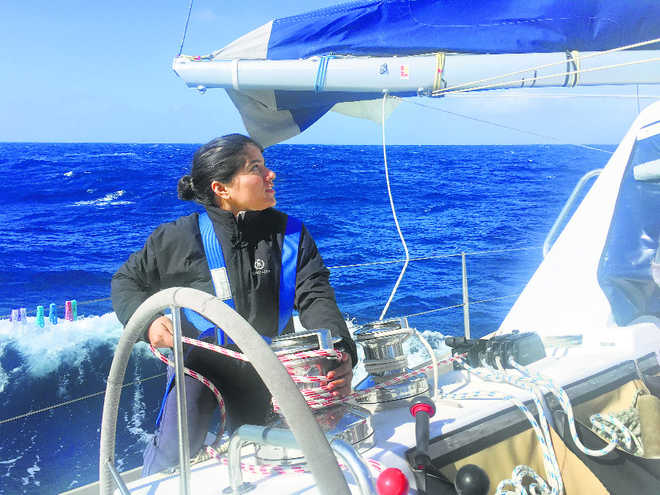
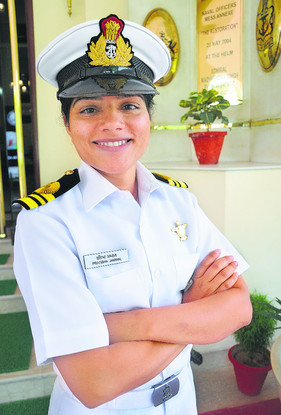
Leaving her loved ones behind and setting sail had been tough for Pratibha Jamwal. Throughout the eight months that she was out on the sea along with her colleagues, Pratibha pictured the day of returning home in her mind so many times. But a few metres from the berth, she didn’t feel that joy. There was, instead, a sinking feeling. She was going to miss her mornings surrounded by the sea. She was going to miss being with her gang, along with whom she had just become one of the first few Indian women to circumnavigate the earth — she was part of the six-member women team of Indian Naval Sailing Vessel (INSV), Tarini.The feat achieved by Pratibha, who hails from Mohal in Kullu, Himachal Pradesh, is unique. The mission makes her and her colleagues an example to follow. Understandably, it was a hard road. As women officers are not posted on sea-going platforms, they had to start from the scratch. “We did our theoretical training in various naval schools and trained in navigation, communication, meteorology and seamanship,” she tells. Then, they were posted at INS Mandovi, where they trained on-board INSV Mhadei, the first Indian boat to circumnavigate the world. “Captain Dilip Donde, the first Indian to circumnavigate the world solo, became our mentor. We covered more than 22,000 nm during training,” tells Pratibha, whose teammates included young women from various backgrounds, all “naive and amateur”, but each “strong headed”.For eight months, she was there in the sea. She says she loved the azure expanse. Was she scared too? She shrugs. “All of us had volunteered for this as it required huge commitment. You can’t force someone as it involves risk of life,” says Pratibha, whose father retired from government service and mother is a homemaker.Rough weather struck near Cape Horn in January when every bit learnt during those three years of training was put to test. The winds were 70-knot strong and waves as high as 9 metres. Pratibha remembers frantic manoeuvring and cherishes their teamwork. “Next morning, everything was clear and there was a sense of pride and accomplishment,” says Pratibha.They met two more storms at the shore while in Falkland Islands and one in Port Louis Mauritius. “While we were close to Falkland, the storm was greater than hurricane force and it was raining continuously,” Pratibha recalls. The temperature too subzero and they were out, steering the boat. “The night had descended. We were wet and cold, but no one could sleep as the person on the wheel had to be relieved every hour. Half of the crew was drying clothes for those steering.”Those eight months were also spent understanding the sea. Pratibha realised they differed in temperament. “The Arabian Sea and the Indian Ocean are calm compared to the Atlantic and South Pacific. There the waves are normally 4-5 m high and winds blow at 60kmph, but, in case of a storm, they can go as high as 9-10m with winds of 140kmph.”So, if the sea was ferocious, it was bountiful too. “The waters offer you a lot of beautiful things. We saw different varieties of marine life, encountered auroras and bioluminescence — things you get to see only at the sea,” she says. Among all this fun, madness and fury, lay the sole aim of creating history. She hopes more and more women are inducted as sailors. “It will widen the horizon and make the working environment better for both the genders,” she says.At the shore in INS Mandovi, Goa, now, she soon heads to Kochi, where she will be an instructor at a school for Naval airmen. Until then, the sea inside her will continue to rise — bring a smile to her face, maybe give her goosebumps too.

The team

INSV Tarini sailed 22,000 nautical miles in 254 days to circumnavigate the globe. The expedition, christened Navika Sagar Parikrama, was flagged off from INS-Mandovi boat pool in Goa on September 10, 2017 and they reached back on May 21. The INSV Tarini team, led by Lt Commander Vartika Joshi, comprised Lieutenant P. Swathi, Lieutenant Pratibha Jamwal (Air Traffic Control specialists), Lieutenant Vijaya Devi, Sub-Lieutenant Payal Gupta (both Education officers) and Lieutenant B Aishwarya, a naval architect.

The tour

The all-women team completed the expedition in six legs, with stopovers at Fremantle (Australia), Lyttleton (New Zealand), Port Stanley (Falkland Islands), Cape Town (South Africa) and Mauritius


HOW MS BRANCH PLAYS WITH CAREERS OF OFFICERS

It has been known for a while now that all is not well in the Military Secretary’s (MS) branch. It has been suspected for some time now that wrapped in secrecy, despite tall claims of transparency, the MS branch utilises the opaqueness to play with careers of officers. Why and at whose bidding, it is not known. But it may vary from case to case. And now it stands utterly and totally exposed. By none other than the Principal Bench of the Armed Forces Tribunal.

The bench of Justice AK Mathur, Chairperson of the Tribunal and the administrative member, Lt Gen SS Dhillon, have blown the lid off one of the worst kept secrets in the Indian Army. That all is not well in the MS Branch and a comprehensive review of how it functions is the need of the hour.

The scathing indictment of the most important branch of the Indian Army, as far as the officer cadre’s career is concerned, came as a result of a petition filed by a Brigadier of the Corps of Engineers. Brig VG Gole, of June 1979 seniority, was shocked when he found out that he had not been empanelled for promotion in the selection board held for the rank of Major General in late 2010. As an officer who had been getting consistently good ACRs, he could not fathom why he was not selected.
And then he found out the reason. To his shock he came to know that the IO portion of his most recent ACR has been effaced, or removed from records in the selection process, as a result of which he fell back in the comparative merit. Why? Because of the following explanation given by the respondents when he filed a case in the AFT:

“A reply has been filed by the respondents contesting the position and took resort to a policy decision at Para 137 of Army Order 45/2001/MS which gives them power to efface the assessment if it is found that the ACR of the incumbent is grossly inconsistent or with inflationary/deflationary/ subjective reporting. This effacing could be done after due approval of the Chief of Army Staff. In this case, the ACR was found grossly inconsistent, therefore, IO’s
assessment was expunged after approval of the Chief of Army Staff”.

When the bench called for the records to see if this was true, they found out that this was not so. The decision to efface had been made arbitrarily. The bench found out that:

“We called upon the respondents to produce the original record before us and after perusing the record, we are constrained to observe that the powers exercised by the respondents is arbitrary. We have seen the ACR record of the petitioner from 2006 to 2010 and we find that during this period
he has earned seven ACRs and has not secured less than 8 marks in any of the qualities mentioned in the ACR. We also found that the IO’s assessment in the ACR from January, 2009 to June, 2009 has been totally effaced. We do not know how much marks were given by the IO but at least we have seen the RO’s assessment in which petitioner was given 8 marks in 5 qualities while in the remaining 12 qualities he has obtained 9 marks. Subsequently, even in the ACR from July, 2009 to November, 2009 he has received almost 8 or 9 marks. From February, 2010 to June, 2010, we find that petitioner has again secured 8 & 9 marks in all the qualities. The explanation given by the respondents is hardly satisfactory. Learned counsel for the respondents has produced before us a minute sheet to justify their stand, but we regret to say that it is a totally arbitrary and if we may say malafide in law also”.

The bench found that there was room for investigating into how and why the officer’s career had been adversely affected. They asked for the officer responsible to be pinpointed and ordered that the Brigadier be considered afresh for promotion notwithstanding his impending retirement and also imposed a cost of Rs 10,000 on the respondents.

“It speaks volumes that such kind of illegality can be committed against an officer. This is a serious matter and we are constrained to observe that it requires deeper consideration by the higher authority and they should pinpoint the officer responsible who has played foul thereby affecting the career of the officer. We allow this petition and expunge the effacing of the ACR of the petitioner for the period from January, 2009 to June, 2009 given by the IO. The marks should be restored back and petitioner should be reconsidered for promotion to the post of Maj Gen in accordance with rules. The impending retirement will not come in the way of consideration of the petitioner for promotion to the post of Maj Gen. The petition is allowed with cost of Rs 10,000”.

If this is how the MS branch functions and if this is how the Chief of Army Staff goes about rubber stamping the illogical and illegal decisions of MS branch put up to him, then it paints a sad picture indeed of the Army hierarchy. How many such cases may have gone unnoticed in the past? What about the time when the AFT was not there? Such cases would drag on and on and the officer’s career be marred for ever by the time he got relief, if any. Criminal, to say the least.

The officer holding the Military secretary’s appointment at the time when this particular case took place is answerable to the entire officer cadre of the Army. He should be held responsible and action taken against him for such illegal action. And Chiefs of Army Staff must sign on the dotted line with their eyes open. Regimental loyalties must not come in the way of being fair to those who serve under the COAS. To say the last.

by

Man Aman Singh Chhina

(As a journalist who has been on the defence beat for many many years, I wish to use this blog to report many things which are not reported in the media, or more importantly, cannot be reported for a variety of reasons. So expect this blog to be brutally honest… about truth, about the men and women in uniform and the Indian defence establishment at large).


Financial frauds to be non-bailable offence

Financial frauds to be non-bailable offence
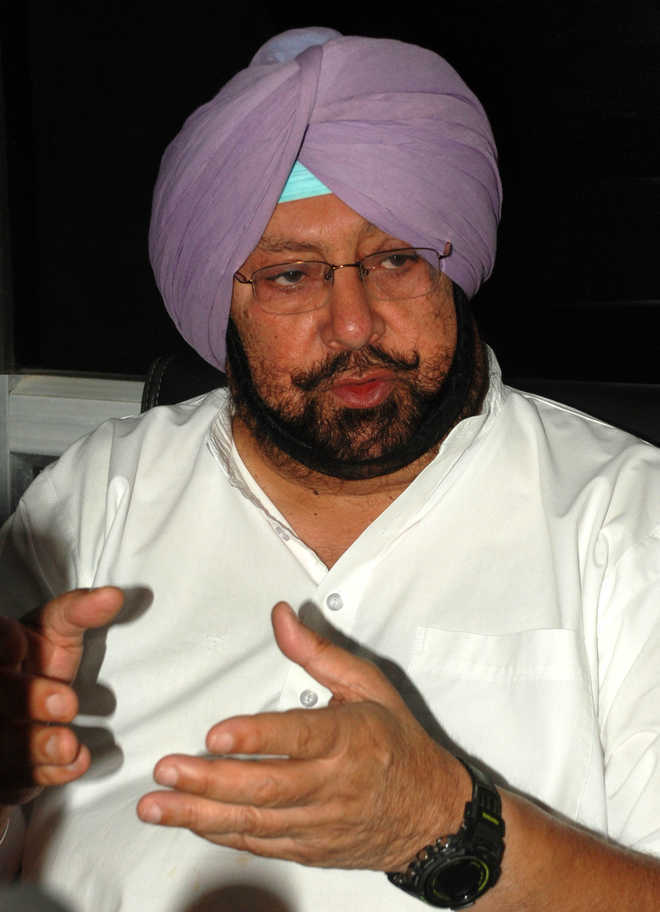
The decision was taken in a Cabinet meeting chaired Punjab CM Capt Amarinder Singh.

Chandigarh, May 31

The Punjab Cabinet on Thursday made fraudulent practices by financial establishments a non-bailable offence, inviting up to 10 years of imprisonment, with provisions for attachment of properties.The cabinet has approved a new legislation to this effect to safeguard the interests of depositors and curb fraudulent practices by financial establishments, an official spokesperson said here.The Punjab Protection of Interests of Depositors (in Financial Establishments) Bill, 2018, has been brought following several complaints of fraud received by the state government, the Reserve Bank of India (RBI) and the Securities and Exchange Board of India (SEBI), he said.The meeting was chaired by Chief Minister Amarinder Singh.Under Section 6 of the legislation, if a finance company fails to return the deposits on the due date or defrauds the public, then the promoters, managers and employees would be liable for imprisonment up to 10 years and fine of Rs 1 lakh, the spokesperson said.The financial establishment shall also be liable for a fine of Rs 2 lakh, which may be extend to Rs 1 crore, he said.Section 5 of the legislation provides that all financial establishments would be required to submit quarterly return of their business to the district magistrate or additional district magistrate, the spokesperson said.In case of default, the company would be liable to pay fine of Rs 1 lakh.Section 3 authorises the government to attach the properties of the company and also that of its owners or directors, and promoters, he said.The spokesperson said Section 4 provides that the officers, notified by the government, such as district magistrates and additional district magistrate, will dispose of properties as per orders of the court.Under Section 8, the government would notify district and session judges as the designated courts to implement the Act.Sections 9 to 12 of the legislation  deals with detailed powers of designated courts, while Section 16 states that no anticipatory bail would be allowed to promoters, managers and employees of the company found guilty of fraud, he said.The move comes in wake of mushrooming of financial establishments in Punjab, with many of them making unlawful gains by way of receiving money as deposits from the public, particularly of the middle class and the poorer sections, the spokesperson said.This done by companies by making impracticable or commercially unviable promises or by offering highly attractive rates of interest or rewards, with the intention of not fulfilling the obligation of refunding deposits on maturity or of not rendering proper services assured to the investors, he said.The proposed Bill would go a long way in protecting the rights of innocent depositors, who were often duped by such fraudulent financial institutions on the pretext of supplementing their money manifold, he said. – PTI 


Army Chief in Valley, says keep extra vigil to check hostile forces

Army Chief in Valley, says keep extra vigil to check hostile forces

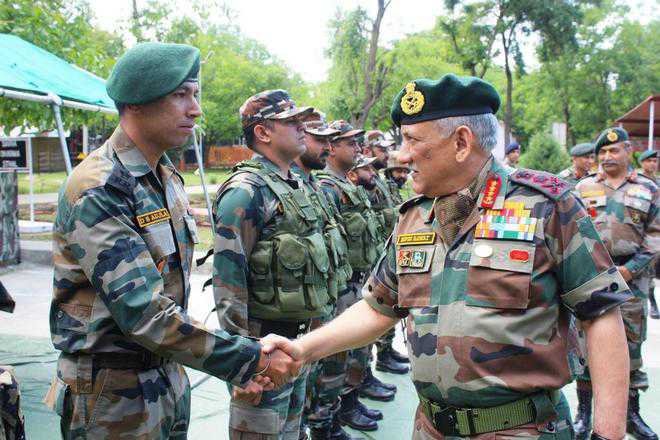
General Bipin Rawat in the Valley on Thursday. Tribune photo

Tribune News Service

Srinagar, May 24

For the first time since the Ramzan ceasefire was implemented, Army Chief General Bipin Rawat arrived in the strife-torn Valley to review the security situation.While the Army officers on ground briefed General Rawat about the security situation, especially in wake of the cessation of the anti-militancy operations, the Army Chief stressed the need to maintain “extra vigil to defeat the evil designs of hostile forces and assured his full support to further strengthen the security posture”.Srinagar-based defence spokesman Col Rajesh Kalia said the Chief of Army Staff reviewed the prevailing security situation in the hinterland.Accompanied by Chinar Corps Commander Lt Gen AK Bhatt, the Army Chief visited the formation headquarters and units where he was briefed by the commanders on ground regarding the operational preparedness.“The Army Chief was appreciative of the measures and the standard operating procedures instituted by the units and formations to meet the challenges posed by the inimical elements. Commending the performance of the troops in the recent successful operations, the Army Chief stressed the need to maintain extra vigil to defeat the evil designs of hostile forces and assured his full support to further strengthen the security posture,” the spokesman said.General Rawat also took stock of the security and administrative arrangements for the upcoming Amarnath yatra, which is scheduled to commence from June 28, and stressed on the need for close coordination with the civil administration to ensure a smooth and efficient conduct of the pilgrimage.While there have been some militant-initiated actions in Kashmir during the past eight days, the situation has been relatively calm, especially in south Kashmir which has been volatile since July 2016, after the killing of militant commander Burhan Wani .Since May 17, militants have initiated few actions across Kashmir, including an attack on Army patrol in north Kashmir’s Hajin area of Bandipore district. Four civilians, including two sisters, were injured allegedly in Army firing in volatile Shopian in south Kashmir on Monday evening during an iftaar party hosted by the Army.


China begins large-scale mining at Arunachal border

Beijing, May 20

China has begun large-scale mining operations on its side of the border with Arunachal Pradesh where a huge trove of gold, silver and other precious minerals valued at about $60 billion has been found, a media report said on Sunday.The mine project is being undertaken in Lhunze County under Chinese control adjacent to the Indian border, the Hong Kong-based South China Morning Post reported.China claims Arunachal Pradesh as part of southern Tibet. Projecting the mining operations as part of China’s move to take over Arunachal Pradesh, the report said “people familiar with the project say the mines are part of an ambitious plan by Beijing to reclaim South Tibet”. “China’s moves to lay claim to the region’s natural resources while rapidly building up infrastructure could turn it into ‘another South China Sea’ they said,” it said.The Post report with inputs from local officials, Chinese geologists as well as strategic experts comes less than a month after the first ever informal summit between Prime Minister Narendra Modi and President Xi Jinping that was aimed at cooling tensions to avert incidents like the Doklam military standoff last year. The 73-day standoff marked a new low in bilateral ties.Lhunze was in the news last October, just about two months after Doklam, when Xi in a rare gesture replied to correspondence from a herding family in Lhunze County underscoring Beijing’s claim to the area.The family is based in Yumai, China’s smallest town in terms of population located close to Arunachal Pradesh. Xi thanked the father and his two daughters for their loyalty and contributions to China, and also urged the people of Lhunze to “set down roots” to develop the area for the national interest.The Post report said although mining has been going on in the world’s highest mountain range for thousands of years, the challenge of accessing the remote terrain and concerns about environmental damage had until now limited the extent of the activities. But the unprecedented heavy investment by the Chinese government to build roads and other infrastructure in the area has made travel easy.Most of the precious minerals which include rare earths used to make hi-tech products are hidden under Lhunze County, the report said. By the end of last year, the scale of mining in Lhunze had surpassed that of all other areas in Tibet, it said. — PTI‘Another South China Sea’

  • The mine project is being undertaken in Lhunze County under Chinese control adjacent to the Indian border
  • People familiar with the mining project say the mines are part of an ambitious plan by Beijing to reclaim South Tibet
  • Most of the precious minerals which include rare earths used to make hi-tech products are hidden under Lhunze County

Militants fire at Army patrol in Bandipora

Tribune News Service

Srinagar, May 18

For the first time after the unilateral ceasefire was announced by the Centre, militants attacked an Army patrol in north Kashmir’s Bandipora district early Friday. However, no one was injured in the attack.
Militants fired upon a patrol party of 13 Rashtriya Rifles in the Bonikhan area of Hajin, 32 km from Srinagar around 1.40 am. “A brief exchange of fire took place between the two sides,” a source said, adding that none was injured during the gunfight.”
Soon after the exchange of fire, additional soldiers were rushed to the area. However, no further contact with militants was established.
The gunfight took place a day after a youth was tortured to death by militants in the area. The police blamed the Lashkar-e-Toiba for the abduction and killing of Hilal Ahmad Parray, whose tortured body was recovered from an orchard on Thursday morning in Hajin. Several killings have taken place in Hajin in the last few months.
The attack on an Army patrol took place two days after the Centre announced cessation of counter-militant operations across Kashmir during the holy month of Ramzan. The security forces, however, reserve the right to retaliate if attacked or if essential to protect the lives of innocent people.
Since the announcement of the ceasefire on Wednesday, militants have made their presence felt at least four places across Kashmir. On Thursday evening, militants looted three rifles from a guard post at a high security zone in Srinagar. The police have already sounded an alert following the rifle looting incident, which took place close to the Sher-e-Kashmir International Convention Centre, where Prime Minister Narendra Modi will inaugurate the 330-MW Kishanganga hydroelectric project.
Hajin gunfight
Militants fired upon a patrol party of 13 Rashtriya Rifles in the Bonikhan area of Hajin, 32 km from Srinagar around 1.40 am on Friday.
A brief exchange of fire took place between the two sides. None was injured during the gunfight. Soon after the exchange of fire, additional soldiers were rushed to the area. However, no further contact with militants was established.


South Korea to bridge gap between US, North Korea

HARSH DEMANDS Washington wants Pyongyang to ship nukes, ICBMs abroad

SEOUL: South Korea said on Thursday it would seek to mediate between the United States and North Korea after Pyongyang threatened to pull out of an unprecedented summit between its leader Kim Jong Un and President Donald Trump on June 12 in Singapore.

NYT FILE■ Playing mediator: South Korea’s President Moon Jae­in with Kim Jong Un in AprilNorth Korea on Wednesday said it might not attend the summit if Washington continues to demand it unilaterally abandon its nuclear arsenal.

Japan’s Asahi newspaper on Thursday reported the United States has demanded North Korea ship some nuclear warheads, an intercontinental ballistic missile (ICBM) and other nuclear material overseas within six months.

The newspaper, citing several sources familiar with North Korean issues, said US secretary of state Mike Pompeo appeared to have told the North Korean leader when they met this month that Pyongyang might be removed from a list of state sponsors of terrorism if it ships out those nuclear items.

The Asahi also reported that if Pyongyang agrees to complete, verifiable and irreversible denuclearisation at the planned Singapore summit, Washington was considering giving guarantees for Kim’s regime.

Doubts over the US-North Korea summit arose on Wednesday when Pyongyang denounced US-South Korean military exercises as a provocation and called off high-level talks with Seoul.

Trump has said it is unclear whether the summit will go ahead but he would continue to insist on denuclearisation of the Korean Peninsula.

South Korea’s presidential Blue House said it would seek to bridge the gap between the Washington and Pyongyang.

A Blue House official said the South Korean government or President Moon Jae-in intends to more actively perform “the role of a mediator” between South Korea, the United States and North Korea.

Trump will host South Korean President Moon at a summit at the White House on May 22, and the two are expected to discuss the upcoming US-North Korea summit.

The Blue House intends to “sufficiently convey (to the United States) what we’ve discerned about North Korea’s position and attitude… and sufficiently convey the United States’ position to North Korea,” thereby helping to bridge the gap between their positions, the official said.

“Seeing the announced statements and responses from North Korea and the United States, we see the two parties as having a sincere and serious attitude (to stand in each other’s shoes),” the official said.

South Korea intends to continue discussions with North Korea to hold high-level talks North Korea cancelled on Wednesday, Blue House said in a separate statement on Thursday.

Meanwhile, Chinese government’s top diplomat, Wang Yi, said on Thursday the measures North Korea has taken to ease tension on the Korean peninsula should be acknowledged, and all other parties, especially the United States, should cherish the opportunity for peace.

The cancellation of the summit, the first between US and North Korean leaders, would deal a major blow to what would be the biggest diplomatic achievement of Trump’s presidency.

This comes at a time when his withdrawal from the Iran nuclear deal has drawn criticism internationally and his move of the US embassy in Israel to Jerusalem has fuelled deadly violence on the Israel-Gaza border.


clip


CONTROLLER GENERAL OF DEFENCE ACCOUNTS – CENTRALISED PENSION DISBURSEMENT SYSTEM CONCEPT PAPER

Ministry of Defence disburses appx Rs. 51,000 crore every year as pension benefits to 24.16 lakh defence pensioners – both service personnel as well as defence civilians. While pension sanction is being done in a centralised way – by PCDA (Pension) Allahabad in r/o Army and defence civilians; by PCDA (Navy) in r/o Navy personnel and by JCDA (AF) Subroto Park, New Delhi in r/o Air Force personnel, pension disbursement is being carried out by a number of agencies who are working as PDAs (Pension Disbursing Agencies) – 28 Public Sector and 4 Pvt Sector Banks, 63 DPDOs, State Treasuries and Post Offices. Banks have the largest number of pensioners on their roll – appx 18.06 lakh pensioners or 75% of the total number of defence pensioners. And they disburse Rs. 3800 crores every month (or Rs. 45,600 crores per annum which is almost 90% of the total pension disbursement to defence pensioners) as pension to these pensioners. Instances have come to notice where different practices have been followed by banks or where different interpretation have been arrived at and implemented for one government order, resulting in complaints from pensioners. An analysis of grievances received at the Ministry or at CGDA office or at PCDA (Pension) office reveal that more than 95% of the complaints pertain to pensioners drawing their pension from the banks. The task of addressing these grievances and providing services to pensioners to their complete satisfaction is an arduous one. This, however, could be changed by adopting a new paradigm for pension disbursement.
2. This new paradigm is centralised disbursement of pension. This simply means disbursing pension from a central agency viz. Centralised Pension Disbursement Agency (CPDA) to all the pensioners. The Existing Pension Disbursement System
PDA – (CPPC) – Bank A/c
PDA  – (DPDO) –  Bank A/c – Cash Payment
PDA (Treasury) – Bank A/c- Cash Payment
3. The present system of pension imbursement is an opaque one in the sense that it does not easily provide details reg. no of pensioners, category wise distribution of pensioners, amount of pension disbursed in a month and govt’s pension liability. Collation of the information from various sources is quite difficult and the output is not always accurate.
4. Further, in the existing system, there is a multiplicity of PDAs ‐ 29 Banks, 63 DPDOs and a large number (500+) of State Treasuries. As mentioned earlier, many a times PDAs tend to interpret Govt. Orders differently. This, in some PSA cases delays the implementation of the order itself and in some other cases the order gets to be implemented differently by different PDAs. In both cases, generally, pensioner is the sufferer. There are other issues/difficulties in the existing pension disbursement system:‐
I. With multiple PDAs, the system is not amendable to effective monitoring as well as grievance handling. It makes the task of all decision makers including the Ministry, a very difficult one.
II. There is a delay in booking the pension amount to Govt. account. This also makes it relatively difficult to know the exact pension liability.
III. Even at a given time, it becomes an arduous task to exactly find out the number of active defence pensioners (including categories‐wise) as the information is to be collated from a large no. of PDAs.
IV. Maximum pensioners are drawing pension from banks. It has been experienced that they (Banks) do not have dedicated staff to deal with pensioners’ issues. Also, they are not well conversant with orders/issues peculiar to Defence pension.
The Proposed System
5. The proposed system of Centralised disbursement of pension is not only transparent but easy for information processing and retrieval (PPO & pension (Pension amt) documents).
PSA – CPDA – Pensioners – Bank A/c
6. Under the proposed system, after sanctioning pension and issuing Pension Payment Order (PPO), the pension sanctioning authority will forward the PPO and other details – including bank details – of the pensioner to the Centralised PDA (CPDA) on soft format through a secured channel. It could be on the CGDA intranet and for enhanced security could also be with digital signature. The CPDA will process the papers and will initiate first payment as well as subsequent monthly pension payments for credit to the pensioners’ bank accounts (as given by the PSA along with the PPO) through the NEFT/RTGS or the CMP (on‐line payment mechanism with SBI). Since the CPDA is making payment of pension – he can directly book the amount to the government account, avoiding any delay or suspense head booking. For the pensioners, there will be no change as they would receive pension in their bank account, as is the status presently. The proposed system only replaces the multitude of PDAs with a single PDA without affecting the pensioners’ interest and rather bringing about a focused delivery mechanism. There are a number of benefits of the proposed system –
i. Uniform interpretation and implementation of govt orders
ii. Instant booking of pension payment to govt accounts – giving authorities a true picture of the pension liability and payment.
iii. Better grievance monitoring system can be instituted with a single PDA. Easier for everybody.
iv. Centralised database will help in better exploitation of information and communication technology for the betterment of services to the pensioners.
v. There will be no change as far as pensioners are concerned. They will continue to receive their pension in their given bank accounts.
vi. No loss to the banks in terms of accounts maintenance as they will continue to be the final pension paying agency.
vii. Future scalability is possible and relatively simple. For example, a centralised call centre could provide solutions to the pensioners for their queries or complaints.
7. In addition to these benefits, the proposed system will also result into a large saving to the Ministry of Defence (MoD). Presently, MoD pays Rs. 60 per transaction to Banks; and with 12 regular payments and 4 DA payments in a year, MOD pays Rs 960 per pensioners per year. For 18.06 lakh Bank pensioners, this amounts to almost Rs. 180 Cr. every year. If all pensioners are brought under the centralised PDA system ‐ where CPDA will credit pension in pensioners Bank A/c through NEFT/RTGS ‐ saving of Rs. 180 Crore could be achieved.
Implementation Modalities
8. Phase I can cover all new pensioners – appx. 80,000 per year – coming into pension fold. This can be done from a particular date which can be decided after taking decision on centralised pension disbursement and creating necessary IT and Communication infrastructure.
9. In Phase II all DPDO pensioners can be covered. All original files may be shifted to the CPDA DPDO‐wise. Given that out of 63 DPDOs, 52 have been centralised under Project Ashraya (Pension disbursement system), this is likely to be smoother phase wherein shifting of files and their appropriate indexing will be the main activity / focus.
10. In Phase III existing bank pensioners can be covered depending upon the response of the banks. This would be the toughest phase both in terms of making banks agree to the new model and in database management Banks revenue loss will also be a big issue from their perspective. As such this phase will require perseverance
and a different strategy (including for database management) which can be derived and decided later from the success of the first two phases.
11. An issue which may require a conscious decision would be whether the centralised disbursement should be from one location or multi‐location. It is considered that in a networked environment, location may not be an important factor from the view‐point of users. However, for the ease and adaptability with the existing pension set‐up, it is recommended to have three centres associated with the existing pension sanctioning authorities, viz. PCDA (P), Allahabad, PCDA (N), Mumbai and JCDA (AF), New Delhi. It is also recommended to have a centralised call centre, which can have access to the complete database of the three centres of CPDA. The call centre can be colocated with one of the three centres for the purpose of administrative convenience.
Role of DPDOs in the proposed centralised system
12. DPDOs are Pension Disbursement Agencies (PDAs) in the exiting set‐up. Each DPDO is a distinct PDA. Presently, 63 DPDOs – 51 in northern India and 12 in Southern India (Eastern central and Western India have no DPDOs) – are working as PDAs for 4.7 lakh pensioners.
13. If we divide the role of a DPDO in terms of (i) processing of monthly pension payments and (ii) identification exercise (which is not restricted to any specific month (e.g. November for bank pensioners) and continues for the whole year) then it can be stated that in the proposed CPDA paradigm, role of DPDOs will not be there for first part (i.e. payment processing). However, they can be effectively used for the second part ‐ identification of pensioners. This would mean that DPDOs would need to be remodelled as service centres for pensioners/ which will carry out their annual identification, accept change requests/applications on behalf of CPDA (for cases related to re‐marriage, re-employment, death, Bank account changes etc.) and can also act as grievance handling /settlement centre as they would be linked with the CPDA server and can have a higher protocol communication with the CPDA call centre. It is considered that in the proposed model ‐ one DPDO may only require one AO, one AAO (or two AAOs) and one MTS ‐ all proficient on the new system. Savings achieved in manpower (to be assessed) can be used for opening up a few more service centres in areas where pensioner concentration is relatively very high or in existing offices of DAD or even with the Zila Sainik Board Offices.
Infrastructure requirements
14. To start the work at the CPDA, it is assessed that manpower strength of one IDAS, One AO, two AAOs, 4 Adrs and 2 MTS would be sufficient and can even last for the first two phases with 2‐4 additional Adrs. It is assessed that this manpower can be spared from the existing resources of the organization of CDA (PD). Hardware requirement would include the following:‐
Two Blade Servers of latest specification 8 PCs, 8 Printers including one line printer
2 10 KV UPS
LAN –  Wan connectivity with 4 MBPS Bandwidth
15. Software requirements would include operating system, Application software, and Anti‐virus. While OS and anti‐virus can be bought off the shelf, Ashraya can be used as application software with modifications amenable to centralised processing as well as call centre type information retrieval. In the medium term, however, there will be an unavoidable requirement of a professionally designed & developed integrated system and action for the same would need to be taken.
16. Other office equipment will include furniture, phones (including highend communication system for call centre purposes), photo‐copiers, Genset etc.
17. Similar hardware requirements would be there for setting up the call centre. While call centre manpower can be outsourced, monitoring can be effected by the CPDA officers, as call centre is proposed to be established colocated with the CPDA.
Costing
18. It is estimated that total fixed cost for establishing the CPDA will be in the range of Rs. 80 – 100 lakh. This will include Computer Hardware, Office Equipment, Communication system, LAN and WAN connectivity (as detailed out above) and other Misc expenses as per following details –
Servers Rs. 35 lakh
Printers Rs. 4 lakh
PCs Rs. 4 lakh
UPS Rs. 4 lakh
Gen Set Rs. 3 lakh
Photocopier Rs. 3 lakh
Furniture Rs. 10 lakh
Communication Rs. 15 lakh
Misc. Rs. 2 lakh
Total Rs. 80 lakh
Thus, for the establishment of three disbursement centres and one call centre, total one‐time cost is estimated to be in the range of Rs. 3 – 4 crores.
19. Running Cost excluding manpower cost but including maintenance of all hardware, communication expenses and WAN connectivity rentals (and hired manpower for call centre) is estimated to be Rs. 25‐30 lakh per year per centre or Rs. 1 to 1.5 crore for the four centres.
20. Manpower cost has not been estimated because it has been considered that the immediate requirement can be met by drawing the required manpower either from the savings which may be achieved in the existing DPDOs or even from the ZO (PD) / CDA (PD). It is, however, estimated that cost will be involved – both for hardware as well as for manpower – if service centres are required to be opened at new locations. While the one‐time establishment cost is estimated to be in the range of Rs. 15 lakh, running cost (including manpower cost for 1 AO+1 AAO+2 MTS, rental charges and other maintenance charges) could be appx Rs. 40 lakh per annum per service centre. For opening of say 50 new service/liaison centres, a one‐time expenditure of Rs. 7.5 crore would be required whereas total running cost would be Rs. 20 crore per annum.
Issues
21.The following issues are expected to emerge in the new set‐up :‐
i. From the feedback received from various quarters, the biggest issue that is likely to emerge in the new set‐up would be the lack of an agency which could provide the pensioners a forum for personal interaction/contact at their nearest place. In the exiting set‐up, DPDOs and bank branches provide this and associated services to their respective pensioners. In the proposed set‐up, as discussed above, DPDOs can continue to play this role for all pensioners in their areas. However for bank pensioners (particularly in areas where DPDOs are not operating), this issue will need resolution as this will have a bearing on other associated issues like identification at the time of first payment, annual identification, change requests, intimation of re‐employment & re‐marriage, death cases & life time arrears payment etc. To address these issues, different models can be considered:‐
I. For first payment, in r/o PBORs, respective PAOs may be authorised to identify the pensioners on the next day of their retirement (since the PBORs are attached with their respective Record Offices till the last day of their retirement). The PAO may log into the CPDA system and do the needful. System would need to provide this facility and necessary rights for the same. Jeevan Praman website can also be an option for this purpose.
II. Officers may also approach Defence Pensioners Liaison Centre for this purpose. Jeevan Praman website can also be an option for this purpose. (Since, original document in the proposed set‐up are to be with CPDA, it is presumed that it may not be possible to assign this responsibility to the pensioners bank branch.) Similar process may be followed for annual identification also, for which even periodical camps may be organised at some of the locations. Further, for inquiries as well as grievance redressal, establishment of a centralised call centre, as discussed in preceding Para, would be a vital and unavoidable requirement. The call centre can also appropriately guide the pensioners about many of their issues and about course of action they need to take regarding any particular activity.
iii. Processing of 25 Lakh pension payments every month could be another challenging issue which would require robust infrastructure ‐ hardware, software, communication, and human ware.
22. It is perceived that this challenge is not insurmountable and could be overcome with a mix of planning, implementation and exploitation of Information & Communication Technologies and also adequate resources as discussed above.
Conclusion
23. The proposed system of Centralised Disbursement of Pension far outweighs the existing distributed system in terms of benefits to the Ministry, to the Pensioners and to the overall system per se. It is easier to implement, to monitor and to maintain. The system is positively susceptible to current grievance management and to future scalability. It would be possible for the Ministry to get information about total number of pensioners, category wise distribution, exact pension liability etc. from a single source. Finally, the system, if fully implemented, can result into a huge saving of Rs. 150 crore every year to the Ministry of Defence.


Attari­Wagah visitors’ gallery aiming for June inauguration

AMRITSAR: After missing several deadlines, the new visitors’ gallery at the AttariWagah joint checkpost is set to be inaugurated in June. The new gallery will accommodate around 20,000 viewers for the Retreat Ceremony on the border.

SAMEER SEHGAL/HT■ The new visitors’ gallery at the Attari Border in Amritsar.

The retreat ceremony at the Attari-Wagah border, in which, BSF Jawans and the Pakistan Rangers indulge in aggressive posturing and foot-stomping, is an attraction for tourists worldwide. There is space for only 5,000 people, but almost 10,000 people reach the venue each evening.

WORK IN PROGRESS

A senior official of Central Public Works Department (CPWD), who didn’t want to be named, said more than 95% work of the gallery has been completed.

“We have already handed over the gallery to the Border Security Force (BSF) for tourists’ access as it provides a better view of the ceremony,” he said, adding that the finishing work of a conference hall and a medical inspection (MI) room inside the gallery was underway, which will be completed before June this year.

The officer further said that earlier the cost of the project was ₹17 crore, which was revised to ₹32 crore. He said that as per information, the gallery will be inaugurated by the Prime Minister or other senior minister of the central government.

Apart from the new U-shaped gallery, washrooms, conference hall, CCTV room, toilets, dining hall, guard room, dormitory and kitchen are also being built at the place. Being a highly-sensitive area, the gallery will also have hi-tech CCTV cameras and other security provisions. The project of the ministry of home affairs (MHA) was expected by the BSF to be completed by March 2017, then by August 2017, and then by January 2018, but all these deadlines were missed pertaining to incomplete work.


Another added attraction to come up is a museum parallel to the gallery. The CPWD official said the construction work of the museum was complete and it would be handed over to the BSF “very soon”. This museum would depict the glorious history of the BSF, its achievements, weapons and other related aspects.


9 MORE IN CAPT’S TEAM

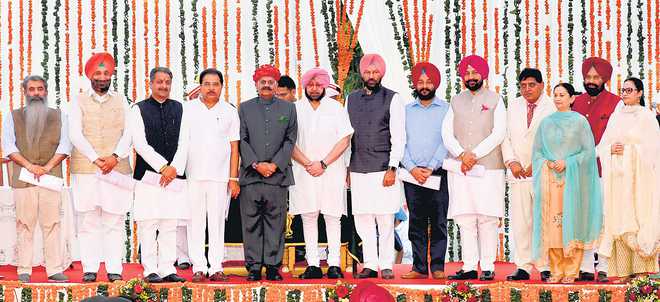
The newly-inducted Punjab Cabinet Ministers pose with Governor VP Singh Badnore (fifth from left) and Chief Minister Capt Amarinder Singh (to his right) after the oath-taking ceremony in Chandigarh on Saturday. The ministers are (from left): Bharat Bhushan Ashu, Sukhjinder Singh Randhawa, Vijay Inder Singla, OP Soni, Rana Gurmit Sodhi, Gurpreet Kangar, Balbir Sidhu, Sunder Sham Arora, Aruna Chaudhary, Sukhbinder Singh Sarkaria and Razia Sultana. Tribune photograph: Pradeep Tewari

Tribune News Service

Chandigarh, April 21

While rewarding his loyalists, Punjab CM Capt Amarinder Singh on Saturday sprung a few surprises in  the allocation of ministries, ignoring senior Cabinet members.  Chief Minister’s confidant Tript Rajinder Bajwa was allotted the important Housing and Urban Development portfolio. He already holds the Rural Development Department. On the other hand, Health Minister Brahm Mohindra, the seniormost minister in the Cabinet, was given the additional charge of the insignificant Removal of Grievances Department. The portfolios held by senior ministers Manpreet Badal and Navjot Singh Sidhu remained untouched, indicating the Rahul Gandhi factor. There was no change in the departments held by Sadhu Singh Dharamsot and Charanjit Channi either. The Chief Minister retained the 19 departments with him, including the crucial departments of Agriculture and Farmers’ Welfare, Excise and Taxation, General Administration, Home Affairs and Personnel. He, however, unburdened himself of Housing and Urban Development Department, which was allotted to Tript Bajwa, Transport  to Aruna Chaudhary, Revenue and Mining to Sukhbinder Singh Sarkaria and Food and Supplies to Bharat Bhushan Ashu. The latter is close to Rahul Gandhi. He and Vijay Inder Singla are the juniormost in the Cabinet. Singla has been given Public Works Department. Sunder Sham Arora, who has the backing of MP Ambika Soni, has been allotted Industries and Commerce, a department which is generally given to a senior minister.By elevating Aruna Chaudhary and Razia Sultana to the Cabinet rank and then rewarding them with important portfolio, the CM has pleased the minorities and Dalits. Sultana, who held Public Works and Social Security departments, has now been given Higher Education and Water Supply and Sanitation. Amarinder’s confidant OP  Soni has been allotted School Education. Gurpeet Kangar and Sukhjinder Randhawa, both close to PPCC chief Sunil Jakhar,  have been given Power and Cooperation, respectively. Mohali MLA Balbir Sidhu has been allotted Animal Husbandry and Dairy Development.


Portfolios of Cabinet Ministers

Capt Amarinder Singh
Administrative Reforms; Agriculture and Farmers’ Welfare; Horticulture; Excise & Taxation; General Admn; Home Affairs & Justice; Legal & Legislative Affairs; Personnel; Vigilance among others.

Brahm Mohindra
Health & Family Welfare; Medical Education & Research; Parliamentary Affairs; Elections; Removal of Grievances.

Navjot Singh Sidhu
Local Government; Tourism and Cultural Affairs

Manpreet Singh Badal
Finance; Planning; Programme Implementation; Governance Reforms

Om Parkash Soni
School Education; Freedom Fighters

Sadhu Singh Dharamsot
Forests; Welfare of SCs and BCs; Printing & Stationery

Tript Rajinder Singh Bajwa
Rural Development & Panchayats; Housing & Urban Development

Rana Gurmit Singh Sodhi
Sports and Youth Affairs

Charanjit Singh Channi
Technical Education & Industrial Training; Employment Generation; Science & Tech

Aruna Chaudhary
Social Security; Women & Child Development; TransportRazia Sultana
Higher Education; Water Supply & Sanitation (Public Health)Sukhjinder Singh Randhawa
Cooperation; JailsSukhbinder Singh Sarkaria
Revenue, Rehabilitation and Disaster Management; Water Resources; Mines & GeologyGurpreet Singh Kangar
Power; New and Renewable Energy SourcesBalbir Singh Sidhu
Animal Husbandry; Dairy Development; LabourVijay Inder Singla
Public Works; Information TechnologySunder Sham Arora
Industries & CommerceBharat Bhushan Ashu
Food & Civil Supplies; Consumer Affairs